


Grades K–2Answer key
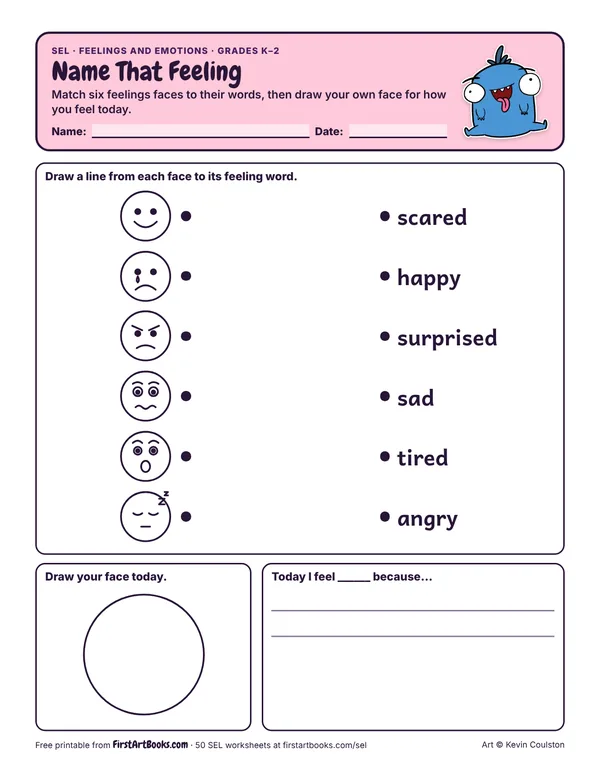
Name That Feeling
Match six feelings faces to their words, then draw your own face for how you feel today.
Print this sheet (PDF)50 free SEL worksheets in 10 topics, from naming feelings and growth mindset to I-messages, SMART goals and kind self-talk. Sorts, matching, real-life scenarios, breathing cards, trackers and coloring pages, with Kevin Coulston’s cartoon characters on every page and 34 answer keys
Grades K–3. Name the feeling on a face, draw feelings faces, sort comfortable and uncomfortable feelings, guess how you would feel and grow a feelings vocabulary from small to big.
Match six feelings faces to their words, then draw your own face for how you feel today.
Print this sheet (PDF)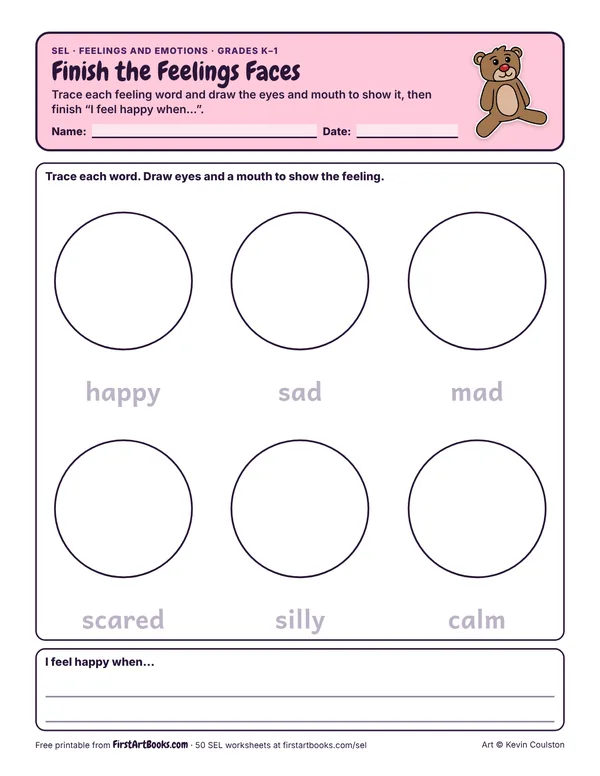
Trace each feeling word and draw the eyes and mouth to show it, then finish “I feel happy when…”.
Print this sheet (PDF)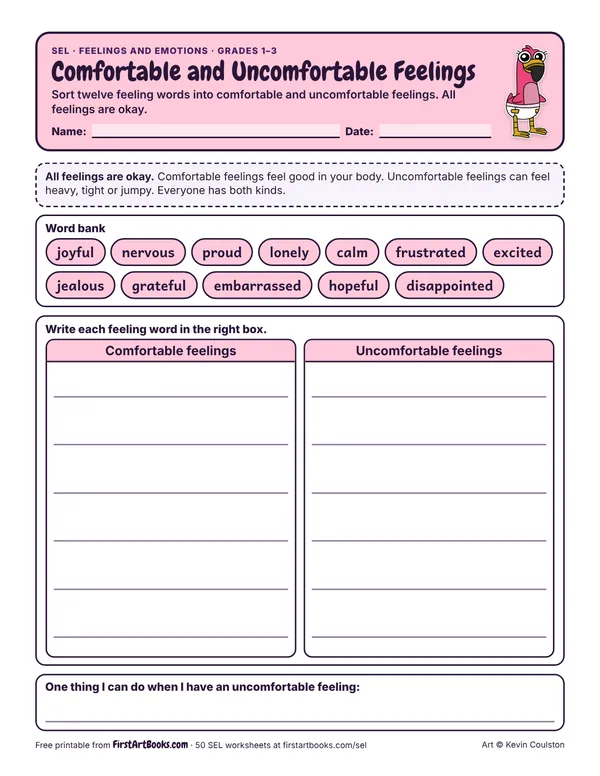
Sort twelve feeling words into comfortable and uncomfortable feelings. All feelings are okay.
Print this sheet (PDF)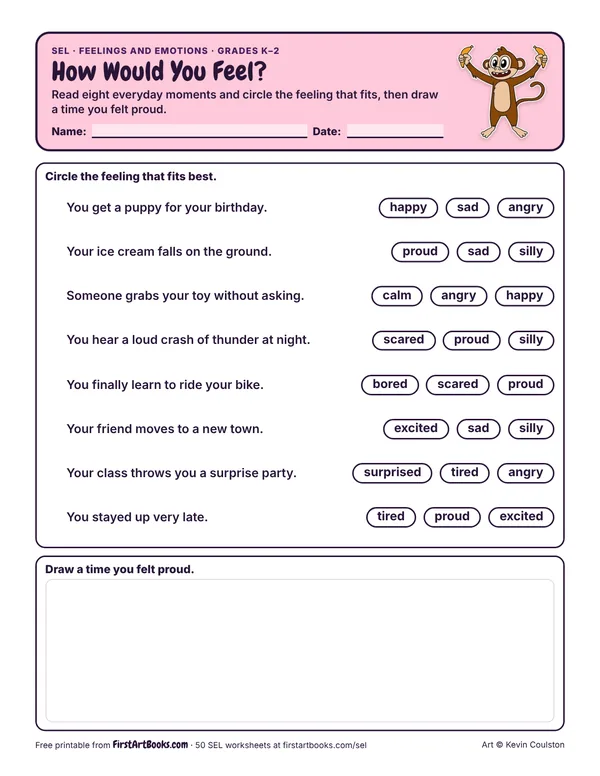
Read eight everyday moments and circle the feeling that fits, then draw a time you felt proud.
Print this sheet (PDF)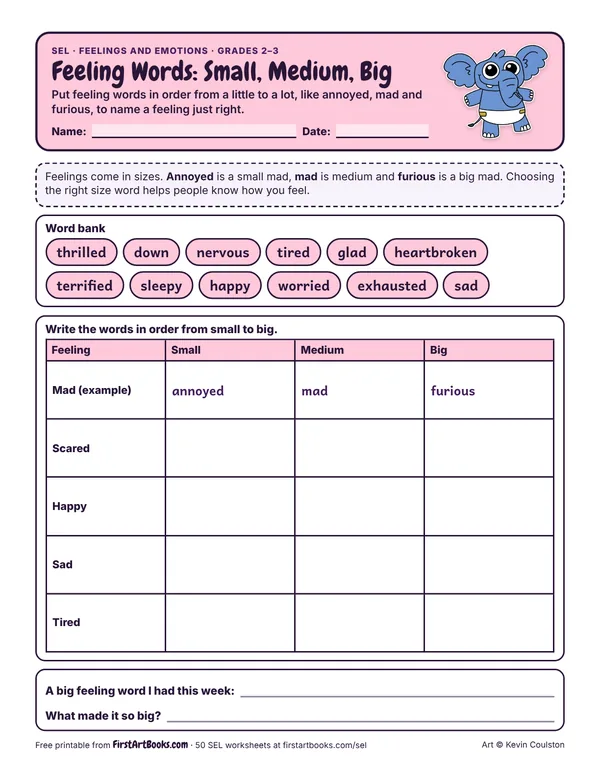
Put feeling words in order from a little to a lot, like annoyed, mad and furious, to name a feeling just right.
Print this sheet (PDF)Grades K–5. Sort fixed and growth mindset thoughts, change your words, see how much you have grown, learn the power words and meet famous mistakes that worked out.
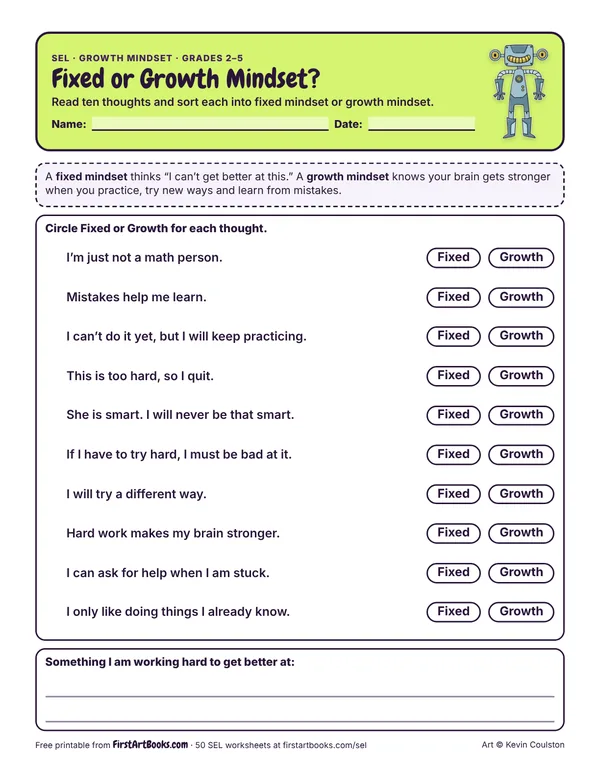
Read ten thoughts and sort each into fixed mindset or growth mindset.
Print this sheet (PDF)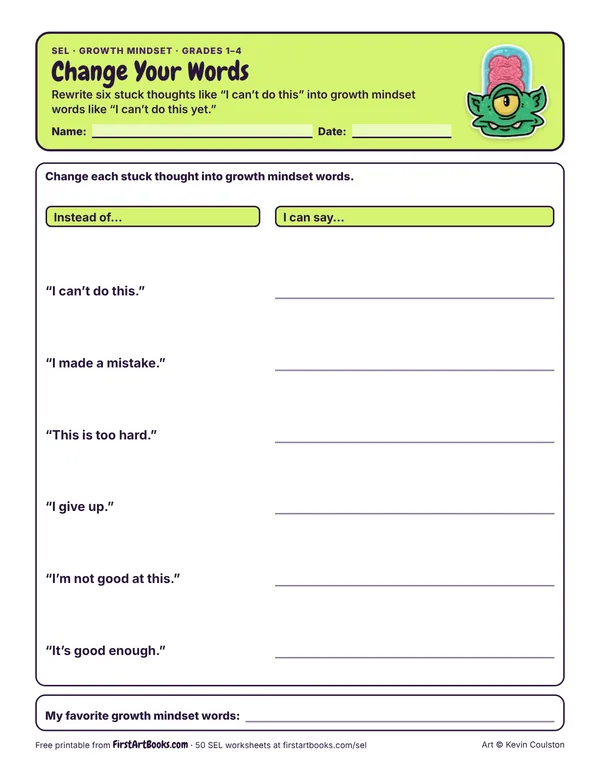
Rewrite six stuck thoughts like “I can’t do this” into growth mindset words like “I can’t do this yet.”
Print this sheet (PDF)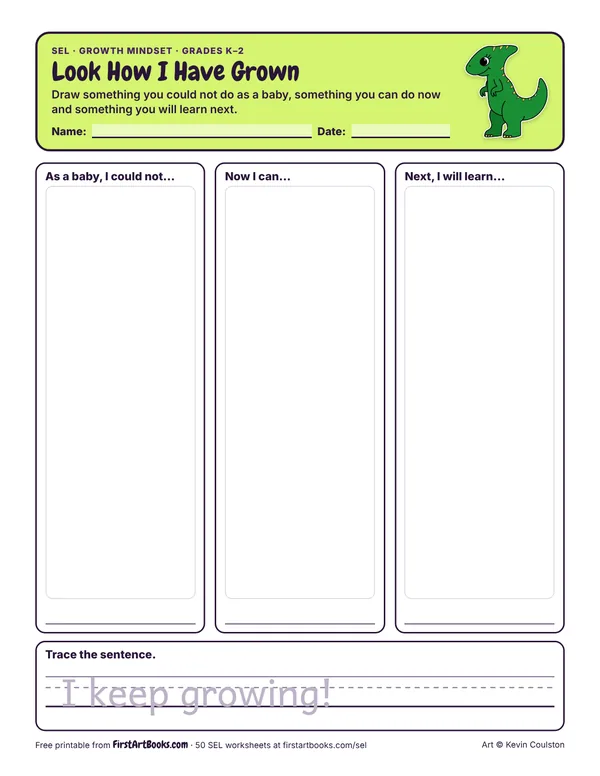
Draw something you could not do as a baby, something you can do now and something you will learn next.
Print this sheet (PDF)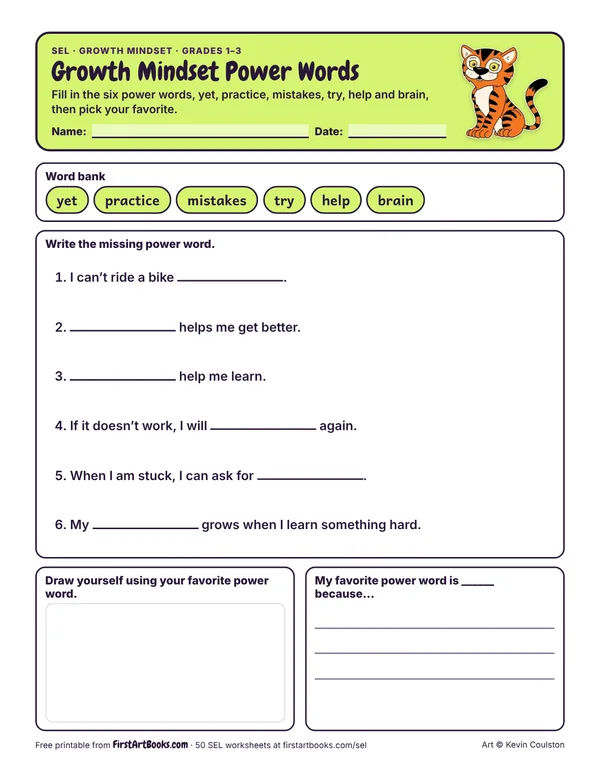
Fill in the six power words, yet, practice, mistakes, try, help and brain, then pick your favorite.
Print this sheet (PDF)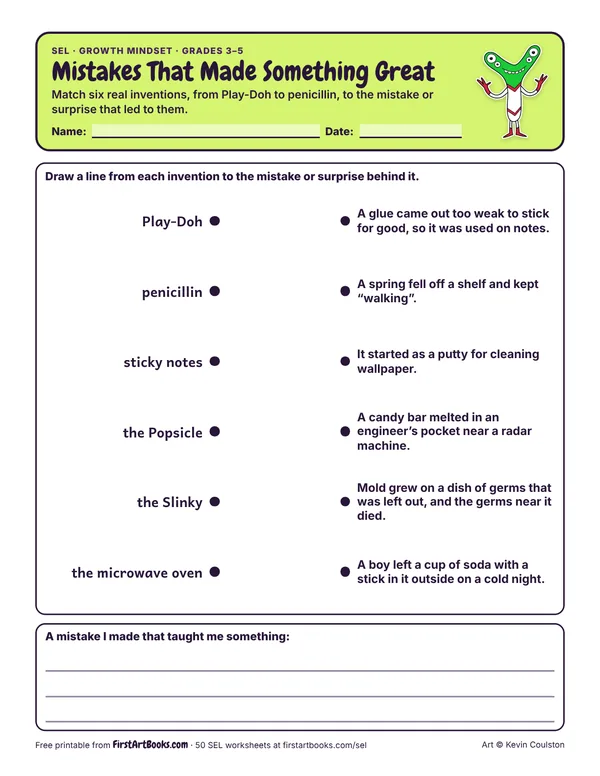
Match six real inventions, from Play-Doh to penicillin, to the mistake or surprise that led to them.
Print this sheet (PDF)Grades K–5. Kind or unkind, the right kind words for each moment, kindness at home, school and in the community, reading feelings clues and choosing the reply that shows empathy.
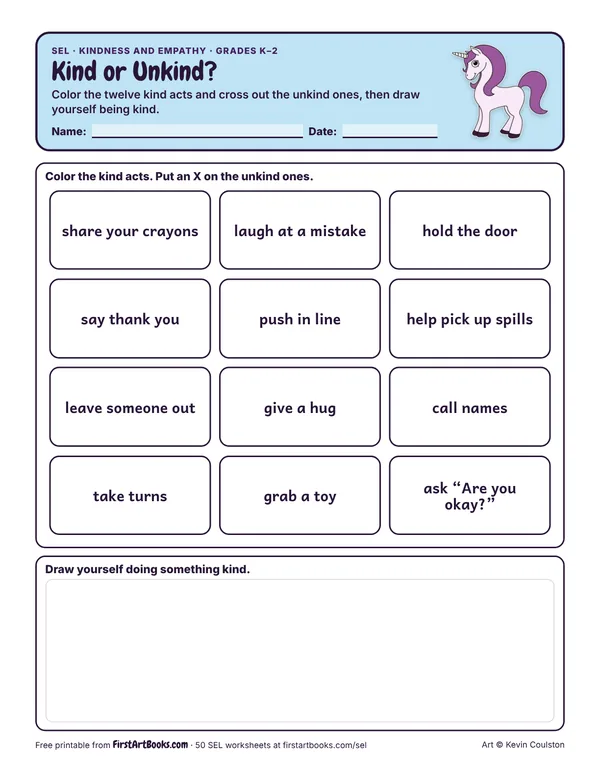
Color the twelve kind acts and cross out the unkind ones, then draw yourself being kind.
Print this sheet (PDF)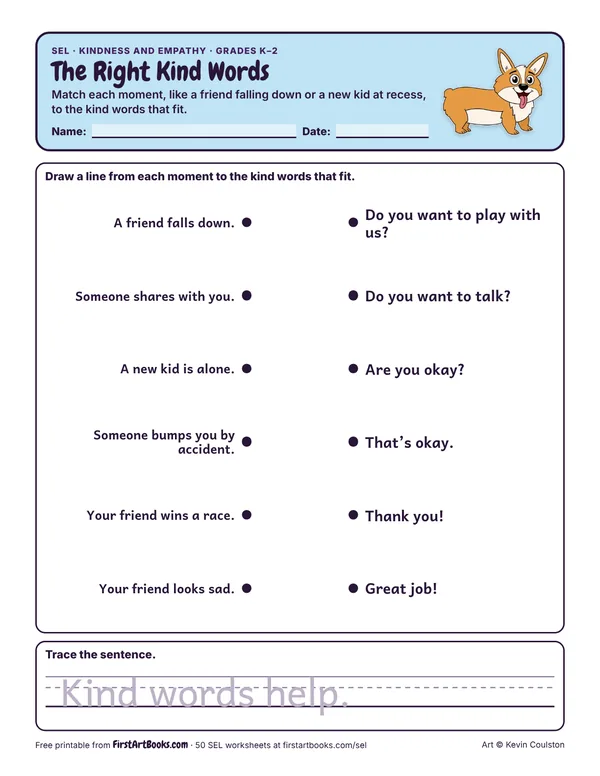
Match each moment, like a friend falling down or a new kid at recess, to the kind words that fit.
Print this sheet (PDF)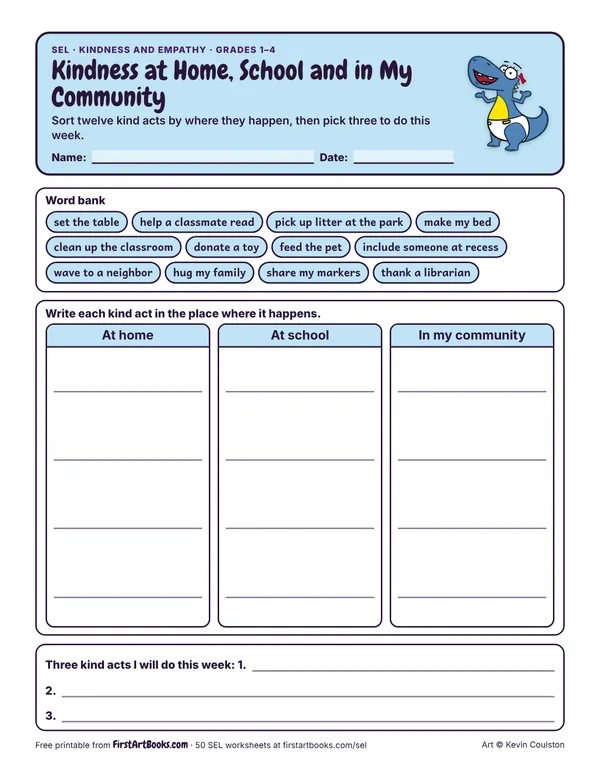
Sort twelve kind acts by where they happen, then pick three to do this week.
Print this sheet (PDF)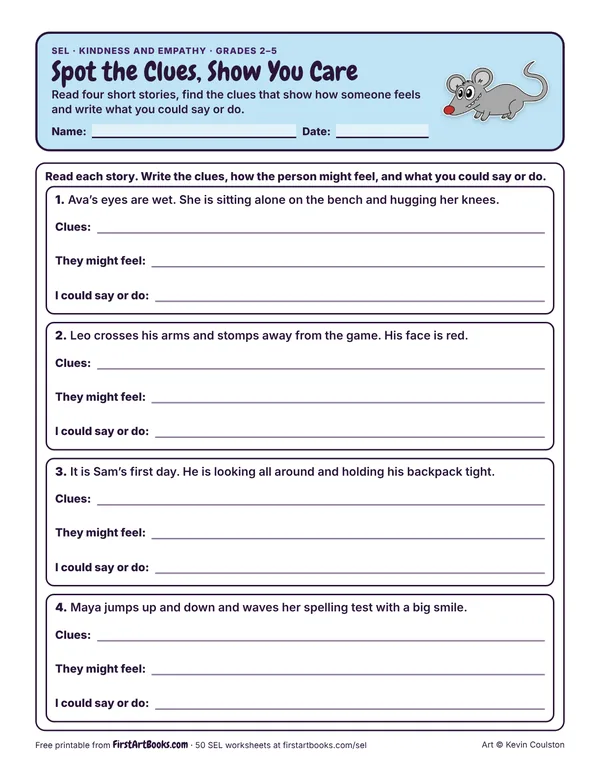
Read four short stories, find the clues that show how someone feels and write what you could say or do.
Print this sheet (PDF)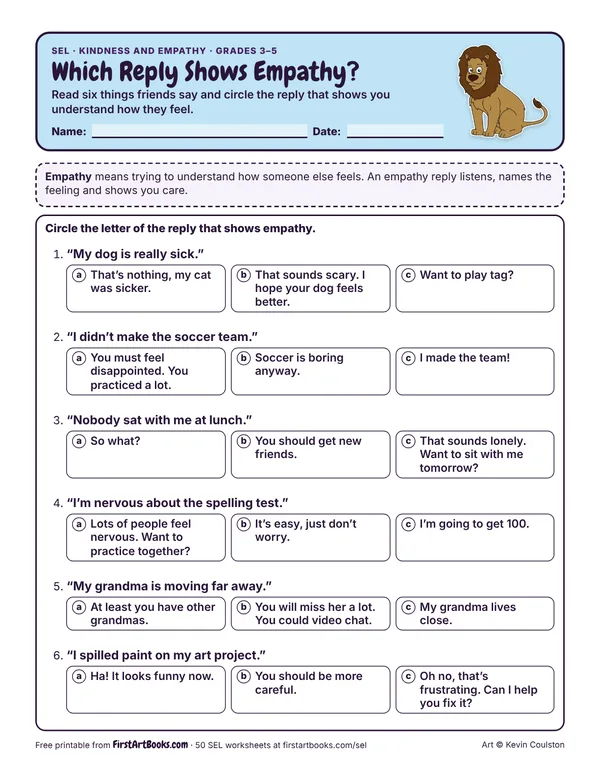
Read six things friends say and circle the reply that shows you understand how they feel.
Print this sheet (PDF)Grades 2–5. Size up a problem, use I-messages, match conflict tools, walk the six steps of the peace path and pick a fair solution for real classroom scenarios.
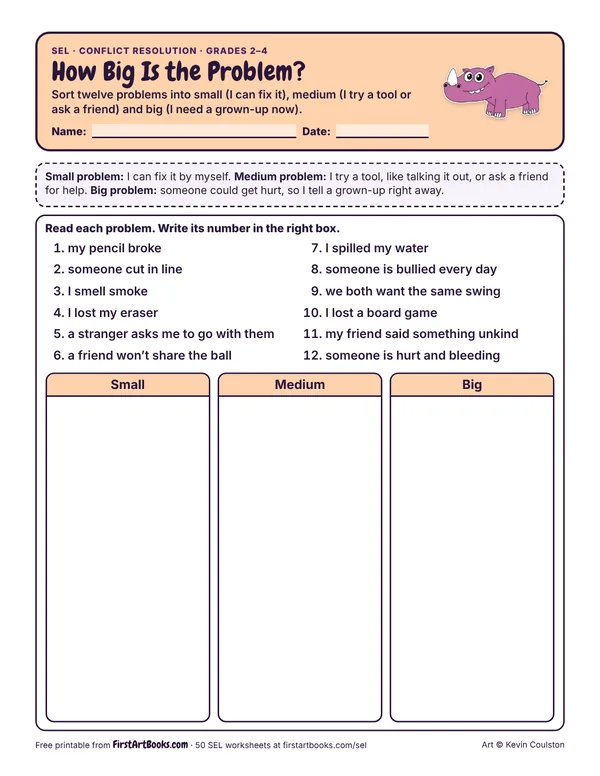
Sort twelve problems into small (I can fix it), medium (I try a tool or ask a friend) and big (I need a grown-up now).
Print this sheet (PDF)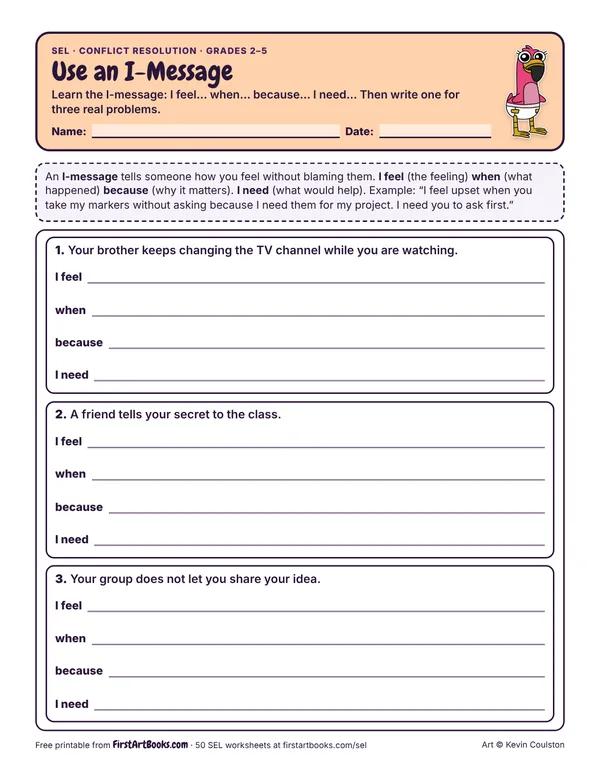
Learn the I-message: I feel… when… because… I need… Then write one for three real problems.
Print this sheet (PDF)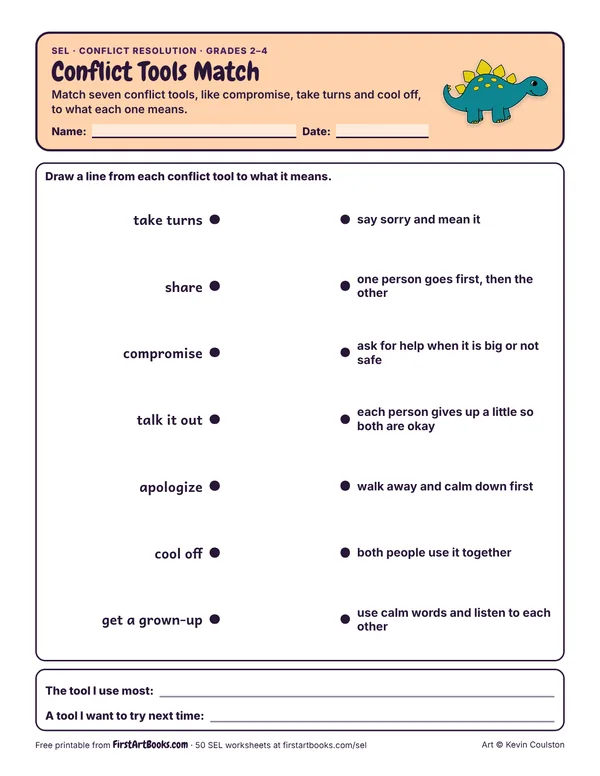
Match seven conflict tools, like compromise, take turns and cool off, to what each one means.
Print this sheet (PDF)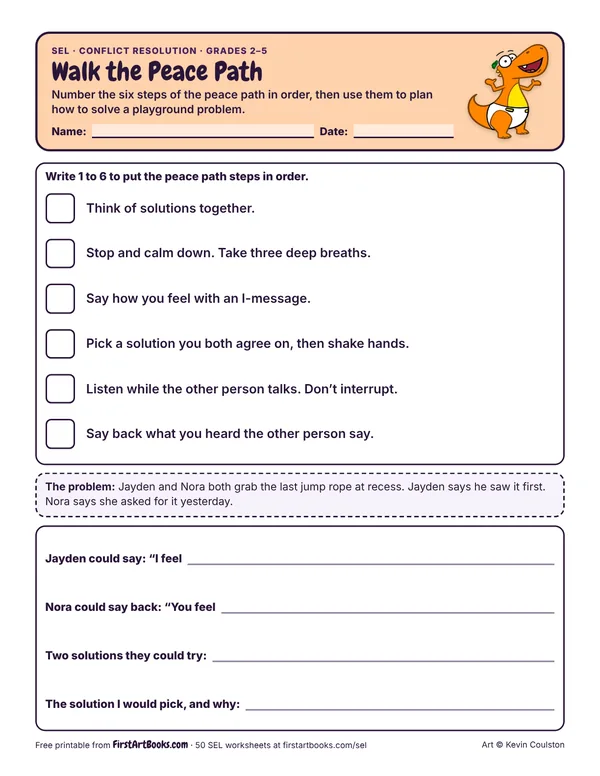
Number the six steps of the peace path in order, then use them to plan how to solve a playground problem.
Print this sheet (PDF)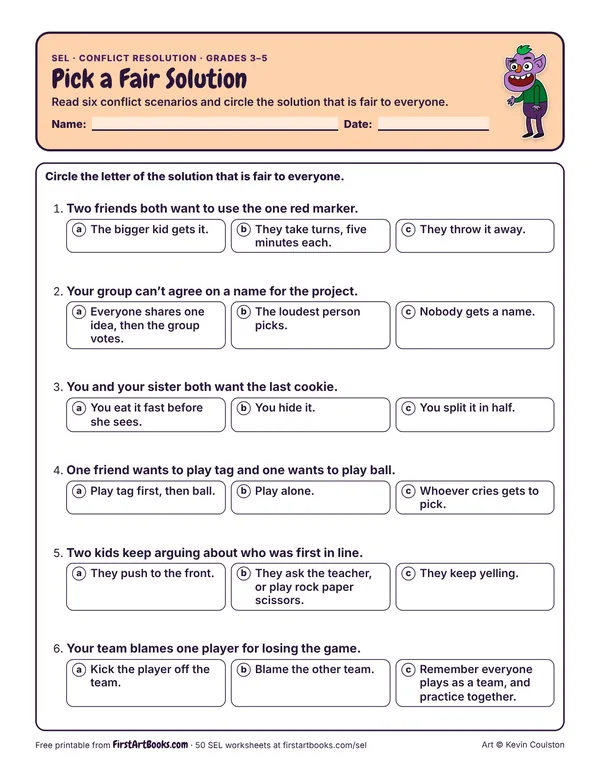
Read six conflict scenarios and circle the solution that is fair to everyone.
Print this sheet (PDF)Grades K–5. What good friends do, how to join in and make a new friend, a classmate interview, teamwork words and friendship true or false.
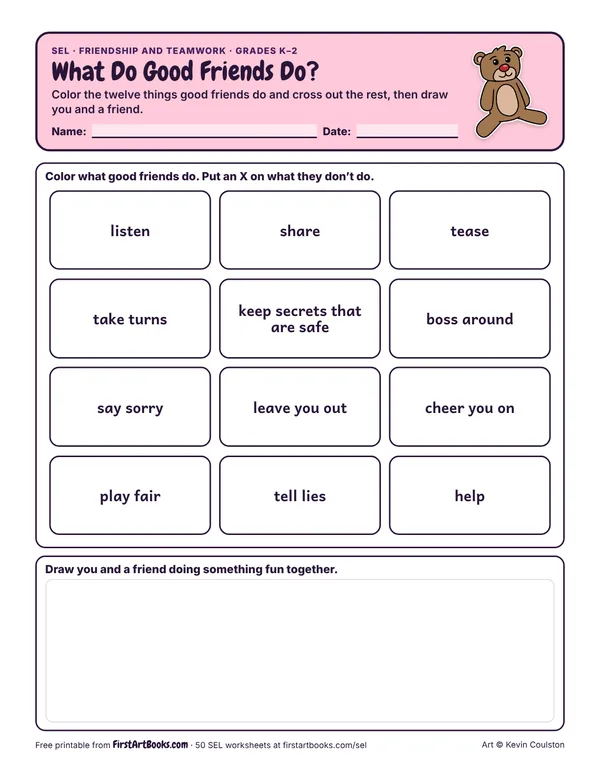
Color the twelve things good friends do and cross out the rest, then draw you and a friend.
Print this sheet (PDF)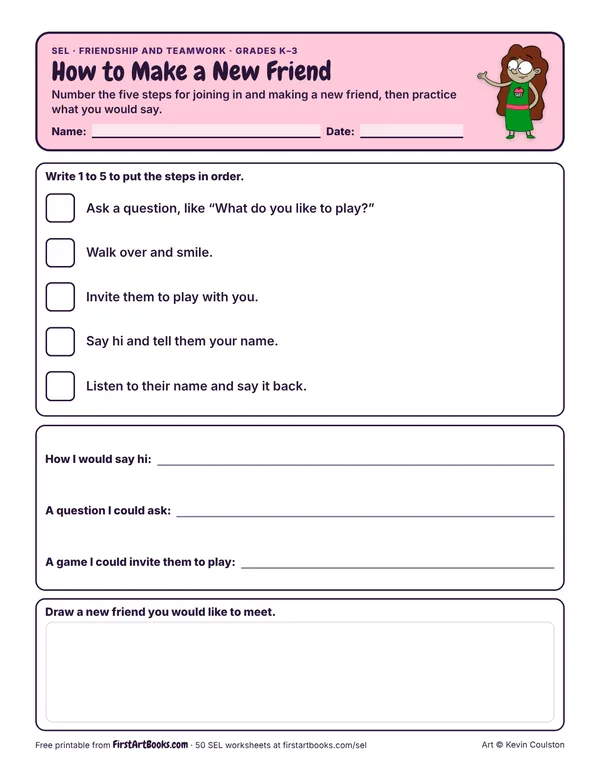
Number the five steps for joining in and making a new friend, then practice what you would say.
Print this sheet (PDF)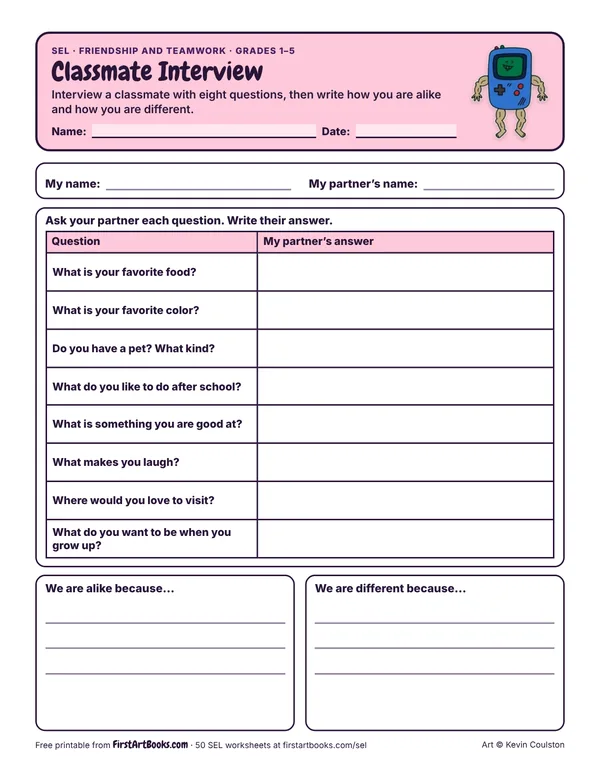
Interview a classmate with eight questions, then write how you are alike and how you are different.
Print this sheet (PDF)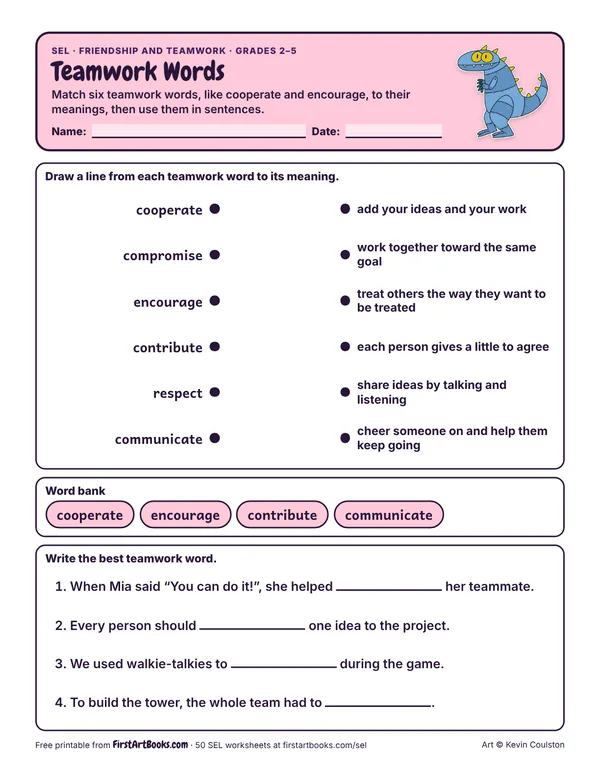
Match six teamwork words, like cooperate and encourage, to their meanings, then use them in sentences.
Print this sheet (PDF)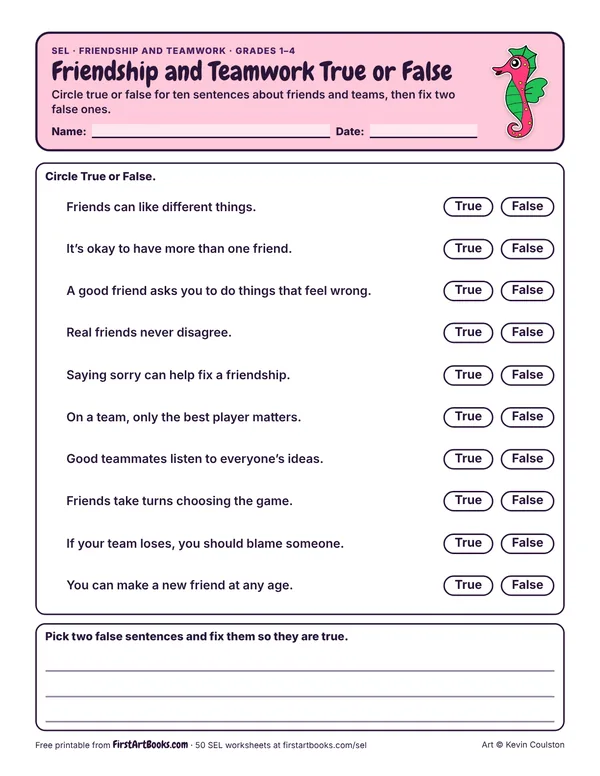
Circle true or false for ten sentences about friends and teams, then fix two false ones.
Print this sheet (PDF)Grades K–5. Animal breathing cards, 5-4-3-2-1 grounding, a mindful coloring pattern, calming choices to color and a five-day mindful minute log.
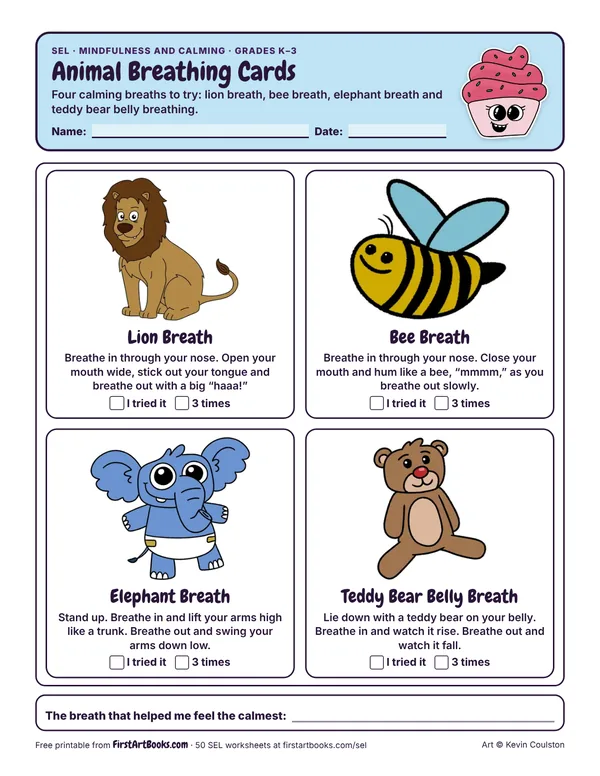
Four calming breaths to try: lion breath, bee breath, elephant breath and teddy bear belly breathing.
Print this sheet (PDF)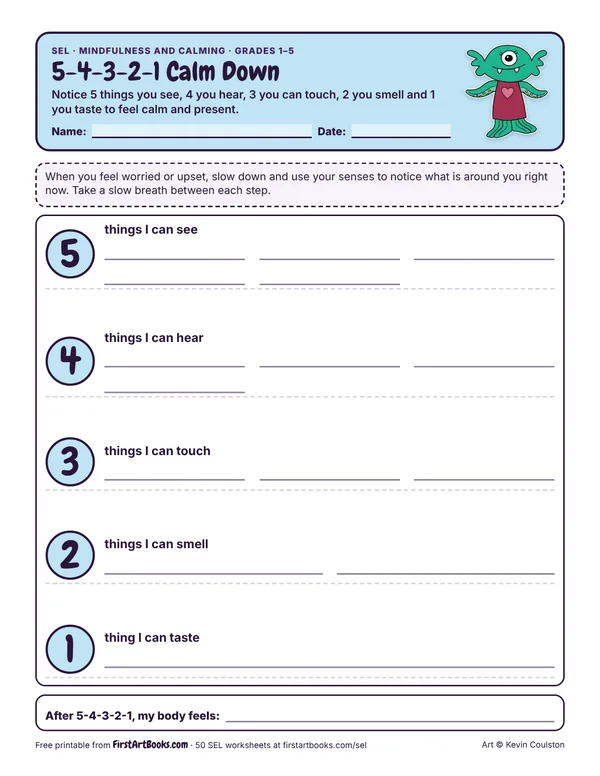
Notice 5 things you see, 4 you hear, 3 you can touch, 2 you smell and 1 you taste to feel calm and present.
Print this sheet (PDF)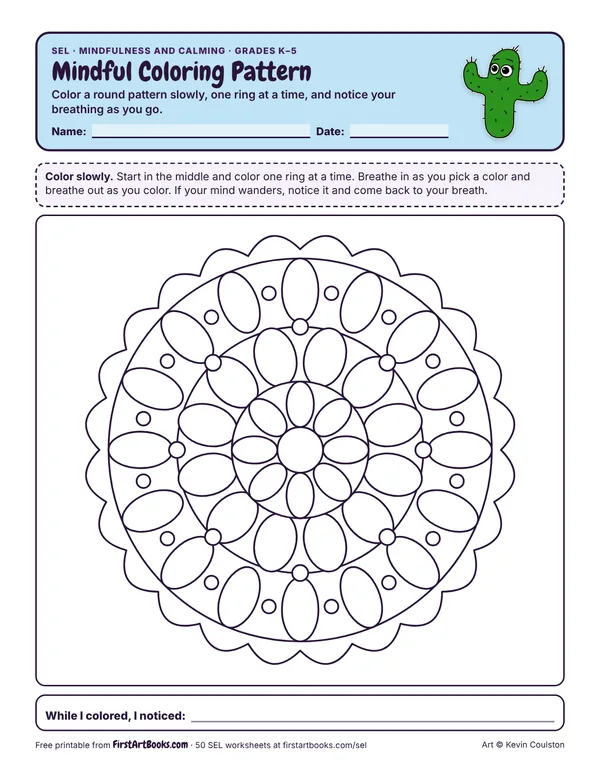
Color a round pattern slowly, one ring at a time, and notice your breathing as you go.
Print this sheet (PDF)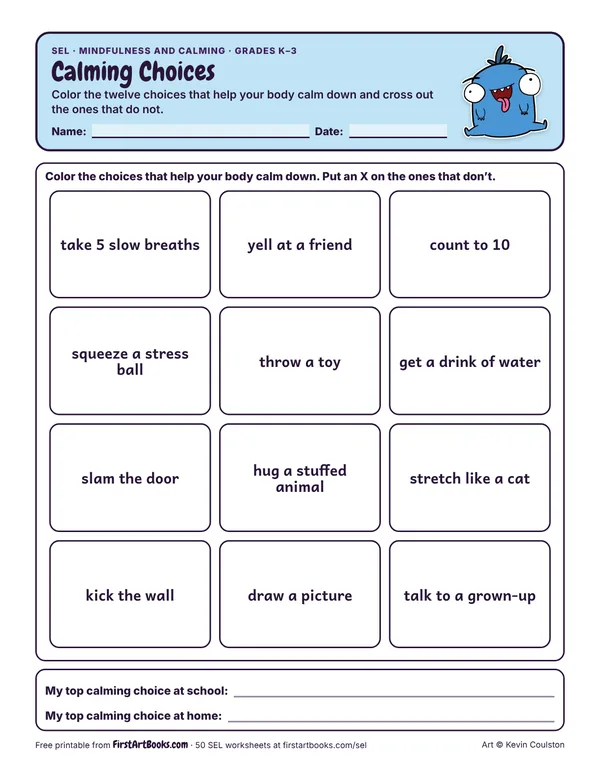
Color the twelve choices that help your body calm down and cross out the ones that do not.
Print this sheet (PDF)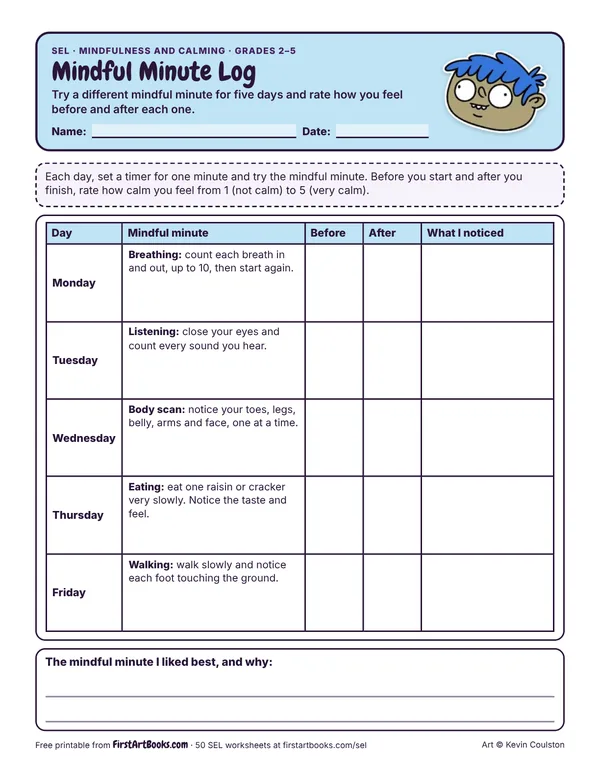
Try a different mindful minute for five days and rate how you feel before and after each one.
Print this sheet (PDF)Grades 2–5. Goal or wish, SMART goals, a goal staircase, if-then plans for when things get in the way and a weekly goal tracker.
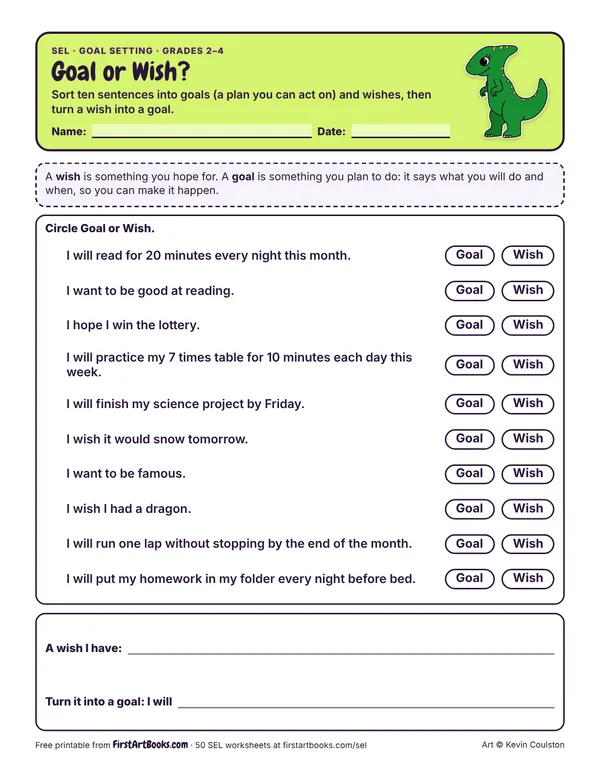
Sort ten sentences into goals (a plan you can act on) and wishes, then turn a wish into a goal.
Print this sheet (PDF)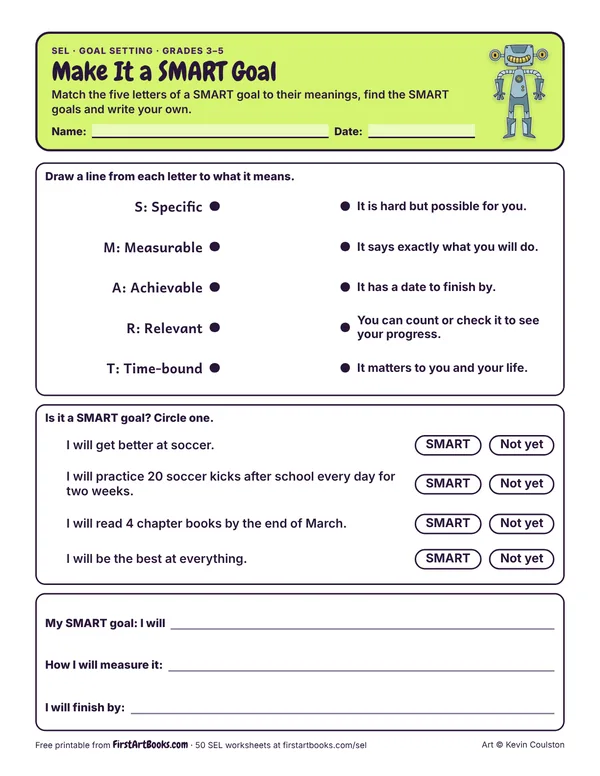
Match the five letters of a SMART goal to their meanings, find the SMART goals and write your own.
Print this sheet (PDF)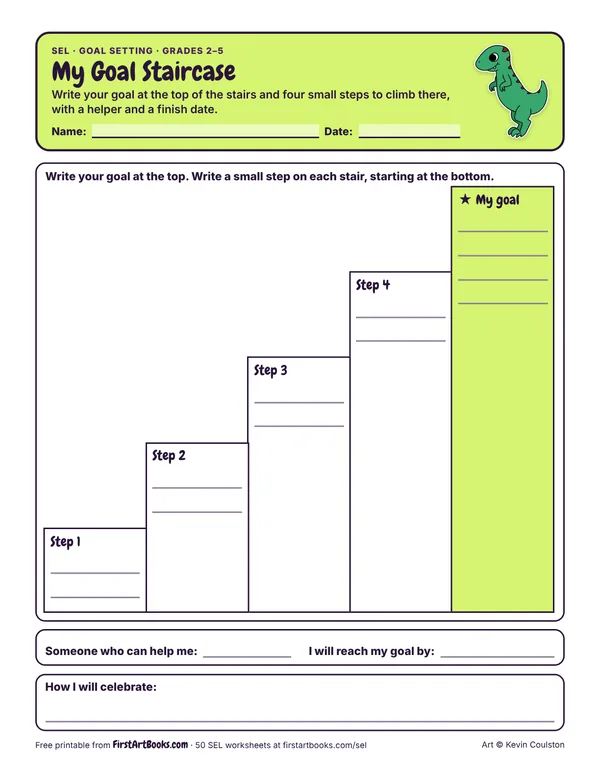
Write your goal at the top of the stairs and four small steps to climb there, with a helper and a finish date.
Print this sheet (PDF)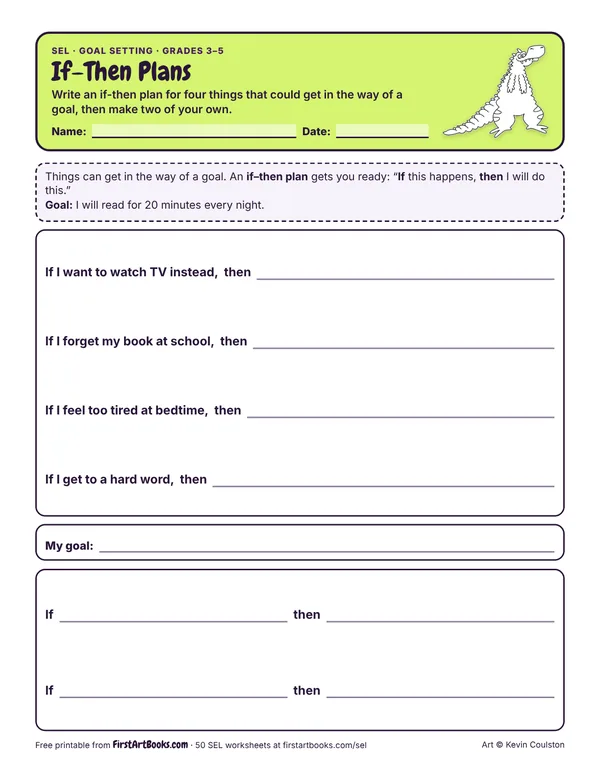
Write an if-then plan for four things that could get in the way of a goal, then make two of your own.
Print this sheet (PDF)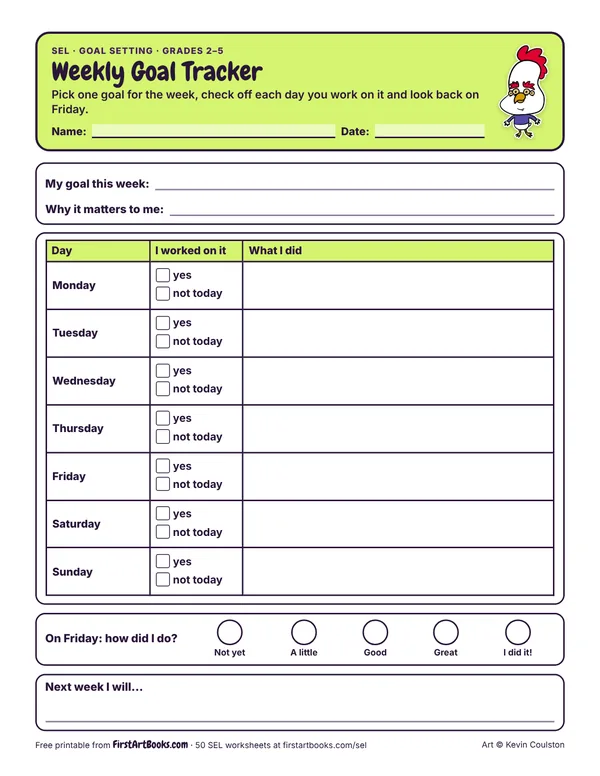
Pick one goal for the week, check off each day you work on it and look back on Friday.
Print this sheet (PDF)Grades 2–5. Five steps to solve a problem, many ways to solve it, stop-think-choose, choices and their consequences and scenarios to pick the best choice.
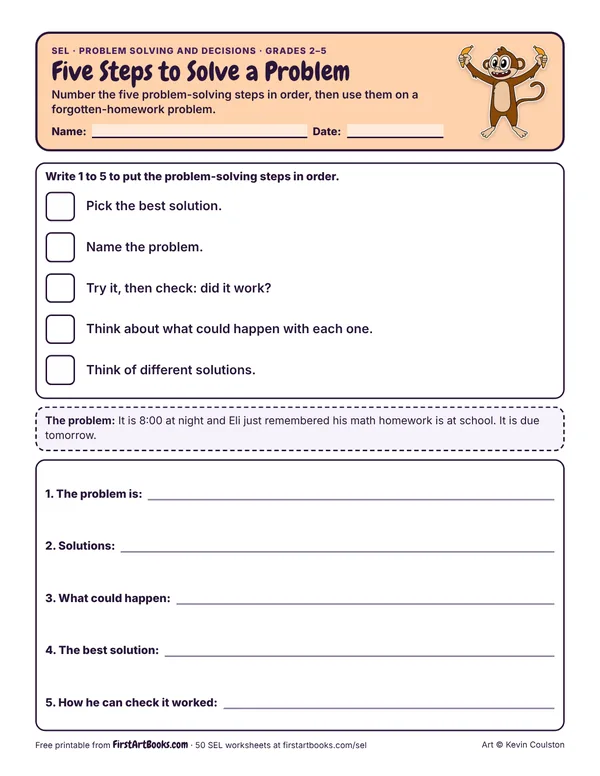
Number the five problem-solving steps in order, then use them on a forgotten-homework problem.
Print this sheet (PDF)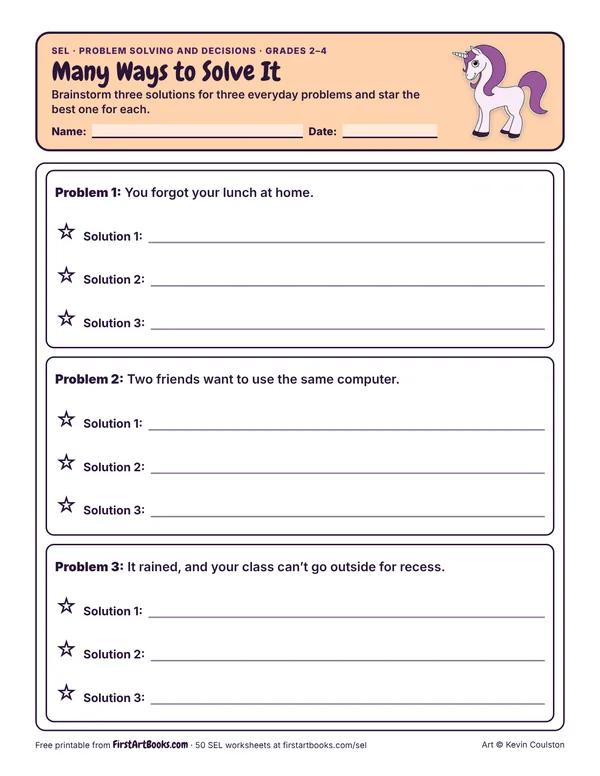
Brainstorm three solutions for three everyday problems and star the best one for each.
Print this sheet (PDF)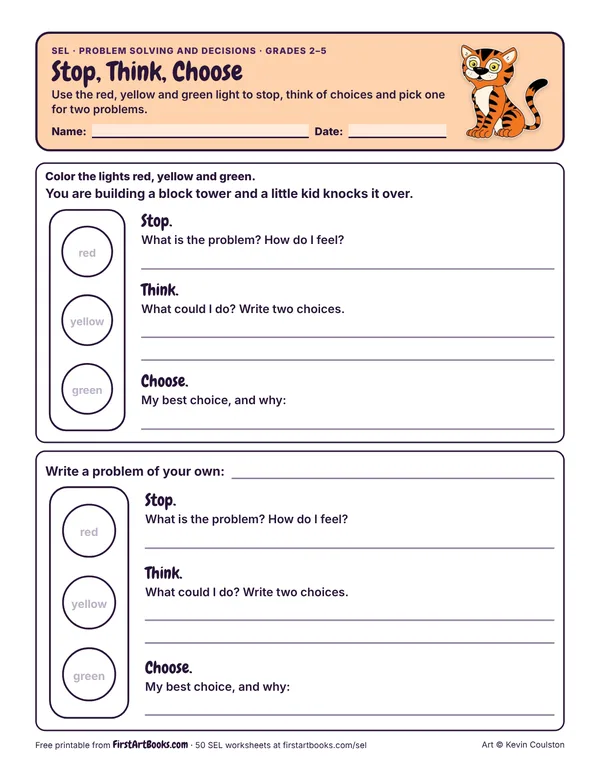
Use the red, yellow and green light to stop, think of choices and pick one for two problems.
Print this sheet (PDF)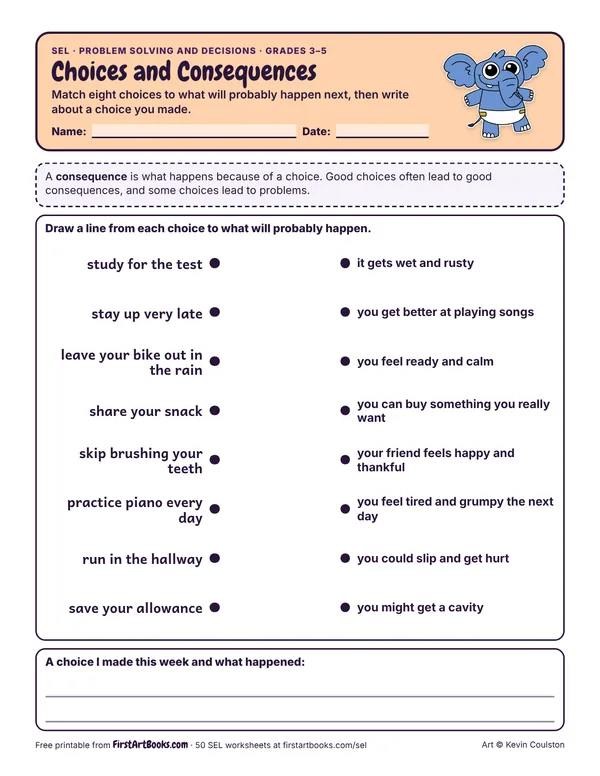
Match eight choices to what will probably happen next, then write about a choice you made.
Print this sheet (PDF)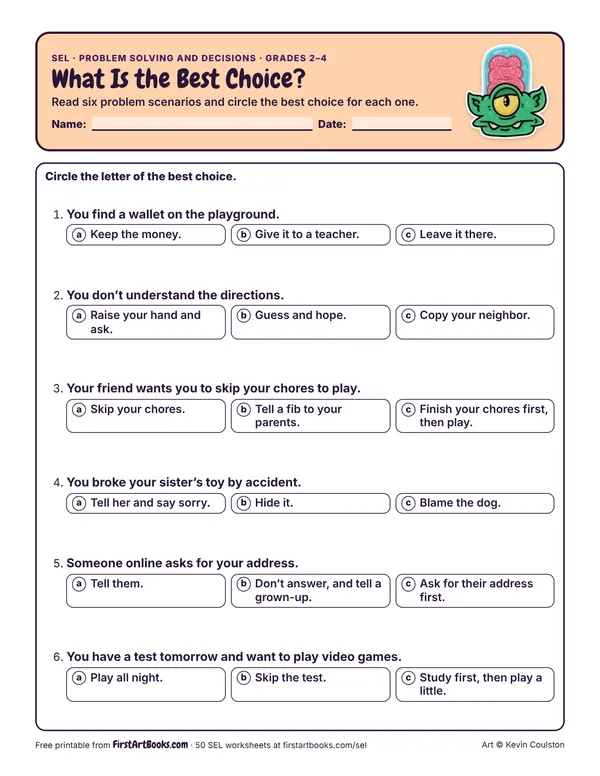
Read six problem scenarios and circle the best choice for each one.
Print this sheet (PDF)Grades K–5. Good choice or not so good, a responsibility chart, who is being responsible, own it and fix it, and the words that describe a responsible person.
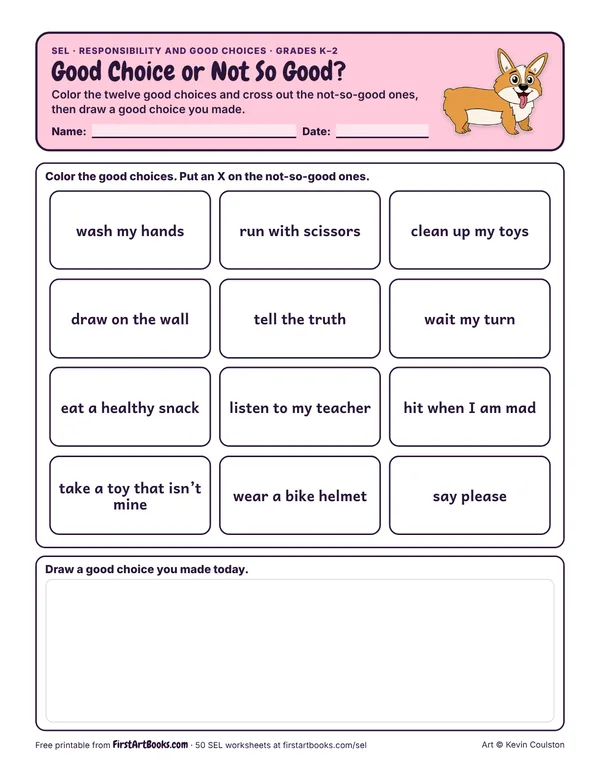
Color the twelve good choices and cross out the not-so-good ones, then draw a good choice you made.
Print this sheet (PDF)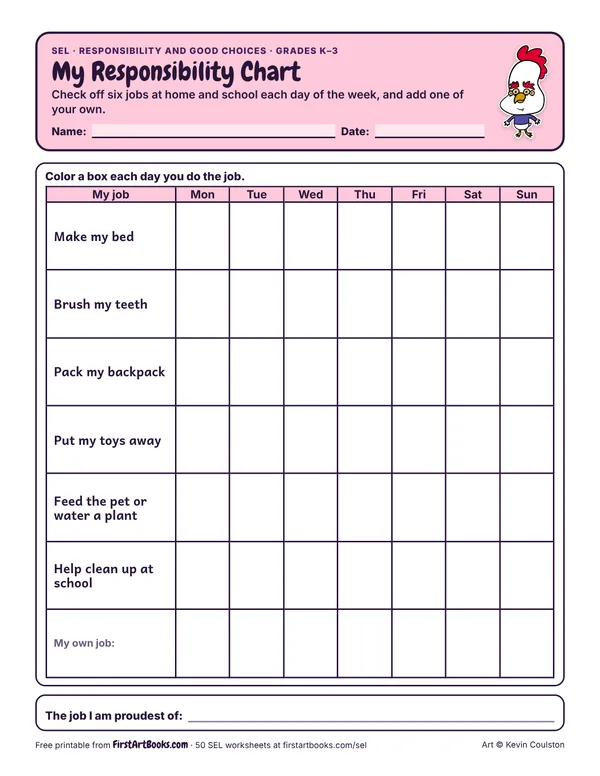
Check off six jobs at home and school each day of the week, and add one of your own.
Print this sheet (PDF)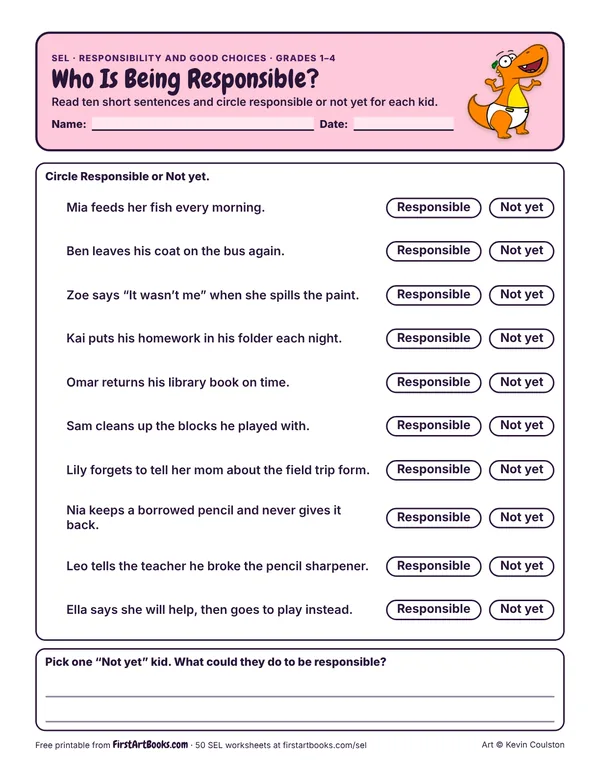
Read ten short sentences and circle responsible or not yet for each kid.
Print this sheet (PDF)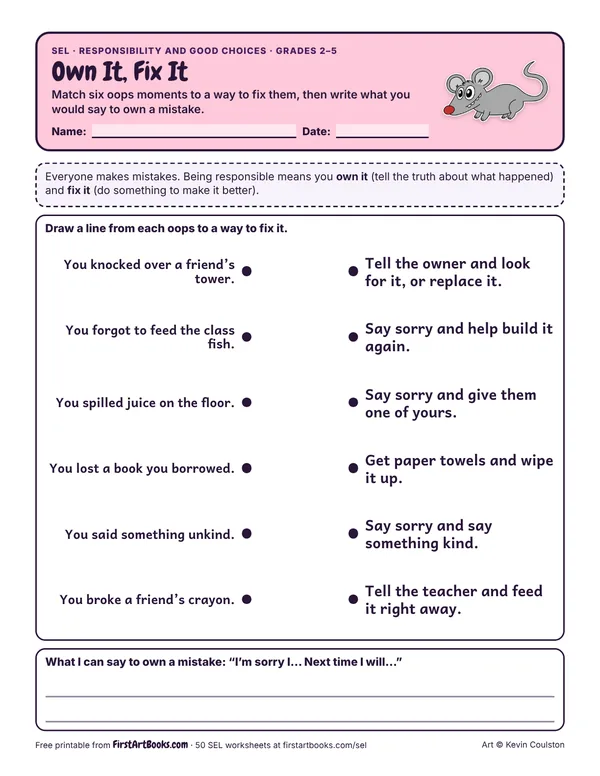
Match six oops moments to a way to fix them, then write what you would say to own a mistake.
Print this sheet (PDF)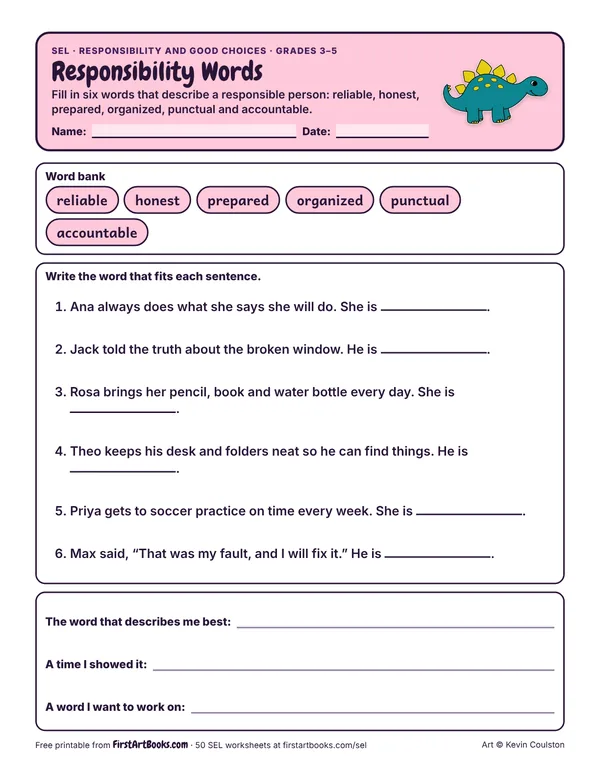
Fill in six words that describe a responsible person: reliable, honest, prepared, organized, punctual and accountable.
Print this sheet (PDF)Grades K–5. Trace “I am” sentences, color affirmation cards, an all-about-me star, kind or unkind self-talk and an affirmation of the day for a whole week.
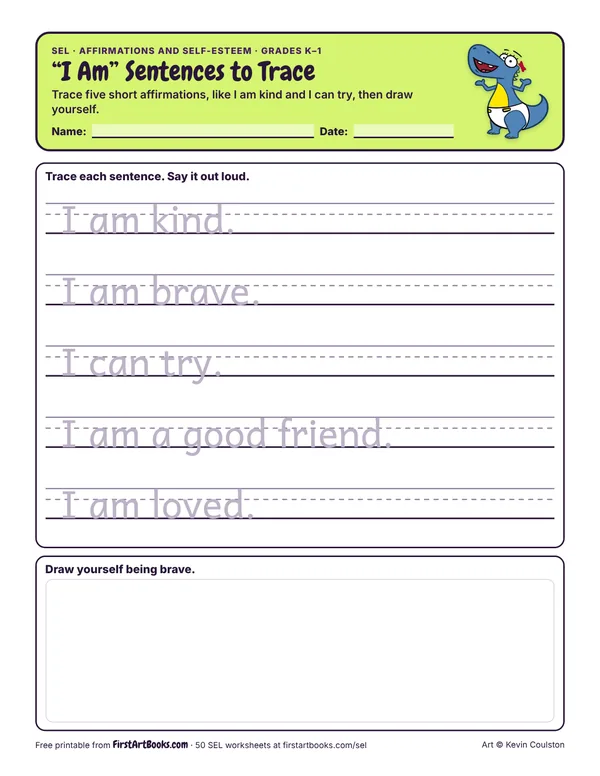
Trace five short affirmations, like I am kind and I can try, then draw yourself.
Print this sheet (PDF)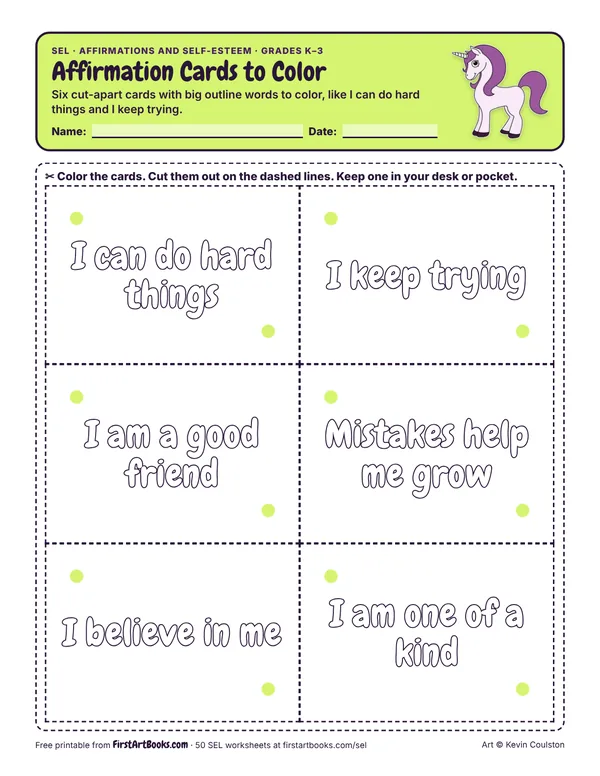
Six cut-apart cards with big outline words to color, like I can do hard things and I keep trying.
Print this sheet (PDF)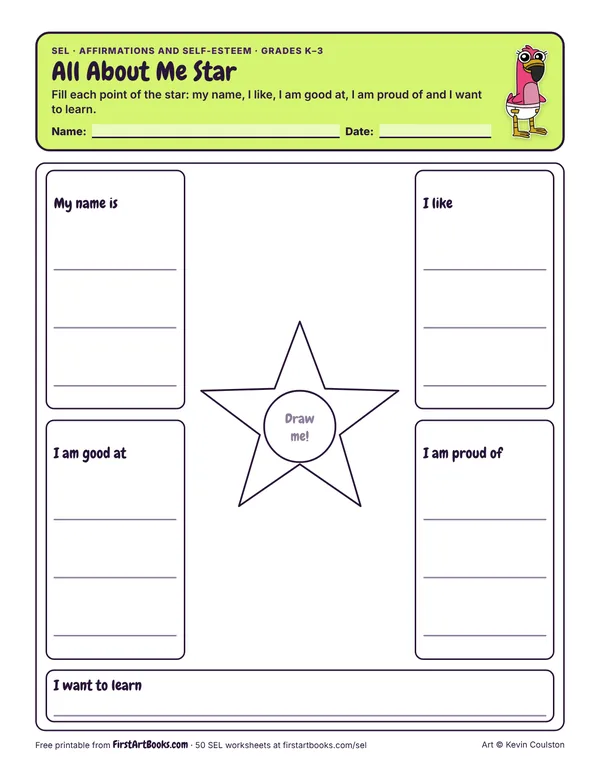
Fill each point of the star: my name, I like, I am good at, I am proud of and I want to learn.
Print this sheet (PDF)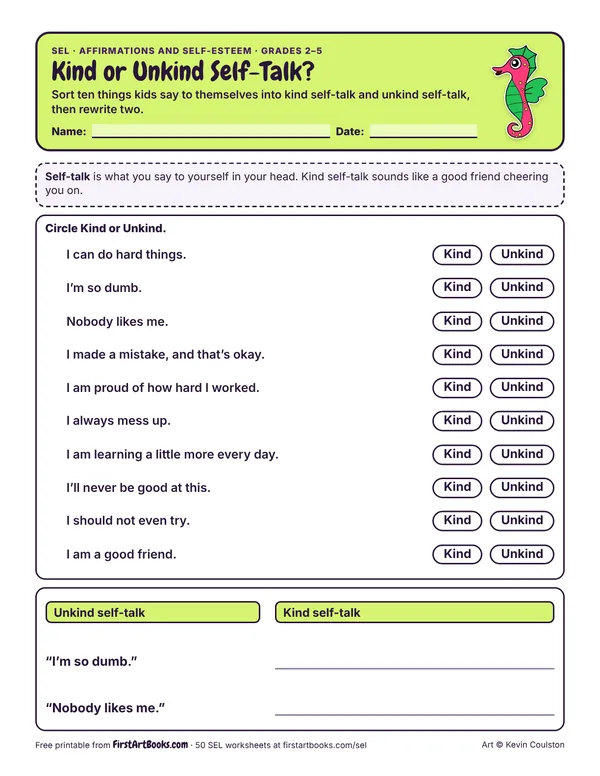
Sort ten things kids say to themselves into kind self-talk and unkind self-talk, then rewrite two.
Print this sheet (PDF)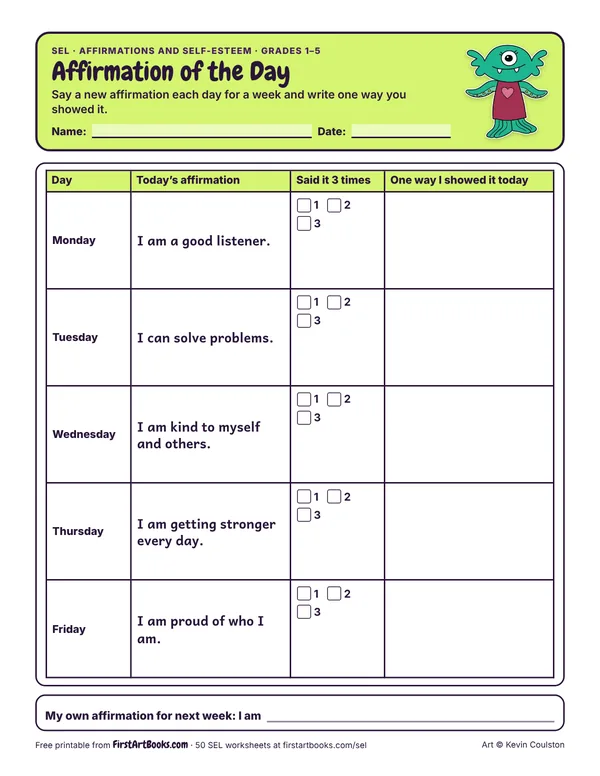
Say a new affirmation each day for a week and write one way you showed it.
Print this sheet (PDF)Every topic has five sheets, so the same plan works for feelings, friendship, goals or good choices.
Silly, grumpy and goofy faces are a fun way to talk about feelings. Kids can draw them step by step in Kevin Coulston’s books.
As an Amazon Associate, FirstArtBooks earns from qualifying purchases.
Yes. All 50 worksheets, the 10 topic packs and the answer key are free to print for home and classroom use, as many copies as your class needs.
Kindergarten to 5th grade. Every sheet shows its grade range. The feelings faces, kind-or-unkind, good choices, animal breathing and “I am” tracing sheets start in kindergarten; the conflict resolution, goal-setting and problem-solving sheets are for grades 2 to 5, and SMART goals, if-then plans and empathy replies are for grades 3 to 5. Use the grade buttons to see only the sheets for your class.
Yes. 34 sheets have an answer key page: the sorts, matching, true or false, put-in-order and fill-in-the-blank sheets. It is page 2 of each sheet’s PDF, at the end of each topic pack and all together in one PDF. Many SEL questions have more than one good answer, so for the write-your-own parts the key shows one example. Trackers, logs, breathing cards and coloring pages have no key.
The thinking sheets are open-ended draw-and-write pages. These SEL worksheets are structured practice for a lesson: kids sort, match, put steps in order, read short scenarios and choose, and track a goal or habit over a week. The two sets work well together, and none of the activities repeat.
Use one sheet after a morning meeting or circle time talk, as a small-group or counseling activity, as a calm-down corner page, or send a tracker home for the week. Each topic has five sheets that build on each other, from naming a skill to practicing it.
10 topics, five sheets each: feelings and emotions, growth mindset, kindness and empathy, conflict resolution, friendship and teamwork, mindfulness and calming, goal setting, problem solving and decisions, responsibility and good choices, affirmations and self-esteem. They line up with the five CASEL areas: self-awareness, self-management, social awareness, relationship skills and responsible decision-making.
Yes. The headers are light colors that look fine in gray, and the faces, traffic lights, star and coloring pattern are black outlines kids can color. Sheets are US Letter and also print on A4.
All sheets are US Letter, print well in black and white, and are free for home and classroom use. More for teachers in the teacher resources library.
12 printable pages: six step-by-step lessons, a grid activity, draw-and-write sheets and teacher notes, sent with your welcome email. After that, new classroom printables by email.
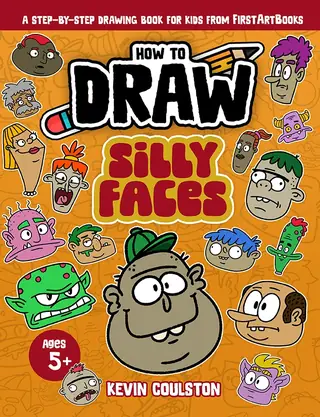 How to Draw: Silly Faces
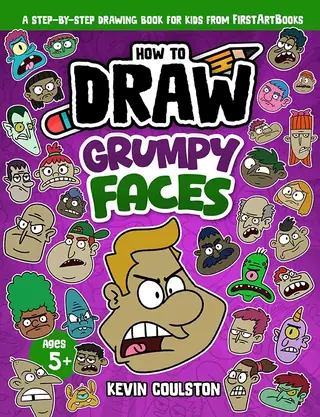 How to Draw: Grumpy Faces
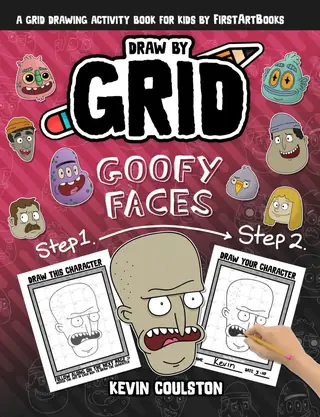 Draw by Grid: Goofy Faces
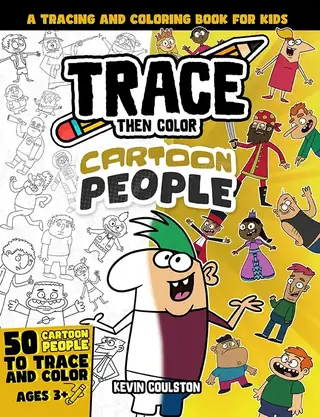 Trace Then Color: Cartoon People