


Grades K–2
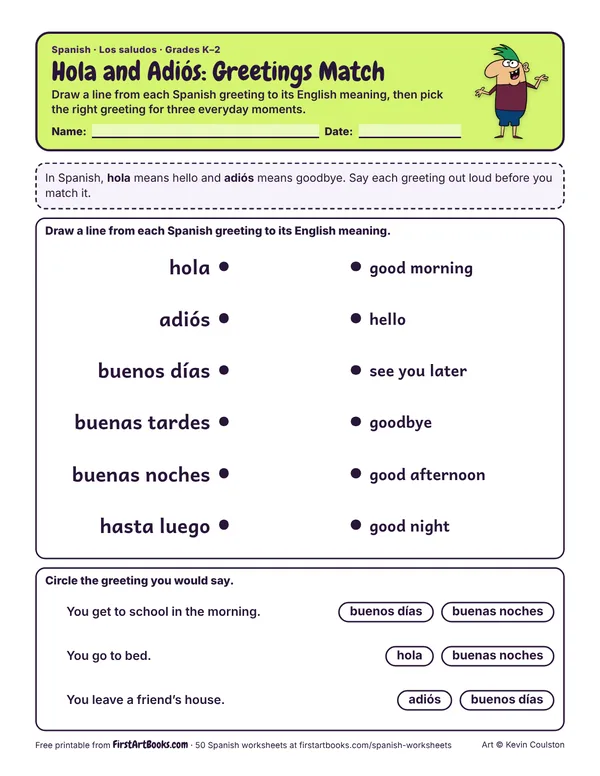
Hola and Adiós: Greetings Match
Draw a line from each Spanish greeting to its English meaning, then pick the right greeting for three everyday moments.
Print this sheet (PDF)Teacher notes and tips50 free Spanish worksheets for English-speaking kids, in 10 topics: greetings, numbers, colors and shapes, the calendar and weather, family, body and clothes, animals, food, school and first grammar. Instructions in English, 42 answer keys and one of Kevin Coulston’s cartoon characters on every page.
Say hola, adiós, buenos días and ¿cómo estás?, tell someone your name and age, use por favor and gracias, and finish a whole conversation.
Draw a line from each Spanish greeting to its English meaning, then pick the right greeting for three everyday moments.
Print this sheet (PDF)Teacher notes and tips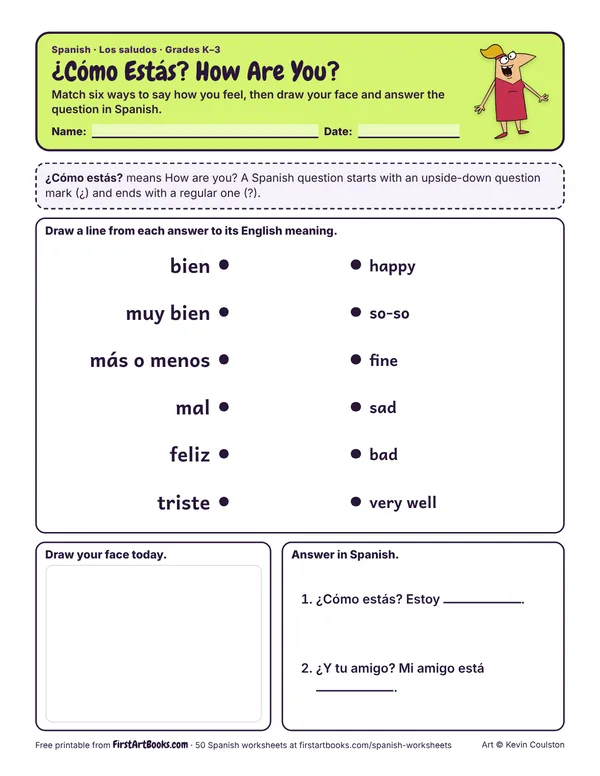
Match six ways to say how you feel, then draw your face and answer the question in Spanish.
Print this sheet (PDF)Teacher notes and tips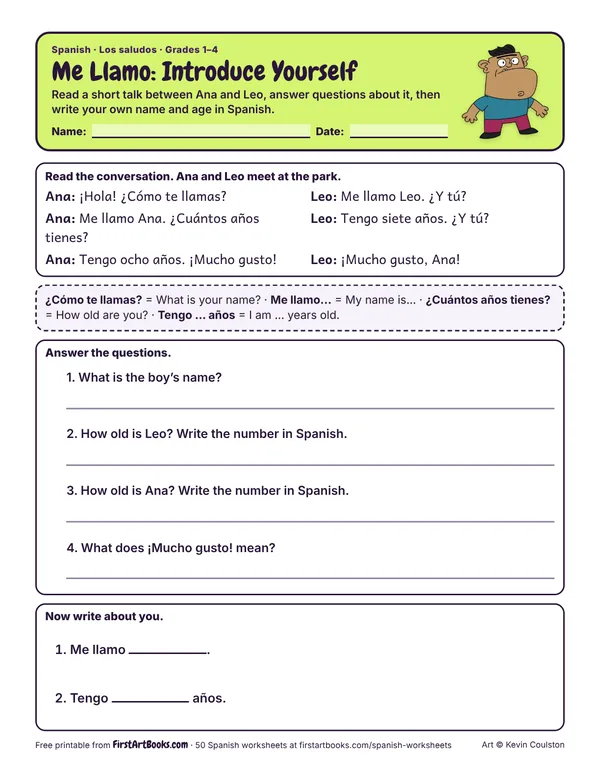
Read a short talk between Ana and Leo, answer questions about it, then write your own name and age in Spanish.
Print this sheet (PDF)Teacher notes and tips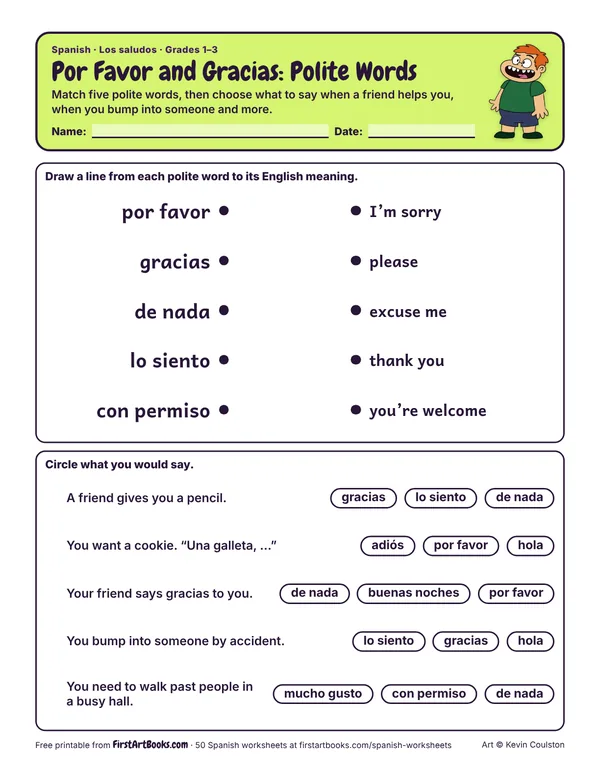
Match five polite words, then choose what to say when a friend helps you, when you bump into someone and more.
Print this sheet (PDF)Teacher notes and tips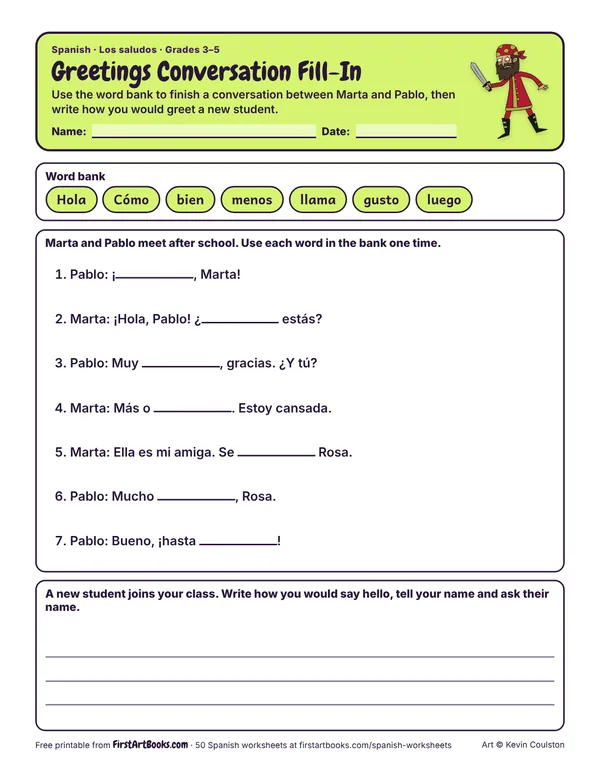
Use the word bank to finish a conversation between Marta and Pablo, then write how you would greet a new student.
Print this sheet (PDF)Teacher notes and tips

Trace the numbers cero to diez, count pictures, match the numbers 11 to 20, do math in Spanish and count by tens to cien.
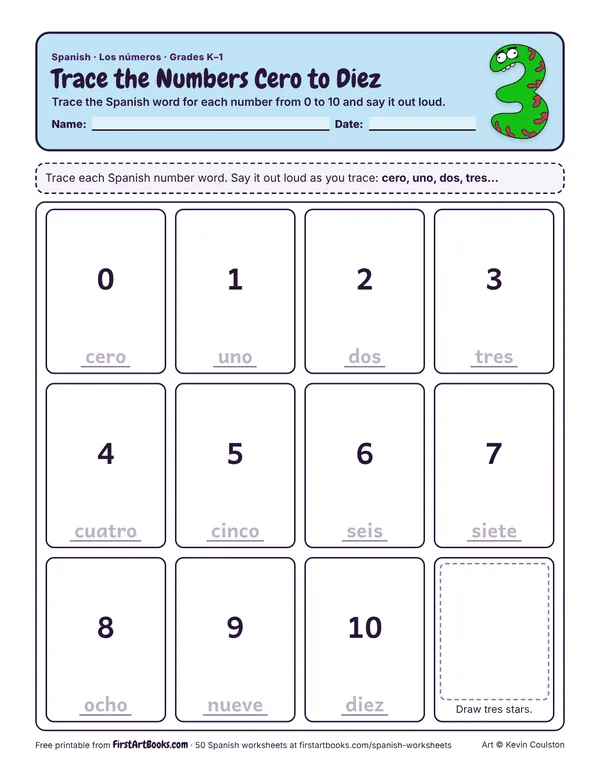
Trace the Spanish word for each number from 0 to 10 and say it out loud.
Print this sheet (PDF)Teacher notes and tips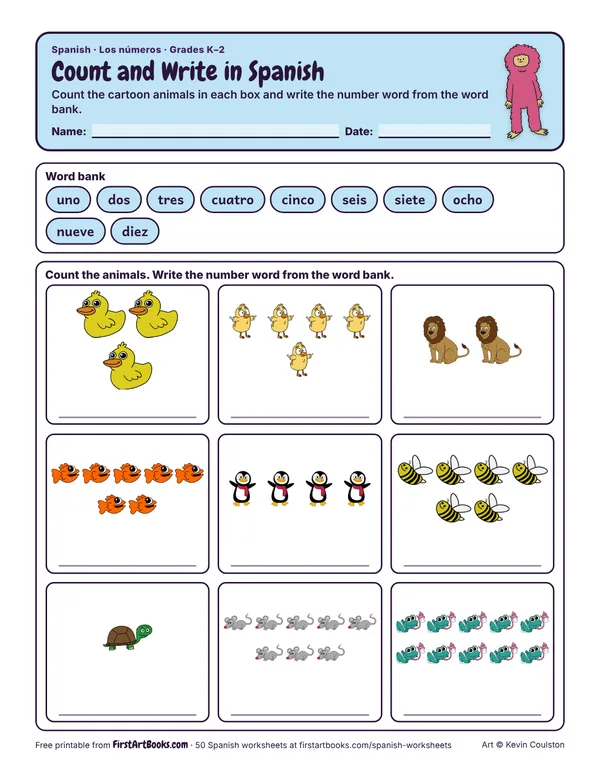
Count the cartoon animals in each box and write the number word from the word bank.
Print this sheet (PDF)Teacher notes and tips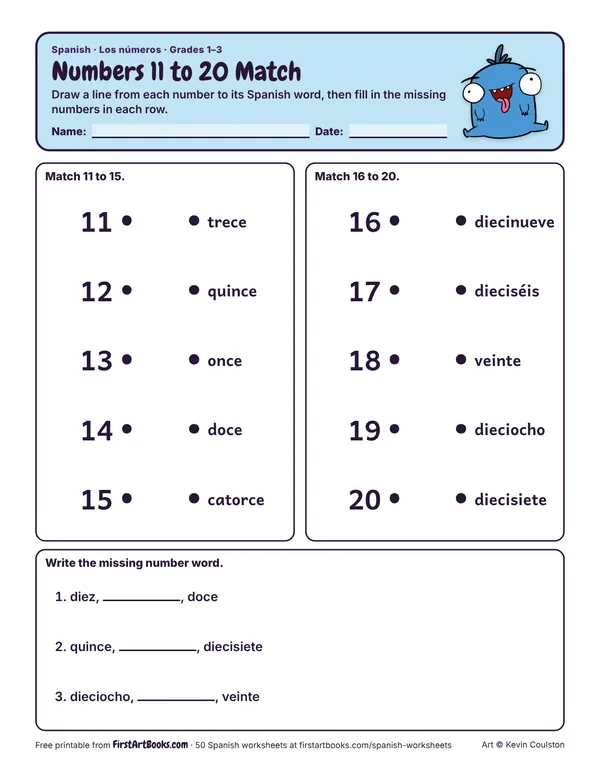
Draw a line from each number to its Spanish word, then fill in the missing numbers in each row.
Print this sheet (PDF)Teacher notes and tips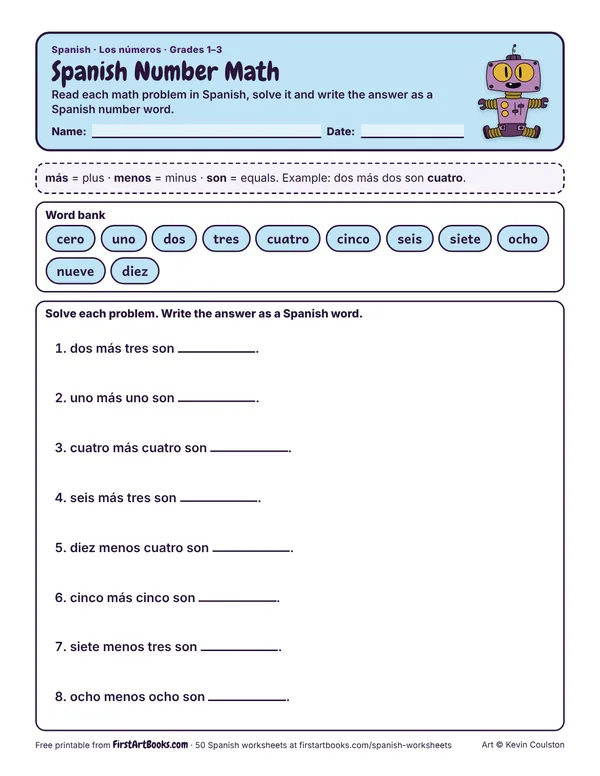
Read each math problem in Spanish, solve it and write the answer as a Spanish number word.
Print this sheet (PDF)Teacher notes and tips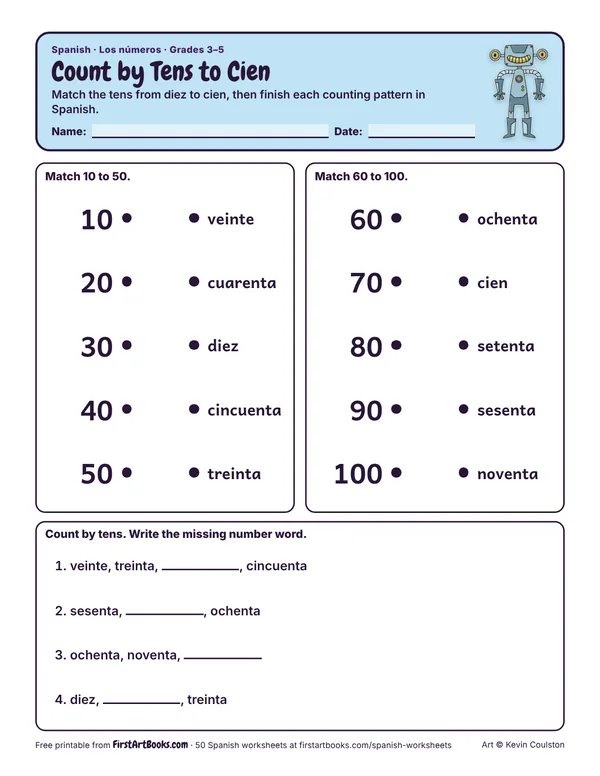
Match the tens from diez to cien, then finish each counting pattern in Spanish.
Print this sheet (PDF)Teacher notes and tips

Meet the color words with Kevin’s crayons, color by word, name the shapes, find the colors in a word search and pick the right color for things you know.
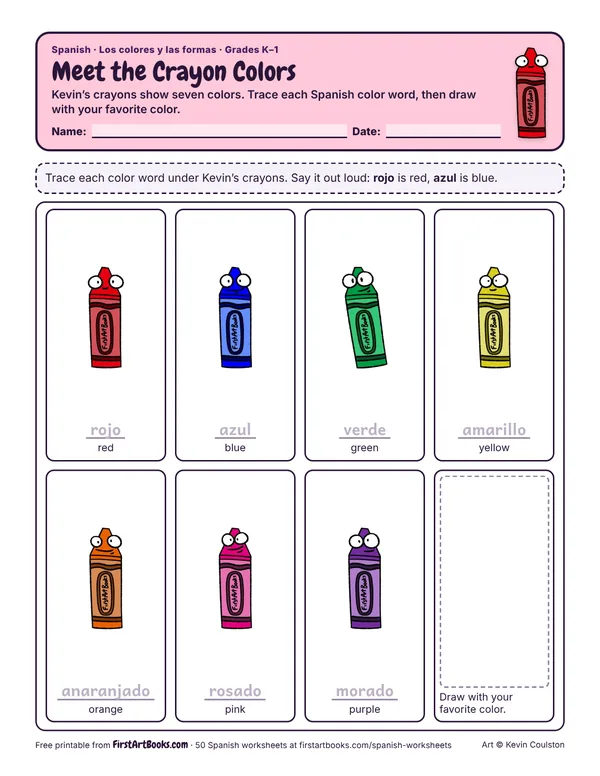
Kevin’s crayons show seven colors. Trace each Spanish color word, then draw with your favorite color.
Print this sheet (PDF)Teacher notes and tips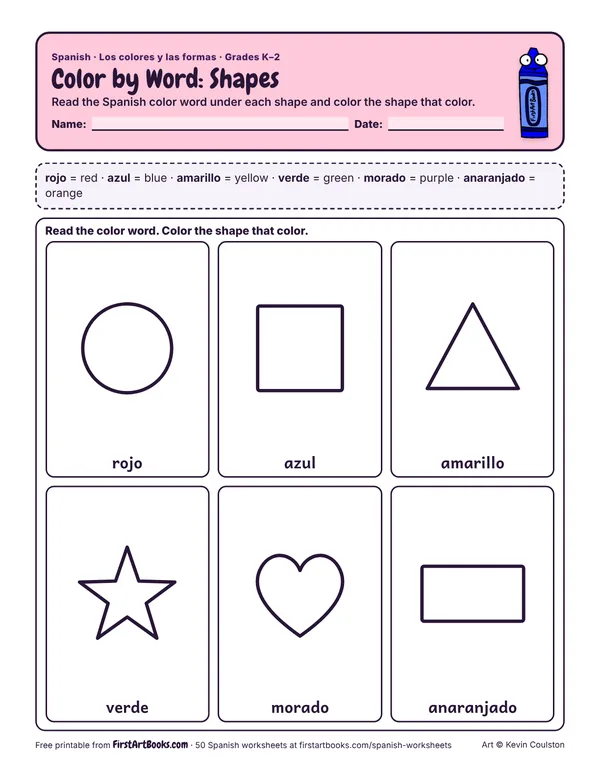
Read the Spanish color word under each shape and color the shape that color.
Print this sheet (PDF)Teacher notes and tips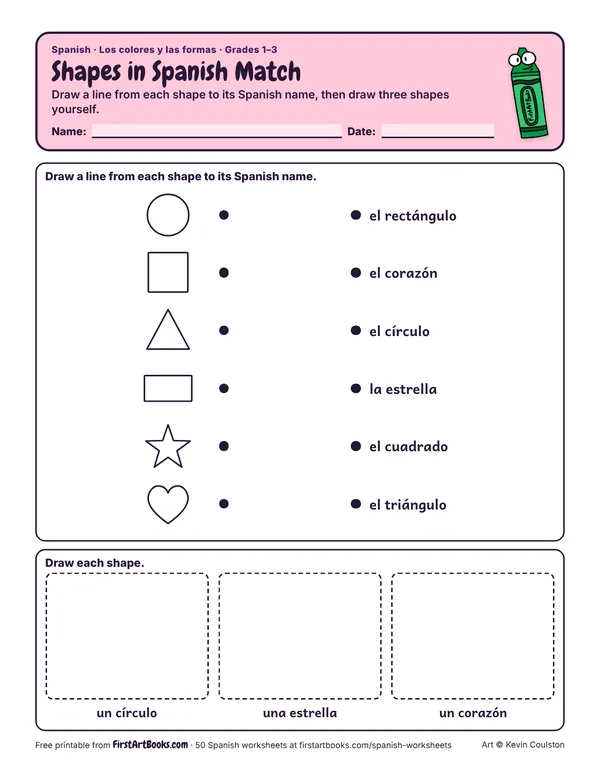
Draw a line from each shape to its Spanish name, then draw three shapes yourself.
Print this sheet (PDF)Teacher notes and tips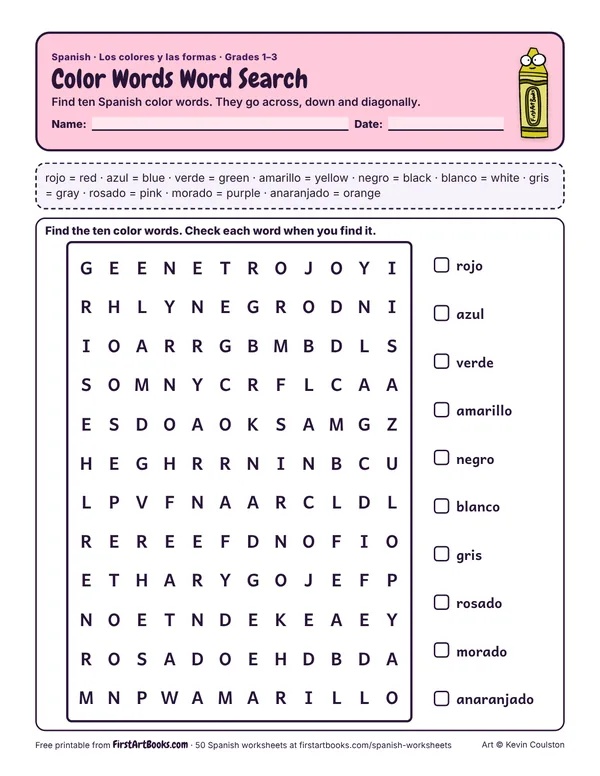
Find ten Spanish color words. They go across, down and diagonally.
Print this sheet (PDF)Teacher notes and tips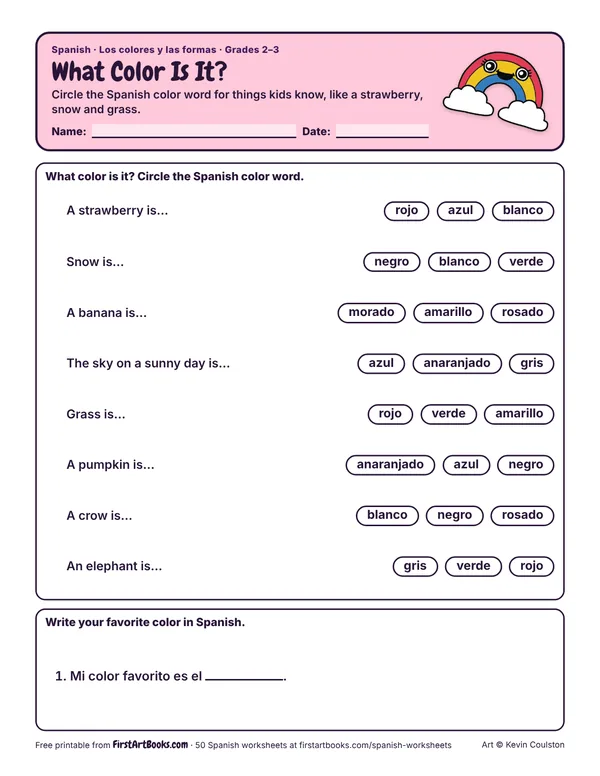
Circle the Spanish color word for things kids know, like a strawberry, snow and grass.
Print this sheet (PDF)Teacher notes and tips

Learn the days of the week and the months, match the four seasons, say ¿qué tiempo hace? and read and write dates and birthdays.
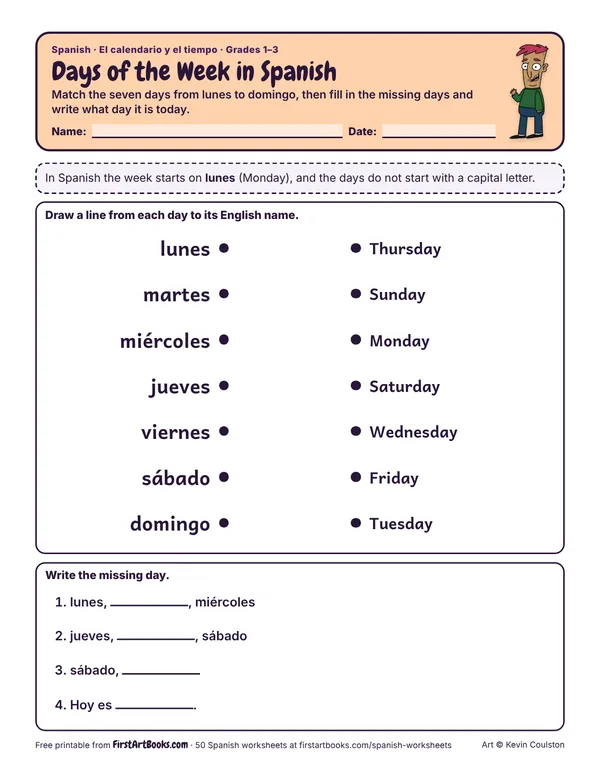
Match the seven days from lunes to domingo, then fill in the missing days and write what day it is today.
Print this sheet (PDF)Teacher notes and tips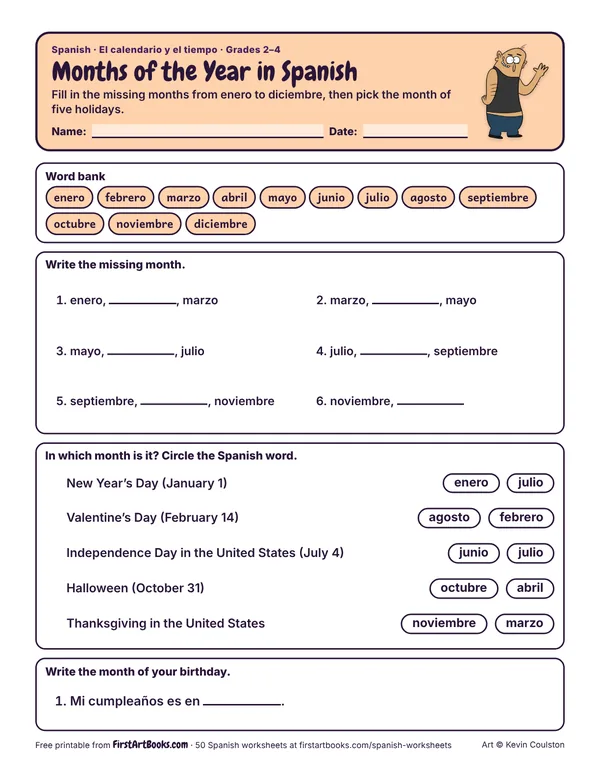
Fill in the missing months from enero to diciembre, then pick the month of five holidays.
Print this sheet (PDF)Teacher notes and tips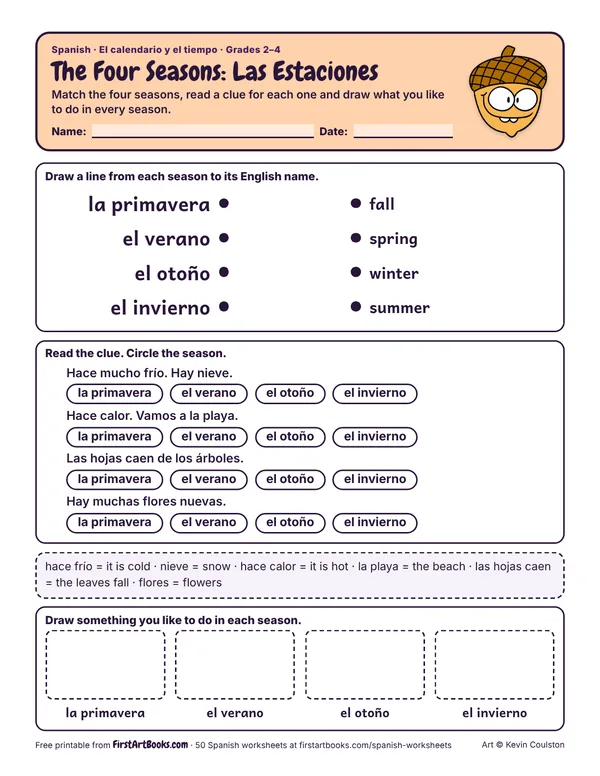
Match the four seasons, read a clue for each one and draw what you like to do in every season.
Print this sheet (PDF)Teacher notes and tips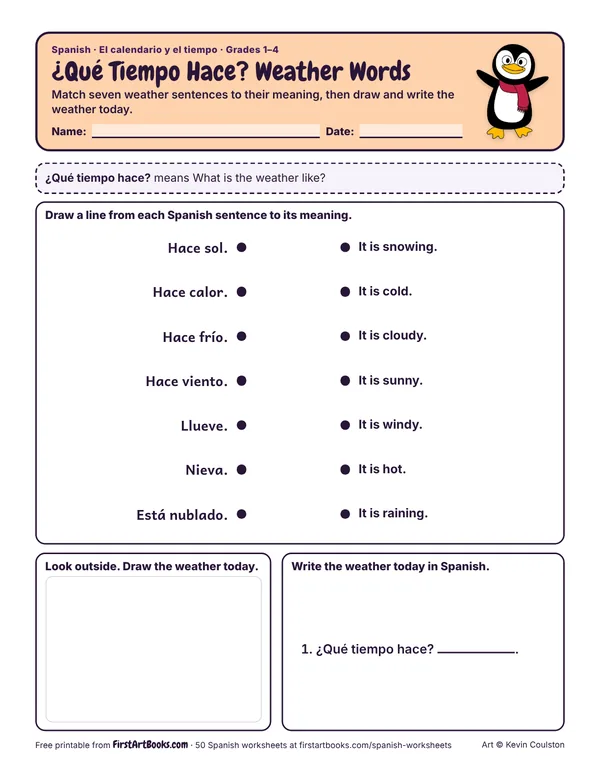
Match seven weather sentences to their meaning, then draw and write the weather today.
Print this sheet (PDF)Teacher notes and tips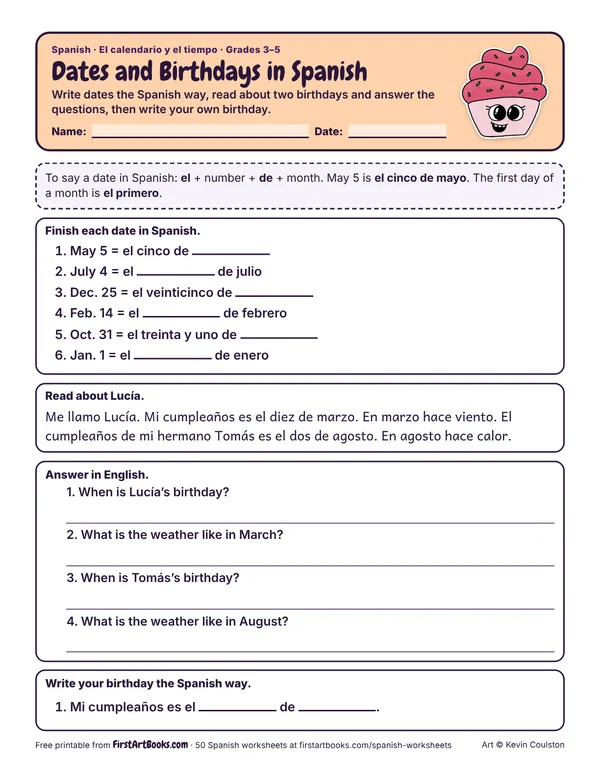
Write dates the Spanish way, read about two birthdays and answer the questions, then write your own birthday.
Print this sheet (PDF)Teacher notes and tips

Name the people in a family, draw your own, read about Sofía’s family tree, name the rooms of a house and solve family riddles.
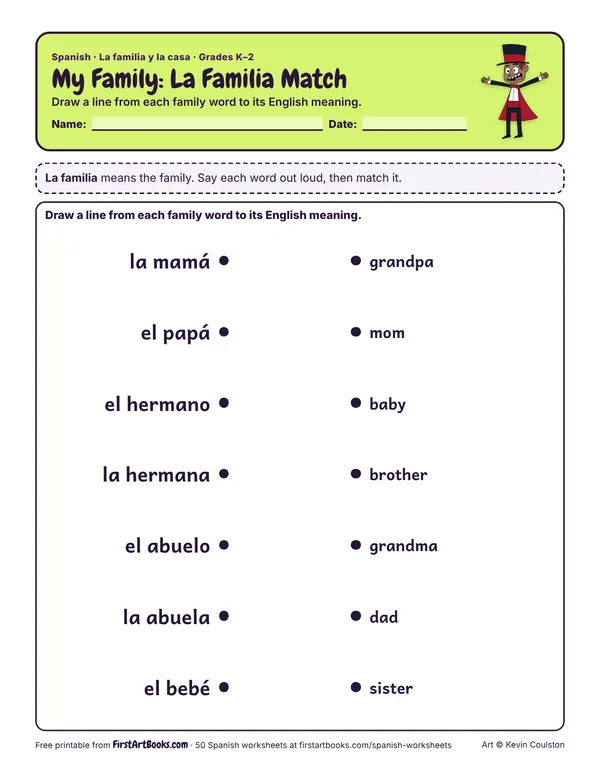
Draw a line from each family word to its English meaning.
Print this sheet (PDF)Teacher notes and tips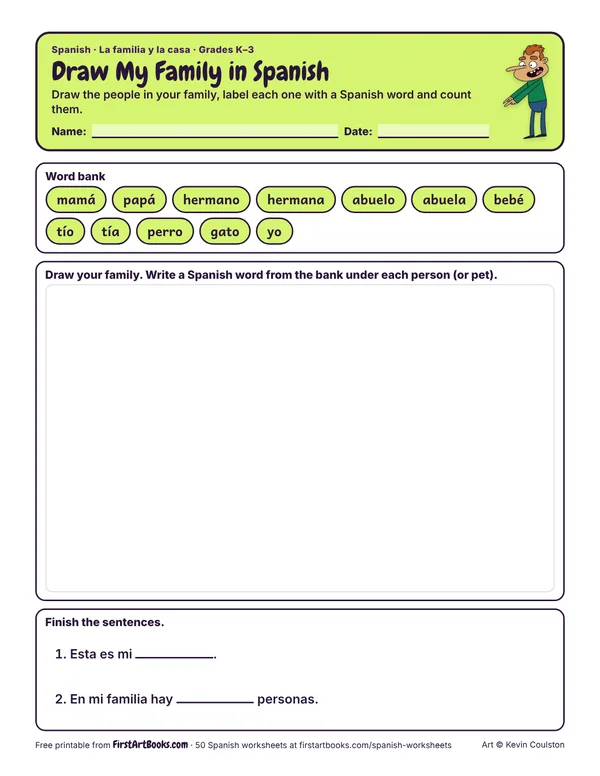
Draw the people in your family, label each one with a Spanish word and count them.
Print this sheet (PDF)Teacher notes and tips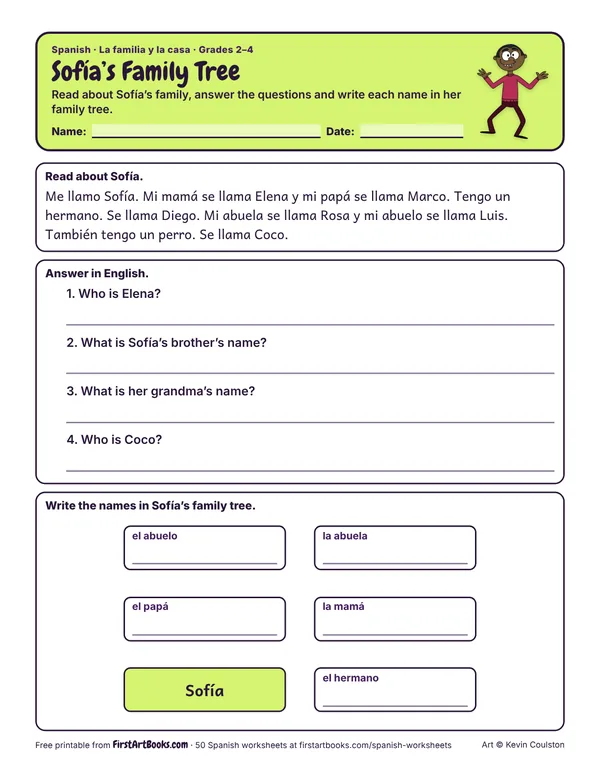
Read about Sofía’s family, answer the questions and write each name in her family tree.
Print this sheet (PDF)Teacher notes and tips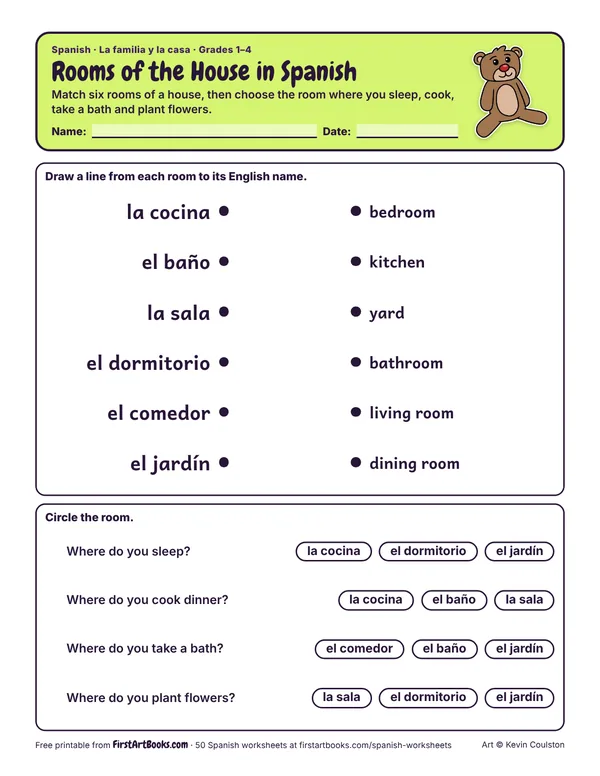
Match six rooms of a house, then choose the room where you sleep, cook, take a bath and plant flowers.
Print this sheet (PDF)Teacher notes and tips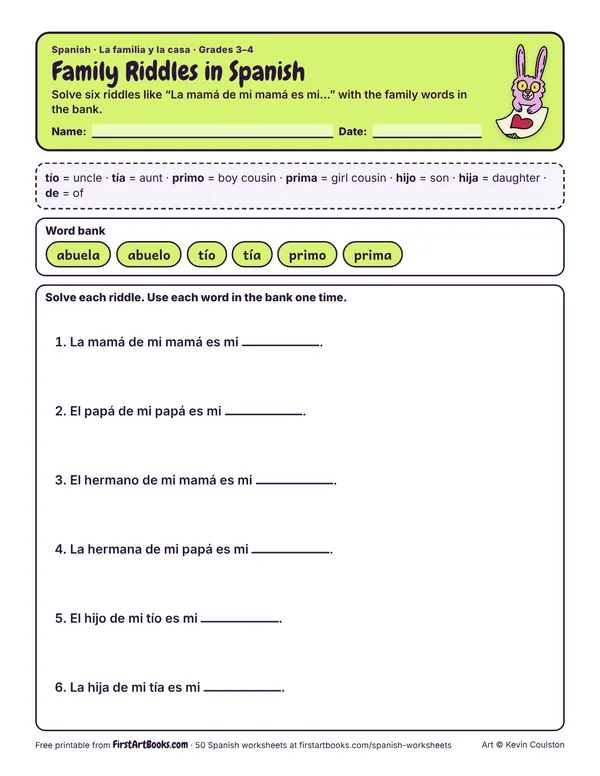
Solve six riddles like “La mamá de mi mamá es mi...” with the family words in the bank.
Print this sheet (PDF)Teacher notes and tips

Name the parts of the face and body, play Simón dice, learn the clothes words and describe an outfit with colors that match.
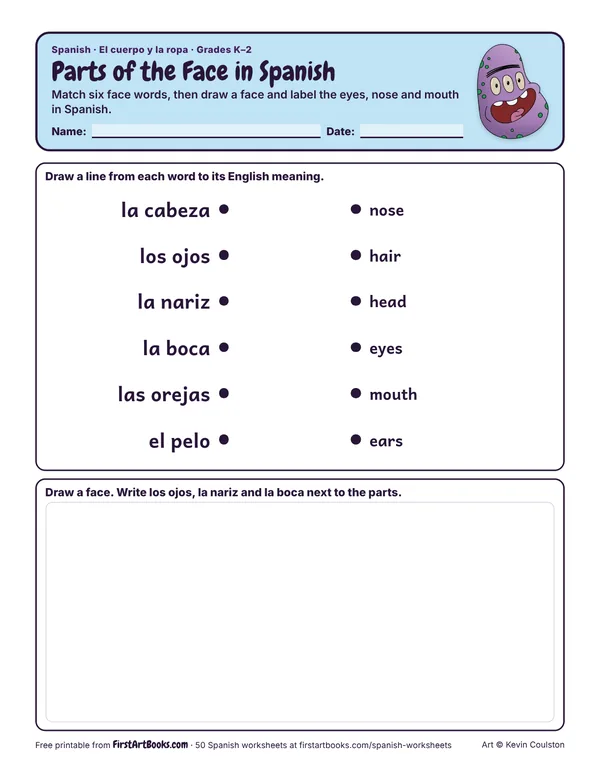
Match six face words, then draw a face and label the eyes, nose and mouth in Spanish.
Print this sheet (PDF)Teacher notes and tips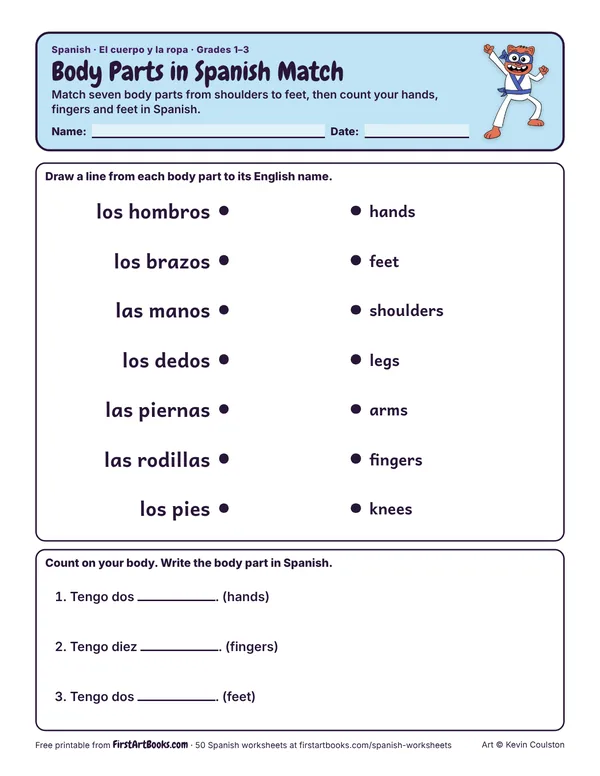
Match seven body parts from shoulders to feet, then count your hands, fingers and feet in Spanish.
Print this sheet (PDF)Teacher notes and tips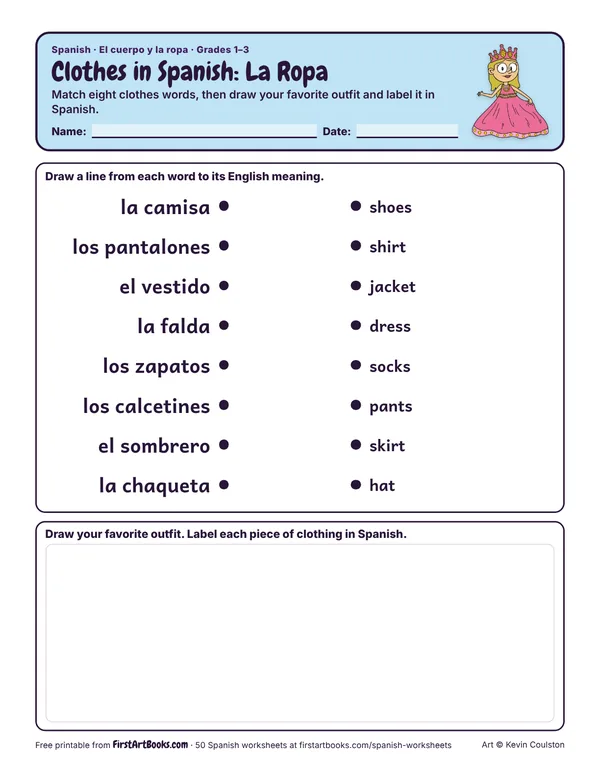
Match eight clothes words, then draw your favorite outfit and label it in Spanish.
Print this sheet (PDF)Teacher notes and tips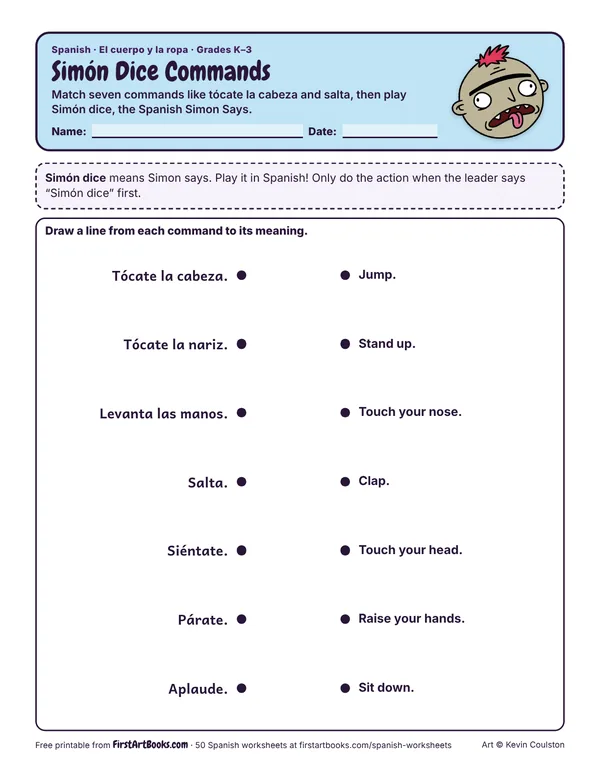
Match seven commands like tócate la cabeza and salta, then play Simón dice, the Spanish Simon Says.
Print this sheet (PDF)Teacher notes and tips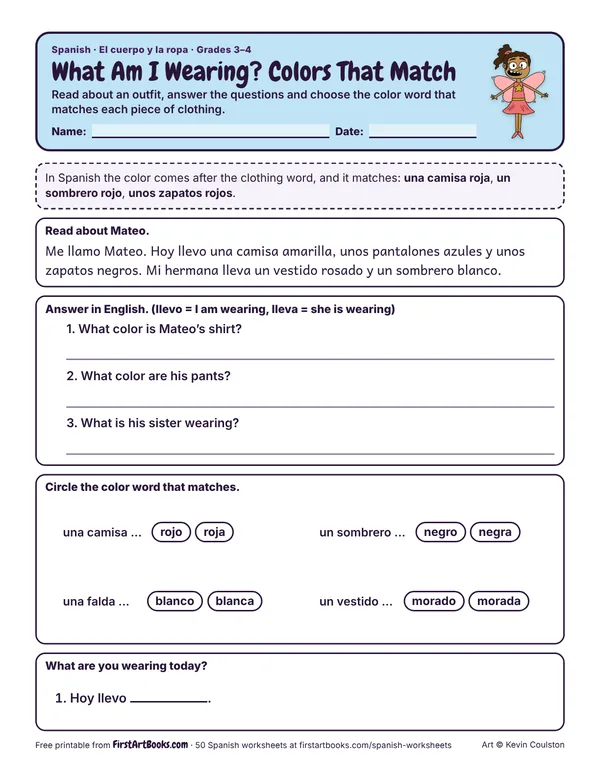
Read about an outfit, answer the questions and choose the color word that matches each piece of clothing.
Print this sheet (PDF)Teacher notes and tips
Match Kevin Coulston’s cartoon animals to their Spanish names, trace the wild animals, find sea animals, tell grande from pequeño and solve riddles.
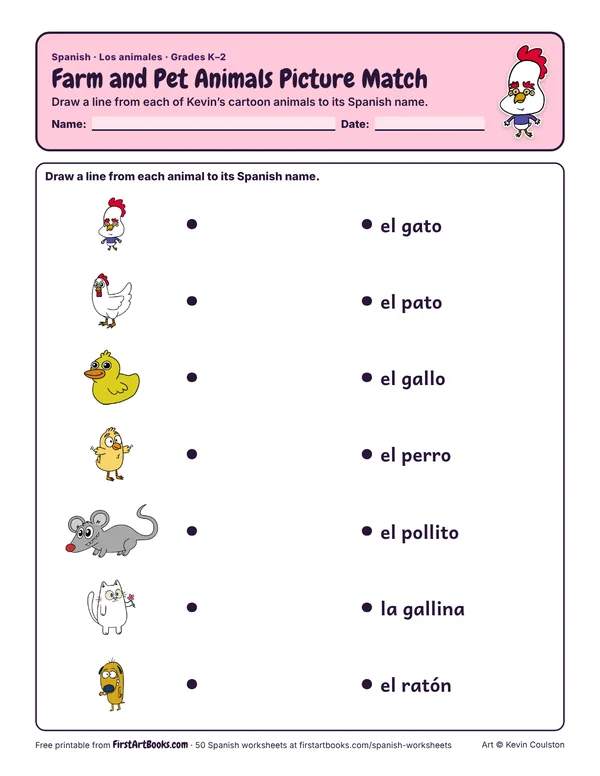
Draw a line from each of Kevin’s cartoon animals to its Spanish name.
Print this sheet (PDF)Teacher notes and tips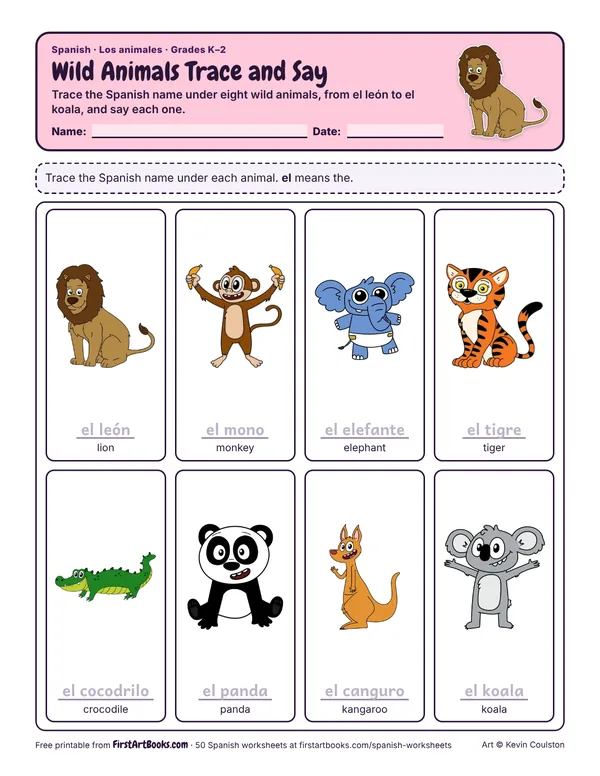
Trace the Spanish name under eight wild animals, from el león to el koala, and say each one.
Print this sheet (PDF)Teacher notes and tips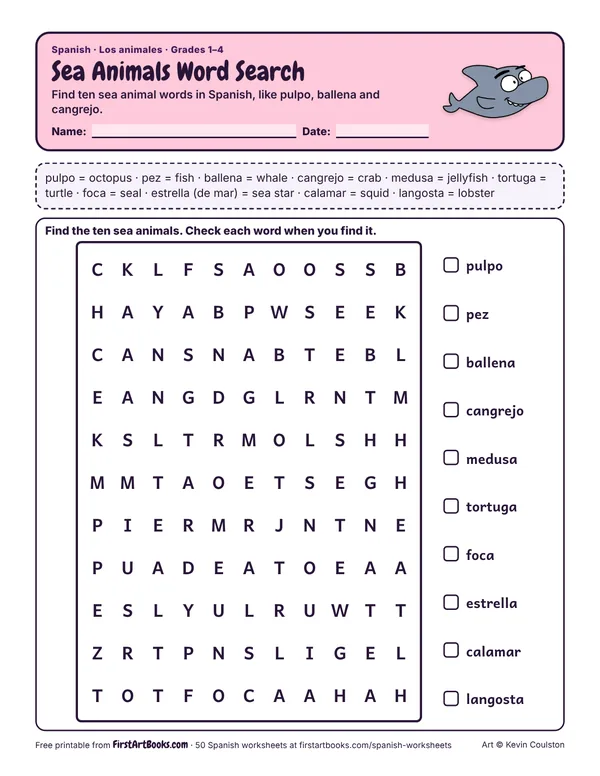
Find ten sea animal words in Spanish, like pulpo, ballena and cangrejo.
Print this sheet (PDF)Teacher notes and tips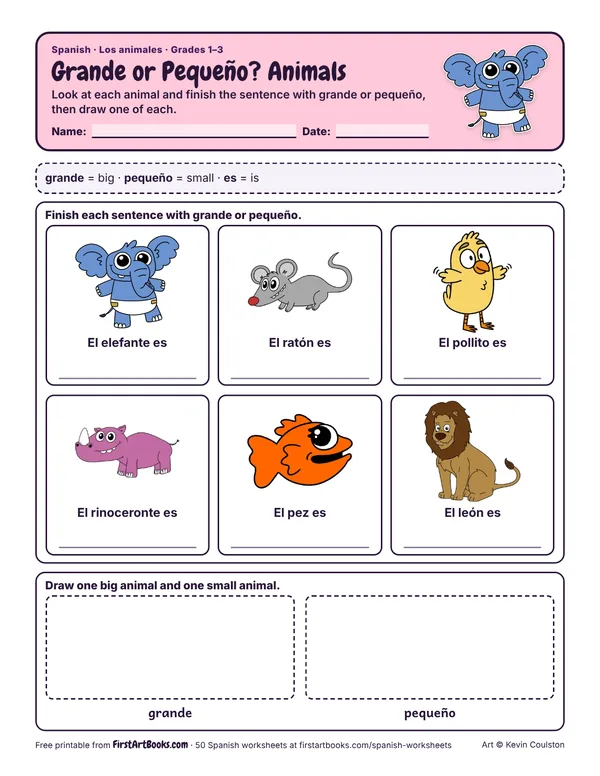
Look at each animal and finish the sentence with grande or pequeño, then draw one of each.
Print this sheet (PDF)Teacher notes and tips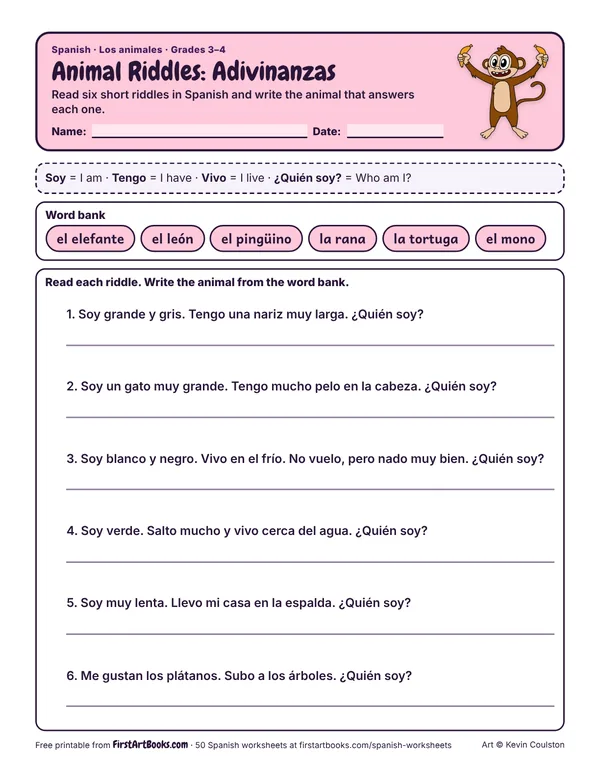
Read six short riddles in Spanish and write the animal that answers each one.
Print this sheet (PDF)Teacher notes and tips

Match the fruits, say me gusta and no me gusta, sort fruits, vegetables and drinks, name the meals and order from a menu.
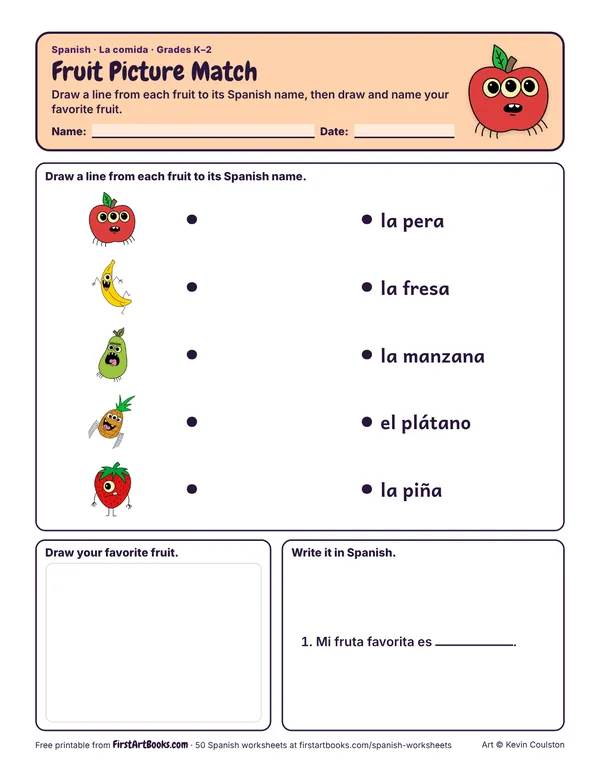
Draw a line from each fruit to its Spanish name, then draw and name your favorite fruit.
Print this sheet (PDF)Teacher notes and tips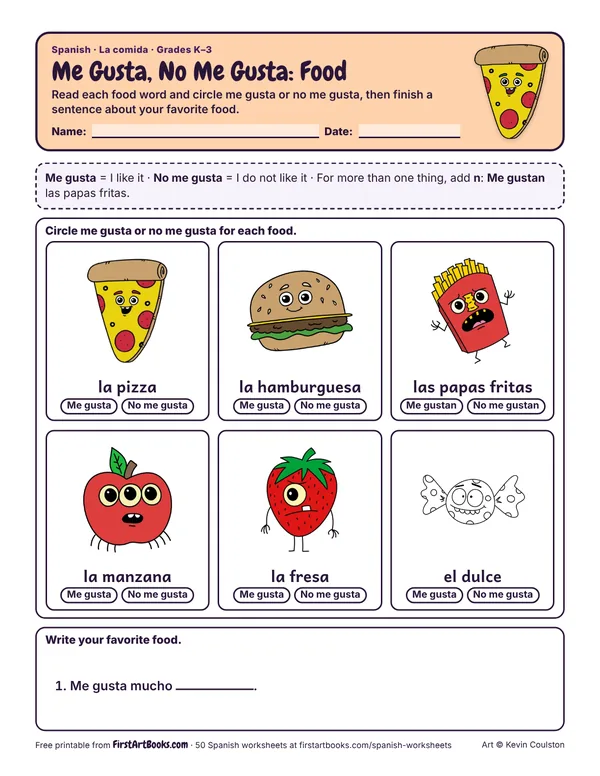
Read each food word and circle me gusta or no me gusta, then finish a sentence about your favorite food.
Print this sheet (PDF)Teacher notes and tips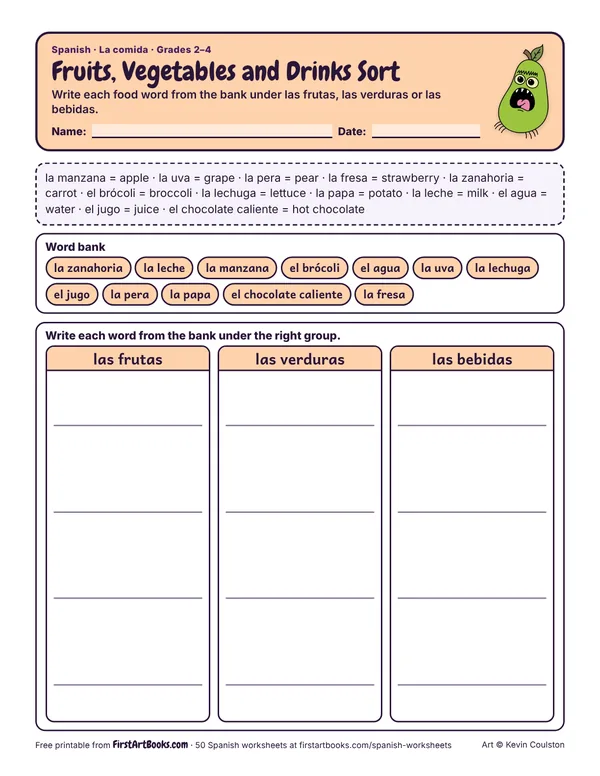
Write each food word from the bank under las frutas, las verduras or las bebidas.
Print this sheet (PDF)Teacher notes and tips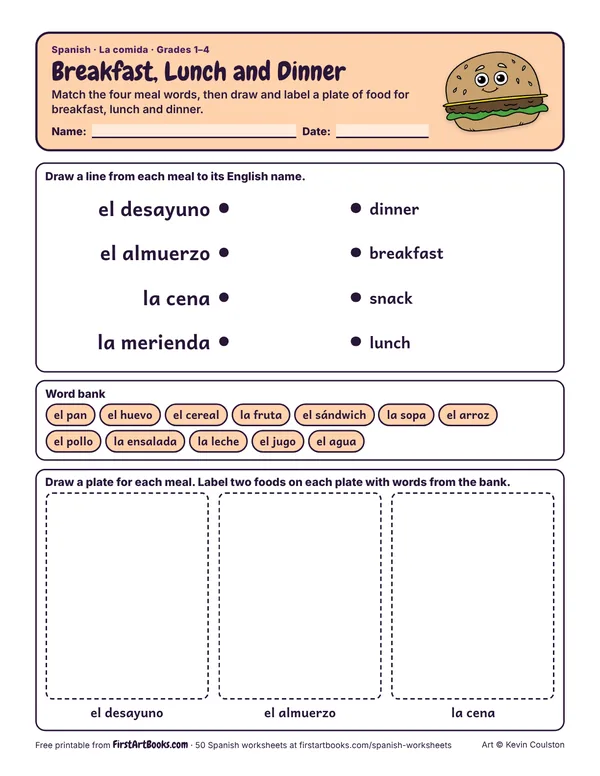
Match the four meal words, then draw and label a plate of food for breakfast, lunch and dinner.
Print this sheet (PDF)Teacher notes and tips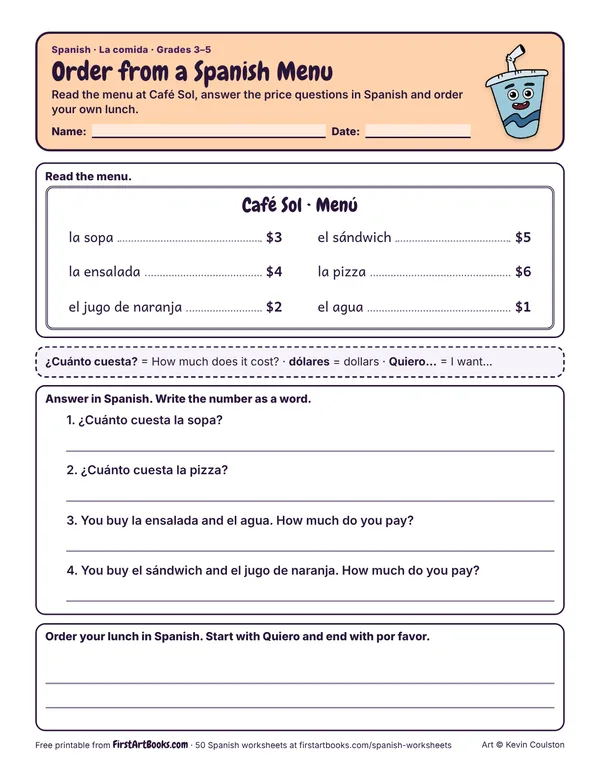
Read the menu at Café Sol, answer the price questions in Spanish and order your own lunch.
Print this sheet (PDF)Teacher notes and tips

Name school supplies, follow classroom commands, show what is in your backpack, learn subjects and places at school and label your classroom.
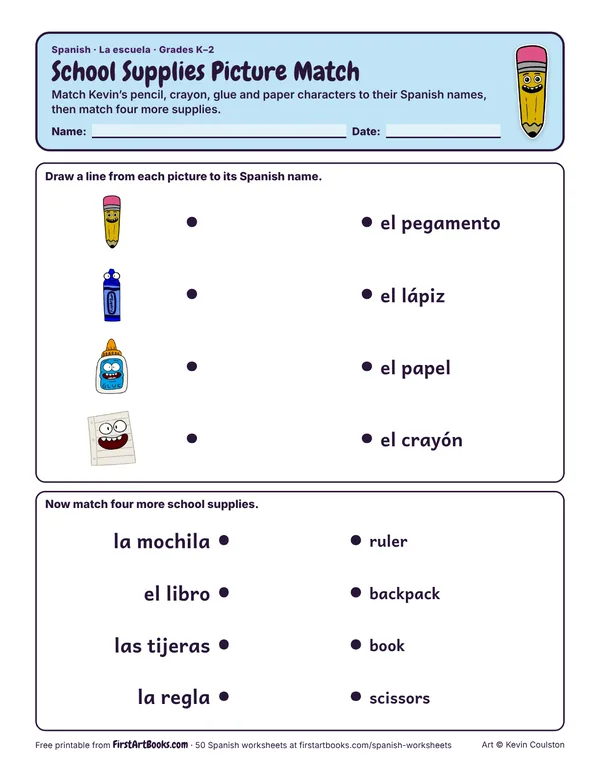
Match Kevin’s pencil, crayon, glue and paper characters to their Spanish names, then match four more supplies.
Print this sheet (PDF)Teacher notes and tips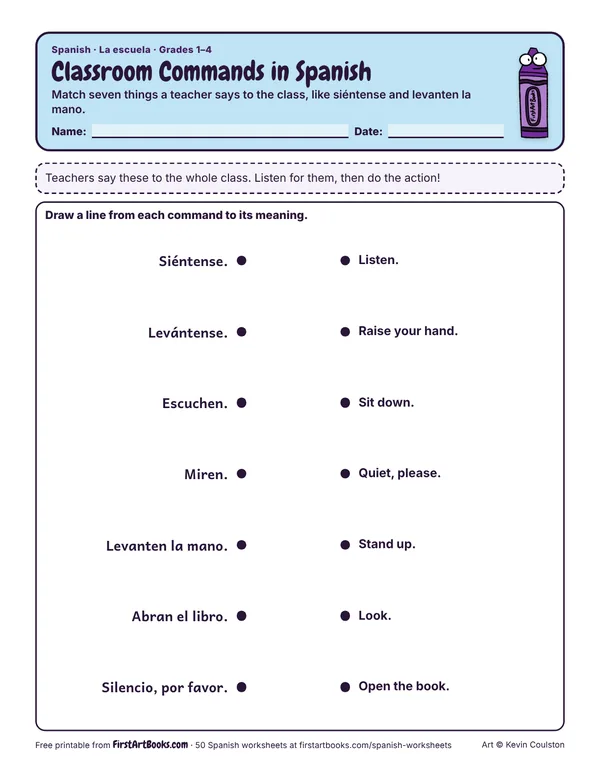
Match seven things a teacher says to the class, like siéntense and levanten la mano.
Print this sheet (PDF)Teacher notes and tips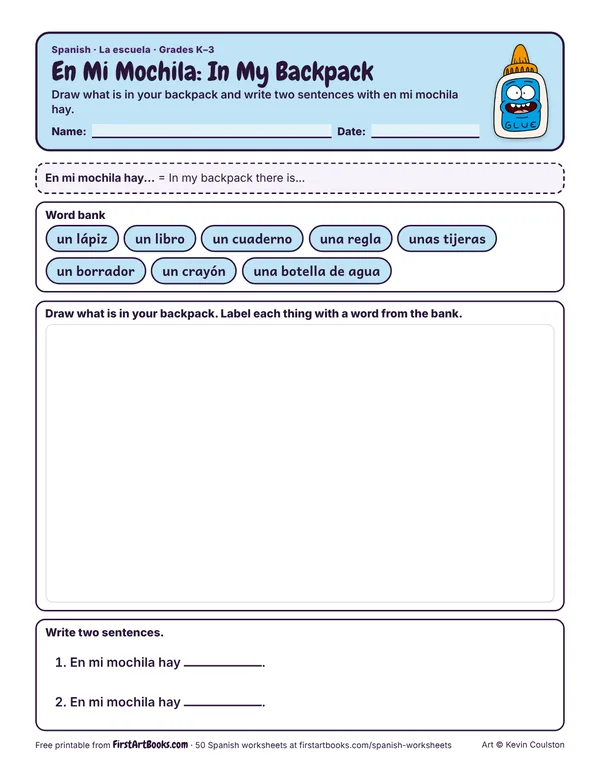
Draw what is in your backpack and write two sentences with en mi mochila hay.
Print this sheet (PDF)Teacher notes and tips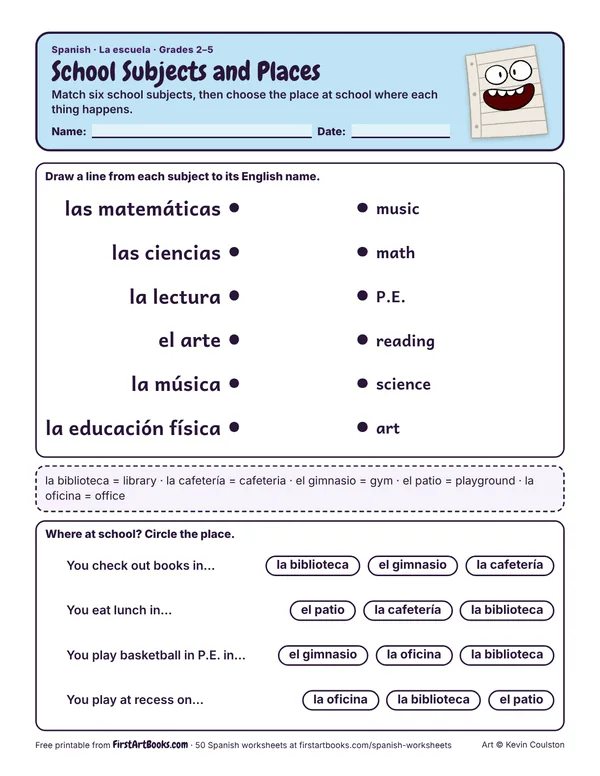
Match six school subjects, then choose the place at school where each thing happens.
Print this sheet (PDF)Teacher notes and tips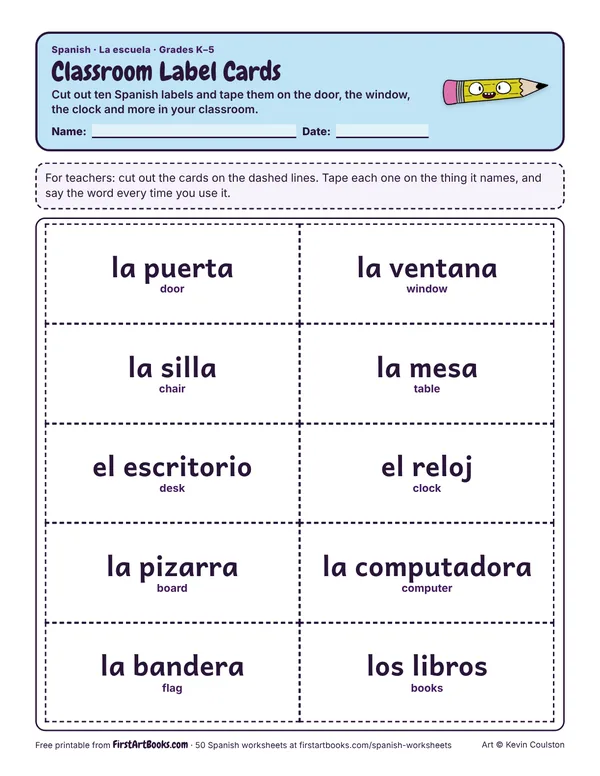
Cut out ten Spanish labels and tape them on the door, the window, the clock and more in your classroom.
Print this sheet (PDF)Teacher notes and tips
Sort words by el and la, make plurals, learn yo, tú, él and ella, make describing words match and choose me gusta or me gustan.
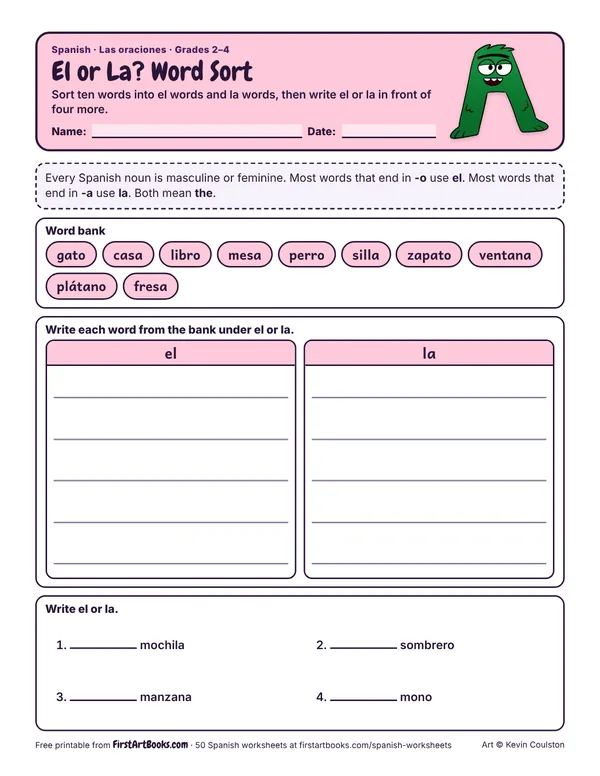
Sort ten words into el words and la words, then write el or la in front of four more.
Print this sheet (PDF)Teacher notes and tips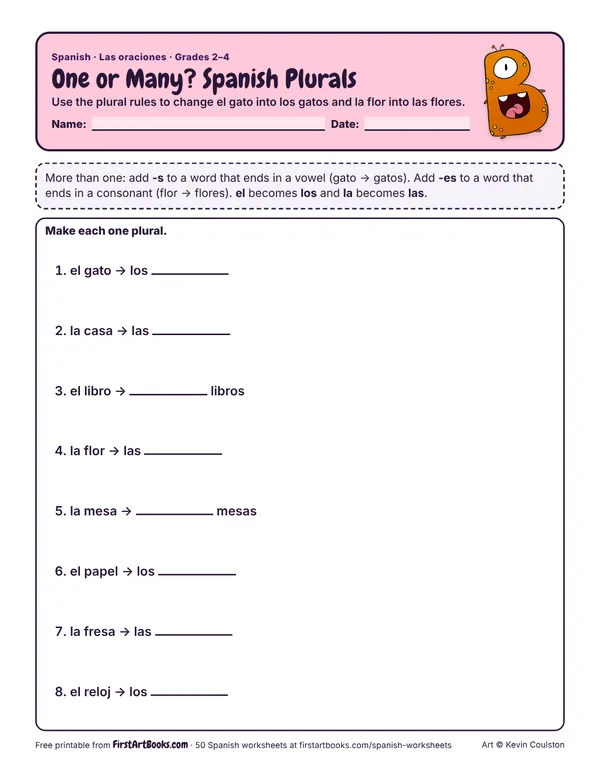
Use the plural rules to change el gato into los gatos and la flor into las flores.
Print this sheet (PDF)Teacher notes and tips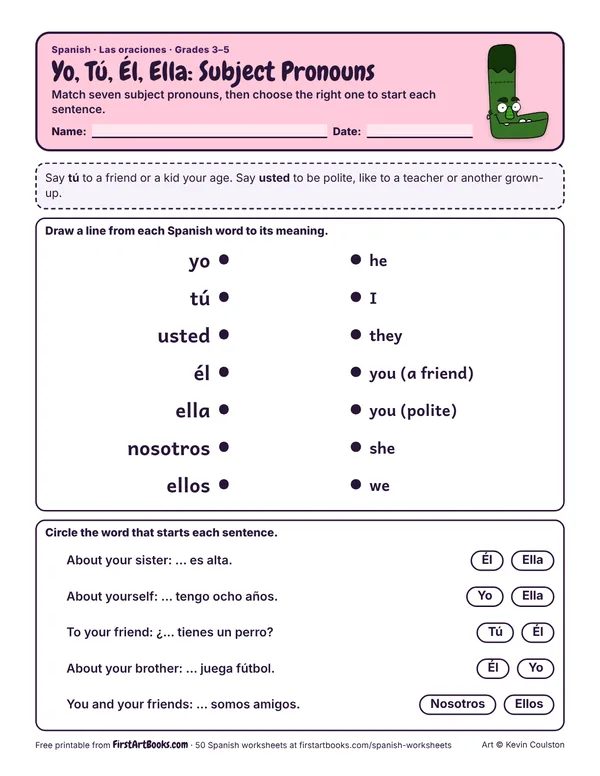
Match seven subject pronouns, then choose the right one to start each sentence.
Print this sheet (PDF)Teacher notes and tips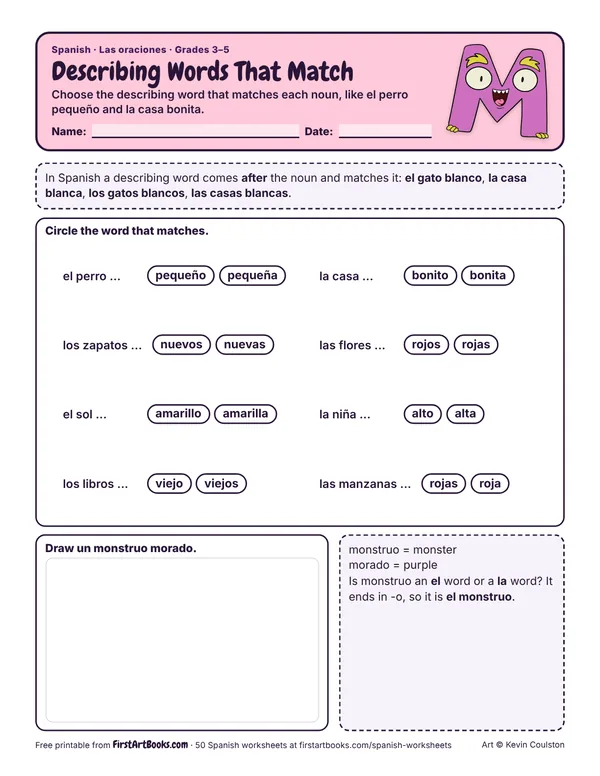
Choose the describing word that matches each noun, like el perro pequeño and la casa bonita.
Print this sheet (PDF)Teacher notes and tips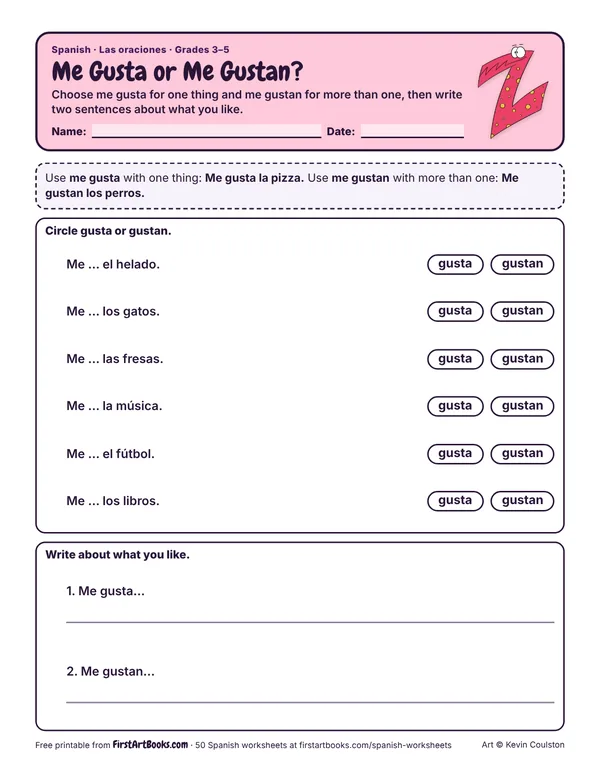
Choose me gusta for one thing and me gustan for more than one, then write two sentences about what you like.
Print this sheet (PDF)Teacher notes and tips
Each topic has a pack of its five sheets and their answer keys: greetings, numbers, colors and shapes, calendar and weather, family and home, body and clothes, animals, food, school, first grammar.
The characters on these worksheets come from Kevin Coulston’s drawing books. Draw an animal from the How to Draw books, then label it in Spanish: el león, el mono, el pingüino.
Yes. All 50 worksheets, the 42 answer keys and the topic packs are free to print for Spanish class, world language specials, homeschool and home practice. Print one sheet, a topic pack of five or the whole set in one PDF.
Kids in kindergarten to 5th grade who speak English and are just starting Spanish. Instructions are in English and the Spanish is what kids learn, so a teacher or parent who is still learning Spanish can use them too. Every matching, fill-in and puzzle sheet has an answer key.
Neutral Latin American Spanish, the kind most US schools teach. Where words change from country to country, the sheets use a common choice: el plátano for banana, la computadora for computer and las papas fritas for French fries. Teach the word your students hear at home if it is different.
The topics run from easiest to hardest. Start with greetings, numbers and colors, then the calendar, family, body, animals, food and school words. The first grammar topic (el and la, plurals, yo and tú, describing words and me gusta) is for kids who already know some words, usually 2nd to 5th grade.
Spanish questions start with an upside-down question mark and end with a regular one: ¿Cómo estás? Excited sentences work the same way: ¡Hola! The ¿Cómo Estás? sheet points this out to kids.
Yes. The animal, fruit, crayon and school supply sheets use Kevin Coulston’s cartoon characters as the pictures, so pre-readers can match a picture to a word they hear. Shapes are drawn as simple outlines kids can color.
Yes, with one note. Meet the Crayon Colors shows Kevin’s crayons in color, so it looks best on a color printer, but every crayon also has its English color word printed under it. All the other answers are in words. Sheets are US Letter and also print on A4.
All sheets are US Letter, print well in black and white, and are free for home and classroom use. Pages are set in Andika, a clear font for young readers. More for teachers in the teacher resources library.
12 printable pages: six step-by-step lessons, a grid activity, draw-and-write sheets and teacher notes, sent with your welcome email. After that, new classroom printables by email.