


Grades K–5
ASL Alphabet Chart
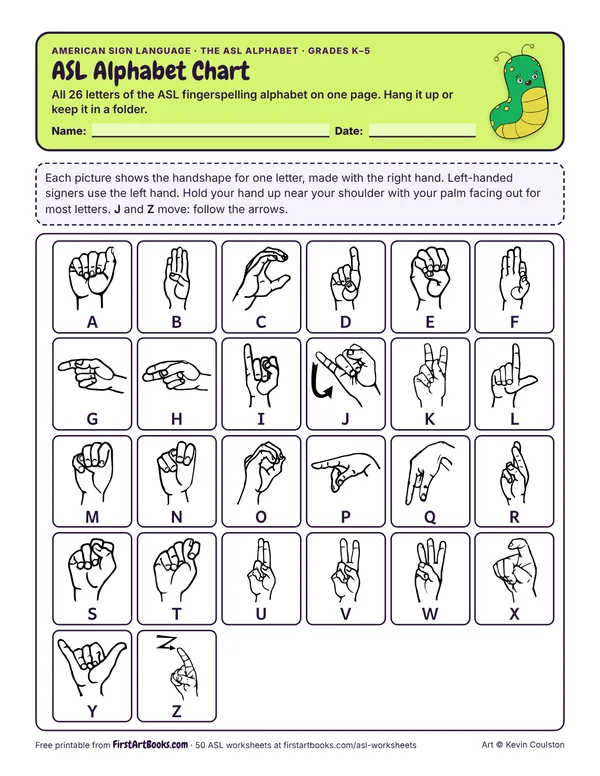
All 26 letters of the ASL fingerspelling alphabet on one page. Hang it up or keep it in a folder.
Print this sheet (PDF)Teacher notes and tips50 free American Sign Language worksheets for English-speaking kids, in 10 topics: the ASL alphabet, look-alike letters, reading fingerspelled words, spell it yourself, more fingerspelling, Deaf culture, Deaf history, how ASL works, games and goals. Accurate handshape pictures, 37 answer keys and one of Kevin Coulston’s cartoon characters on every page.
A full ASL alphabet chart, then trace and sign A to M and N to Z, match handshapes to letters and name each handshape on your own.
All 26 letters of the ASL fingerspelling alphabet on one page. Hang it up or keep it in a folder.
Print this sheet (PDF)Teacher notes and tips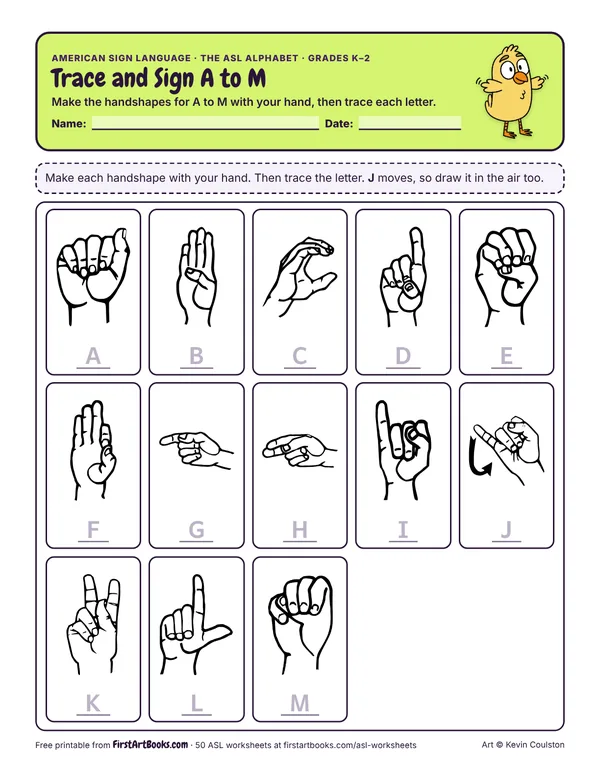
Make the handshapes for A to M with your hand, then trace each letter.
Print this sheet (PDF)Teacher notes and tips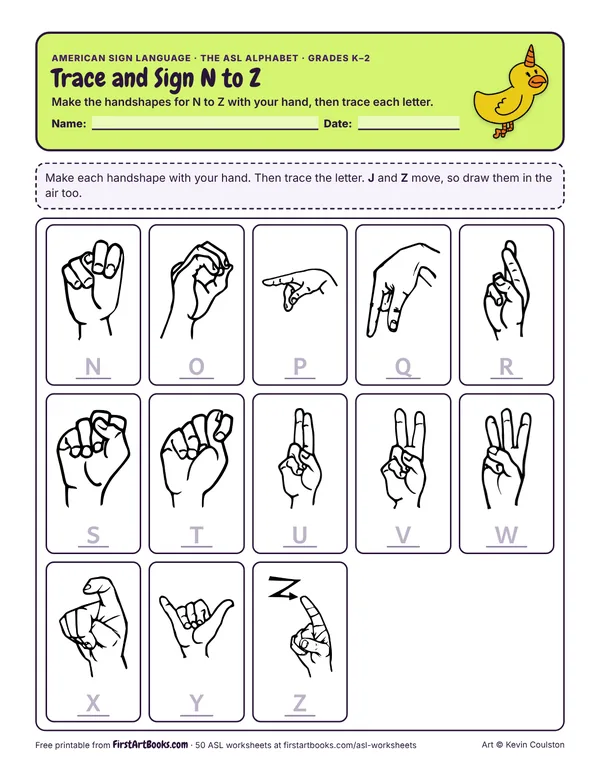
Make the handshapes for N to Z with your hand, then trace each letter.
Print this sheet (PDF)Teacher notes and tips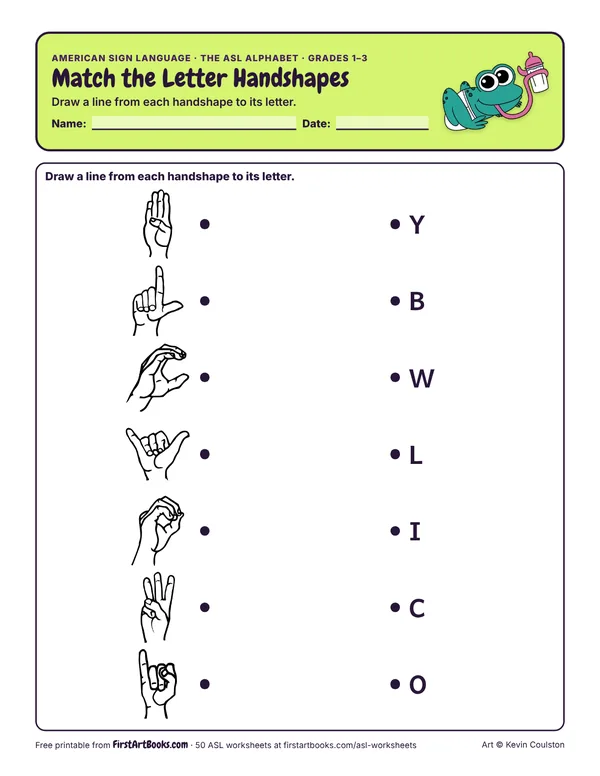
Draw a line from each handshape to its letter.
Print this sheet (PDF)Teacher notes and tips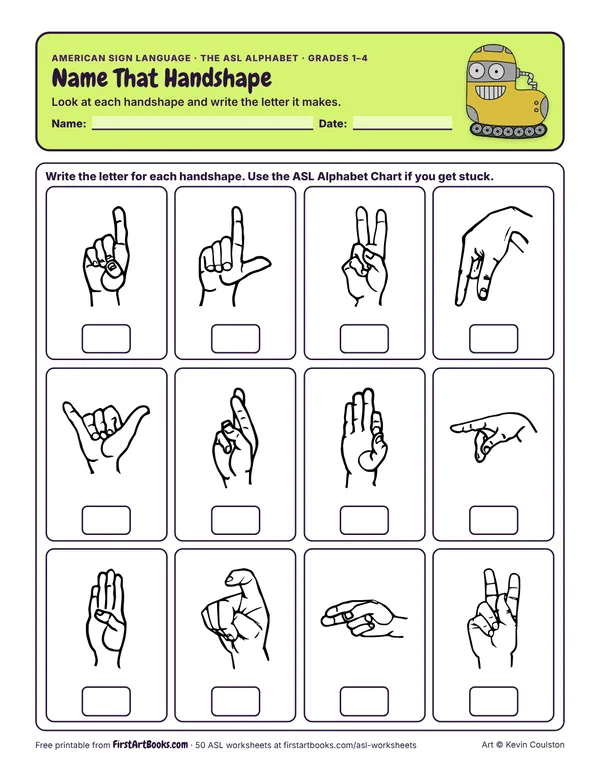
Look at each handshape and write the letter it makes.
Print this sheet (PDF)Teacher notes and tips
Tell apart the letters that look almost the same: A, S, T, M, N and E, then U, V, R and K, then G, H, P and Q, the moving letters J and Z, and sort every letter by its handshape.
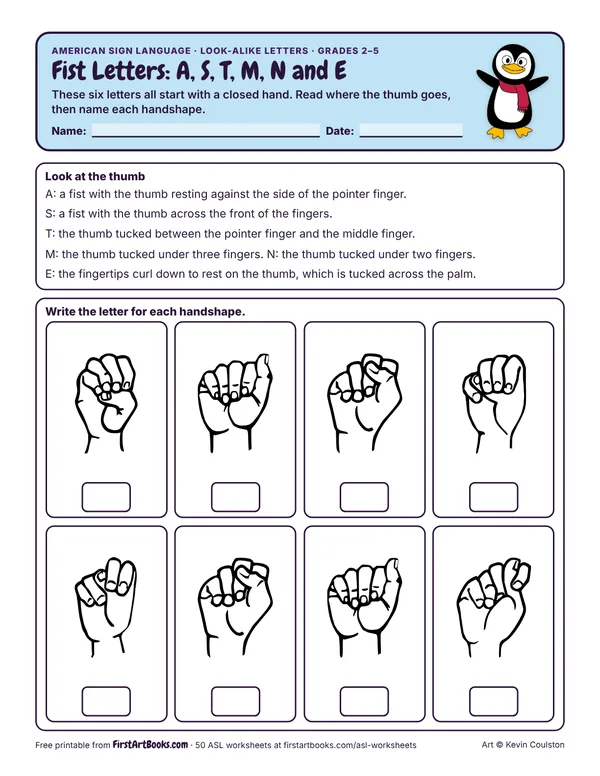
These six letters all start with a closed hand. Read where the thumb goes, then name each handshape.
Print this sheet (PDF)Teacher notes and tips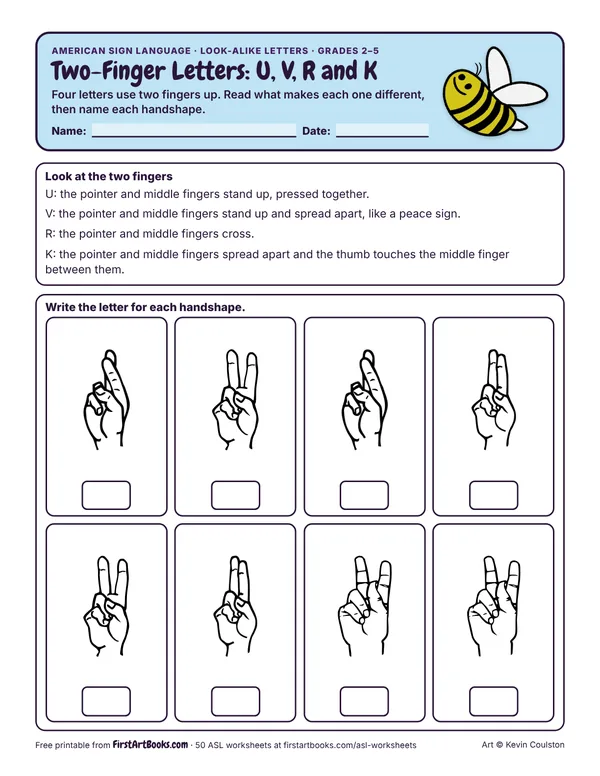
Four letters use two fingers up. Read what makes each one different, then name each handshape.
Print this sheet (PDF)Teacher notes and tips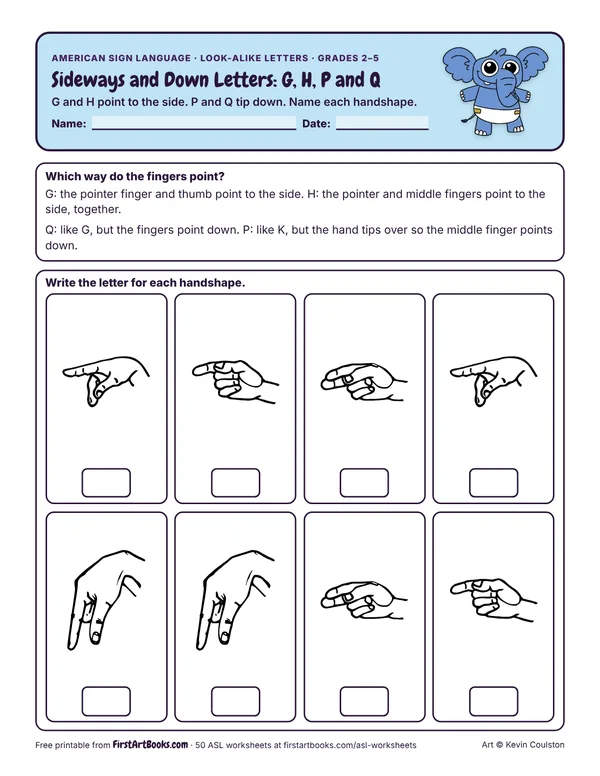
G and H point to the side. P and Q tip down. Name each handshape.
Print this sheet (PDF)Teacher notes and tips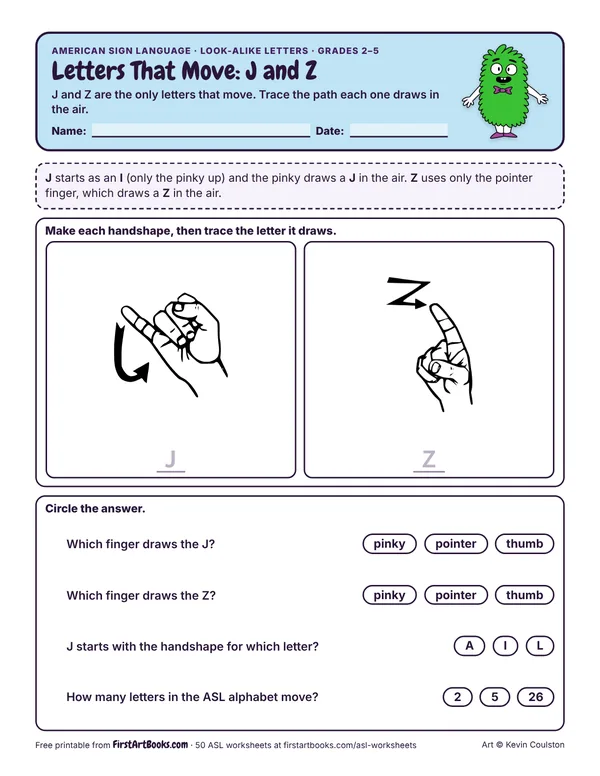
J and Z are the only letters that move. Trace the path each one draws in the air.
Print this sheet (PDF)Teacher notes and tips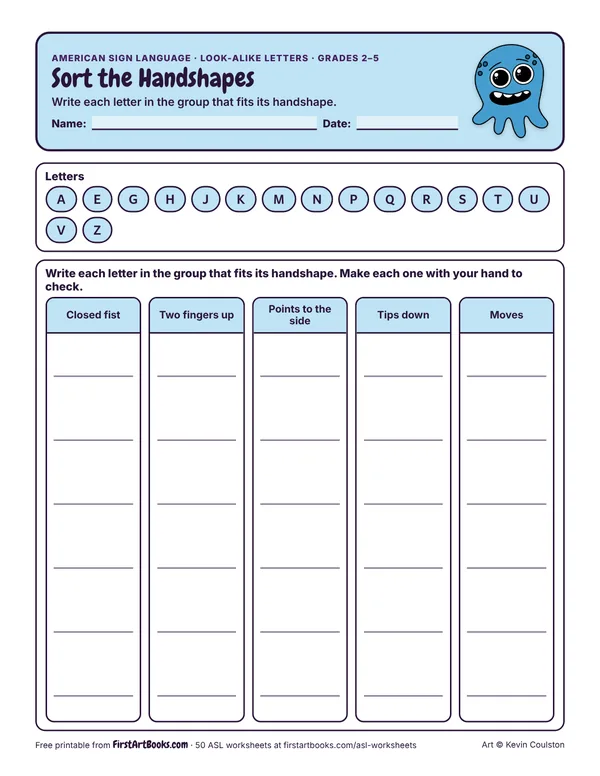
Write each letter in the group that fits its handshape.
Print this sheet (PDF)Teacher notes and tips

Read sight words, three-letter words, animals and colors spelled with ASL handshapes, and find the missing letter in each word.
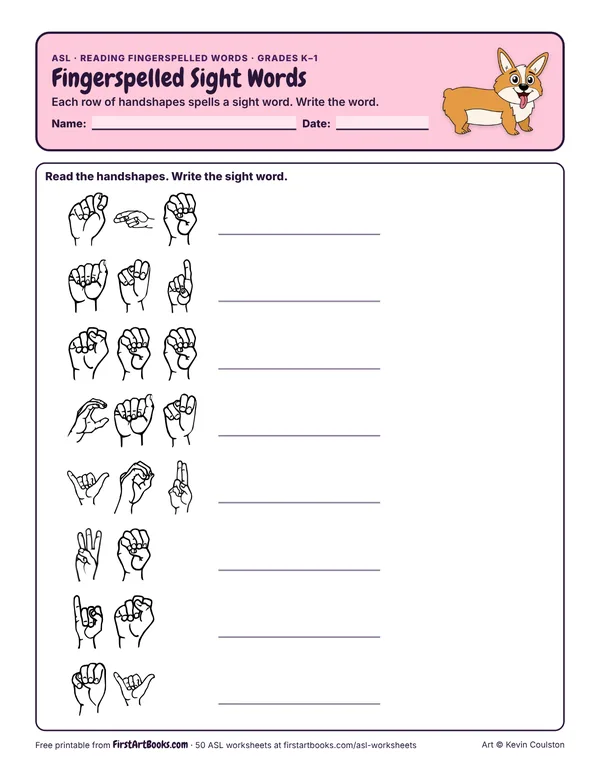
Each row of handshapes spells a sight word. Write the word.
Print this sheet (PDF)Teacher notes and tips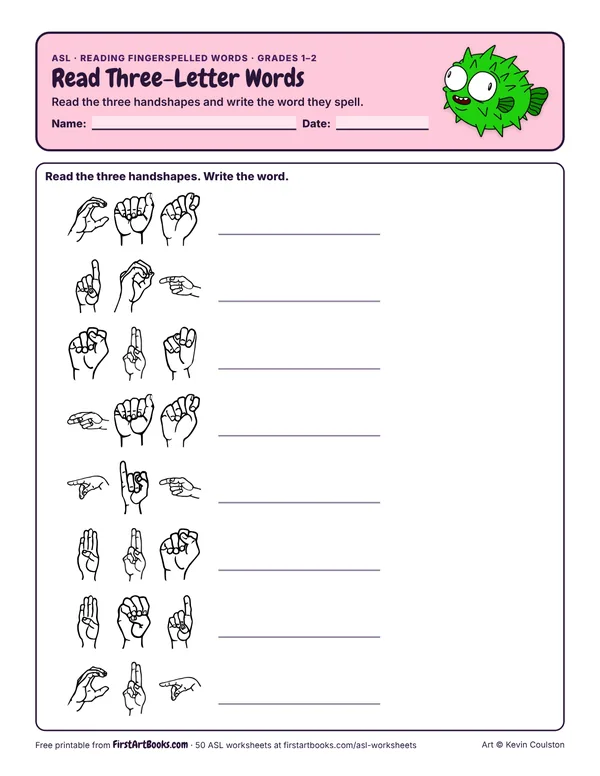
Read the three handshapes and write the word they spell.
Print this sheet (PDF)Teacher notes and tips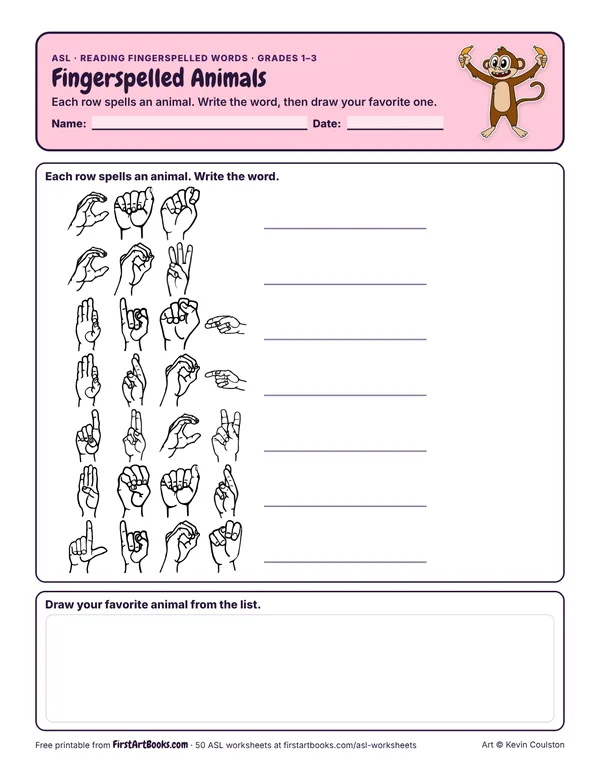
Each row spells an animal. Write the word, then draw your favorite one.
Print this sheet (PDF)Teacher notes and tips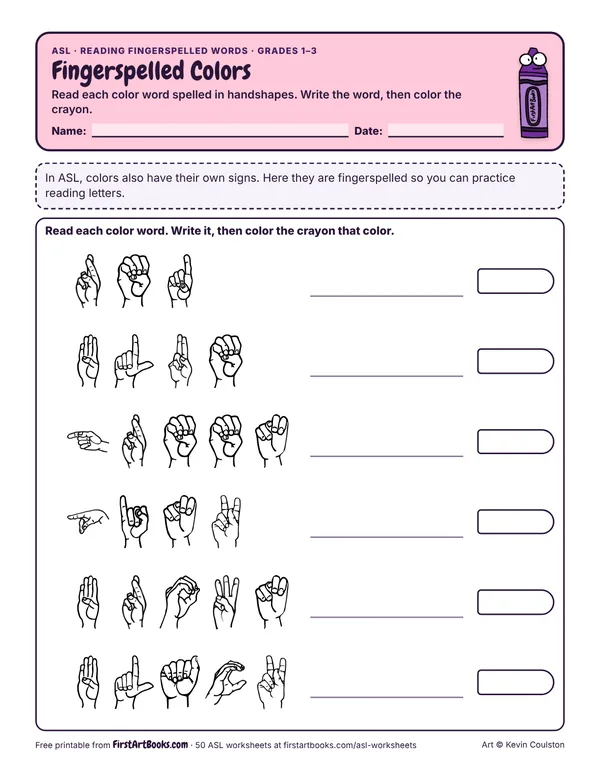
Read each color word spelled in handshapes. Write the word, then color the crayon.
Print this sheet (PDF)Teacher notes and tips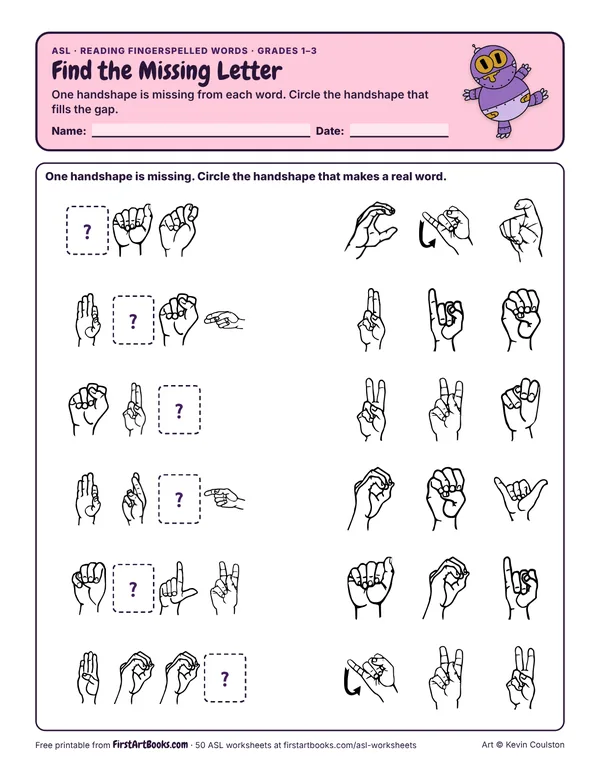
One handshape is missing from each word. Circle the handshape that fills the gap.
Print this sheet (PDF)Teacher notes and tips

Fingerspell your own name, play a partner spelling game, put handshapes in ABC order, decode a secret message and keep a spelling practice list.
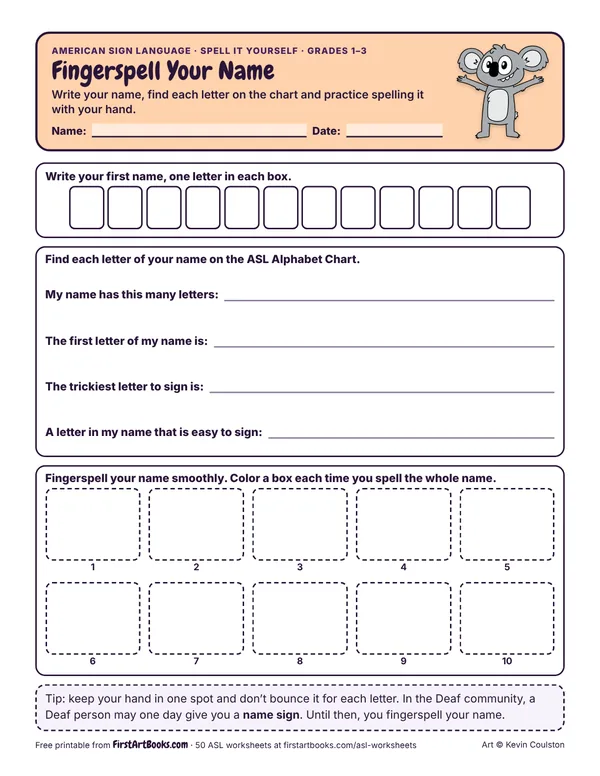
Write your name, find each letter on the chart and practice spelling it with your hand.
Print this sheet (PDF)Teacher notes and tips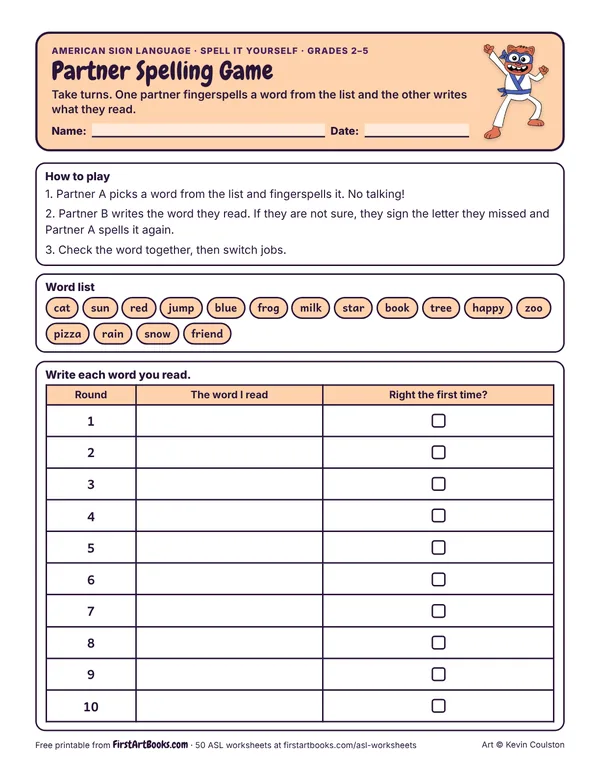
Take turns. One partner fingerspells a word from the list and the other writes what they read.
Print this sheet (PDF)Teacher notes and tips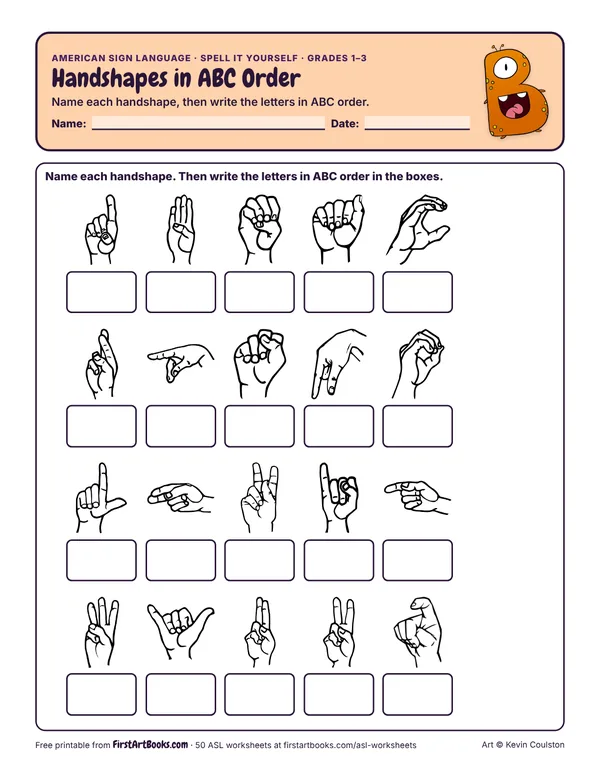
Name each handshape, then write the letters in ABC order.
Print this sheet (PDF)Teacher notes and tips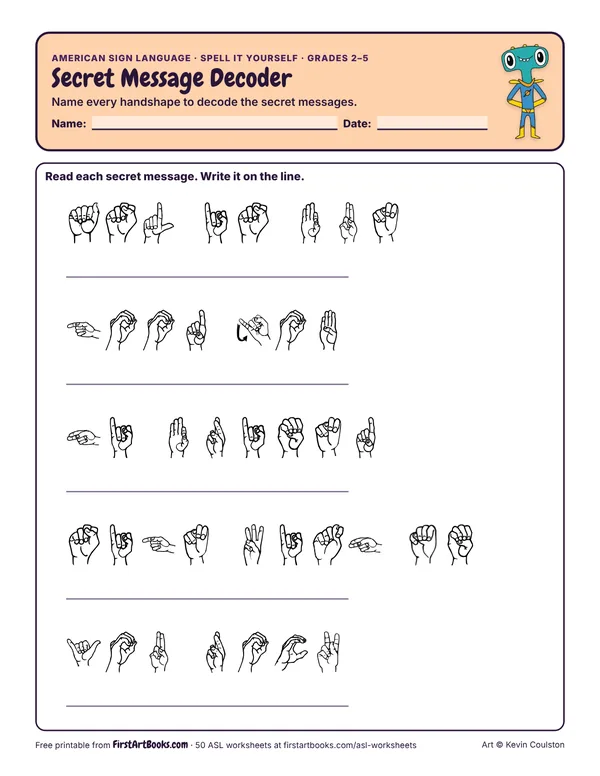
Name every handshape to decode the secret messages.
Print this sheet (PDF)Teacher notes and tips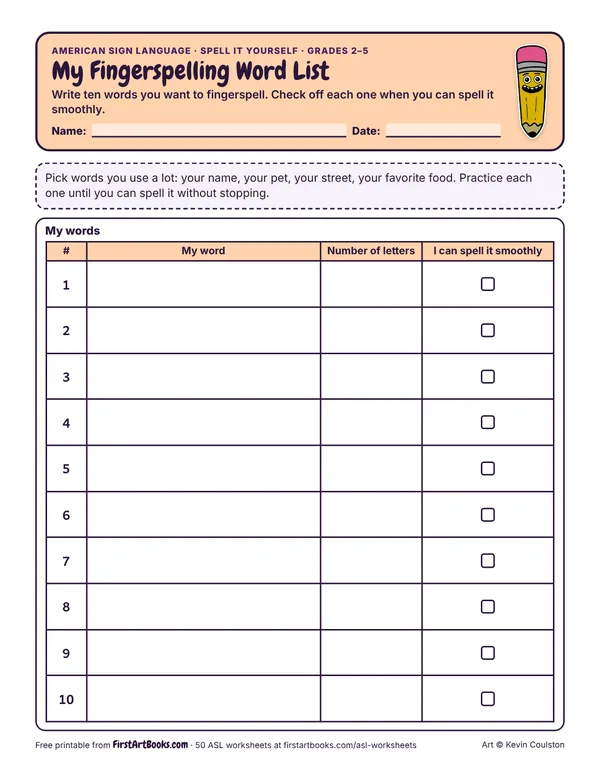
Write ten words you want to fingerspell. Check off each one when you can spell it smoothly.
Print this sheet (PDF)Teacher notes and tips

Read fingerspelled food words, unscramble handshapes into words, find the letters before and after, match rhyming words and draw what you read.
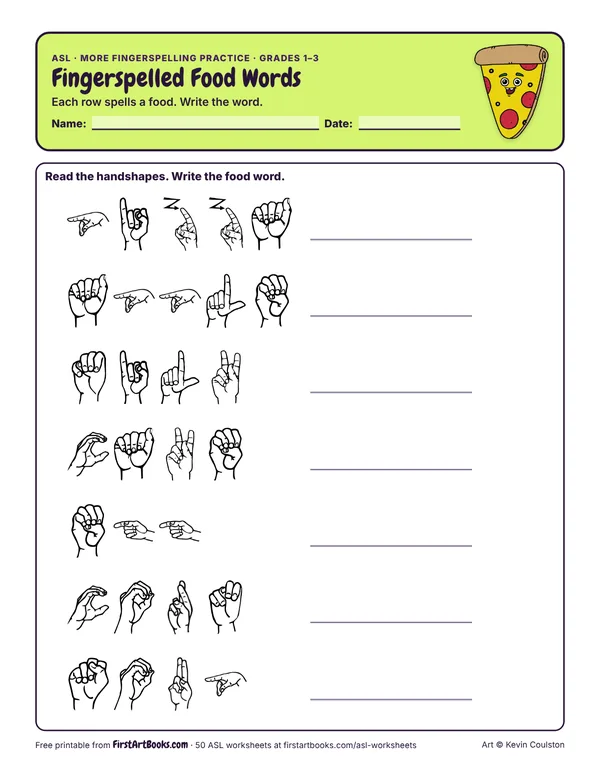
Each row spells a food. Write the word.
Print this sheet (PDF)Teacher notes and tips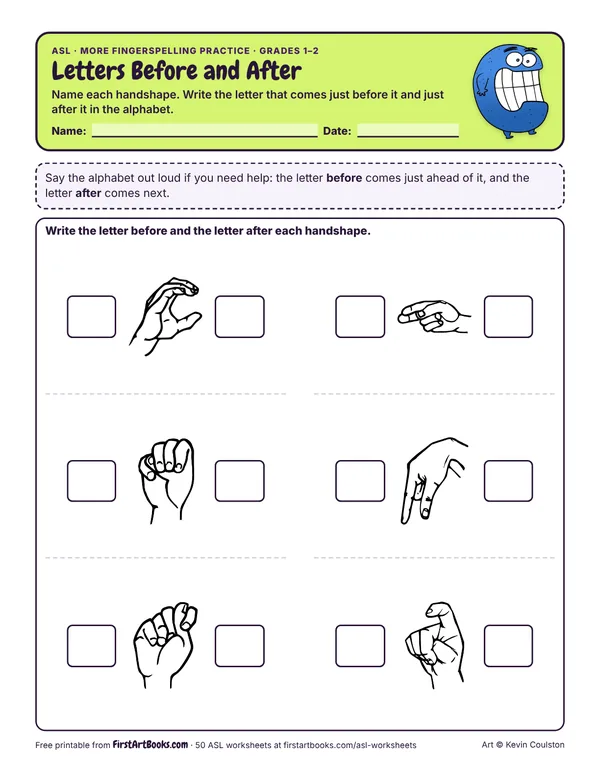
Name each handshape. Write the letter that comes just before it and just after it in the alphabet.
Print this sheet (PDF)Teacher notes and tips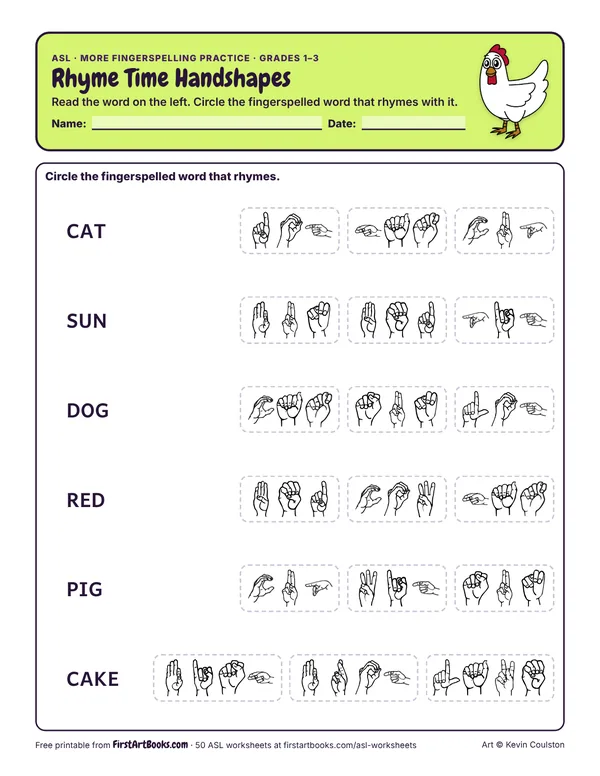
Read the word on the left. Circle the fingerspelled word that rhymes with it.
Print this sheet (PDF)Teacher notes and tips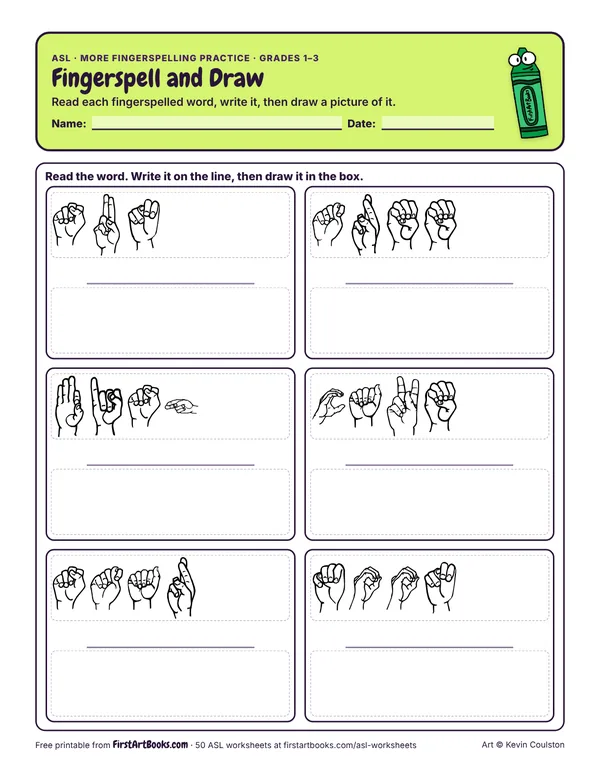
Read each fingerspelled word, write it, then draw a picture of it.
Print this sheet (PDF)Teacher notes and tips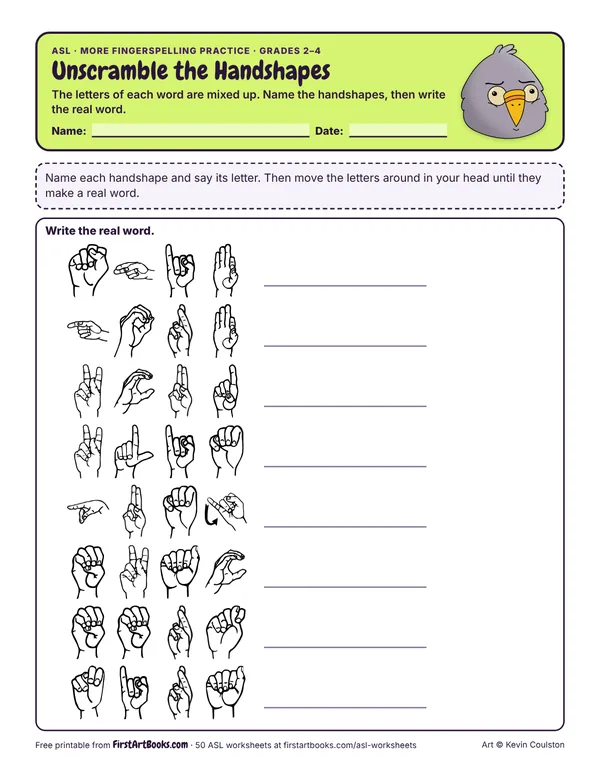
The letters of each word are mixed up. Name the handshapes, then write the real word.
Print this sheet (PDF)Teacher notes and tips

Learn what ASL is, sort true and false facts, find polite ways to get a Deaf person’s attention, read about name signs and the many ways people communicate.
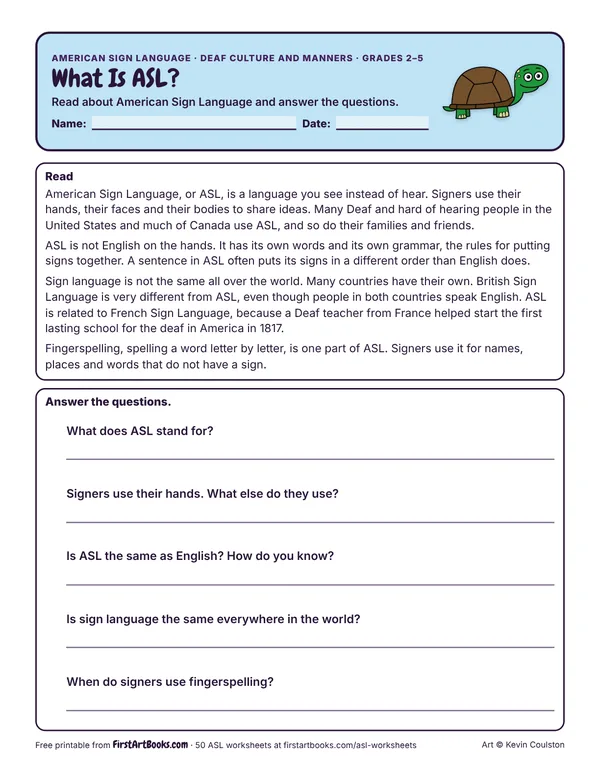
Read about American Sign Language and answer the questions.
Print this sheet (PDF)Teacher notes and tips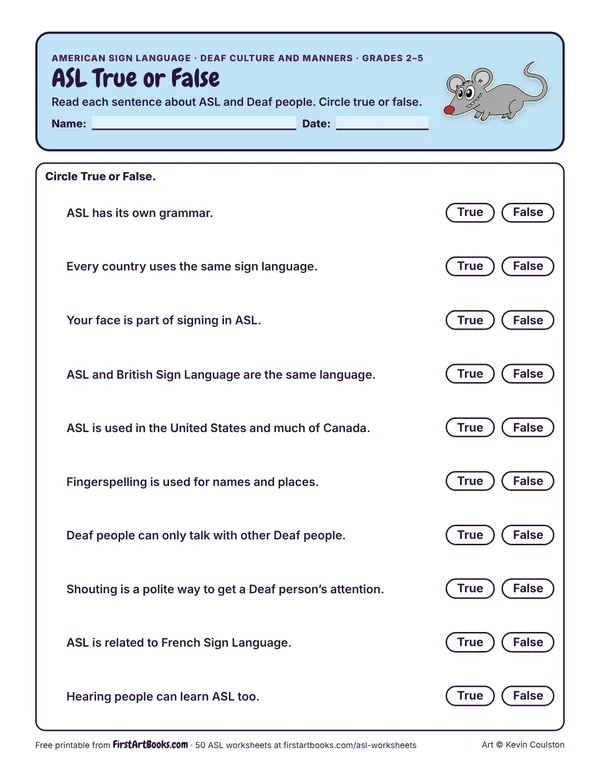
Read each sentence about ASL and Deaf people. Circle true or false.
Print this sheet (PDF)Teacher notes and tips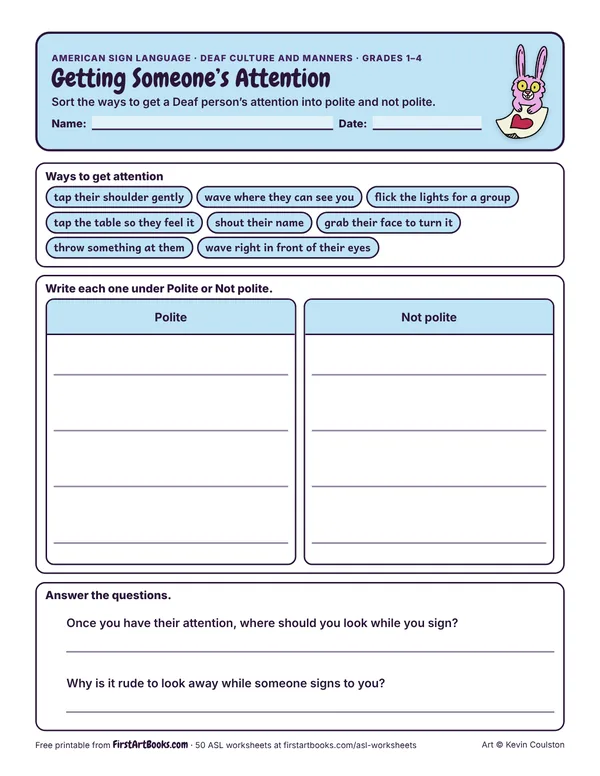
Sort the ways to get a Deaf person’s attention into polite and not polite.
Print this sheet (PDF)Teacher notes and tips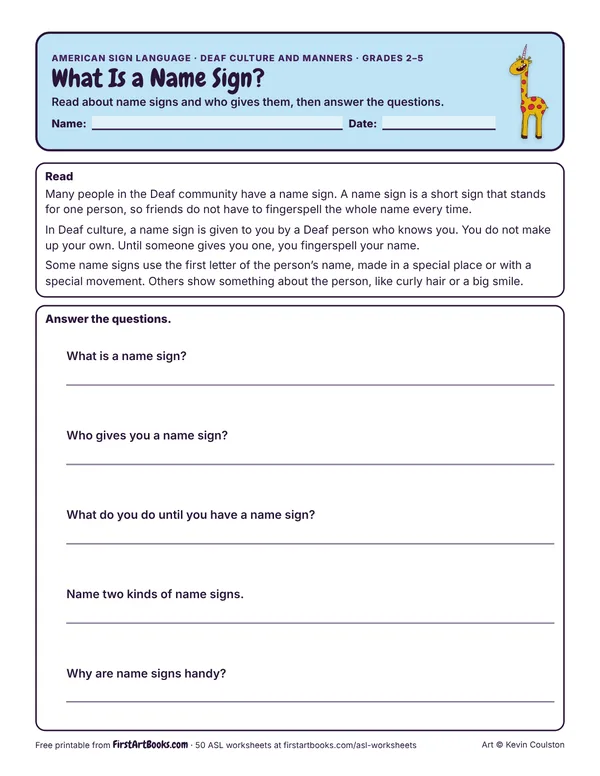
Read about name signs and who gives them, then answer the questions.
Print this sheet (PDF)Teacher notes and tips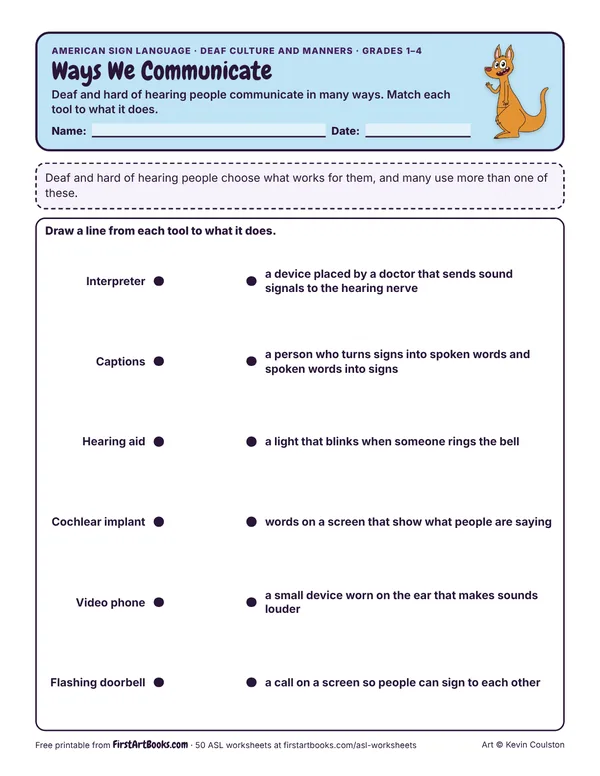
Deaf and hard of hearing people communicate in many ways. Match each tool to what it does.
Print this sheet (PDF)Teacher notes and tips

Read and answer questions about Laurent Clerc, Thomas Hopkins Gallaudet and Alice Cogswell, Martha’s Vineyard, the Deaf President Now protest, and put Deaf history in order on a timeline.
Read about the Deaf teacher who helped start the first permanent school for the deaf in America, then answer the questions.
Print this sheet (PDF)Teacher notes and tips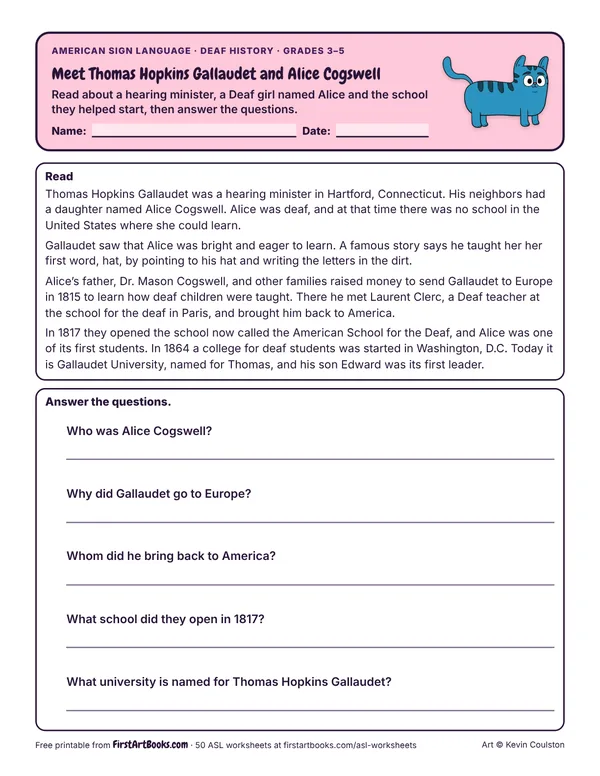
Read about a hearing minister, a Deaf girl named Alice and the school they helped start, then answer the questions.
Print this sheet (PDF)Teacher notes and tips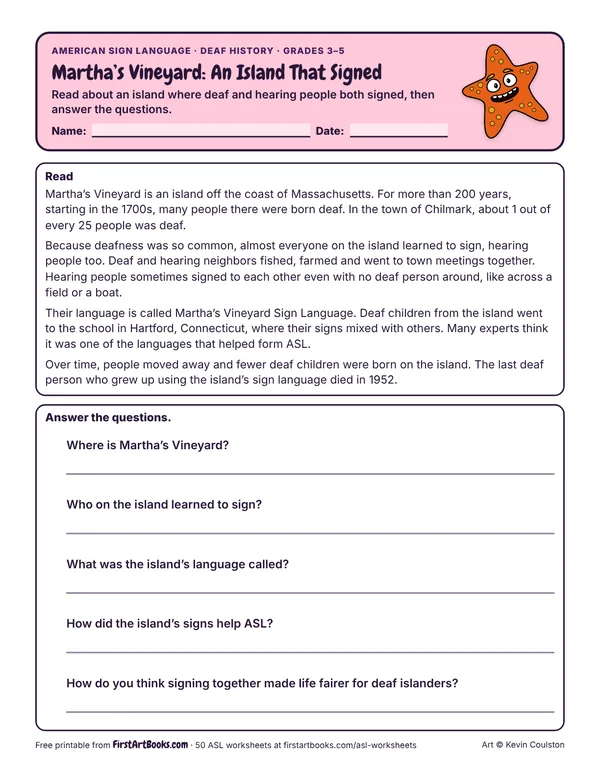
Read about an island where deaf and hearing people both signed, then answer the questions.
Print this sheet (PDF)Teacher notes and tips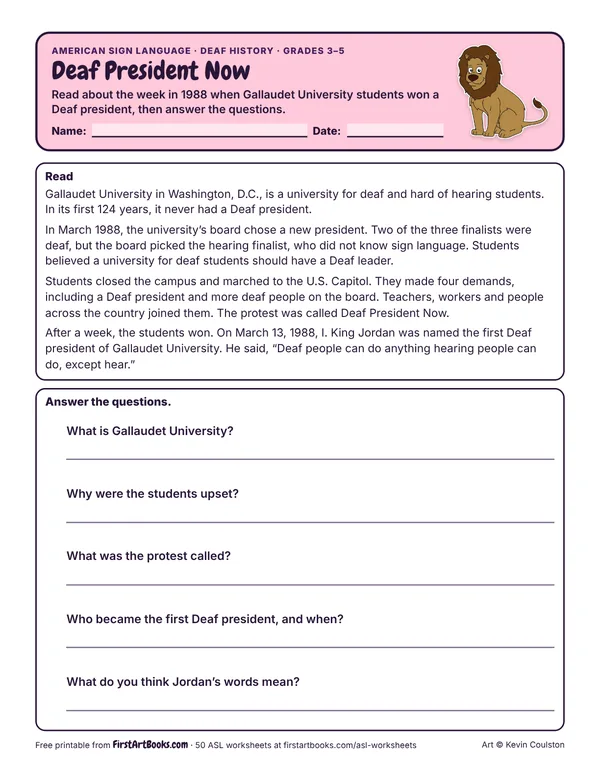
Read about the week in 1988 when Gallaudet University students won a Deaf president, then answer the questions.
Print this sheet (PDF)Teacher notes and tips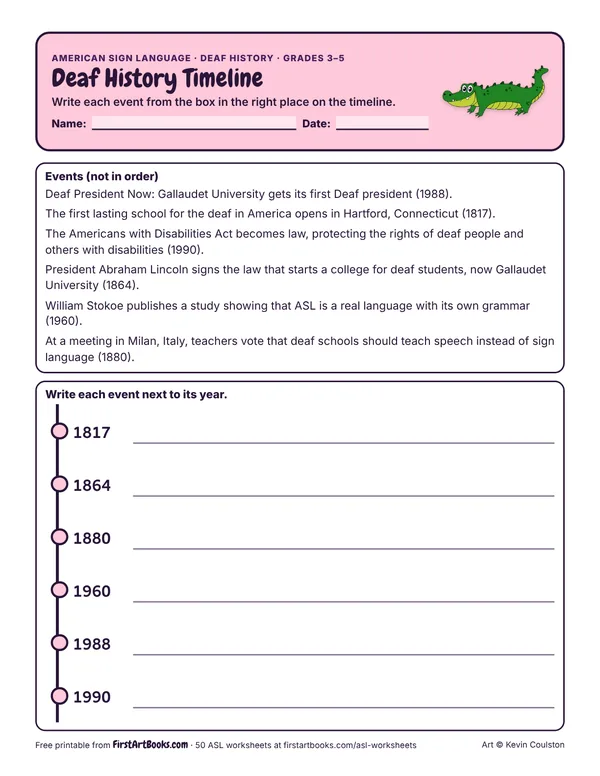
Write each event from the box in the right place on the timeline.
Print this sheet (PDF)Teacher notes and tips

Meet the five parts of a sign, see how eyebrows change a question, learn which hand to sign with and find ASL words in a word search.
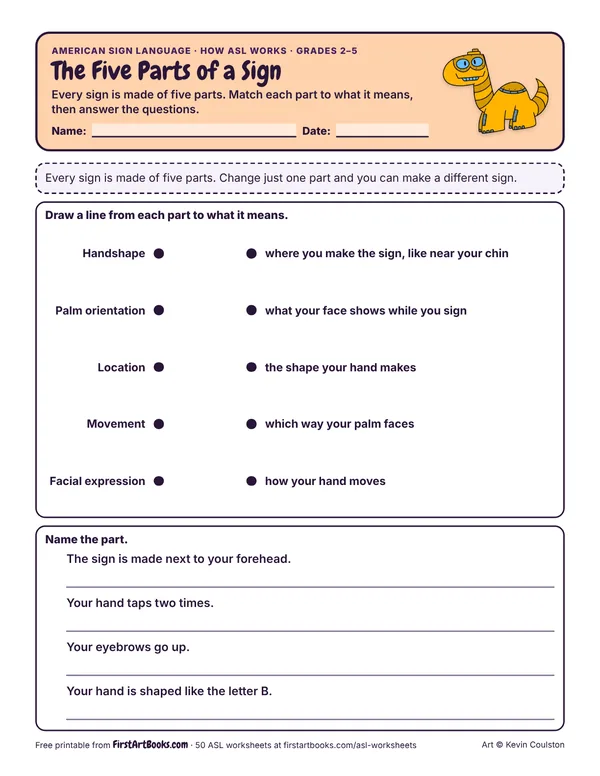
Every sign is made of five parts. Match each part to what it means, then answer the questions.
Print this sheet (PDF)Teacher notes and tips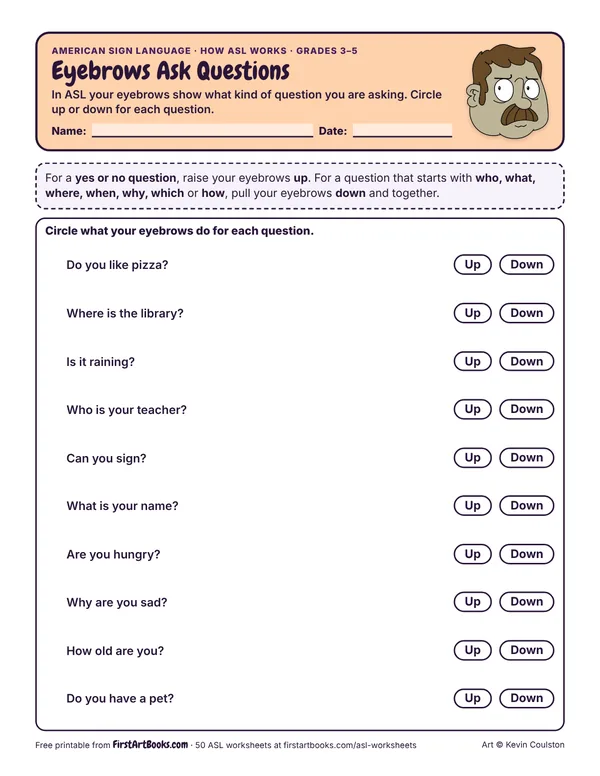
In ASL your eyebrows show what kind of question you are asking. Circle up or down for each question.
Print this sheet (PDF)Teacher notes and tips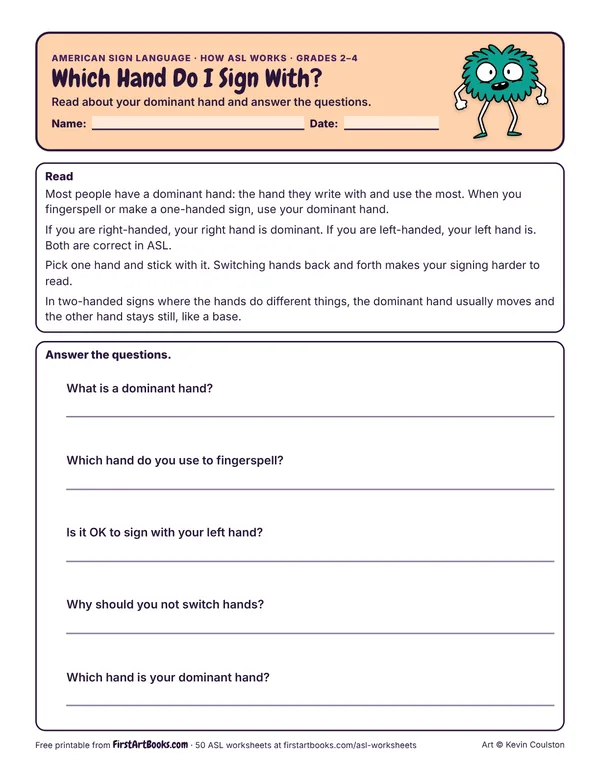
Read about your dominant hand and answer the questions.
Print this sheet (PDF)Teacher notes and tips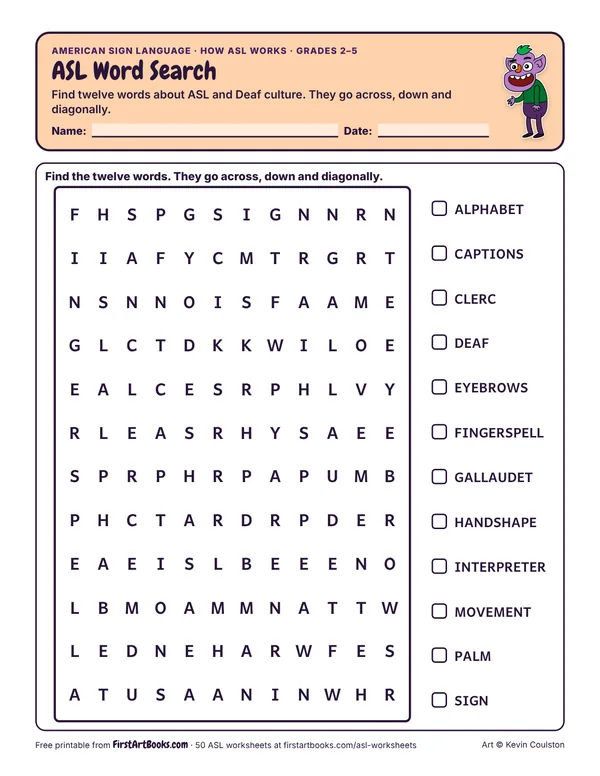
Find twelve words about ASL and Deaf culture. They go across, down and diagonally.
Print this sheet (PDF)Teacher notes and tips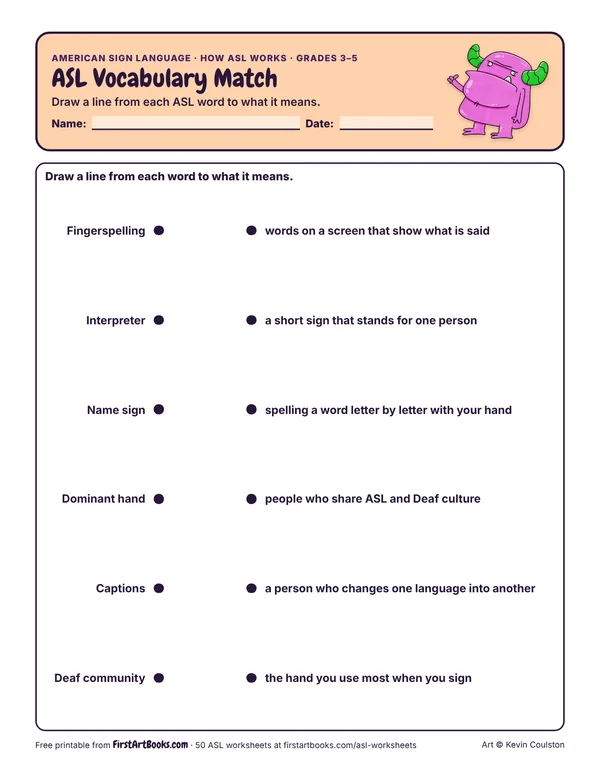
Draw a line from each ASL word to what it means.
Print this sheet (PDF)Teacher notes and tips

Play fingerspelling bingo, find the odd handshape out, cut out handshape memory cards, solve riddles answered in ASL letters and search for fingerspelled words.
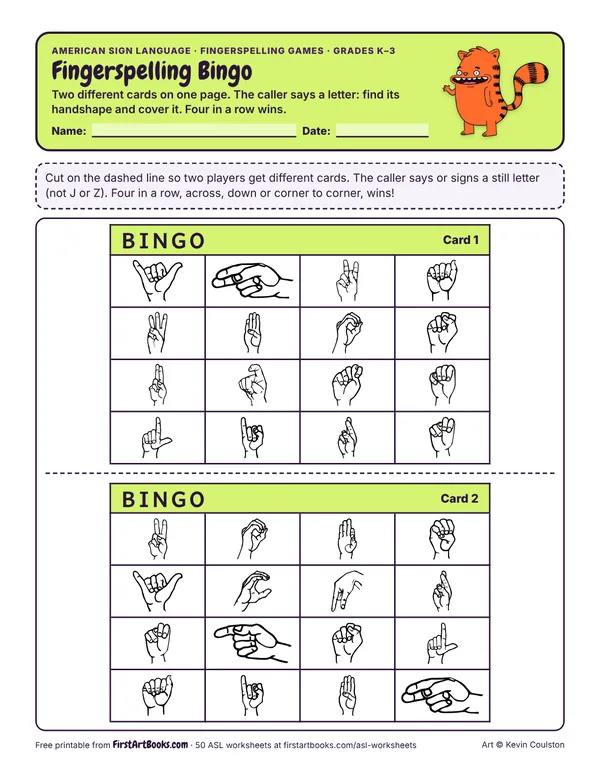
Two different cards on one page. The caller says a letter: find its handshape and cover it. Four in a row wins.
Print this sheet (PDF)Teacher notes and tips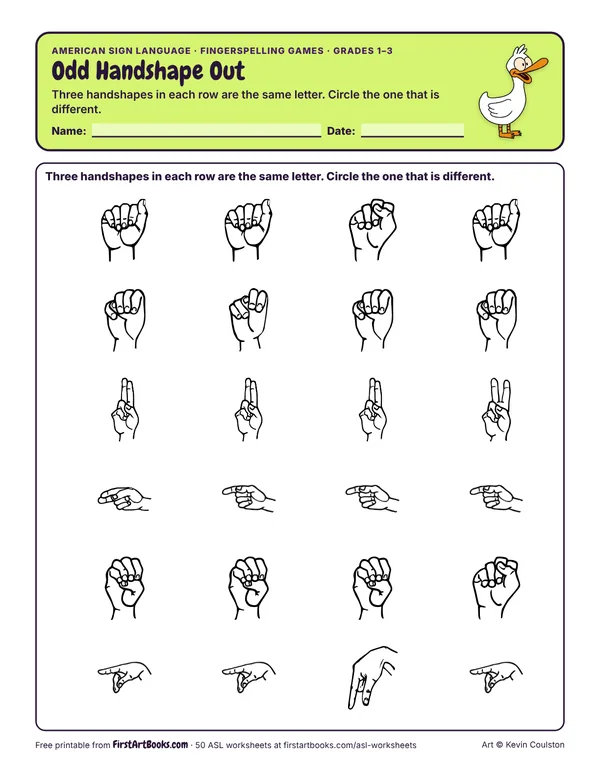
Three handshapes in each row are the same letter. Circle the one that is different.
Print this sheet (PDF)Teacher notes and tips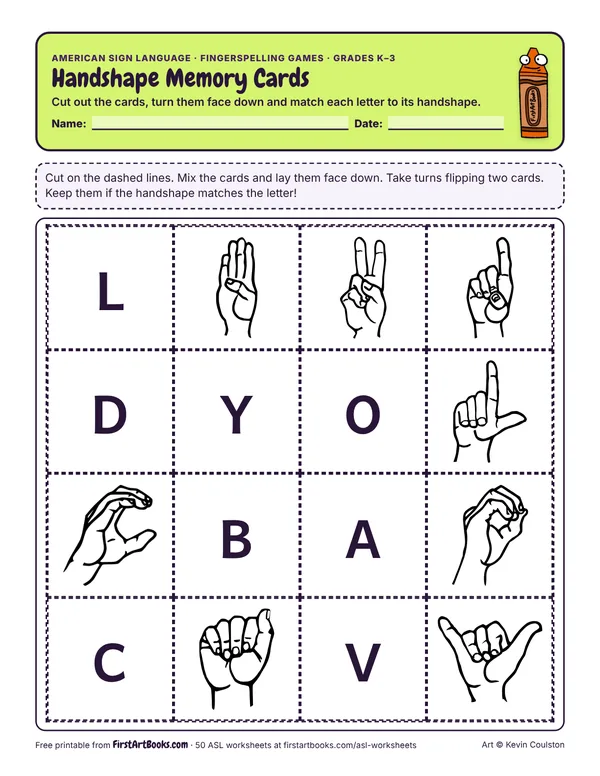
Cut out the cards, turn them face down and match each letter to its handshape.
Print this sheet (PDF)Teacher notes and tips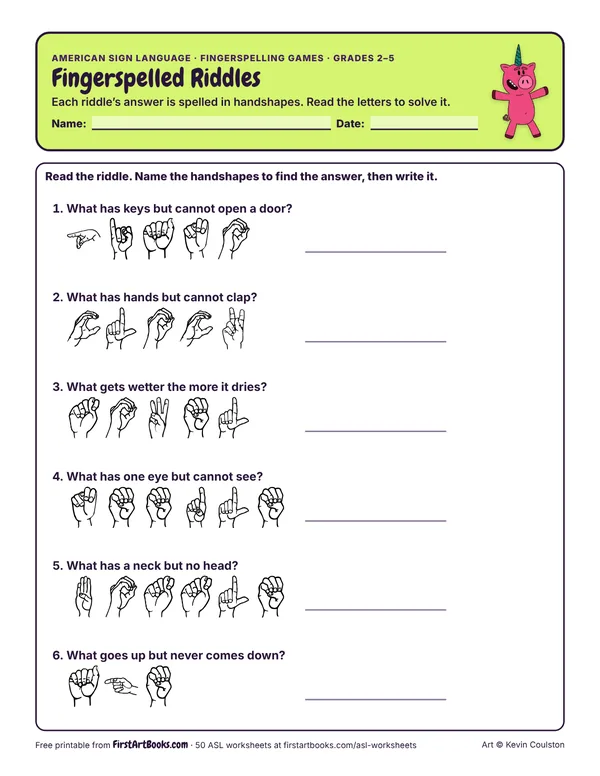
Each riddle’s answer is spelled in handshapes. Read the letters to solve it.
Print this sheet (PDF)Teacher notes and tips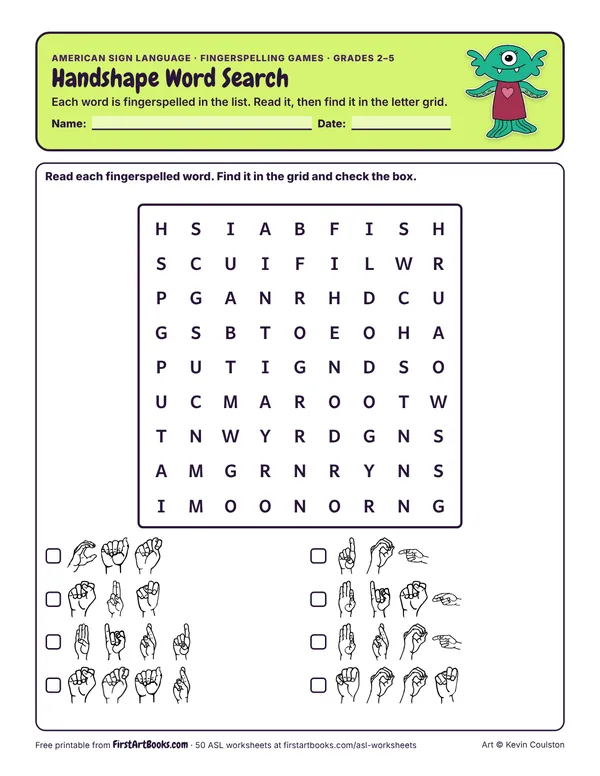
Each word is fingerspelled in the list. Read it, then find it in the letter grid.
Print this sheet (PDF)Teacher notes and tips

Track daily fingerspelling practice, check your own handshapes, set ASL goals, teach a friend and earn an ASL alphabet certificate.
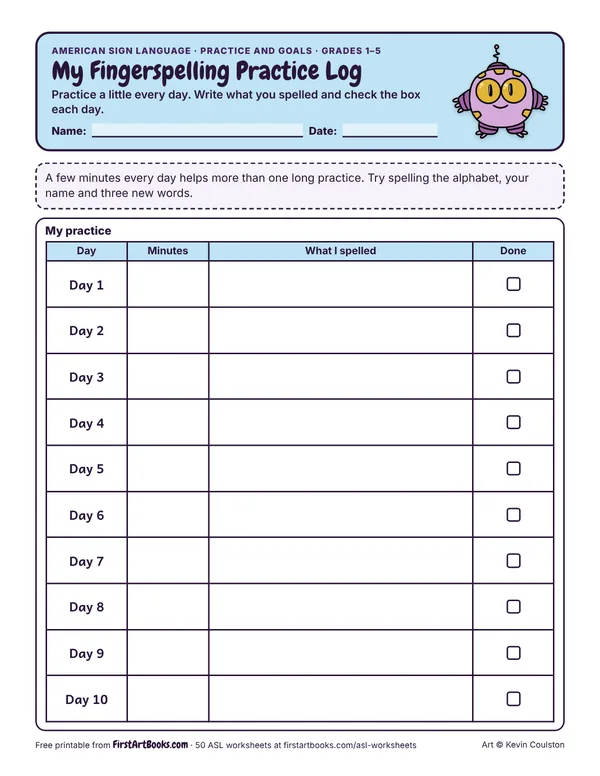
Practice a little every day. Write what you spelled and check the box each day.
Print this sheet (PDF)Teacher notes and tips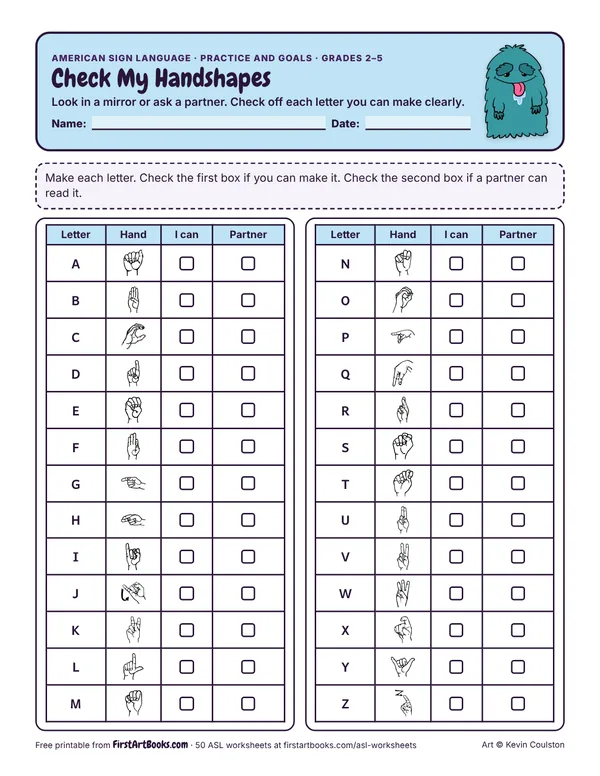
Look in a mirror or ask a partner. Check off each letter you can make clearly.
Print this sheet (PDF)Teacher notes and tips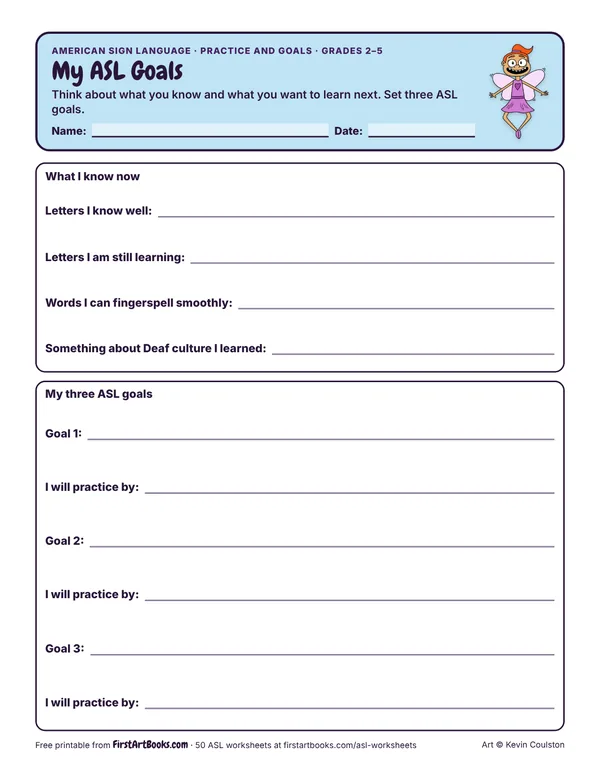
Think about what you know and what you want to learn next. Set three ASL goals.
Print this sheet (PDF)Teacher notes and tips
Teach a friend or family member some ASL letters, then write and draw about it.
Print this sheet (PDF)Teacher notes and tips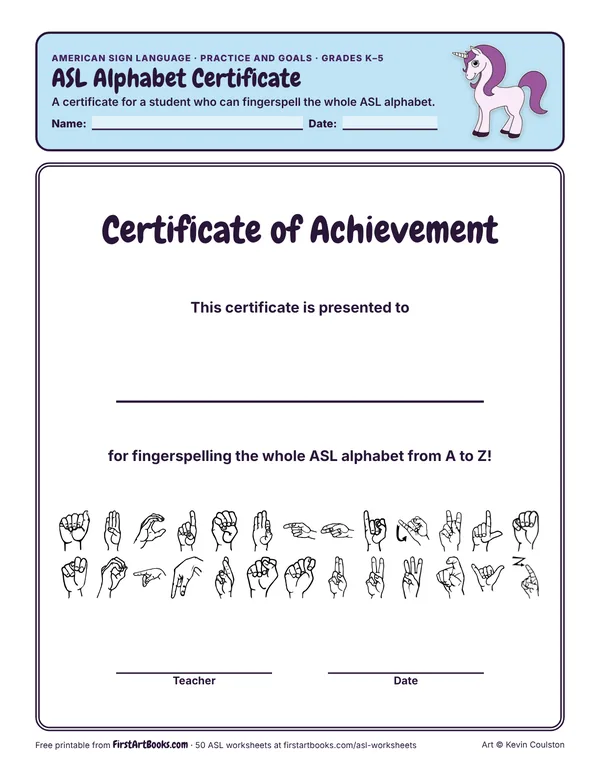
A certificate for a student who can fingerspell the whole ASL alphabet.
Print this sheet (PDF)Teacher notes and tips

Each topic has a pack of its five sheets and their answer keys: asl alphabet, look-alike letters, fingerspelled words, spell it yourself, more fingerspelling, deaf culture, deaf history, how asl works, games, practice.
The characters on these worksheets come from Kevin Coulston’s drawing books. Keep one in the classroom for kids who finish early: the How to Draw books build a drawing one small step at a time.
Yes. All 50 worksheets, the 37 answer keys and the topic packs are free to print for the classroom, homeschool, ASL club and home practice. Print one sheet, a topic pack of five or the whole set.
Kindergarten to 5th grade. Each card shows the grades it suits best, and the grade buttons hide the rest. Beginners of any age start with the alphabet chart, tracing and three-letter words; older kids add the look-alike letters, Deaf history and how ASL works.
Not yet. Word signs move, and a still picture can easily teach them wrong, so this set sticks to what a picture shows well, the fingerspelling alphabet, plus reading pages about ASL and Deaf culture. ASL numbers are not included yet either. For word signs, learn from a Deaf teacher or a video dictionary made by Deaf signers.
They are a public domain ASL fingerspelling set from Wikimedia Commons, first drawn for wpclipart.com, the same style as the classic ASL alphabet chart. Every letter is drawn with the right hand, and J and Z have arrows that show their movement. Left-handed signers make the same shapes with the left hand.
No. The ASL Alphabet Chart is part of the set, four of the five look-alike letter pages spell out each difference in a box at the top, and every sheet with right answers has an answer key page right after it. Practice the handshapes along with your students.
The topics are grouped by kind, so follow the grades rather than the topic order. Start with the alphabet chart and tracing, then read fingerspelled words, practice spelling and play the games. The look-alike letters, Deaf culture, Deaf history and how ASL works pages suit 2nd to 5th grade.
Yes. The handshapes are black line drawings and nothing depends on color, except the crayon on the color word sheet, which kids color in. Sheets are US Letter and also print on A4.
All sheets are US Letter, print well in black and white, and are free for home and classroom use. The hand pictures are a public domain ASL handshape set. More for teachers in the teacher resources library.
12 printable pages: six step-by-step lessons, a grid activity, draw-and-write sheets and teacher notes, sent with your welcome email. After that, new classroom printables by email.