


Kindergarten
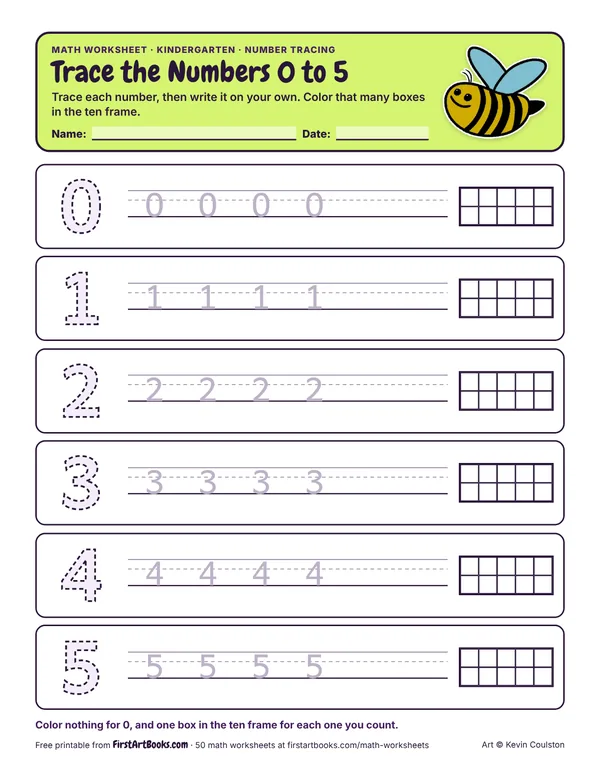
Trace the Numbers 0 to 5
Big numbers to trace and write, from 0 to 5, each with a ten frame to color in. Start each number at the top.
Print this sheet (PDF)Teacher notes and tips200 free printable math worksheets in 10 topics, twenty per topic from easy to harder: counting, facts, fractions, place value, word problems, telling time and money. Answer keys included, and every page has one of Kevin Coulston’s cartoon characters.
Trace and write the numbers 0 to 20 and the number words, then spot each number in a crowd.
Big numbers to trace and write, from 0 to 5, each with a ten frame to color in. Start each number at the top.
Print this sheet (PDF)Teacher notes and tips
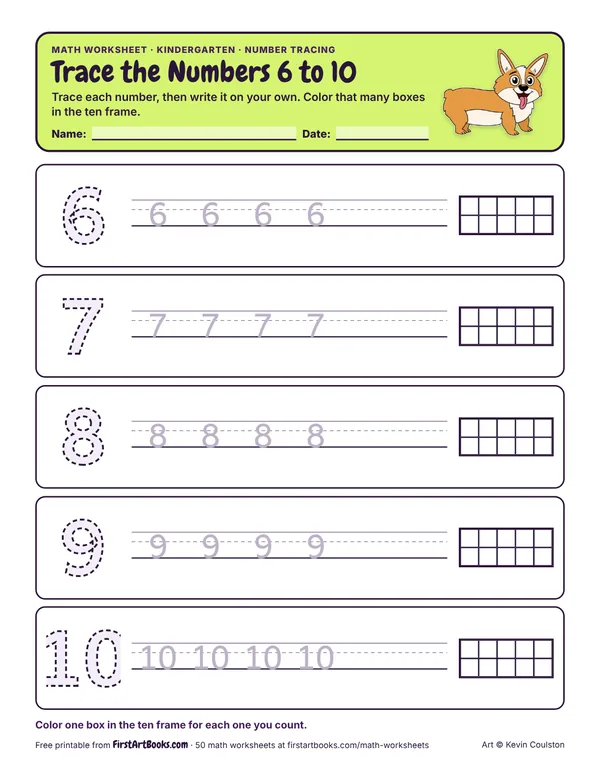
Trace and write 6, 7, 8, 9 and 10, and color each one in a ten frame to see how close it is to 10.
Print this sheet (PDF)Teacher notes and tips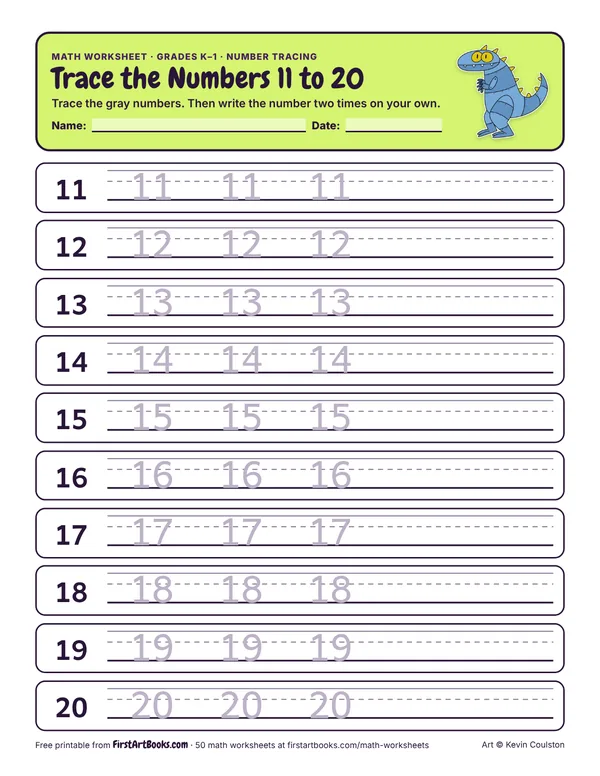
The teen numbers and 20 in rows: trace three, then write two on your own. A ten and some more on every line.
Print this sheet (PDF)Teacher notes and tips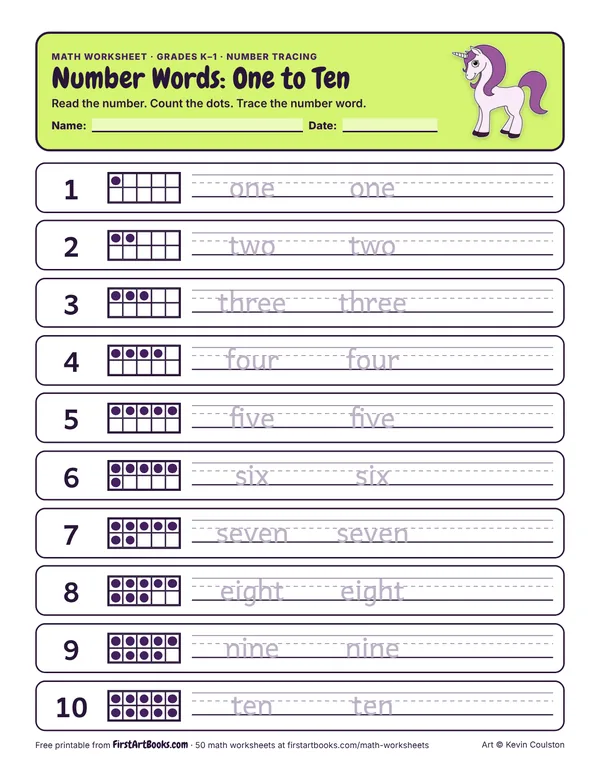
Read each number, count the dots and trace the number word from one to ten.
Print this sheet (PDF)Teacher notes and tips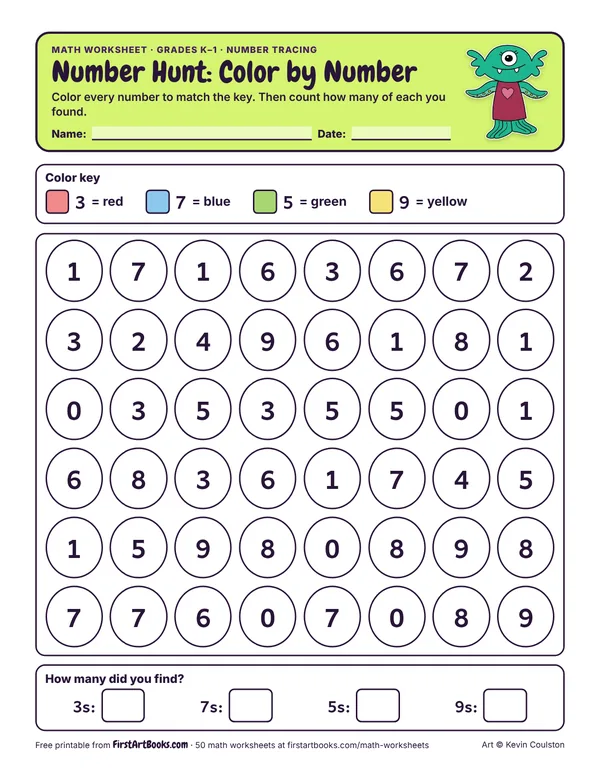
A grid of numbers from 0 to 9. Kids color every 3, 7, 5 and 9 to the key, then count how many of each they found.
Print this sheet (PDF)Teacher notes and tips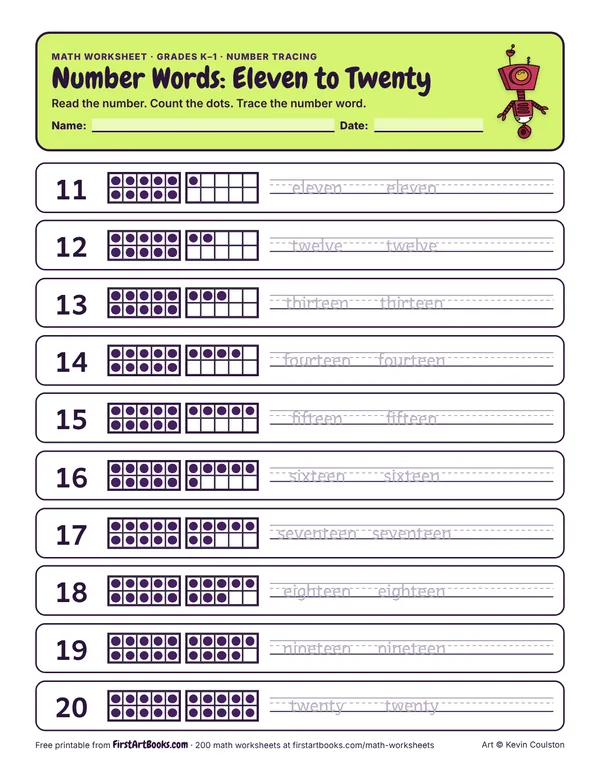
The teen number words and twenty: read the number, count the dots in two ten frames and trace the word.
Print this sheet (PDF)Teacher notes and tips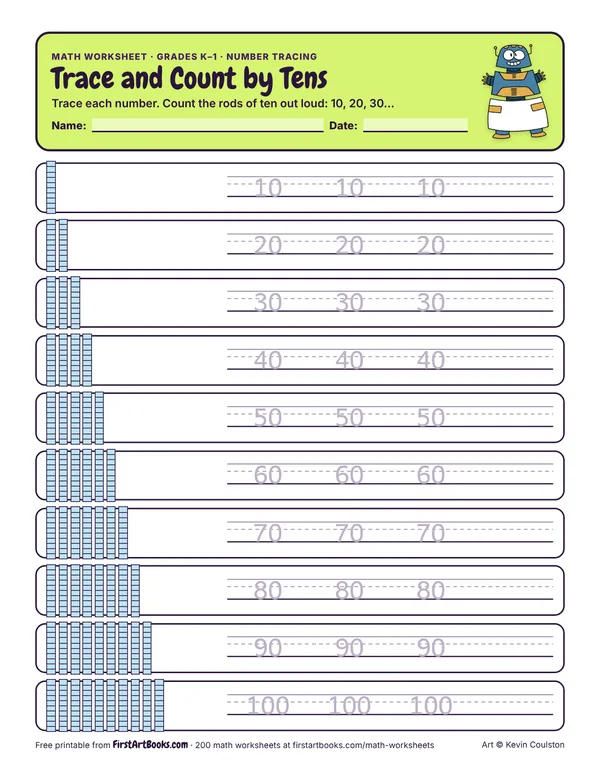
Trace 10, 20, 30 and on up to 100, with rods of ten to count along the way. The first look at counting by tens.
Print this sheet (PDF)Teacher notes and tips

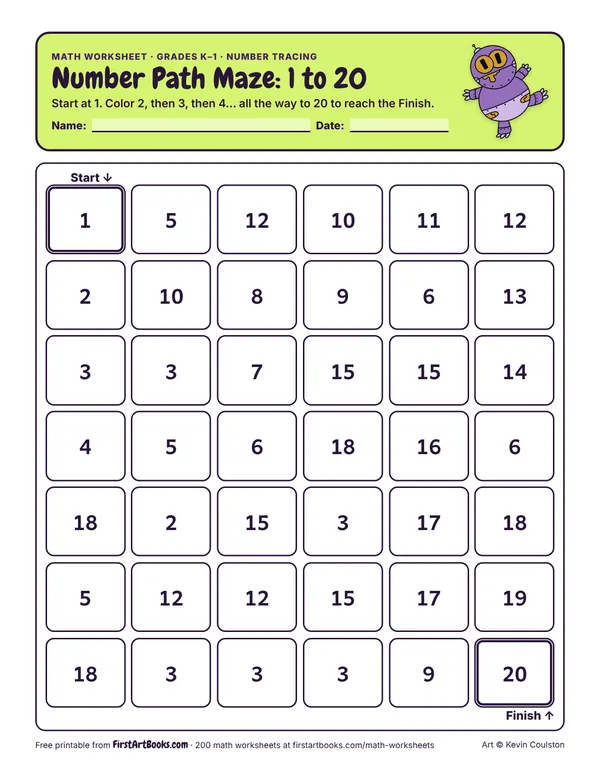
Color the squares in order from 1 to 20 to find the path from Start to Finish. Wrong numbers block the way.
Print this sheet (PDF)Teacher notes and tips

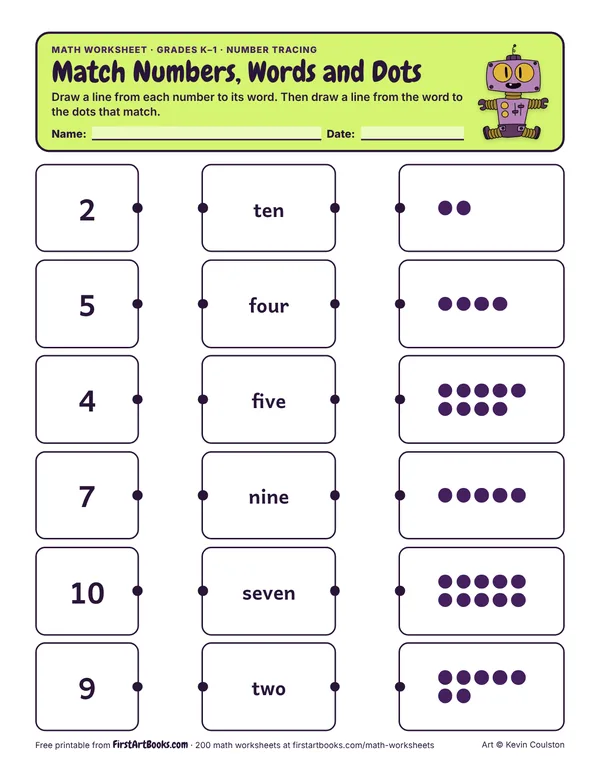
Six numbers, six words and six dot groups, all mixed up. Draw lines to join the three that go together.
Print this sheet (PDF)Teacher notes and tips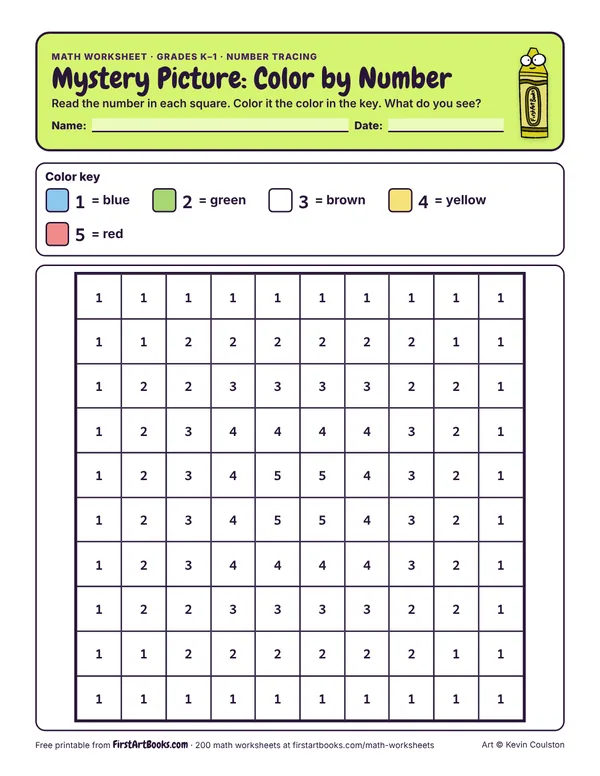
A 10 by 10 grid of the numbers 1 to 5. Color each square to the key and a picture appears.
Print this sheet (PDF)Teacher notes and tips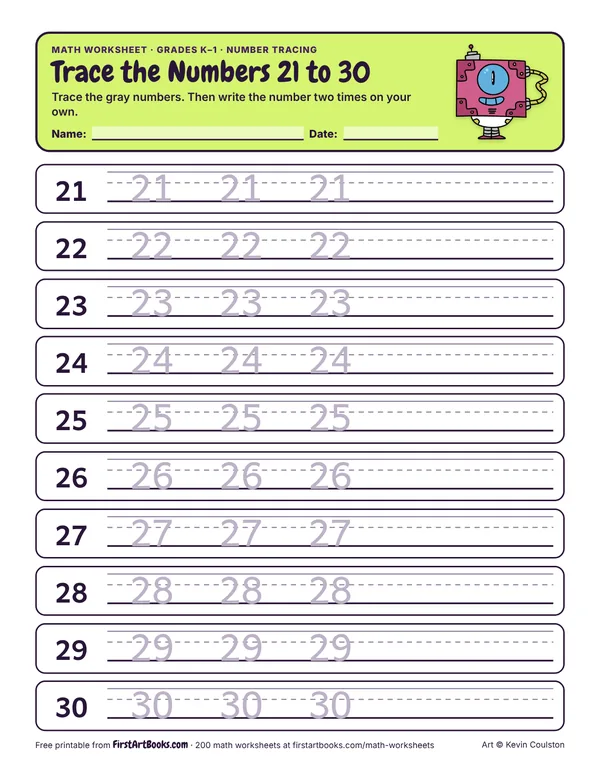
The twenties in rows: trace three, then write two on your own. Two tens and some more on every line.
Print this sheet (PDF)Teacher notes and tips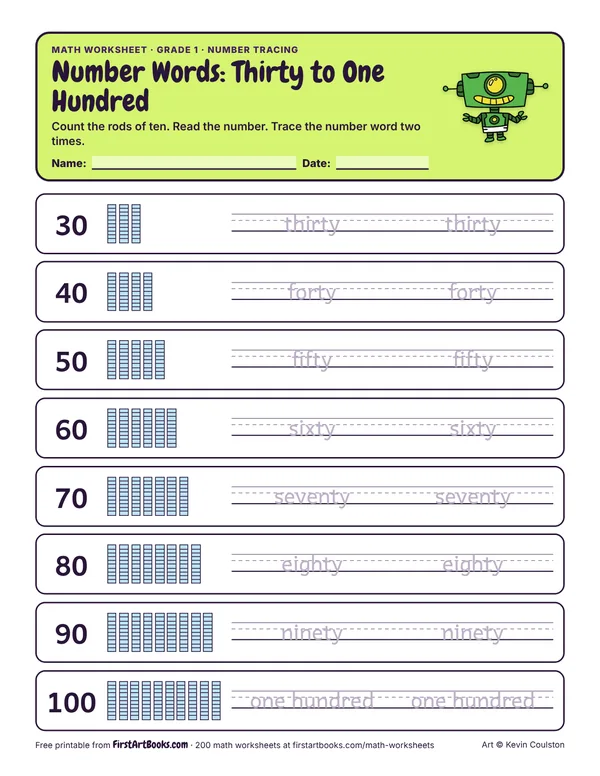
Read the tens from thirty to one hundred, count the rods of ten and trace each number word twice.
Print this sheet (PDF)Teacher notes and tips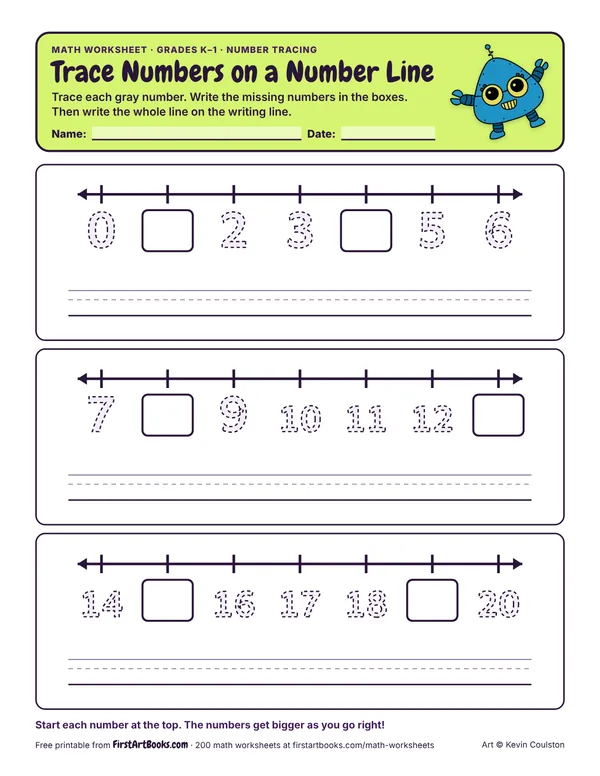
Three number lines from 0 to 20. Trace the gray numbers under the marks, write the ones that are missing, then copy each line on a writing line.
Print this sheet (PDF)Teacher notes and tips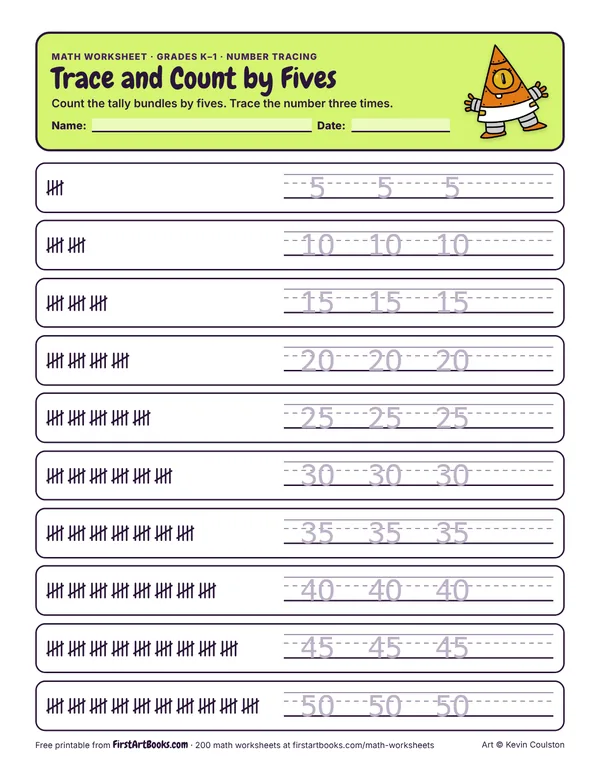
Bundles of five tally marks next to 5, 10, 15 and on up to 50. Trace each number and count the bundles by fives.
Print this sheet (PDF)Teacher notes and tips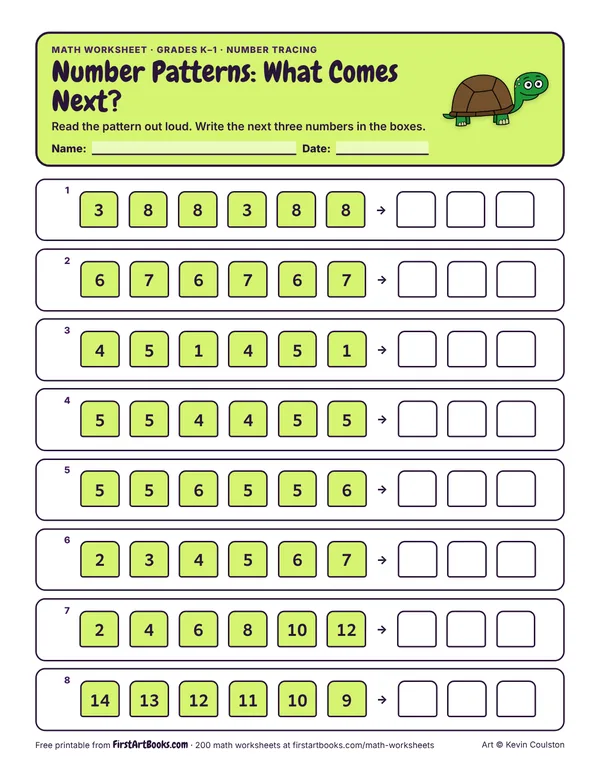
Eight rows of repeating and growing number patterns. Read the pattern out loud and write the next three numbers.
Print this sheet (PDF)Teacher notes and tips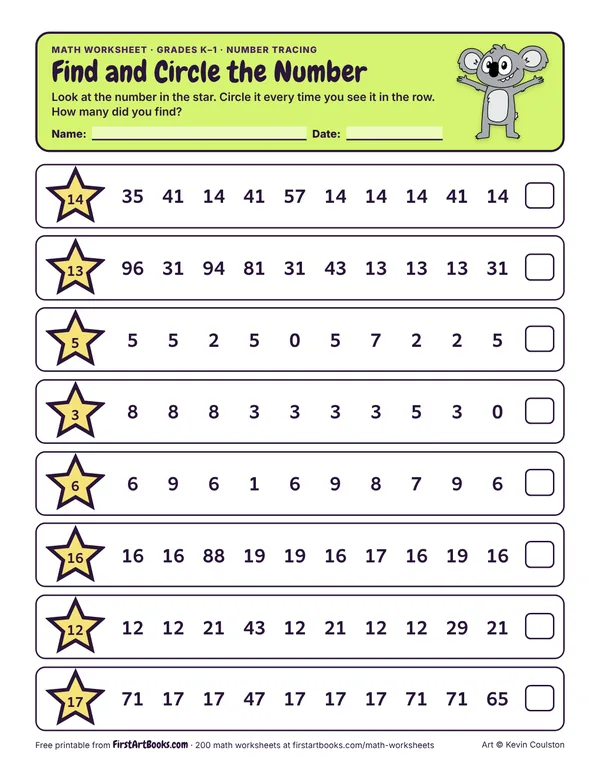
Each row has a number to find hiding among look-alikes like 6 and 9 or 12 and 21. Circle every match, then count them.
Print this sheet (PDF)Teacher notes and tips

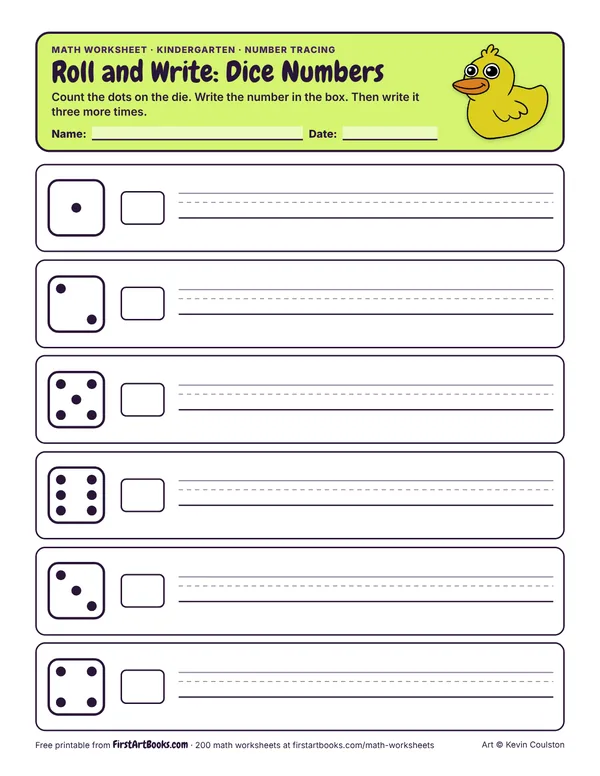
Six dice faces to count. Kids write the number in the box, then write it three more times on the writing line.
Print this sheet (PDF)Teacher notes and tips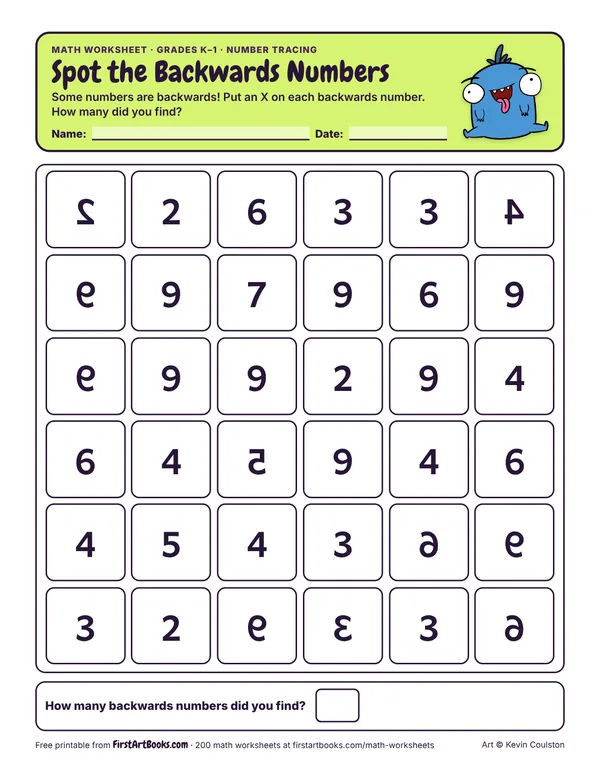
A grid of numbers where some are flipped like in a mirror. Kids cross out every backwards number and count them.
Print this sheet (PDF)Teacher notes and tips

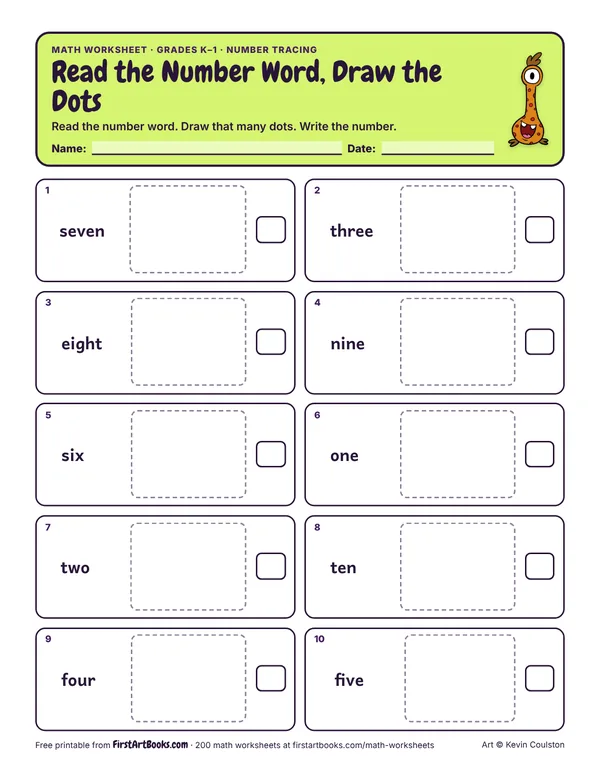
Ten number words from one to ten. Kids read each word, draw that many dots in the box and write the number.
Print this sheet (PDF)Teacher notes and tips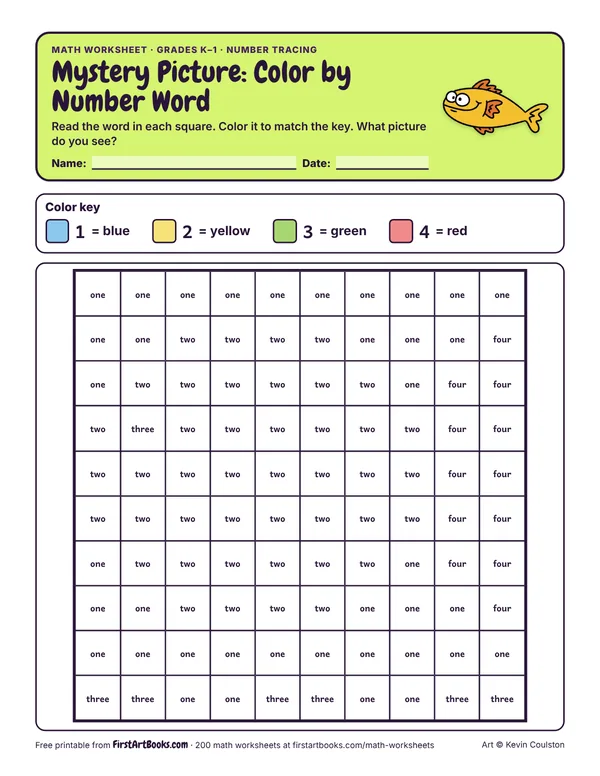
A 10 by 10 grid with a number word in every square. Read the word, color the square to the key and find the hidden picture.
Print this sheet (PDF)Teacher notes and tipsCount groups and ten frames, match numbers to groups, and fill in the hundred chart.
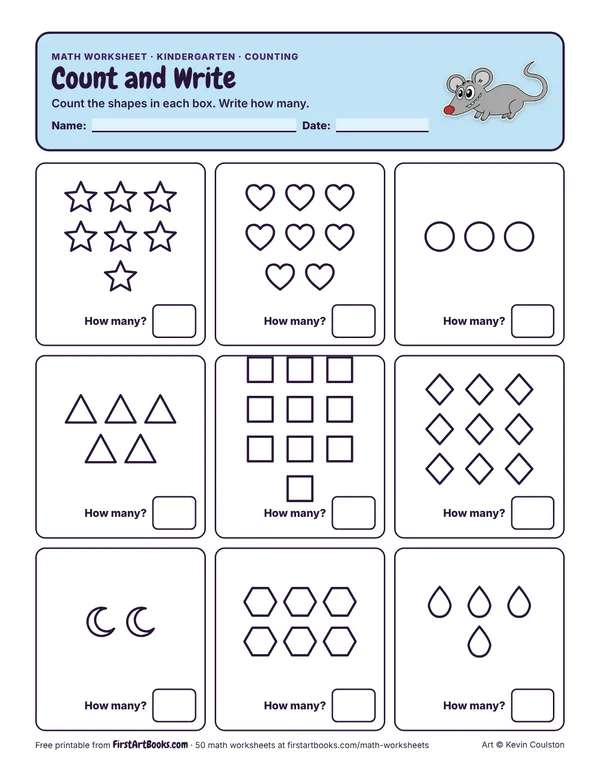
Nine groups of shapes to count, from 1 to 10. Kids touch and count each one, then write the number.
Print this sheet (PDF)Teacher notes and tips

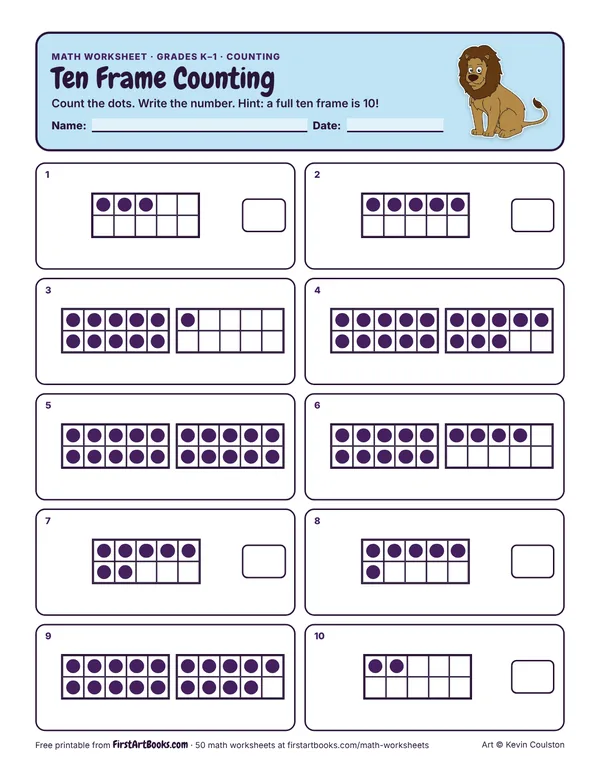
Count the dots in ten frames and double ten frames, from 1 to 20, and write each number.
Print this sheet (PDF)Teacher notes and tips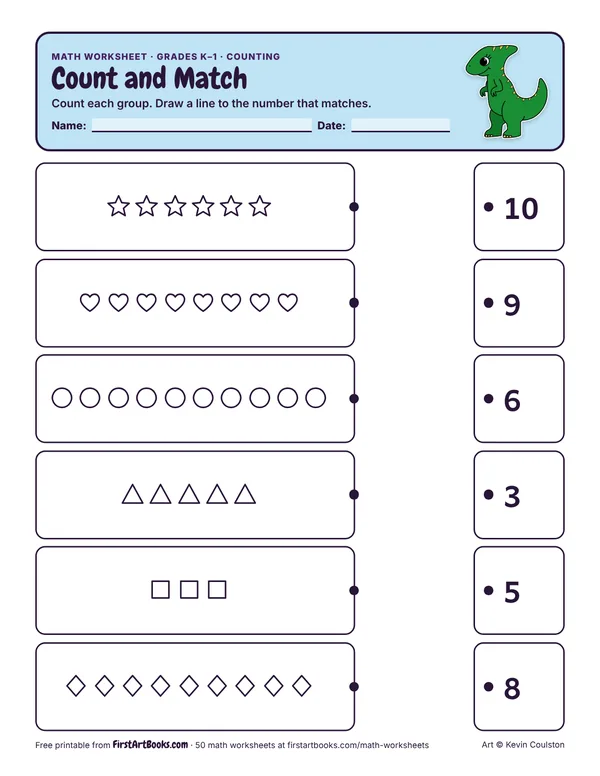
Six groups to count and six numbers to match. Kids draw a line from each group to its number.
Print this sheet (PDF)Teacher notes and tips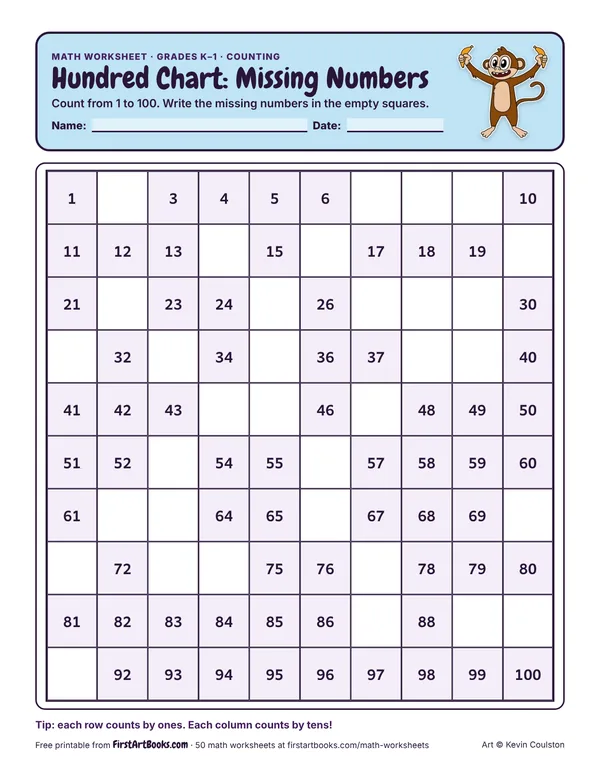
A hundred chart with 34 numbers missing. Kids count by ones and tens to fill every blank square.
Print this sheet (PDF)Teacher notes and tips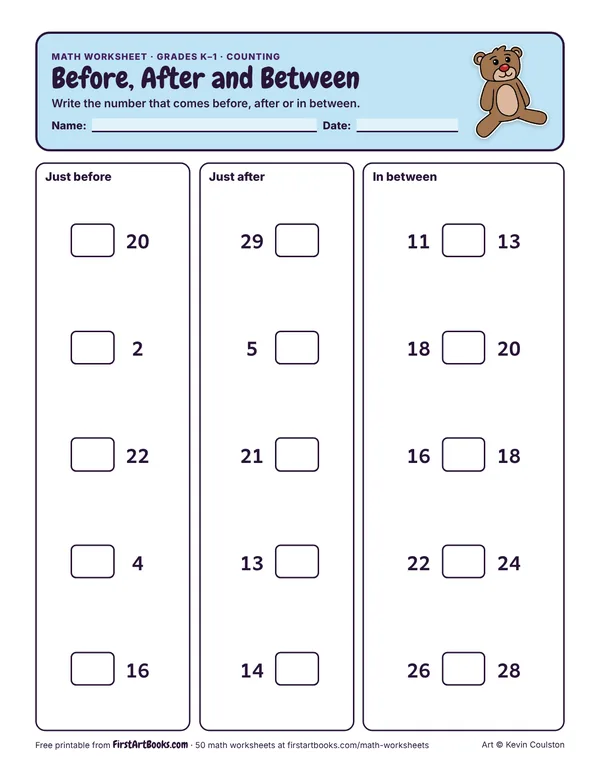
Which number comes just before, just after or in between? Fifteen number puzzles up to 30.
Print this sheet (PDF)Teacher notes and tips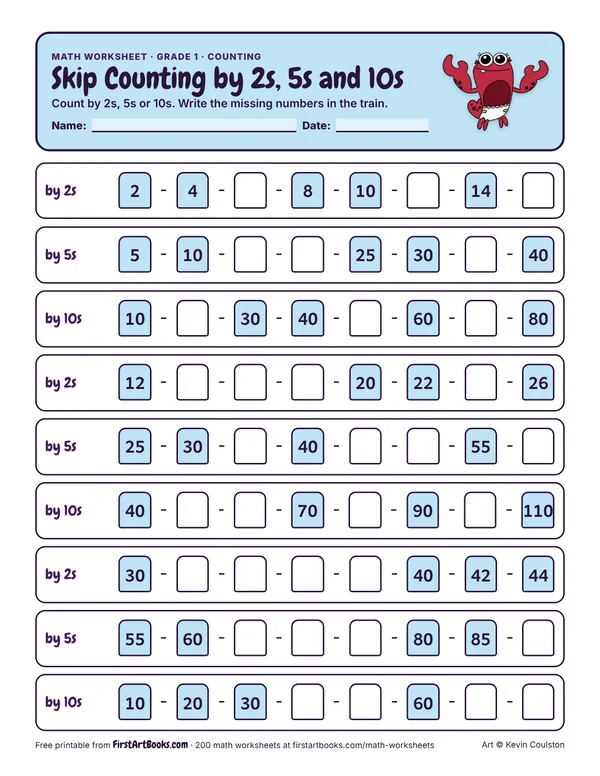
Nine number trains to finish by counting by twos, fives and tens, up to 100.
Print this sheet (PDF)Teacher notes and tips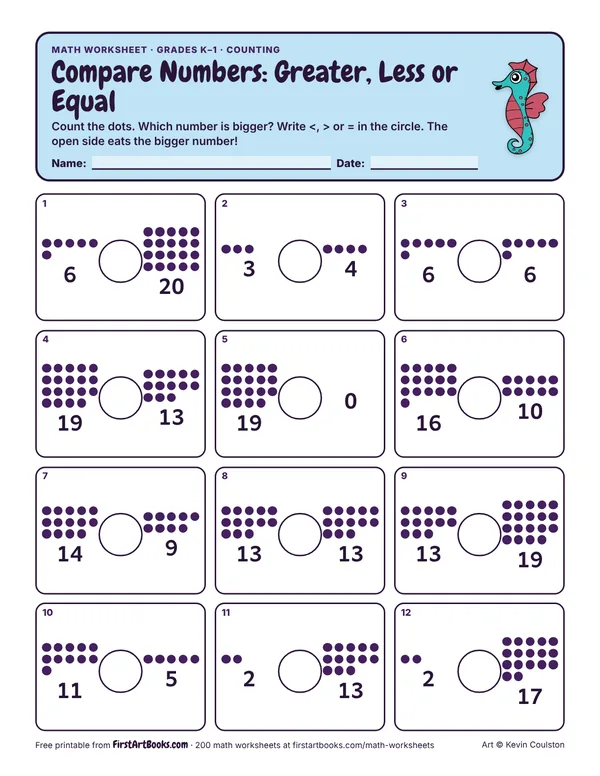
Twelve pairs of numbers up to 20 with dot groups to count. Kids write <, > or = in the circle.
Print this sheet (PDF)Teacher notes and tips

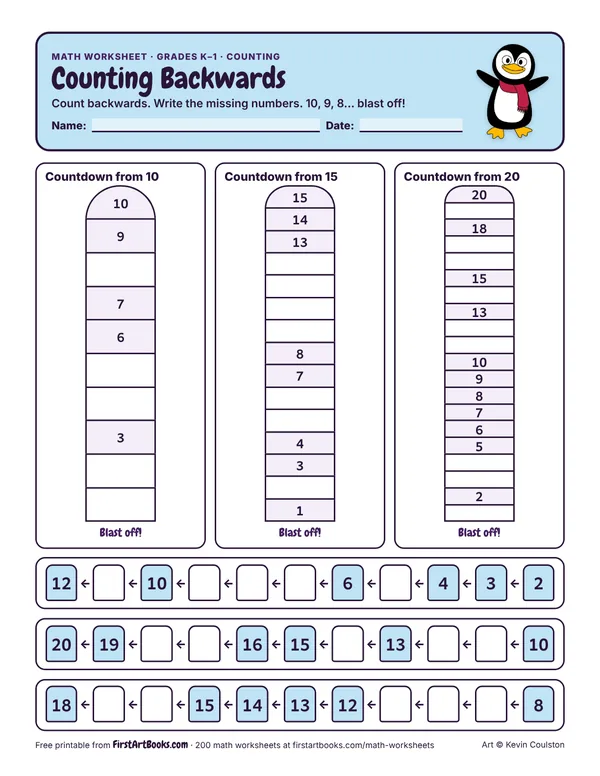
Rocket countdowns from 10, 15 and 20, and number lines to fill in going down. Blast off!
Print this sheet (PDF)Teacher notes and tips

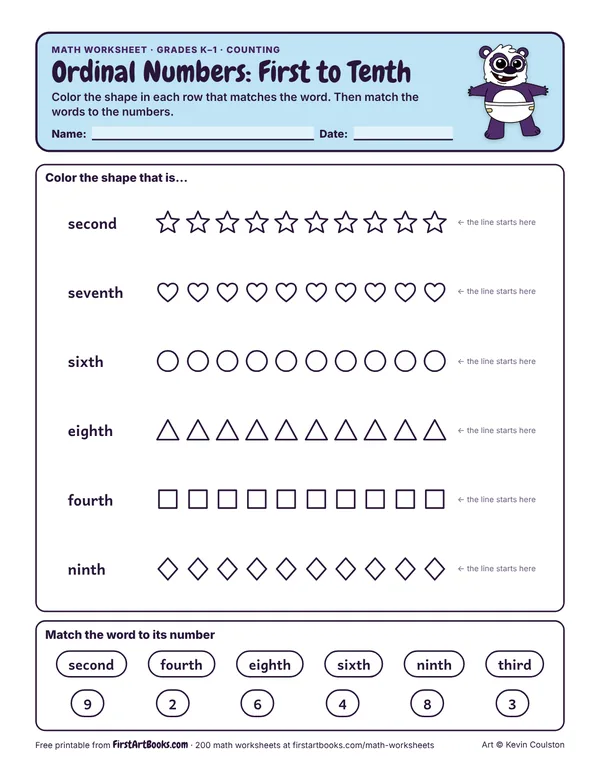
Rows of shapes in a line. Kids color the first, third, fifth and so on, then match the ordinal words to their numbers.
Print this sheet (PDF)Teacher notes and tips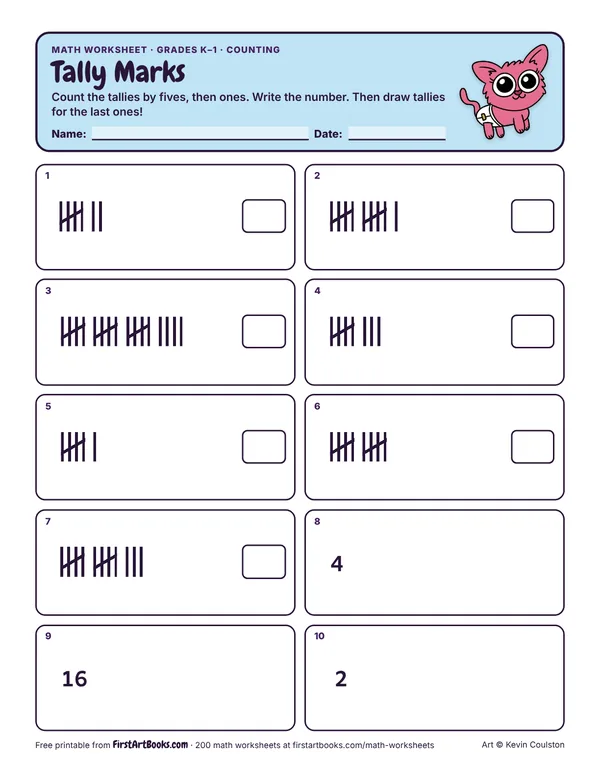
Count tally marks in bundles of five and write the number, then draw tallies for a number.
Print this sheet (PDF)Teacher notes and tips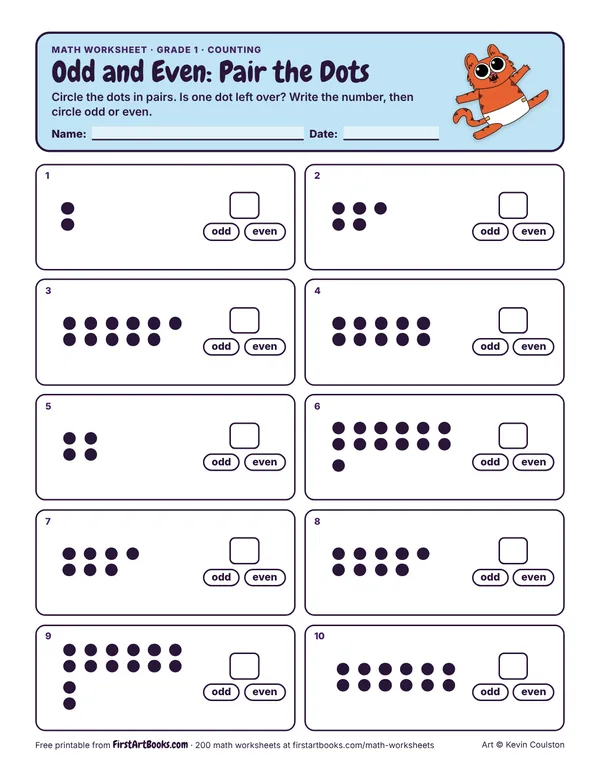
Ten groups of dots to pair up. If every dot has a partner the number is even; if one is left over it is odd.
Print this sheet (PDF)Teacher notes and tips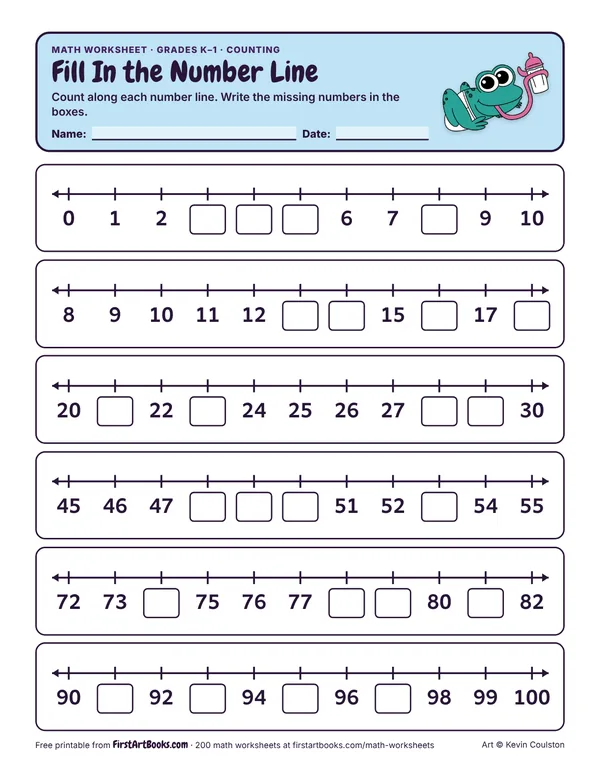
Six number lines that start at different numbers, from 0 up to 100. Kids count along and fill in the missing numbers.
Print this sheet (PDF)Teacher notes and tips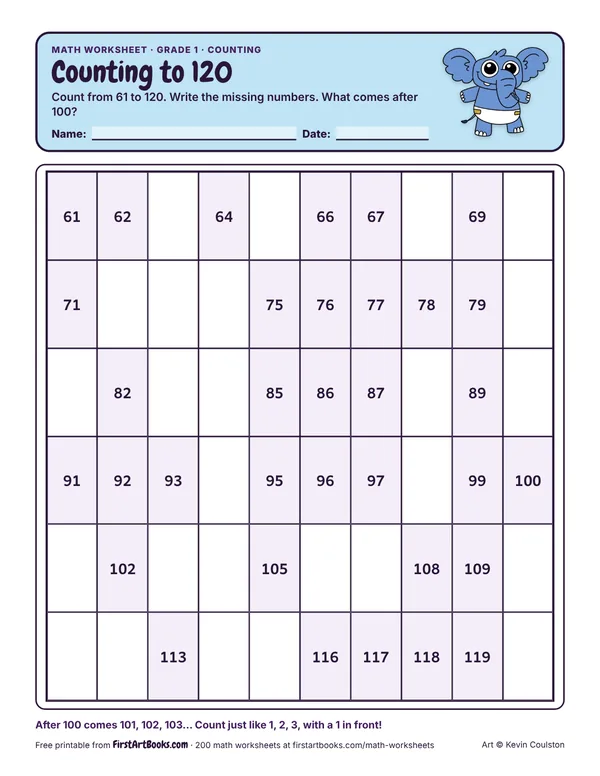
The numbers 61 to 120 in a chart with 26 missing. Kids count past 100 and fill in every empty square.
Print this sheet (PDF)Teacher notes and tips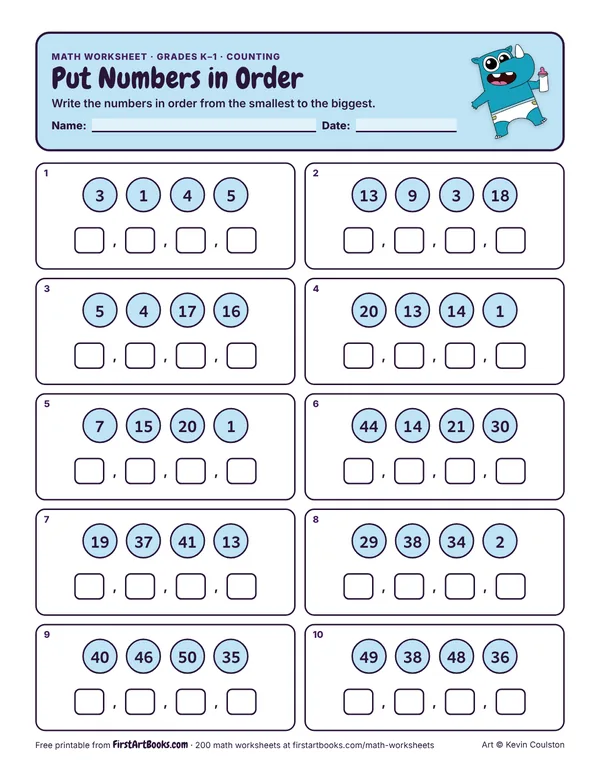
Ten sets of mixed-up numbers, up to 20 and then up to 50. Kids write each set in order from least to greatest.
Print this sheet (PDF)Teacher notes and tips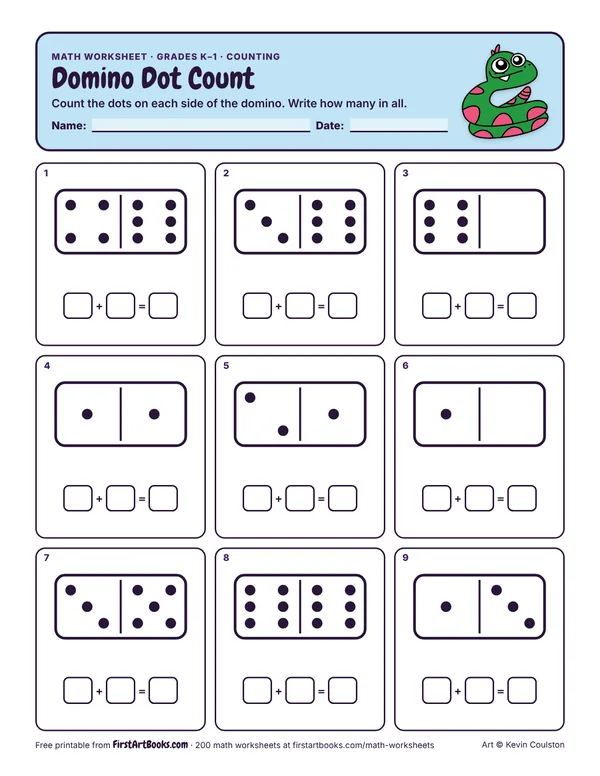
Nine dominoes. Kids count the dots on each half, write both numbers and then the total.
Print this sheet (PDF)Teacher notes and tips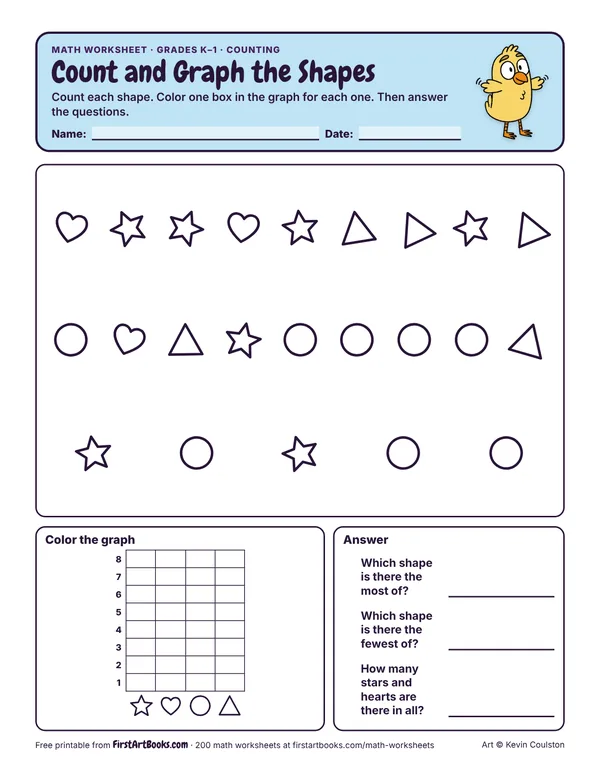
A jumble of stars, hearts, circles and triangles. Kids count each kind, color a bar graph and answer three questions.
Print this sheet (PDF)Teacher notes and tips

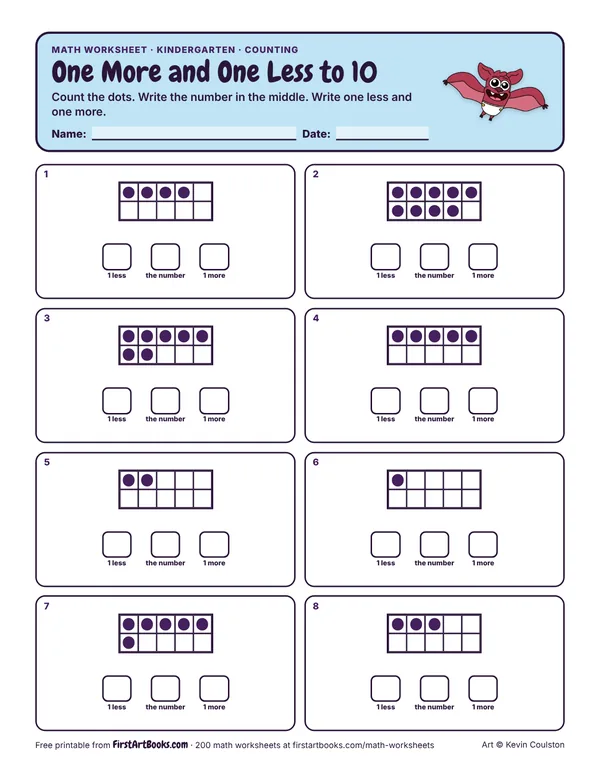
Eight ten frames to count. Kids write the number, the number that is one less and the number that is one more.
Print this sheet (PDF)Teacher notes and tips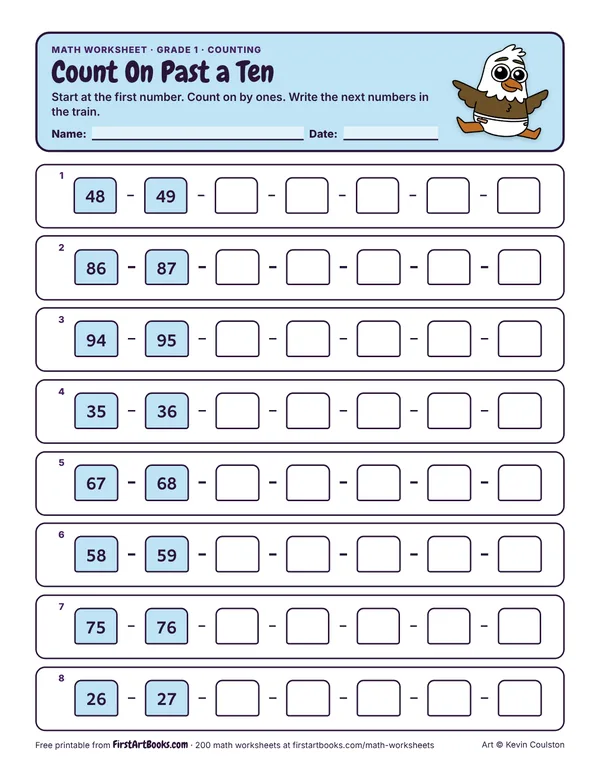
Eight counting trains that cross a ten, like 37, 38, 39, 40, 41. Kids count on by ones up to 100.
Print this sheet (PDF)Teacher notes and tips

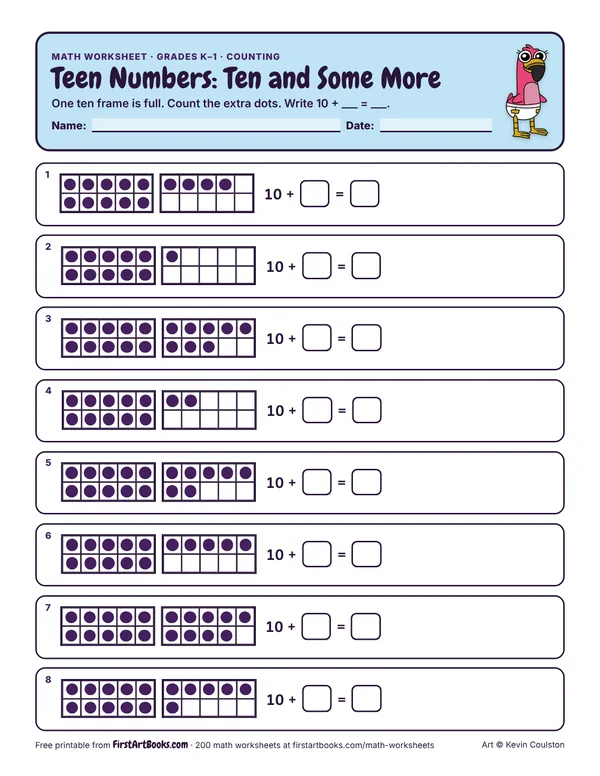
A full ten frame and some more on each row. Kids write each teen number as 10 plus some more.
Print this sheet (PDF)Teacher notes and tips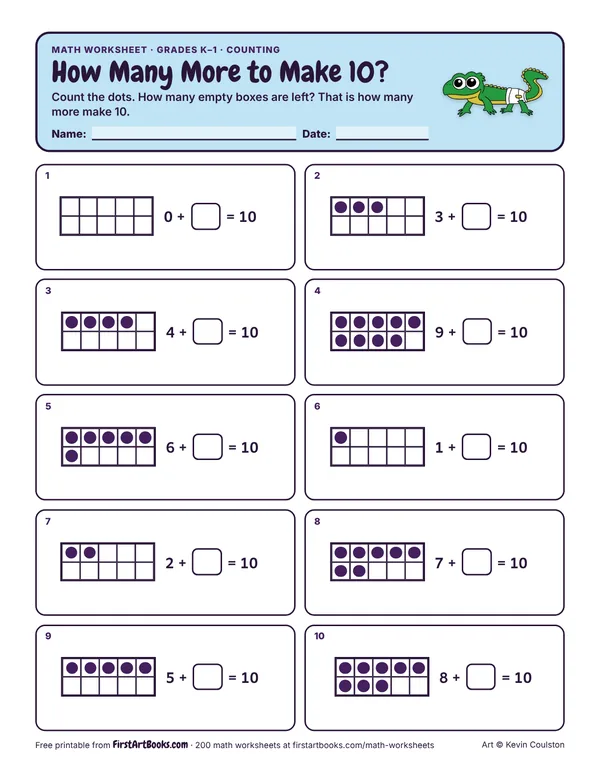
Ten ten frames with some dots. Kids count the empty boxes to find how many more make 10.
Print this sheet (PDF)Teacher notes and tipsPicture addition within 10, facts within 20, then two- and three-digit problems with regrouping.
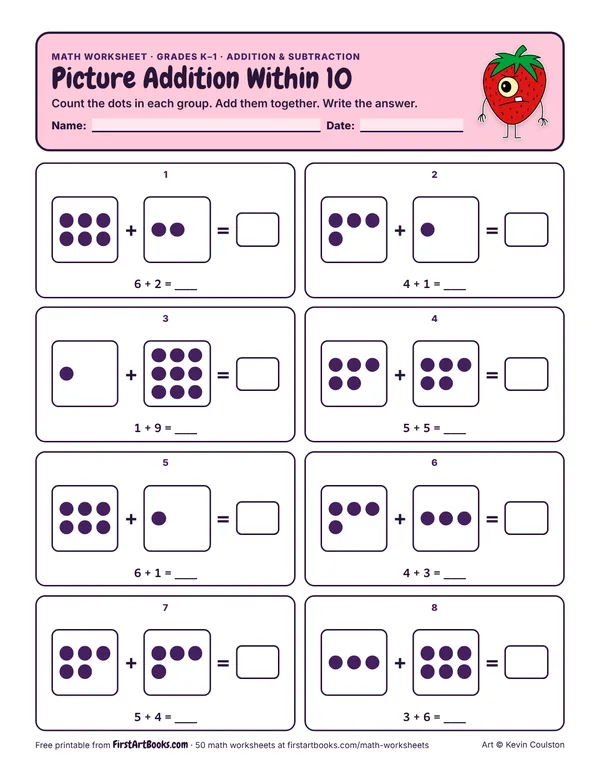
Count two groups of dots and add them: eight picture problems with sums up to 10.
Print this sheet (PDF)Teacher notes and tips
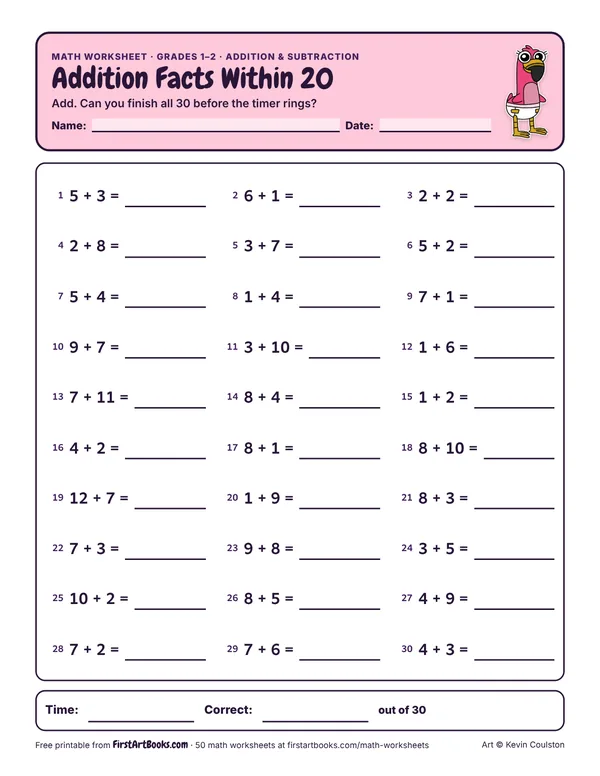
Thirty addition facts with sums up to 20, mixed so kids can’t just count on from the last one.
Print this sheet (PDF)Teacher notes and tips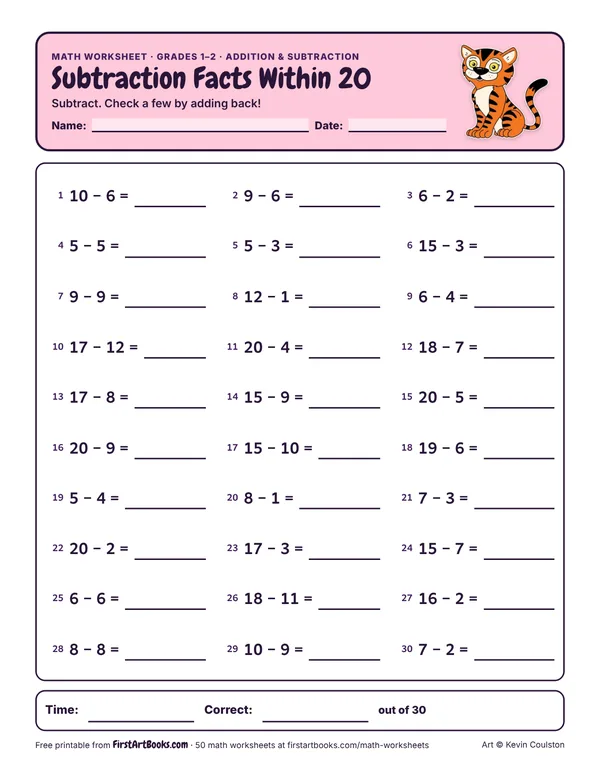
Thirty subtraction facts from 20 and below. Every answer is 0 or more.
Print this sheet (PDF)Teacher notes and tips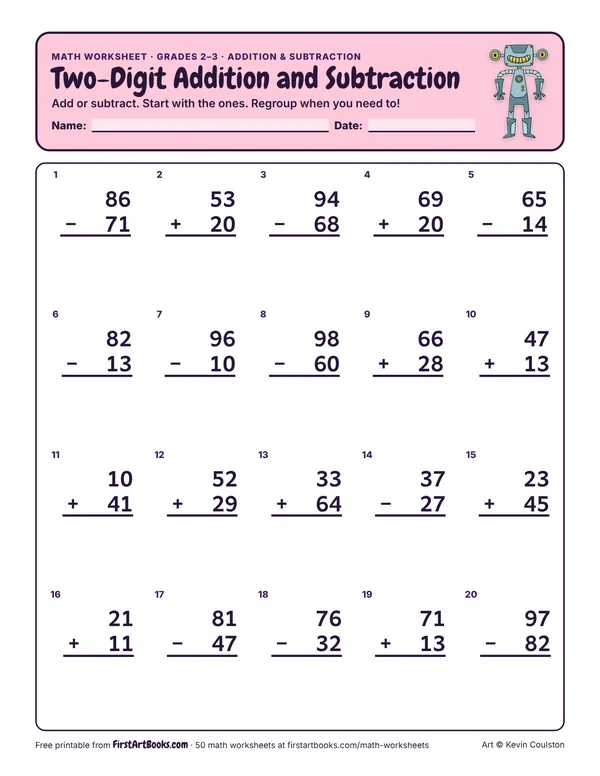
Twenty stacked problems with two-digit numbers, about half with regrouping (carrying and borrowing).
Print this sheet (PDF)Teacher notes and tips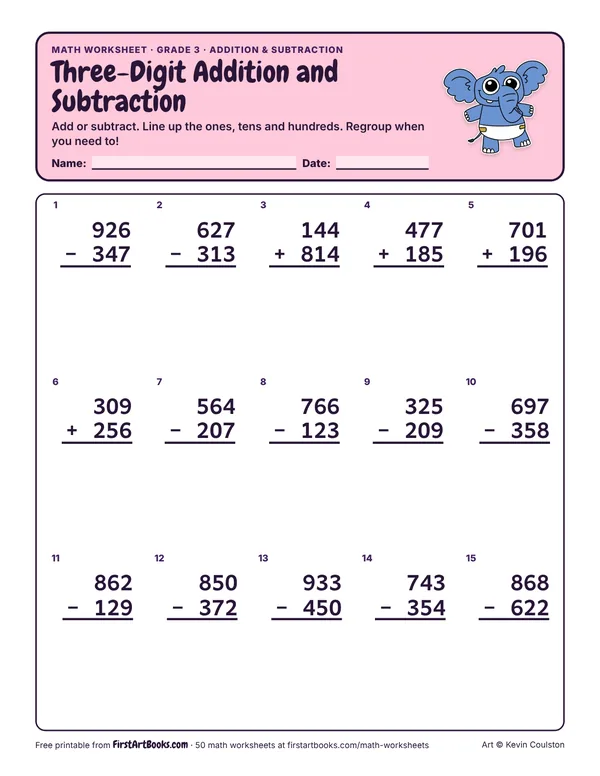
Fifteen three-digit problems with regrouping across the ones, tens and hundreds.
Print this sheet (PDF)Teacher notes and tips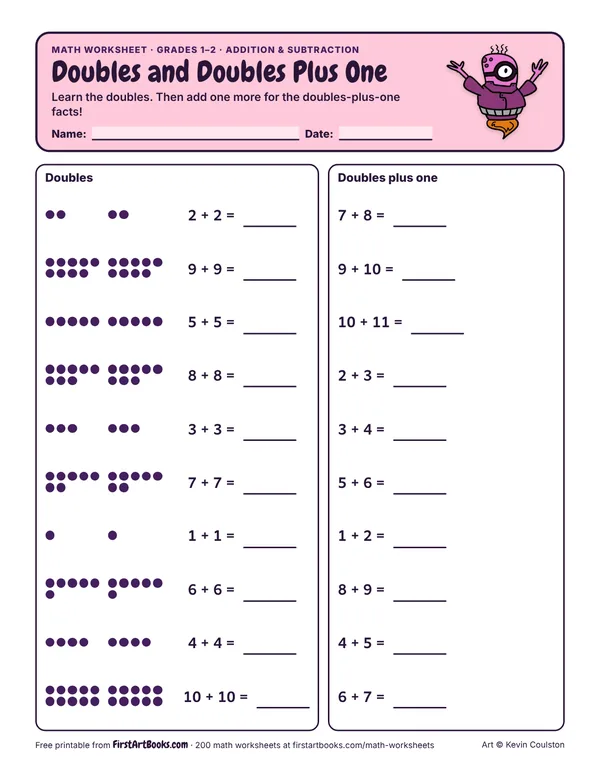
Ten doubles facts (6 + 6) and ten near-doubles (6 + 7), with the doubles pictured so kids see the trick.
Print this sheet (PDF)Teacher notes and tips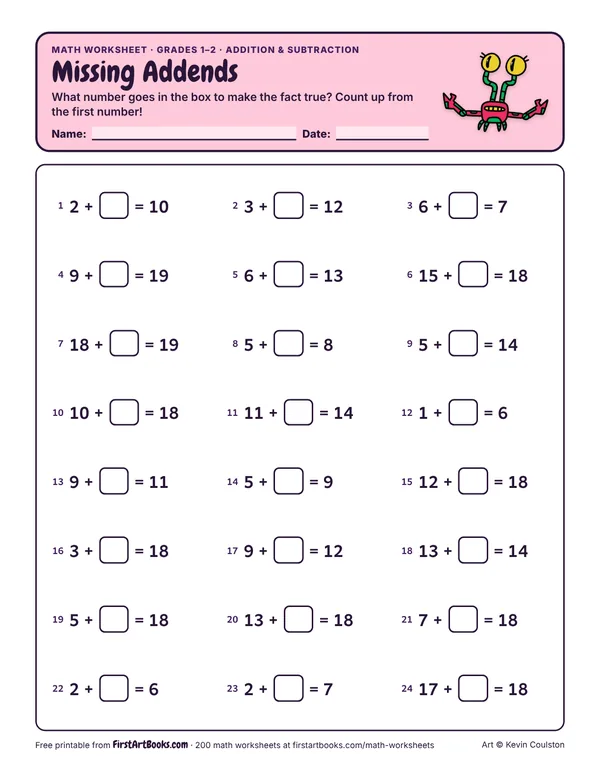
Twenty-four facts with a blank in the middle: 7 + ___ = 12. Count on or subtract to find the missing part.
Print this sheet (PDF)Teacher notes and tips

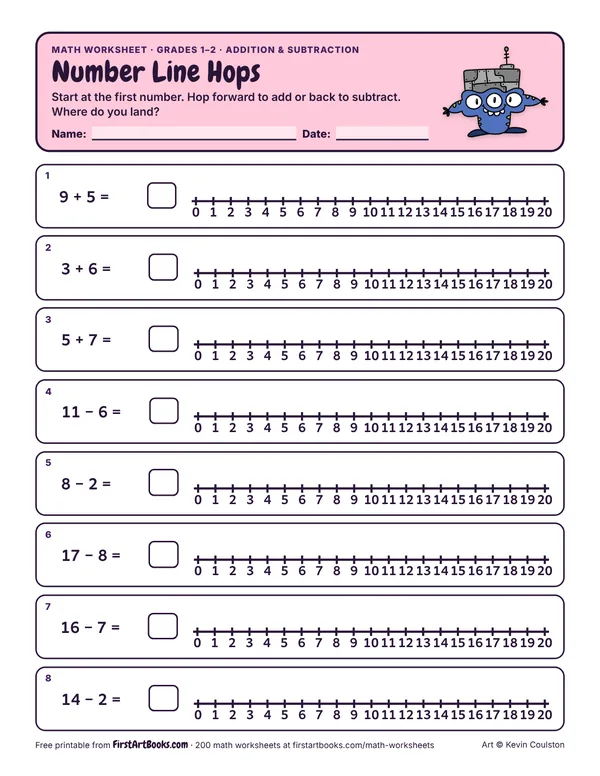
Eight problems within 20, each with a number line. Kids draw the hops and land on the answer.
Print this sheet (PDF)Teacher notes and tips

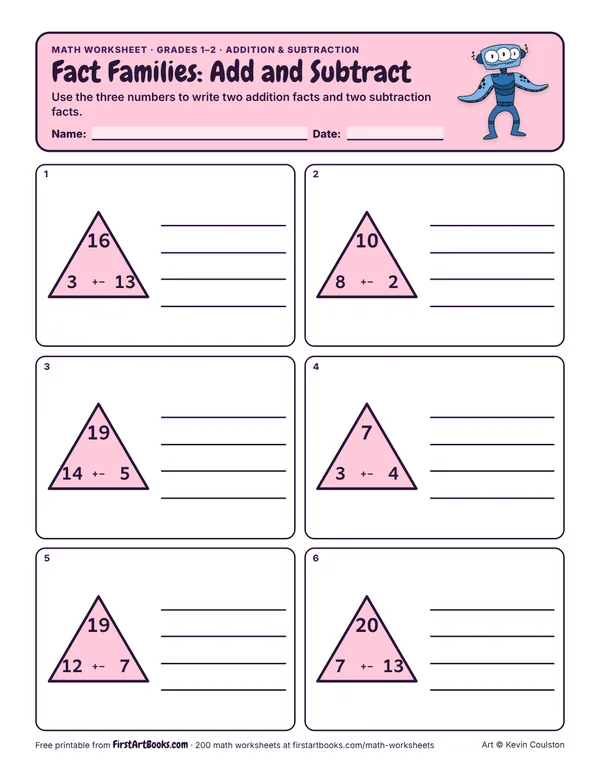
Six fact triangles. Kids write the two addition and two subtraction facts in each family.
Print this sheet (PDF)Teacher notes and tips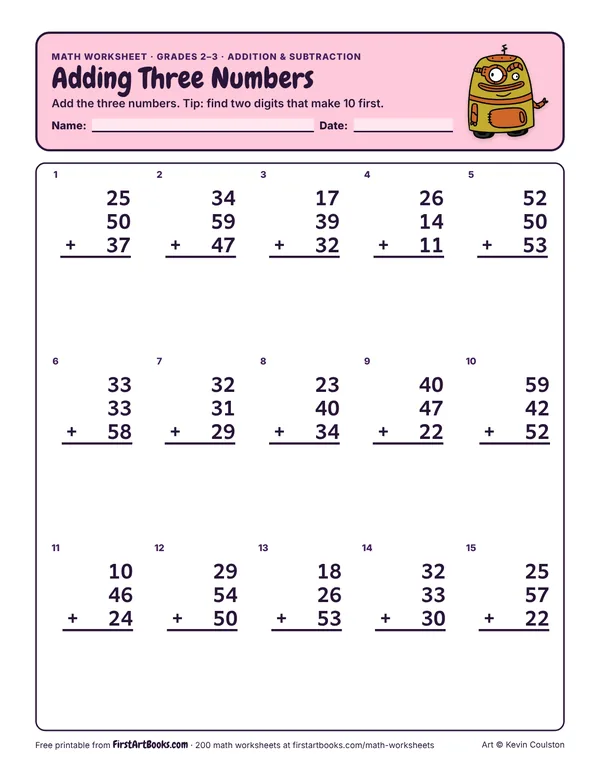
Fifteen stacked problems that add three two-digit numbers. Look for tens that pair up.
Print this sheet (PDF)Teacher notes and tips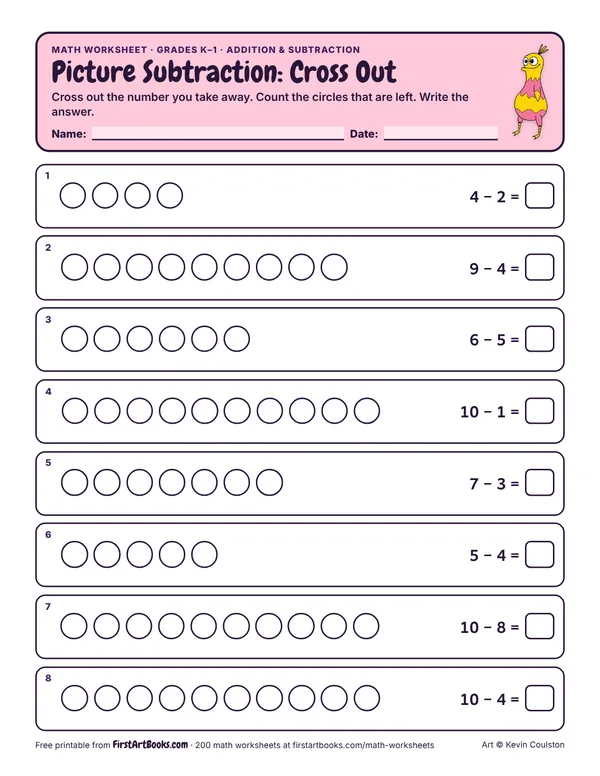
Eight rows of circles. Kids cross out the number taken away, count what is left and write the answer.
Print this sheet (PDF)Teacher notes and tips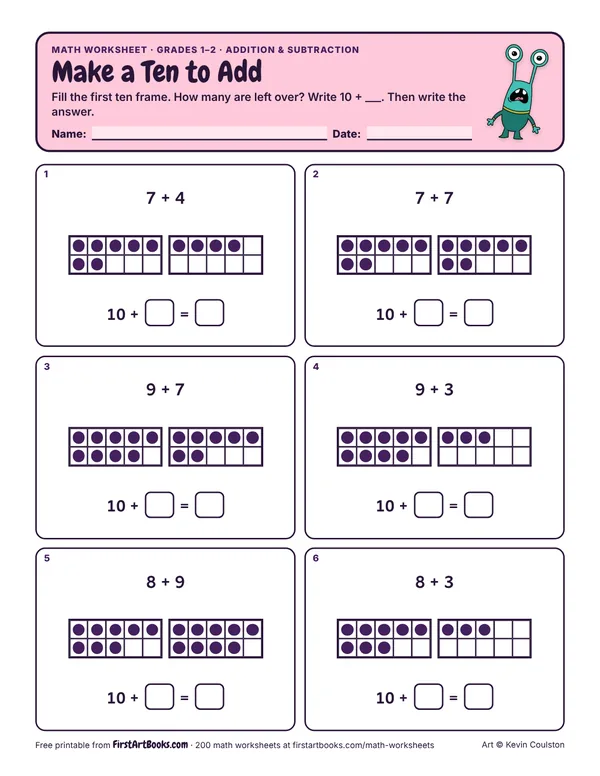
Six facts like 9 + 5 with two ten frames. Move dots to fill the first frame, then add 10 and the rest.
Print this sheet (PDF)Teacher notes and tips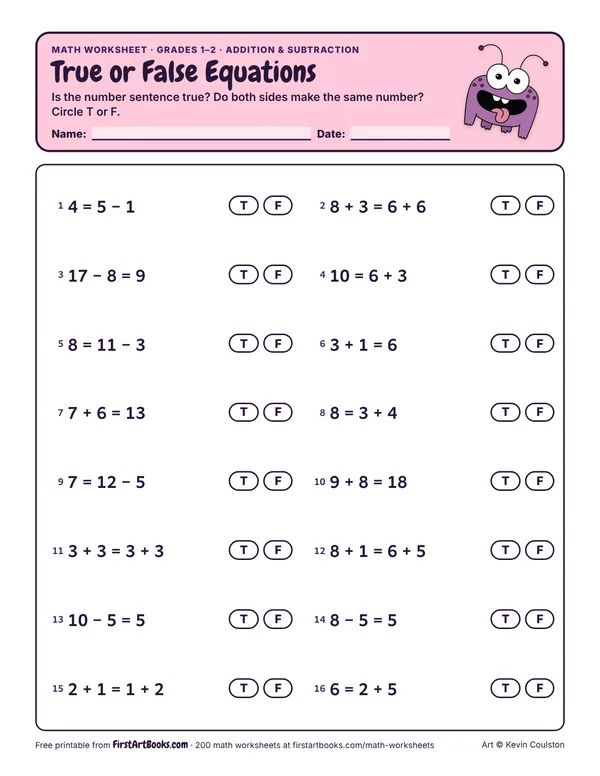
Sixteen number sentences like 8 = 3 + 5 or 6 + 4 = 5 + 5. Kids decide if both sides are equal and circle true or false.
Print this sheet (PDF)Teacher notes and tips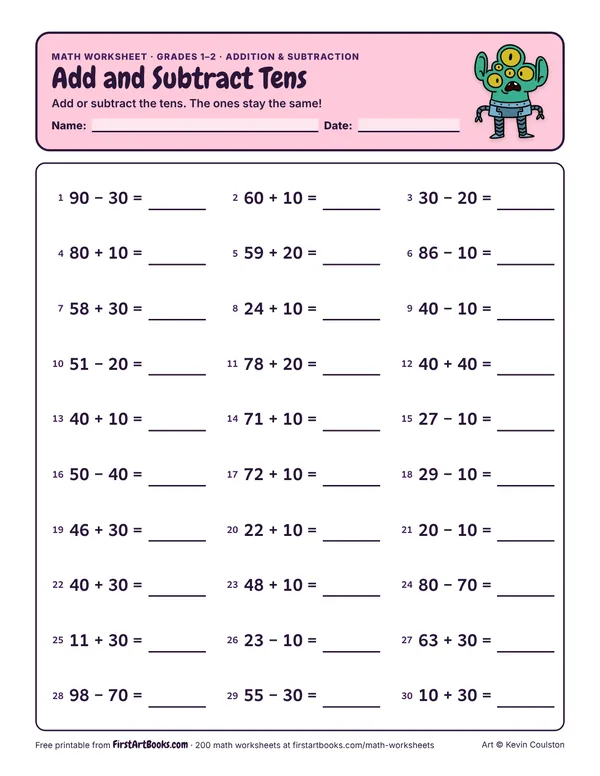
Thirty mental math problems like 30 + 40, 90 − 60 and 45 + 30. Only the tens change!
Print this sheet (PDF)Teacher notes and tips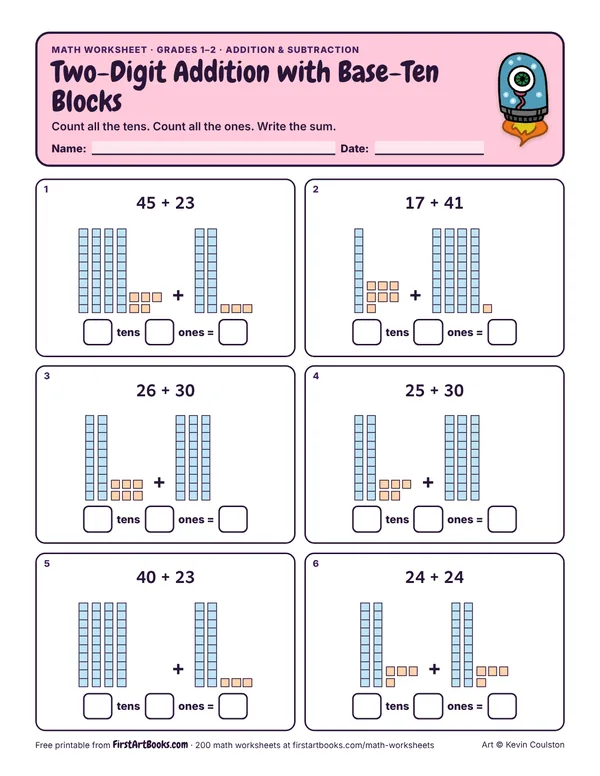
Six problems drawn as tens rods and ones cubes. Kids put the tens together, then the ones, and write the sum.
Print this sheet (PDF)Teacher notes and tips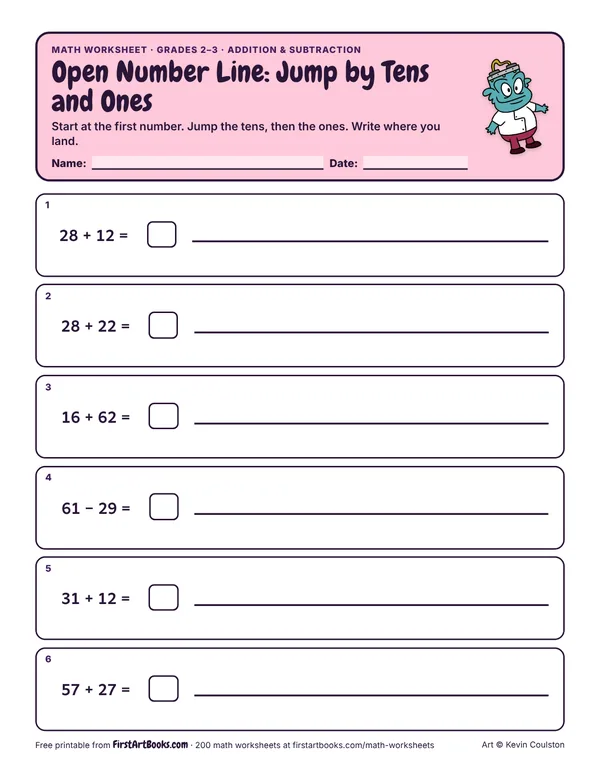
Six problems within 100 with an empty number line. Kids jump by tens, then ones, and write where they land.
Print this sheet (PDF)Teacher notes and tips

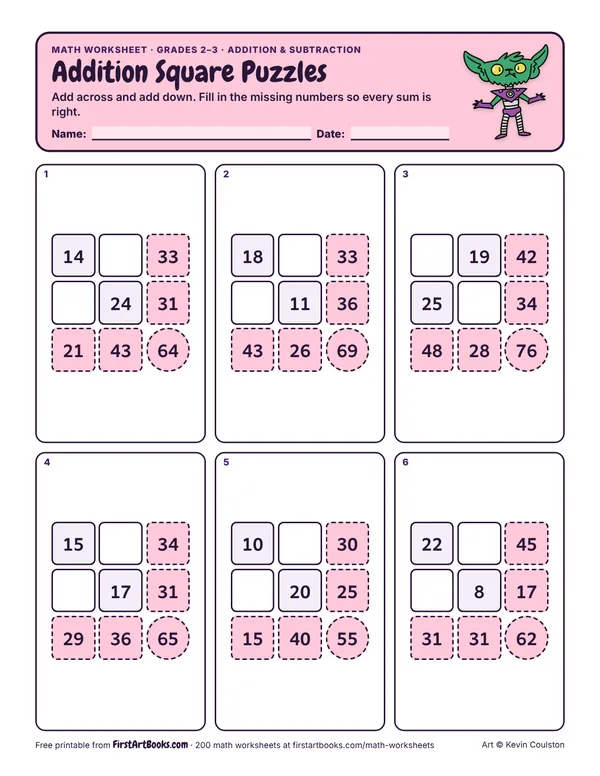
Six little number squares. Every row and column adds up to the number at its end. Find the missing numbers.
Print this sheet (PDF)Teacher notes and tips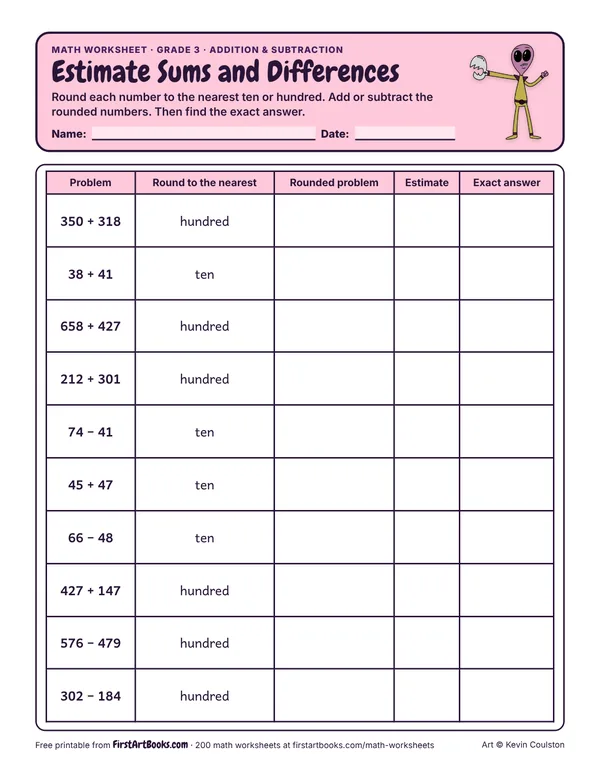
Ten problems to round, estimate and then solve. Kids check that the exact answer is close to the estimate.
Print this sheet (PDF)Teacher notes and tips

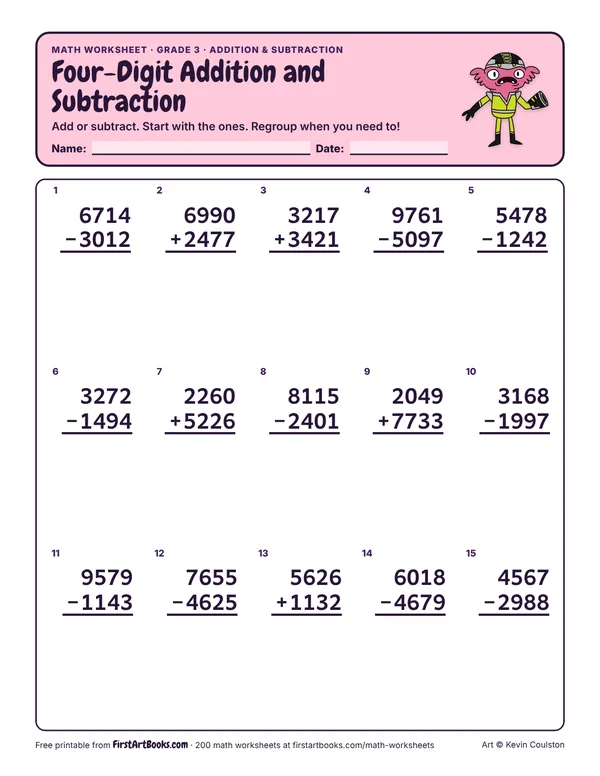
Fifteen stacked problems with thousands, hundreds, tens and ones, most with regrouping.
Print this sheet (PDF)Teacher notes and tips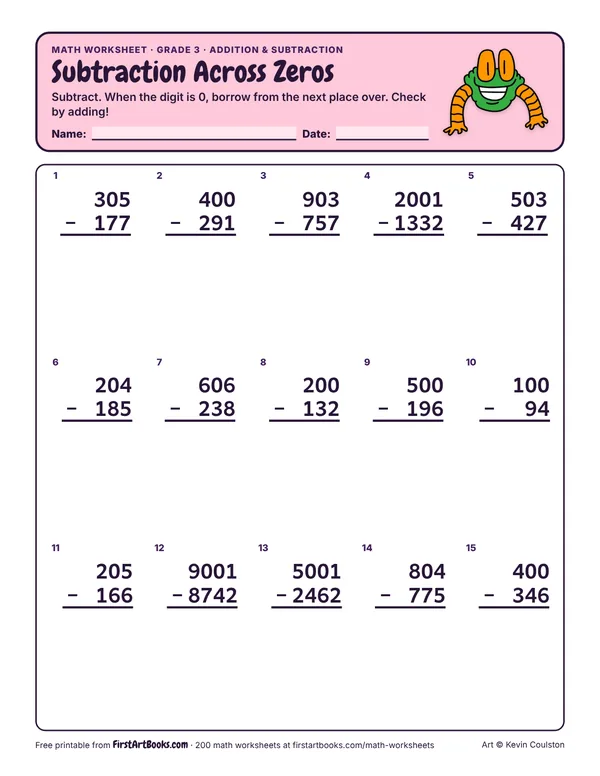
Fifteen problems like 400 − 167 and 3,005 − 1,248, where kids have to regroup across one or more zeros.
Print this sheet (PDF)Teacher notes and tipsArrays, facts from 0 to 10, a fill-in multiplication chart and two-digit by one-digit problems.
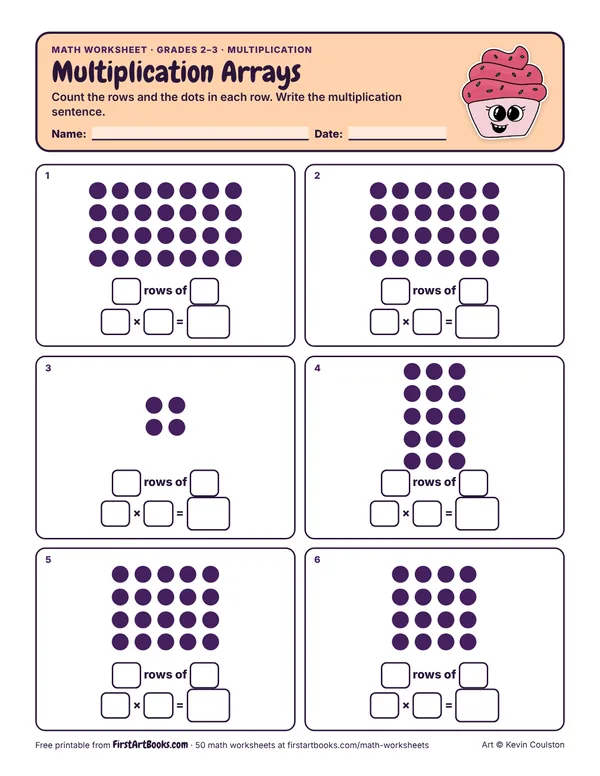
Six dot arrays. Kids count the rows and the dots in each row, then write the multiplication sentence.
Print this sheet (PDF)Teacher notes and tips

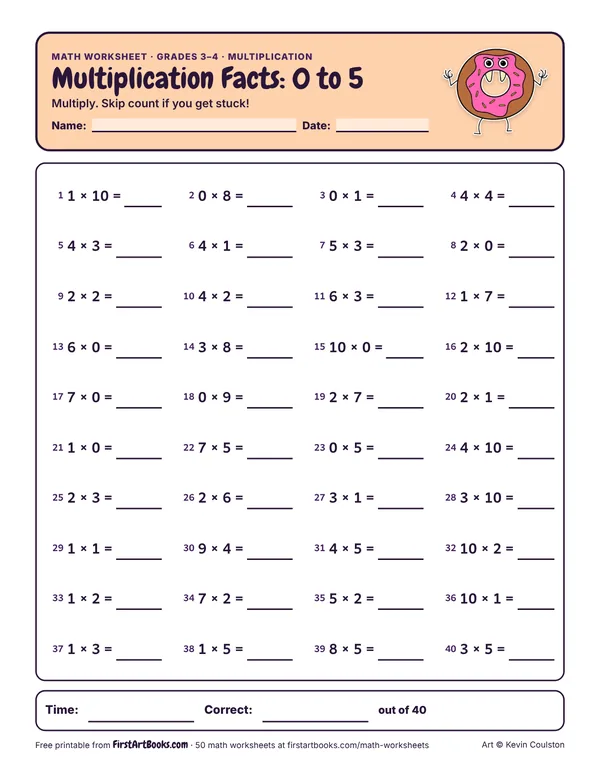
Forty facts with the 0, 1, 2, 3, 4 and 5 times tables, mixed up. Great for a timed quiz.
Print this sheet (PDF)Teacher notes and tips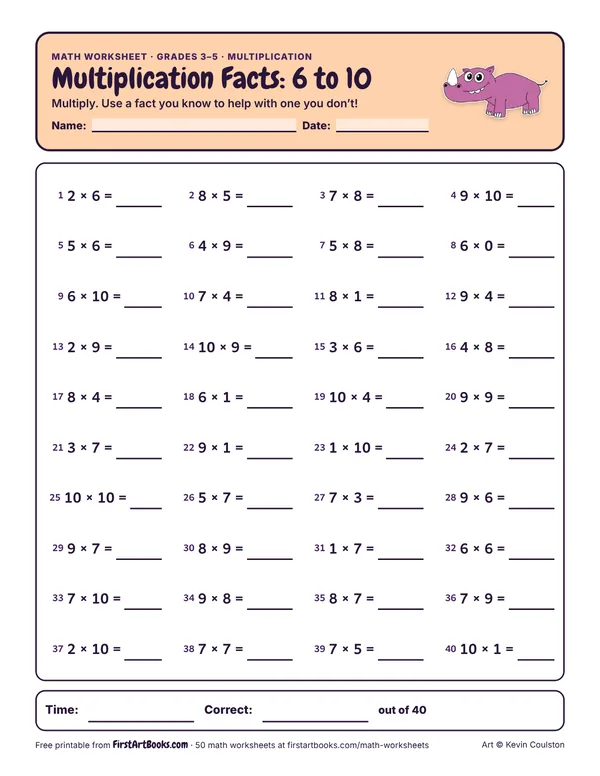
Forty facts with the 6, 7, 8, 9 and 10 times tables, the trickier half of the chart.
Print this sheet (PDF)Teacher notes and tips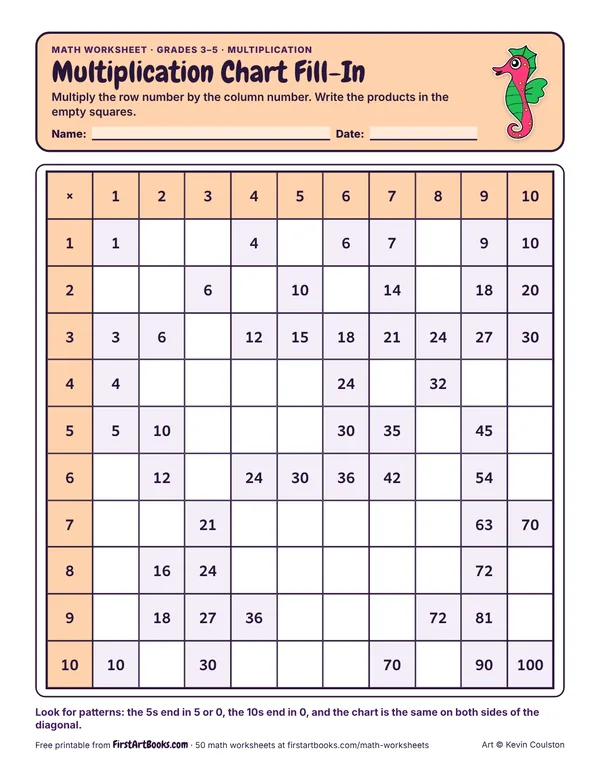
A 10 by 10 multiplication chart with 50 products missing. Kids fill it in and spot the patterns.
Print this sheet (PDF)Teacher notes and tips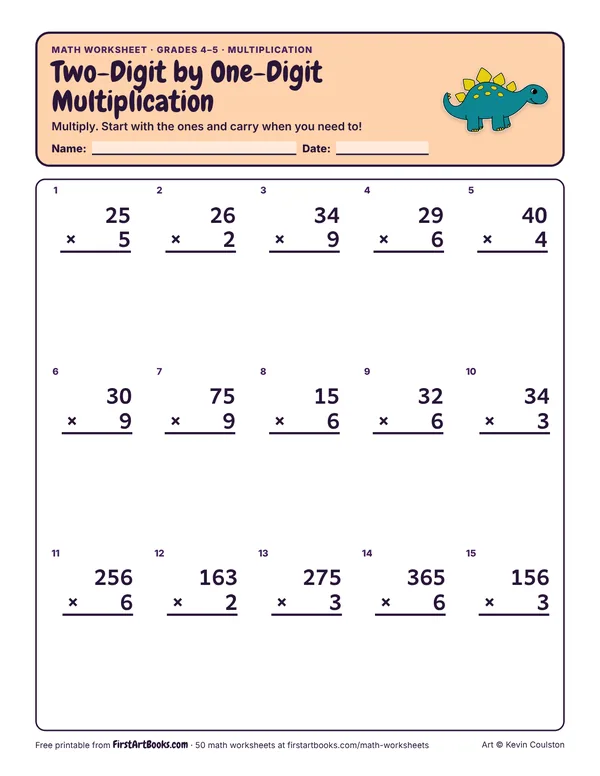
Fifteen stacked problems: two- and three-digit numbers times a one-digit number, with regrouping.
Print this sheet (PDF)Teacher notes and tips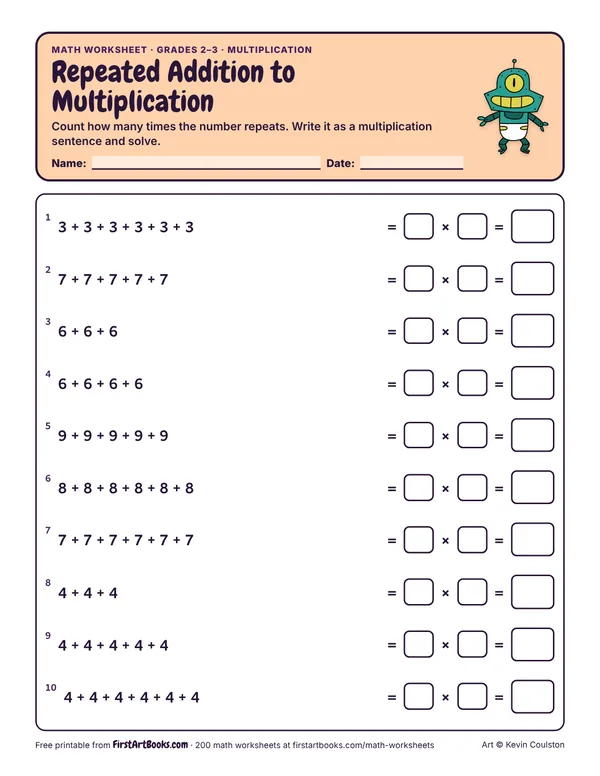
Ten rows: 4 + 4 + 4 becomes 3 × 4. Kids write the multiplication sentence for each addition and solve it.
Print this sheet (PDF)Teacher notes and tips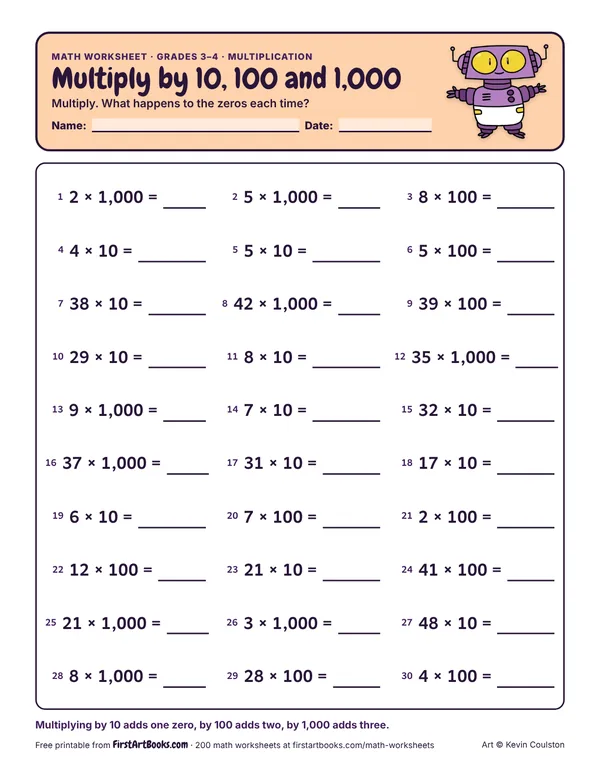
Thirty problems that multiply by 10, 100 and 1,000. Kids spot the zeros pattern.
Print this sheet (PDF)Teacher notes and tips

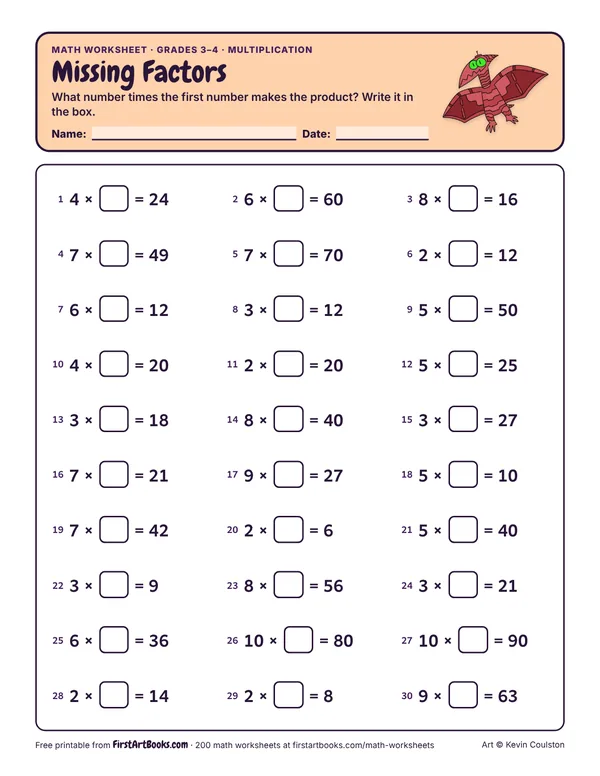
Thirty facts with a factor missing: 7 × ___ = 42. The bridge to division.
Print this sheet (PDF)Teacher notes and tips

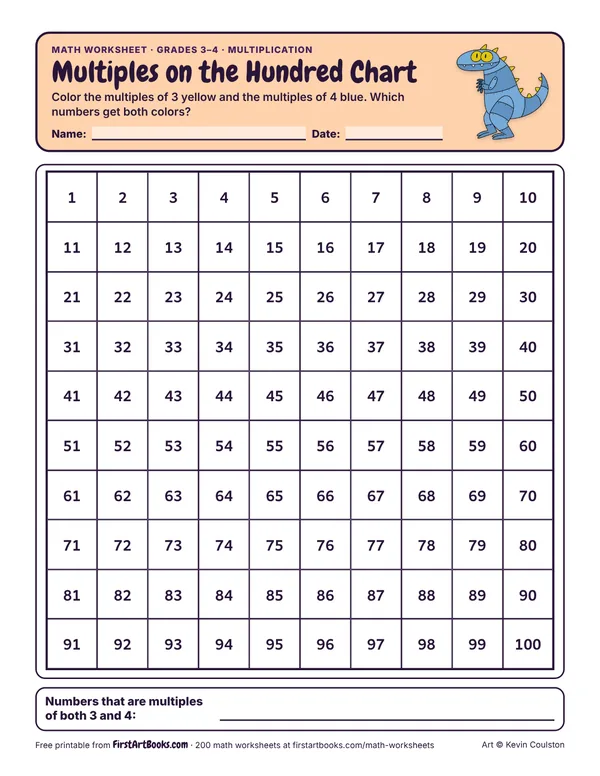
Color every multiple of 3 one color and every multiple of 4 another, then list the numbers that got both.
Print this sheet (PDF)Teacher notes and tips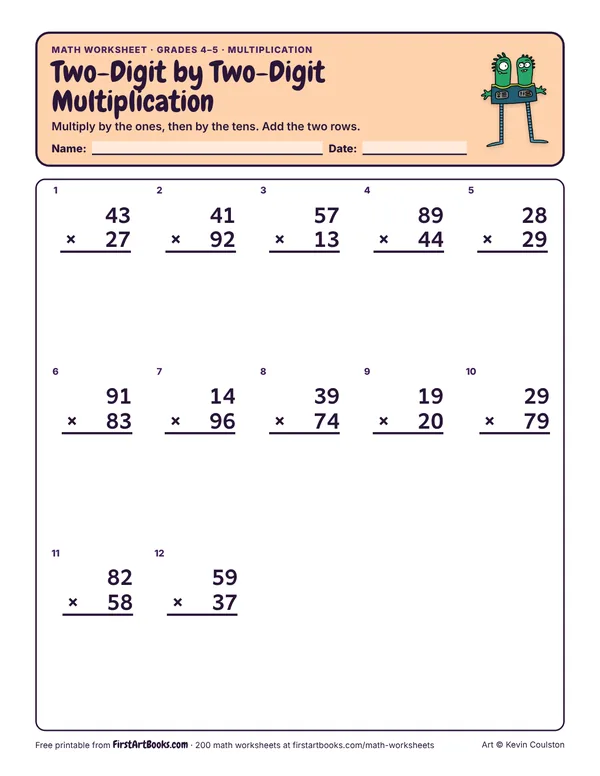
Twelve stacked problems, two digits by two digits, with room for both partial products.
Print this sheet (PDF)Teacher notes and tips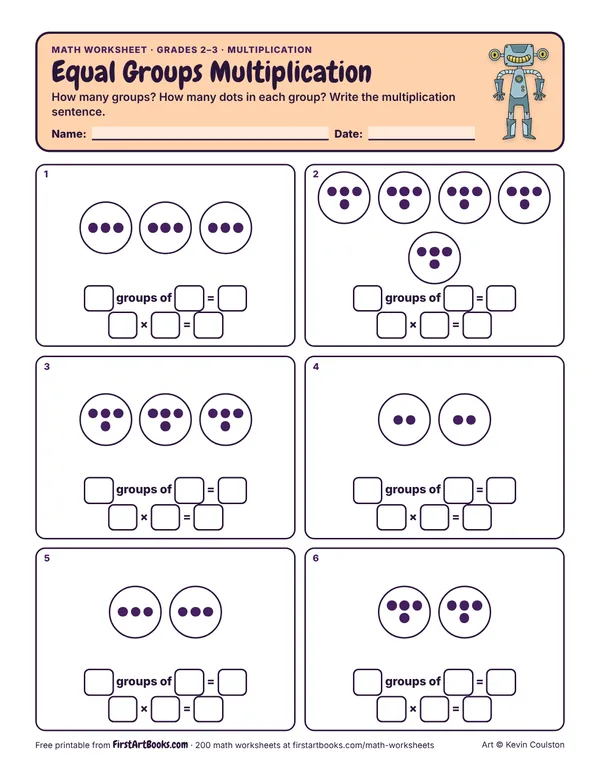
Six pictures of equal groups of dots. Kids write how many groups, how many in each group and the product.
Print this sheet (PDF)Teacher notes and tips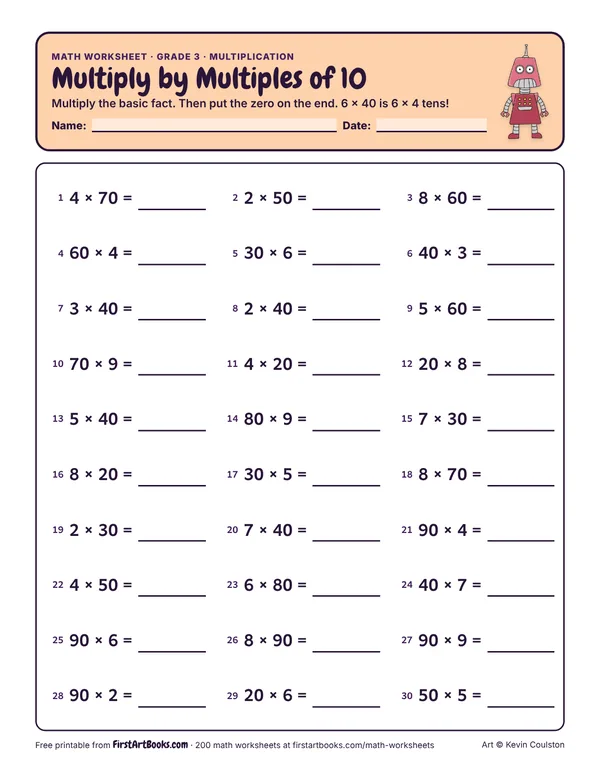
Thirty problems like 7 × 40 and 60 × 5. Use the basic fact, then add the zero.
Print this sheet (PDF)Teacher notes and tips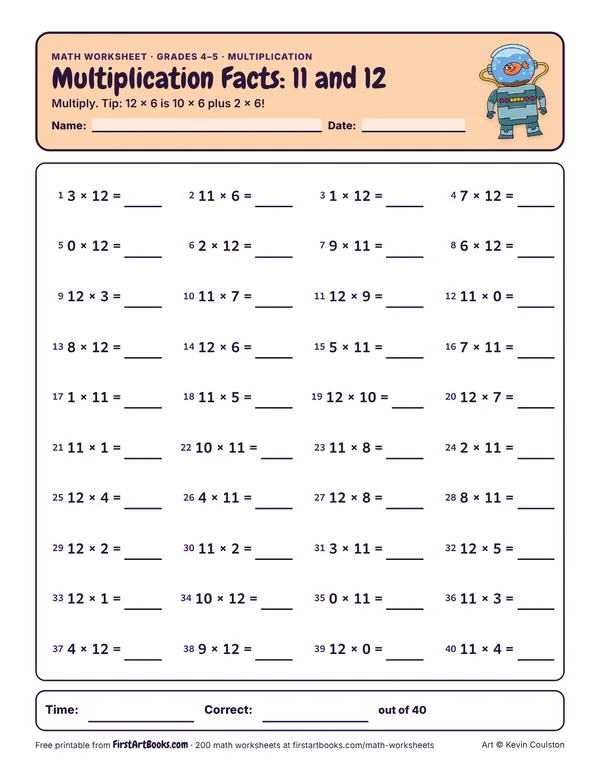
Forty facts with the 11 and 12 times tables, mixed up, to finish off the whole multiplication chart.
Print this sheet (PDF)Teacher notes and tips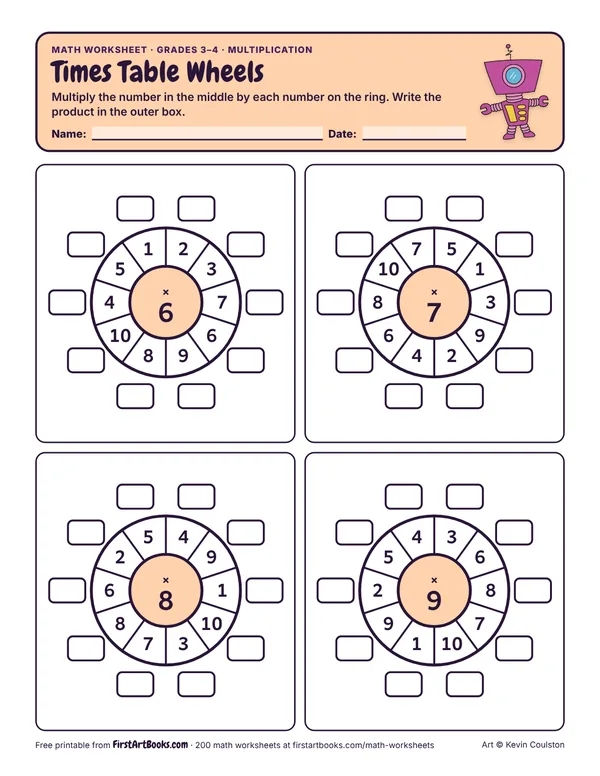
Four wheels for the 6, 7, 8 and 9 times tables. Multiply the center by each number on the ring and write the product outside.
Print this sheet (PDF)Teacher notes and tips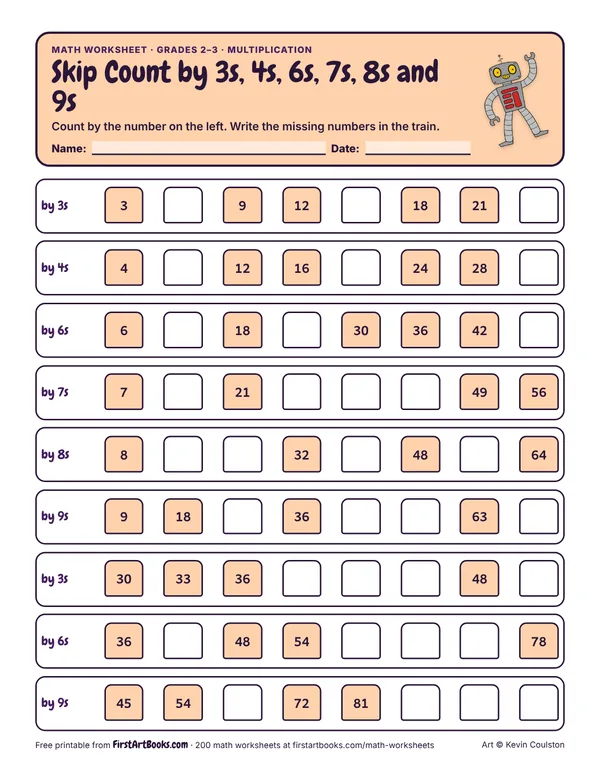
Nine number trains that count by 3s, 4s, 6s, 7s, 8s and 9s. The skip-counting behind every times table.
Print this sheet (PDF)Teacher notes and tips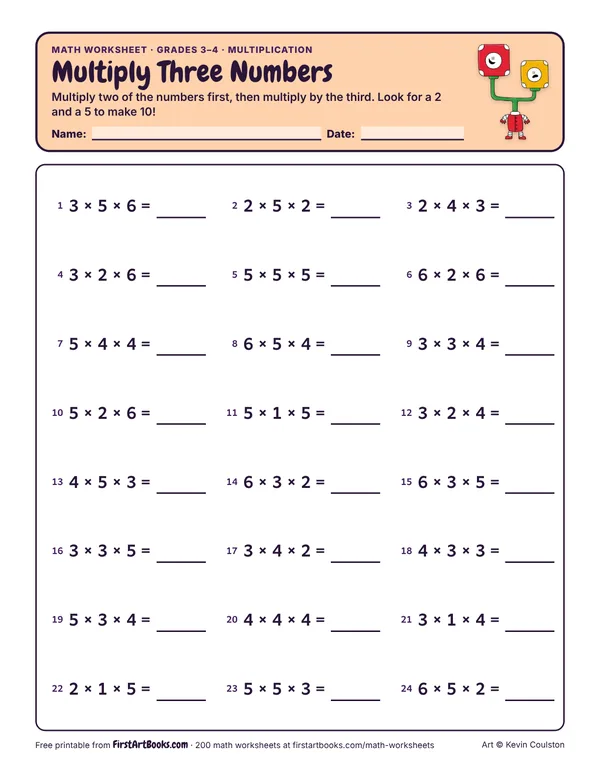
Twenty-four problems like 2 × 3 × 4. Multiply any two first: the answer comes out the same.
Print this sheet (PDF)Teacher notes and tips

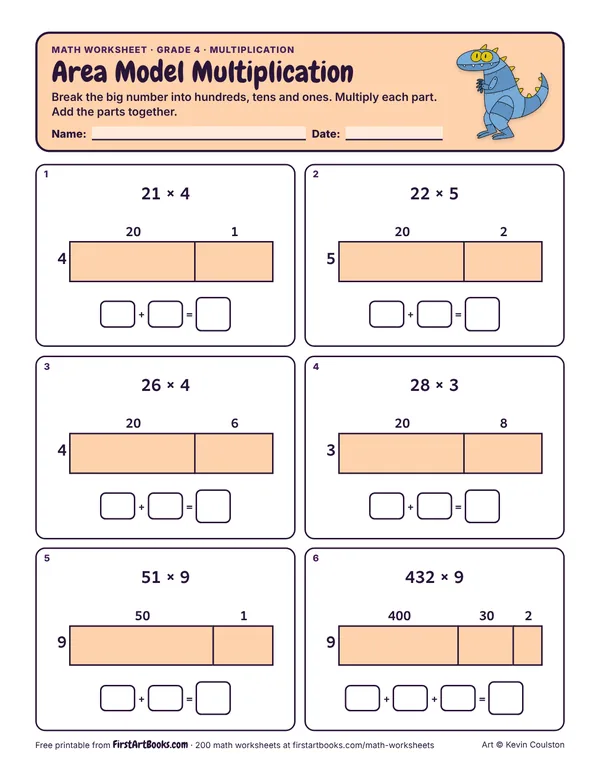
Six two- and three-digit by one-digit problems split into tens and ones boxes. Find each part, then add the parts.
Print this sheet (PDF)Teacher notes and tips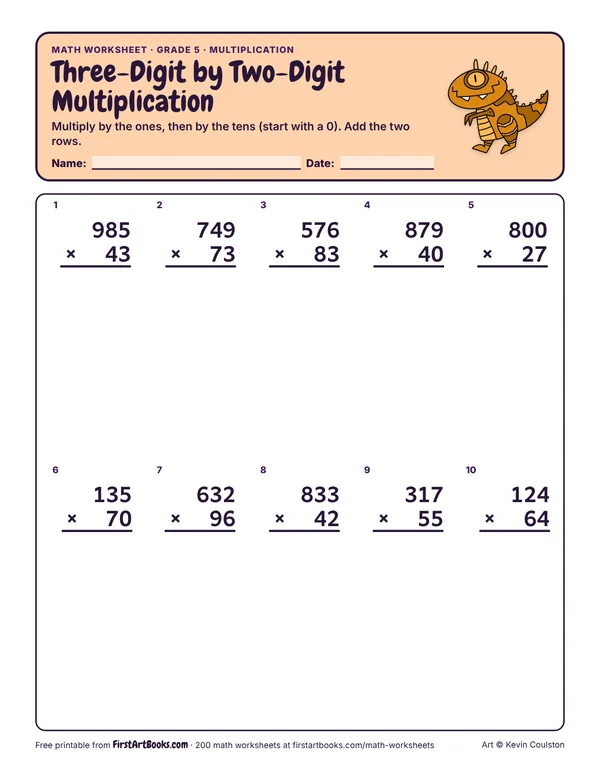
Ten stacked problems, three digits by two digits, with room for the two partial products.
Print this sheet (PDF)Teacher notes and tips

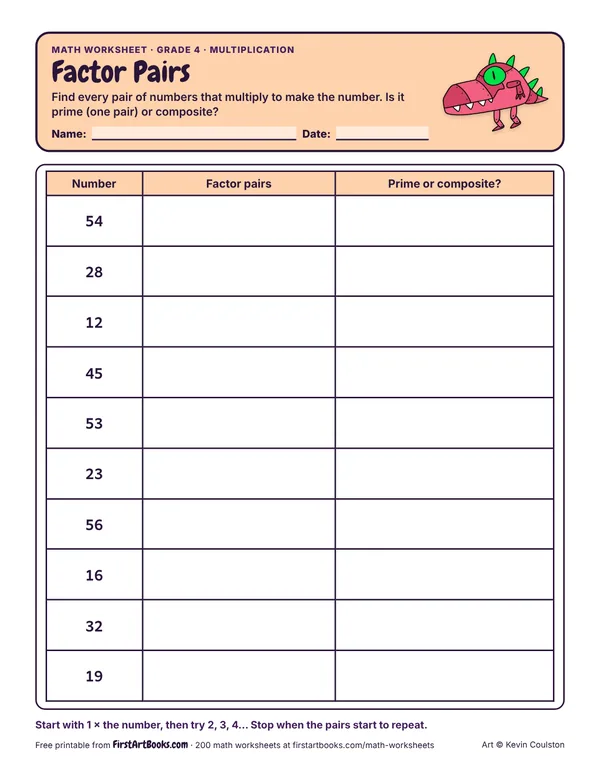
Ten numbers up to 60. Kids list every pair of factors, then say whether the number is prime or composite.
Print this sheet (PDF)Teacher notes and tips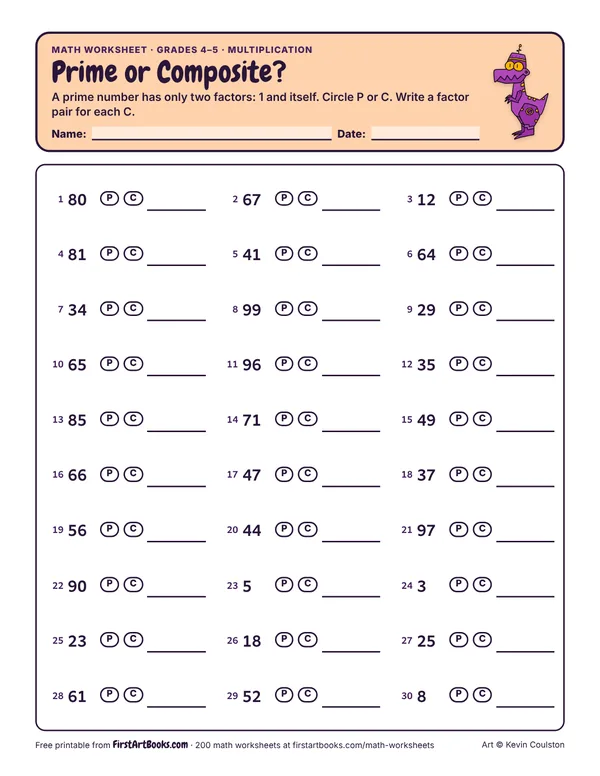
Thirty numbers from 2 to 99. Kids circle P for prime or C for composite and write one factor pair for each composite.
Print this sheet (PDF)Teacher notes and tipsEqual groups, division facts, fact families and long division with remainders.
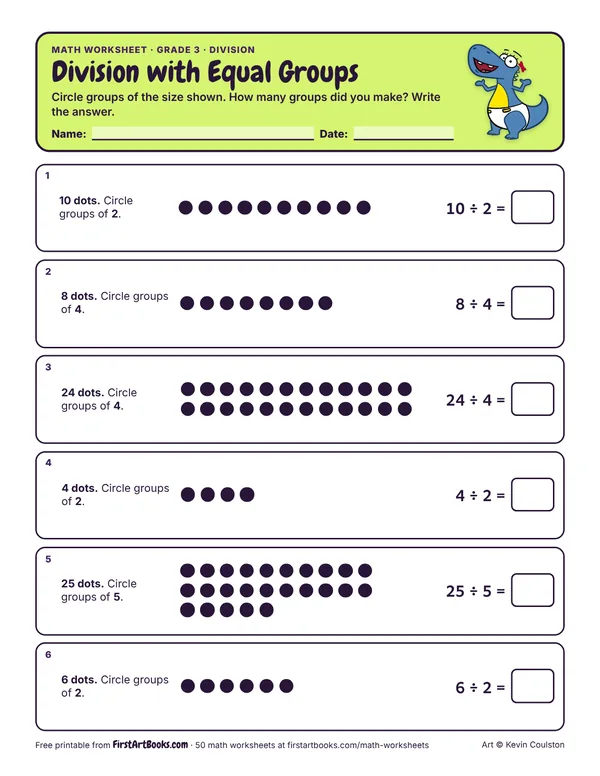
Six rows of dots. Kids circle equal groups, count the groups and write the division sentence.
Print this sheet (PDF)Teacher notes and tips
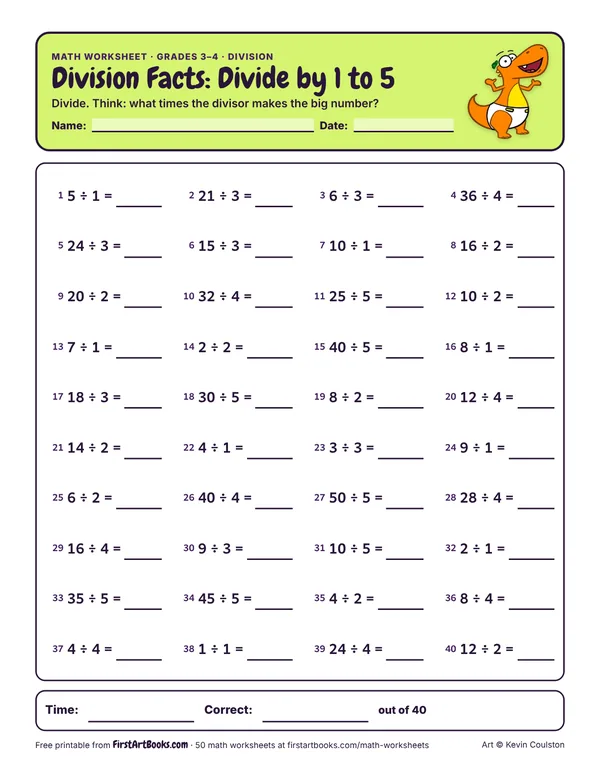
Forty division facts with divisors from 1 to 5. Every answer is a whole number from 0 to 10.
Print this sheet (PDF)Teacher notes and tips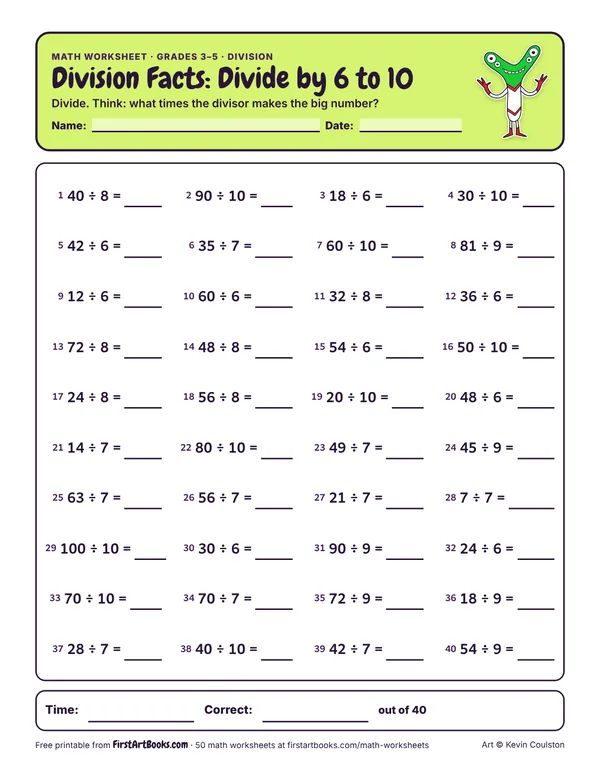
Forty division facts with divisors from 6 to 10, to match the harder multiplication facts.
Print this sheet (PDF)Teacher notes and tips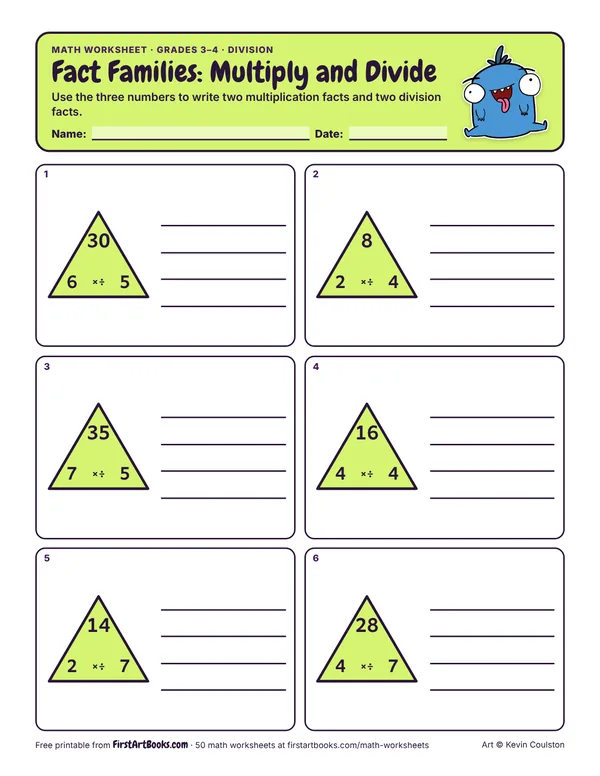
Six fact triangles. Kids write the two multiplication and two division facts each family makes.
Print this sheet (PDF)Teacher notes and tips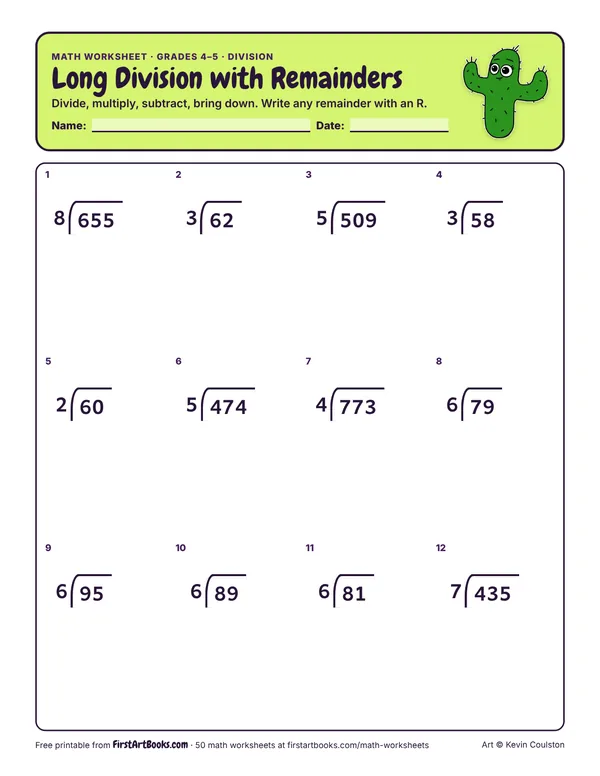
Twelve long division problems: two- and three-digit numbers divided by one digit, some with remainders.
Print this sheet (PDF)Teacher notes and tips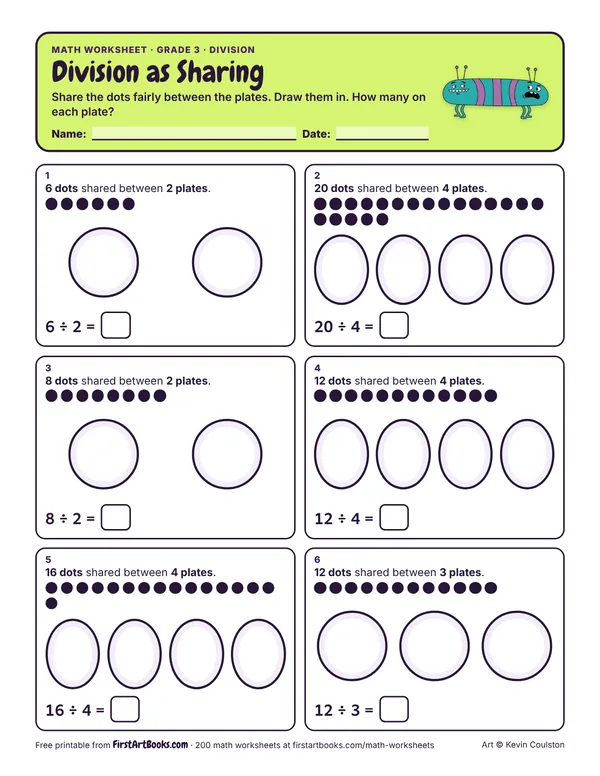
Six sharing problems: draw the dots onto the plates one at a time, then count how many each plate gets.
Print this sheet (PDF)Teacher notes and tips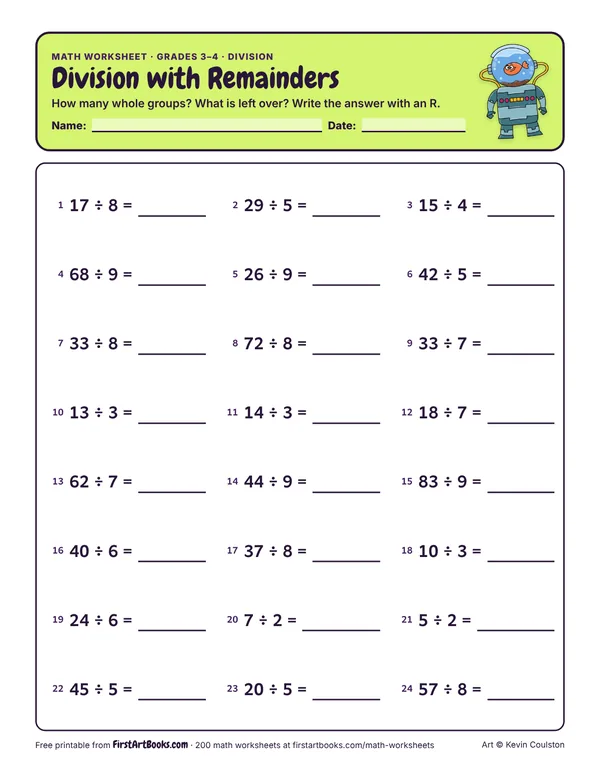
Twenty-four short problems like 17 ÷ 5 = 3 R2, before long division. The leftover is the remainder.
Print this sheet (PDF)Teacher notes and tips

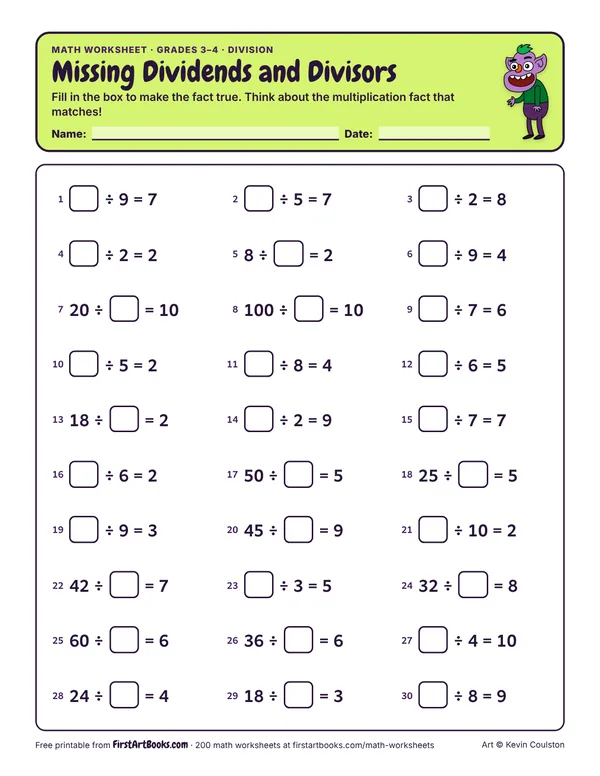
Thirty facts with a blank in a different spot each time: ___ ÷ 4 = 6 or 35 ÷ ___ = 7.
Print this sheet (PDF)Teacher notes and tips

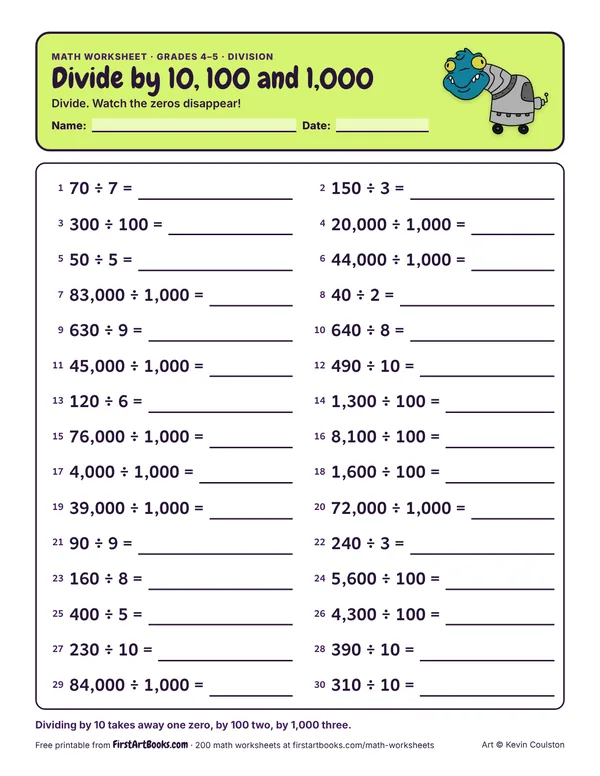
Thirty problems that divide by 10, 100 and 1,000, and multiples of ten like 240 ÷ 6.
Print this sheet (PDF)Teacher notes and tips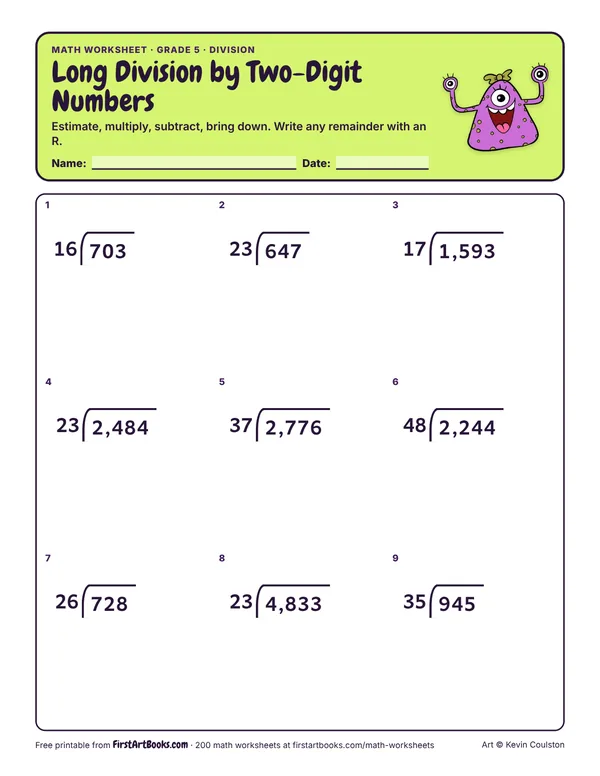
Nine long division problems with two-digit divisors, three- and four-digit dividends and remainders.
Print this sheet (PDF)Teacher notes and tips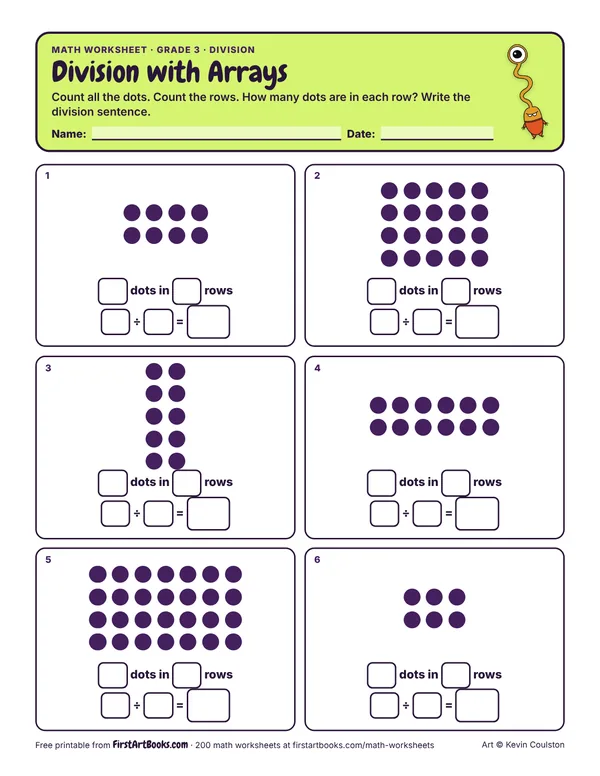
Six dot arrays. Kids use the rows to write a division sentence: the total divided into equal rows.
Print this sheet (PDF)Teacher notes and tips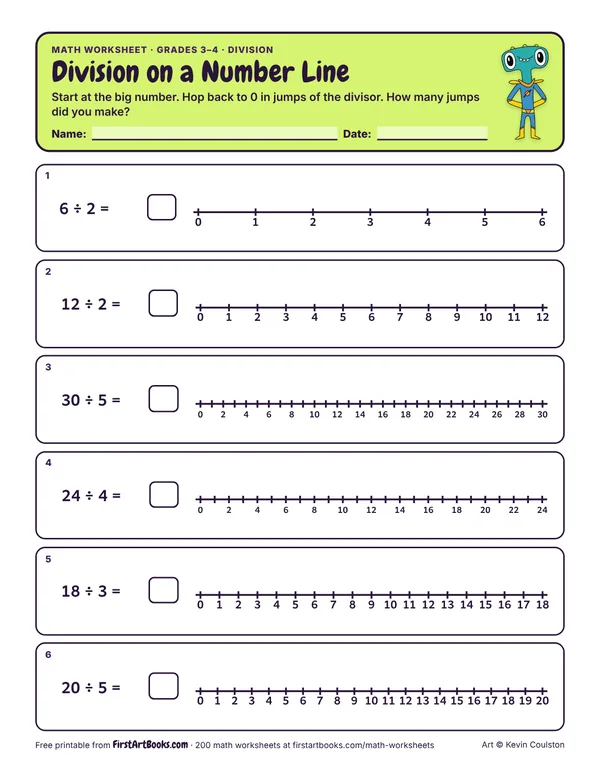
Six number lines. Kids hop back from the big number to 0 in equal jumps and count the jumps.
Print this sheet (PDF)Teacher notes and tips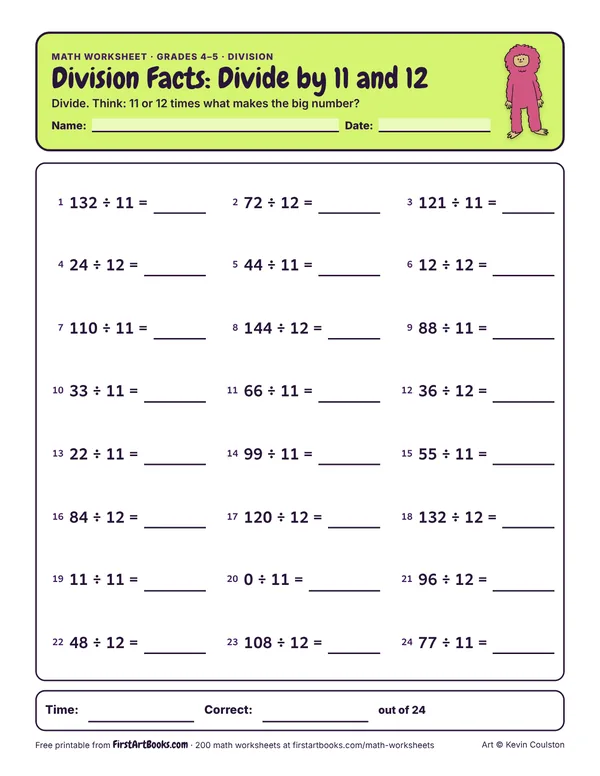
Twenty-four division facts with divisors of 11 and 12, up to 144 ÷ 12, to match the last rows of the times table.
Print this sheet (PDF)Teacher notes and tips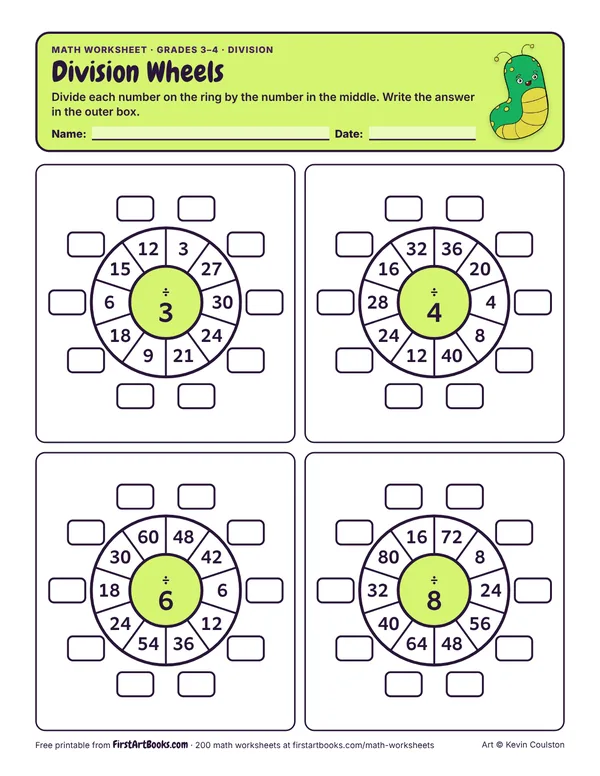
Four wheels for dividing by 3, 4, 6 and 8. Divide each number on the ring by the center and write the quotient.
Print this sheet (PDF)Teacher notes and tips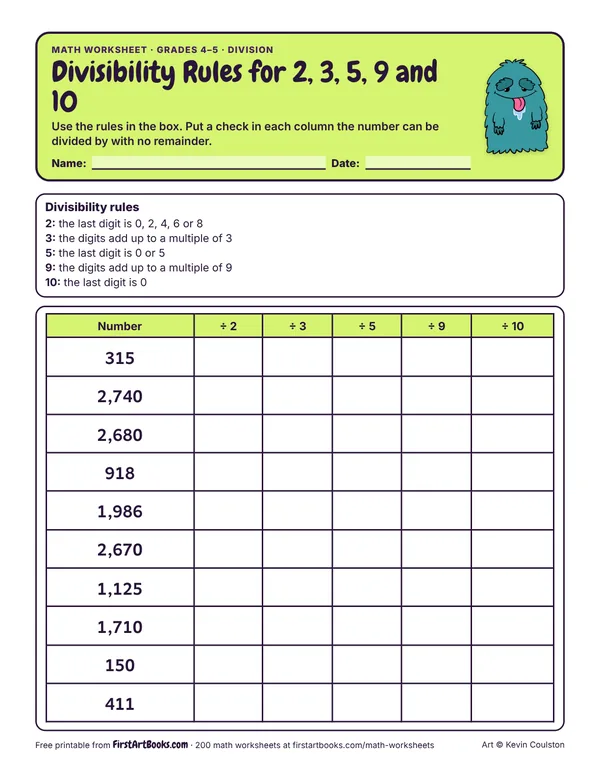
The five rules in a box, then twelve numbers to test. Kids check each number against each rule.
Print this sheet (PDF)Teacher notes and tips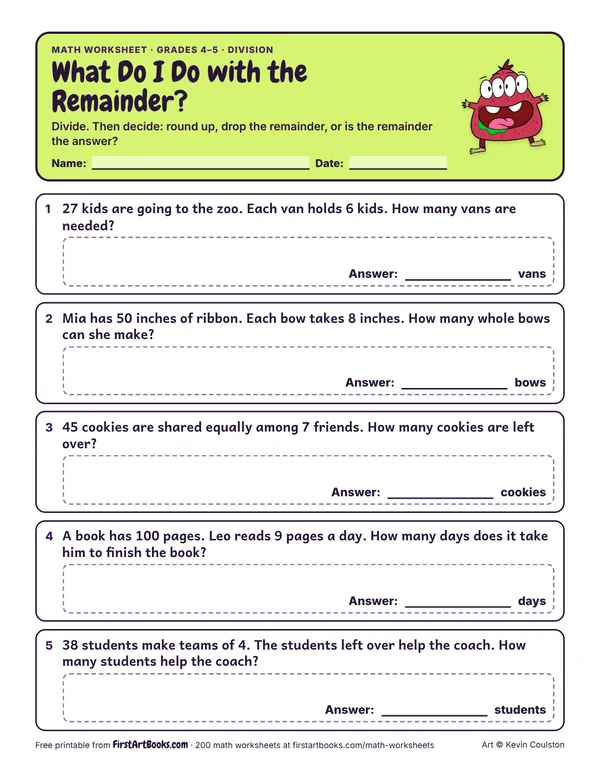
Five division stories. Sometimes you round up, sometimes you drop the leftover and sometimes the leftover is the answer.
Print this sheet (PDF)Teacher notes and tips
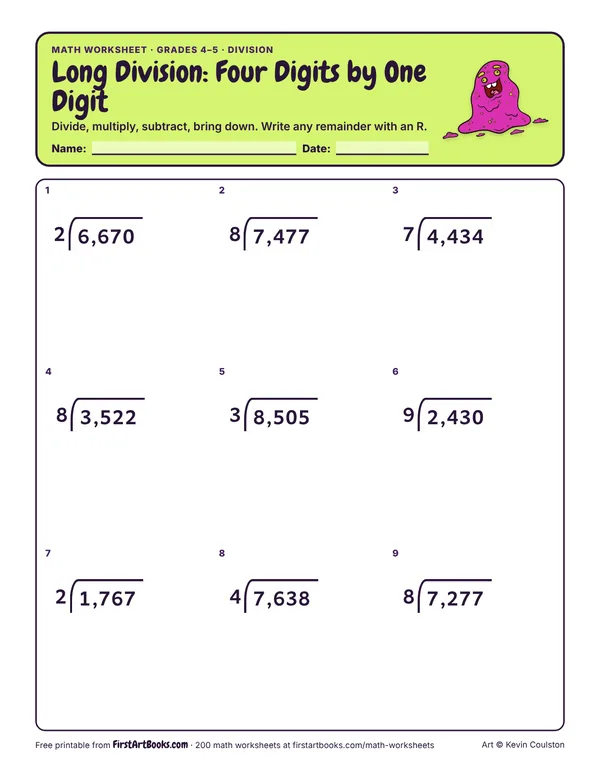
Nine long division problems with four-digit dividends and one-digit divisors, some with remainders.
Print this sheet (PDF)Teacher notes and tips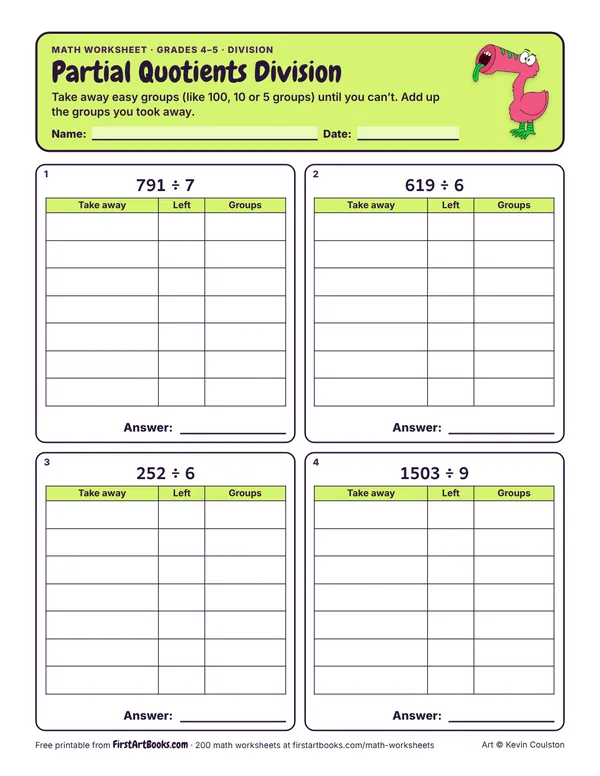
Four problems with a work box for the partial quotients method: take away easy chunks like 10 or 100 groups, then add the chunks.
Print this sheet (PDF)Teacher notes and tips

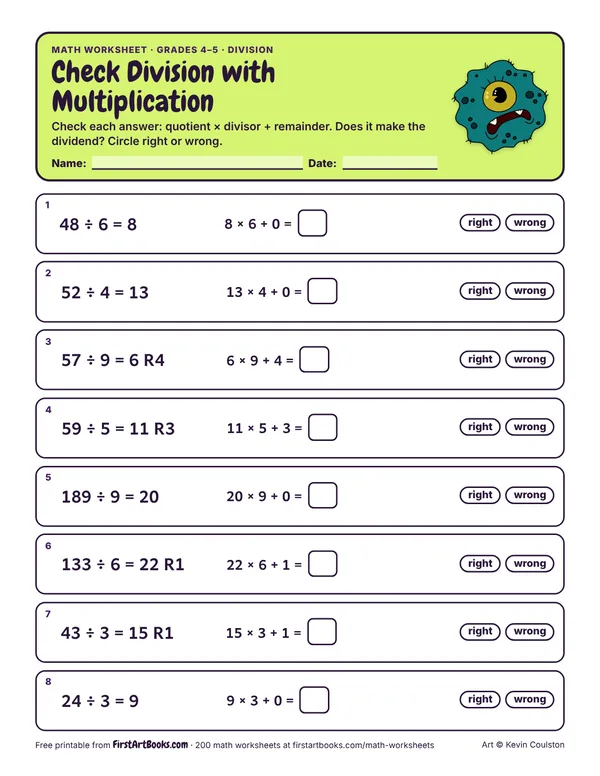
Eight division answers that may or may not be right. Kids multiply and add the remainder to check each one.
Print this sheet (PDF)Teacher notes and tips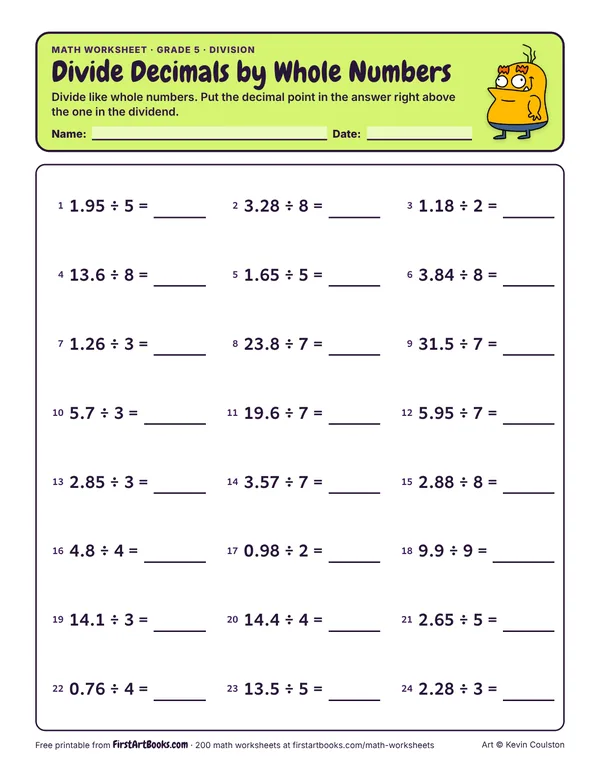
Twenty-four problems like 8.4 ÷ 4 and 1.35 ÷ 3. Divide like whole numbers and line up the decimal point.
Print this sheet (PDF)Teacher notes and tipsName and color fractions of shapes, place them on a number line, compare them and find equivalent fractions.
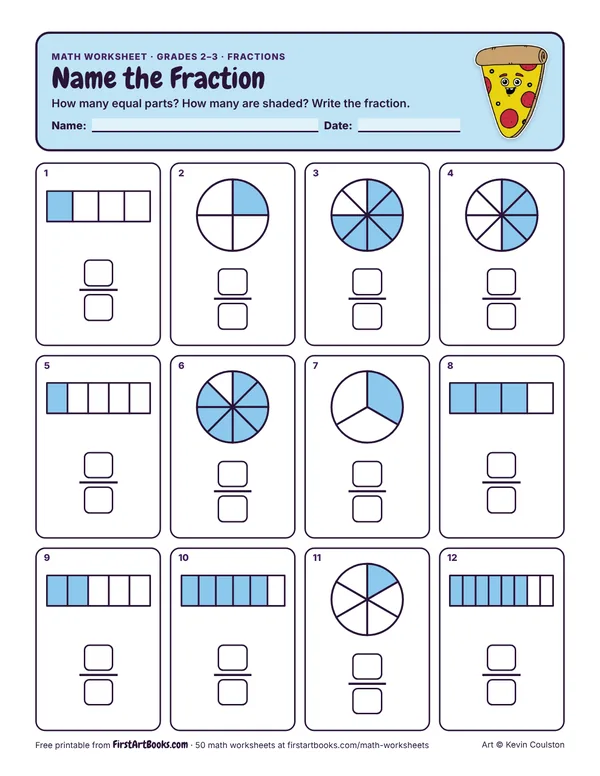
Twelve circles and bars split into equal parts. Kids write the fraction that is shaded.
Print this sheet (PDF)Teacher notes and tips
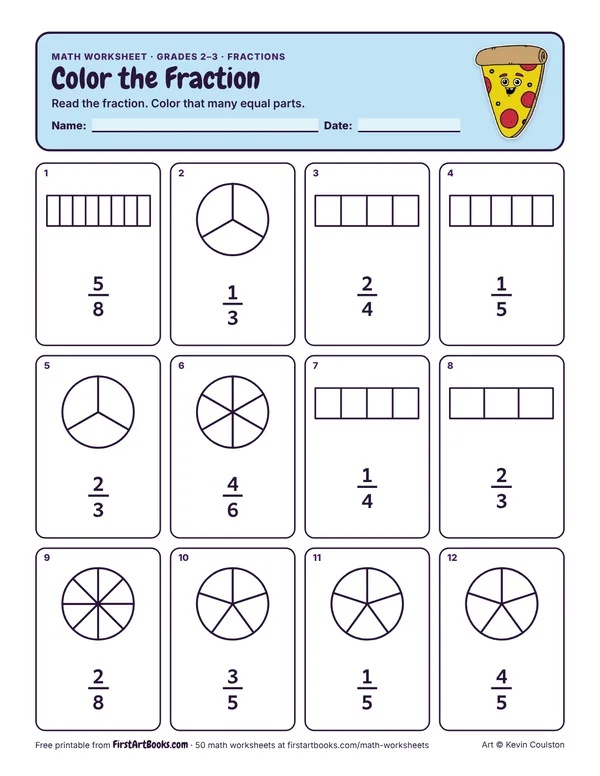
Twelve shapes in equal parts and a fraction under each. Kids color that many parts.
Print this sheet (PDF)Teacher notes and tips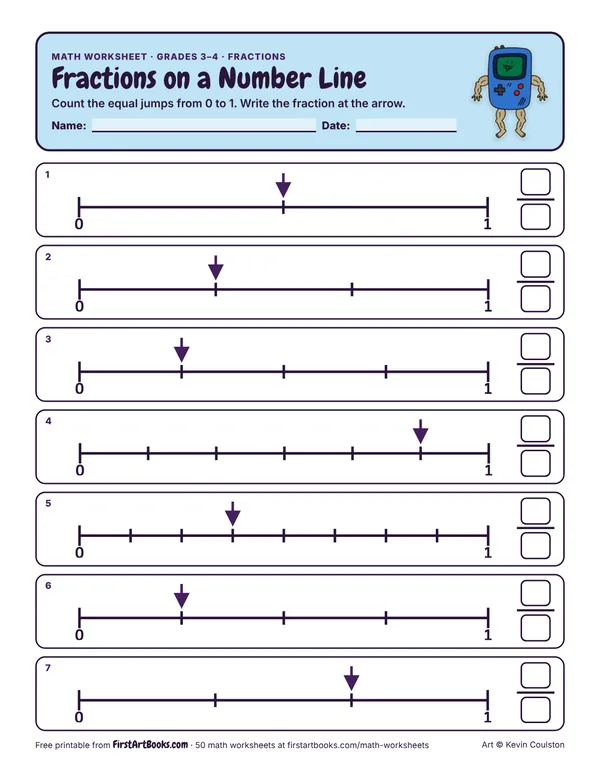
Seven number lines from 0 to 1, split into halves, thirds, fourths, sixths and eighths. Kids name the fraction at each arrow.
Print this sheet (PDF)Teacher notes and tips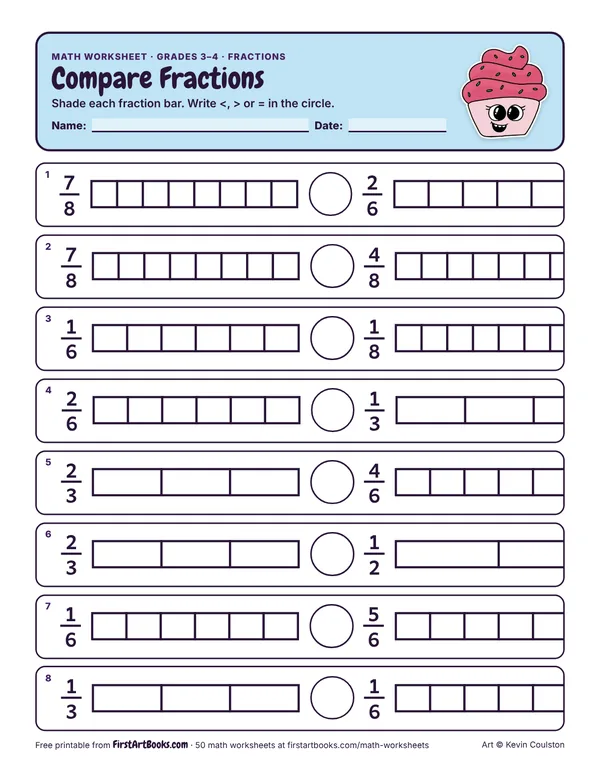
Eight pairs of fractions with fraction bars to shade. Kids write <, > or = between them.
Print this sheet (PDF)Teacher notes and tips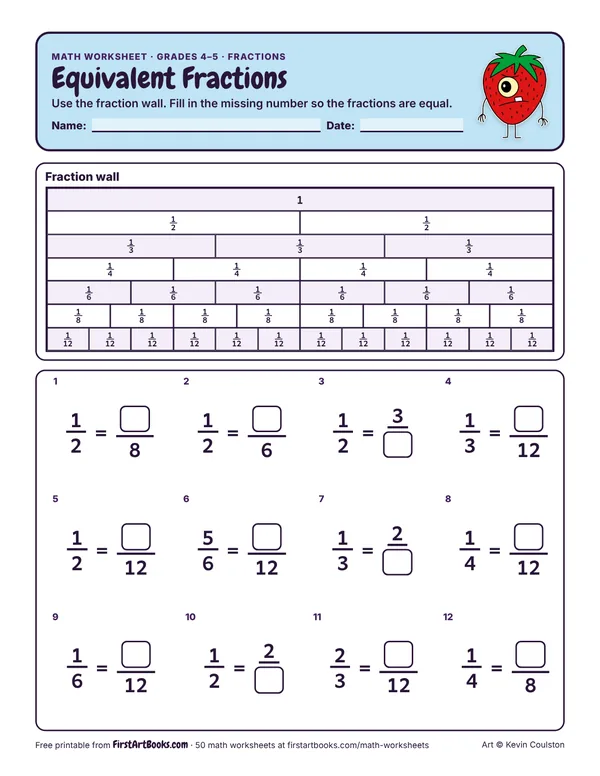
A fraction wall to read from, then twelve fractions to finish so both sides are equal.
Print this sheet (PDF)Teacher notes and tips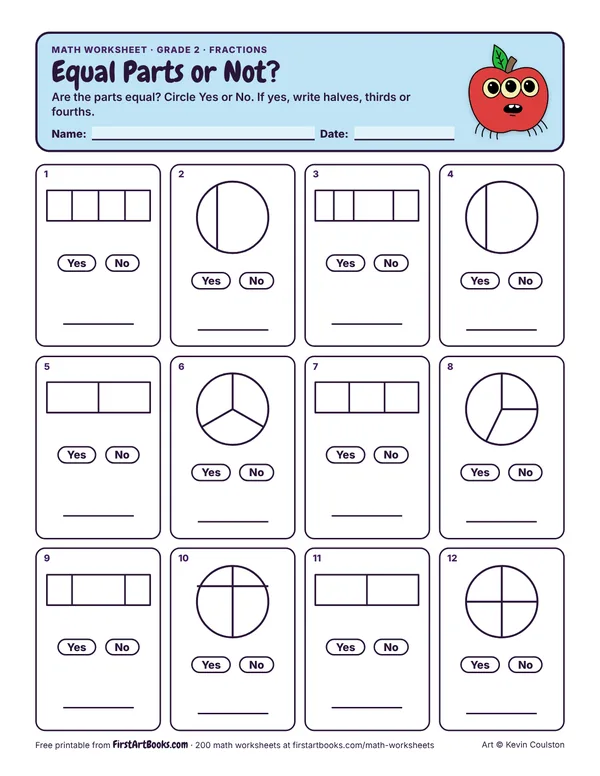
Twelve shapes split into parts, some fair and some not. Kids circle the ones cut into equal parts and name them halves, thirds or fourths.
Print this sheet (PDF)Teacher notes and tips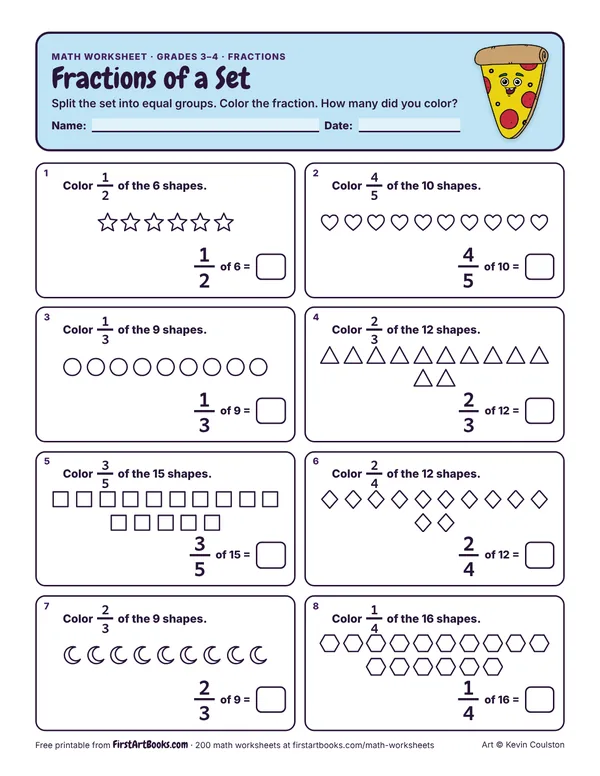
Eight groups of shapes. Color 2/3 of 9, 3/4 of 12 and more, then write how many that is.
Print this sheet (PDF)Teacher notes and tips

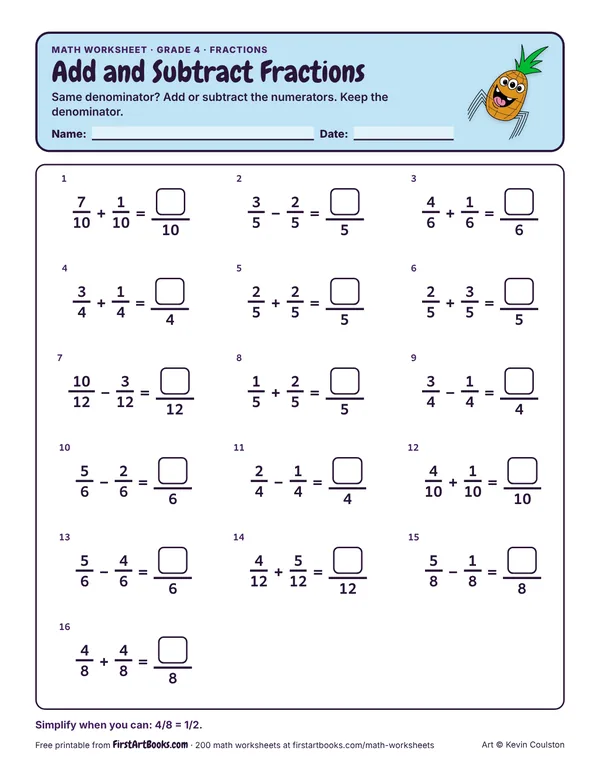
Sixteen problems with like denominators: add or subtract the tops, keep the bottom, then simplify where you can.
Print this sheet (PDF)Teacher notes and tips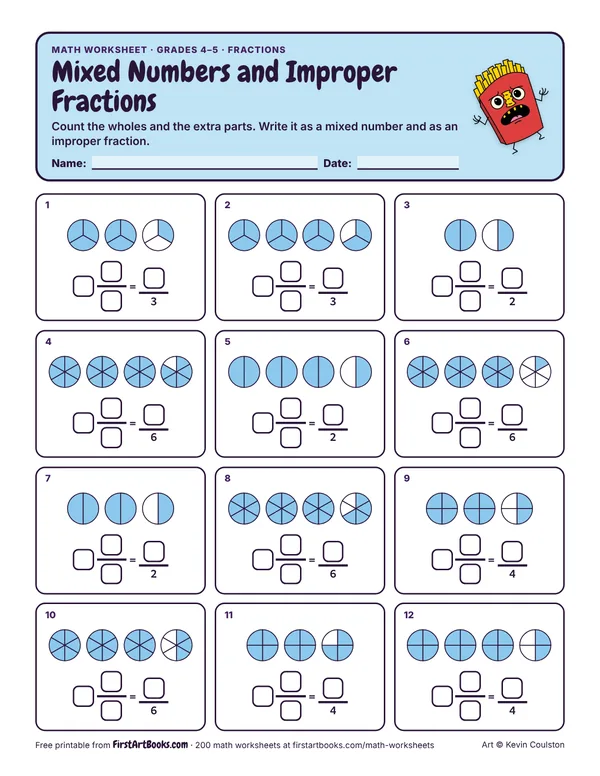
Pictures of whole pies plus a part. Kids write each one as a mixed number and as an improper fraction.
Print this sheet (PDF)Teacher notes and tips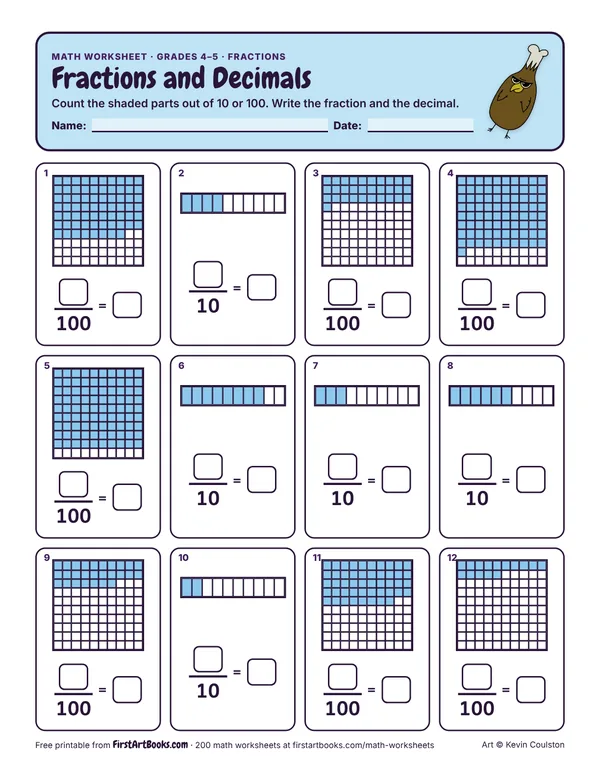
Tenths and hundredths on shaded grids. Kids write each one as a fraction and as a decimal.
Print this sheet (PDF)Teacher notes and tips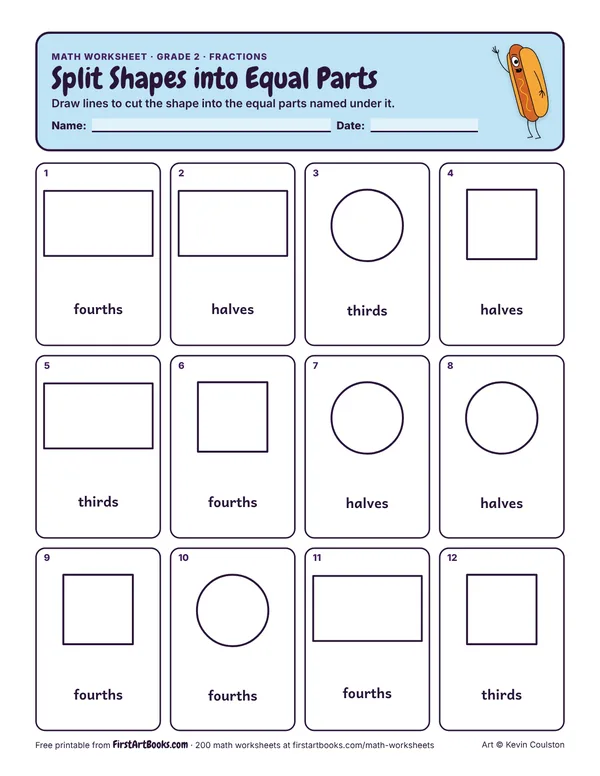
Twelve squares, circles and rectangles. Kids draw lines to cut each one into halves, thirds or fourths.
Print this sheet (PDF)Teacher notes and tips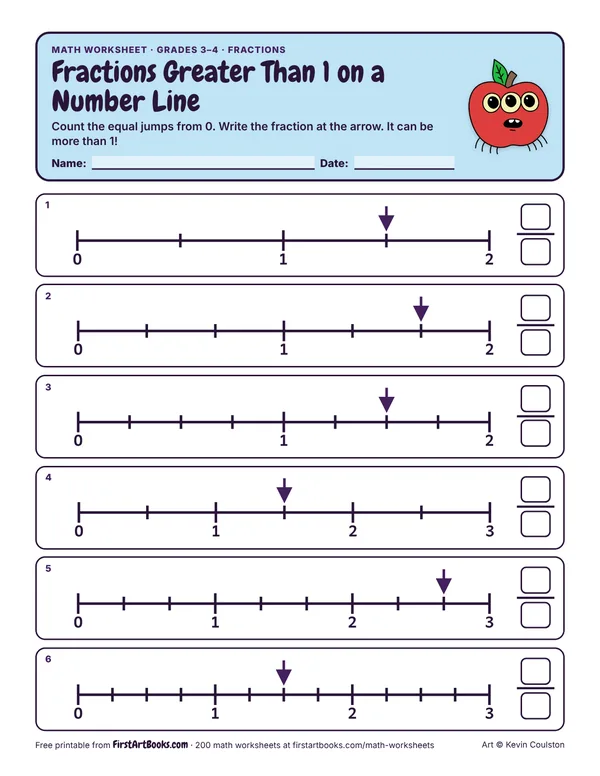
Six number lines from 0 to 2 or 0 to 3, in halves, thirds and fourths. Kids name the fraction at each arrow.
Print this sheet (PDF)Teacher notes and tips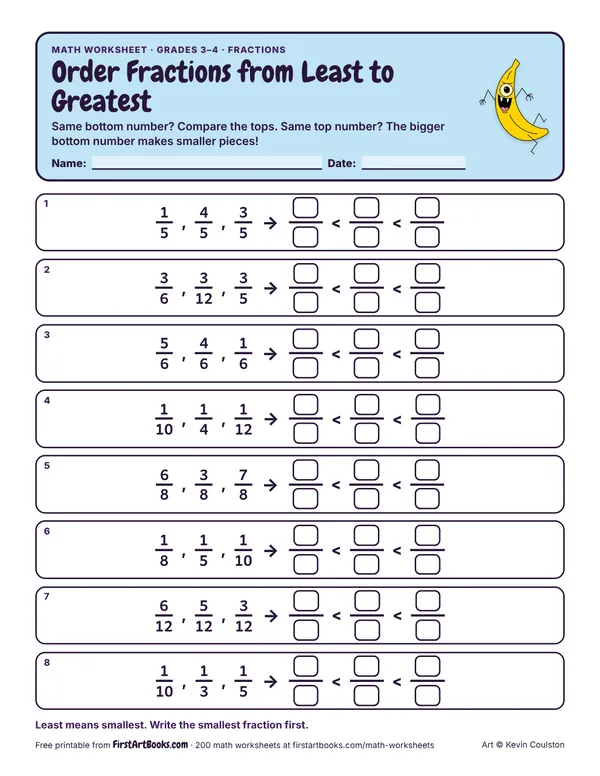
Eight sets of three fractions with the same denominator or the same numerator. Kids put each set in order.
Print this sheet (PDF)Teacher notes and tips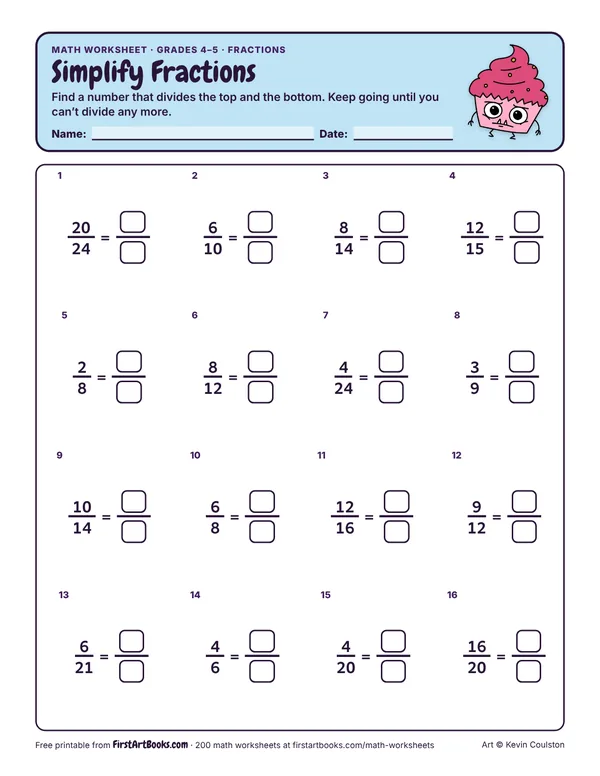
Sixteen fractions to write in simplest form. Divide the top and bottom by the same number.
Print this sheet (PDF)Teacher notes and tips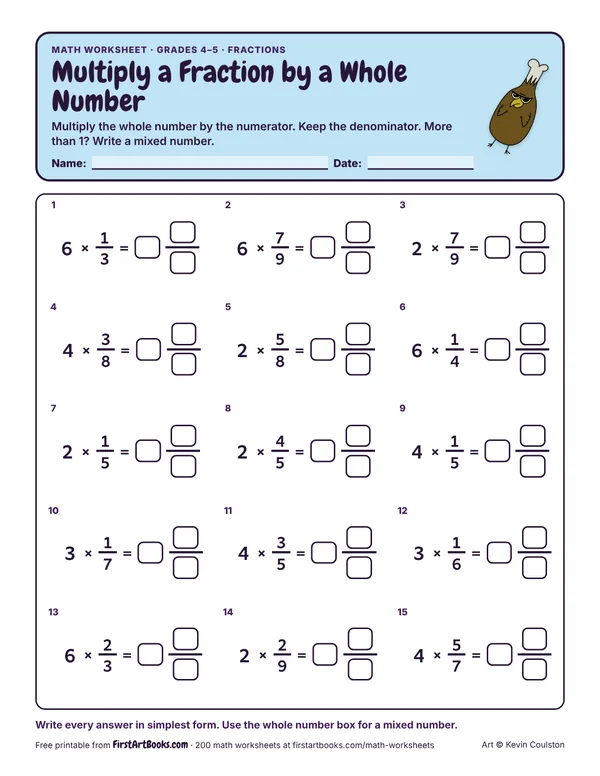
Fifteen problems like 3 × 2/5. Multiply the whole number by the top, keep the bottom, and write it as a mixed number if you can.
Print this sheet (PDF)Teacher notes and tips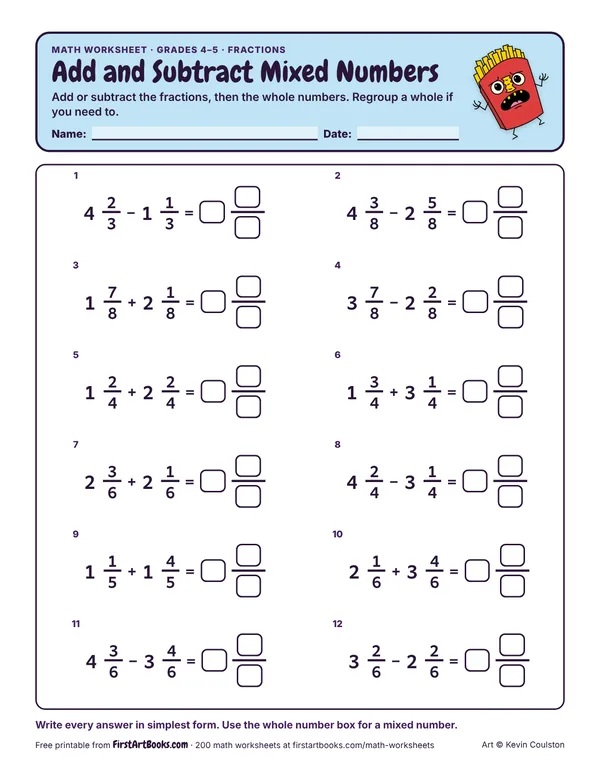
Twelve mixed number problems with like denominators. Add or subtract the wholes and the fractions, and regroup when you need to.
Print this sheet (PDF)Teacher notes and tips

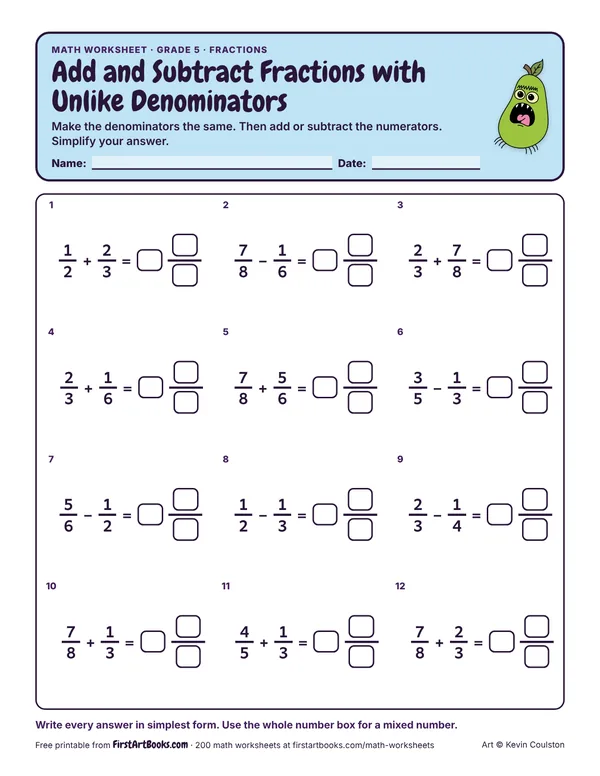
Twelve problems like 1/2 + 1/3. Find a common denominator first, then add or subtract and simplify.
Print this sheet (PDF)Teacher notes and tips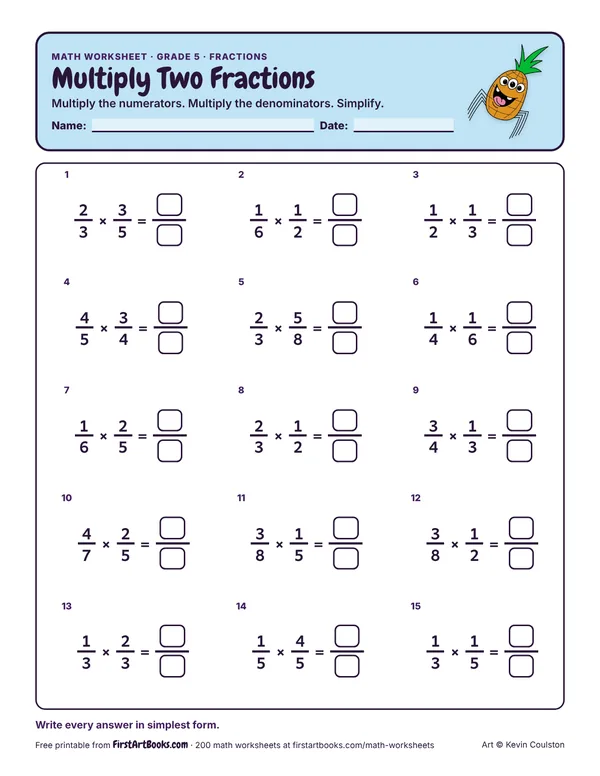
Fifteen fraction times fraction problems. Multiply the tops, multiply the bottoms, then simplify.
Print this sheet (PDF)Teacher notes and tips

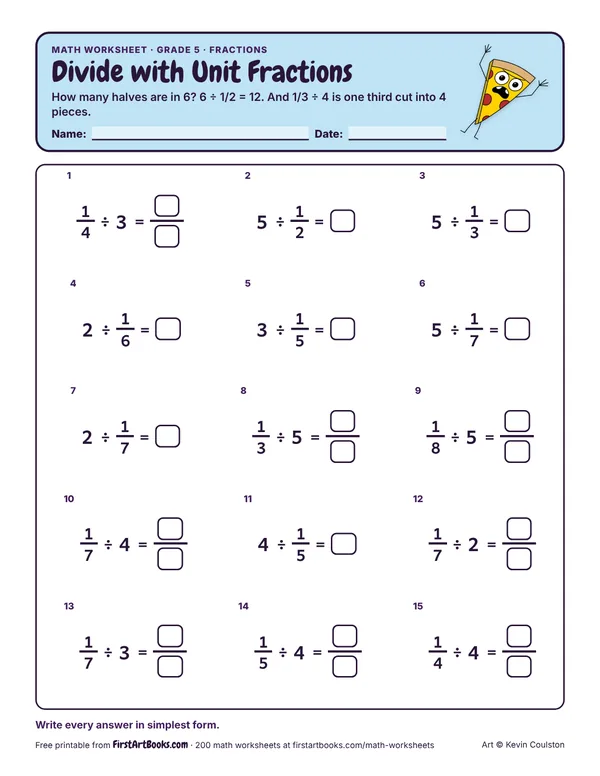
Fifteen problems like 1/3 ÷ 4 and 6 ÷ 1/2: unit fractions divided by whole numbers and whole numbers divided by unit fractions.
Print this sheet (PDF)Teacher notes and tips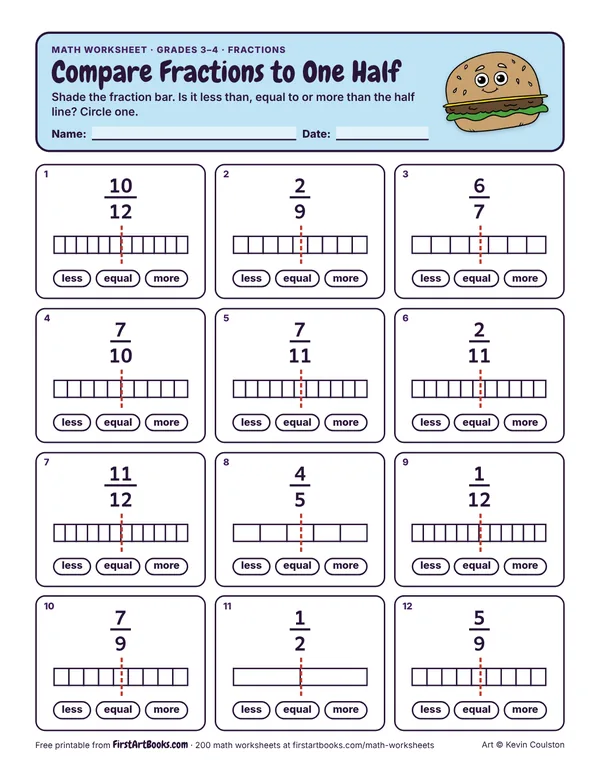
Twelve fractions with fraction bars and a line at the halfway mark. Kids decide if each is less than, equal to or more than 1/2.
Print this sheet (PDF)Teacher notes and tipsTens and ones blocks, number bonds, hundreds, tens and ones, expanded and word form, and rounding.
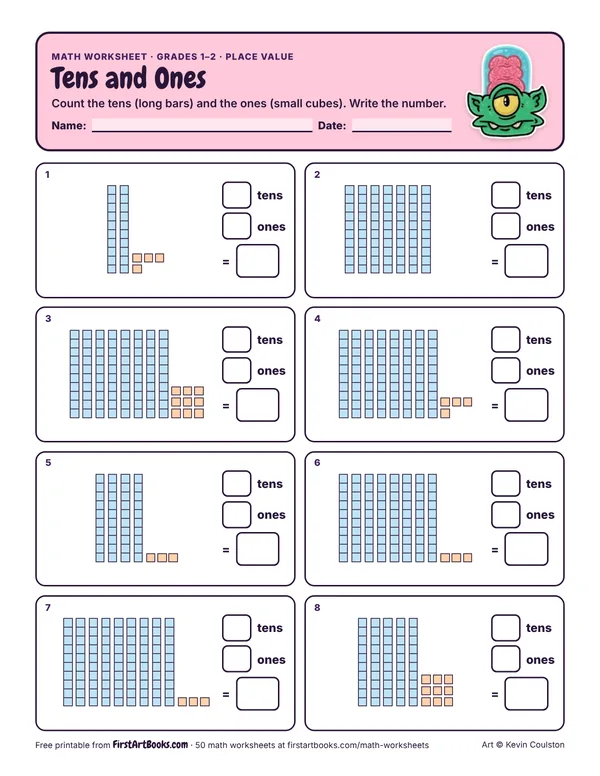
Eight sets of base-ten blocks. Kids count the tens and ones and write the number.
Print this sheet (PDF)Teacher notes and tips
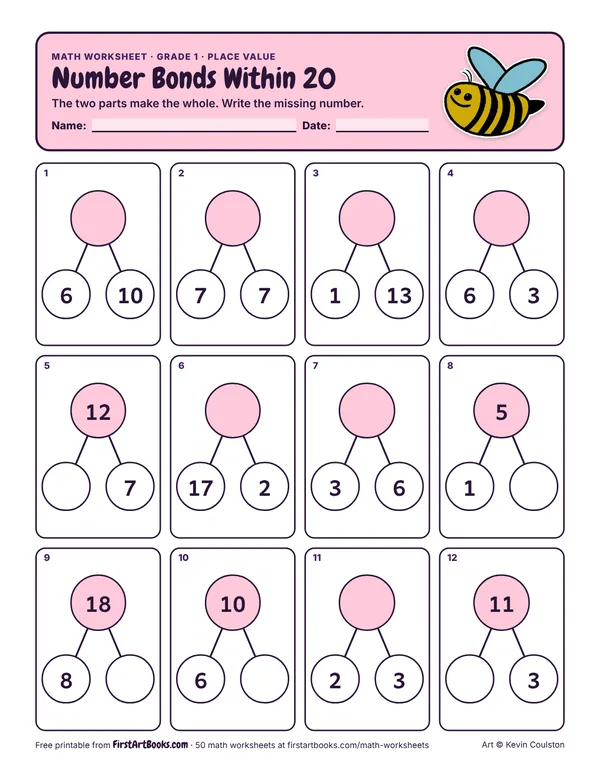
Twelve number bonds. Kids find the missing part or the whole, breaking numbers up to 20 into two parts.
Print this sheet (PDF)Teacher notes and tips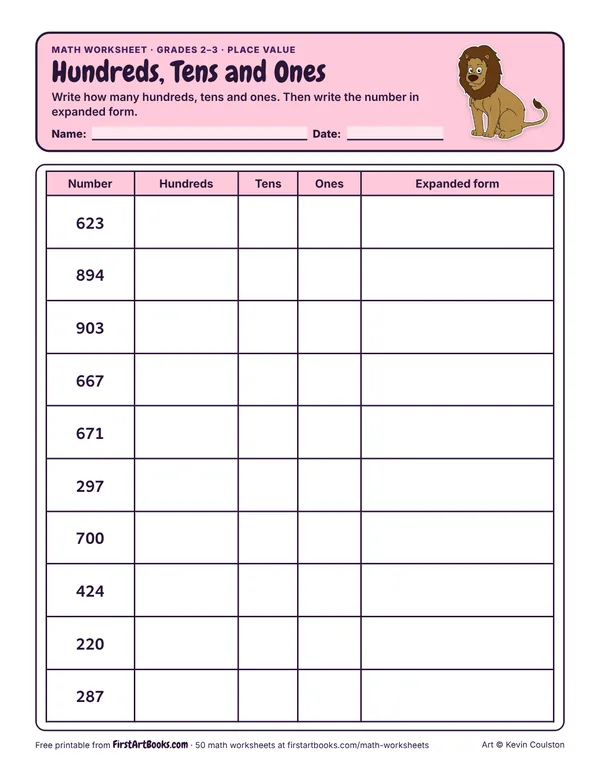
Ten three-digit numbers to break into hundreds, tens and ones and write in expanded form.
Print this sheet (PDF)Teacher notes and tips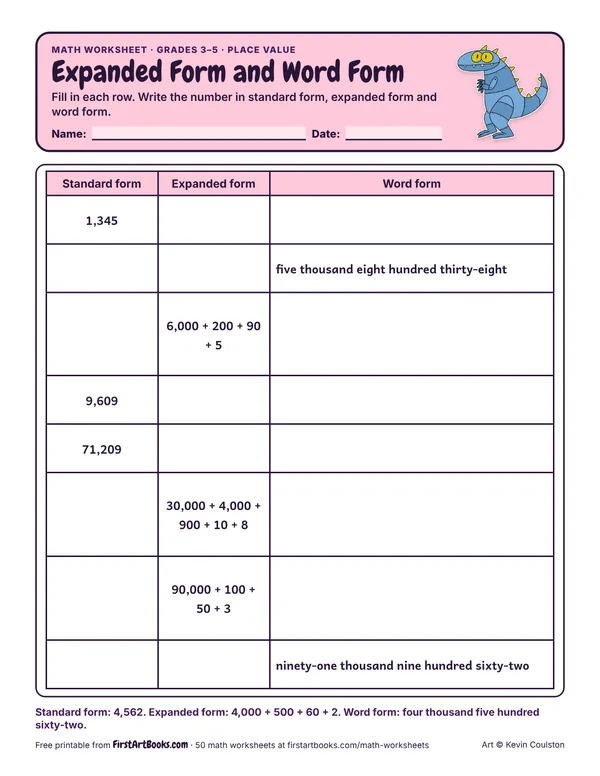
Numbers into the thousands written three ways: standard form, expanded form and word form.
Print this sheet (PDF)Teacher notes and tips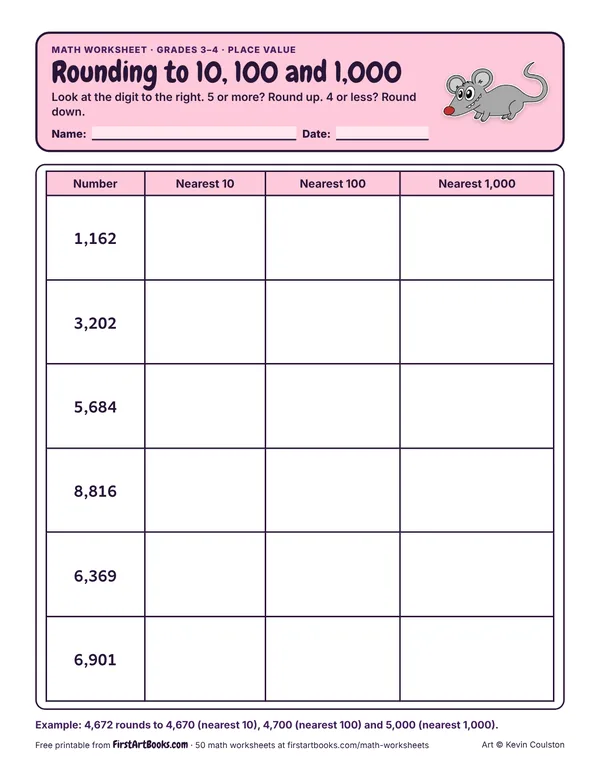
Eighteen numbers to round to the nearest ten, hundred and thousand. Five or more rounds up.
Print this sheet (PDF)Teacher notes and tips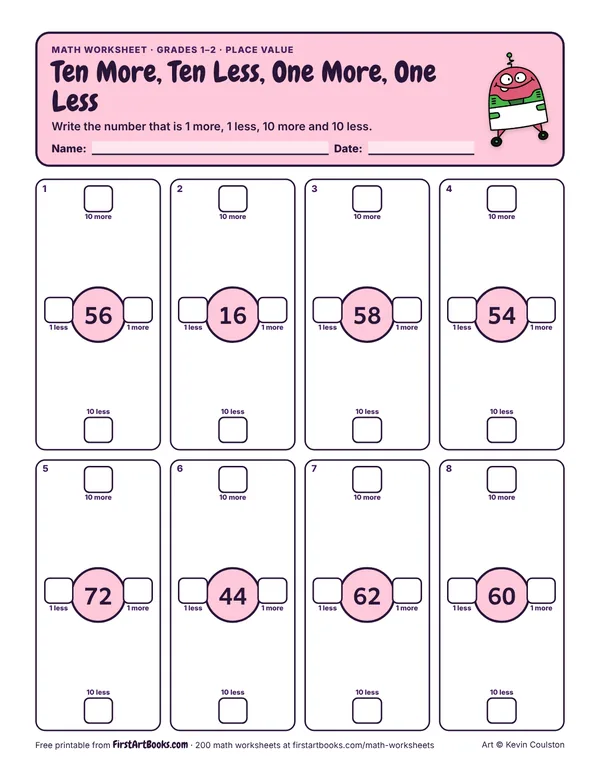
Eight numbers in the middle of a cross. Kids write ten more, ten less, one more and one less around each.
Print this sheet (PDF)Teacher notes and tips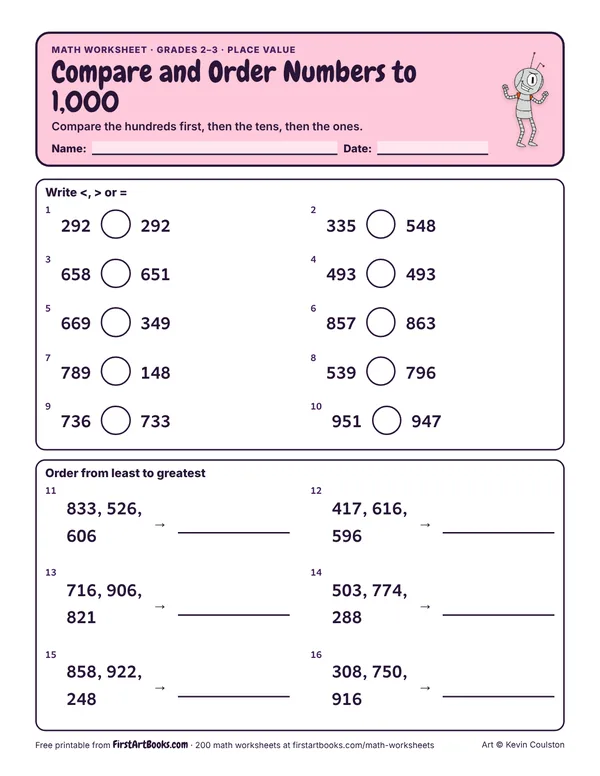
Ten pairs to compare with <, > or =, then six sets of three numbers to put in order from least to greatest.
Print this sheet (PDF)Teacher notes and tips

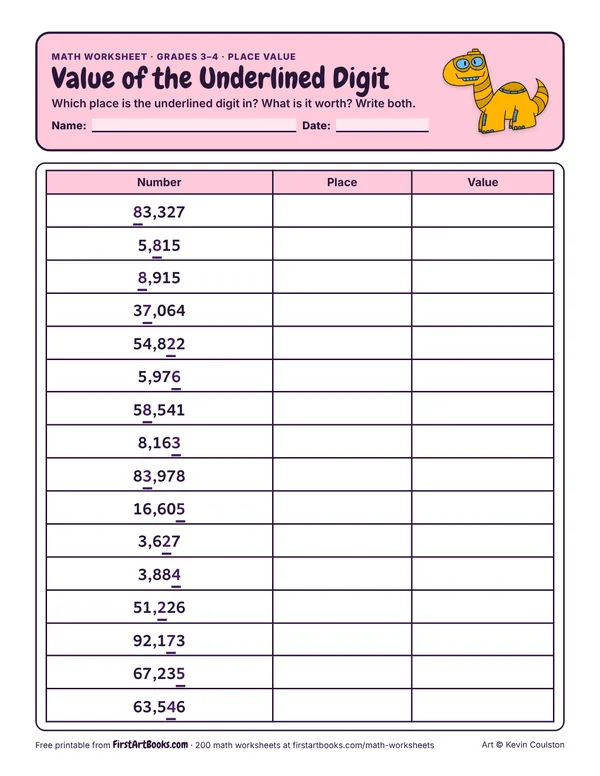
Sixteen numbers up to 99,999 with one digit underlined. Kids write its place and its value.
Print this sheet (PDF)Teacher notes and tips

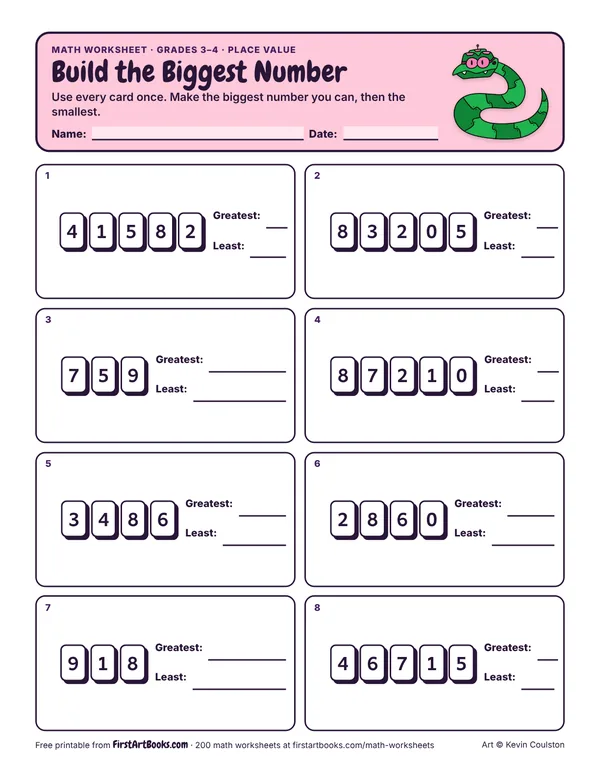
Eight sets of digit cards. Kids arrange them to make the greatest and the least number they can.
Print this sheet (PDF)Teacher notes and tips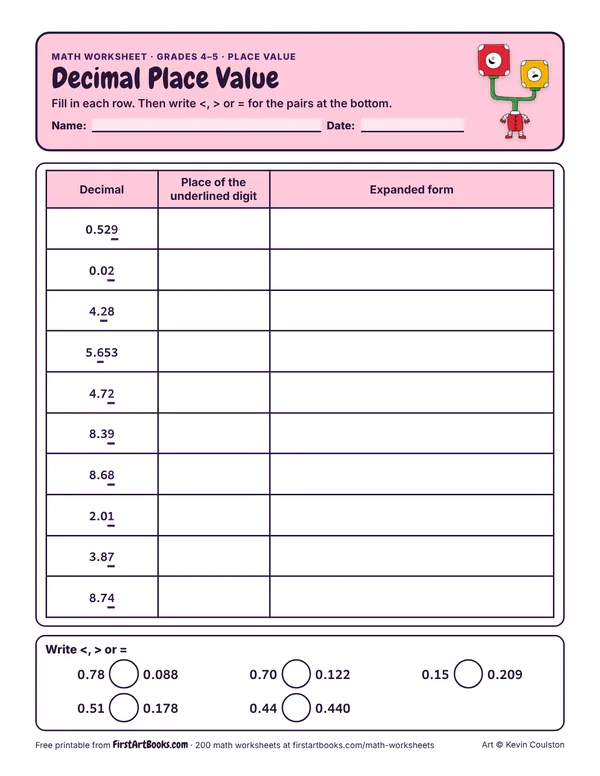
Ten decimals to the hundredths and thousandths: name the digits, write in expanded form and compare.
Print this sheet (PDF)Teacher notes and tips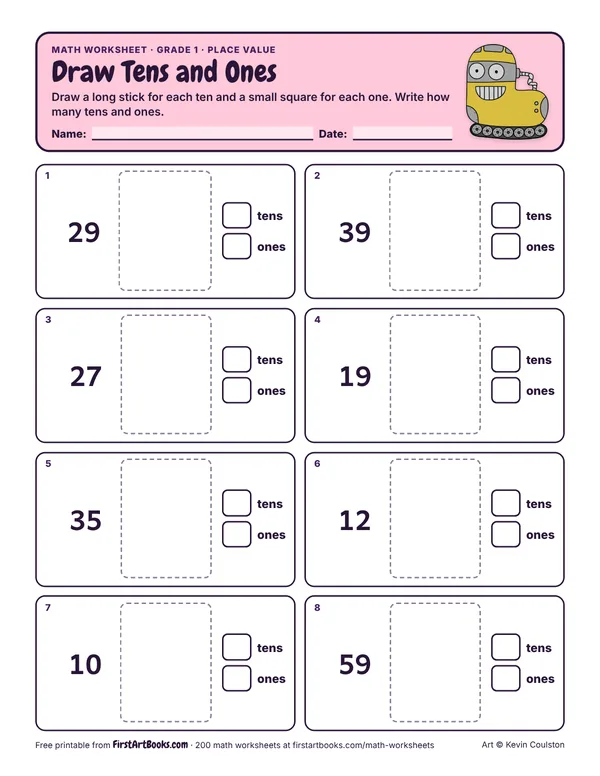
Eight two-digit numbers. Kids draw tens as long sticks and ones as little squares, then write the tens and ones.
Print this sheet (PDF)Teacher notes and tips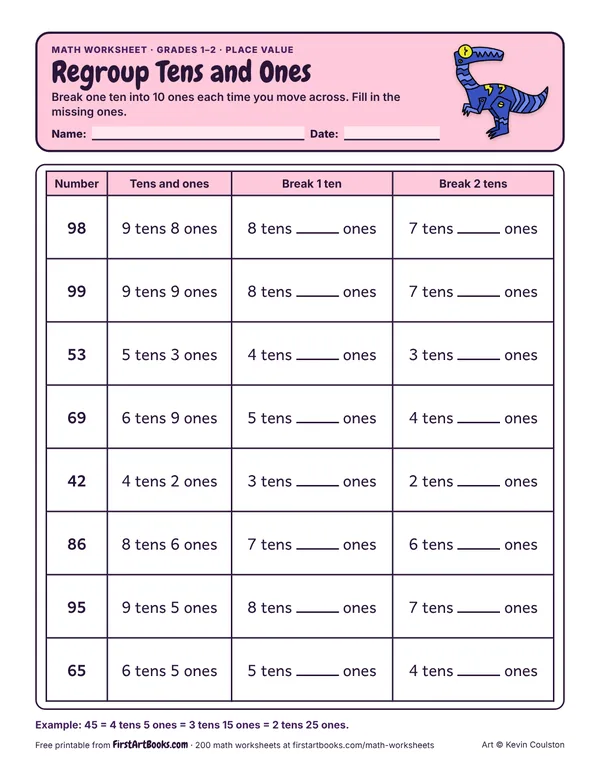
Eight numbers written three ways: 45 is 4 tens 5 ones, and also 3 tens 15 ones, and 2 tens 25 ones.
Print this sheet (PDF)Teacher notes and tips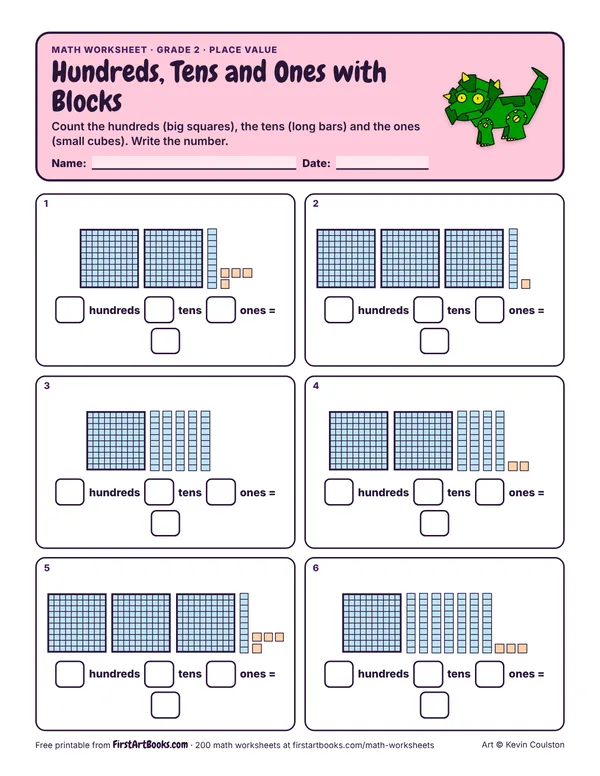
Six sets of base-ten blocks with hundreds flats, tens rods and ones cubes. Kids count each and write the number.
Print this sheet (PDF)Teacher notes and tips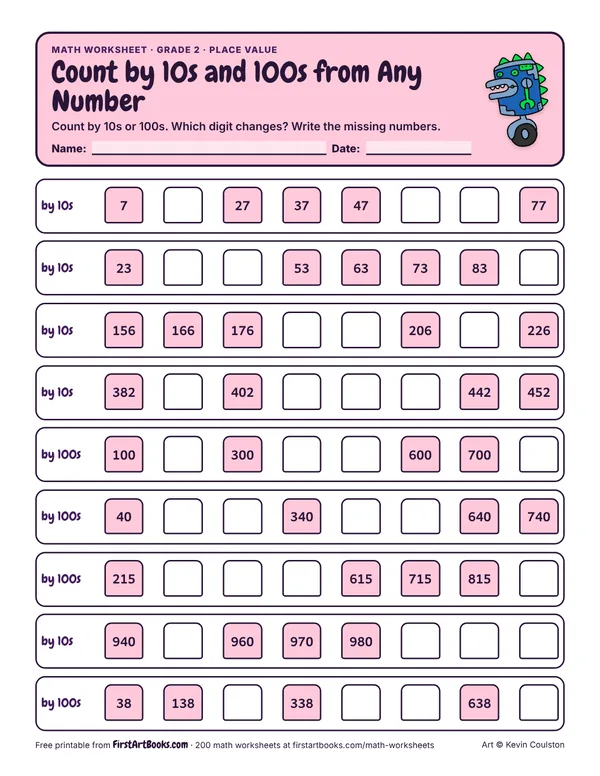
Nine number trains that count by tens and hundreds from numbers like 23, 156 and 215. Only one digit changes each time!
Print this sheet (PDF)Teacher notes and tips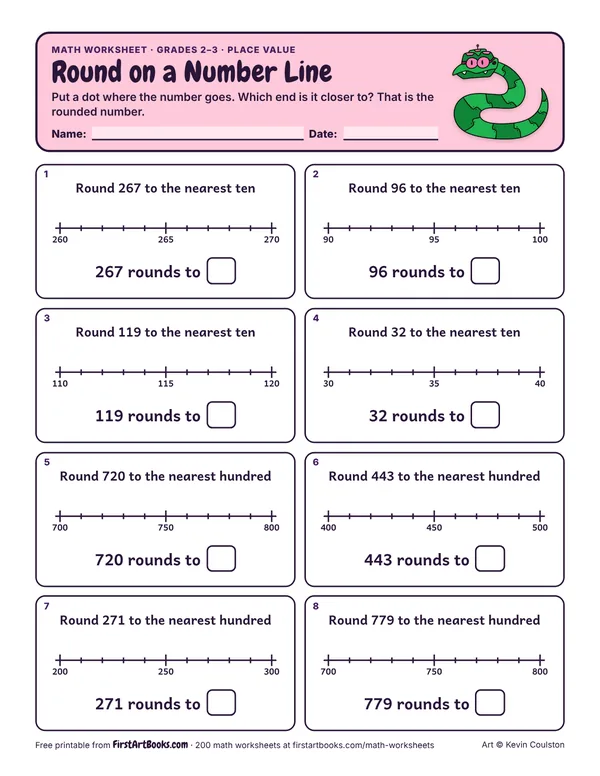
Eight numbers to mark on a number line between two tens or two hundreds. Kids see which one is closer and round.
Print this sheet (PDF)Teacher notes and tips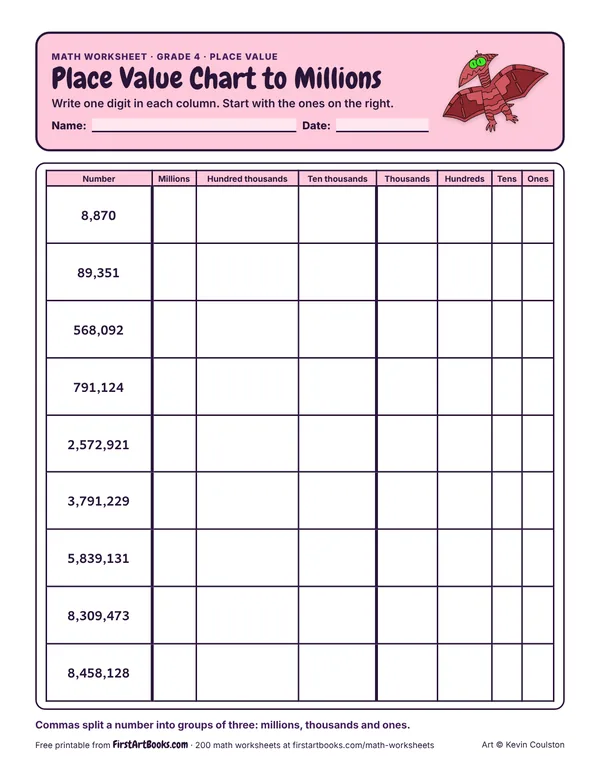
Nine numbers up to 9,999,999 to write in a place value chart, one digit in each column, from millions to ones.
Print this sheet (PDF)Teacher notes and tips

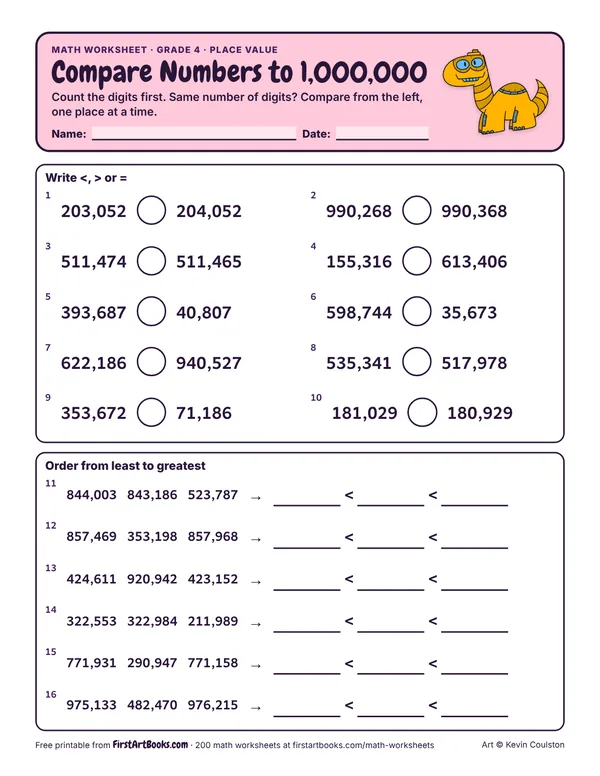
Ten pairs of numbers up to a million to compare with <, > or =, then six sets of three to put in order.
Print this sheet (PDF)Teacher notes and tips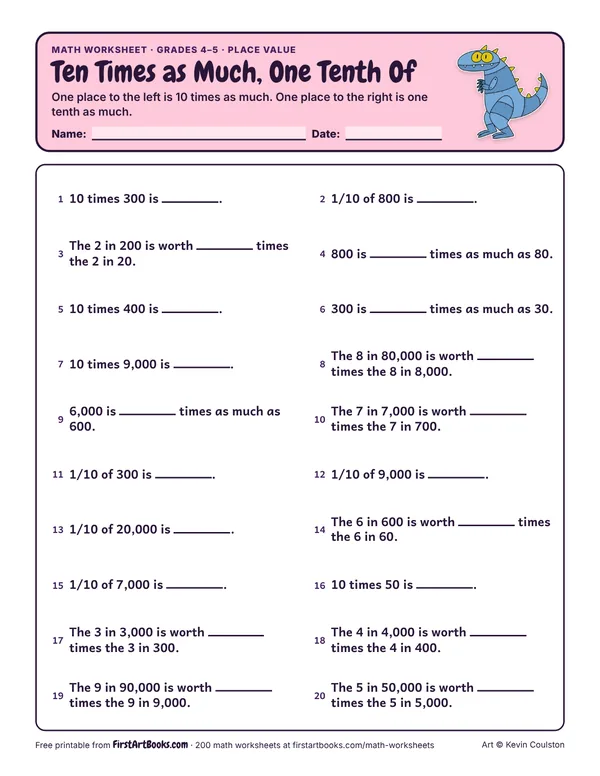
Twenty questions like “700 is ___ times 70” and “1/10 of 5,000 is ___”. A digit is worth ten times more one place to the left.
Print this sheet (PDF)Teacher notes and tips

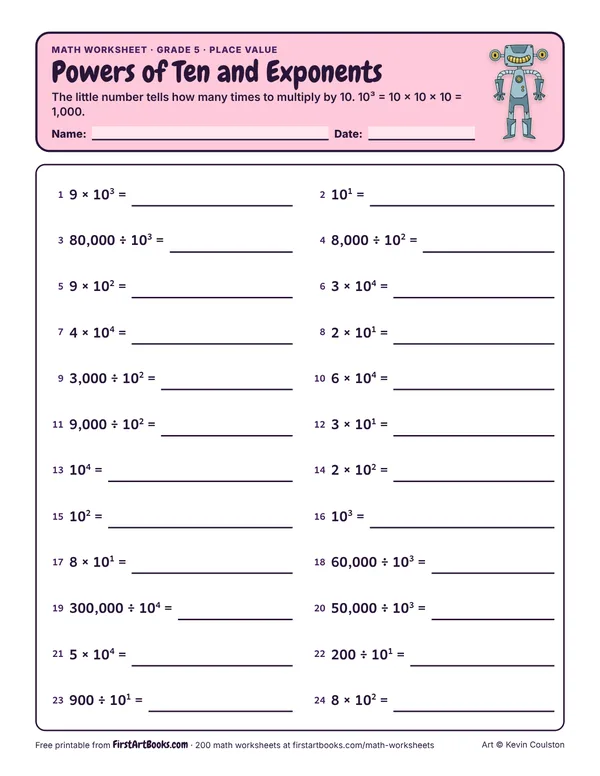
Twenty-four problems with 10², 10³ and 10⁴: write the number, multiply by a power of ten and divide by one.
Print this sheet (PDF)Teacher notes and tips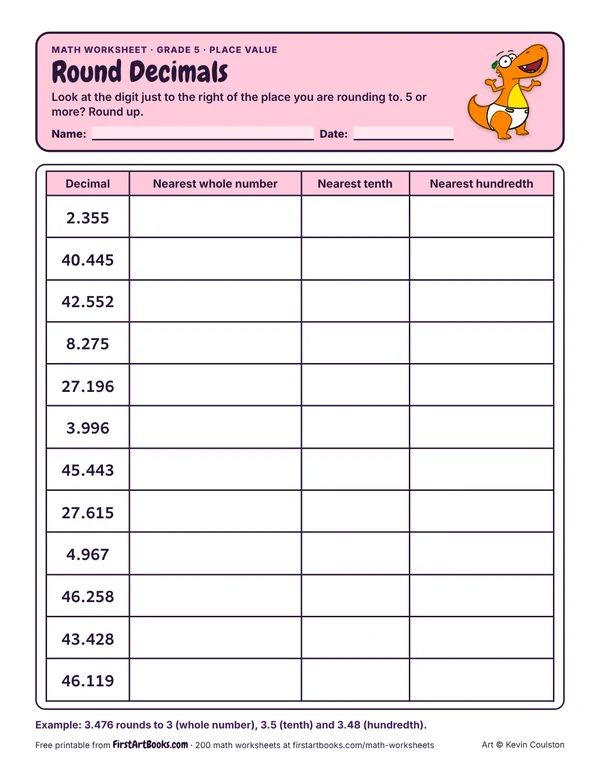
Twelve decimals to round to the nearest whole number, tenth and hundredth. Five or more rounds up.
Print this sheet (PDF)Teacher notes and tipsOne page of story problems for each grade from 1st to 5th, with room to draw or show the work.
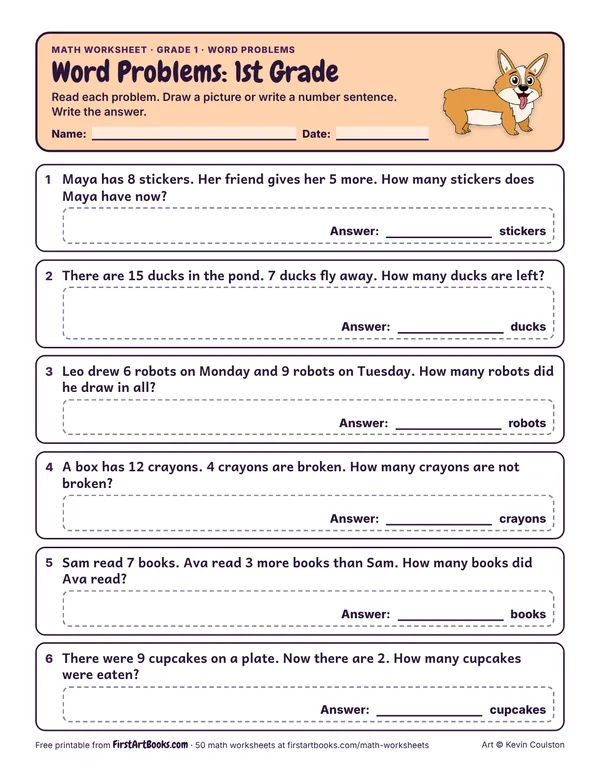
Six story problems with adding and subtracting within 20, including a “some went away” and a “how many more” problem.
Print this sheet (PDF)Teacher notes and tips

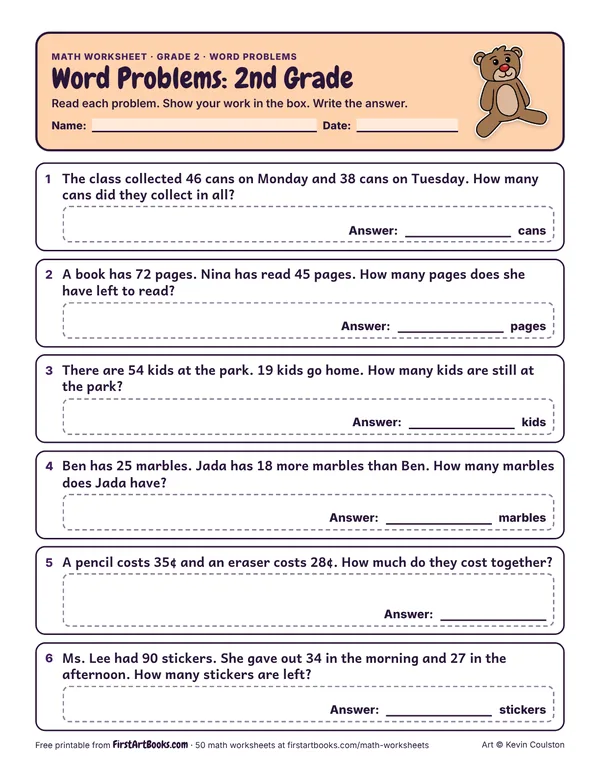
Six story problems with adding and subtracting within 100, one money problem and one two-step problem.
Print this sheet (PDF)Teacher notes and tips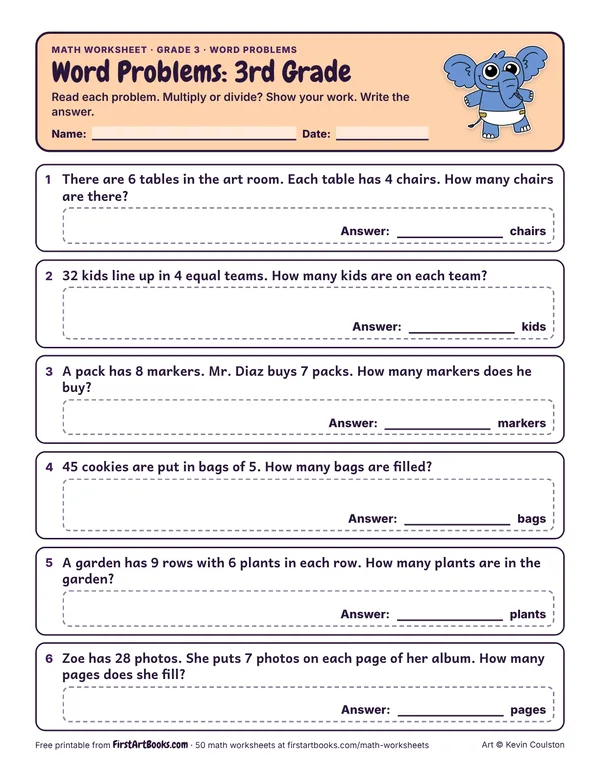
Six multiplication and division story problems: equal groups, rows and sharing.
Print this sheet (PDF)Teacher notes and tips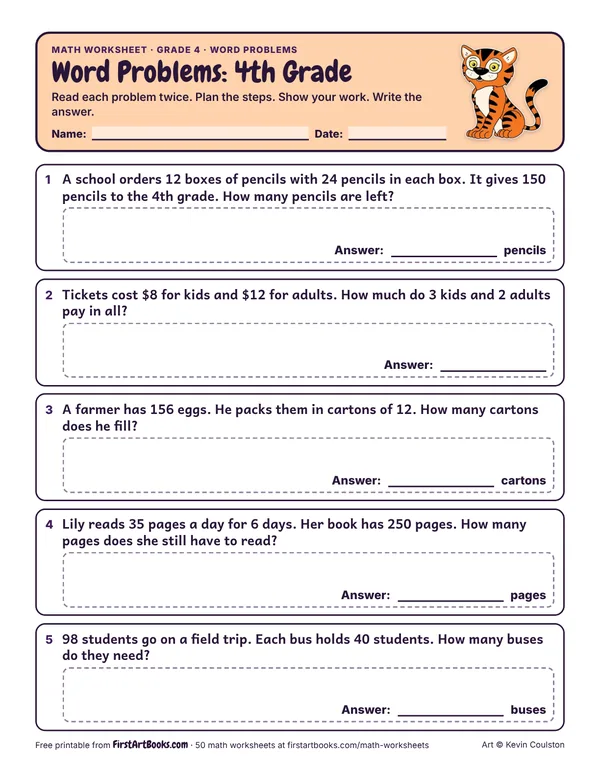
Five multi-step story problems with bigger numbers, including one where the remainder changes the answer.
Print this sheet (PDF)Teacher notes and tips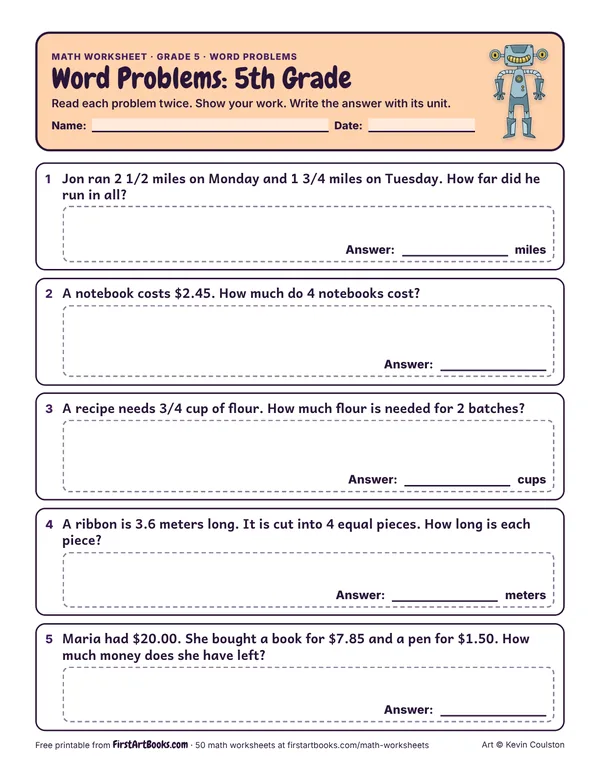
Five story problems with fractions, mixed numbers, decimals and money.
Print this sheet (PDF)Teacher notes and tips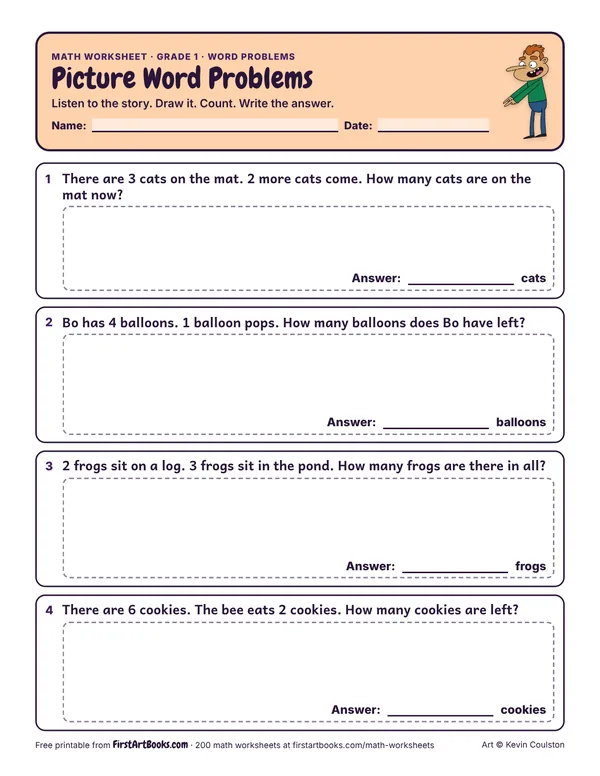
Four short stories within 10, with a big box to draw each one. An easy first sheet: read them aloud together.
Print this sheet (PDF)Teacher notes and tips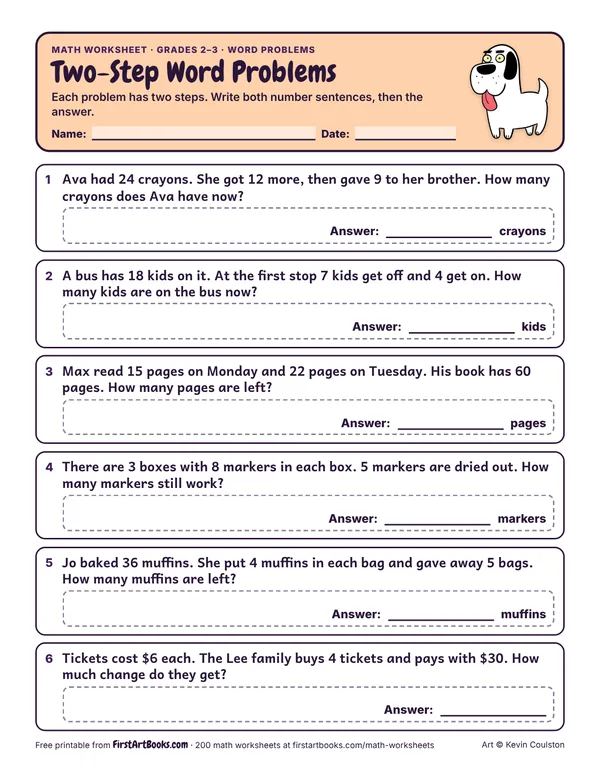
Six problems that take two steps: something happens, then something else. Kids plan both before they start.
Print this sheet (PDF)Teacher notes and tips

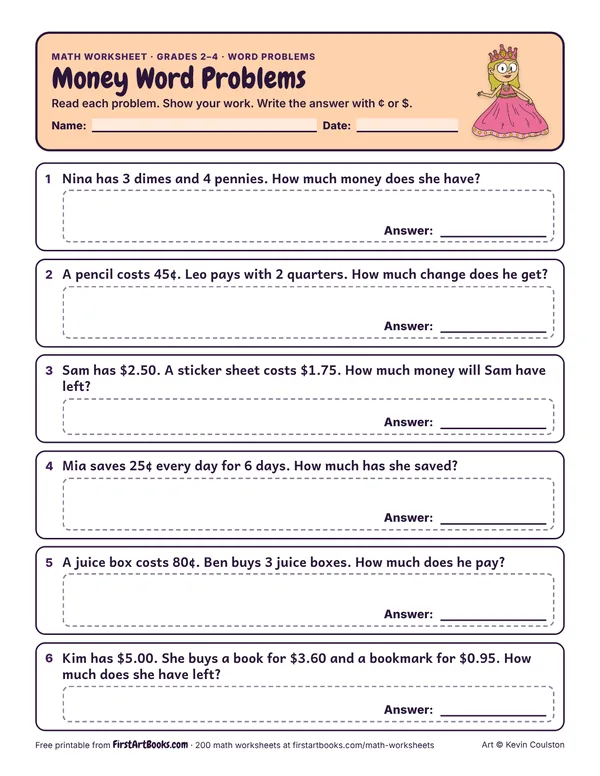
Six story problems with coins, change and saving, up to $5.
Print this sheet (PDF)Teacher notes and tips

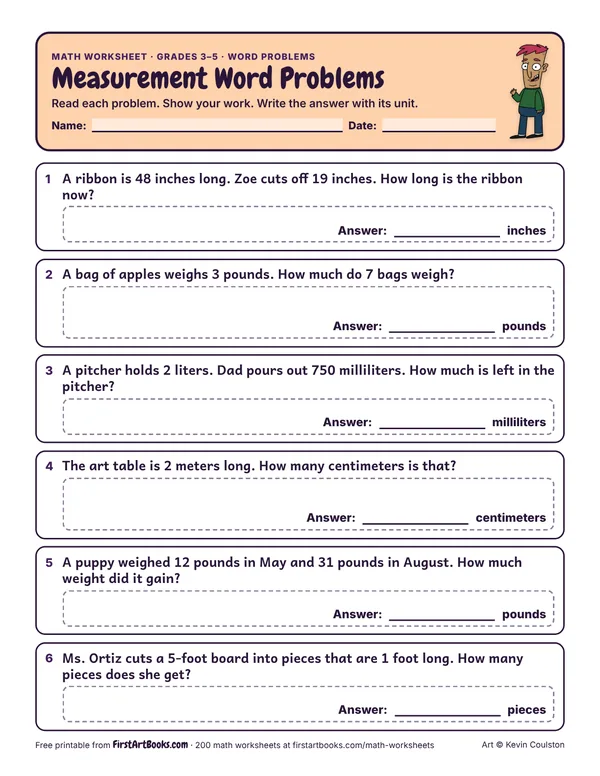
Six problems with inches, feet, pounds, meters and liters. Watch the units!
Print this sheet (PDF)Teacher notes and tips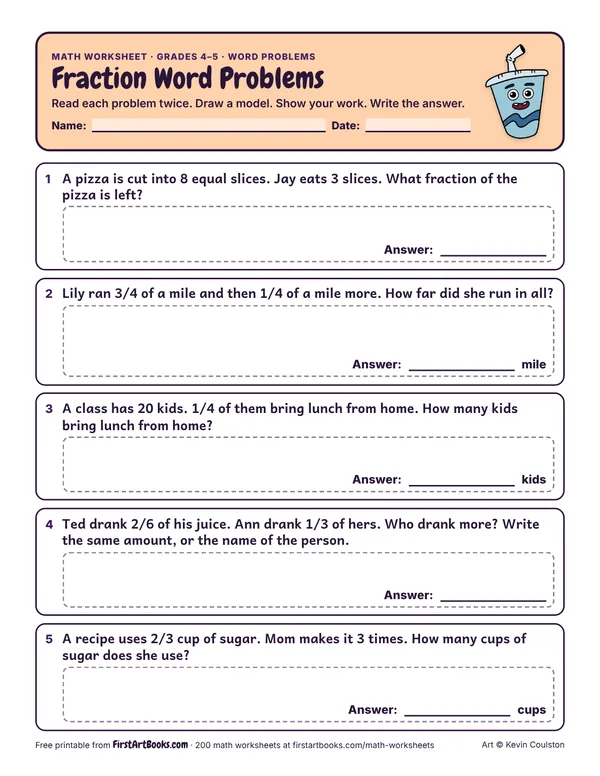
Five story problems with fractions of a whole and of a set. Draw a model if it helps.
Print this sheet (PDF)Teacher notes and tips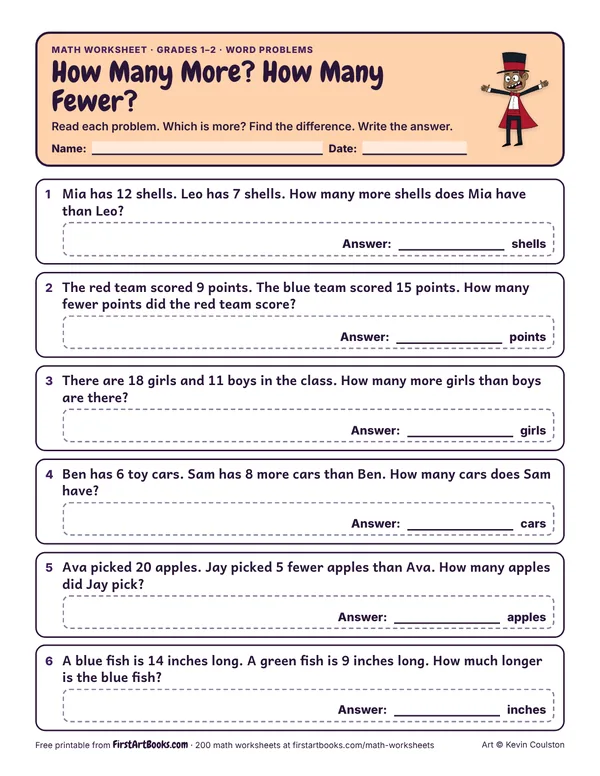
Six compare stories: how many more, how many fewer and how much longer. Kids find the difference between two amounts.
Print this sheet (PDF)Teacher notes and tips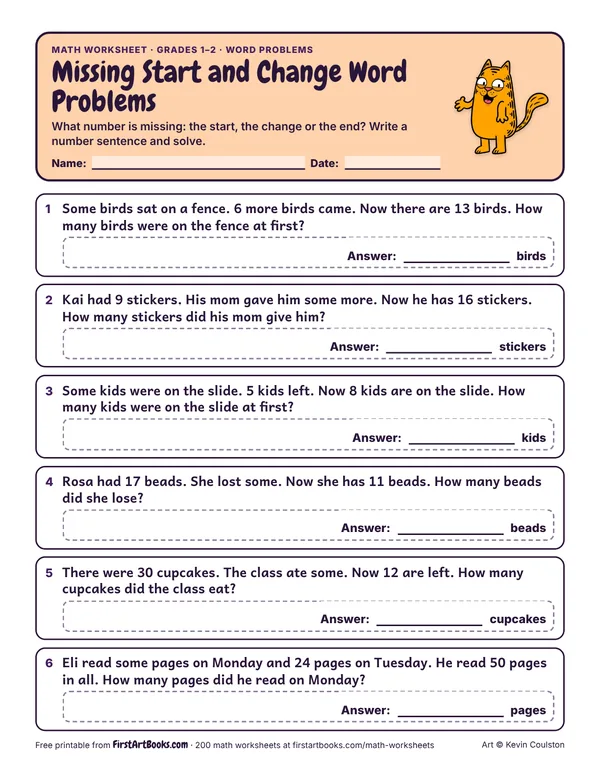
Six stories where the missing number is at the start or in the middle: “Some birds sat on a fence…”.
Print this sheet (PDF)Teacher notes and tips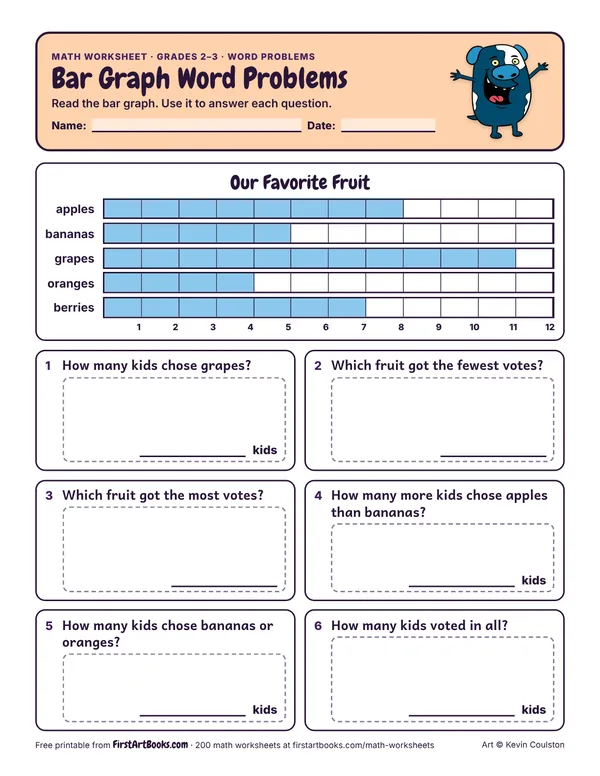
A bar graph of favorite fruit votes and six questions: how many, how many more, how many in all.
Print this sheet (PDF)Teacher notes and tips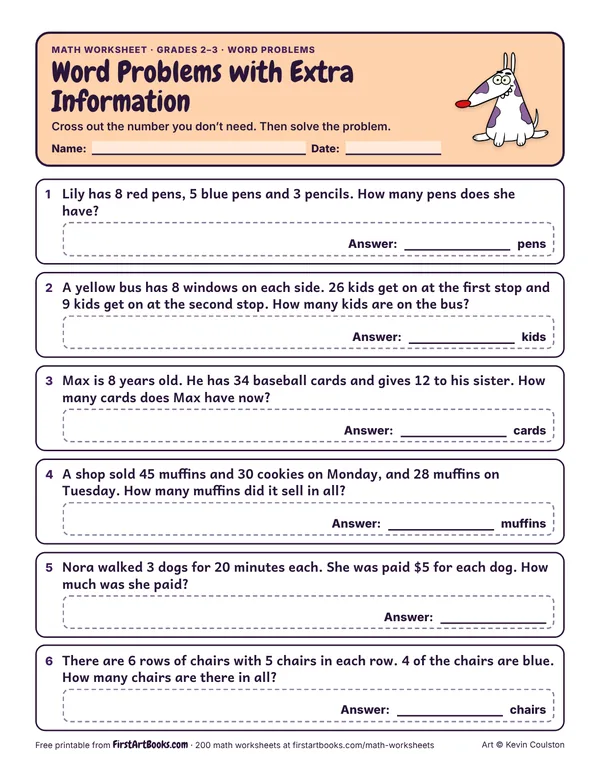
Six stories with a number you don’t need. Kids cross out the extra information before they solve.
Print this sheet (PDF)Teacher notes and tips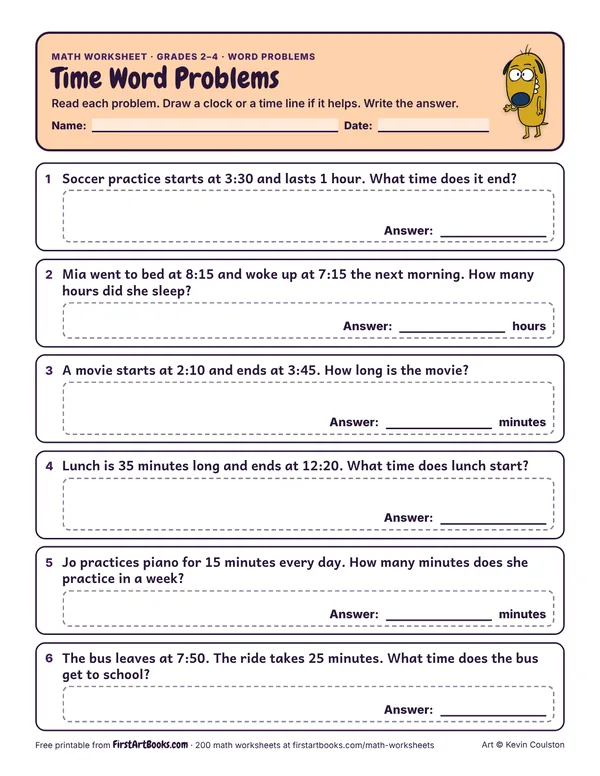
Six stories about start times, end times and how long things take: practice, movies, lunch and the bus.
Print this sheet (PDF)Teacher notes and tips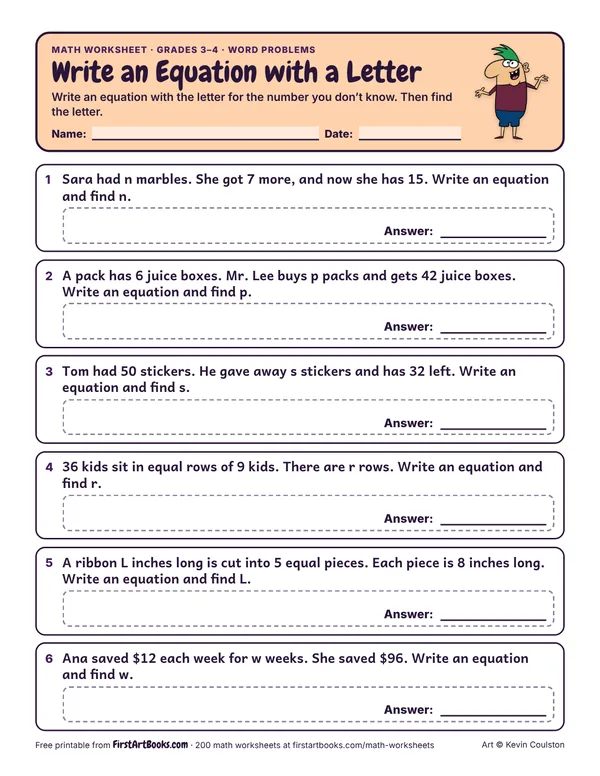
Six stories where a letter stands for the unknown number. Kids write the equation, then solve for the letter.
Print this sheet (PDF)Teacher notes and tips

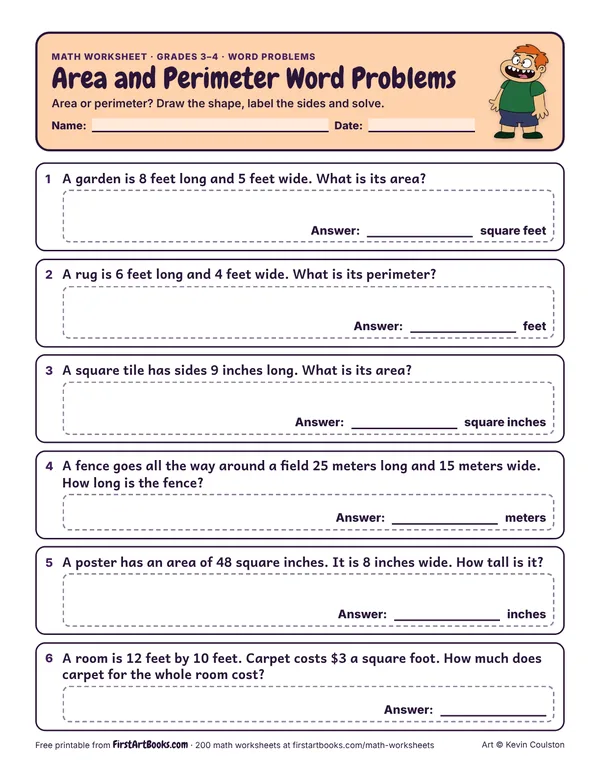
Six stories about gardens, rugs, fences and posters. Area is the space inside; perimeter is the distance around.
Print this sheet (PDF)Teacher notes and tips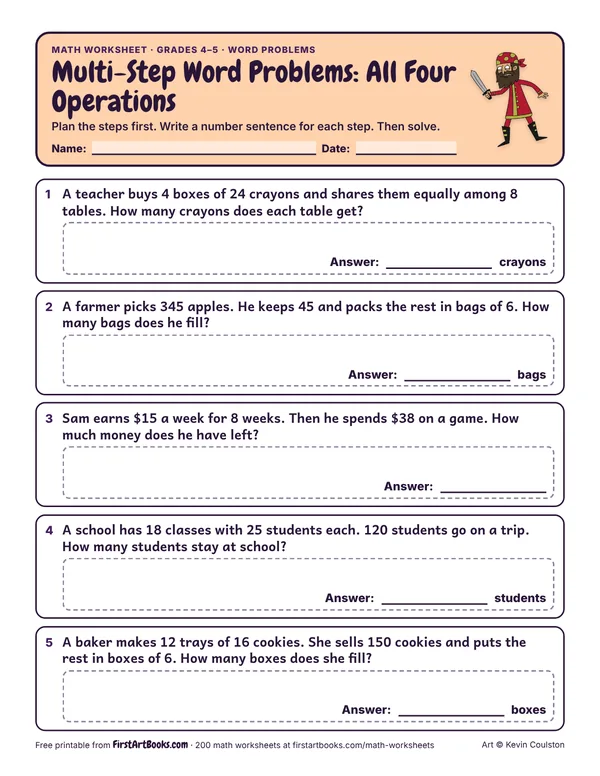
Five longer stories that use adding, subtracting, multiplying and dividing in the same problem.
Print this sheet (PDF)Teacher notes and tips

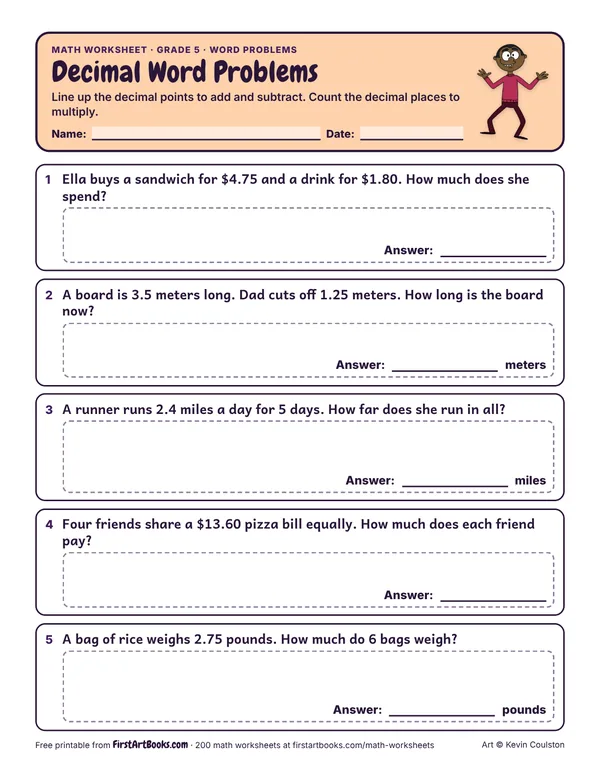
Five stories with decimals: money, meters, miles and pounds. Add, subtract, multiply and divide decimals.
Print this sheet (PDF)Teacher notes and tips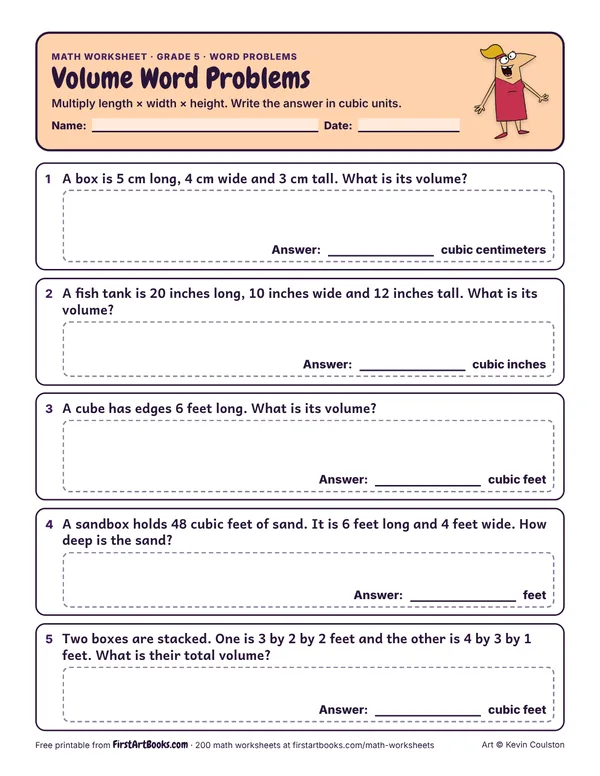
Five stories about boxes, tanks and sandboxes. Volume = length × width × height, in cubic units.
Print this sheet (PDF)Teacher notes and tipsRead and draw clocks to the hour, half hour, five minutes and minute, then work out elapsed time.
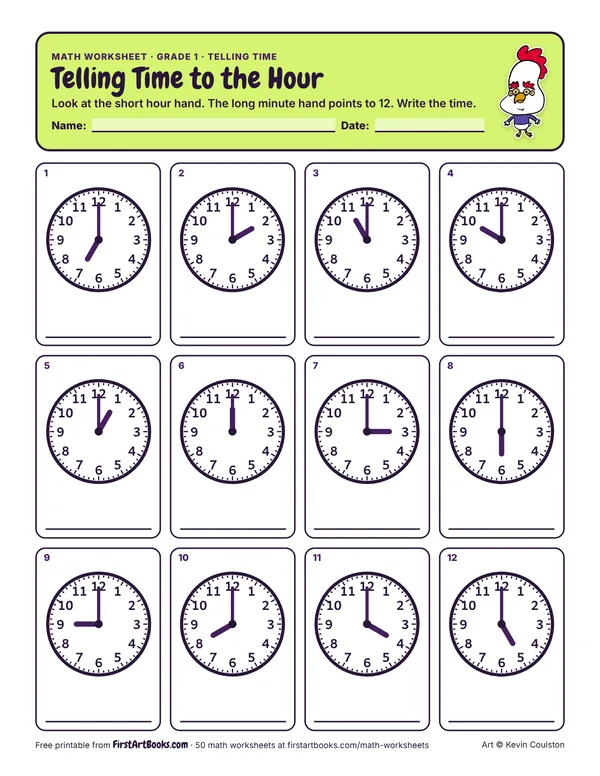
Twelve clocks showing o’clock times. Kids read the hour hand and write the time.
Print this sheet (PDF)Teacher notes and tips

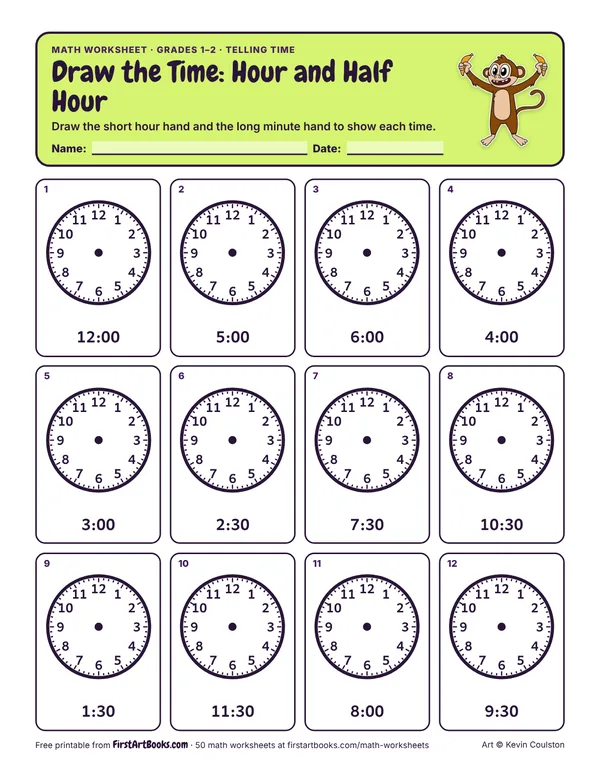
Twelve blank clocks with a time under each. Kids draw the hour hand and minute hand, on the hour and half hour.
Print this sheet (PDF)Teacher notes and tips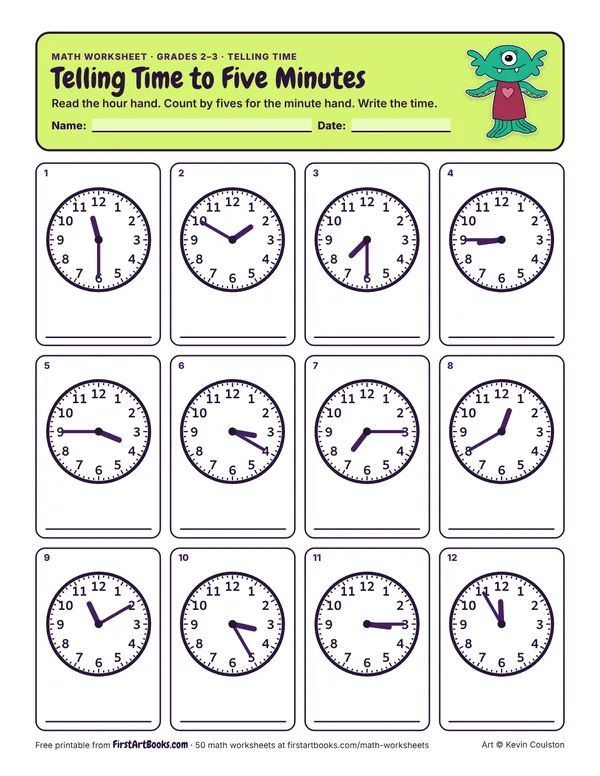
Twelve clocks at five-minute times. Kids count by fives around the clock and write the time.
Print this sheet (PDF)Teacher notes and tips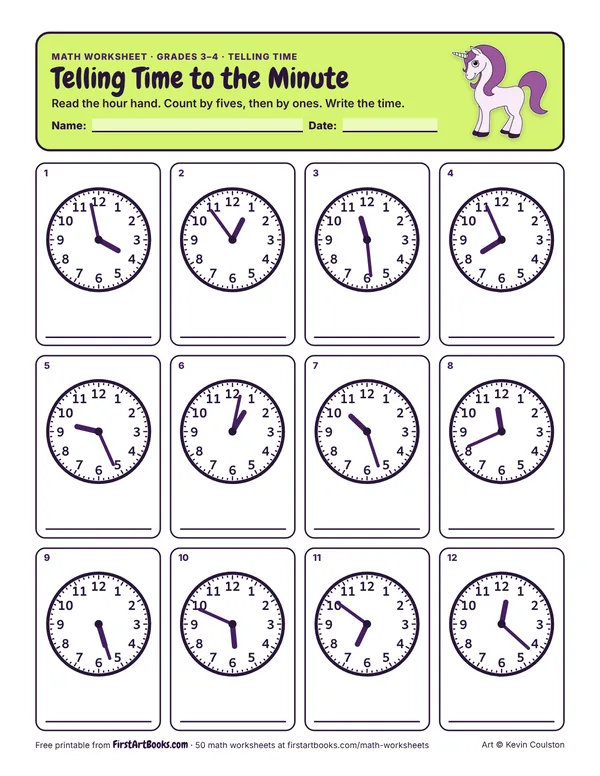
Twelve clocks at any minute. Kids count by fives, then by ones, and write the time.
Print this sheet (PDF)Teacher notes and tips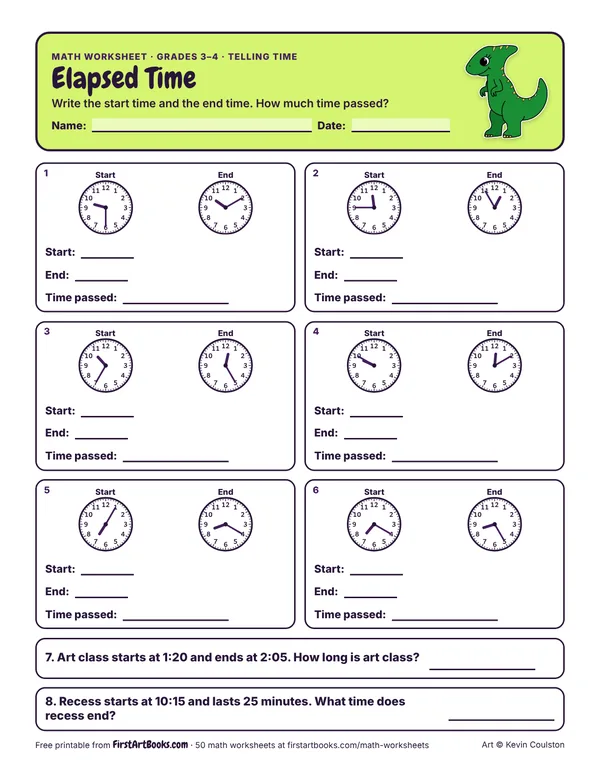
Six start and end clocks to read, then work out how much time passed, plus two short time problems.
Print this sheet (PDF)Teacher notes and tips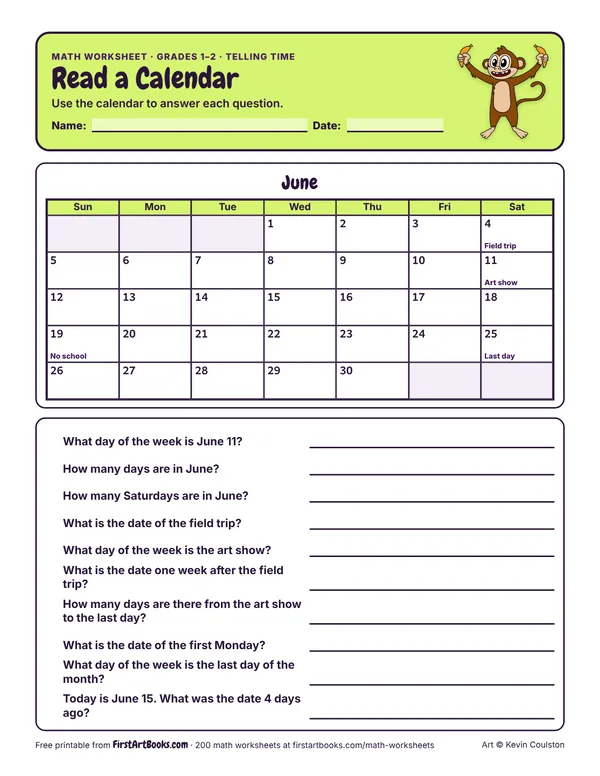
A month calendar with four events marked and ten questions: what day is the 11th, how many Saturdays, what date is one week after the field trip?
Print this sheet (PDF)Teacher notes and tips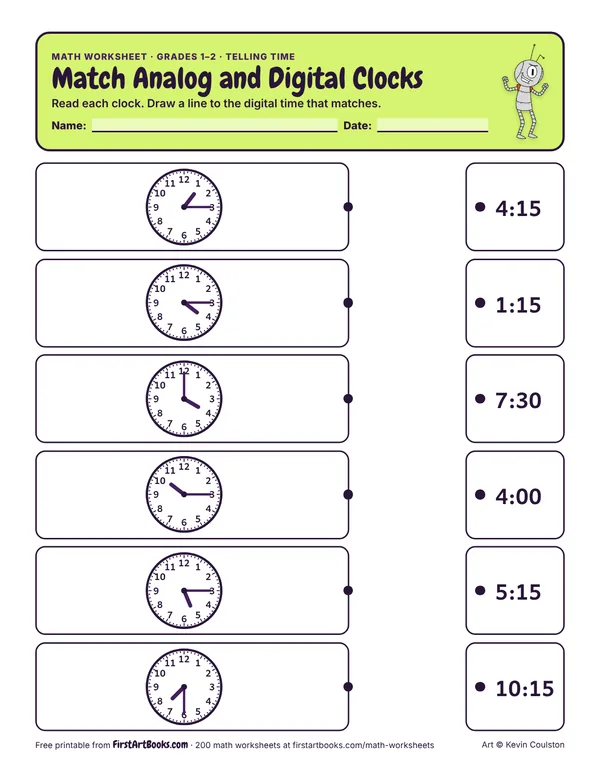
Six clock faces and six digital times, mixed up. Kids draw a line from each clock to its time.
Print this sheet (PDF)Teacher notes and tips

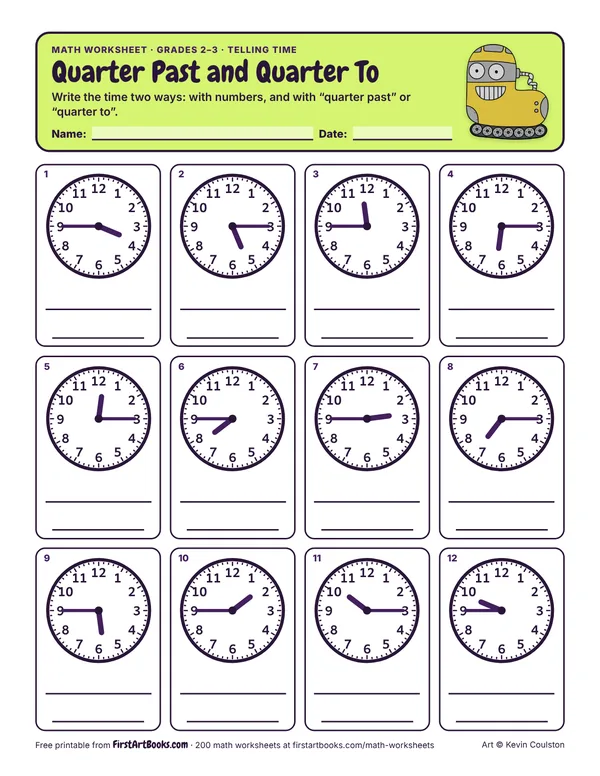
Twelve clocks at :15 and :45. Kids write the time with numbers and with the words quarter past or quarter to.
Print this sheet (PDF)Teacher notes and tips
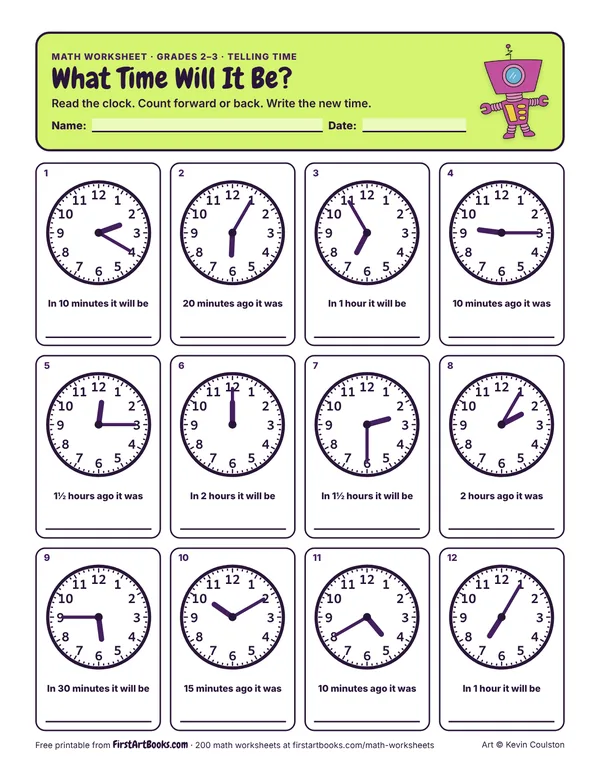
Twelve clocks with a question under each: what time will it be in 20 minutes, or what time was it 1 hour ago?
Print this sheet (PDF)Teacher notes and tips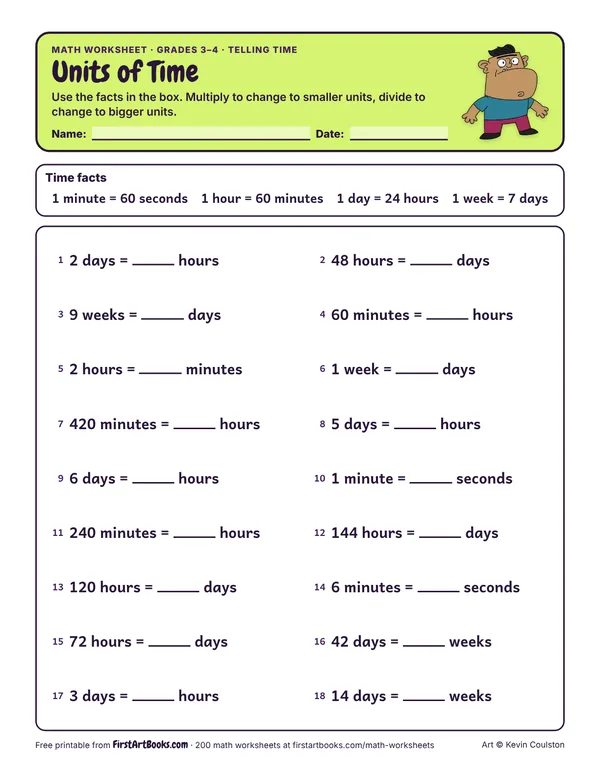
Eighteen conversions between seconds, minutes, hours, days and weeks, with the facts listed at the top.
Print this sheet (PDF)Teacher notes and tips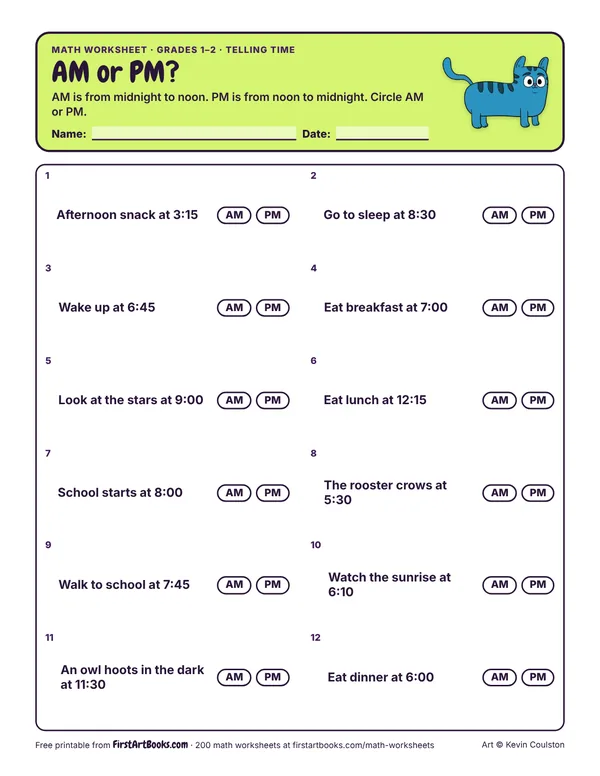
Twelve things people do at a time of day. Kids decide if each happens in the AM (morning) or PM (afternoon and night).
Print this sheet (PDF)Teacher notes and tips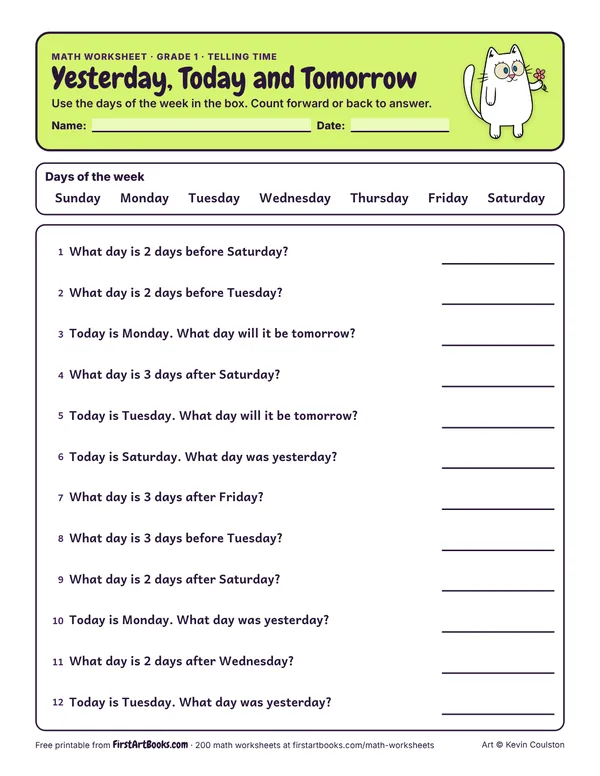
Twelve questions about the days of the week: what day was yesterday, what day is two days after Friday?
Print this sheet (PDF)Teacher notes and tips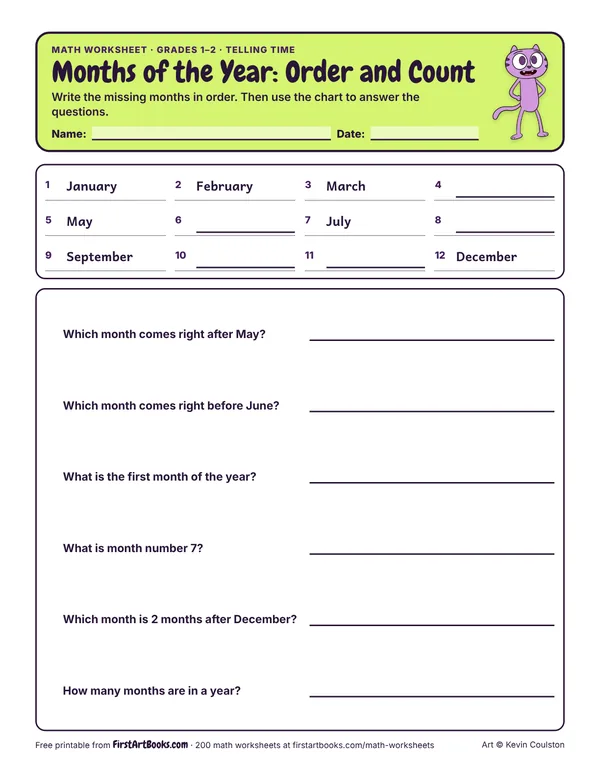
Fill in the missing months on the year chart, then answer questions: which month comes after April? What is the 9th month?
Print this sheet (PDF)Teacher notes and tips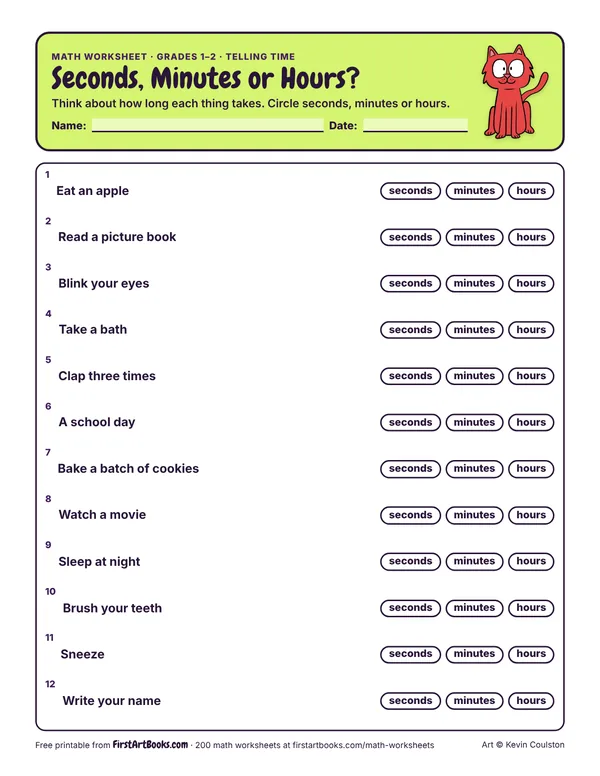
How long does it take to blink, brush your teeth or sleep at night? Kids pick the best unit of time for twelve things.
Print this sheet (PDF)Teacher notes and tips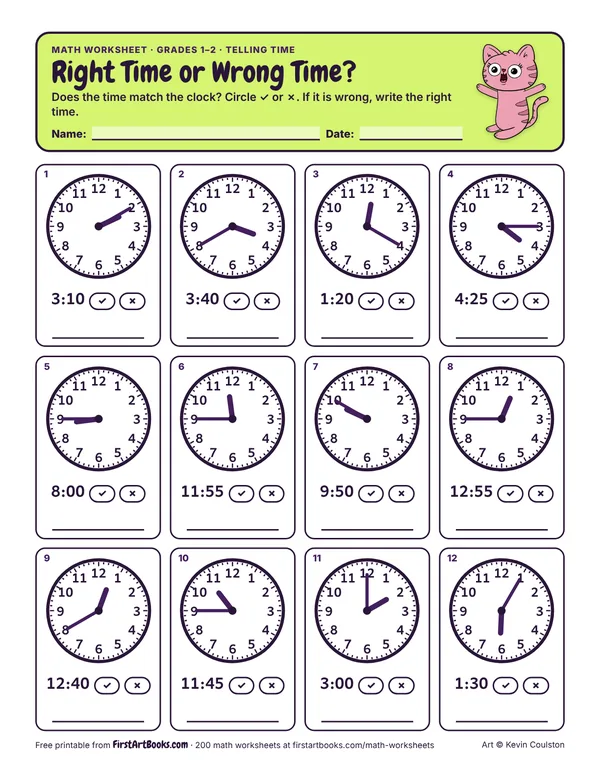
Twelve clocks, each with a time under it. Some match and some don’t. Kids check the hands and fix the wrong ones.
Print this sheet (PDF)Teacher notes and tips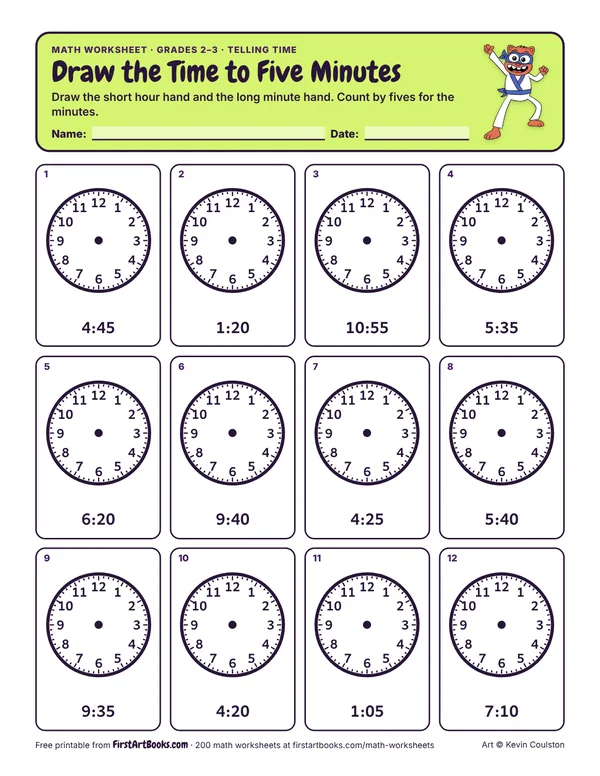
Twelve blank clocks and a five-minute time under each. Kids draw the hour hand a little past the hour and the minute hand on a five.
Print this sheet (PDF)Teacher notes and tips
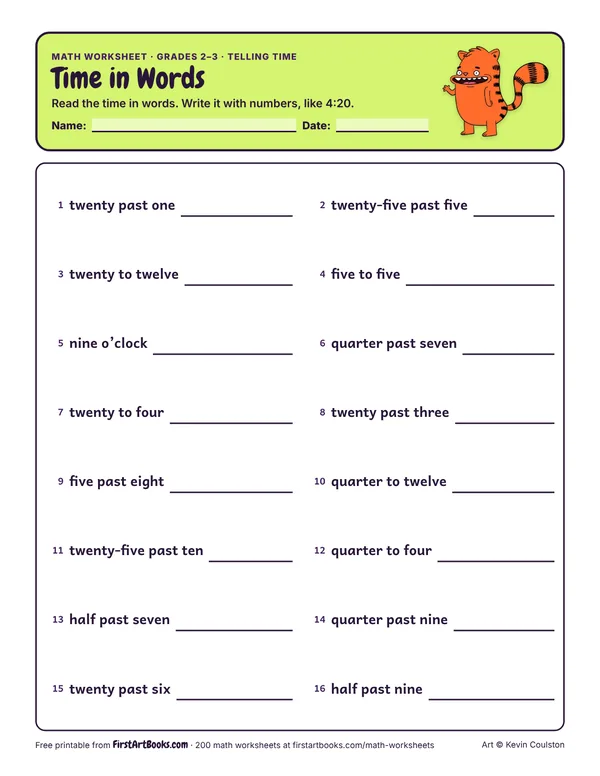
Sixteen times written in words, like “twenty past four” or “ten to nine”. Kids write each one as a digital time.
Print this sheet (PDF)Teacher notes and tips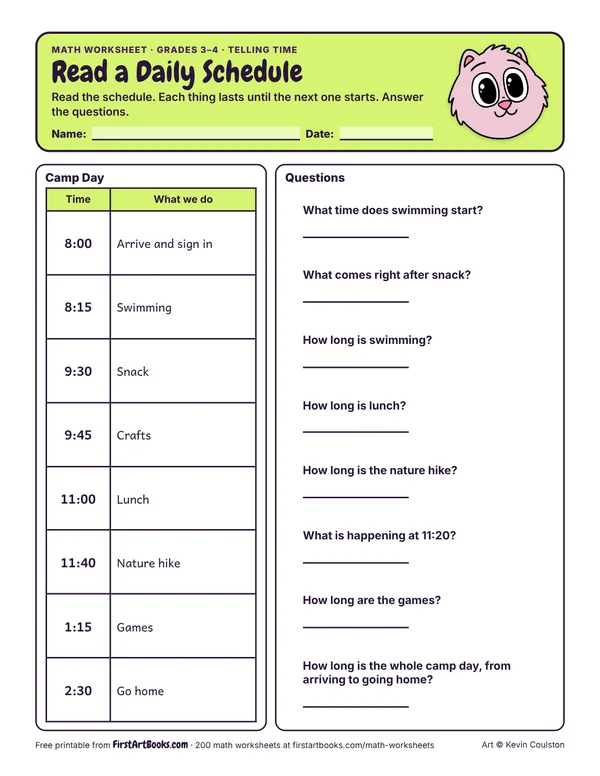
A camp day schedule and eight questions: what time does swimming start, how long is the hike, how long is the whole day?
Print this sheet (PDF)Teacher notes and tips

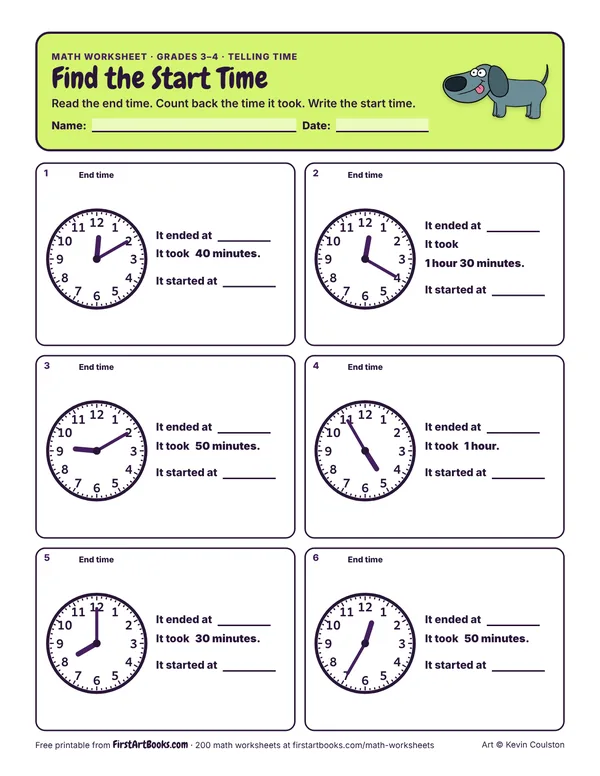
Six end-time clocks with how long each thing lasted. Kids count back to find when it started.
Print this sheet (PDF)Teacher notes and tips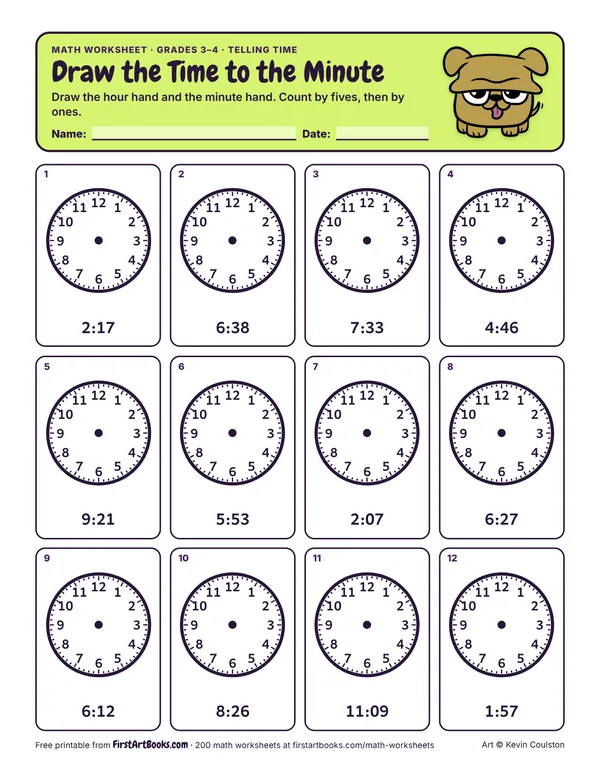
Twelve blank clocks with times like 3:17 and 8:42. Kids count by fives and ones to place the minute hand.
Print this sheet (PDF)Teacher notes and tipsCoin values, counting coins and bills, making change from a dollar and a classroom store.
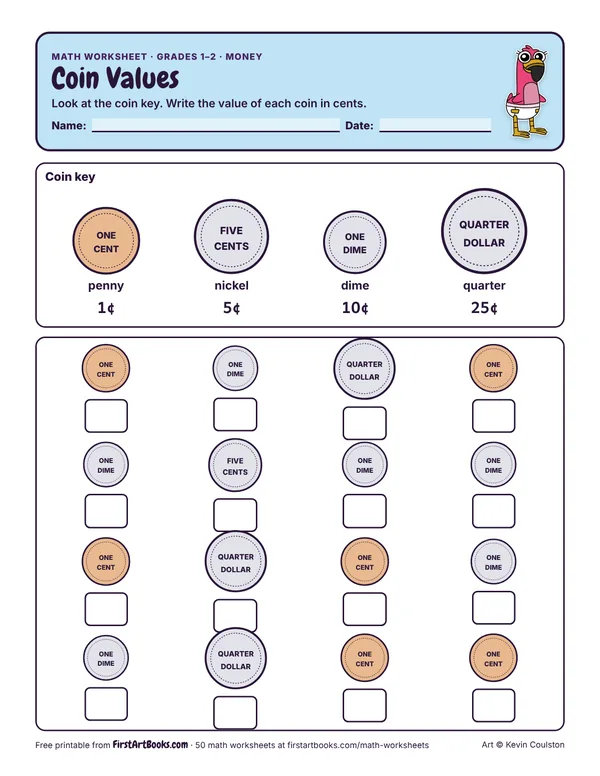
Meet the penny, nickel, dime and quarter, then write the value under sixteen coins.
Print this sheet (PDF)Teacher notes and tips
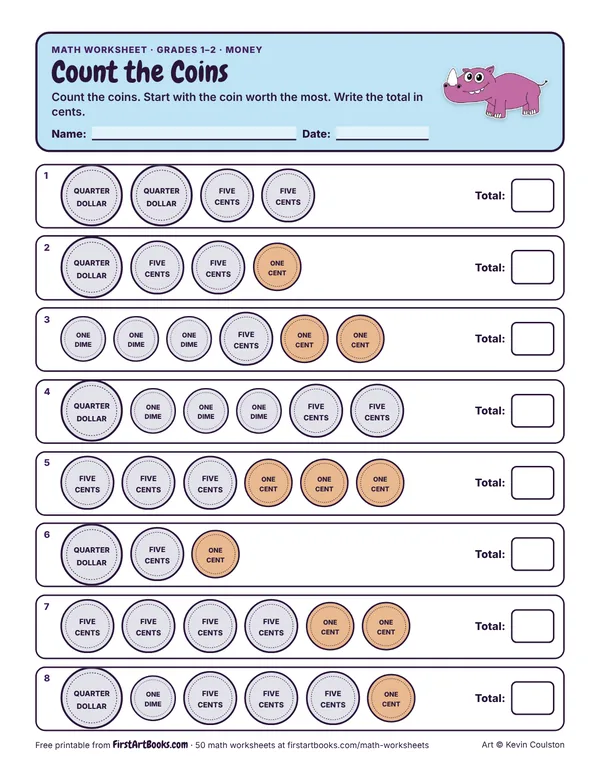
Eight groups of coins to count, up to 99 cents. Start with the biggest coins and count on.
Print this sheet (PDF)Teacher notes and tips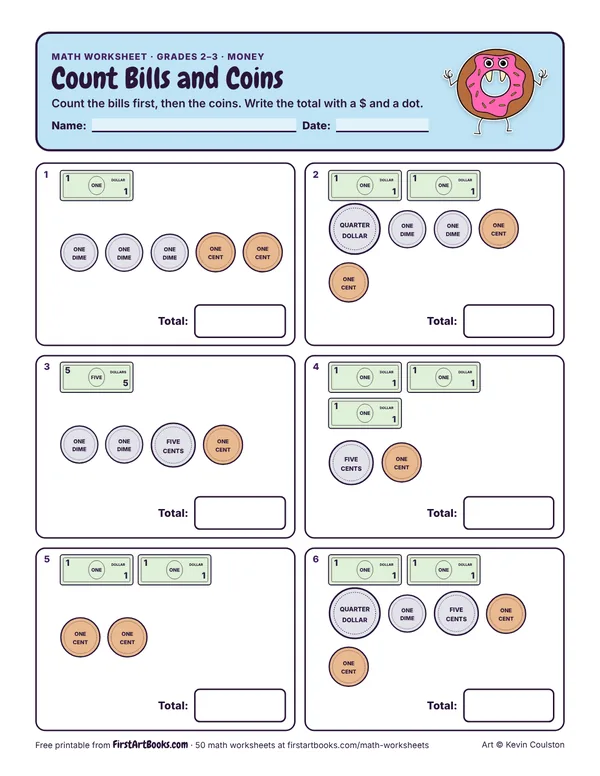
Six groups of dollar bills and coins. Kids count the dollars, then the cents, and write the amount.
Print this sheet (PDF)Teacher notes and tips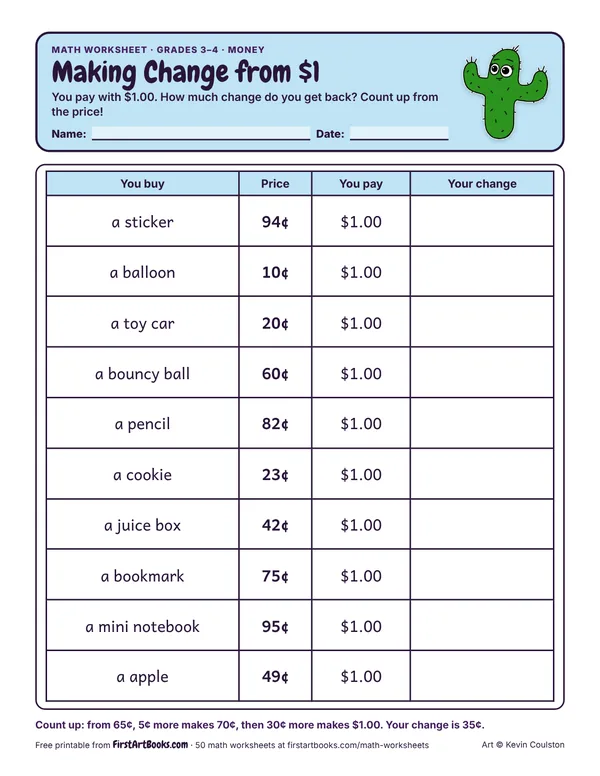
Ten things to buy with a dollar. Kids count up from the price to find the change.
Print this sheet (PDF)Teacher notes and tips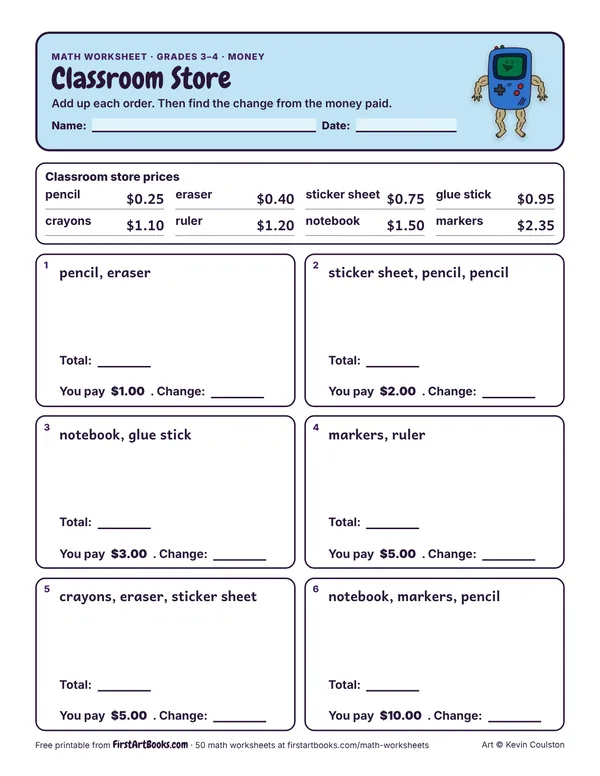
A price list and six shopping orders. Kids add up each order and work out the change.
Print this sheet (PDF)Teacher notes and tips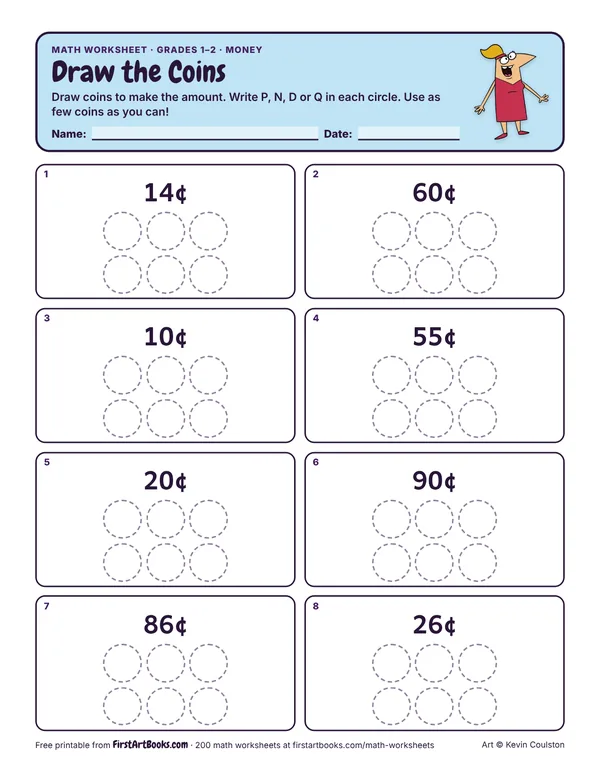
Eight amounts from 7¢ to 99¢. Kids draw a set of coins to make each one, using the fewest coins they can.
Print this sheet (PDF)Teacher notes and tips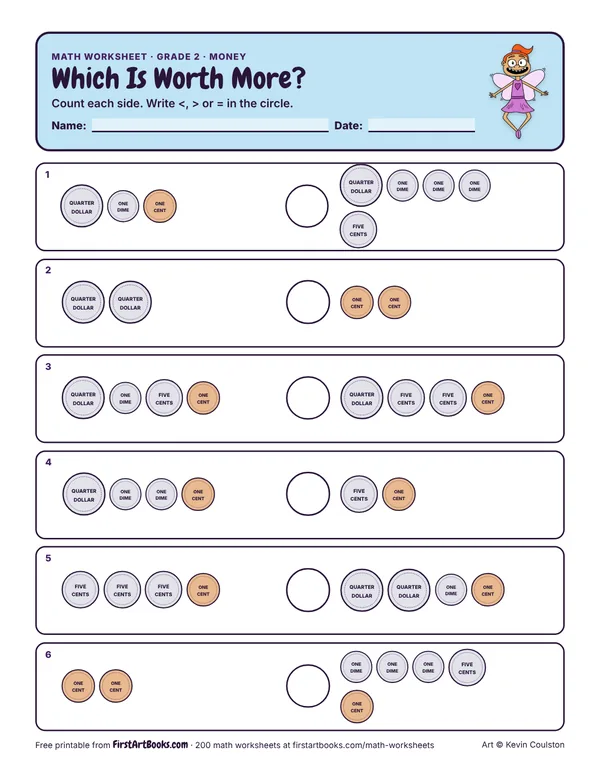
Six pairs of coin groups. Kids count both sides and write <, > or = in the circle. More coins is not always more money!
Print this sheet (PDF)Teacher notes and tips

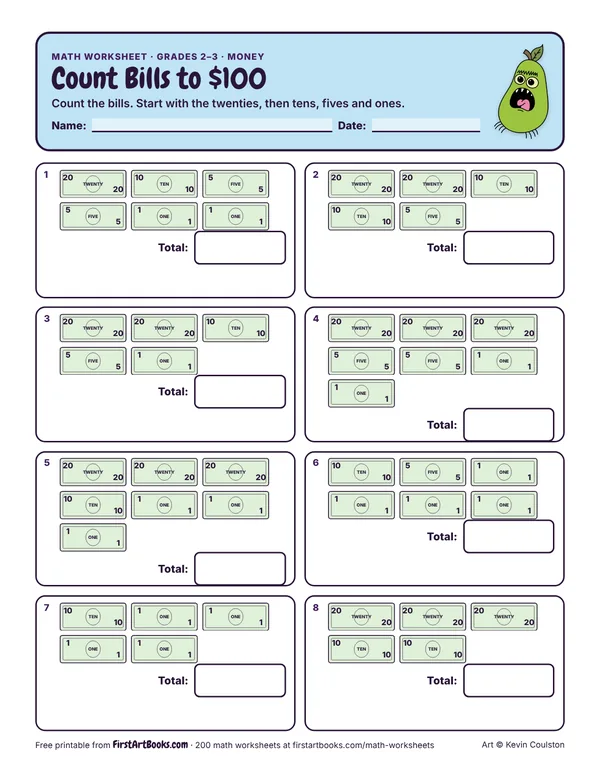
Eight groups of $1, $5, $10 and $20 bills to count, up to $100. Start with the biggest bills.
Print this sheet (PDF)Teacher notes and tips

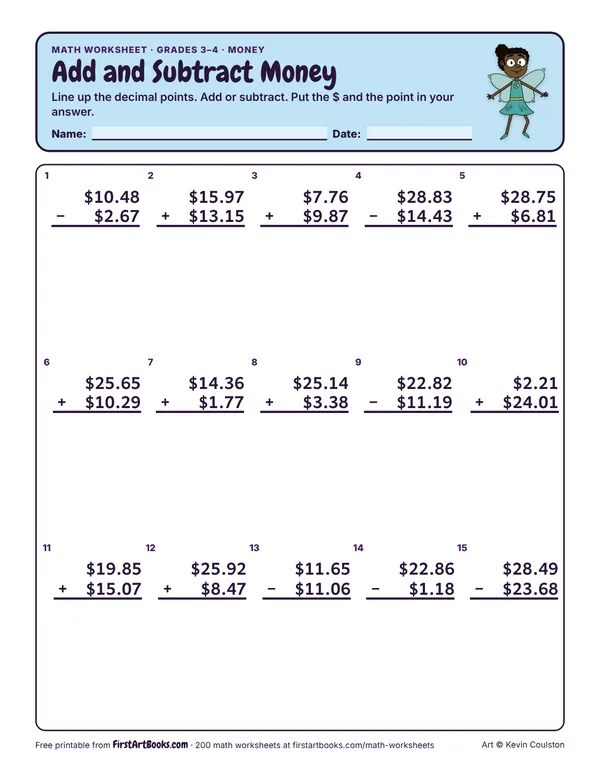
Fifteen stacked problems with dollars and cents. Line up the decimal points and regroup like whole numbers.
Print this sheet (PDF)Teacher notes and tips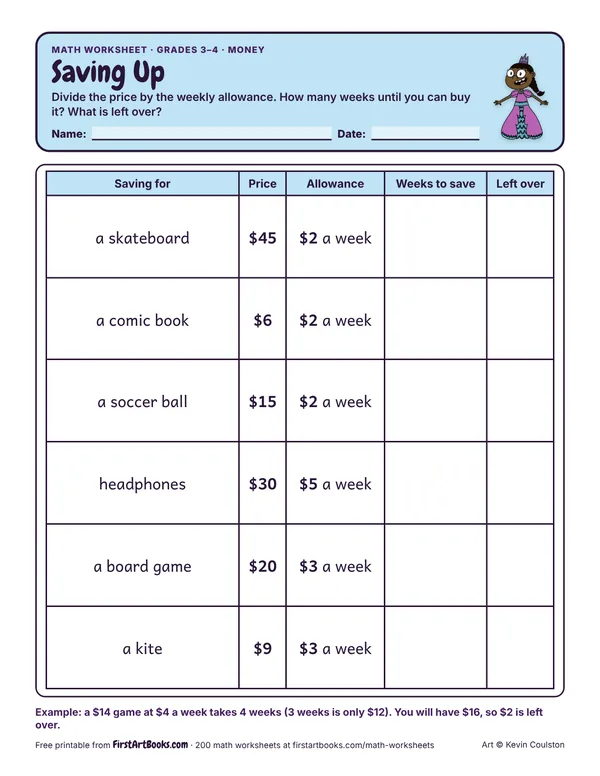
Six things to save for. Kids work out how many weeks of allowance each one takes, and what is left over.
Print this sheet (PDF)Teacher notes and tips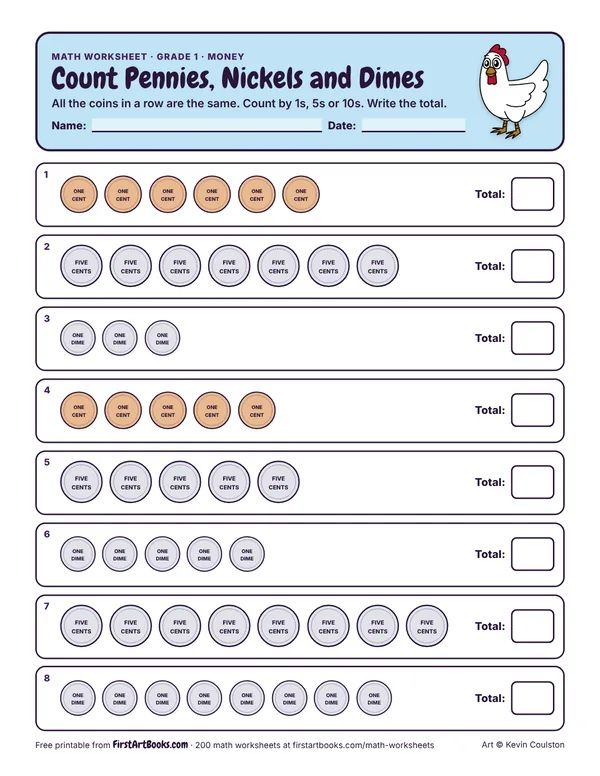
Eight rows of the same kind of coin. Kids count by ones for pennies, fives for nickels and tens for dimes.
Print this sheet (PDF)Teacher notes and tips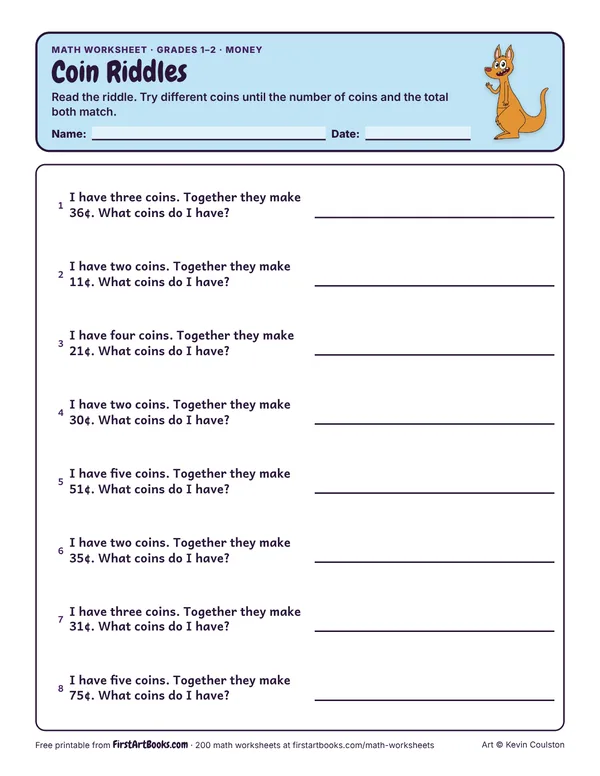
Eight riddles like “I have 3 coins that make 16¢. What are they?” Every riddle has just one answer.
Print this sheet (PDF)Teacher notes and tips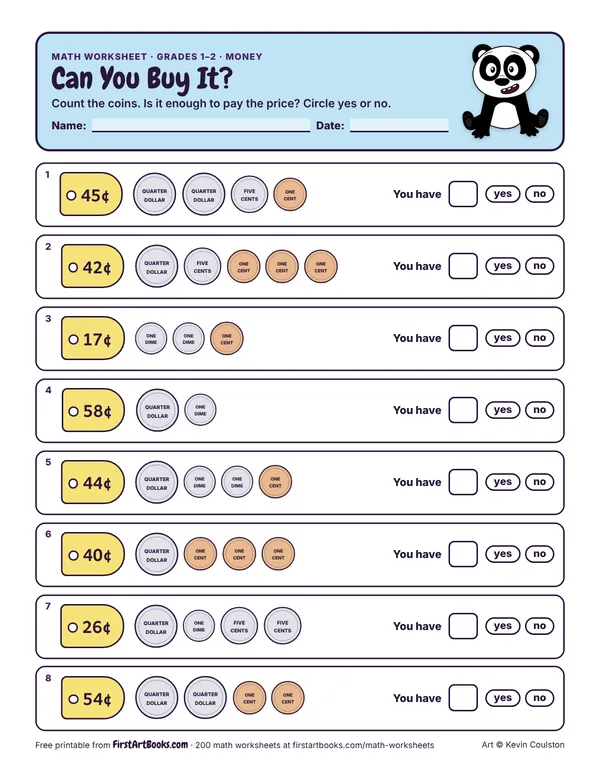
Eight price tags and a handful of coins for each. Kids count the coins and decide if there is enough money.
Print this sheet (PDF)Teacher notes and tips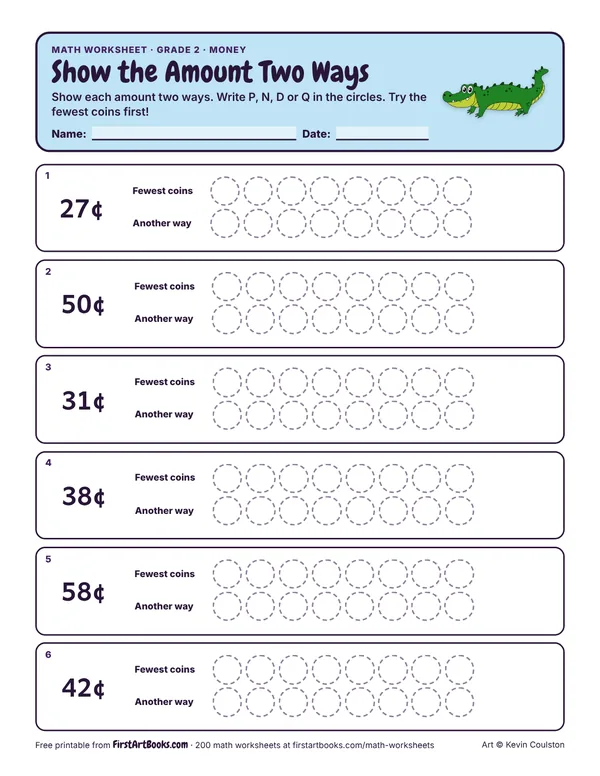
Six amounts. Kids draw two different sets of coins for each: one with the fewest coins and one another way.
Print this sheet (PDF)Teacher notes and tips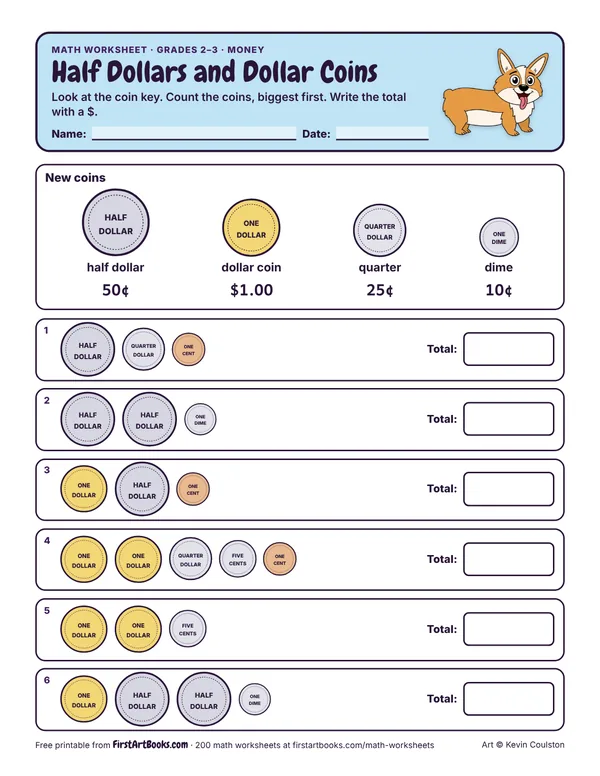
Meet the half dollar (50¢) and the dollar coin ($1), then count six groups of coins up to $3.
Print this sheet (PDF)Teacher notes and tips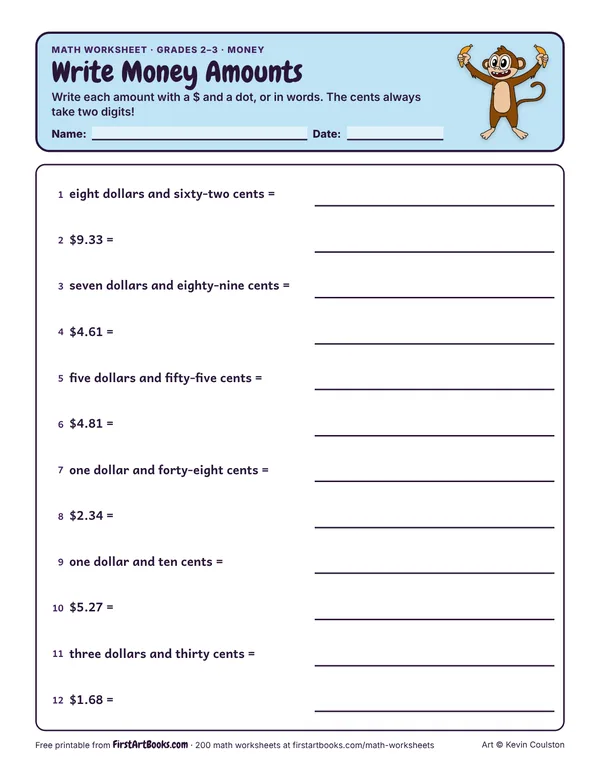
Twelve amounts to write two ways: “three dollars and forty cents” becomes $3.40, and $5.07 becomes words.
Print this sheet (PDF)Teacher notes and tips

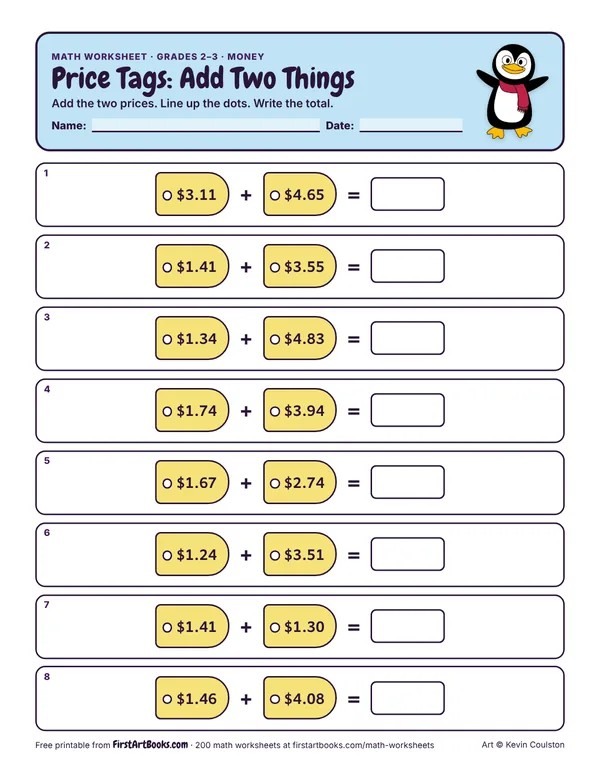
Eight pairs of price tags. Kids add the two prices to find what both things cost together.
Print this sheet (PDF)Teacher notes and tips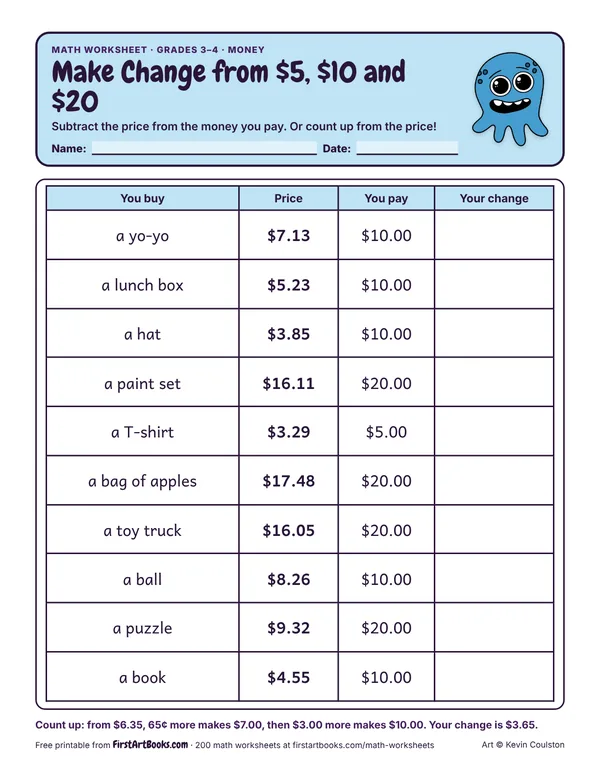
Ten things to buy with a $5, $10 or $20 bill. Kids subtract or count up to find the change.
Print this sheet (PDF)Teacher notes and tips

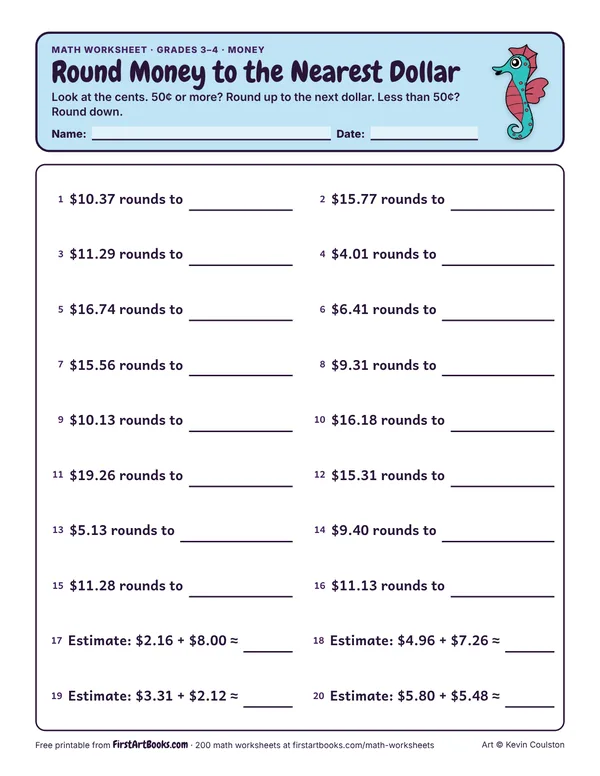
Twenty prices to round to the nearest dollar, then four shopping lists to estimate with the rounded prices.
Print this sheet (PDF)Teacher notes and tips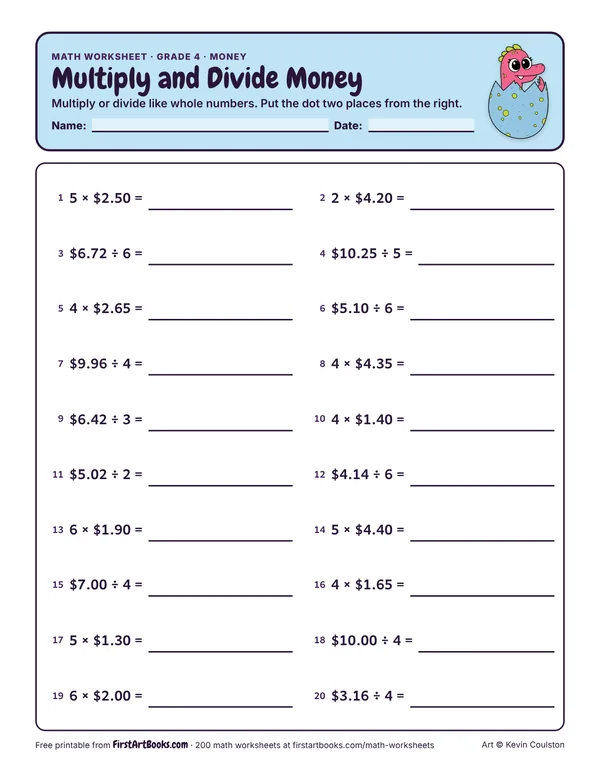
Twenty problems like 4 × $1.25 and $9.60 ÷ 3: the cost of several things, and sharing money equally.
Print this sheet (PDF)Teacher notes and tipsAll 200 worksheets in four PDFs of 50, each with its answer keys at the back.
Set 1: sheets 1–50 (PDF)Set 2: sheets 51–100 (PDF)Set 3: sheets 101–150 (PDF)Set 4: sheets 151–200 (PDF)
Every answer key in two PDFs, for the grown-up’s folder. Each key is the worksheet with the answers filled in.
Each topic has a pack of its twenty sheets and their keys: number tracing, counting, addition & subtraction, multiplication, division, fractions, place value, word problems, telling time, money.
Kevin Coulston’s Draw by Grid books have kids copy a cartoon one square at a time, using rows and columns like a coordinate grid. It is sneaky practice in counting, position and proportion.
Yes. All 200 worksheets, their answer keys and the topic packs are free to print for home and classroom use. Print one sheet, a topic pack of twenty or the whole set in four PDFs.
Kindergarten to 5th grade. Each topic covers a few grades, and every card shows its grade range, so you can see at a glance which sheets fit your class. The grade buttons filter the list.
Yes. 191 of the 200 sheets have an answer key: the same page with every answer filled in. It is the second page of each sheet’s PDF, it is in each topic pack, and all the keys are in two PDFs too. The tracing pages don’t need one.
number tracing and number recognition, counting and number matching, addition and subtraction practice, multiplication fact worksheets, division practice worksheets, fractions and fraction models, place value and number decomposition, math word problems, telling time and elapsed time, money counting and making change. That is twenty sheets for each topic, from the easiest to the hardest.
Yes. The headers are light colors that look fine in gray, and nothing on a sheet depends on color, except the color keys on the number hunt and the two mystery picture color by number sheets, which name each color in words. Sheets are US Letter and also print on A4.
Yes. The fact sheets (addition, subtraction, multiplication and division) have a time and score box at the bottom, so kids can try the same sheet again and beat their own time.
All sheets are US Letter, print well in black and white, and are free for home and classroom use. The numbers are set in Andika, a font for young readers with a clear 1, 4 and 7. More for teachers in the teacher resources library.
12 printable pages: six step-by-step lessons, a grid activity, draw-and-write sheets and teacher notes, sent with your welcome email. After that, new classroom printables by email.