



Grades K–1
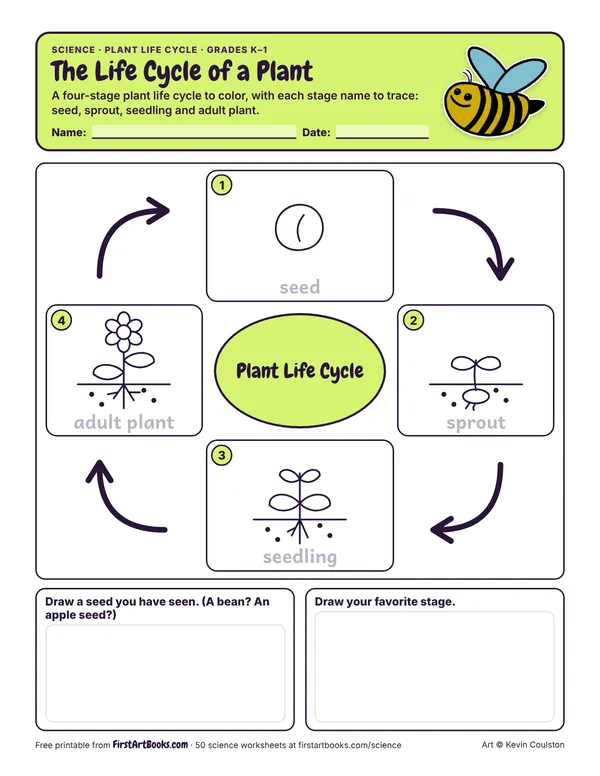
The Life Cycle of a Plant
A four-stage plant life cycle to color, with each stage name to trace: seed, sprout, seedling and adult plant.
Print this sheet (PDF)Teacher notes and tips200 free science worksheets in 40 topics, from plant life cycles and the five senses to magnets, circuits, volcanoes, dinosaurs, ocean zones and unplugged coding. Color-and-trace life cycles, cut-and-paste sorts, labeling, experiments, engineering challenges and recording sheets, with Kevin Coulston’s cartoon characters on every page and 140 answer keys.
Print sheets 1–100 (PDF)Print sheets 101–200 (PDF)Pick a topicAnswer key (PDF)
Grades K–3. Seed, sprout, seedling and adult plant: a life cycle to color, a cut-and-paste cycle, the parts of a plant, what plants need and a bean journal.
A four-stage plant life cycle to color, with each stage name to trace: seed, sprout, seedling and adult plant.
Print this sheet (PDF)Teacher notes and tips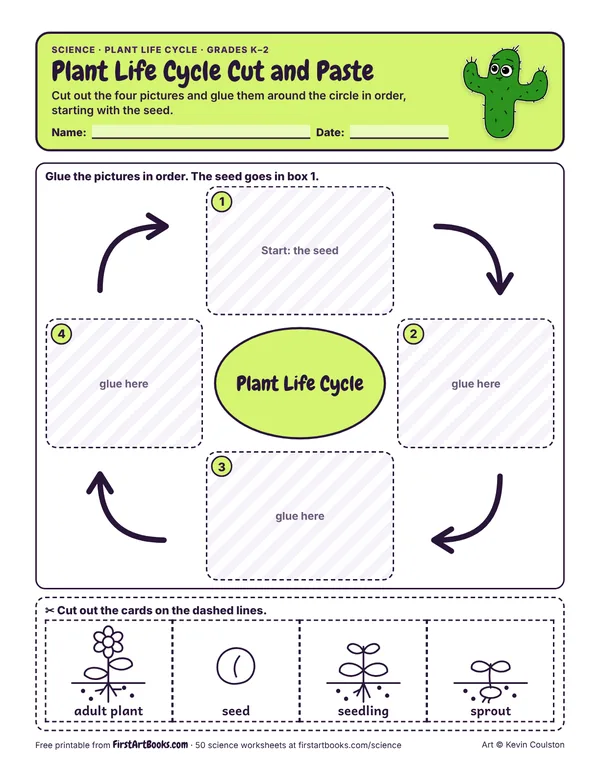
Cut out the four pictures and glue them around the circle in order, starting with the seed.
Print this sheet (PDF)Teacher notes and tips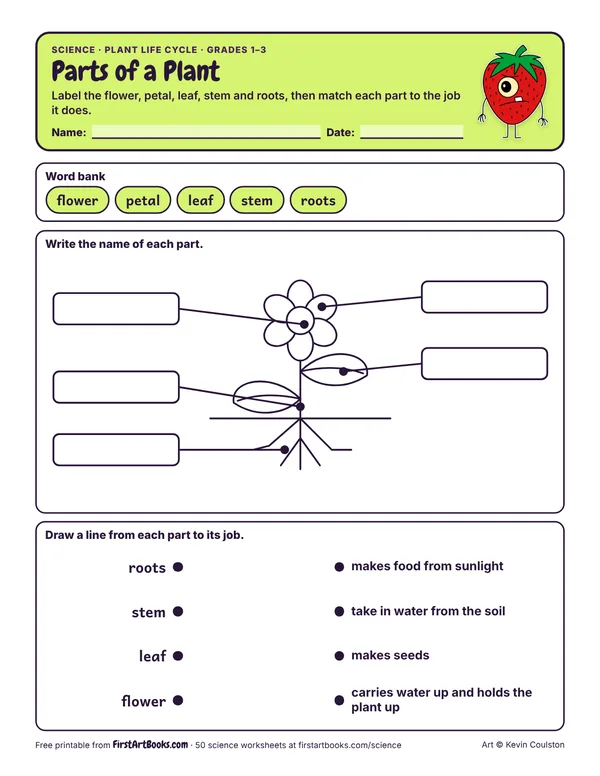
Label the flower, petal, leaf, stem and roots, then match each part to the job it does.
Print this sheet (PDF)Teacher notes and tips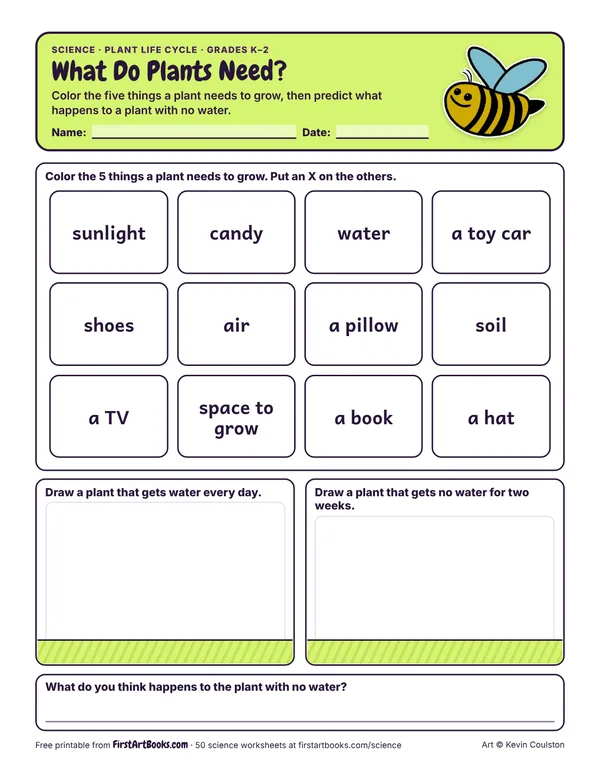
Color the five things a plant needs to grow, then predict what happens to a plant with no water.
Print this sheet (PDF)Teacher notes and tips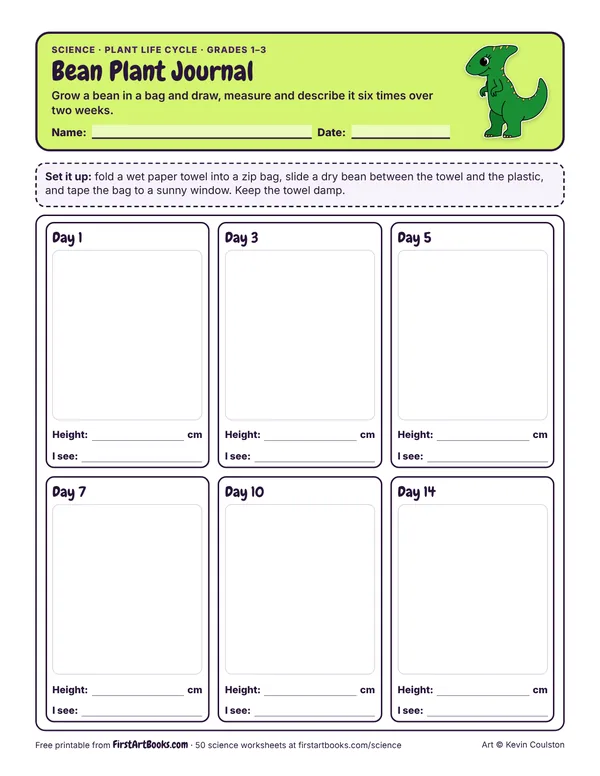
Grow a bean in a bag and draw, measure and describe it six times over two weeks.
Print this sheet (PDF)Teacher notes and tipsGrades K–3. Egg, caterpillar, chrysalis and butterfly. Eggs, tadpole, froglet and frog. Color the cycles, put the stages in order, compare the two and learn the words.
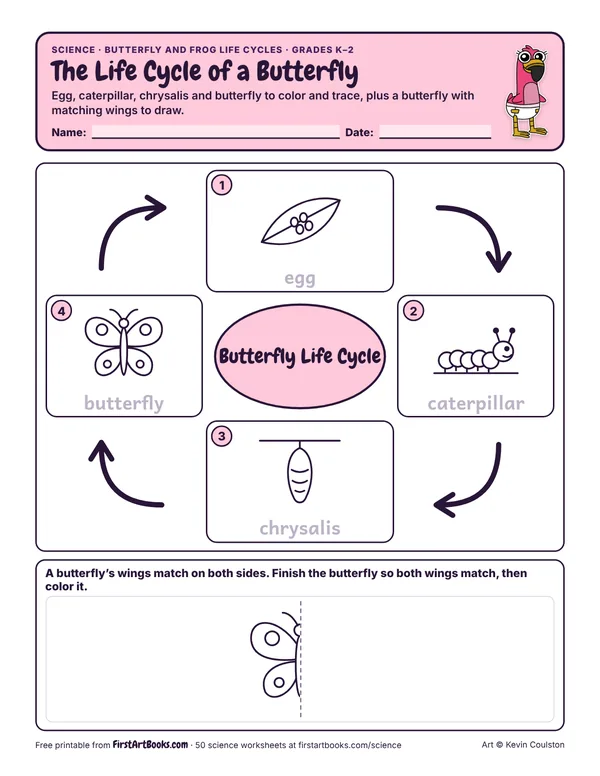
Egg, caterpillar, chrysalis and butterfly to color and trace, plus a butterfly with matching wings to draw.
Print this sheet (PDF)Teacher notes and tips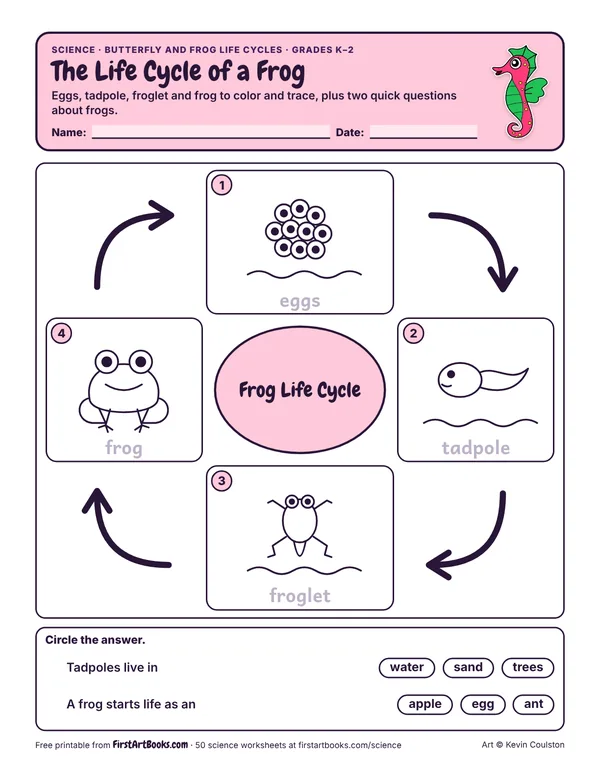
Eggs, tadpole, froglet and frog to color and trace, plus two quick questions about frogs.
Print this sheet (PDF)Teacher notes and tips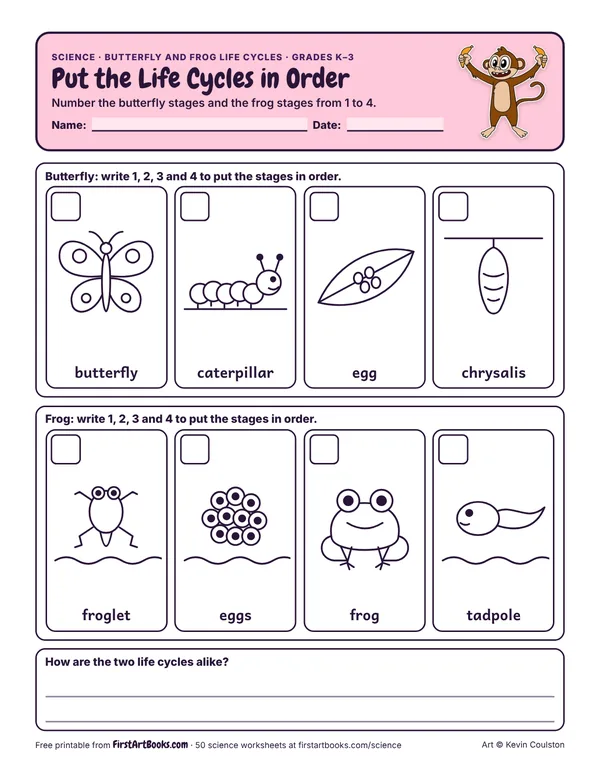
Number the butterfly stages and the frog stages from 1 to 4.
Print this sheet (PDF)Teacher notes and tips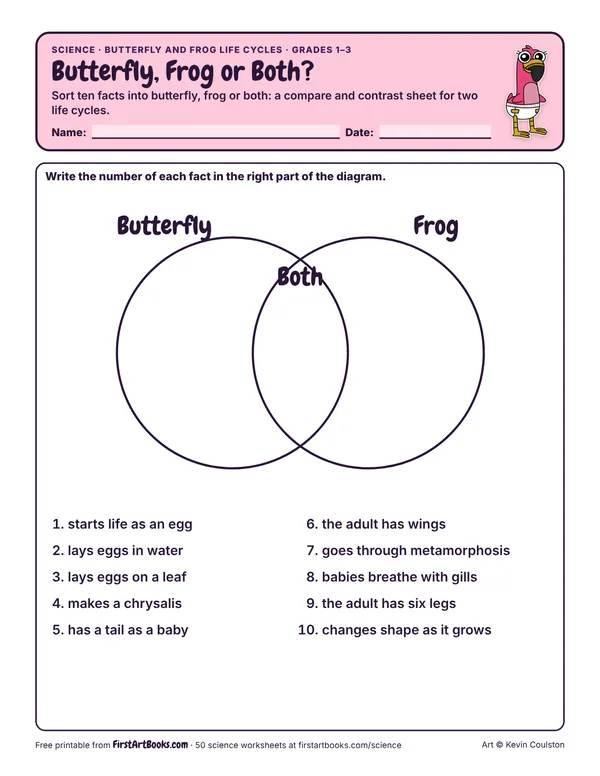
Sort ten facts into butterfly, frog or both: a compare and contrast sheet for two life cycles.
Print this sheet (PDF)Teacher notes and tips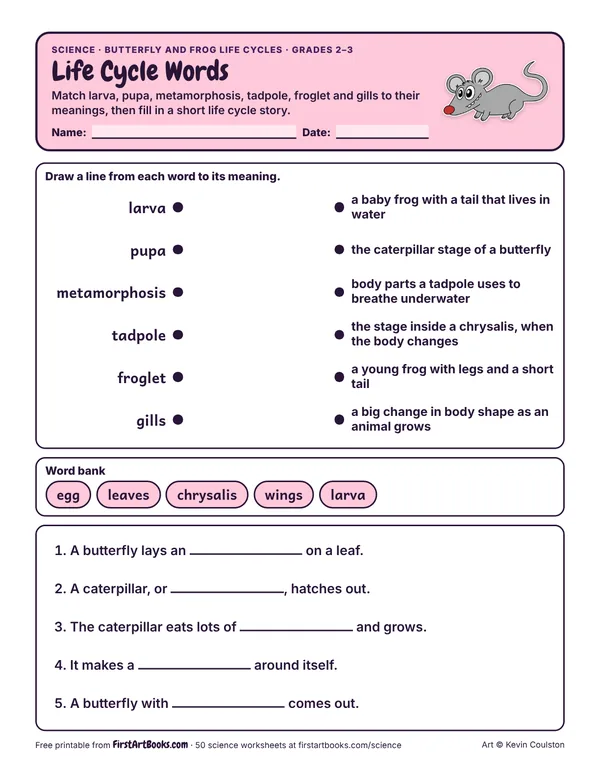
Match larva, pupa, metamorphosis, tadpole, froglet and gills to their meanings, then fill in a short life cycle story.
Print this sheet (PDF)Teacher notes and tipsGrades K–5. A weather calendar, a weather graph, a daily weather log, weather symbols and the tools scientists use to measure the weather.
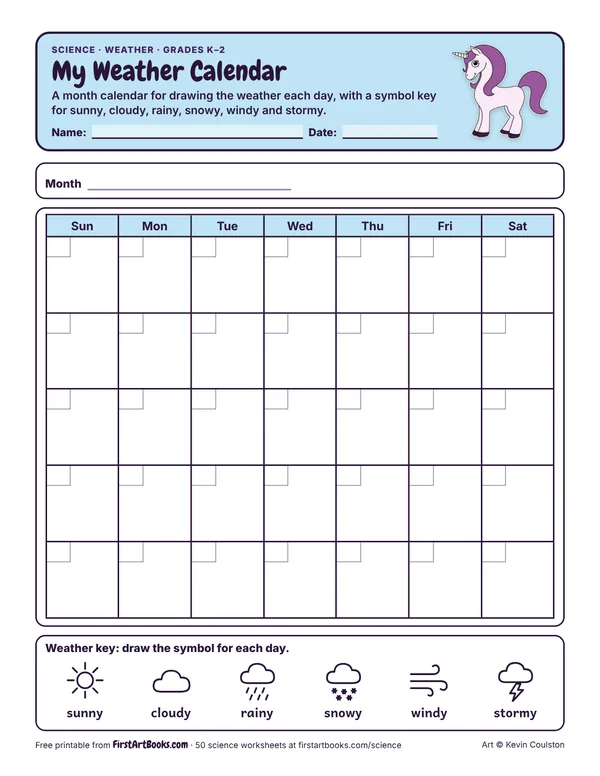
A month calendar for drawing the weather each day, with a symbol key for sunny, cloudy, rainy, snowy, windy and stormy.
Print this sheet (PDF)Teacher notes and tips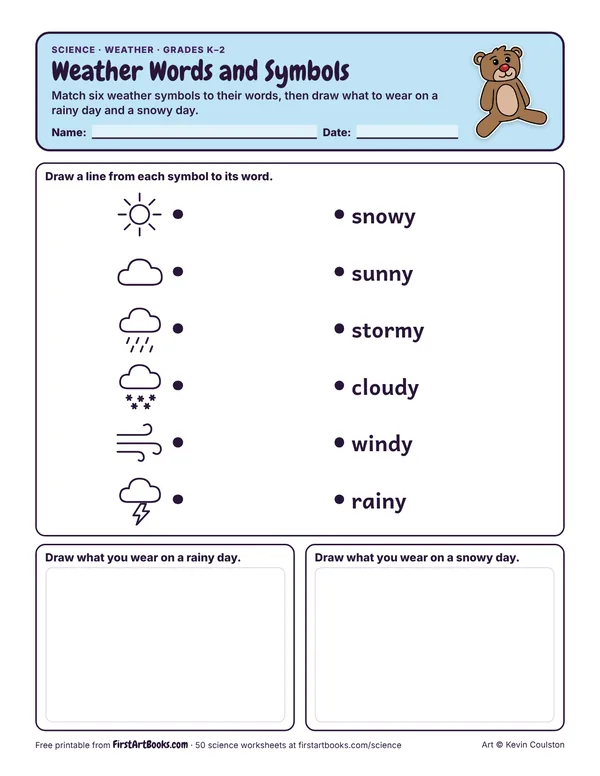
Match six weather symbols to their words, then draw what to wear on a rainy day and a snowy day.
Print this sheet (PDF)Teacher notes and tips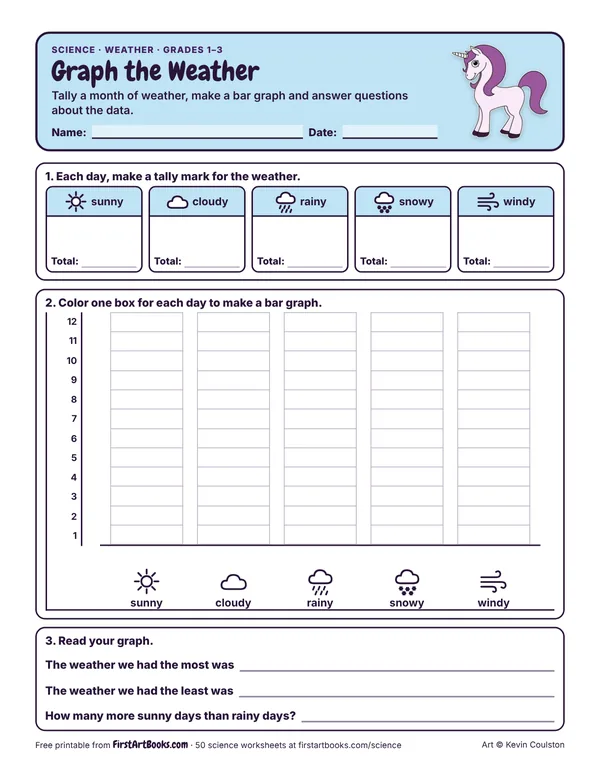
Tally a month of weather, make a bar graph and answer questions about the data.
Print this sheet (PDF)Teacher notes and tips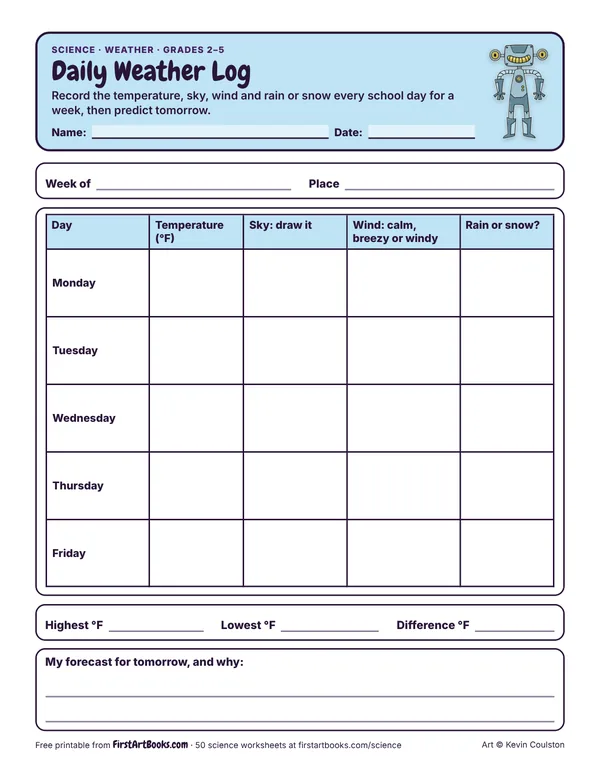
Record the temperature, sky, wind and rain or snow every school day for a week, then predict tomorrow.
Print this sheet (PDF)Teacher notes and tips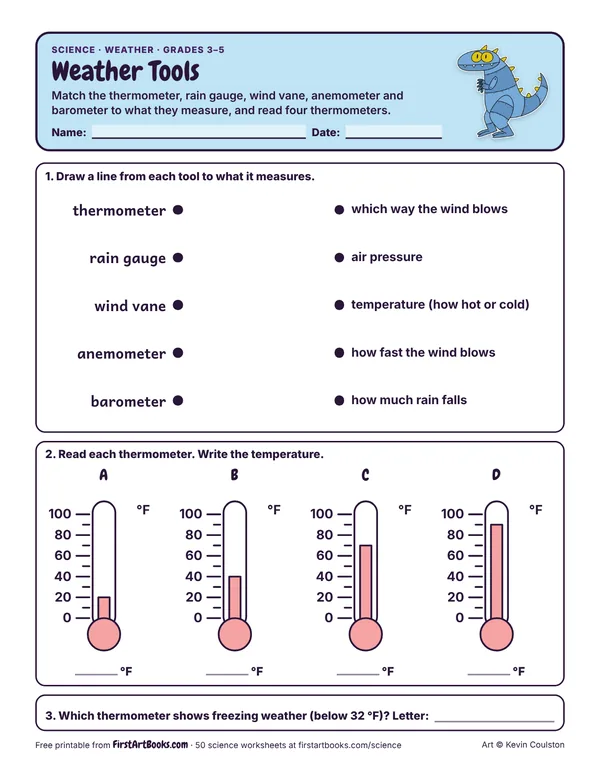
Match the thermometer, rain gauge, wind vane, anemometer and barometer to what they measure, and read four thermometers.
Print this sheet (PDF)Teacher notes and tipsGrades 1–5. The eight planets in order, rocky planets and giant planets, the phases of the moon, space true or false and a planet research report.
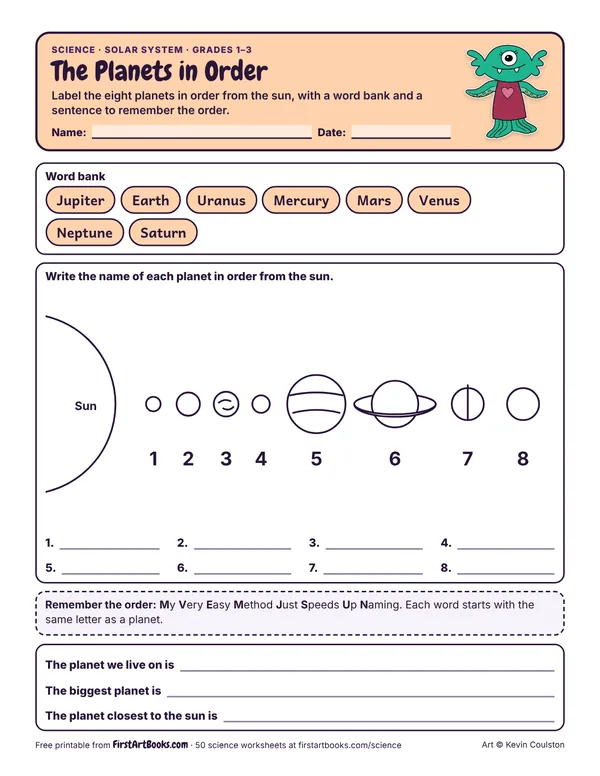
Label the eight planets in order from the sun, with a word bank and a sentence to remember the order.
Print this sheet (PDF)Teacher notes and tips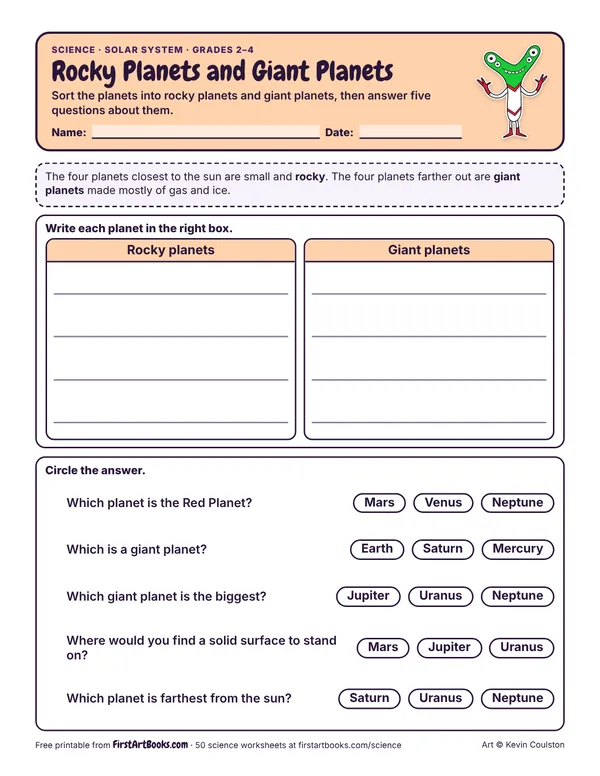
Sort the planets into rocky planets and giant planets, then answer five questions about them.
Print this sheet (PDF)Teacher notes and tips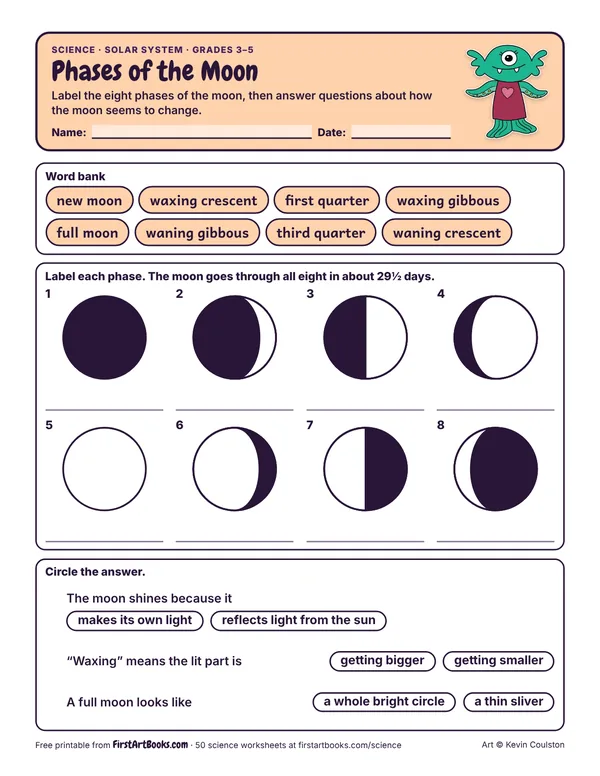
Label the eight phases of the moon, then answer questions about how the moon seems to change.
Print this sheet (PDF)Teacher notes and tips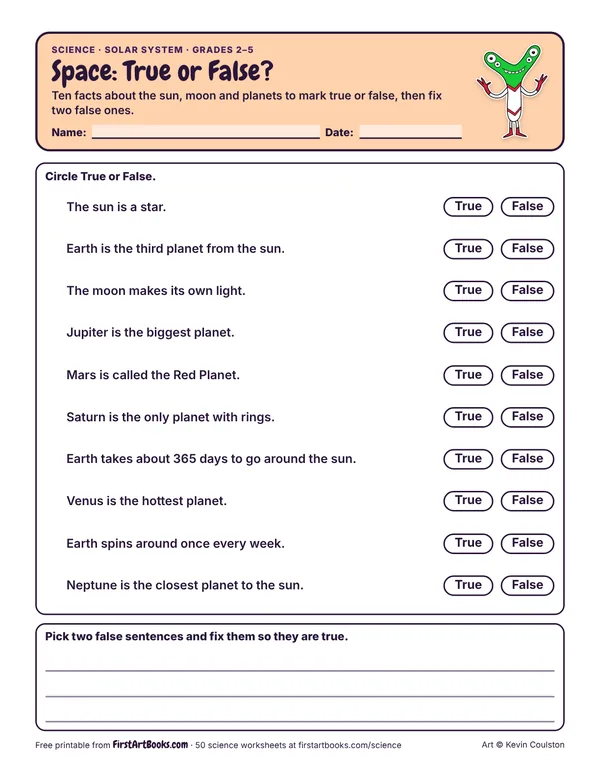
Ten facts about the sun, moon and planets to mark true or false, then fix two false ones.
Print this sheet (PDF)Teacher notes and tips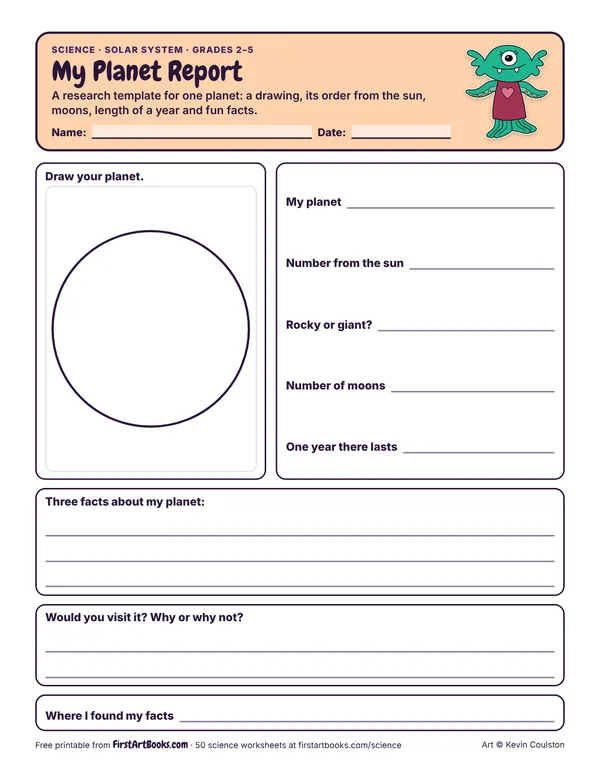
A research template for one planet: a drawing, its order from the sun, moons, length of a year and fun facts.
Print this sheet (PDF)Teacher notes and tipsGrades 1–5. Sort animals by habitat, draw what an animal needs, match adaptations, sort physical and behavioral adaptations and invent an animal.
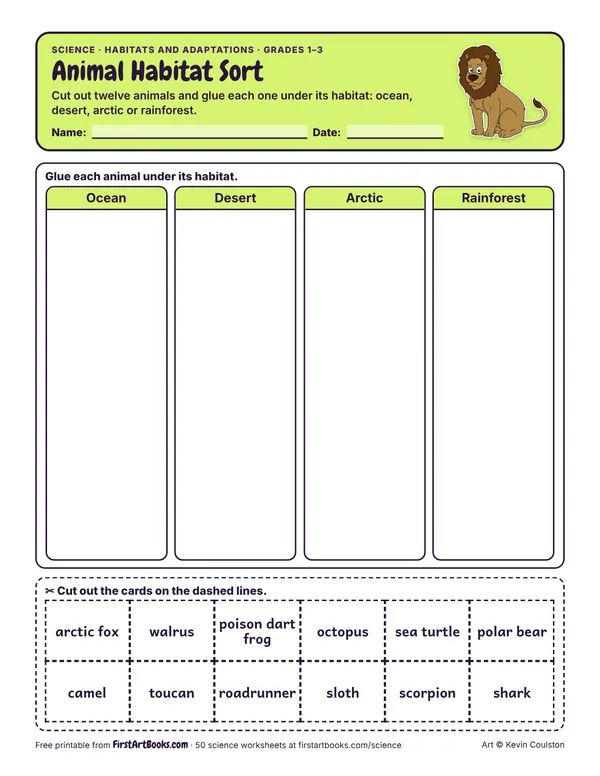
Cut out twelve animals and glue each one under its habitat: ocean, desert, arctic or rainforest.
Print this sheet (PDF)Teacher notes and tips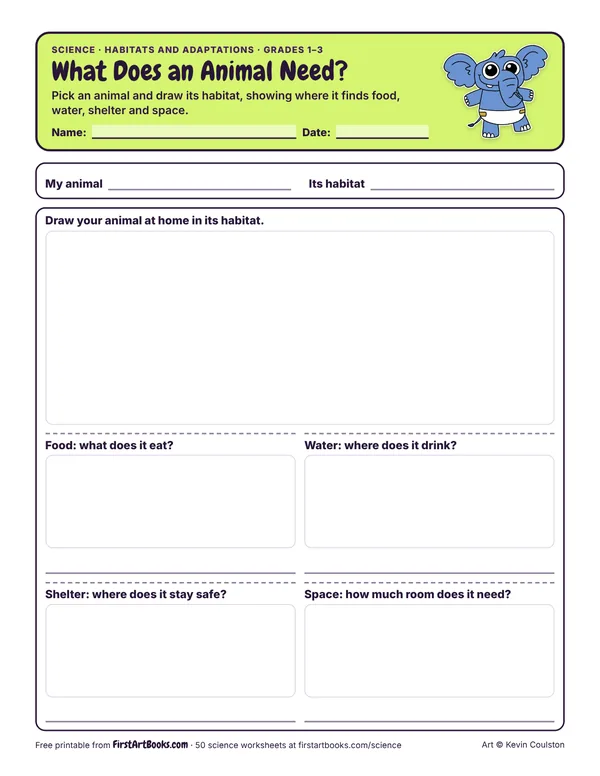
Pick an animal and draw its habitat, showing where it finds food, water, shelter and space.
Print this sheet (PDF)Teacher notes and tips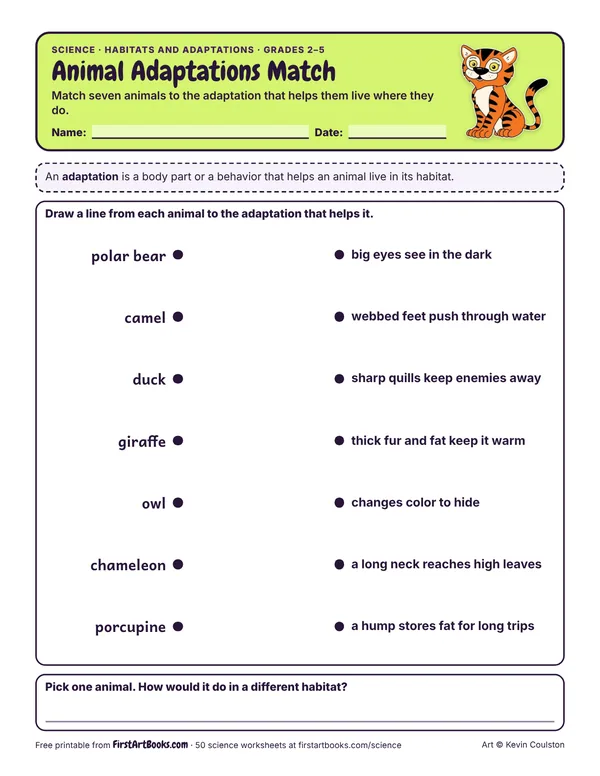
Match seven animals to the adaptation that helps them live where they do.
Print this sheet (PDF)Teacher notes and tips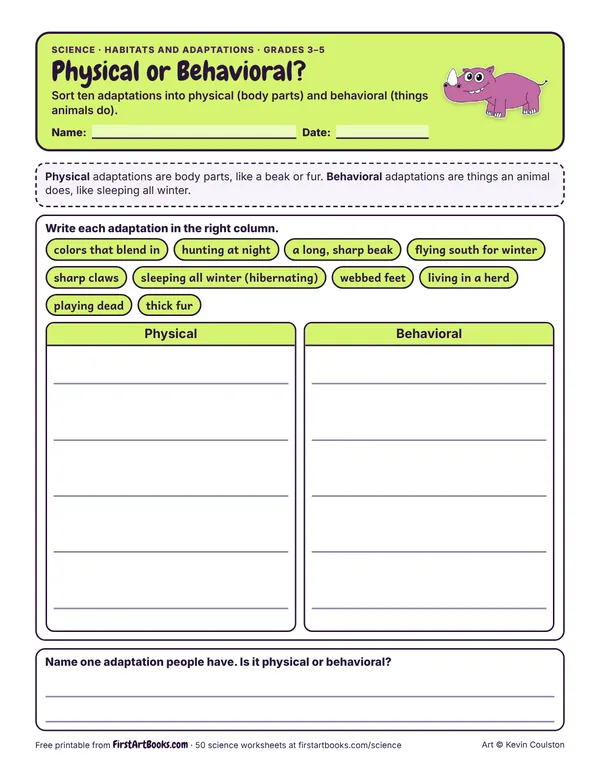
Sort ten adaptations into physical (body parts) and behavioral (things animals do).
Print this sheet (PDF)Teacher notes and tips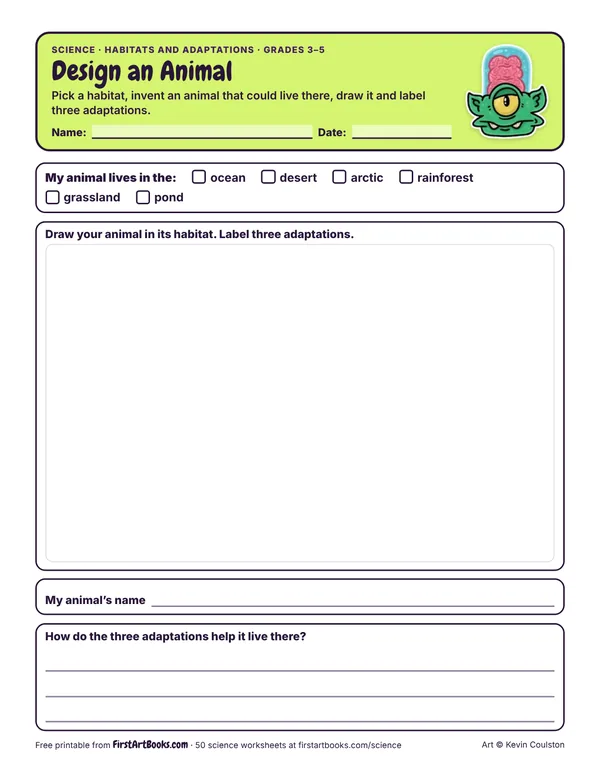
Pick a habitat, invent an animal that could live there, draw it and label three adaptations.
Print this sheet (PDF)Teacher notes and tipsGrades K–2. See, hear, smell, taste and touch: match the body parts, sort by sense, go on a senses walk, describe a snack and solve a mystery bag.
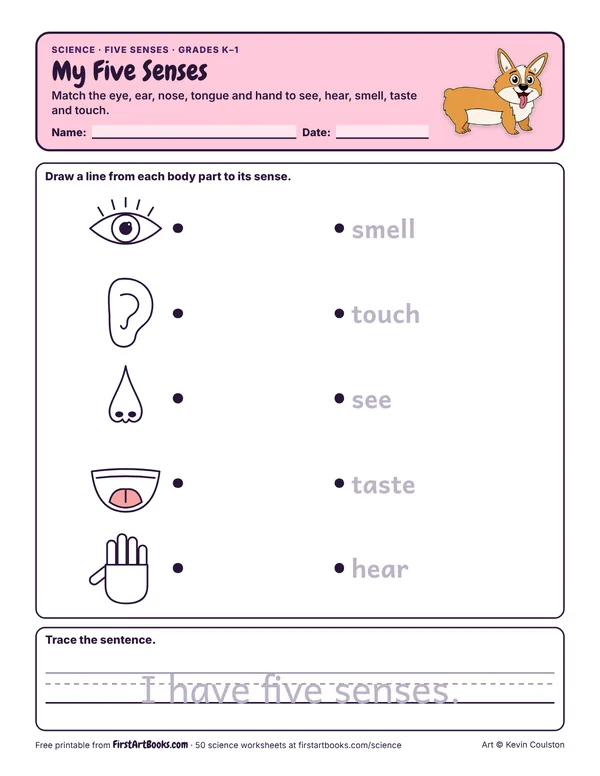
Match the eye, ear, nose, tongue and hand to see, hear, smell, taste and touch.
Print this sheet (PDF)Teacher notes and tips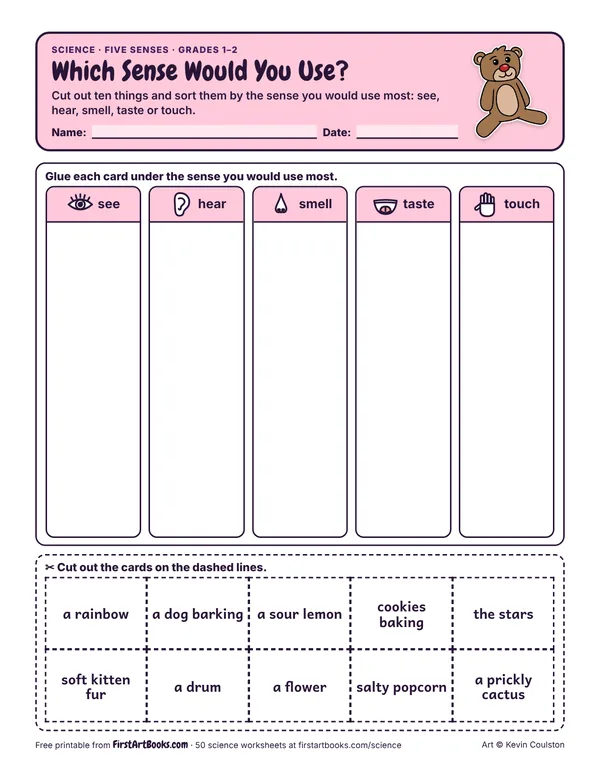
Cut out ten things and sort them by the sense you would use most: see, hear, smell, taste or touch.
Print this sheet (PDF)Teacher notes and tips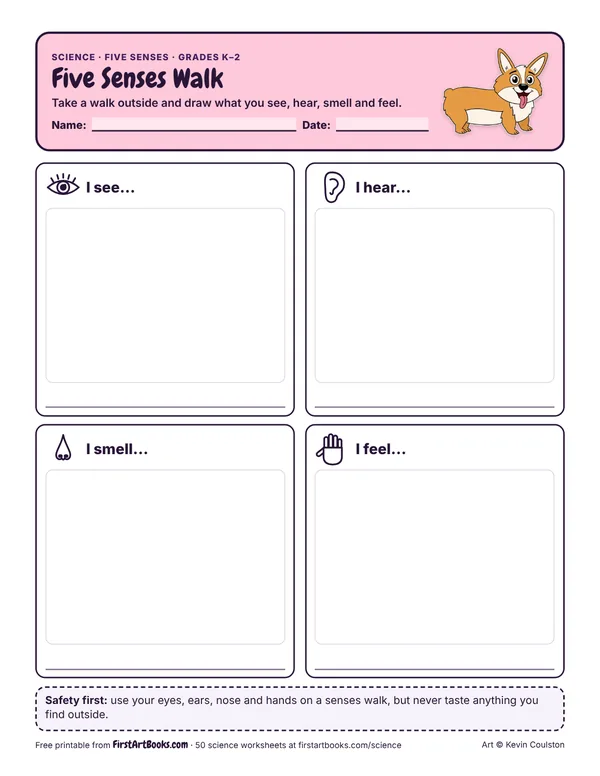
Take a walk outside and draw what you see, hear, smell and feel.
Print this sheet (PDF)Teacher notes and tips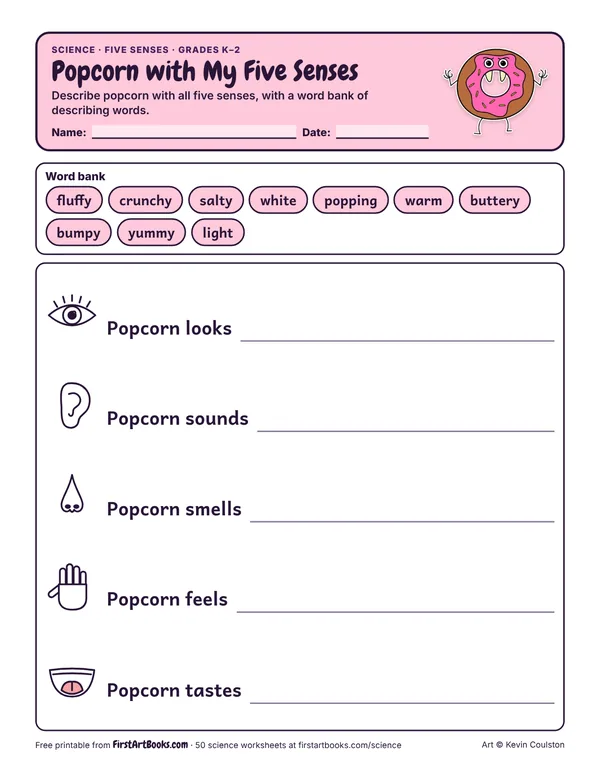
Describe popcorn with all five senses, with a word bank of describing words.
Print this sheet (PDF)Teacher notes and tips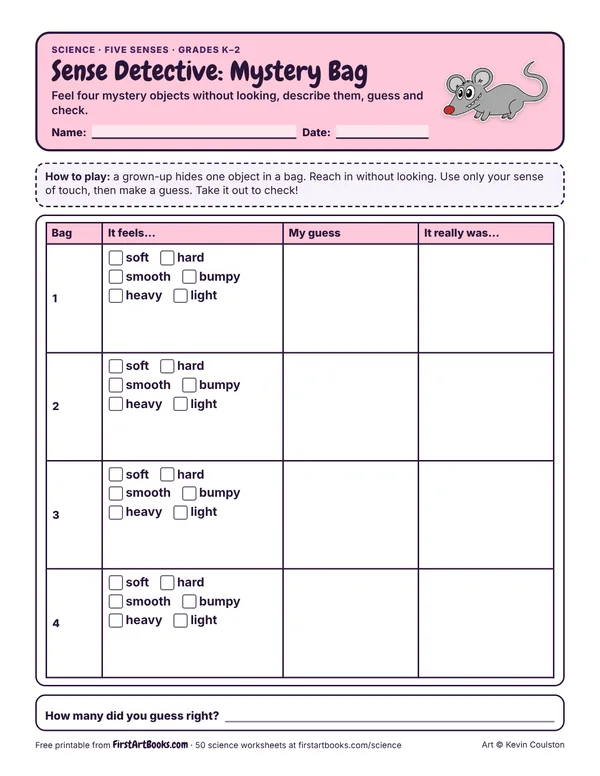
Feel four mystery objects without looking, describe them, guess and check.
Print this sheet (PDF)Teacher notes and tipsGrades 2–5. Solids, liquids and gases: a cut-and-paste sort, particle drawings, melting and freezing, a matter scavenger hunt and an ice melt race.
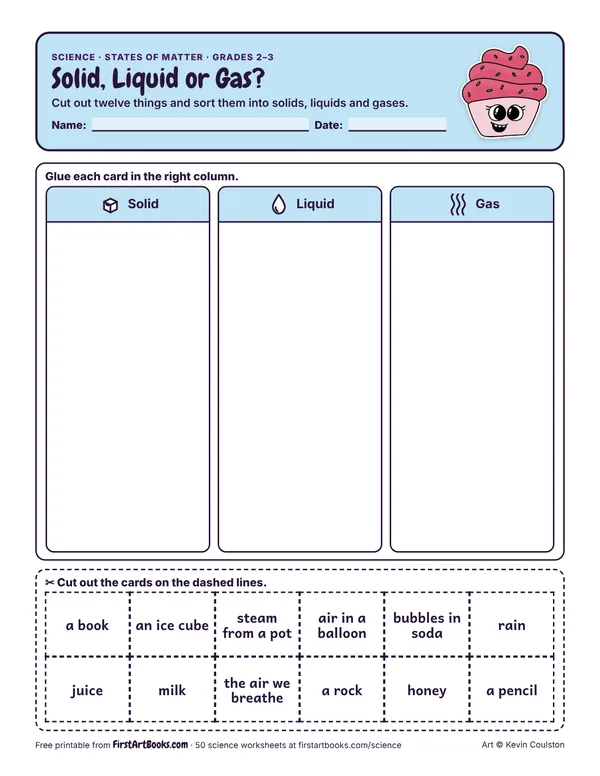
Cut out twelve things and sort them into solids, liquids and gases.
Print this sheet (PDF)Teacher notes and tips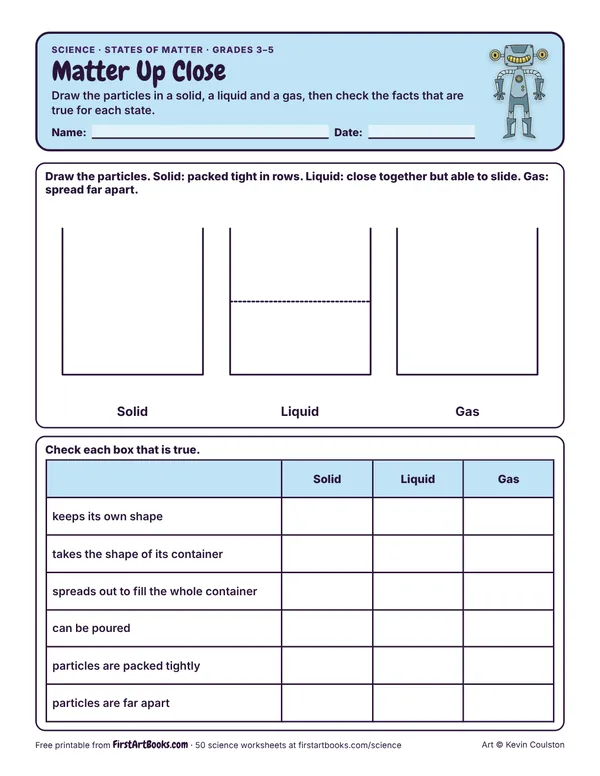
Draw the particles in a solid, a liquid and a gas, then check the facts that are true for each state.
Print this sheet (PDF)Teacher notes and tips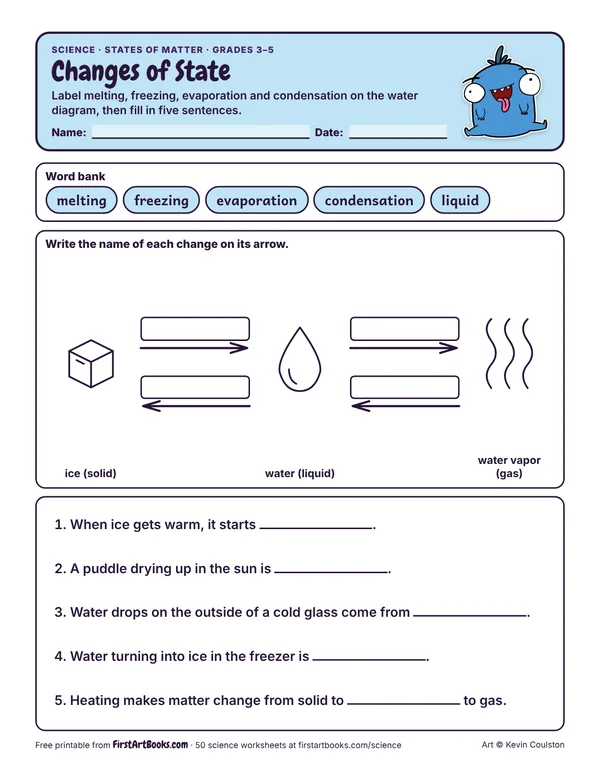
Label melting, freezing, evaporation and condensation on the water diagram, then fill in five sentences.
Print this sheet (PDF)Teacher notes and tips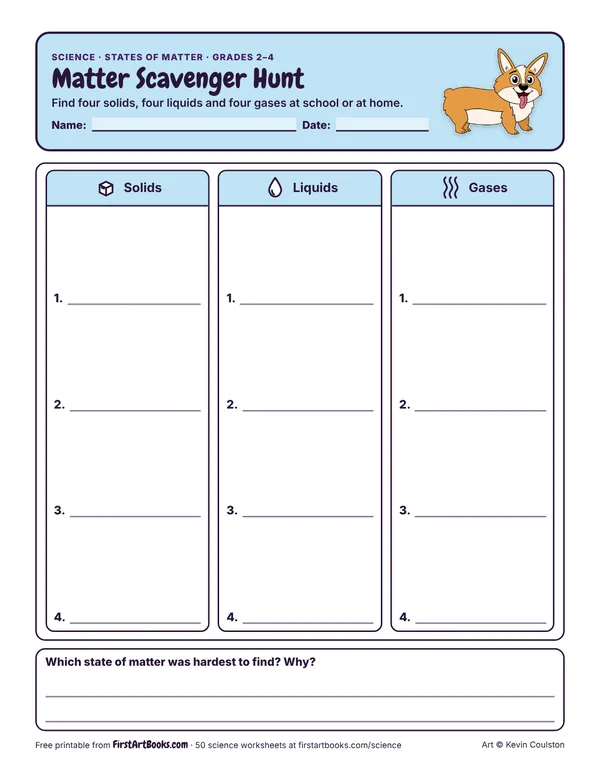
Find four solids, four liquids and four gases at school or at home.
Print this sheet (PDF)Teacher notes and tips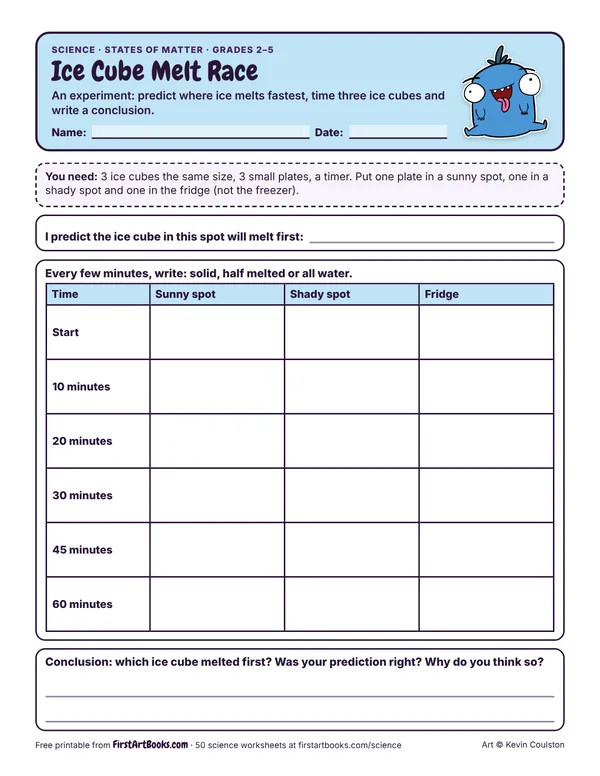
An experiment: predict where ice melts fastest, time three ice cubes and write a conclusion.
Print this sheet (PDF)Teacher notes and tipsGrades 2–5. The six simple machines, simple machines at home, and three engineering challenges: a paper tower, a paper bridge and a ramp test.
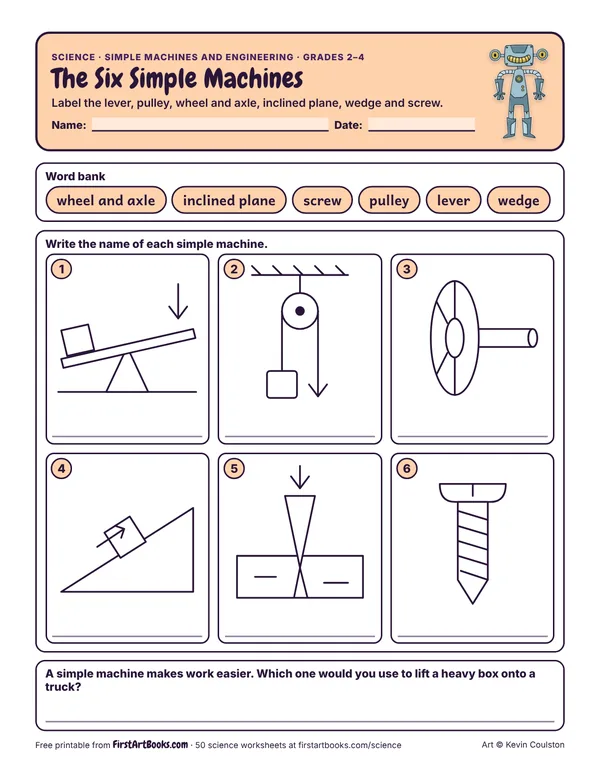
Label the lever, pulley, wheel and axle, inclined plane, wedge and screw.
Print this sheet (PDF)Teacher notes and tips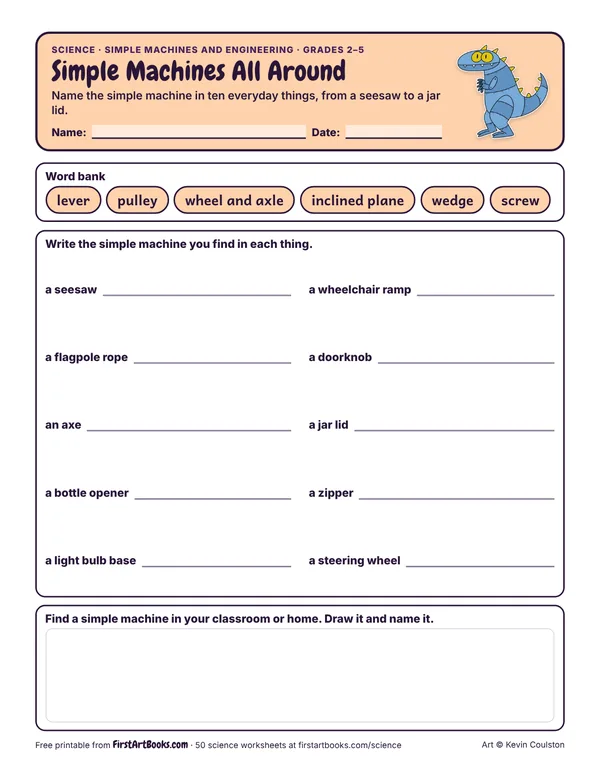
Name the simple machine in ten everyday things, from a seesaw to a jar lid.
Print this sheet (PDF)Teacher notes and tips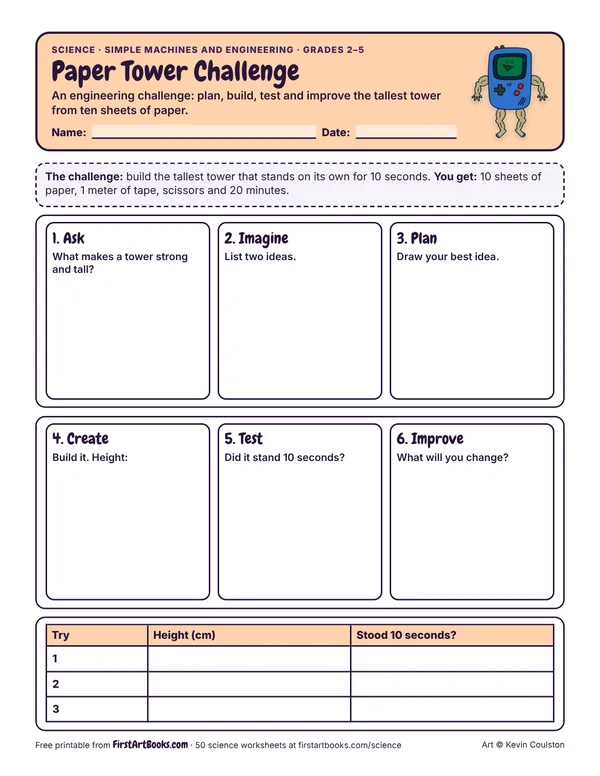
An engineering challenge: plan, build, test and improve the tallest tower from ten sheets of paper.
Print this sheet (PDF)Teacher notes and tips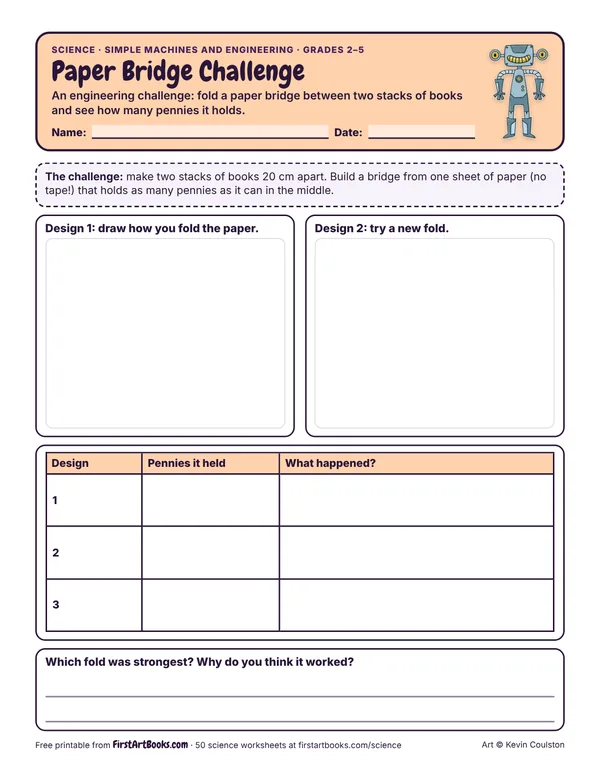
An engineering challenge: fold a paper bridge between two stacks of books and see how many pennies it holds.
Print this sheet (PDF)Teacher notes and tips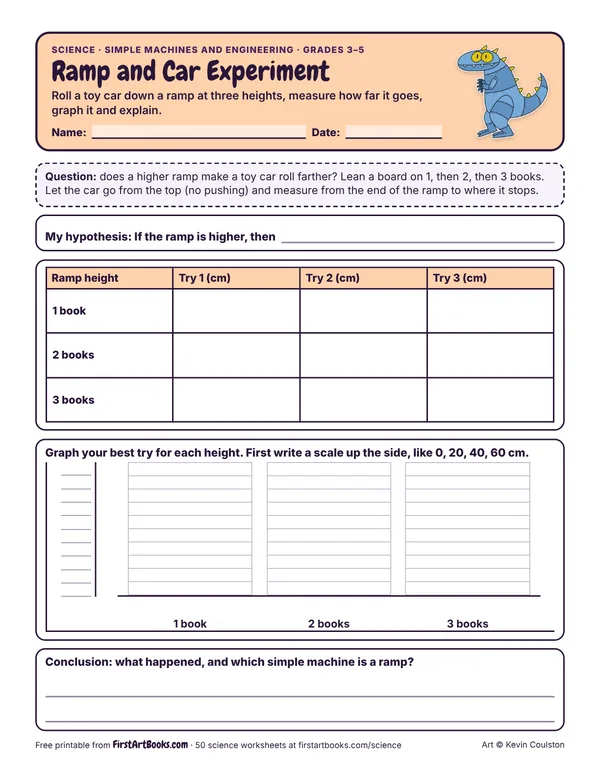
Roll a toy car down a ramp at three heights, measure how far it goes, graph it and explain.
Print this sheet (PDF)Teacher notes and tipsGrades 2–5. The steps of the scientific method, a lab sheet for any experiment, hypotheses and variables, an observation journal and observation or inference.
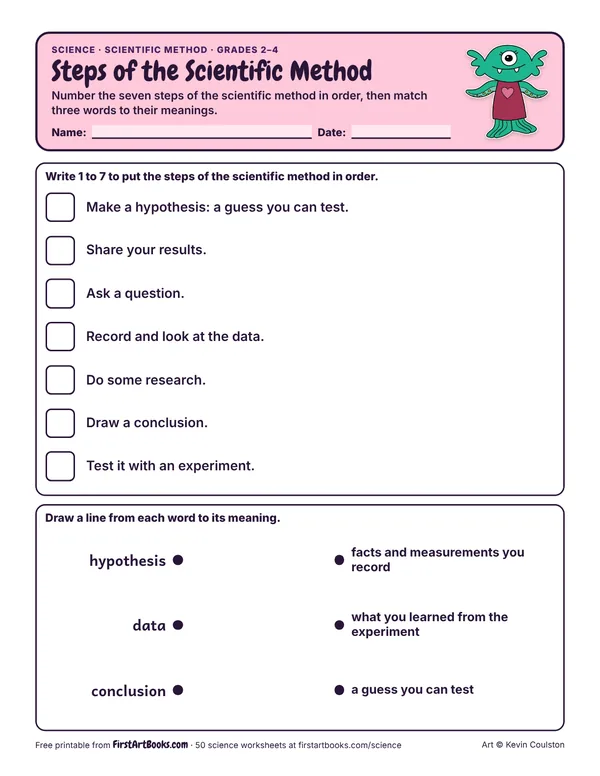
Number the seven steps of the scientific method in order, then match three words to their meanings.
Print this sheet (PDF)Teacher notes and tips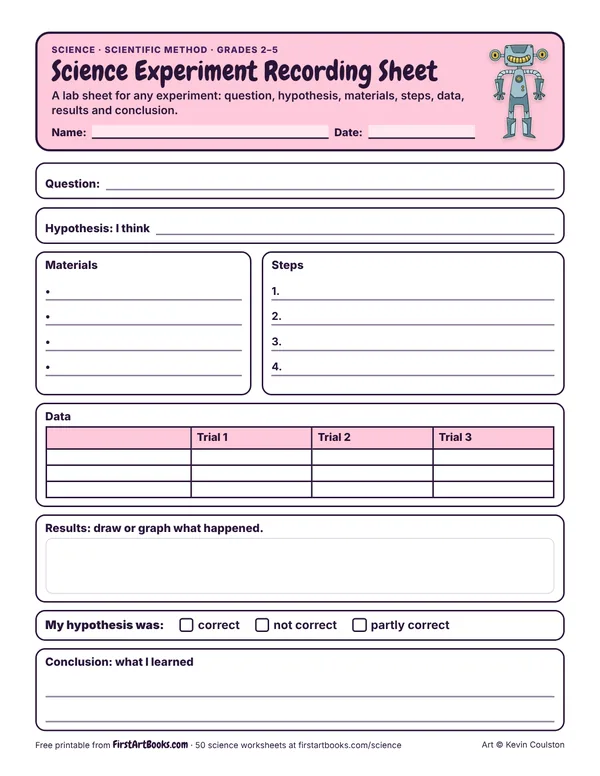
A lab sheet for any experiment: question, hypothesis, materials, steps, data, results and conclusion.
Print this sheet (PDF)Teacher notes and tips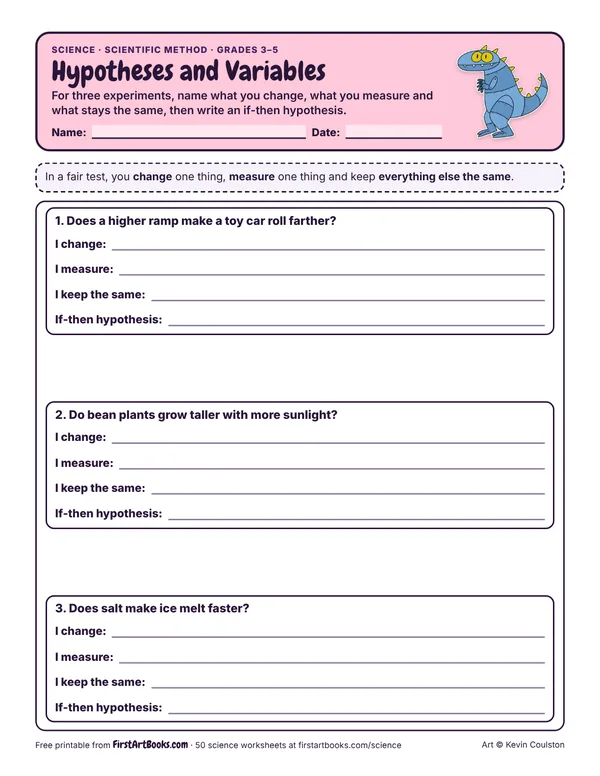
For three experiments, name what you change, what you measure and what stays the same, then write an if-then hypothesis.
Print this sheet (PDF)Teacher notes and tips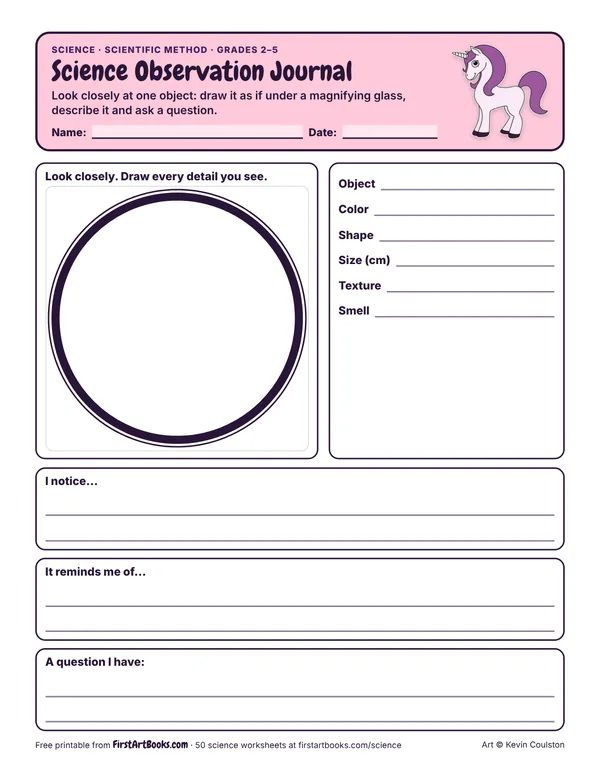
Look closely at one object: draw it as if under a magnifying glass, describe it and ask a question.
Print this sheet (PDF)Teacher notes and tips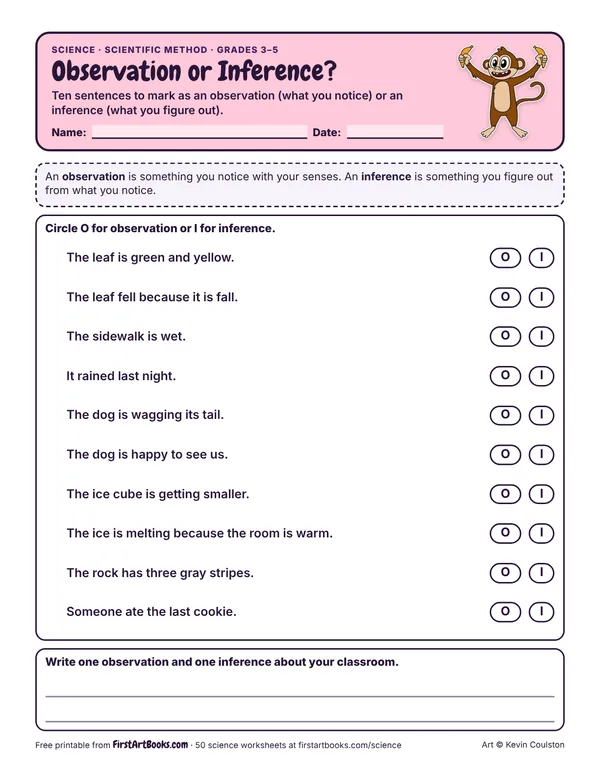
Ten sentences to mark as an observation (what you notice) or an inference (what you figure out).
Print this sheet (PDF)Teacher notes and tipsGrades 3–5. Build food chains, sort producers, consumers and decomposers, sort herbivores, carnivores and omnivores, read a food web and fill an energy pyramid.
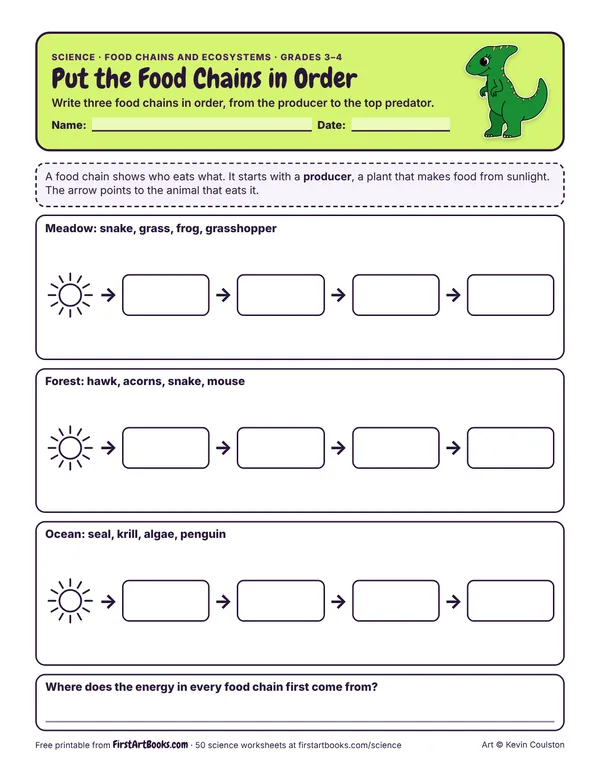
Write three food chains in order, from the producer to the top predator.
Print this sheet (PDF)Teacher notes and tips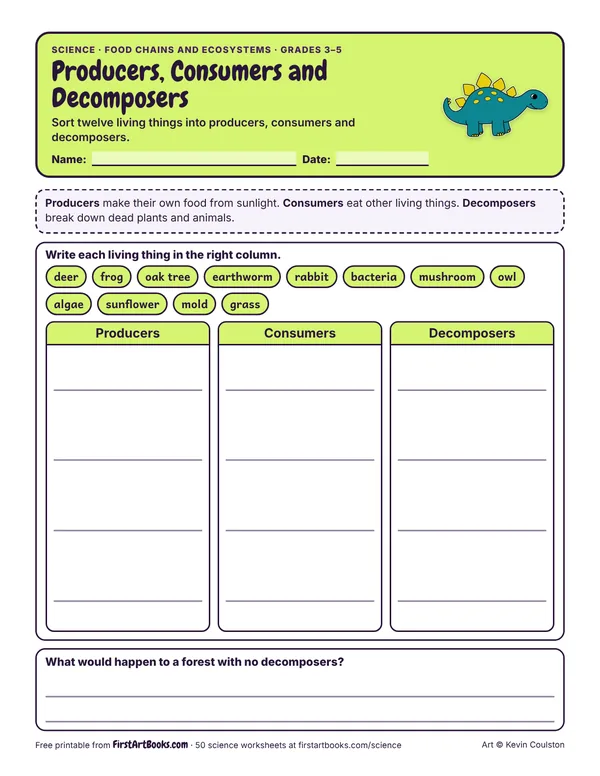
Sort twelve living things into producers, consumers and decomposers.
Print this sheet (PDF)Teacher notes and tips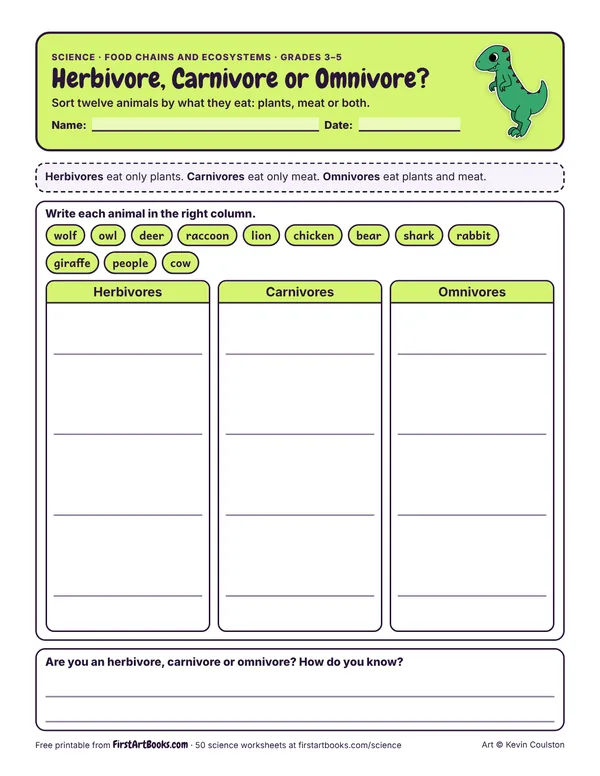
Sort twelve animals by what they eat: plants, meat or both.
Print this sheet (PDF)Teacher notes and tips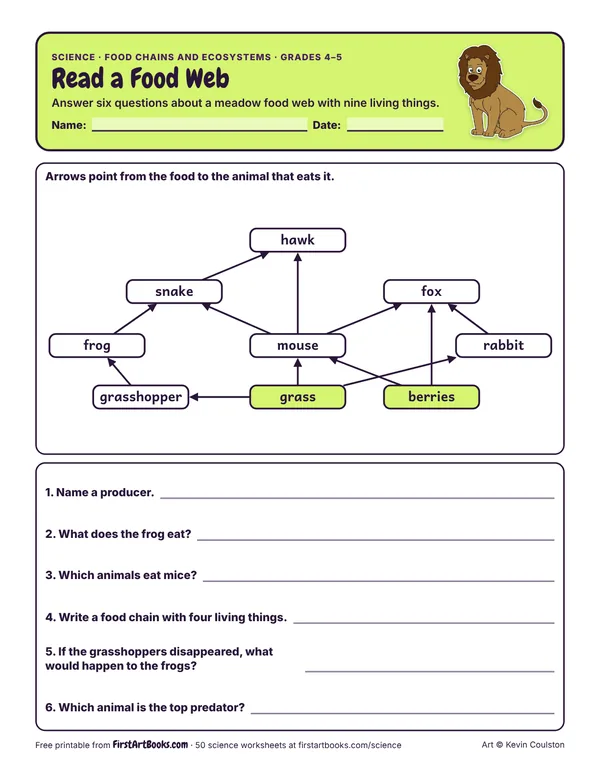
Answer six questions about a meadow food web with nine living things.
Print this sheet (PDF)Teacher notes and tips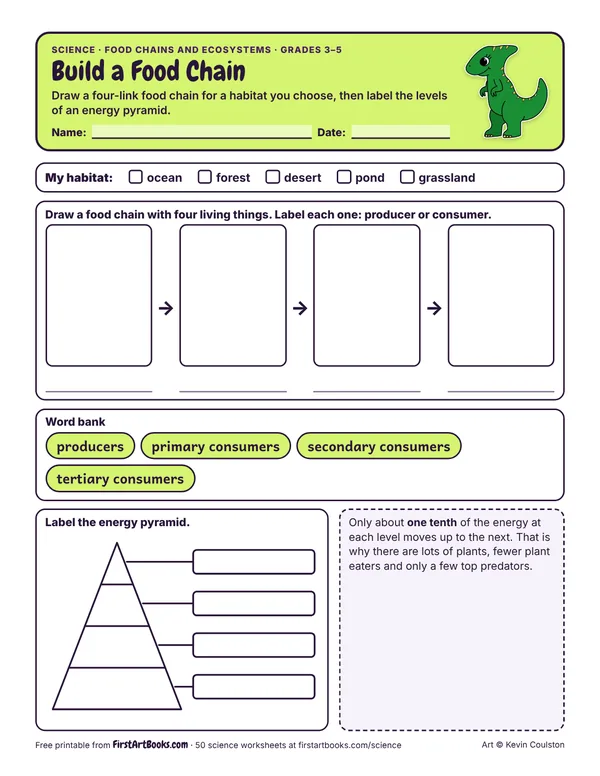
Draw a four-link food chain for a habitat you choose, then label the levels of an energy pyramid.
Print this sheet (PDF)Teacher notes and tipsGrades K–3. Label the parts of the body, meet your bones and organs, sort healthy habits and measure your own heartbeat.
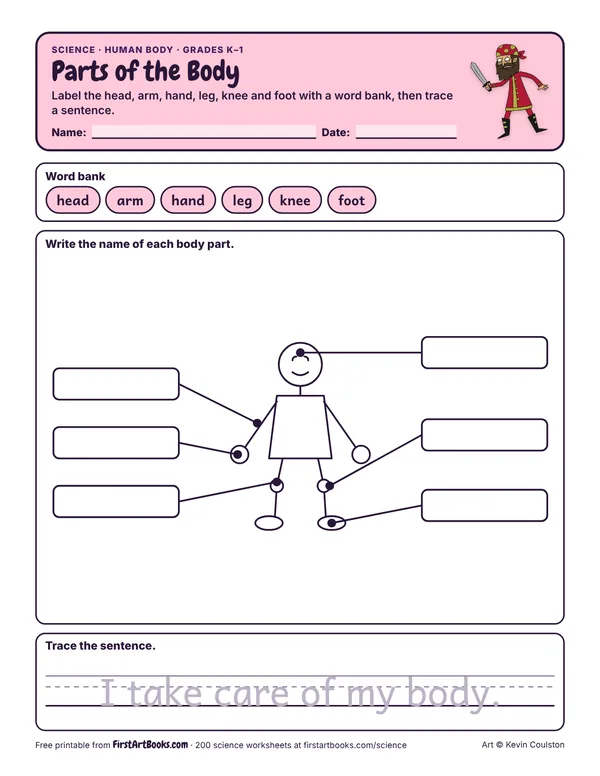
Label the head, arm, hand, leg, knee and foot with a word bank, then trace a sentence.
Print this sheet (PDF)Teacher notes and tips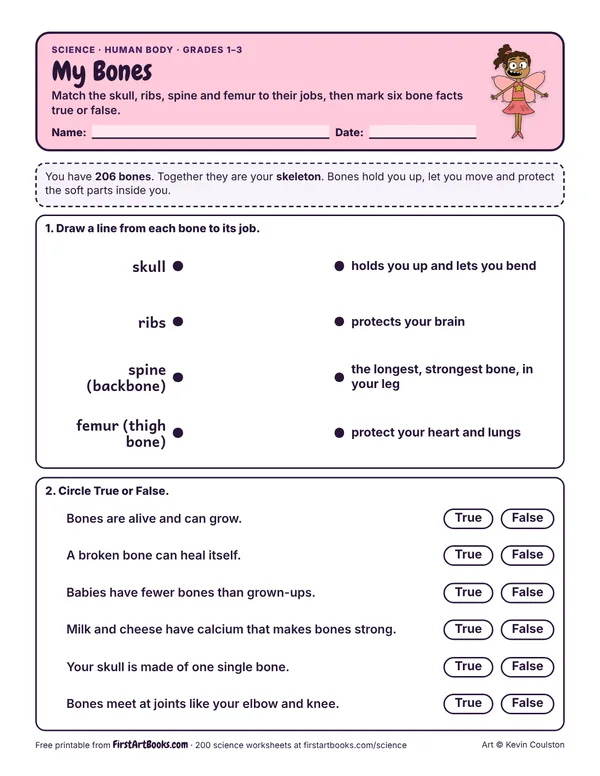
Match the skull, ribs, spine and femur to their jobs, then mark six bone facts true or false.
Print this sheet (PDF)Teacher notes and tips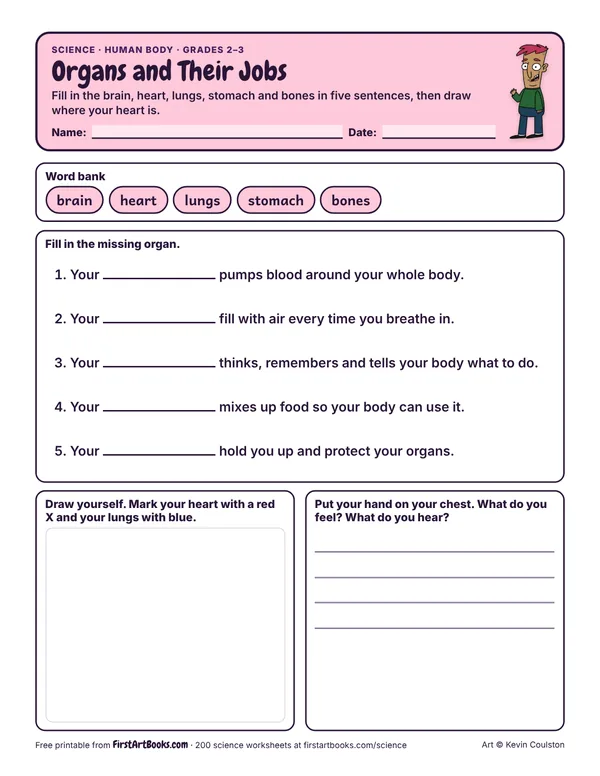
Fill in the brain, heart, lungs, stomach and bones in five sentences, then draw where your heart is.
Print this sheet (PDF)Teacher notes and tips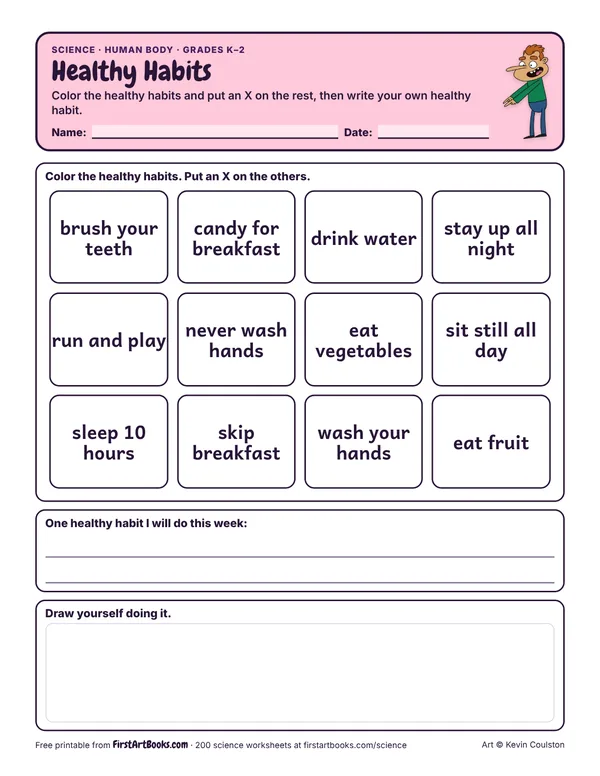
Color the healthy habits and put an X on the rest, then write your own healthy habit.
Print this sheet (PDF)Teacher notes and tips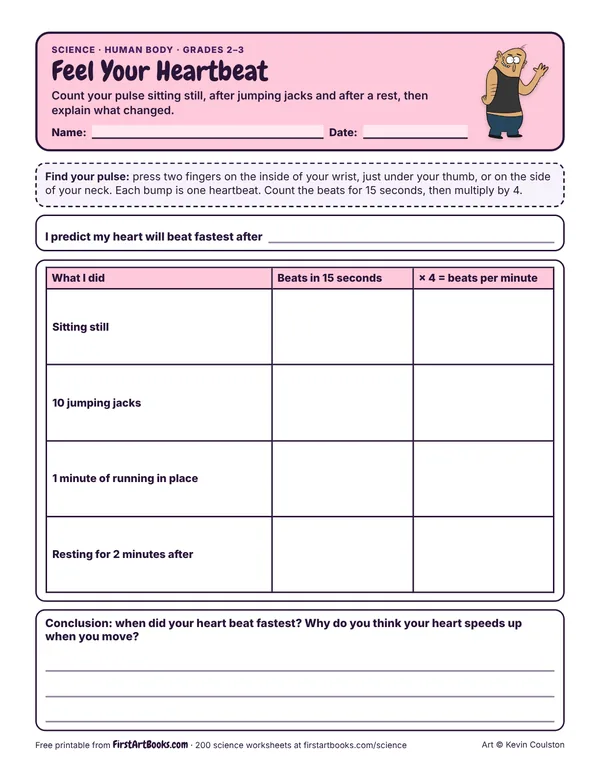
Count your pulse sitting still, after jumping jacks and after a rest, then explain what changed.
Print this sheet (PDF)Teacher notes and tipsGrades K–3. Magnetic or not, predict and test, north and south poles, a magnet hunt and how strong is a magnet.
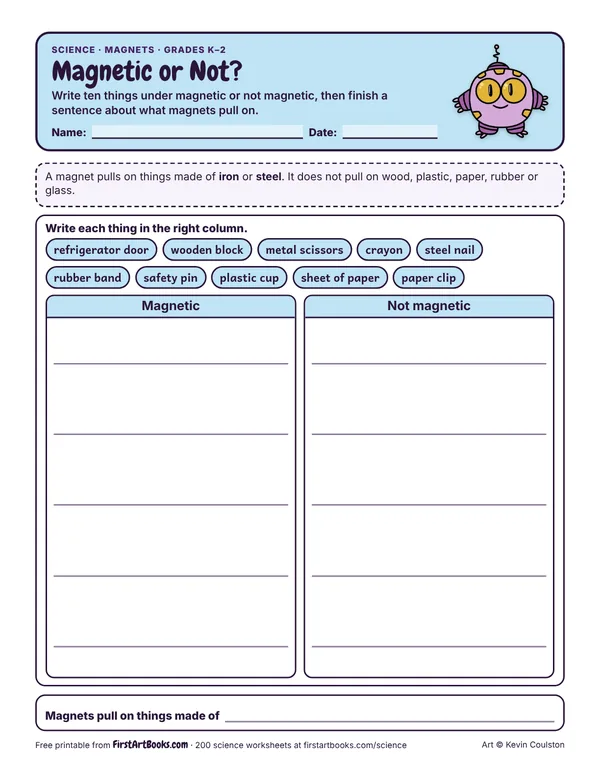
Write ten things under magnetic or not magnetic, then finish a sentence about what magnets pull on.
Print this sheet (PDF)Teacher notes and tips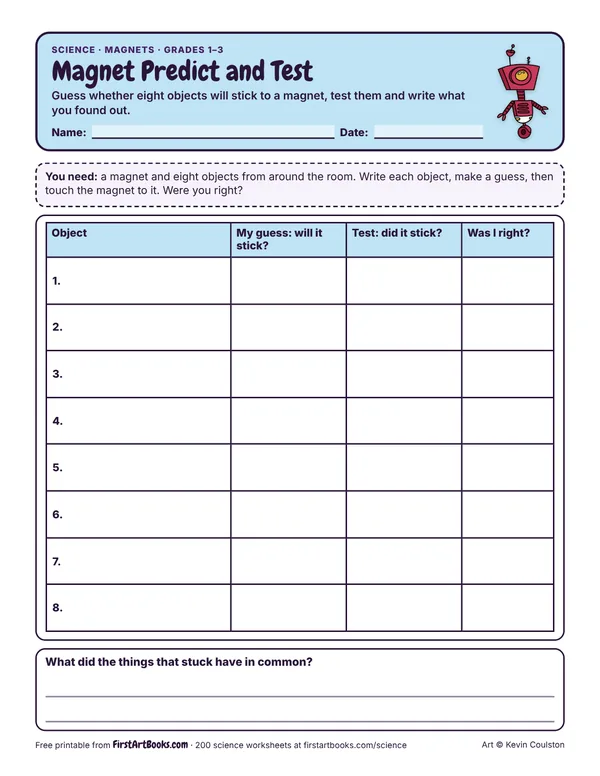
Guess whether eight objects will stick to a magnet, test them and write what you found out.
Print this sheet (PDF)Teacher notes and tips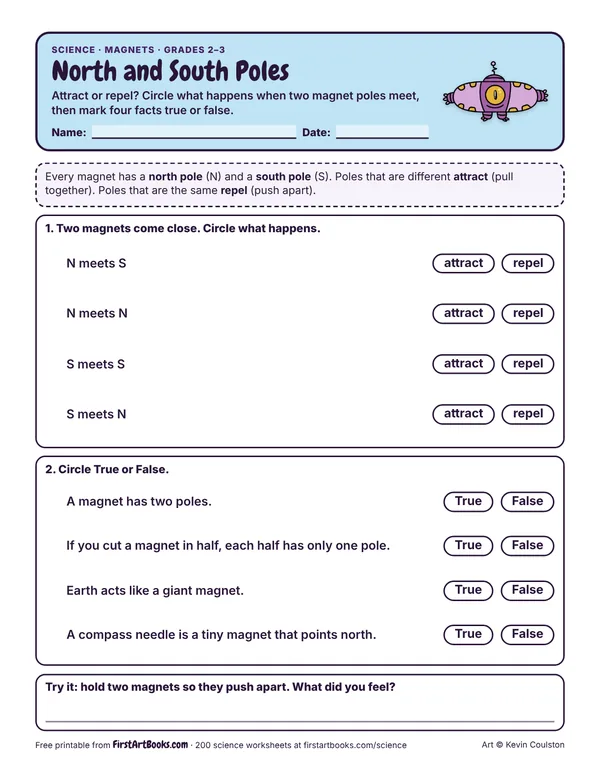
Attract or repel? Circle what happens when two magnet poles meet, then mark four facts true or false.
Print this sheet (PDF)Teacher notes and tips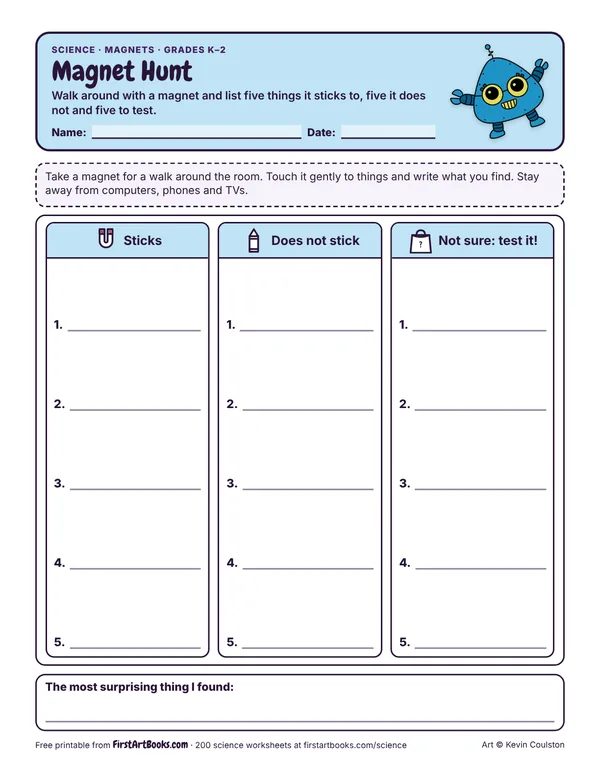
Walk around with a magnet and list five things it sticks to, five it does not and five to test.
Print this sheet (PDF)Teacher notes and tips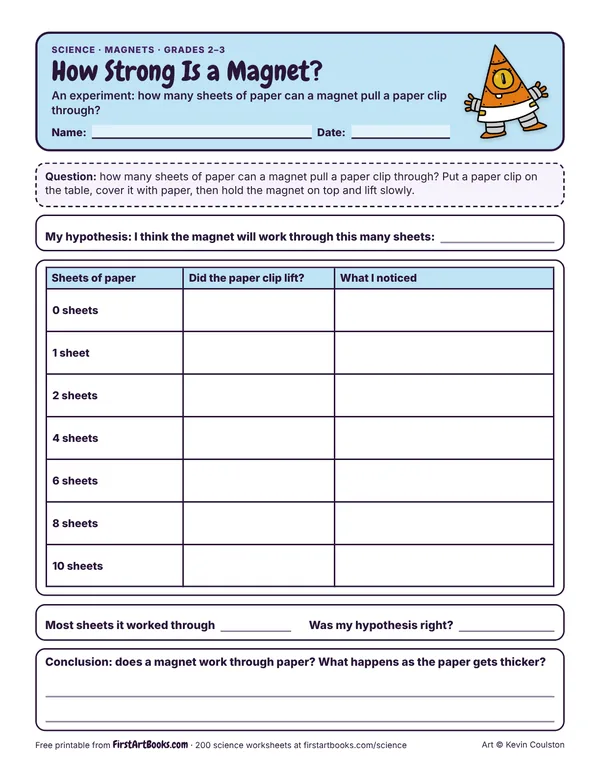
An experiment: how many sheets of paper can a magnet pull a paper clip through?
Print this sheet (PDF)Teacher notes and tipsGrades 1–4. Natural and made light, tracking shadows through the day, transparent or opaque, mirrors and reflections and the colors of the rainbow.
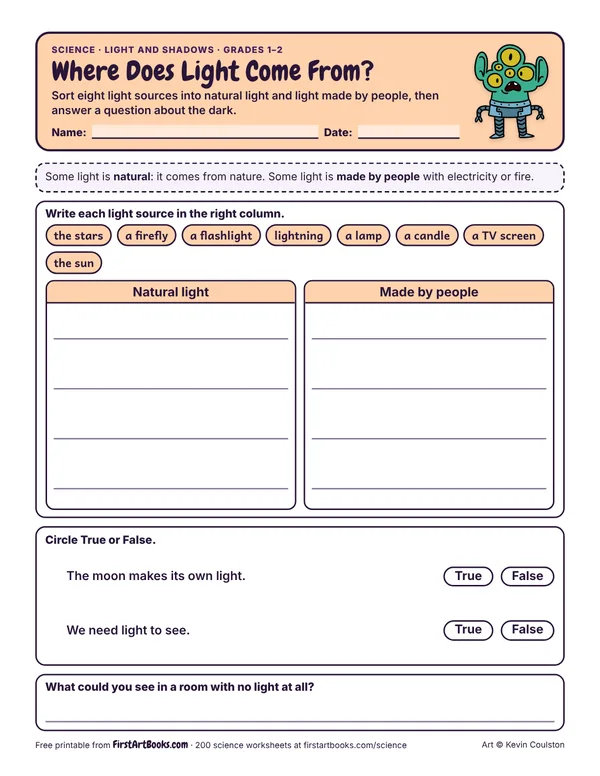
Sort eight light sources into natural light and light made by people, then answer a question about the dark.
Print this sheet (PDF)Teacher notes and tips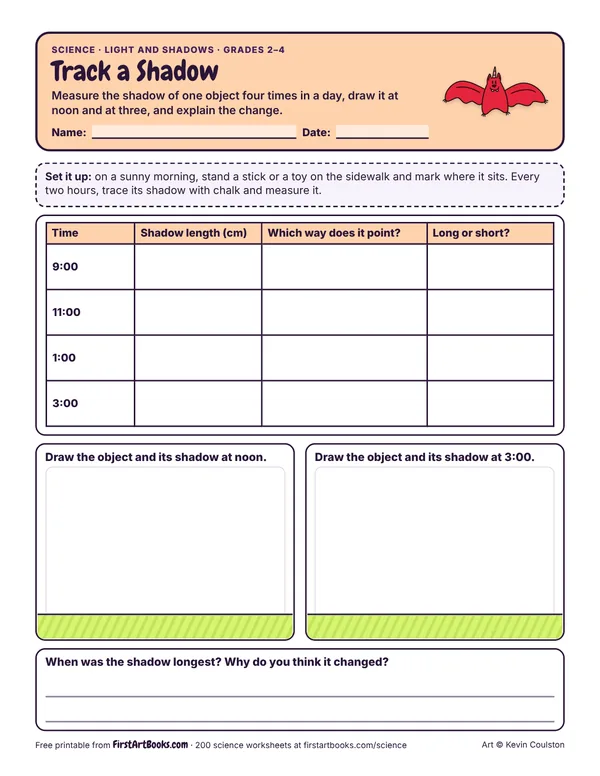
Measure the shadow of one object four times in a day, draw it at noon and at three, and explain the change.
Print this sheet (PDF)Teacher notes and tips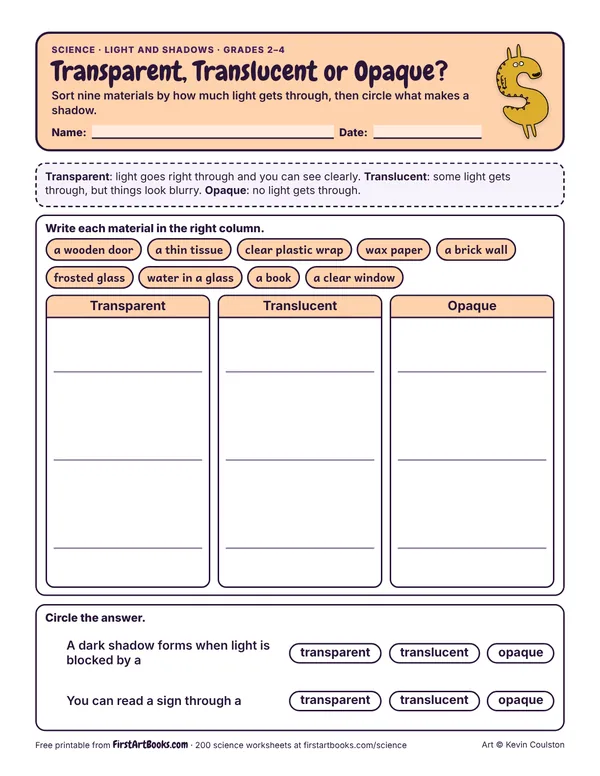
Sort nine materials by how much light gets through, then circle what makes a shadow.
Print this sheet (PDF)Teacher notes and tips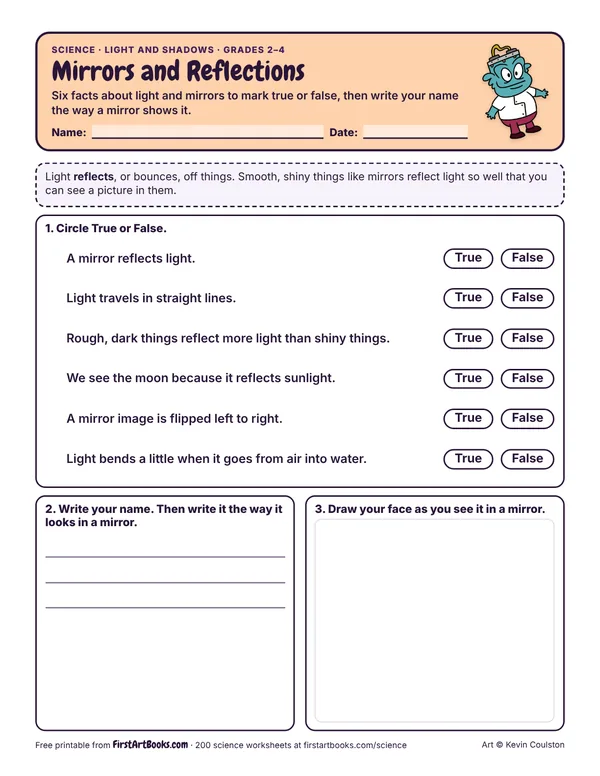
Six facts about light and mirrors to mark true or false, then write your name the way a mirror shows it.
Print this sheet (PDF)Teacher notes and tips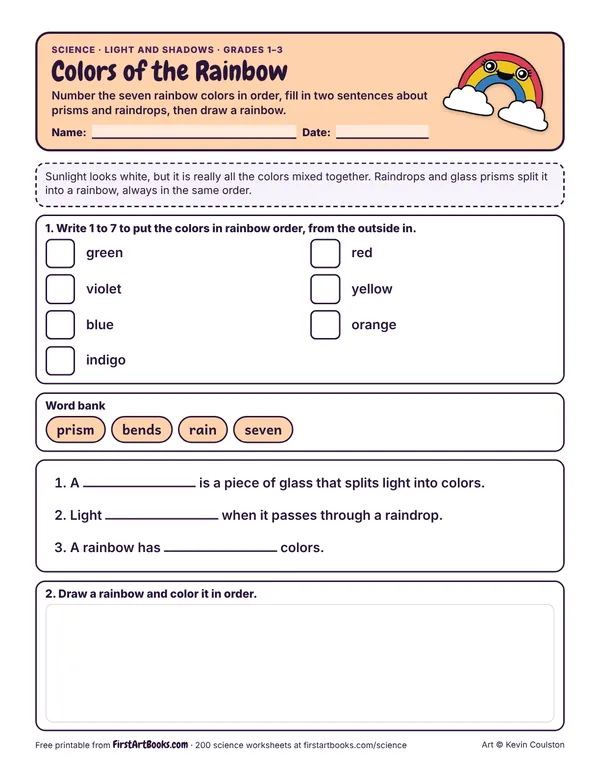
Number the seven rainbow colors in order, fill in two sentences about prisms and raindrops, then draw a rainbow.
Print this sheet (PDF)Teacher notes and tipsGrades K–4. What makes sound, loud and soft, high and low pitch, a sound walk and a rubber band guitar experiment.
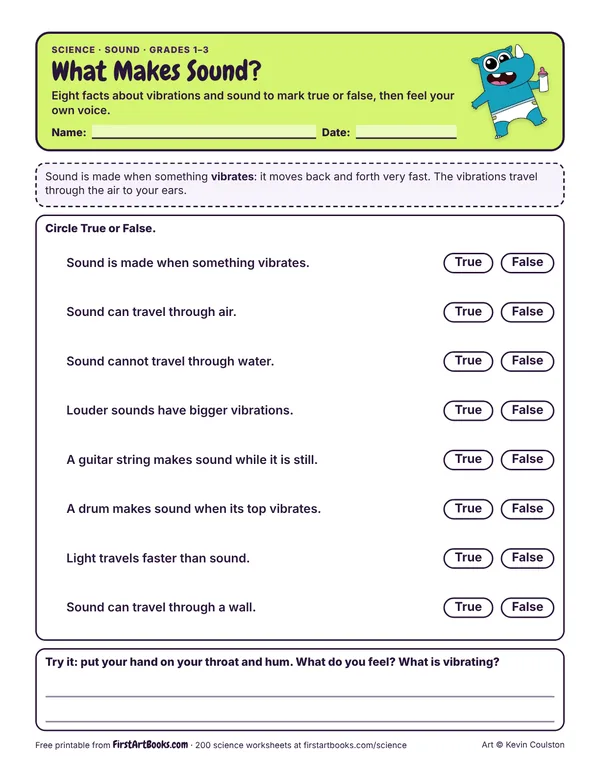
Eight facts about vibrations and sound to mark true or false, then feel your own voice.
Print this sheet (PDF)Teacher notes and tips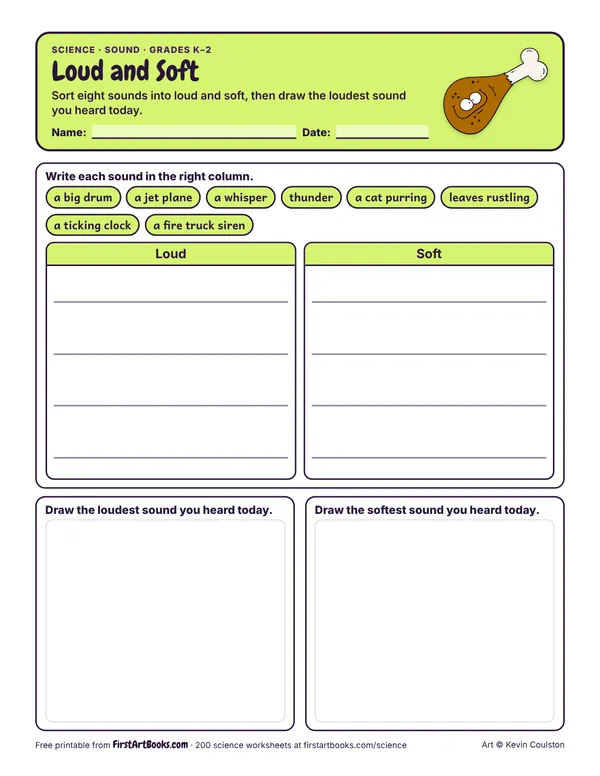
Sort eight sounds into loud and soft, then draw the loudest sound you heard today.
Print this sheet (PDF)Teacher notes and tips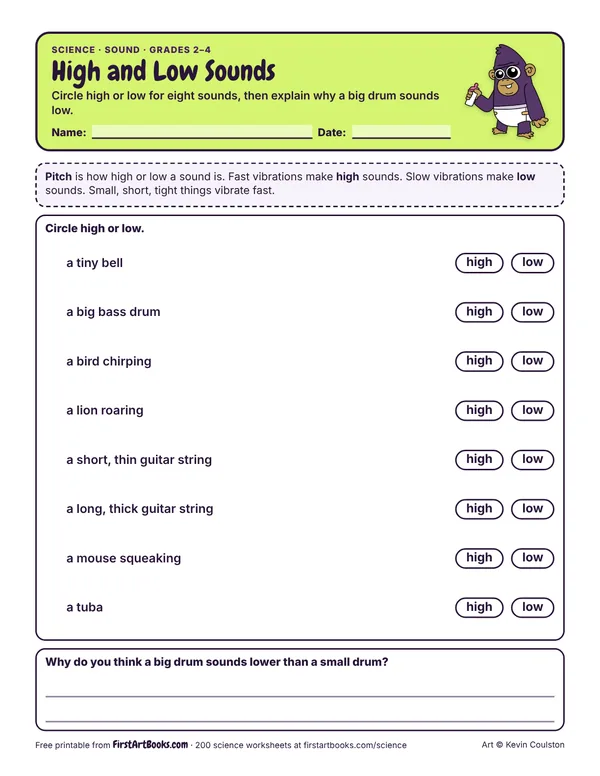
Circle high or low for eight sounds, then explain why a big drum sounds low.
Print this sheet (PDF)Teacher notes and tips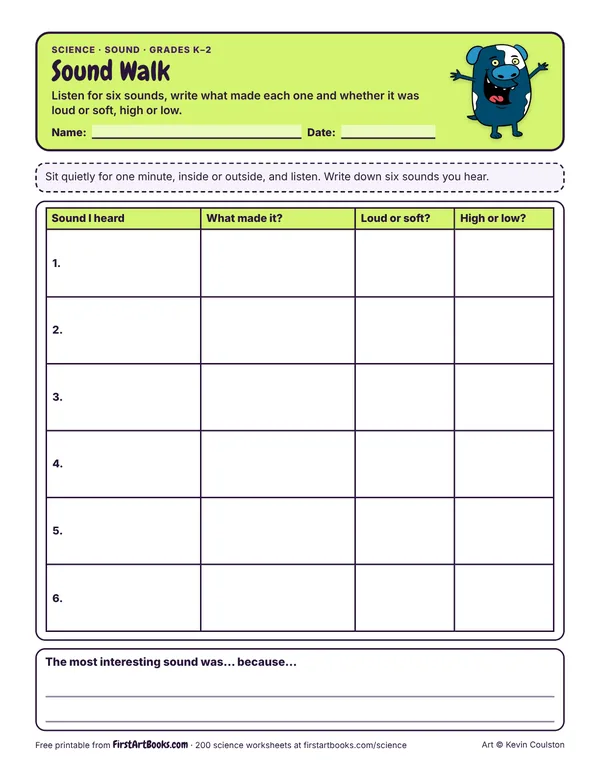
Listen for six sounds, write what made each one and whether it was loud or soft, high or low.
Print this sheet (PDF)Teacher notes and tips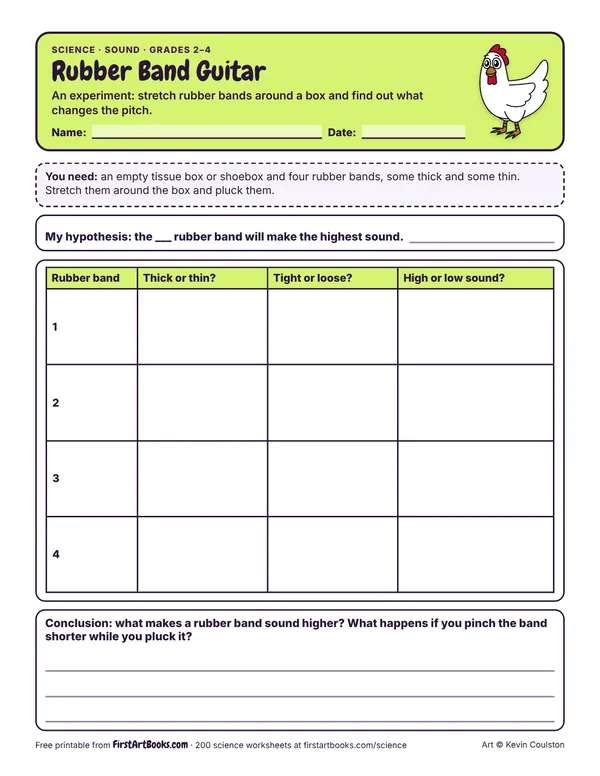
An experiment: stretch rubber bands around a box and find out what changes the pitch.
Print this sheet (PDF)Teacher notes and tipsGrades 2–5. Three kinds of rocks, a rock observation table, the layers of soil, how fossils form and the layers of the Earth.
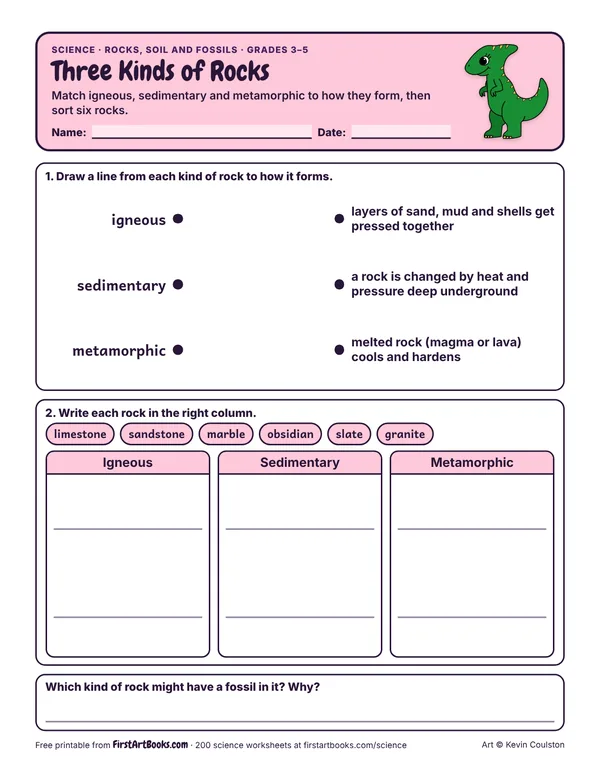
Match igneous, sedimentary and metamorphic to how they form, then sort six rocks.
Print this sheet (PDF)Teacher notes and tips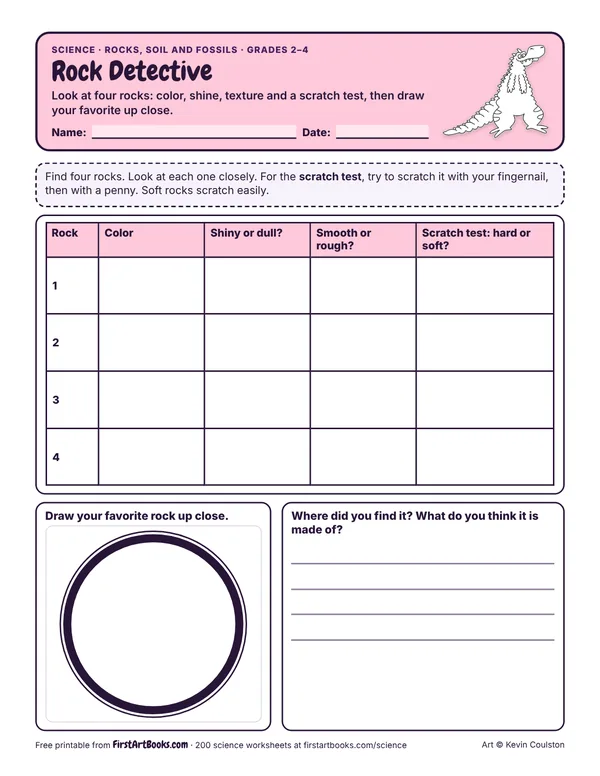
Look at four rocks: color, shine, texture and a scratch test, then draw your favorite up close.
Print this sheet (PDF)Teacher notes and tips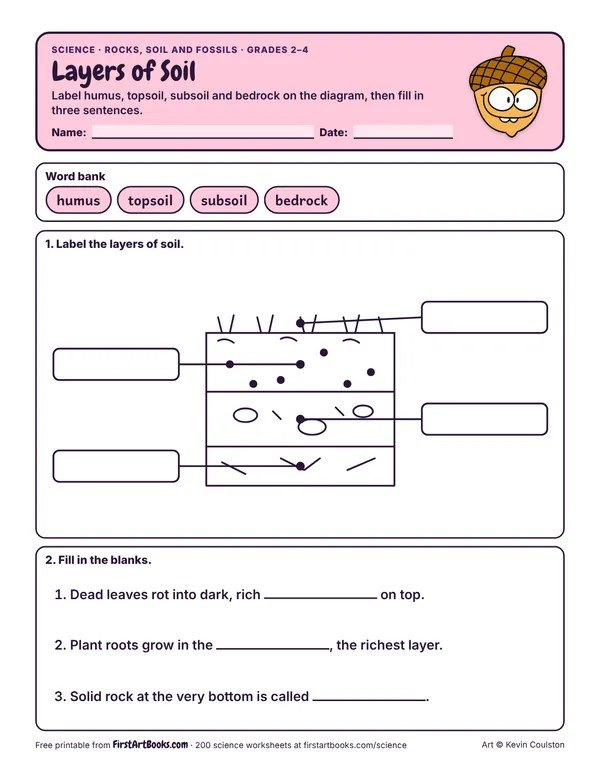
Label humus, topsoil, subsoil and bedrock on the diagram, then fill in three sentences.
Print this sheet (PDF)Teacher notes and tips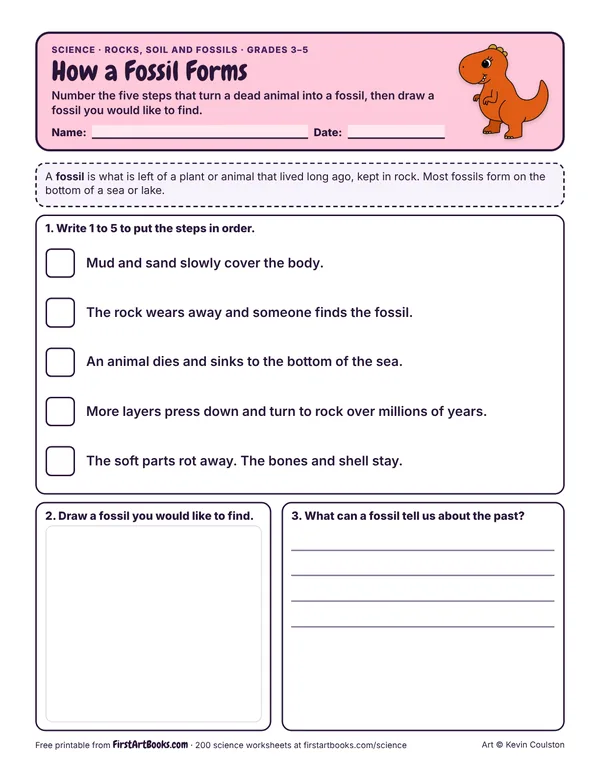
Number the five steps that turn a dead animal into a fossil, then draw a fossil you would like to find.
Print this sheet (PDF)Teacher notes and tips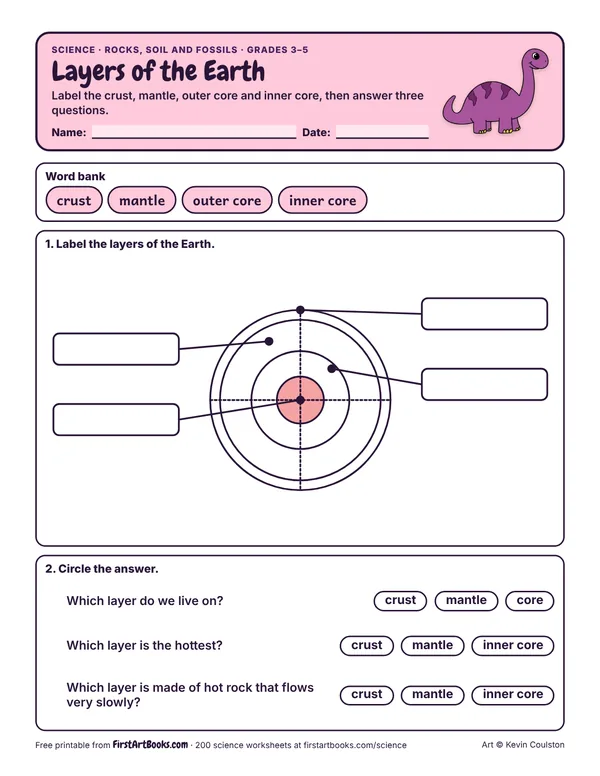
Label the crust, mantle, outer core and inner core, then answer three questions.
Print this sheet (PDF)Teacher notes and tipsGrades 2–5. Label the water cycle, learn the words, make a water cycle in a bag, find where Earth’s water is and plan to save water at home.
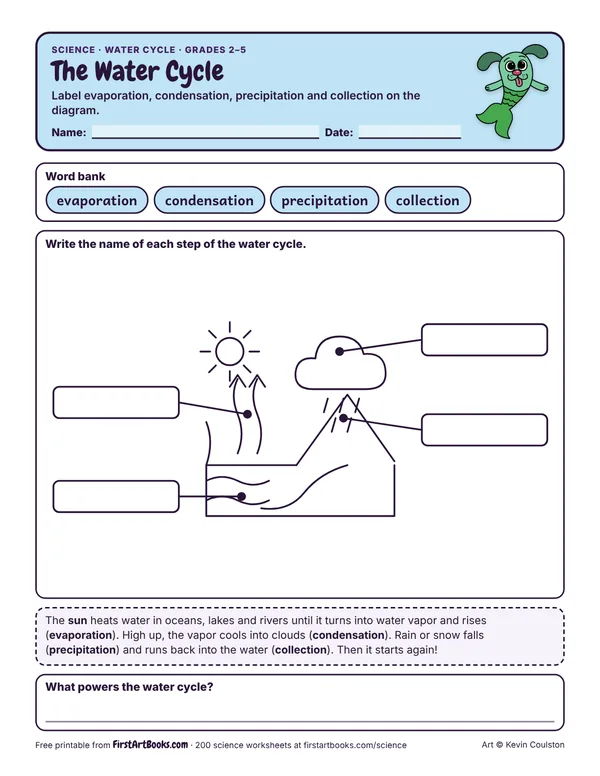
Label evaporation, condensation, precipitation and collection on the diagram.
Print this sheet (PDF)Teacher notes and tips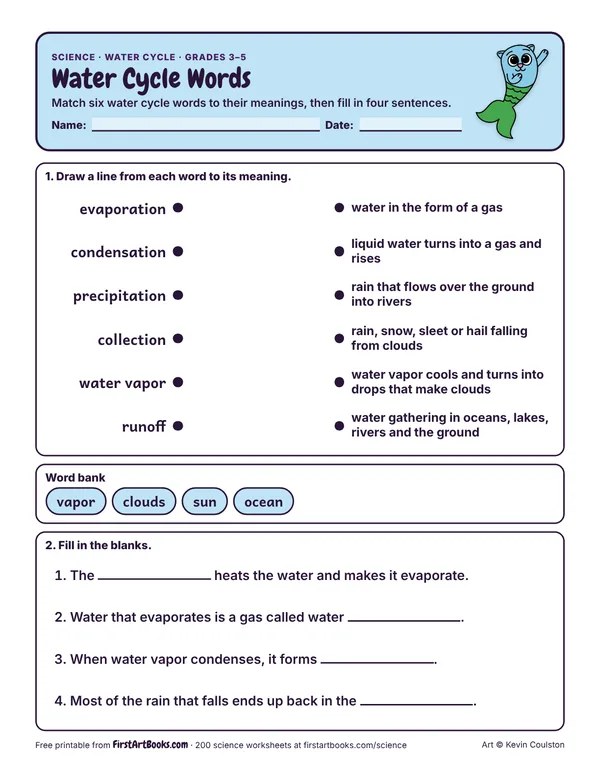
Match six water cycle words to their meanings, then fill in four sentences.
Print this sheet (PDF)Teacher notes and tips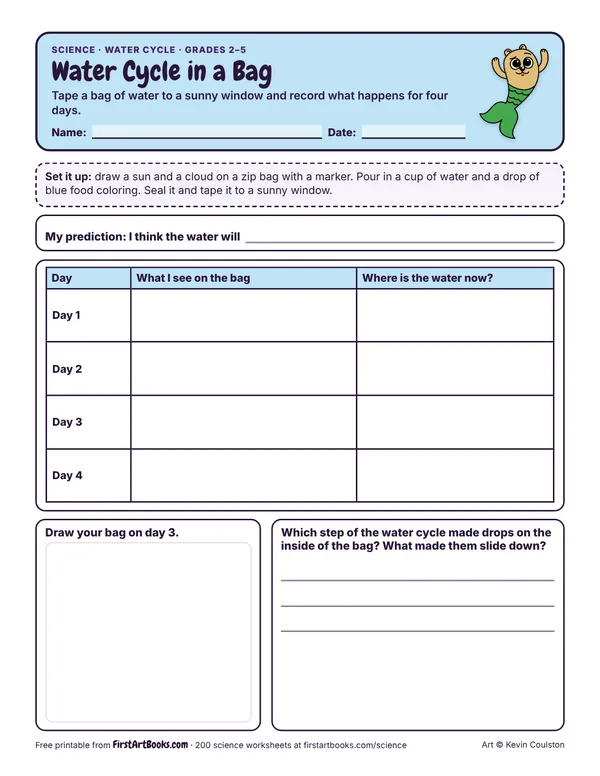
Tape a bag of water to a sunny window and record what happens for four days.
Print this sheet (PDF)Teacher notes and tips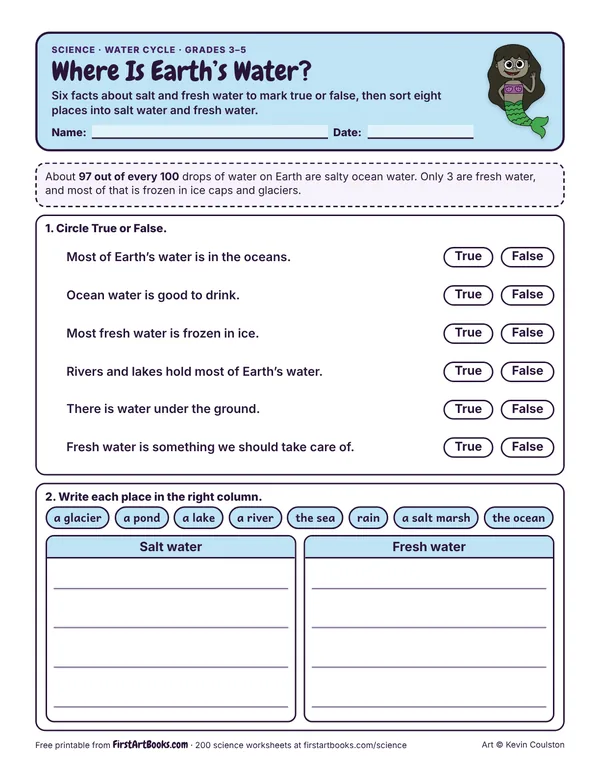
Six facts about salt and fresh water to mark true or false, then sort eight places into salt water and fresh water.
Print this sheet (PDF)Teacher notes and tips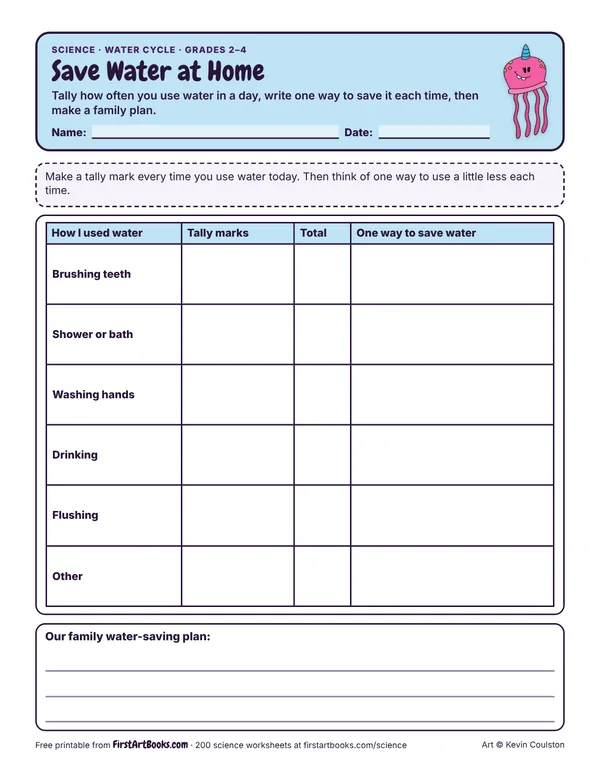
Tally how often you use water in a day, write one way to save it each time, then make a family plan.
Print this sheet (PDF)Teacher notes and tipsGrades 3–5. Parts of a circuit, will the bulb light, conductors and insulators, a static electricity experiment and electrical safety.
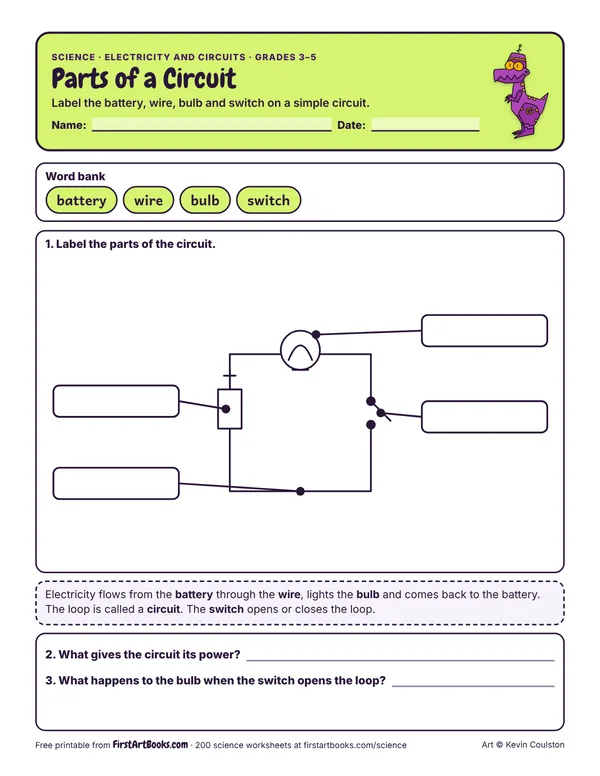
Label the battery, wire, bulb and switch on a simple circuit.
Print this sheet (PDF)Teacher notes and tips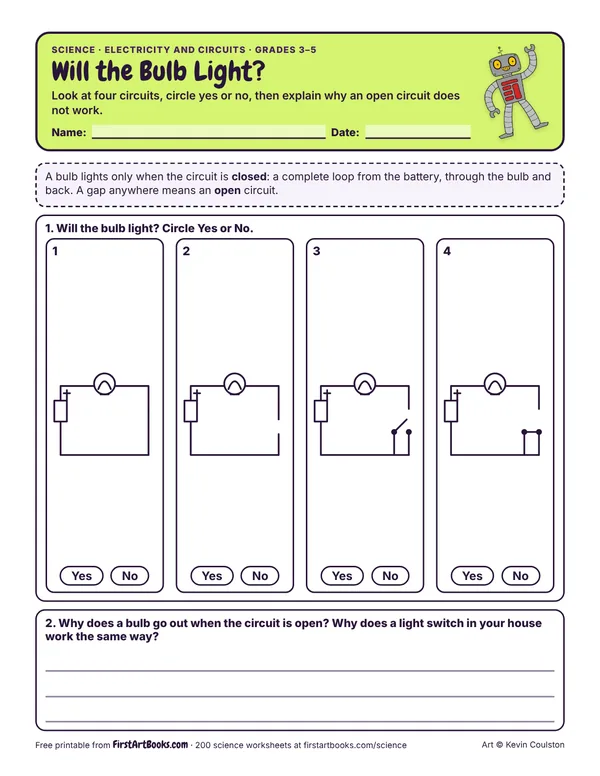
Look at four circuits, circle yes or no, then explain why an open circuit does not work.
Print this sheet (PDF)Teacher notes and tips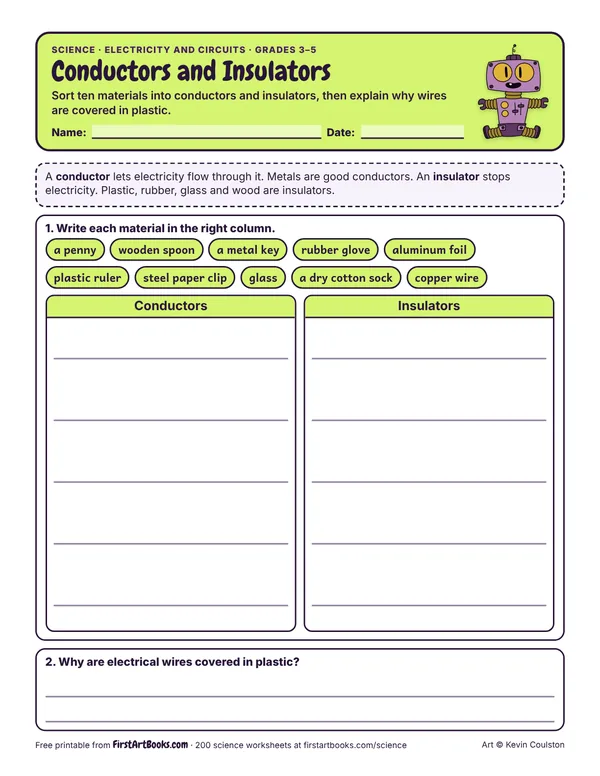
Sort ten materials into conductors and insulators, then explain why wires are covered in plastic.
Print this sheet (PDF)Teacher notes and tips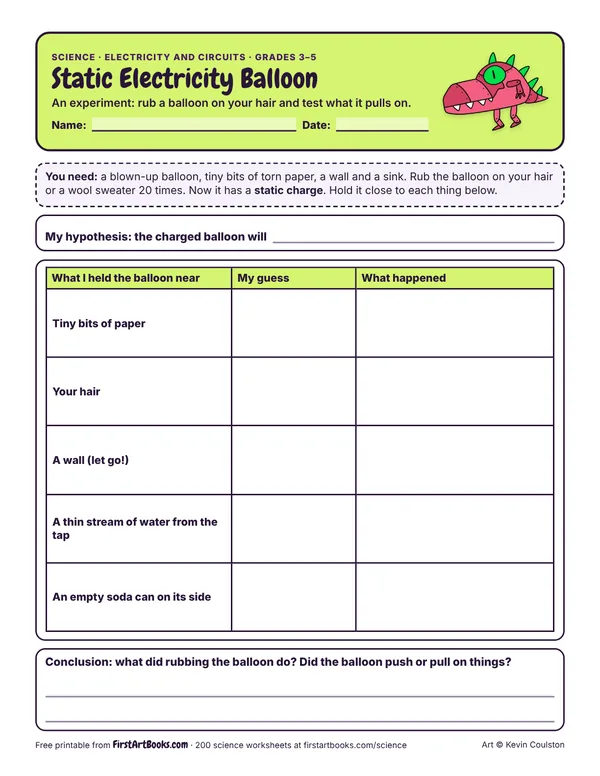
An experiment: rub a balloon on your hair and test what it pulls on.
Print this sheet (PDF)Teacher notes and tips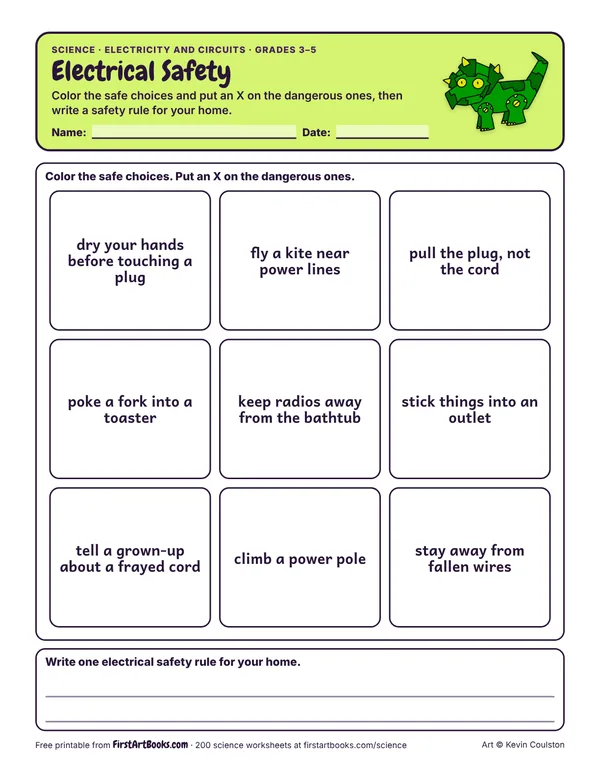
Color the safe choices and put an X on the dangerous ones, then write a safety rule for your home.
Print this sheet (PDF)Teacher notes and tipsGrades 1–5. Push or pull, a friction test, gravity true or false, balanced and unbalanced forces and a paper airplane test.
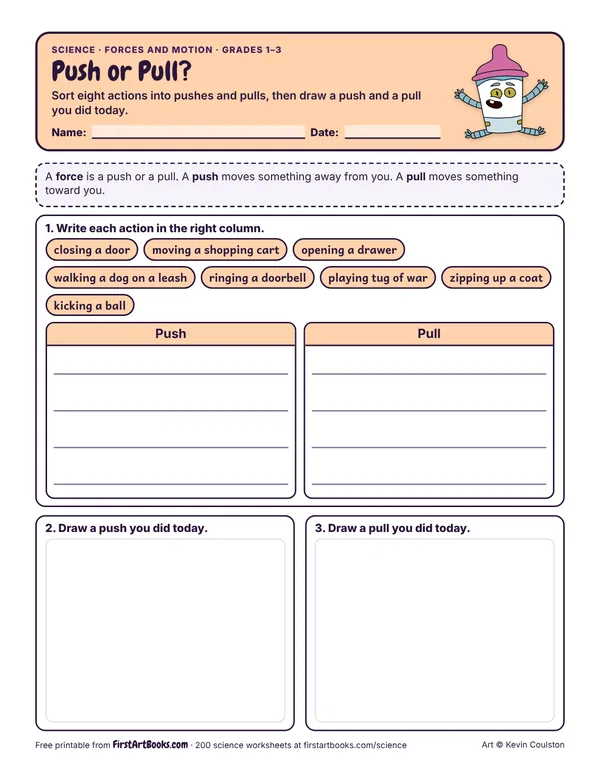
Sort eight actions into pushes and pulls, then draw a push and a pull you did today.
Print this sheet (PDF)Teacher notes and tips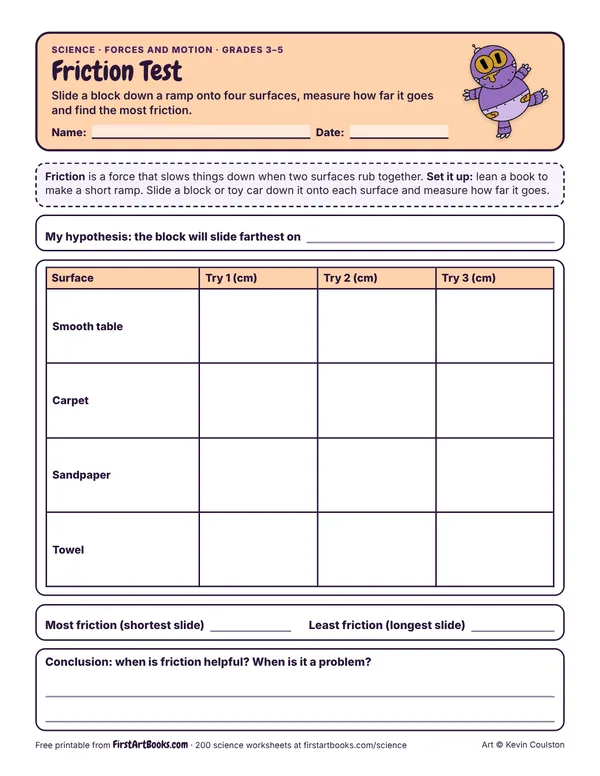
Slide a block down a ramp onto four surfaces, measure how far it goes and find the most friction.
Print this sheet (PDF)Teacher notes and tips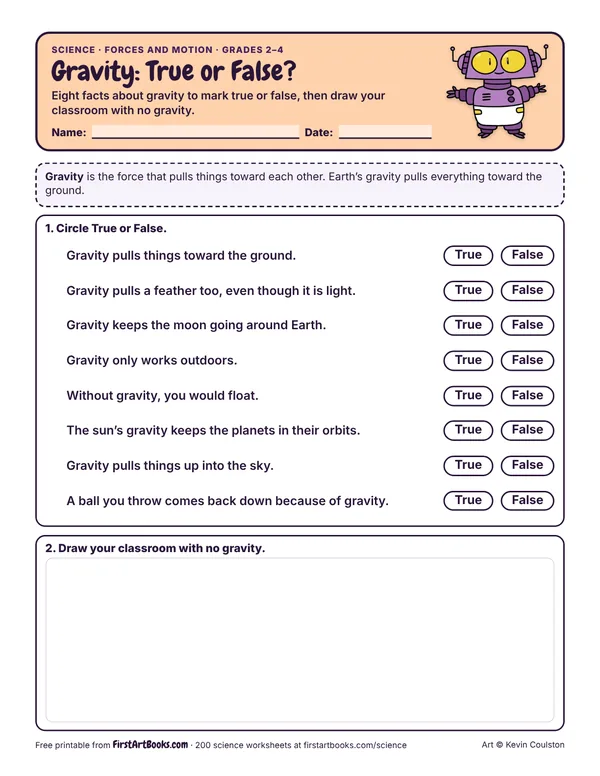
Eight facts about gravity to mark true or false, then draw your classroom with no gravity.
Print this sheet (PDF)Teacher notes and tips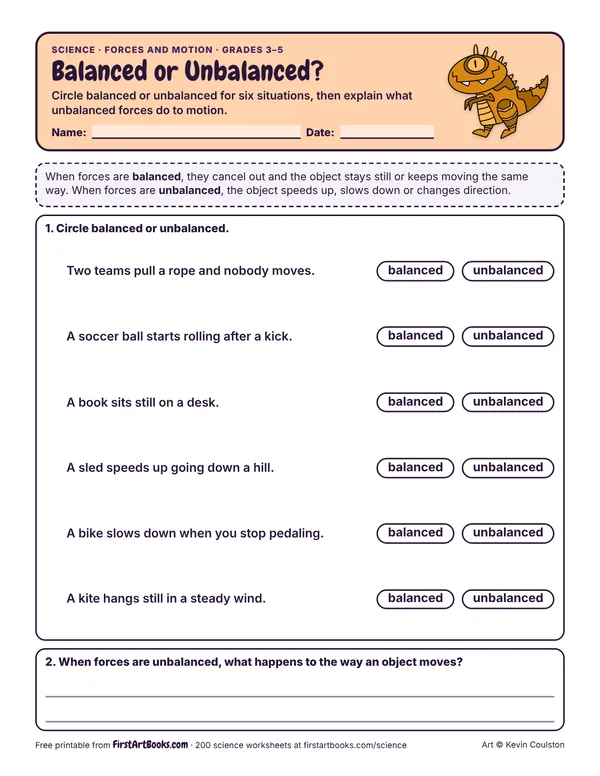
Circle balanced or unbalanced for six situations, then explain what unbalanced forces do to motion.
Print this sheet (PDF)Teacher notes and tips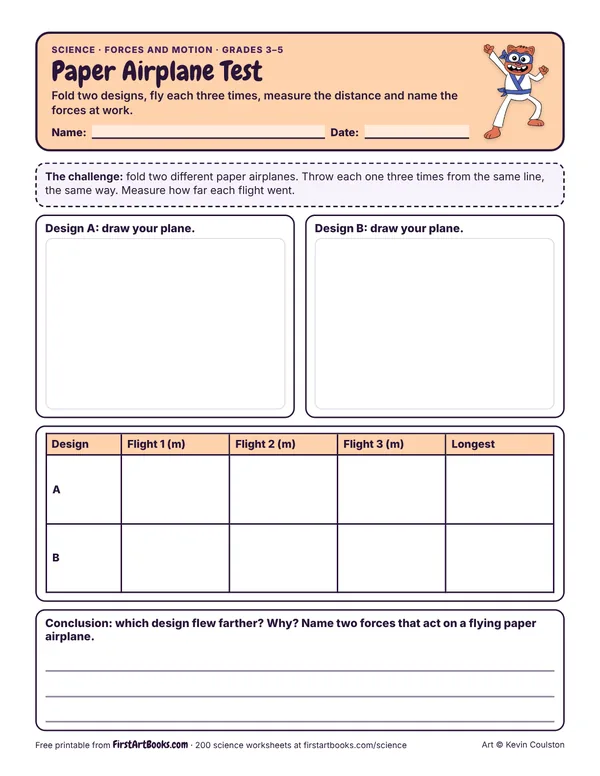
Fold two designs, fly each three times, measure the distance and name the forces at work.
Print this sheet (PDF)Teacher notes and tipsGrades 1–4. Sort animals into mammals, birds, fish, reptiles and amphibians, match the group clues, label an insect, vertebrates and invertebrates and make a classification key.
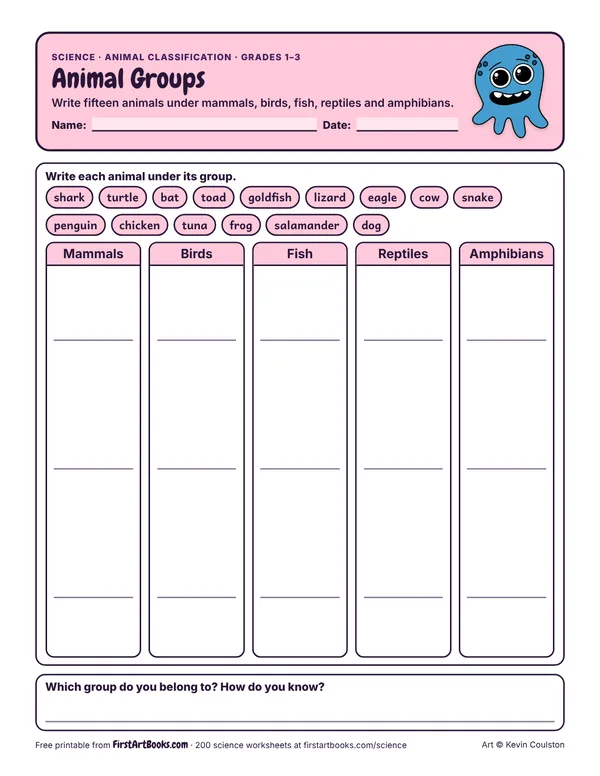
Write fifteen animals under mammals, birds, fish, reptiles and amphibians.
Print this sheet (PDF)Teacher notes and tips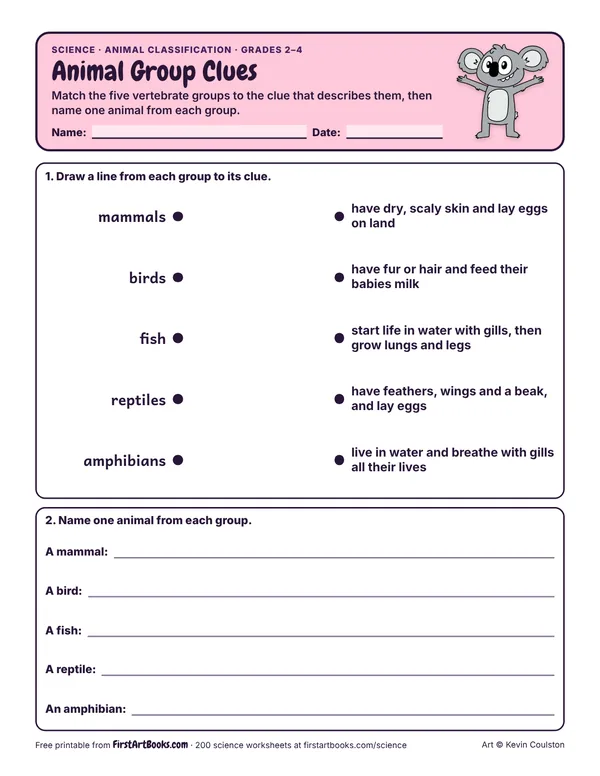
Match the five vertebrate groups to the clue that describes them, then name one animal from each group.
Print this sheet (PDF)Teacher notes and tips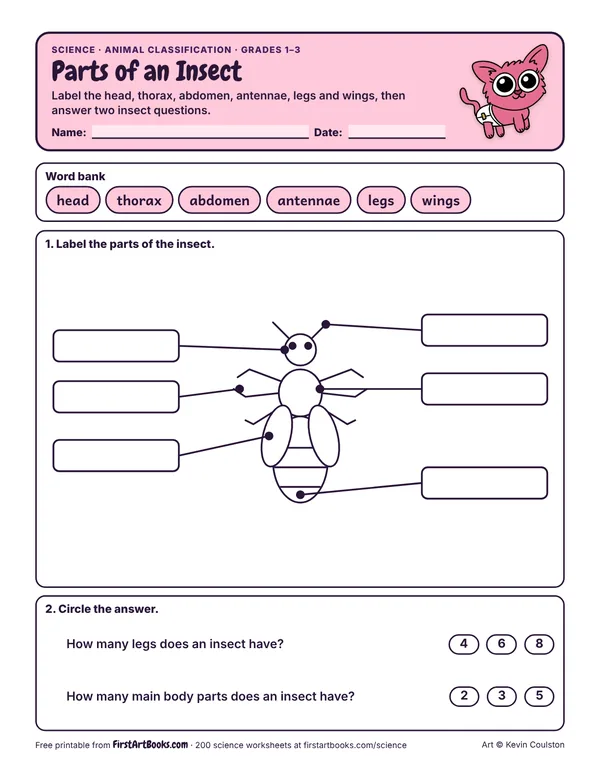
Label the head, thorax, abdomen, antennae, legs and wings, then answer two insect questions.
Print this sheet (PDF)Teacher notes and tips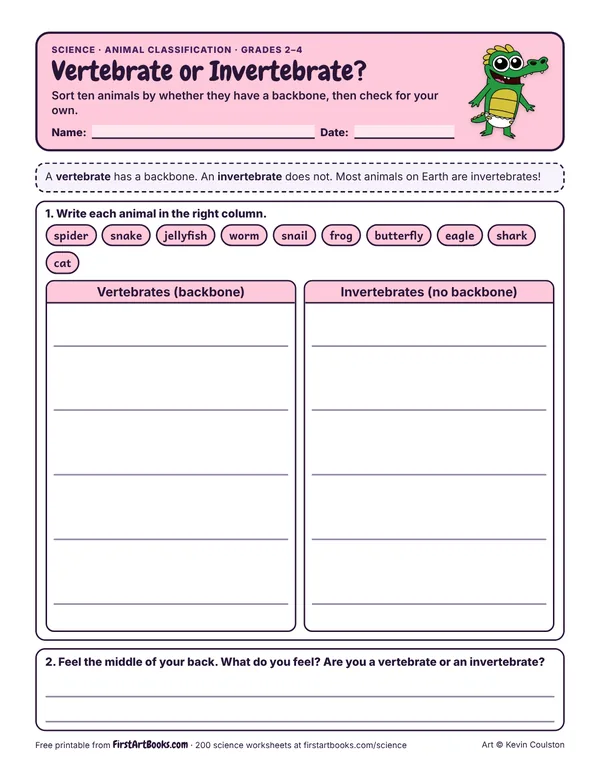
Sort ten animals by whether they have a backbone, then check for your own.
Print this sheet (PDF)Teacher notes and tips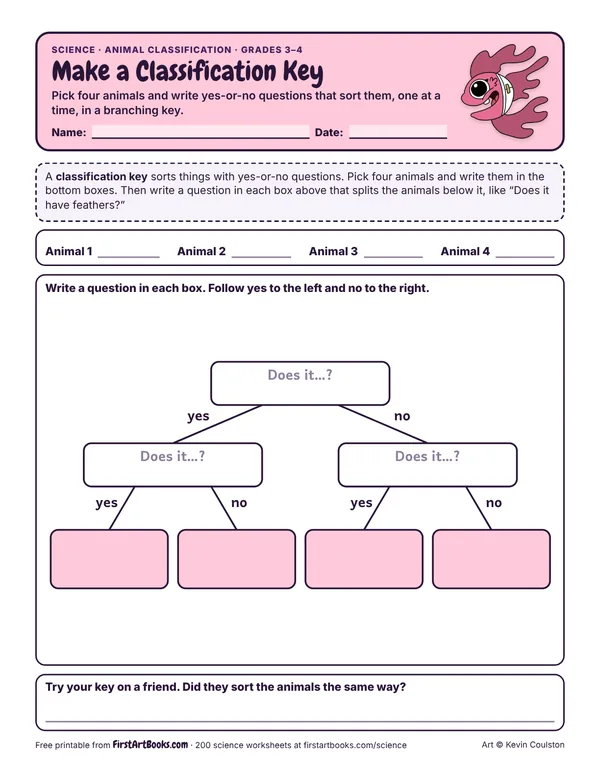
Pick four animals and write yes-or-no questions that sort them, one at a time, in a branching key.
Print this sheet (PDF)Teacher notes and tipsGrades K–3. Recycle, compost or trash, reduce, reuse and recycle, a litter survey, energy from the sun, wind and water and an Earth helper pledge.
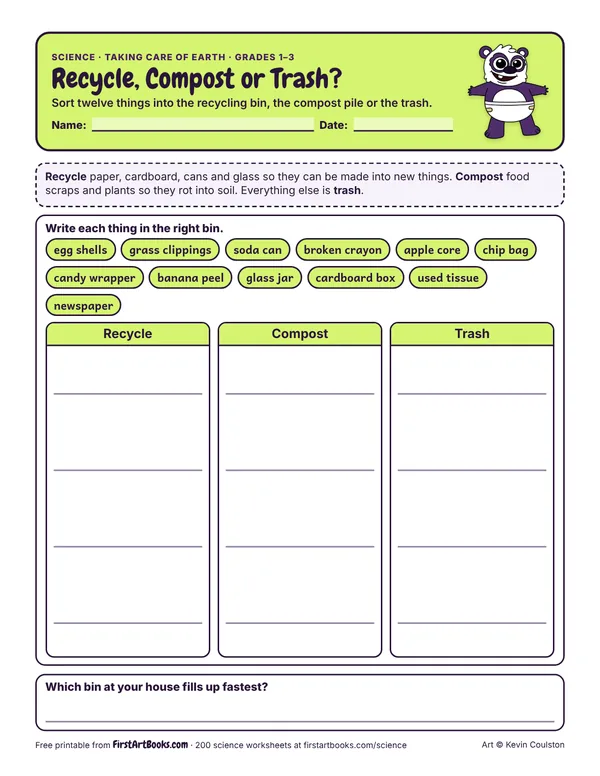
Sort twelve things into the recycling bin, the compost pile or the trash.
Print this sheet (PDF)Teacher notes and tips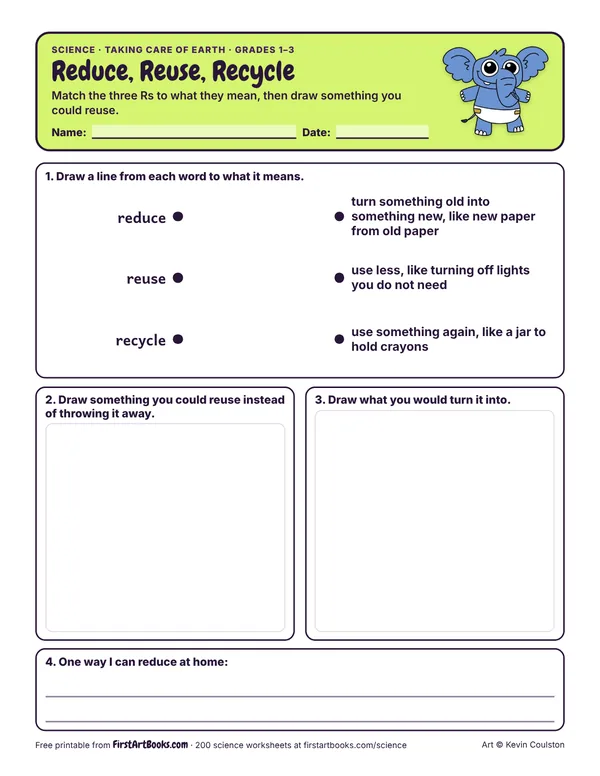
Match the three Rs to what they mean, then draw something you could reuse.
Print this sheet (PDF)Teacher notes and tips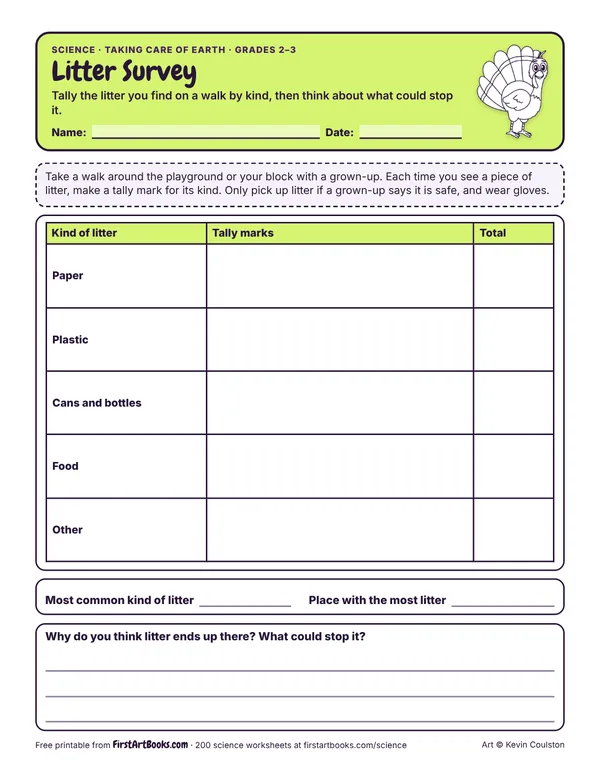
Tally the litter you find on a walk by kind, then think about what could stop it.
Print this sheet (PDF)Teacher notes and tips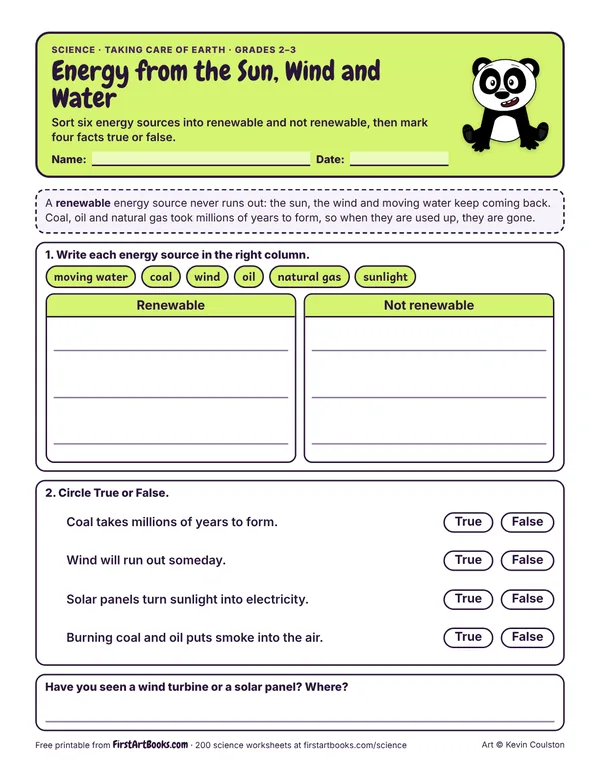
Sort six energy sources into renewable and not renewable, then mark four facts true or false.
Print this sheet (PDF)Teacher notes and tips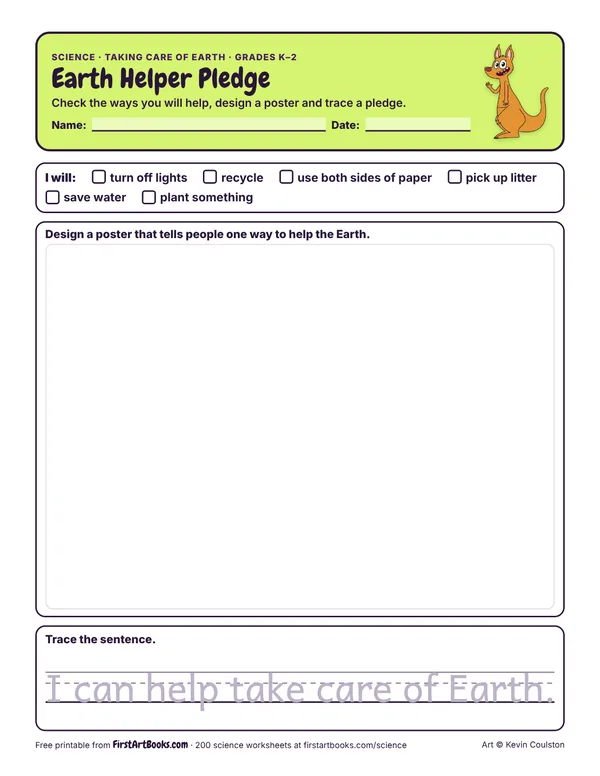
Check the ways you will help, design a poster and trace a pledge.
Print this sheet (PDF)Teacher notes and tipsGrades K–4. Spring, summer, fall and winter: a seasons wheel to color, a seasons sort, why Earth has seasons, how animals get ready for winter and season riddles.
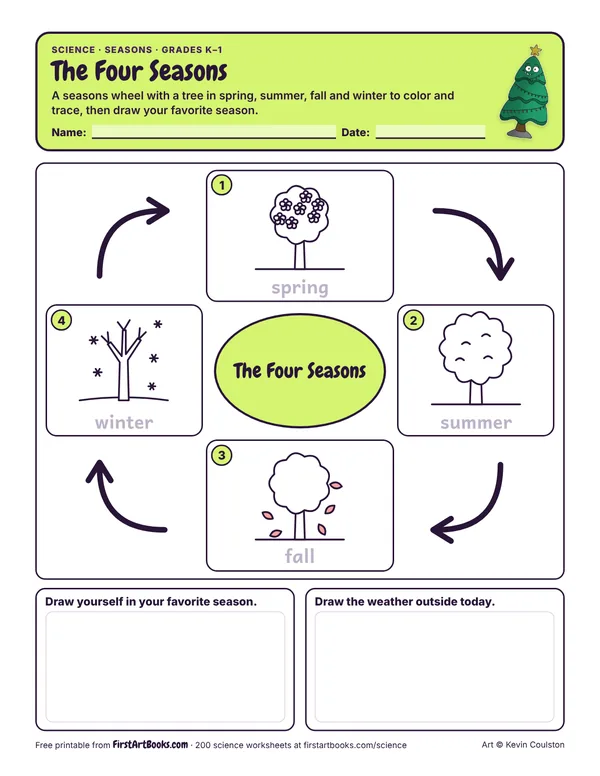
A seasons wheel with a tree in spring, summer, fall and winter to color and trace, then draw your favorite season.
Print this sheet (PDF)Teacher notes and tips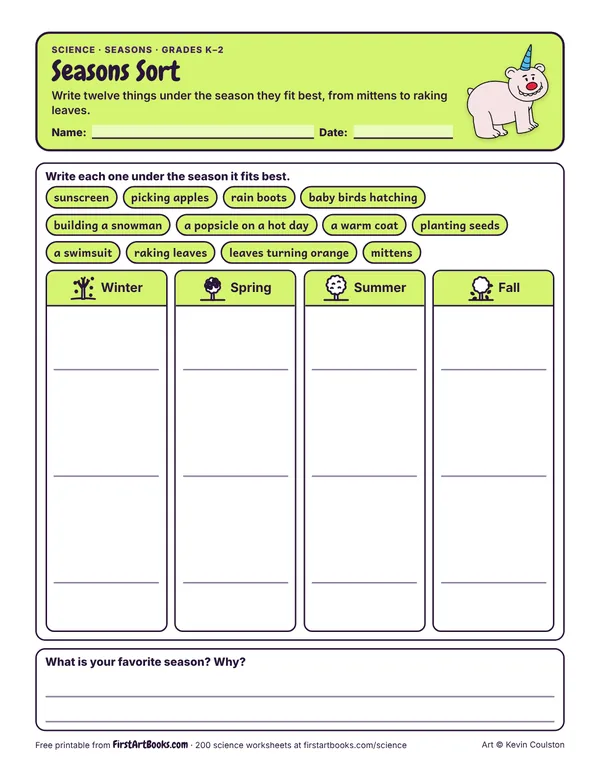
Write twelve things under the season they fit best, from mittens to raking leaves.
Print this sheet (PDF)Teacher notes and tips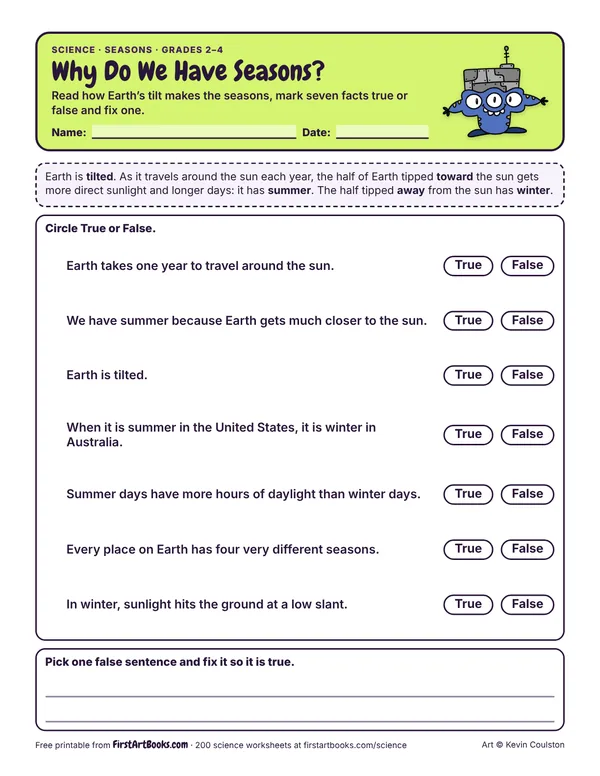
Read how Earth’s tilt makes the seasons, mark seven facts true or false and fix one.
Print this sheet (PDF)Teacher notes and tips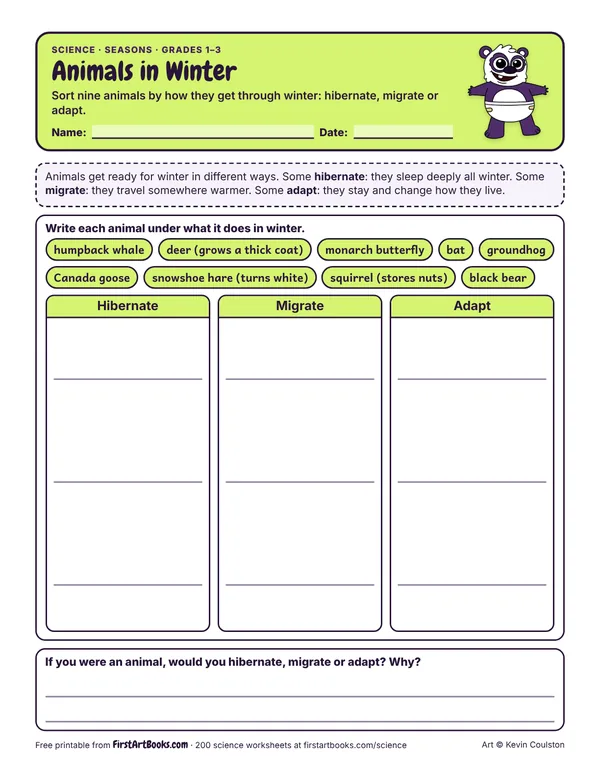
Sort nine animals by how they get through winter: hibernate, migrate or adapt.
Print this sheet (PDF)Teacher notes and tips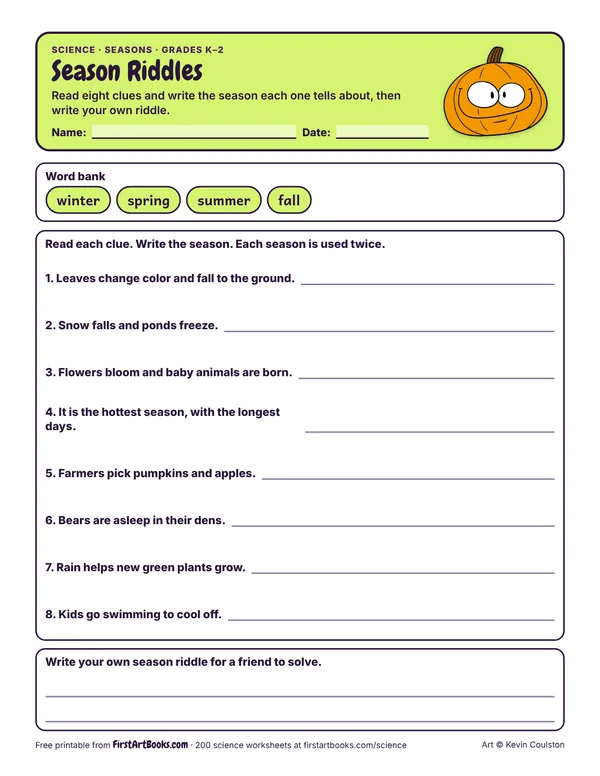
Read eight clues and write the season each one tells about, then write your own riddle.
Print this sheet (PDF)Teacher notes and tipsGrades K–5. Sort day and night, see how Earth’s spin makes day and night, sort nocturnal and diurnal animals, track the length of the day and draw your day and night.
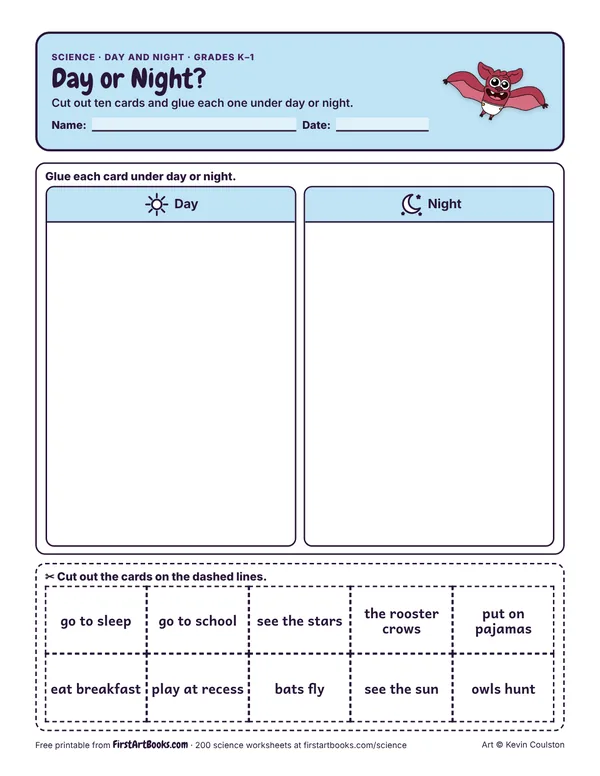
Cut out ten cards and glue each one under day or night.
Print this sheet (PDF)Teacher notes and tips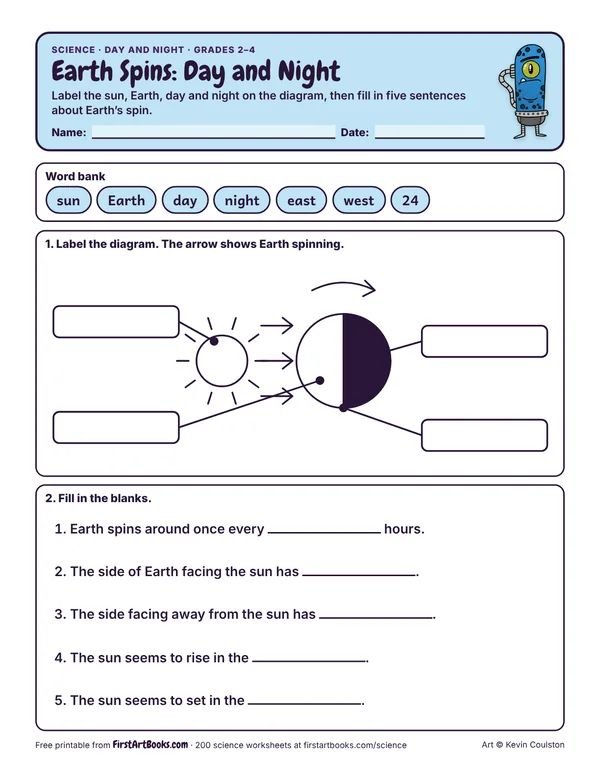
Label the sun, Earth, day and night on the diagram, then fill in five sentences about Earth’s spin.
Print this sheet (PDF)Teacher notes and tips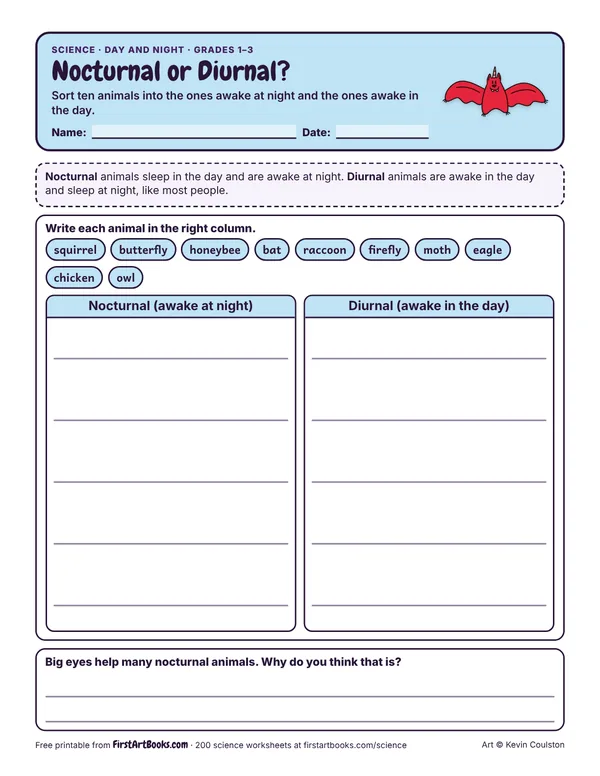
Sort ten animals into the ones awake at night and the ones awake in the day.
Print this sheet (PDF)Teacher notes and tips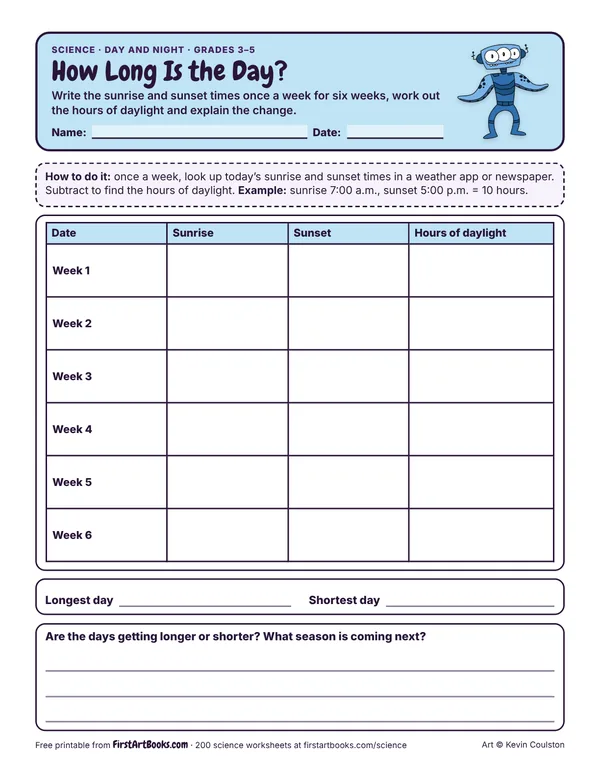
Write the sunrise and sunset times once a week for six weeks, work out the hours of daylight and explain the change.
Print this sheet (PDF)Teacher notes and tips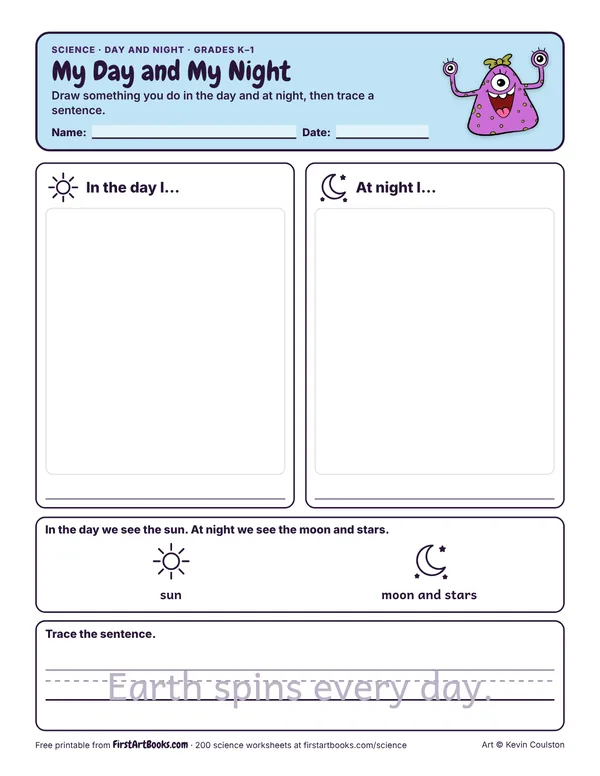
Draw something you do in the day and at night, then trace a sentence.
Print this sheet (PDF)Teacher notes and tipsGrades 1–5. Connect the Big Dipper, star facts true or false, space words, star colors from hottest to coolest and a night sky journal.
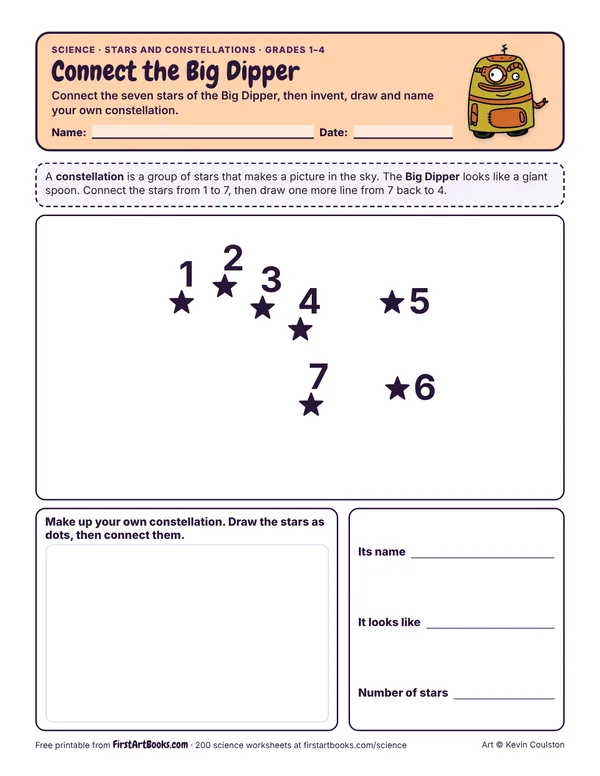
Connect the seven stars of the Big Dipper, then invent, draw and name your own constellation.
Print this sheet (PDF)Teacher notes and tips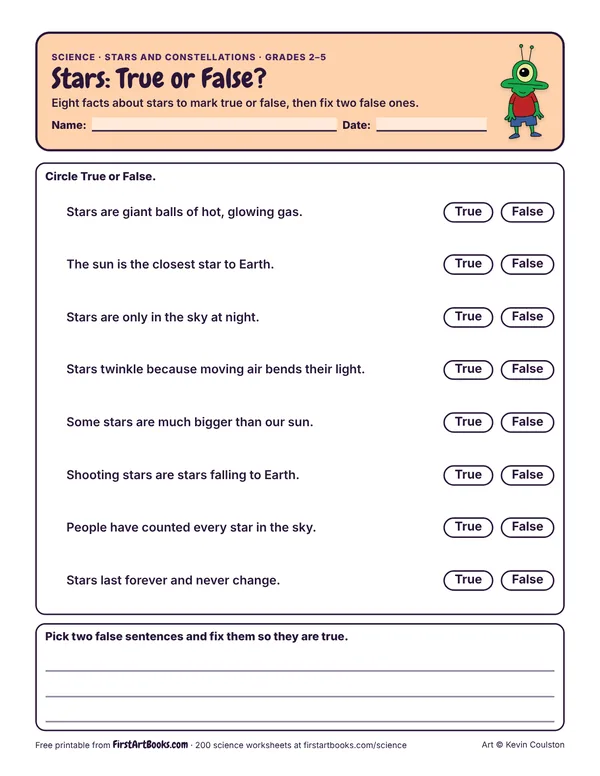
Eight facts about stars to mark true or false, then fix two false ones.
Print this sheet (PDF)Teacher notes and tips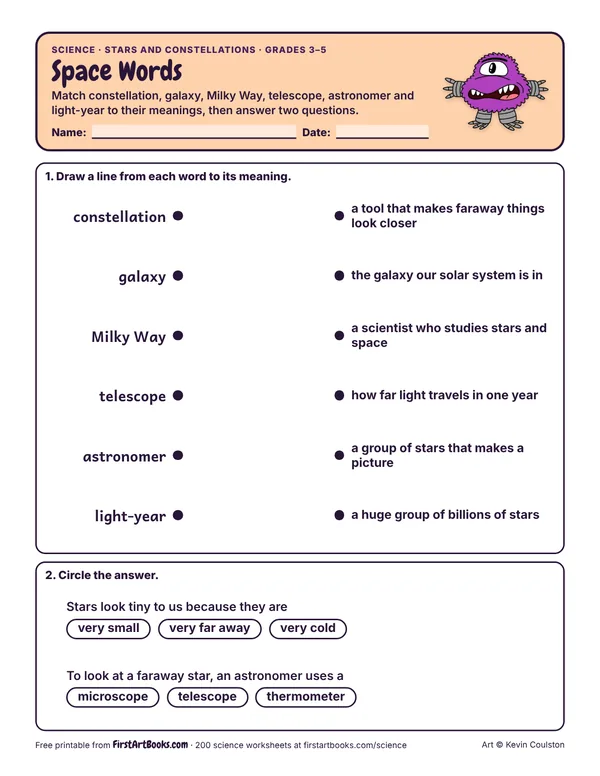
Match constellation, galaxy, Milky Way, telescope, astronomer and light-year to their meanings, then answer two questions.
Print this sheet (PDF)Teacher notes and tips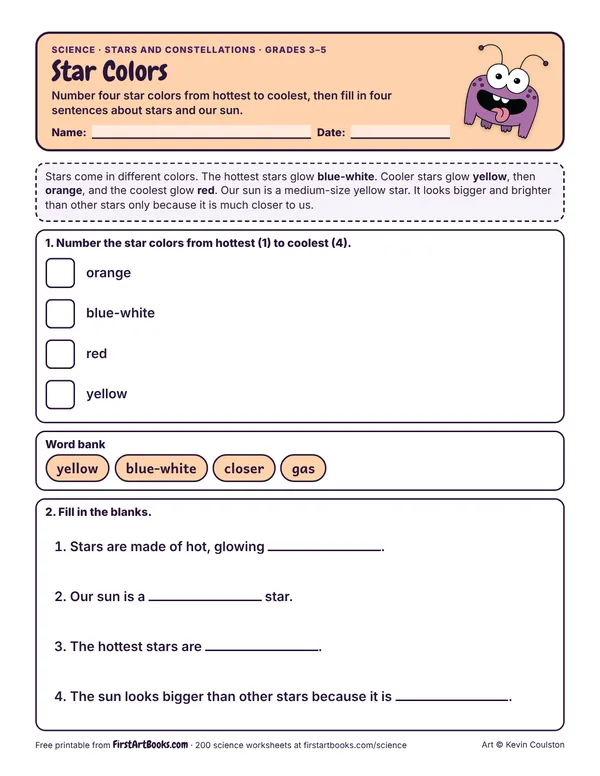
Number four star colors from hottest to coolest, then fill in four sentences about stars and our sun.
Print this sheet (PDF)Teacher notes and tips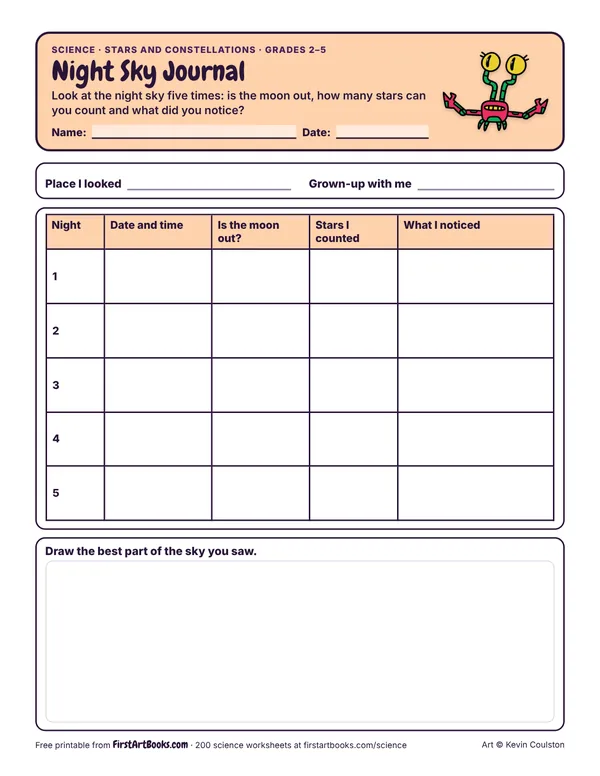
Look at the night sky five times: is the moon out, how many stars can you count and what did you notice?
Print this sheet (PDF)Teacher notes and tipsGrades 1–4. Plant eaters and meat eaters, a paleontologist’s tools, compare dinosaur lengths, dinosaur true or false and a dinosaur research report.
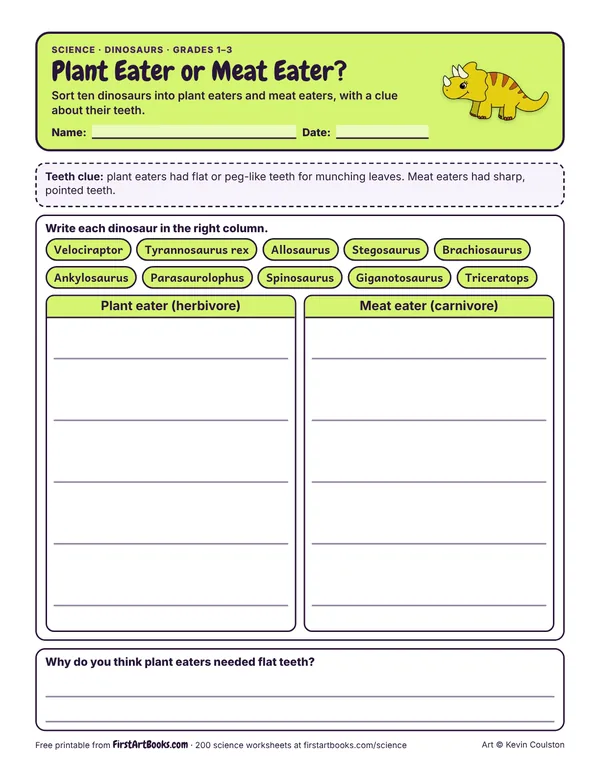
Sort ten dinosaurs into plant eaters and meat eaters, with a clue about their teeth.
Print this sheet (PDF)Teacher notes and tips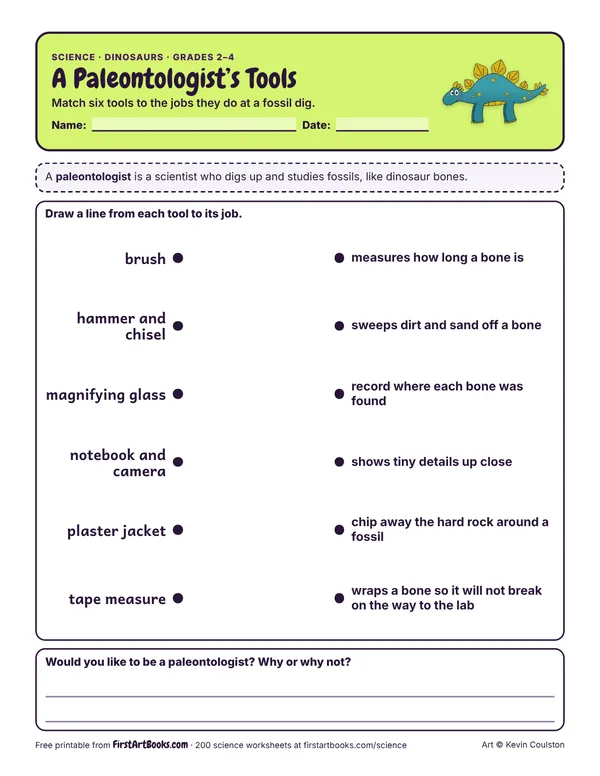
Match six tools to the jobs they do at a fossil dig.
Print this sheet (PDF)Teacher notes and tips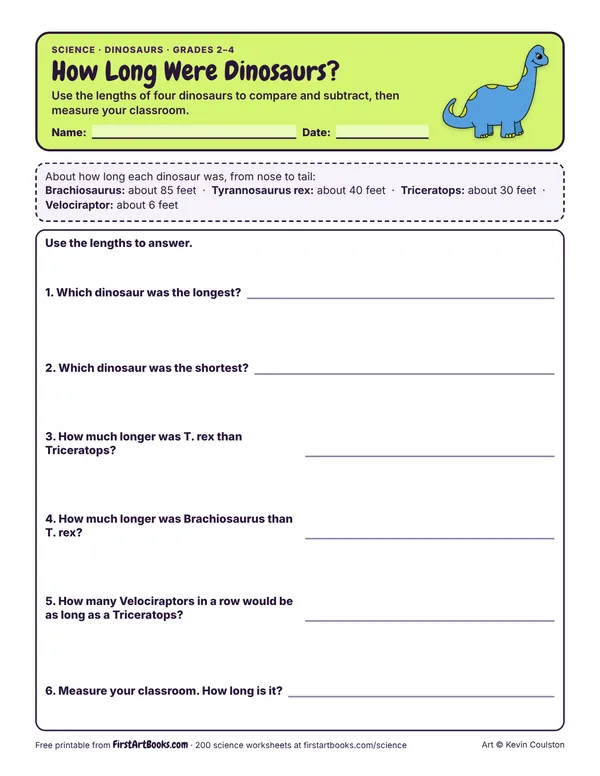
Use the lengths of four dinosaurs to compare and subtract, then measure your classroom.
Print this sheet (PDF)Teacher notes and tips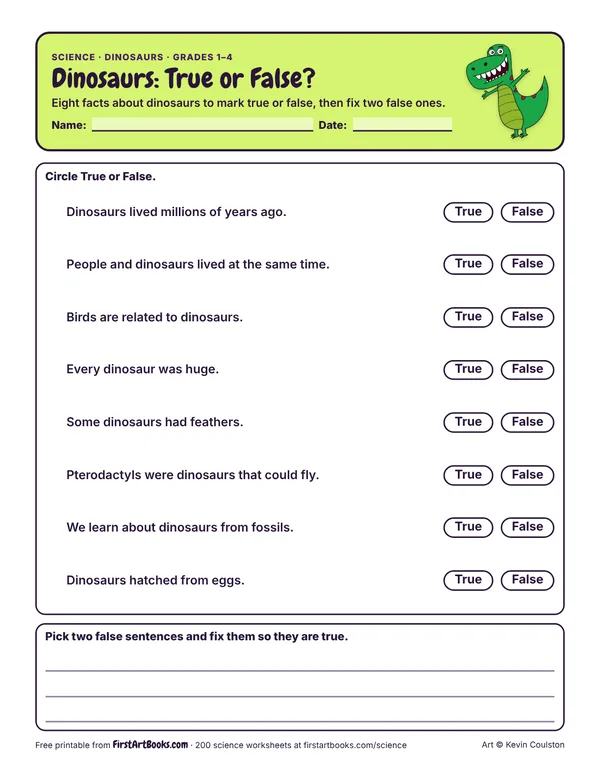
Eight facts about dinosaurs to mark true or false, then fix two false ones.
Print this sheet (PDF)Teacher notes and tips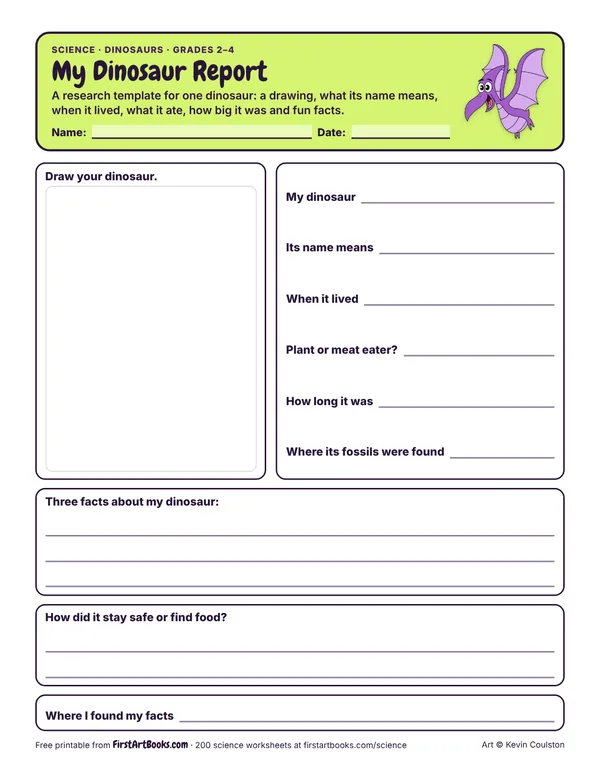
A research template for one dinosaur: a drawing, what its name means, when it lived, what it ate, how big it was and fun facts.
Print this sheet (PDF)Teacher notes and tipsGrades 1–5. The five ocean zones, sea animal adaptations, coral reef facts, ways to help the ocean and a salt water float test.
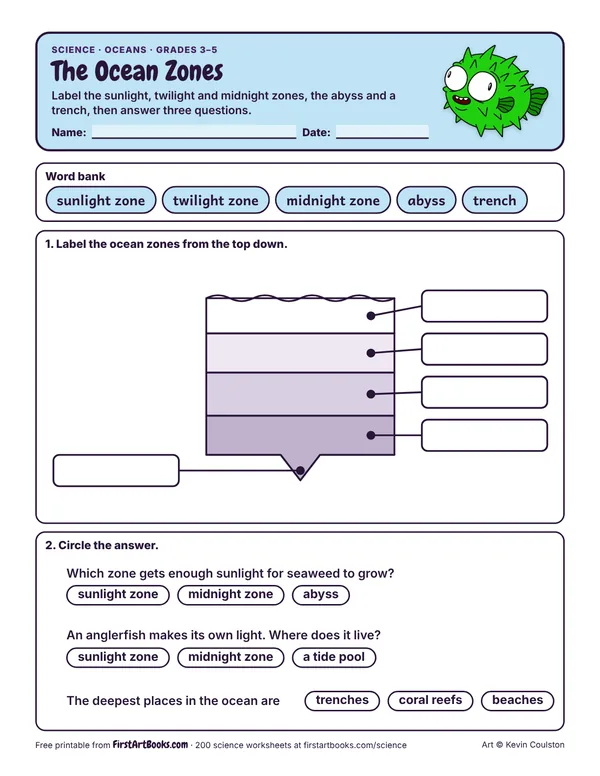
Label the sunlight, twilight and midnight zones, the abyss and a trench, then answer three questions.
Print this sheet (PDF)Teacher notes and tips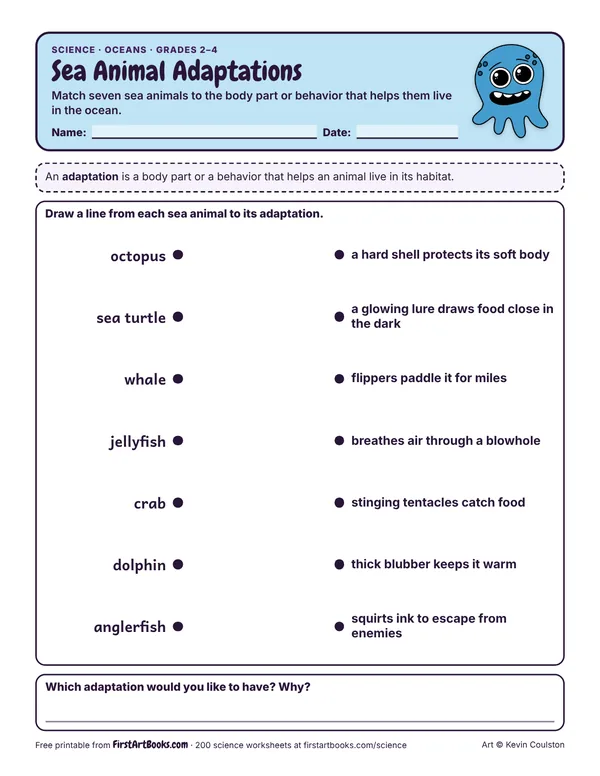
Match seven sea animals to the body part or behavior that helps them live in the ocean.
Print this sheet (PDF)Teacher notes and tips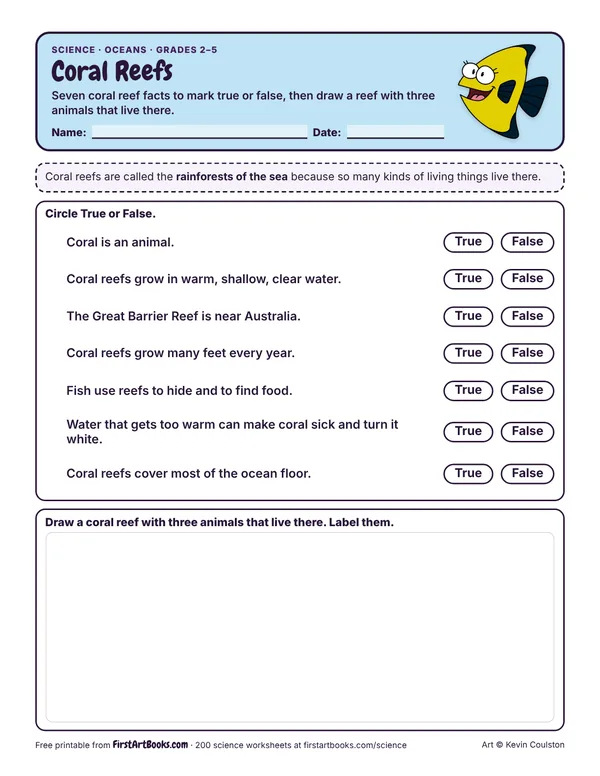
Seven coral reef facts to mark true or false, then draw a reef with three animals that live there.
Print this sheet (PDF)Teacher notes and tips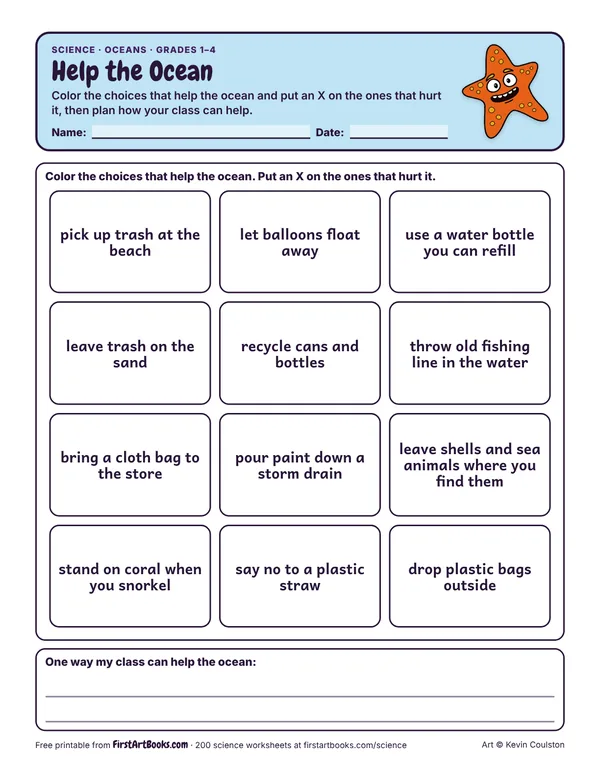
Color the choices that help the ocean and put an X on the ones that hurt it, then plan how your class can help.
Print this sheet (PDF)Teacher notes and tips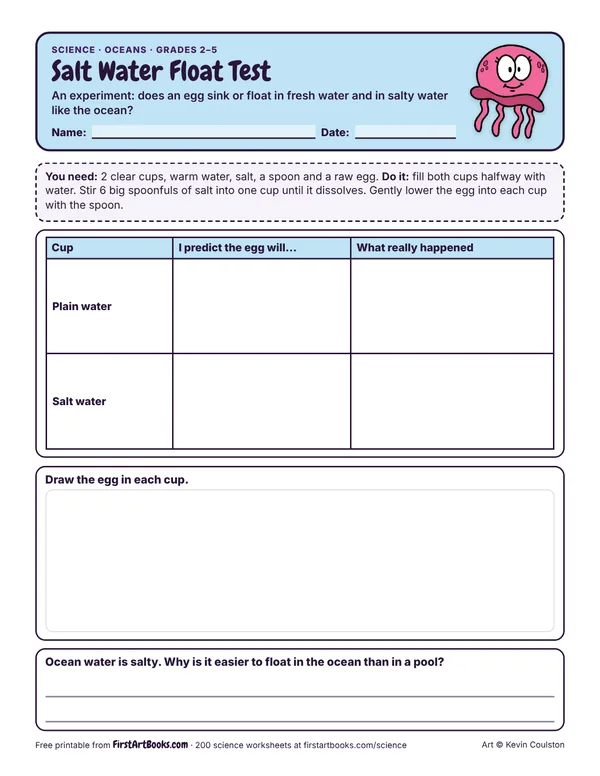
An experiment: does an egg sink or float in fresh water and in salty water like the ocean?
Print this sheet (PDF)Teacher notes and tipsGrades K–3. Insect or not, insects and spiders compared, the ladybug life cycle, helpful bugs and their jobs and a bug hunt log.
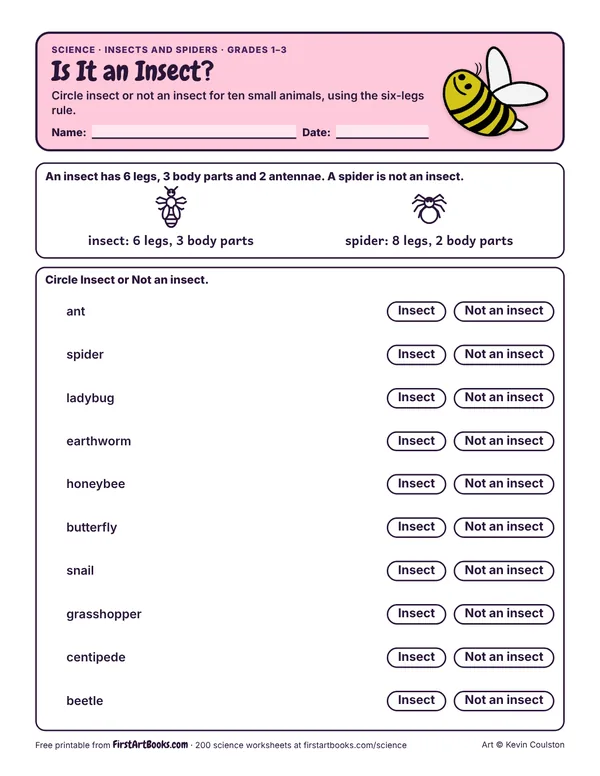
Circle insect or not an insect for ten small animals, using the six-legs rule.
Print this sheet (PDF)Teacher notes and tips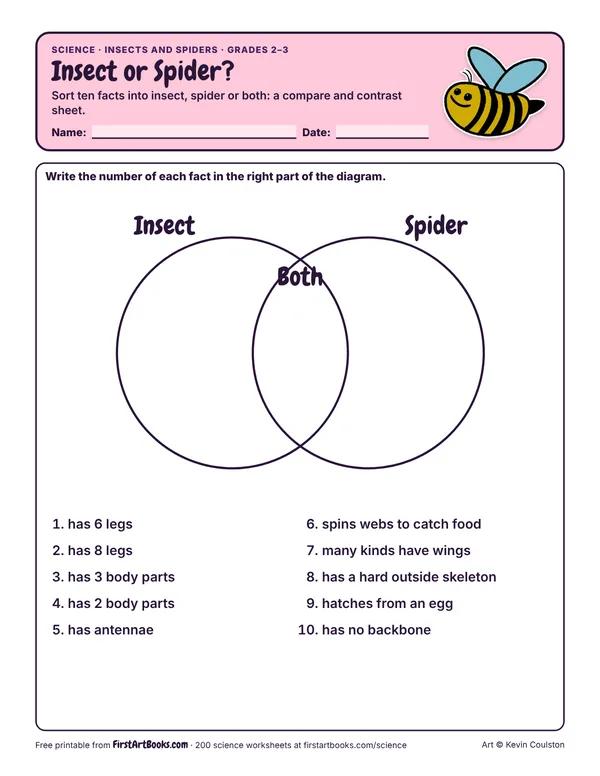
Sort ten facts into insect, spider or both: a compare and contrast sheet.
Print this sheet (PDF)Teacher notes and tips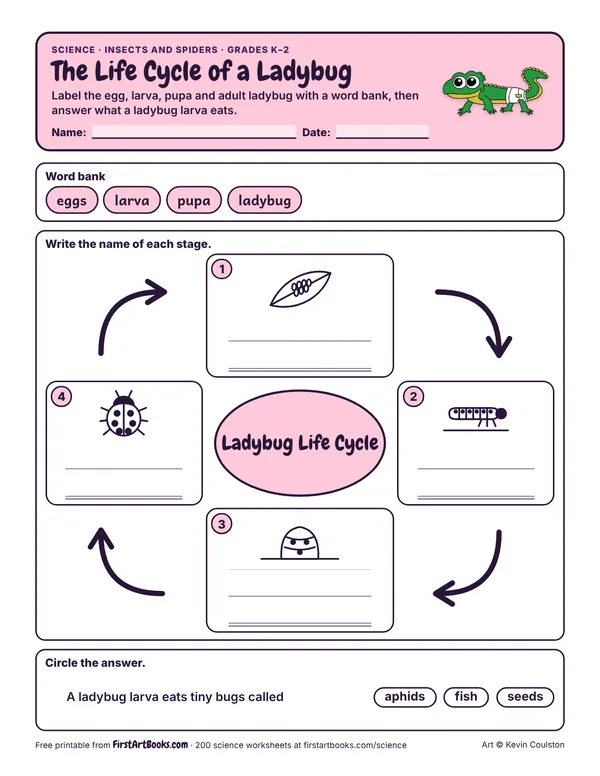
Label the egg, larva, pupa and adult ladybug with a word bank, then answer what a ladybug larva eats.
Print this sheet (PDF)Teacher notes and tips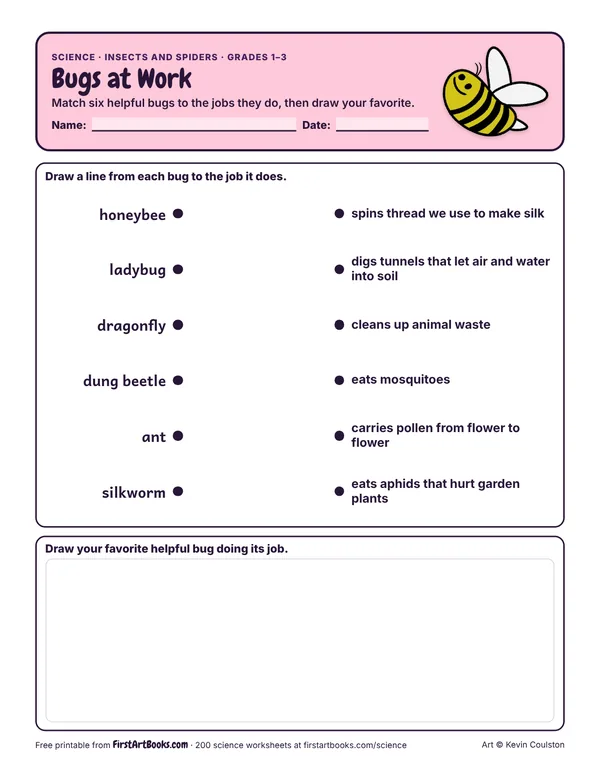
Match six helpful bugs to the jobs they do, then draw your favorite.
Print this sheet (PDF)Teacher notes and tips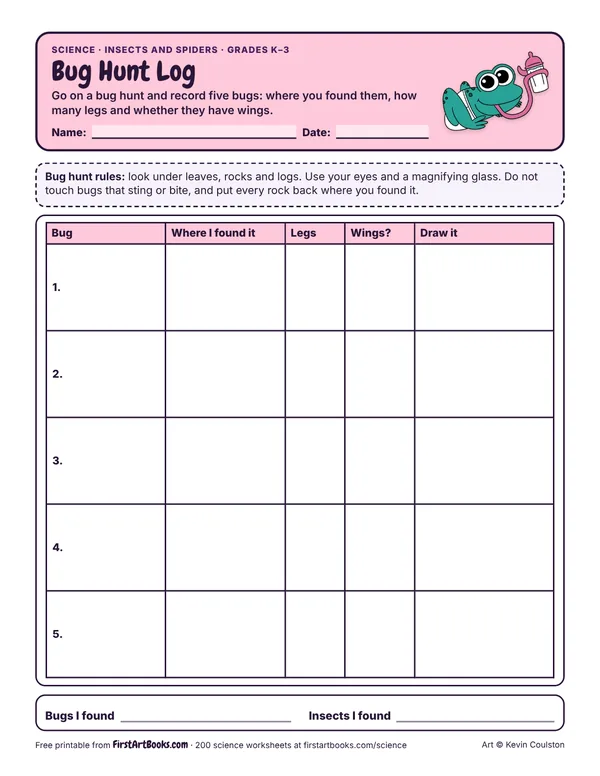
Go on a bug hunt and record five bugs: where you found them, how many legs and whether they have wings.
Print this sheet (PDF)Teacher notes and tipsGrades K–4. Beaks and the food they fit, the parts of a bird, what makes a bird a bird, a bird watching tally and why birds migrate.
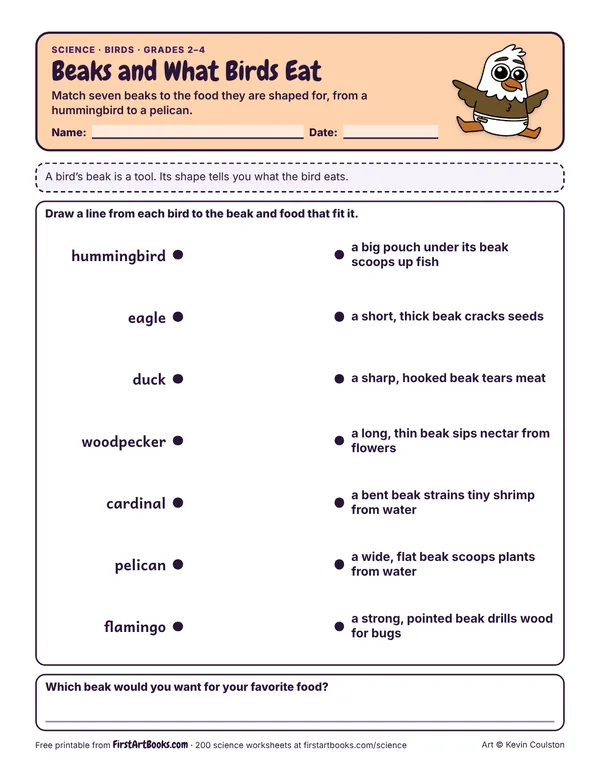
Match seven beaks to the food they are shaped for, from a hummingbird to a pelican.
Print this sheet (PDF)Teacher notes and tips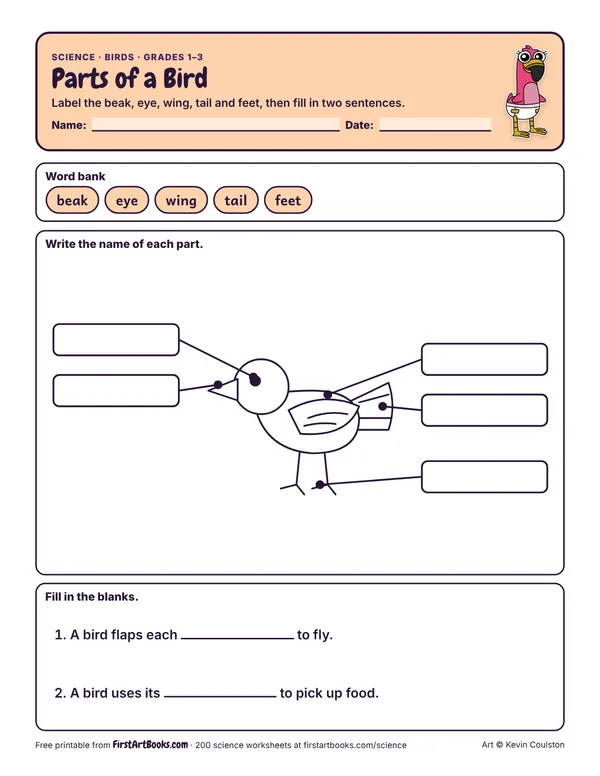
Label the beak, eye, wing, tail and feet, then fill in two sentences.
Print this sheet (PDF)Teacher notes and tips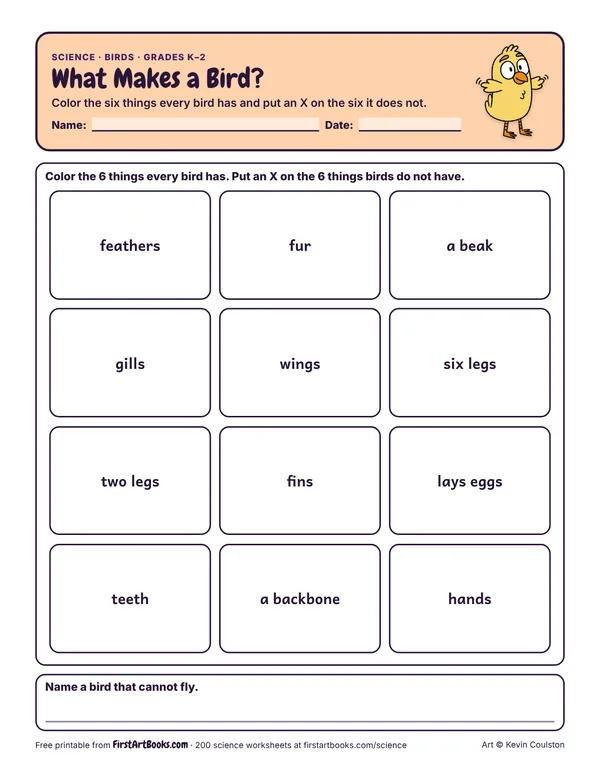
Color the six things every bird has and put an X on the six it does not.
Print this sheet (PDF)Teacher notes and tips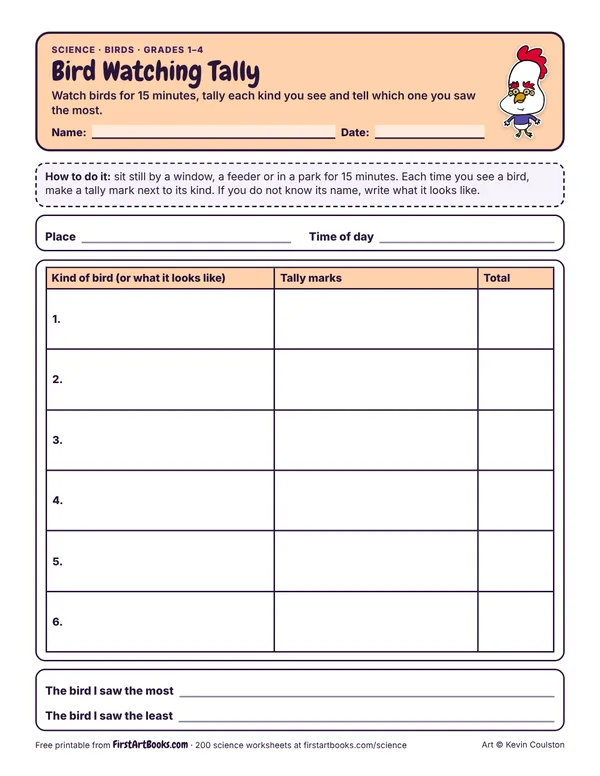
Watch birds for 15 minutes, tally each kind you see and tell which one you saw the most.
Print this sheet (PDF)Teacher notes and tips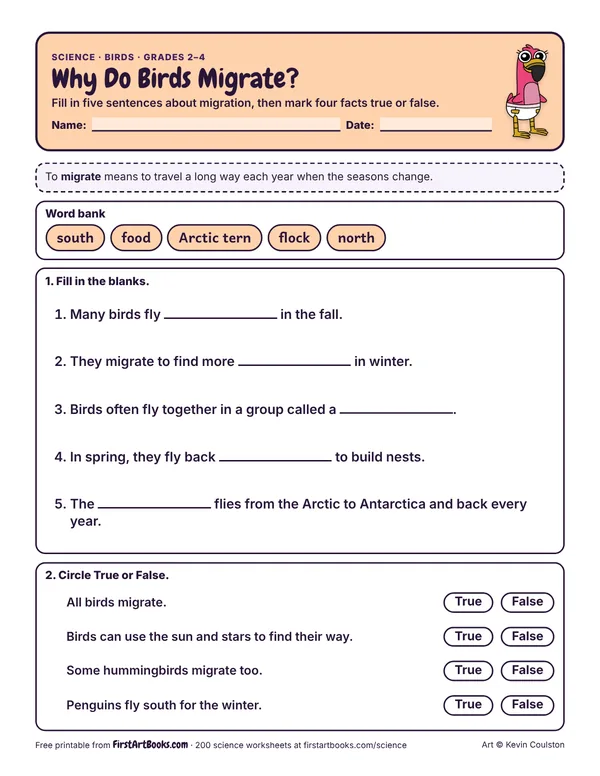
Fill in five sentences about migration, then mark four facts true or false.
Print this sheet (PDF)Teacher notes and tipsGrades K–4. The parts of a tree, four leaf shapes and a leaf rubbing, count the rings to find a tree’s age, gifts from trees and adopt a tree.
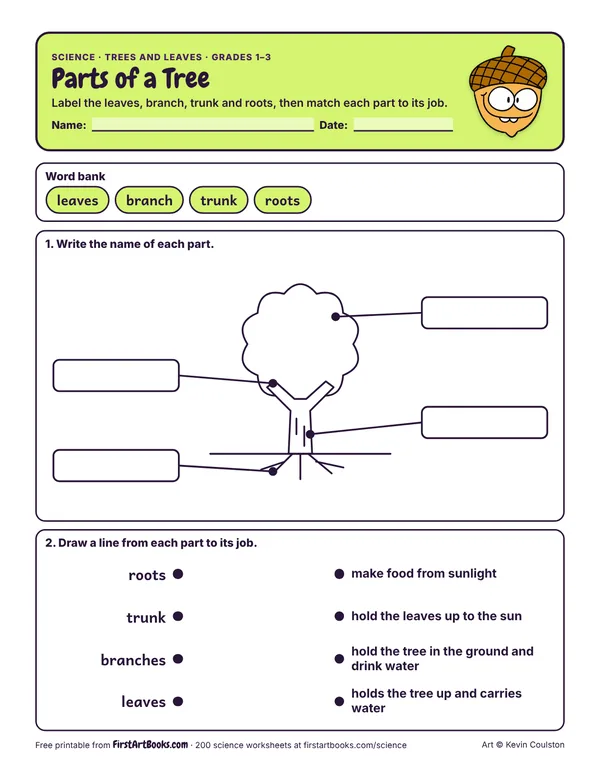
Label the leaves, branch, trunk and roots, then match each part to its job.
Print this sheet (PDF)Teacher notes and tips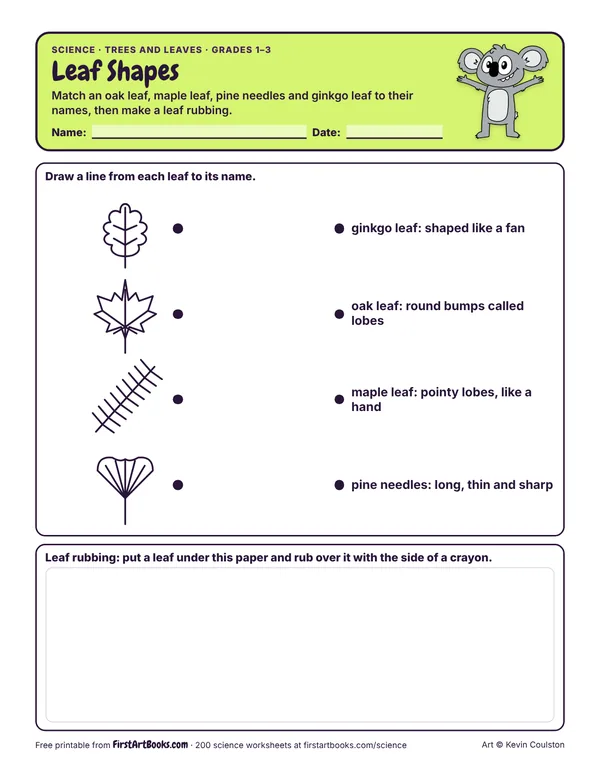
Match an oak leaf, maple leaf, pine needles and ginkgo leaf to their names, then make a leaf rubbing.
Print this sheet (PDF)Teacher notes and tips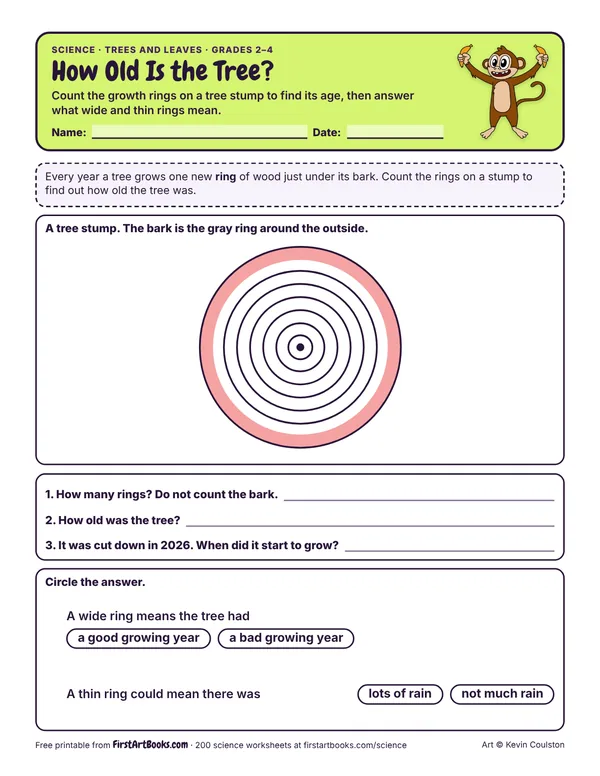
Count the growth rings on a tree stump to find its age, then answer what wide and thin rings mean.
Print this sheet (PDF)Teacher notes and tips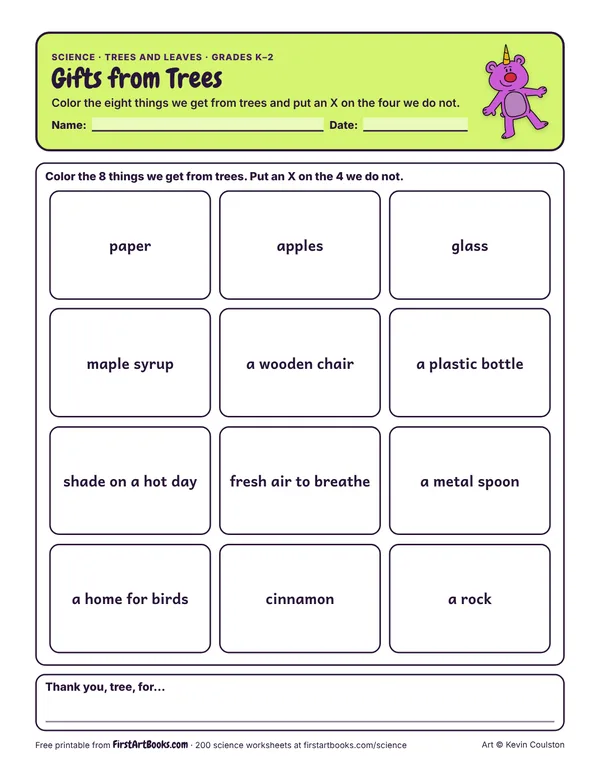
Color the eight things we get from trees and put an X on the four we do not.
Print this sheet (PDF)Teacher notes and tips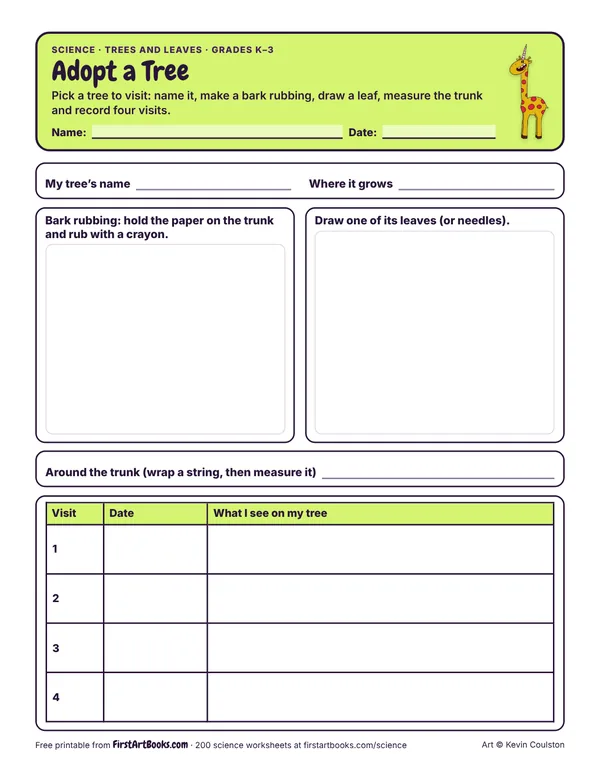
Pick a tree to visit: name it, make a bark rubbing, draw a leaf, measure the trunk and record four visits.
Print this sheet (PDF)Teacher notes and tipsGrades 2–5. The parts of a flower, how seeds travel, the steps of pollination, how plants make food and a bean seed you open up.
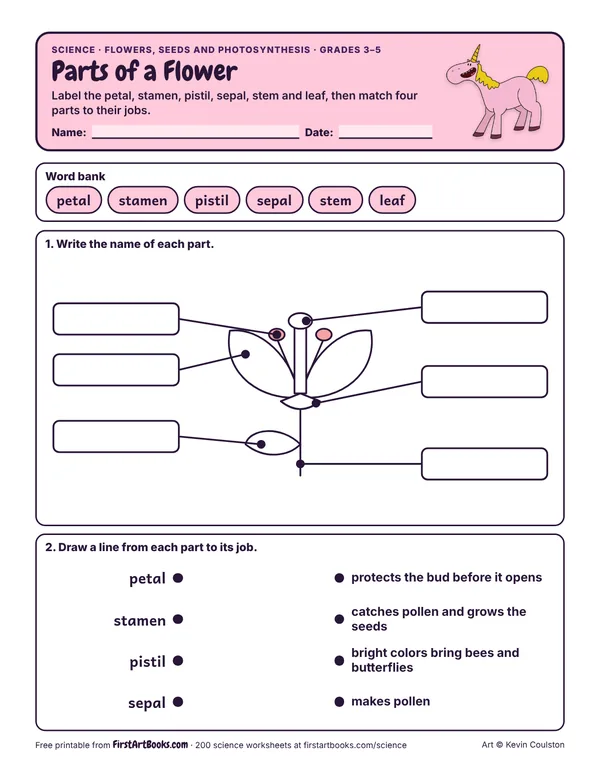
Label the petal, stamen, pistil, sepal, stem and leaf, then match four parts to their jobs.
Print this sheet (PDF)Teacher notes and tips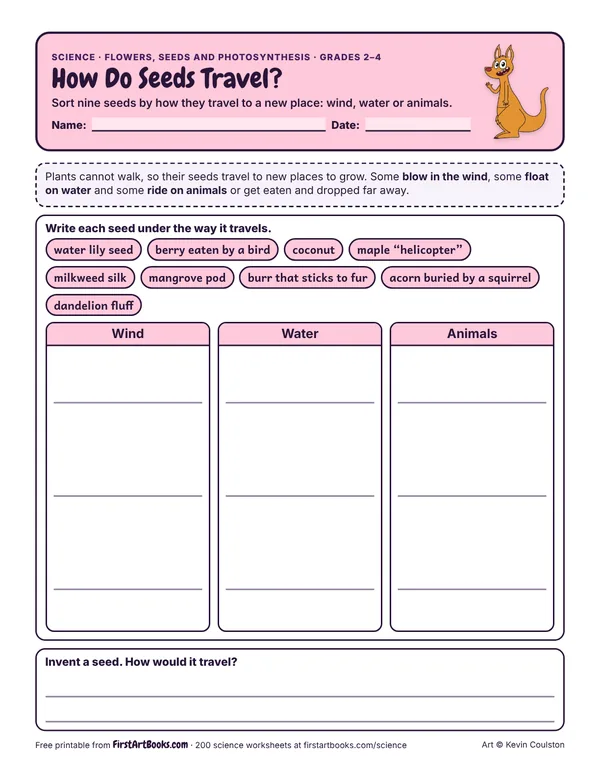
Sort nine seeds by how they travel to a new place: wind, water or animals.
Print this sheet (PDF)Teacher notes and tips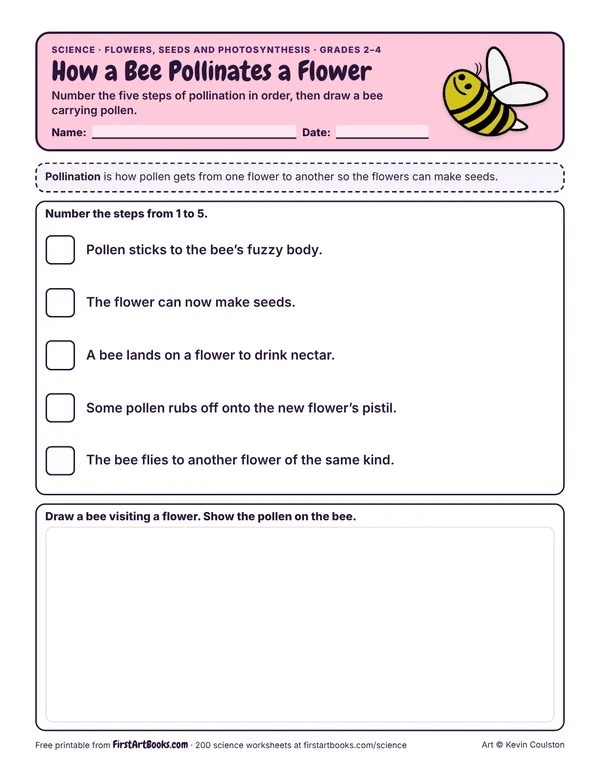
Number the five steps of pollination in order, then draw a bee carrying pollen.
Print this sheet (PDF)Teacher notes and tips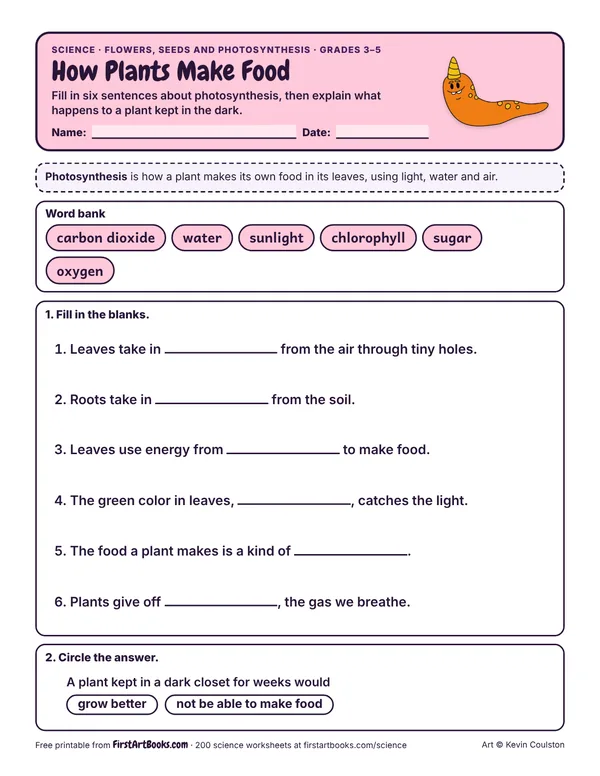
Fill in six sentences about photosynthesis, then explain what happens to a plant kept in the dark.
Print this sheet (PDF)Teacher notes and tips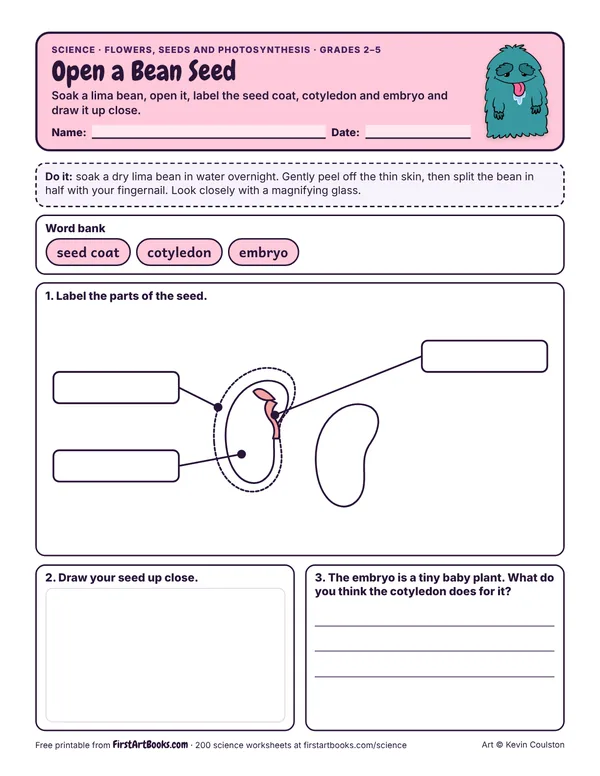
Soak a lima bean, open it, label the seed coat, cotyledon and embryo and draw it up close.
Print this sheet (PDF)Teacher notes and tipsGrades K–5. Baby animal names, babies that look like their parents or not, inherited or learned, a class traits survey and how animal parents care for babies.
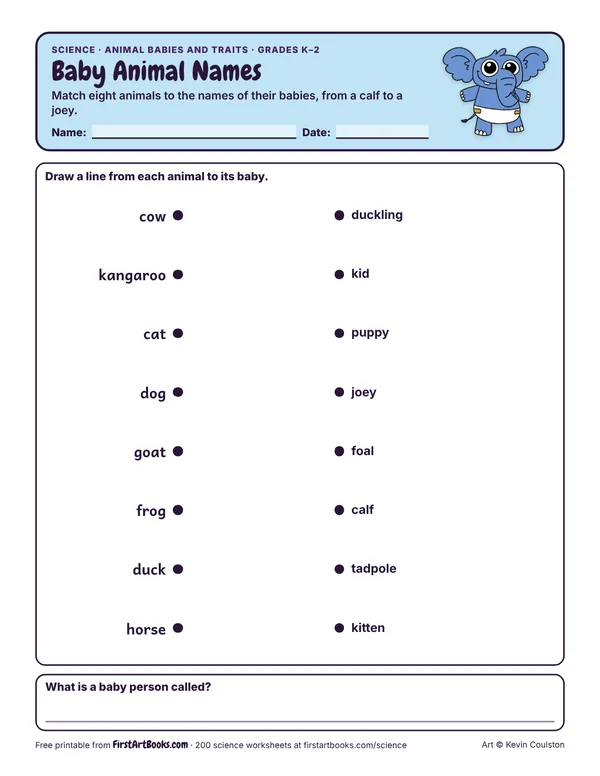
Match eight animals to the names of their babies, from a calf to a joey.
Print this sheet (PDF)Teacher notes and tips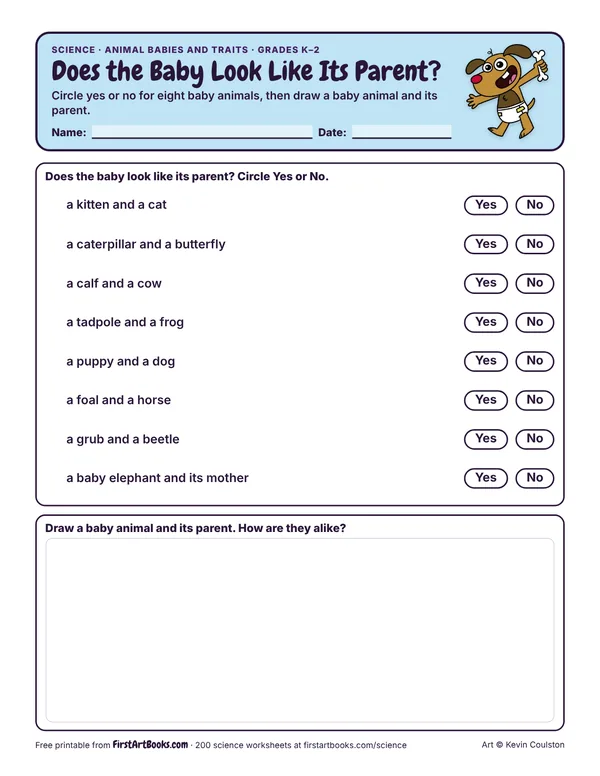
Circle yes or no for eight baby animals, then draw a baby animal and its parent.
Print this sheet (PDF)Teacher notes and tips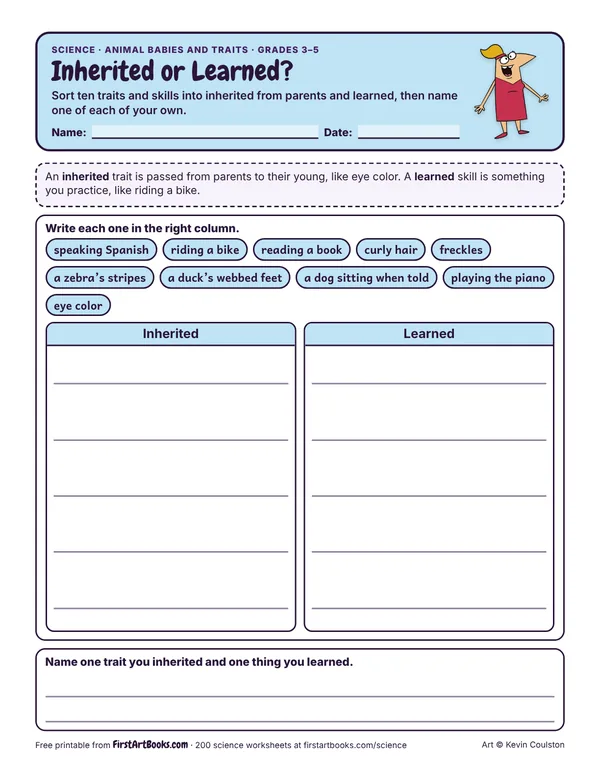
Sort ten traits and skills into inherited from parents and learned, then name one of each of your own.
Print this sheet (PDF)Teacher notes and tips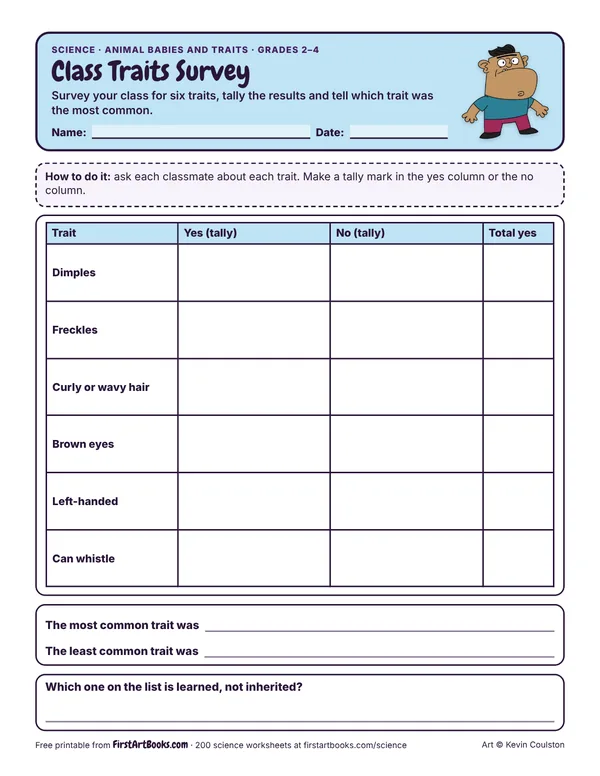
Survey your class for six traits, tally the results and tell which trait was the most common.
Print this sheet (PDF)Teacher notes and tips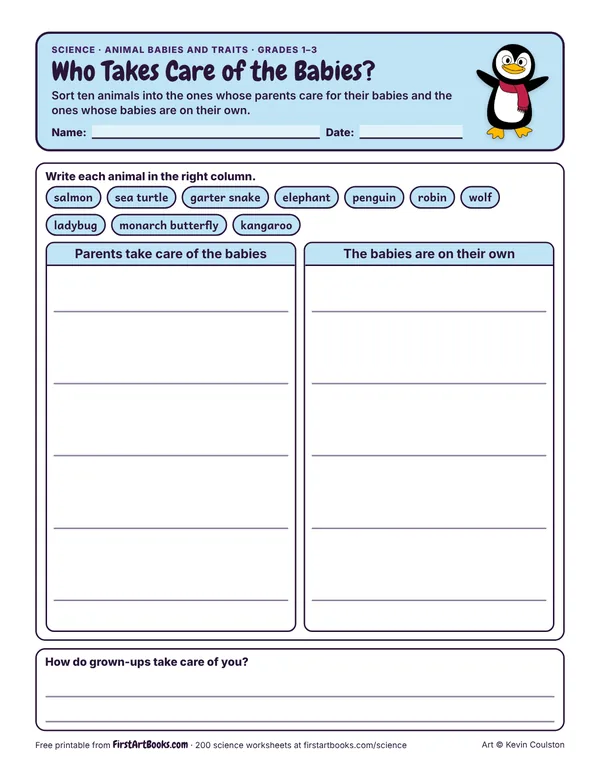
Sort ten animals into the ones whose parents care for their babies and the ones whose babies are on their own.
Print this sheet (PDF)Teacher notes and tipsGrades K–5. Sort the five food groups, label a healthy plate, everyday and sometimes foods, read a food label and foods from plants or animals.
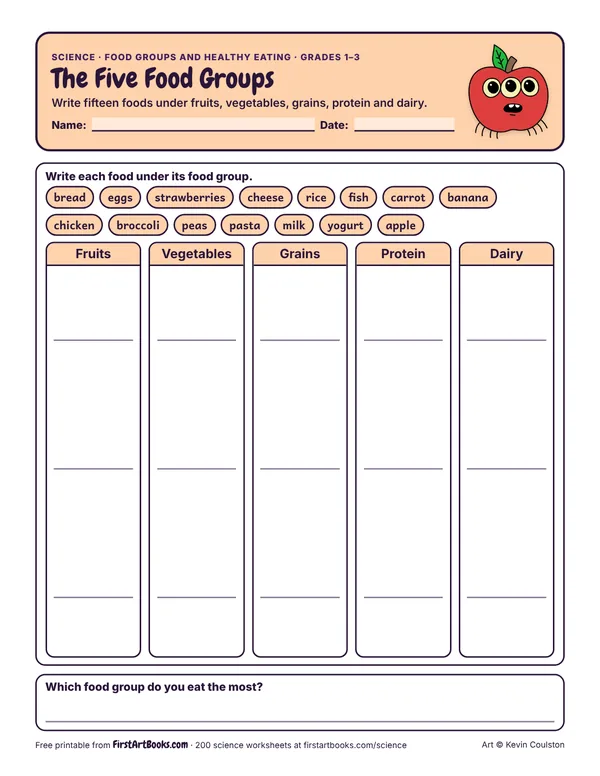
Write fifteen foods under fruits, vegetables, grains, protein and dairy.
Print this sheet (PDF)Teacher notes and tips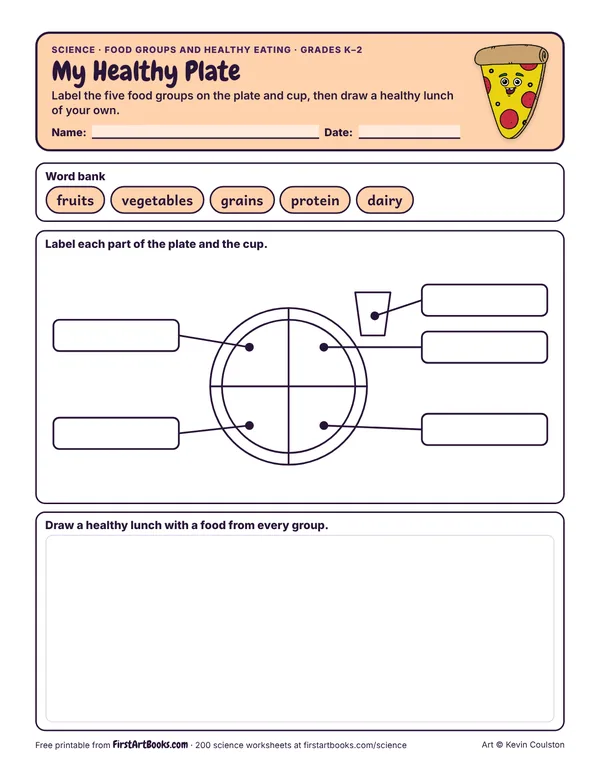
Label the five food groups on the plate and cup, then draw a healthy lunch of your own.
Print this sheet (PDF)Teacher notes and tips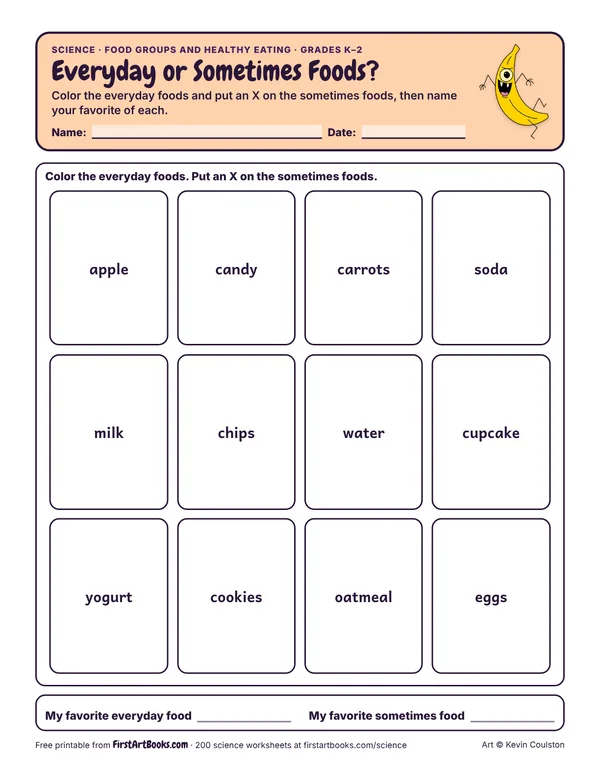
Color the everyday foods and put an X on the sometimes foods, then name your favorite of each.
Print this sheet (PDF)Teacher notes and tips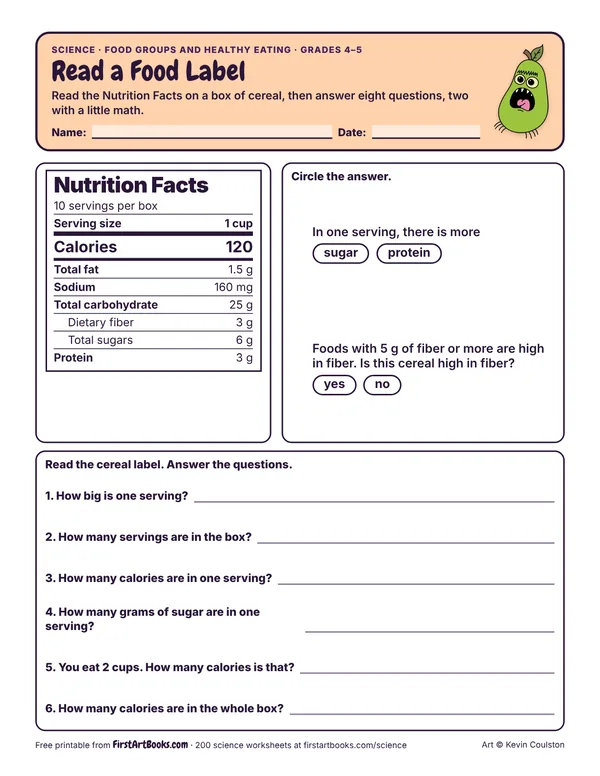
Read the Nutrition Facts on a box of cereal, then answer eight questions, two with a little math.
Print this sheet (PDF)Teacher notes and tips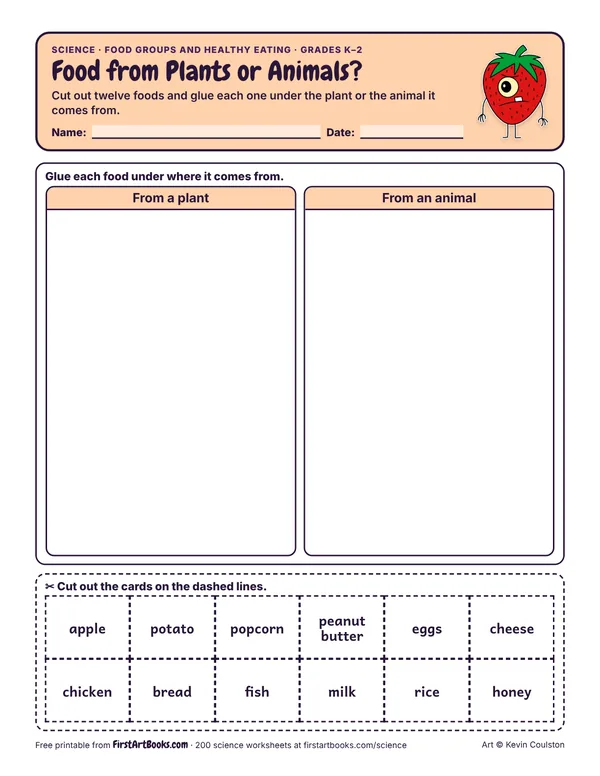
Cut out twelve foods and glue each one under the plant or the animal it comes from.
Print this sheet (PDF)Teacher notes and tipsGrades 2–5. Label six landforms, landform words, weathering or erosion, an erosion experiment with soil and plants and fast or slow changes to Earth.
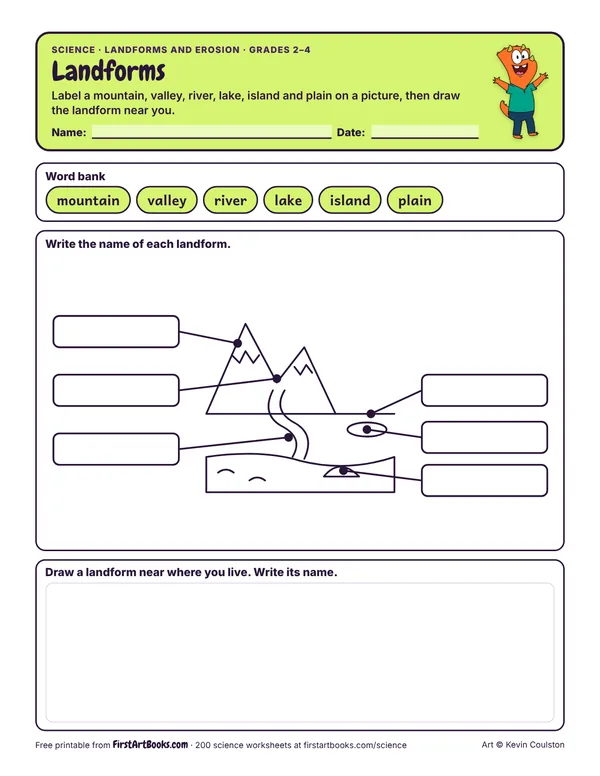
Label a mountain, valley, river, lake, island and plain on a picture, then draw the landform near you.
Print this sheet (PDF)Teacher notes and tips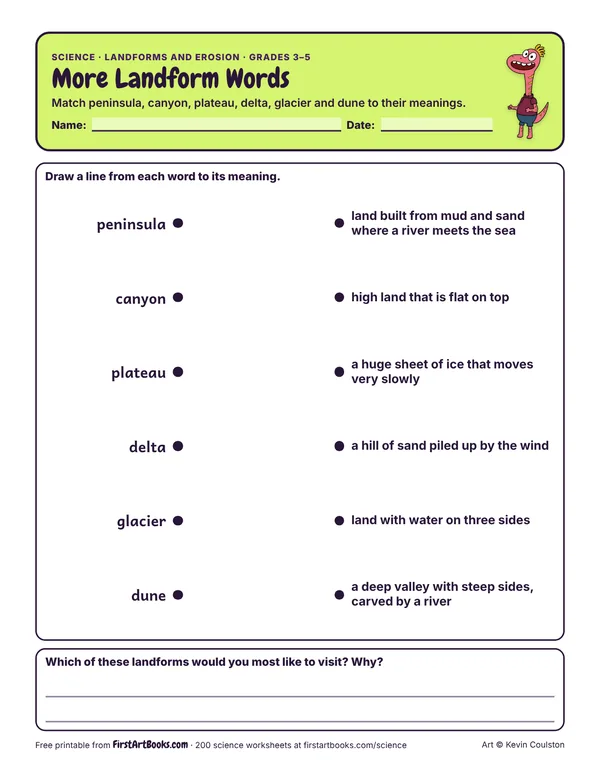
Match peninsula, canyon, plateau, delta, glacier and dune to their meanings.
Print this sheet (PDF)Teacher notes and tips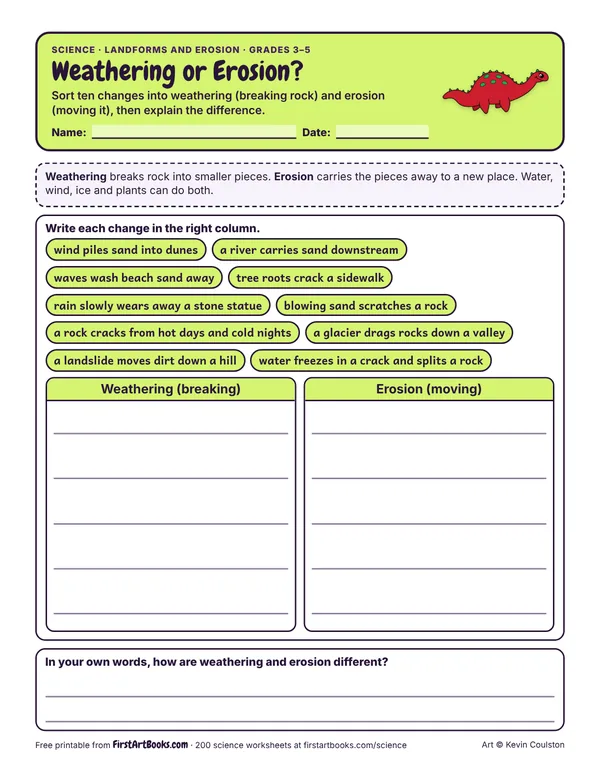
Sort ten changes into weathering (breaking rock) and erosion (moving it), then explain the difference.
Print this sheet (PDF)Teacher notes and tips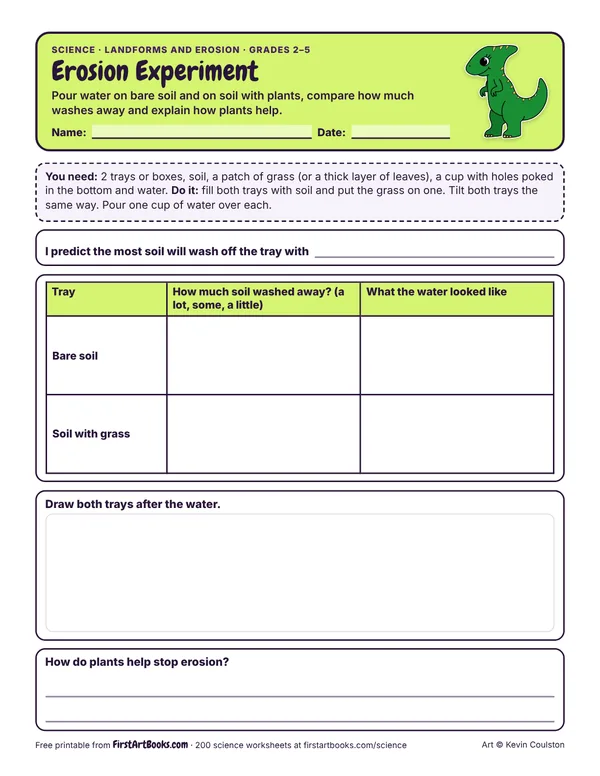
Pour water on bare soil and on soil with plants, compare how much washes away and explain how plants help.
Print this sheet (PDF)Teacher notes and tips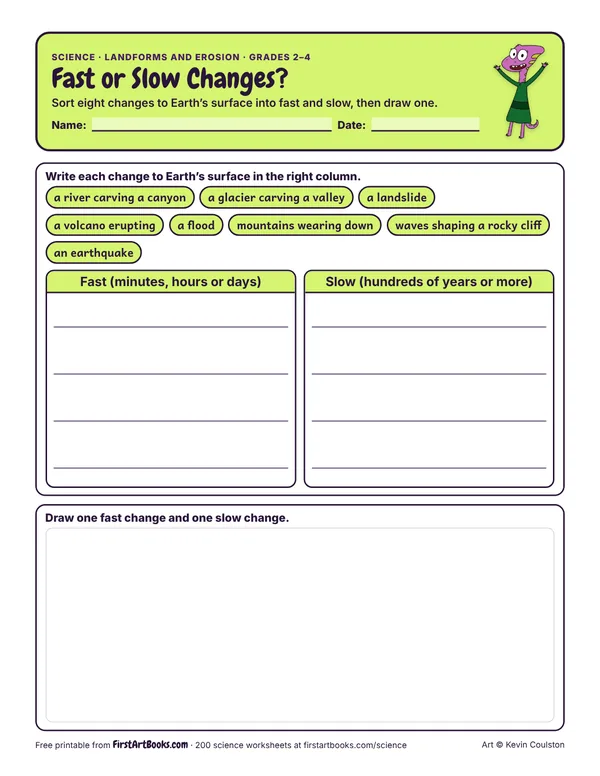
Sort eight changes to Earth’s surface into fast and slow, then draw one.
Print this sheet (PDF)Teacher notes and tipsGrades 1–5. The parts of a volcano, volcano true or false, earthquake safety, Earth’s moving plates and a baking soda volcano experiment.
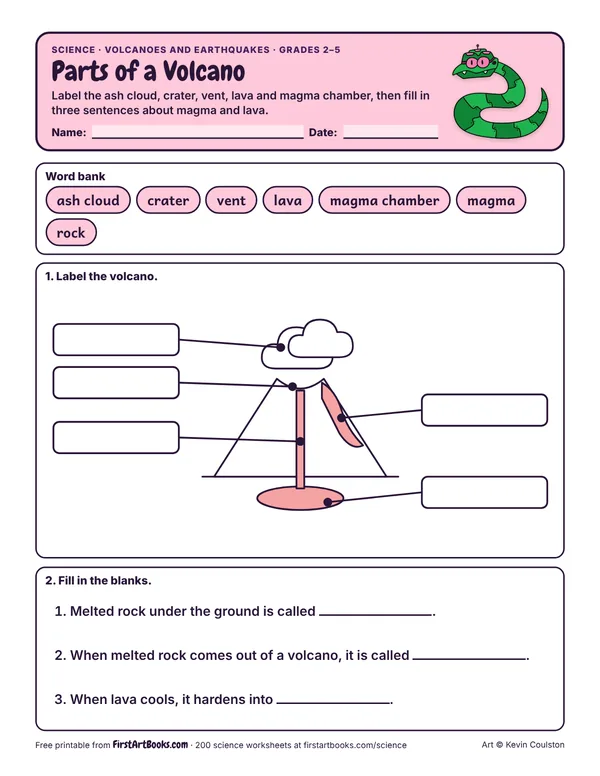
Label the ash cloud, crater, vent, lava and magma chamber, then fill in three sentences about magma and lava.
Print this sheet (PDF)Teacher notes and tips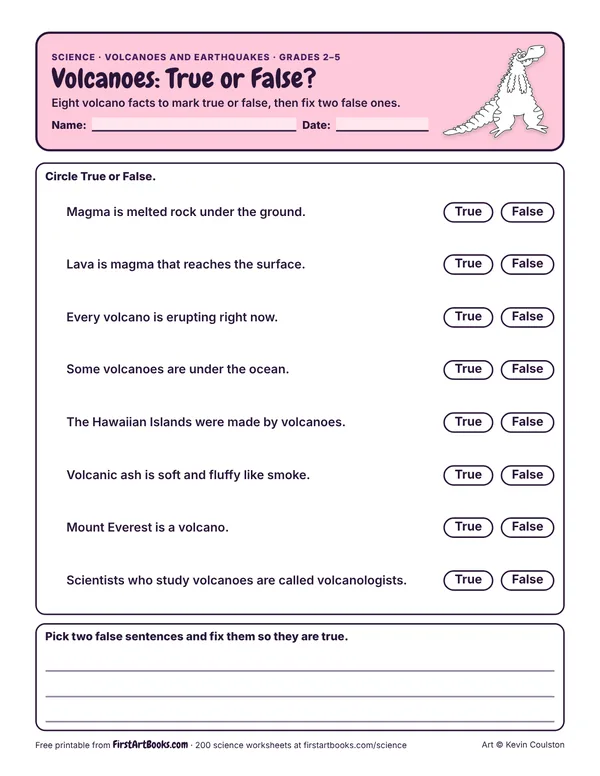
Eight volcano facts to mark true or false, then fix two false ones.
Print this sheet (PDF)Teacher notes and tips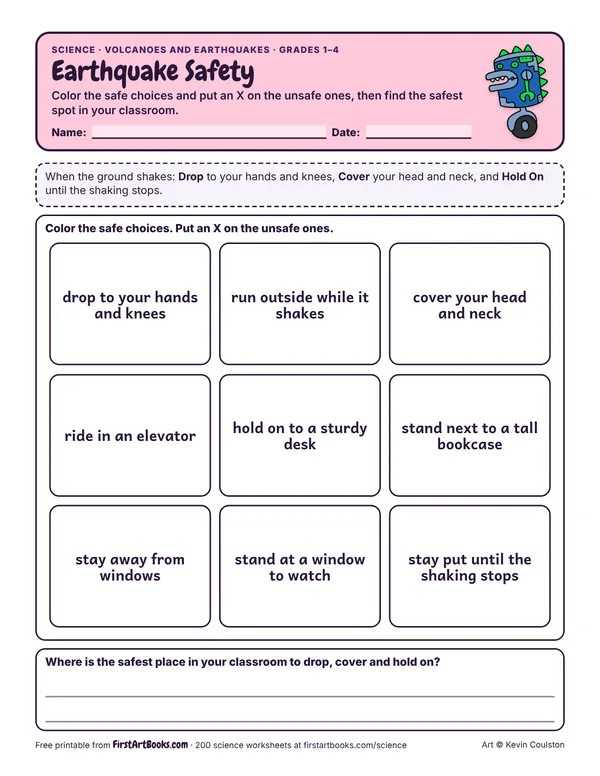
Color the safe choices and put an X on the unsafe ones, then find the safest spot in your classroom.
Print this sheet (PDF)Teacher notes and tips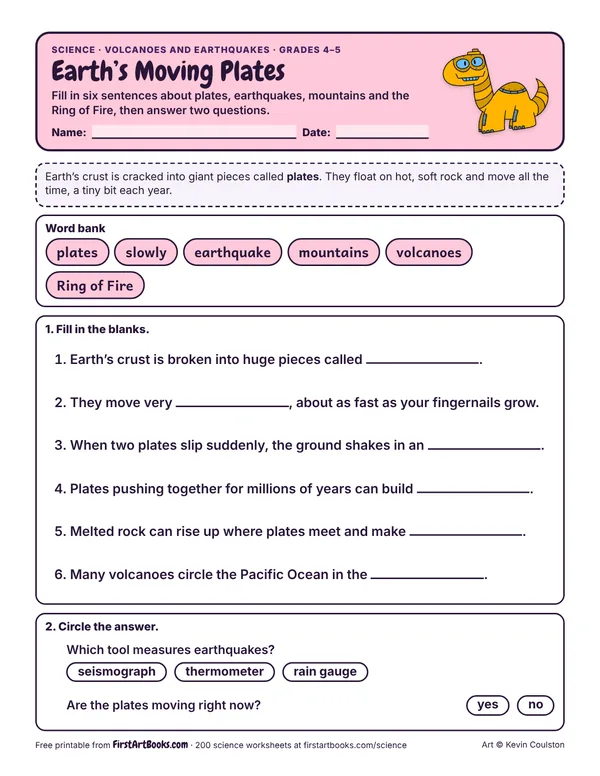
Fill in six sentences about plates, earthquakes, mountains and the Ring of Fire, then answer two questions.
Print this sheet (PDF)Teacher notes and tips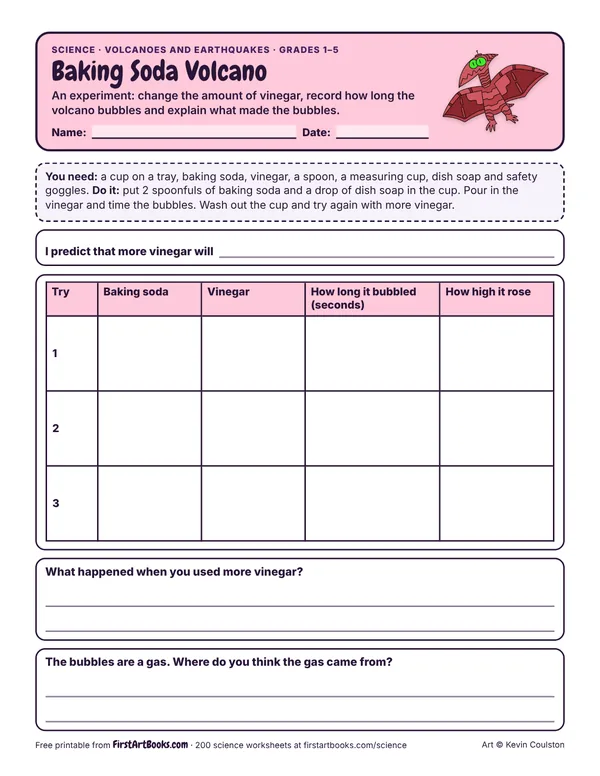
An experiment: change the amount of vinegar, record how long the volcano bubbles and explain what made the bubbles.
Print this sheet (PDF)Teacher notes and tipsGrades K–5. Hot or cold, things that give off heat, which spoon gets warm, an insulation challenge and conduction, convection and radiation.
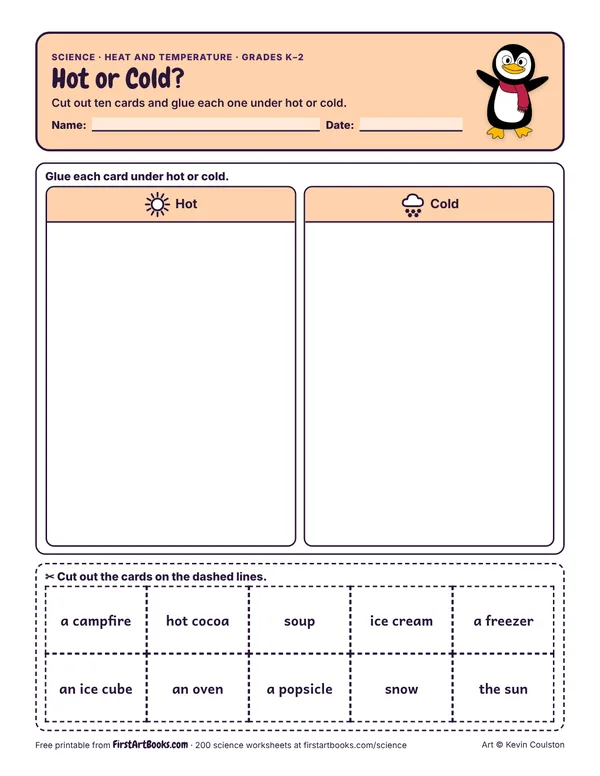
Cut out ten cards and glue each one under hot or cold.
Print this sheet (PDF)Teacher notes and tips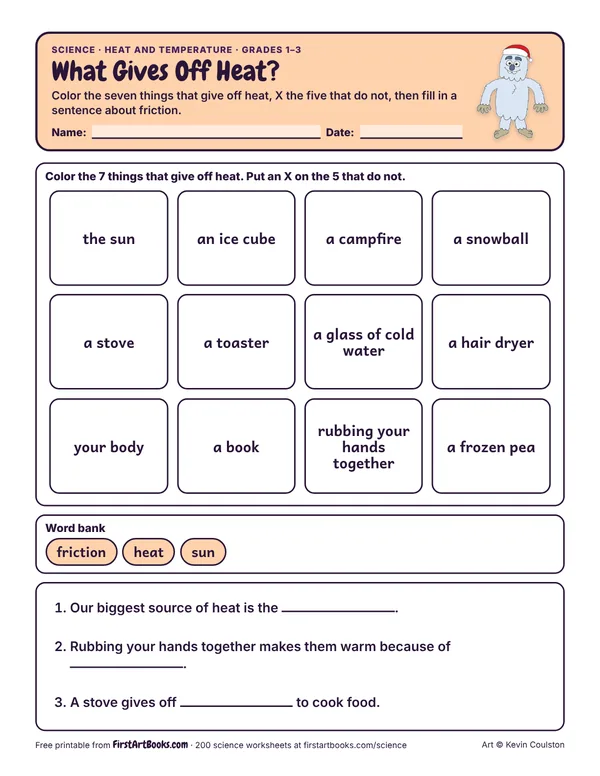
Color the seven things that give off heat, X the five that do not, then fill in a sentence about friction.
Print this sheet (PDF)Teacher notes and tips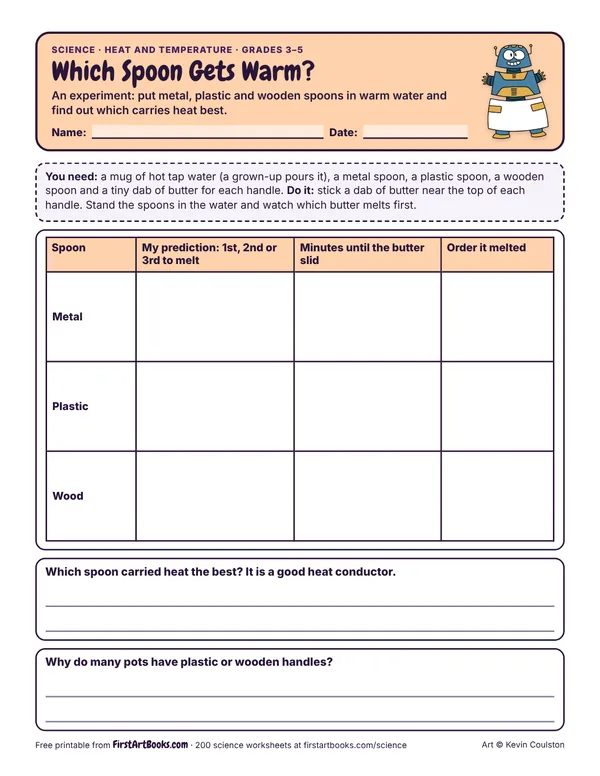
An experiment: put metal, plastic and wooden spoons in warm water and find out which carries heat best.
Print this sheet (PDF)Teacher notes and tips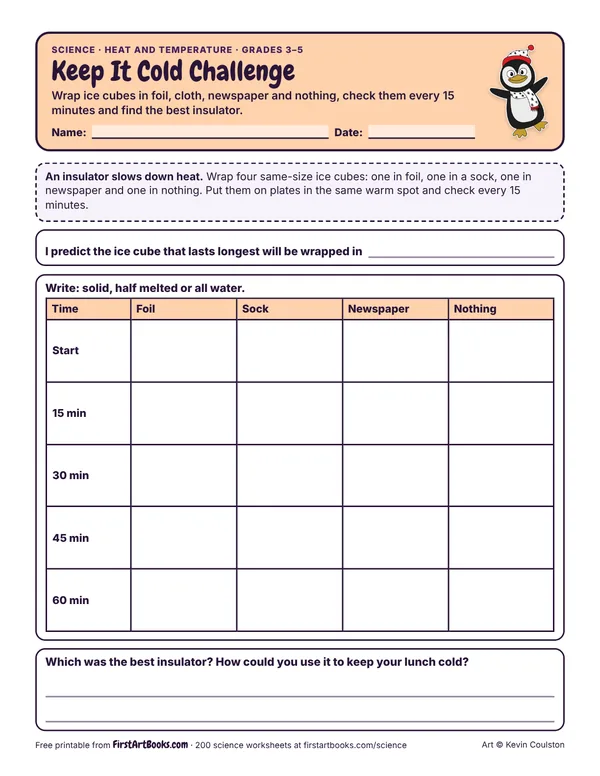
Wrap ice cubes in foil, cloth, newspaper and nothing, check them every 15 minutes and find the best insulator.
Print this sheet (PDF)Teacher notes and tips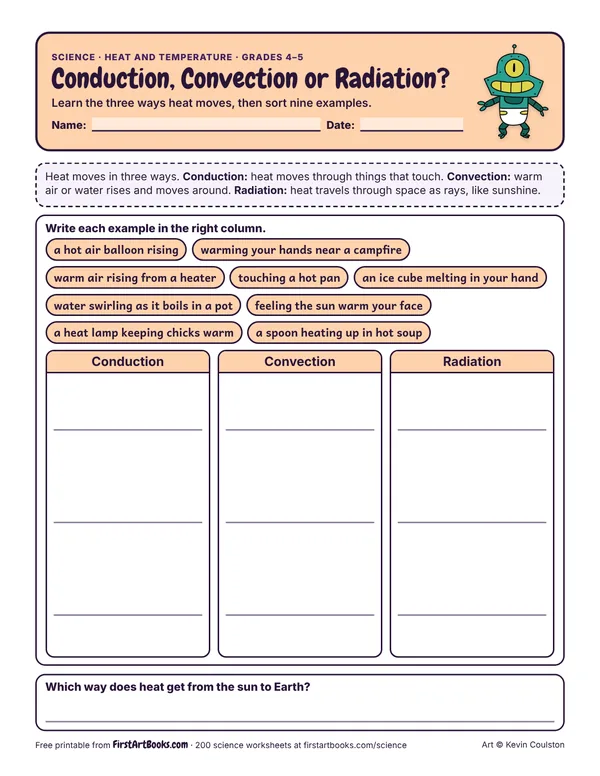
Learn the three ways heat moves, then sort nine examples.
Print this sheet (PDF)Teacher notes and tipsGrades 3–5. Forms of energy, potential or kinetic, energy changing from one form to another, a bouncing ball experiment and an energy hunt at home.
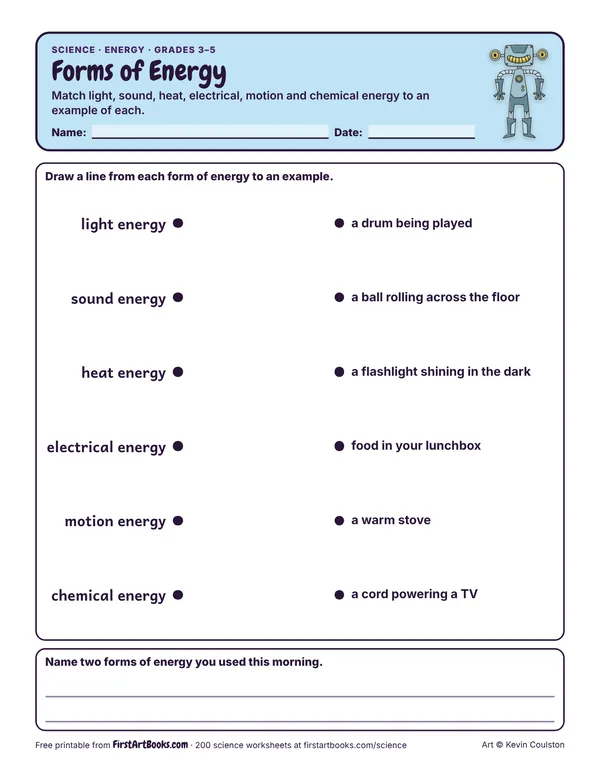
Match light, sound, heat, electrical, motion and chemical energy to an example of each.
Print this sheet (PDF)Teacher notes and tips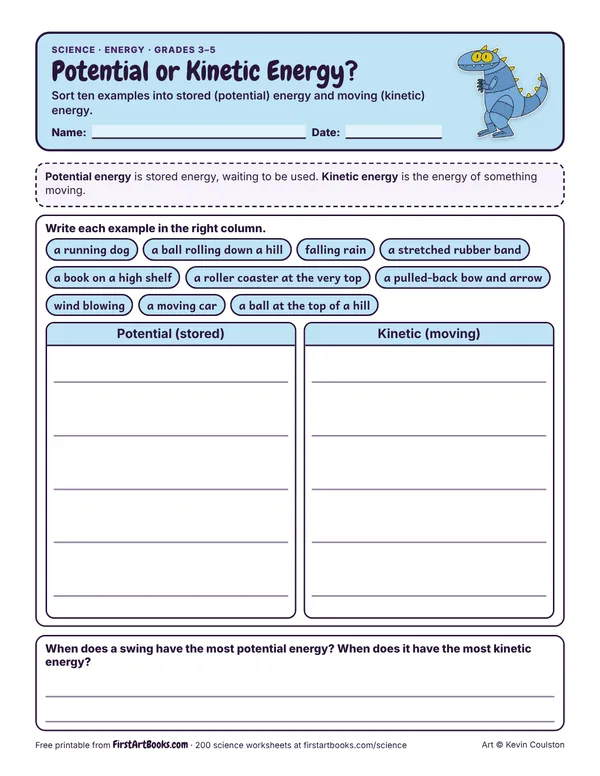
Sort ten examples into stored (potential) energy and moving (kinetic) energy.
Print this sheet (PDF)Teacher notes and tips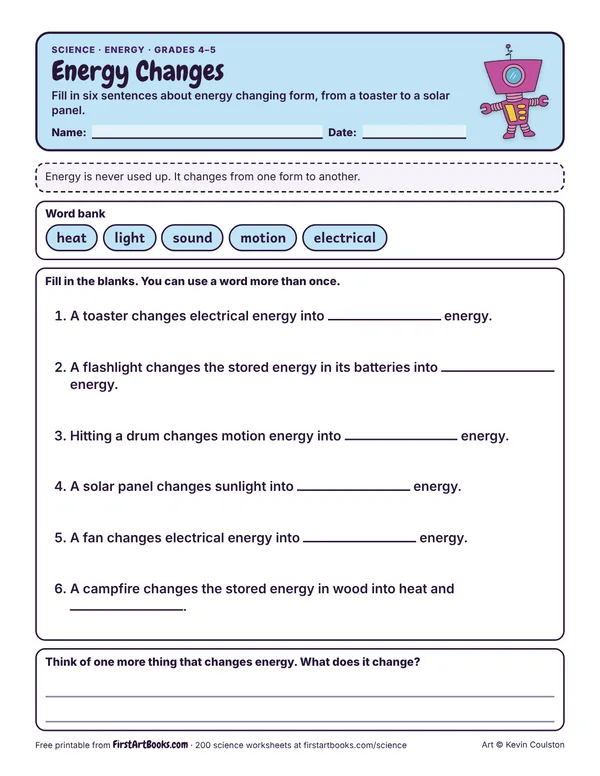
Fill in six sentences about energy changing form, from a toaster to a solar panel.
Print this sheet (PDF)Teacher notes and tips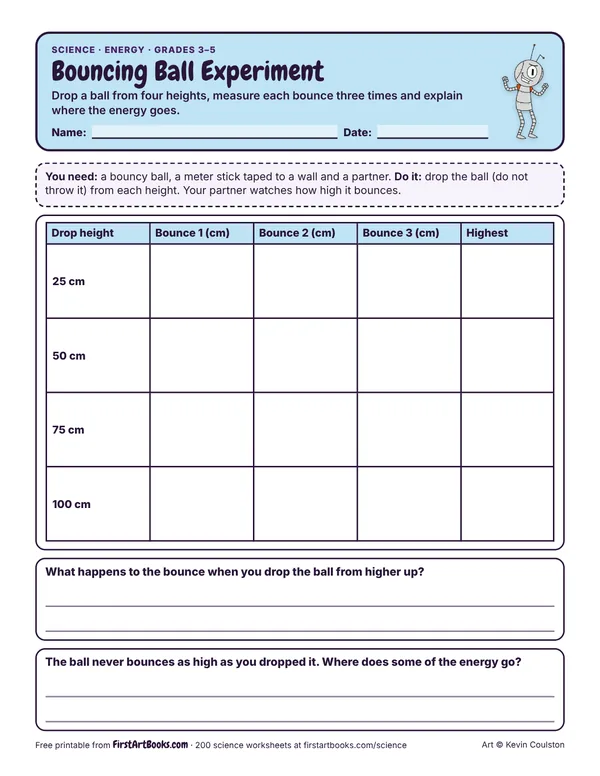
Drop a ball from four heights, measure each bounce three times and explain where the energy goes.
Print this sheet (PDF)Teacher notes and tips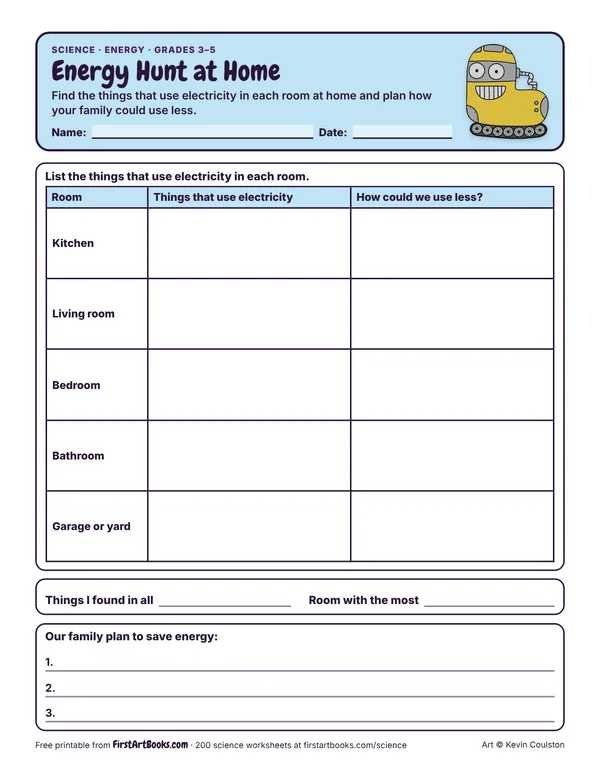
Find the things that use electricity in each room at home and plan how your family could use less.
Print this sheet (PDF)Teacher notes and tipsGrades 2–5. Dissolve or not, mixture or solution, physical or chemical change, separate a mixture and chemistry words.
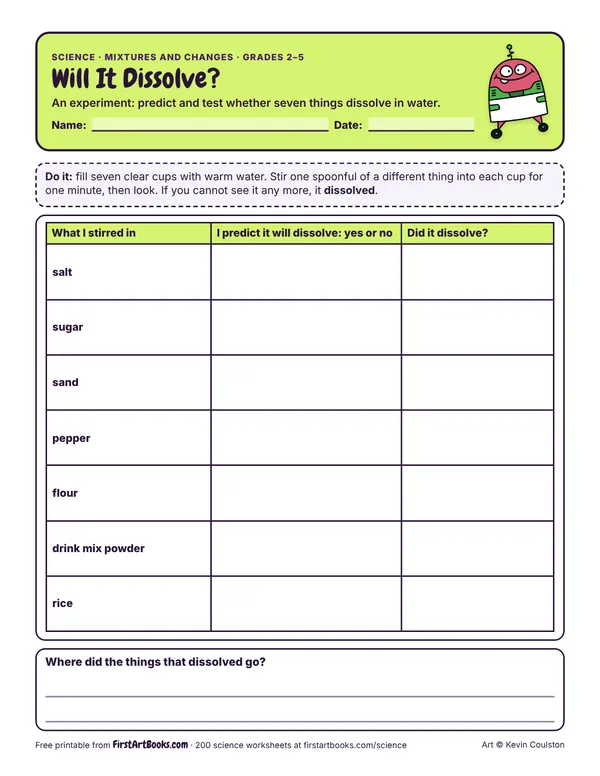
An experiment: predict and test whether seven things dissolve in water.
Print this sheet (PDF)Teacher notes and tips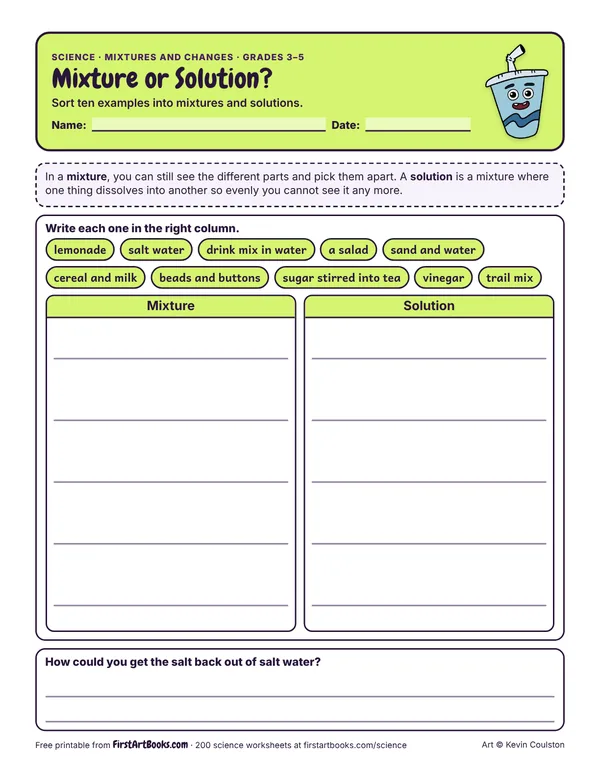
Sort ten examples into mixtures and solutions.
Print this sheet (PDF)Teacher notes and tips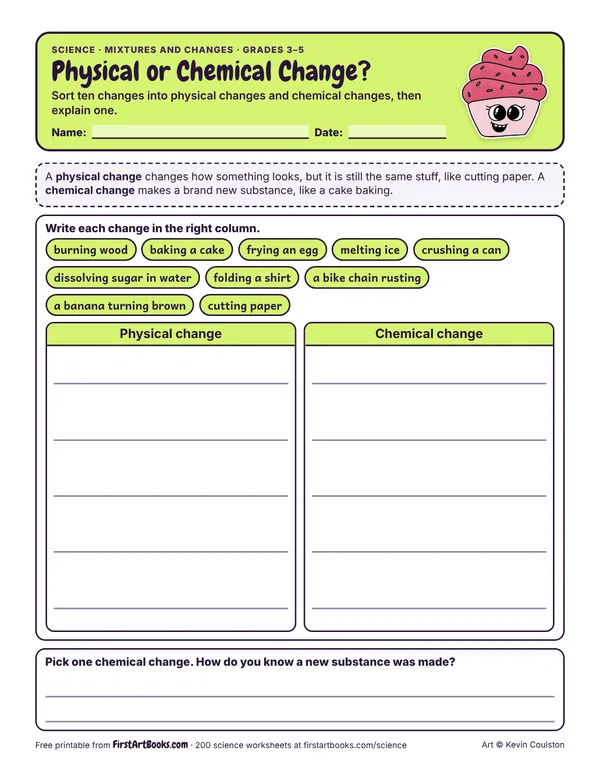
Sort ten changes into physical changes and chemical changes, then explain one.
Print this sheet (PDF)Teacher notes and tips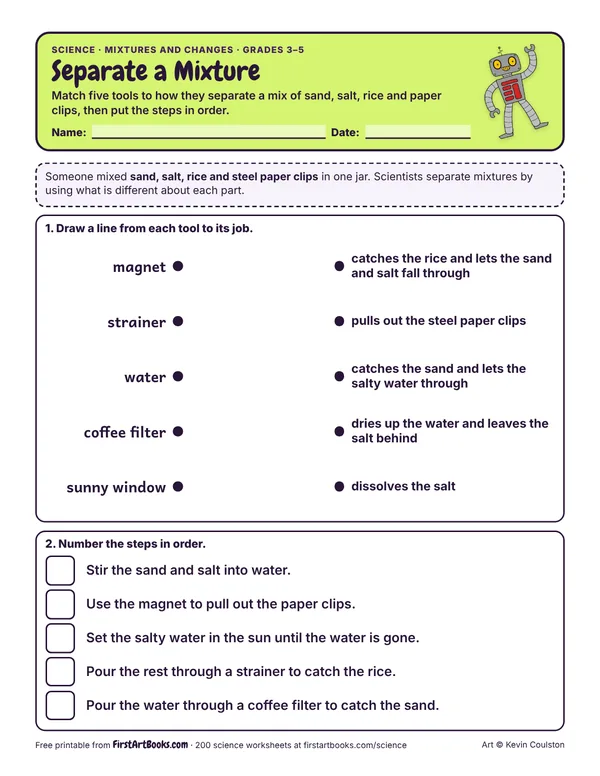
Match five tools to how they separate a mix of sand, salt, rice and paper clips, then put the steps in order.
Print this sheet (PDF)Teacher notes and tips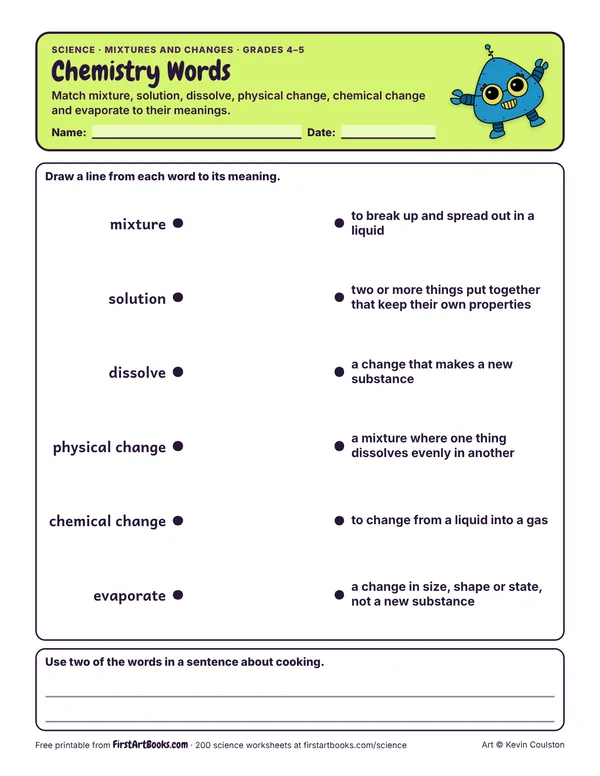
Match mixture, solution, dissolve, physical change, chemical change and evaporate to their meanings.
Print this sheet (PDF)Teacher notes and tipsGrades K–5. Predict and test, a sink or float sort, a clay boat challenge, floating true or false and a liquid density tower.
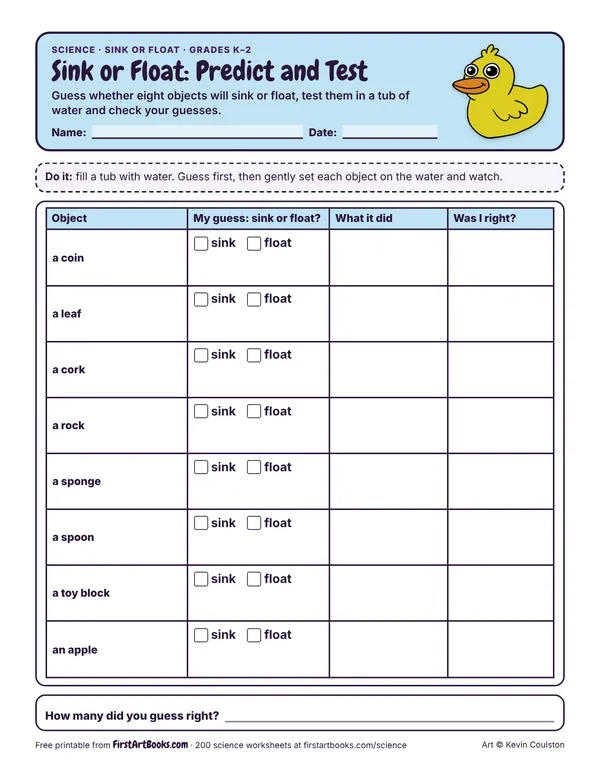
Guess whether eight objects will sink or float, test them in a tub of water and check your guesses.
Print this sheet (PDF)Teacher notes and tips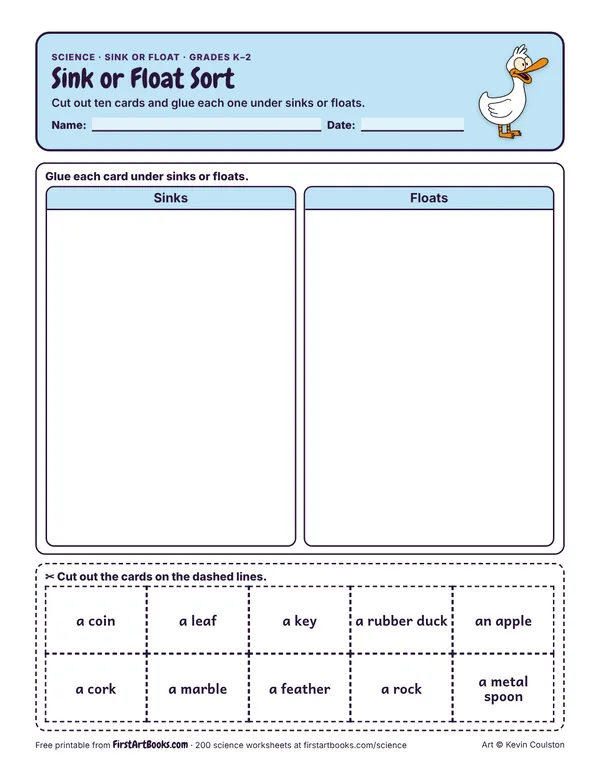
Cut out ten cards and glue each one under sinks or floats.
Print this sheet (PDF)Teacher notes and tips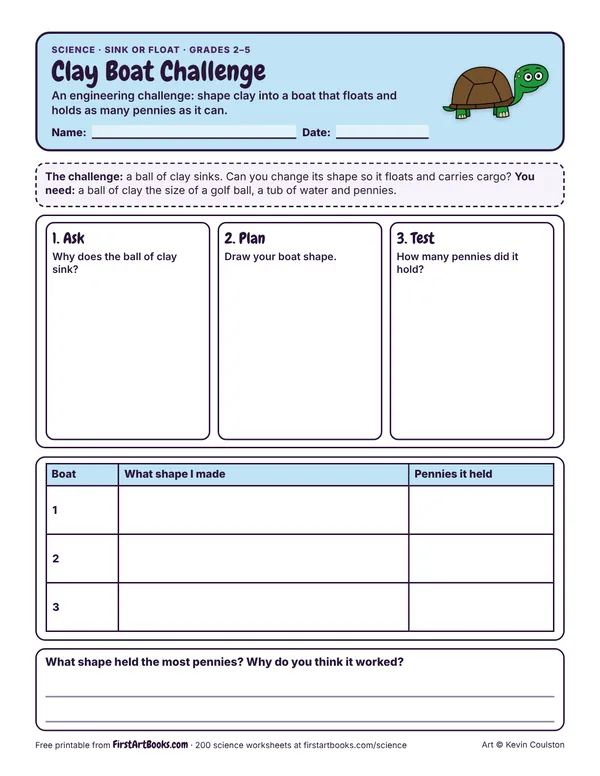
An engineering challenge: shape clay into a boat that floats and holds as many pennies as it can.
Print this sheet (PDF)Teacher notes and tips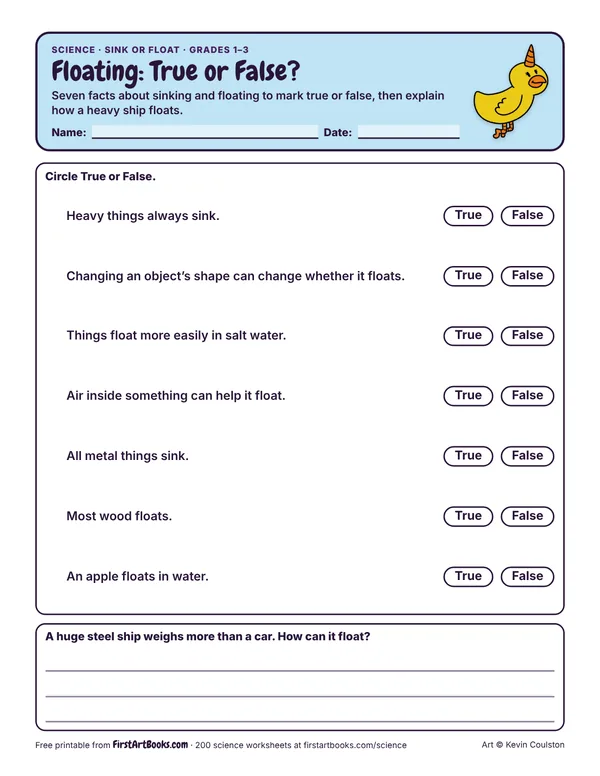
Seven facts about sinking and floating to mark true or false, then explain how a heavy ship floats.
Print this sheet (PDF)Teacher notes and tips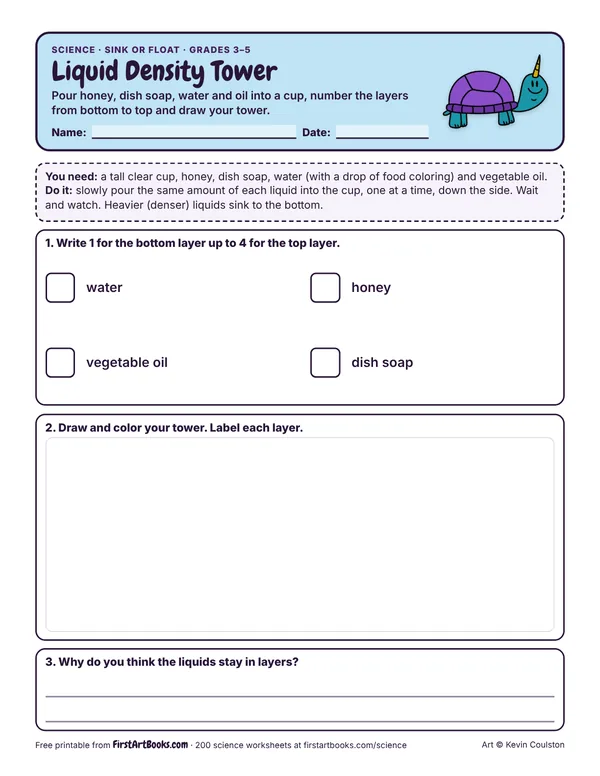
Pour honey, dish soap, water and oil into a cup, number the layers from bottom to top and draw your tower.
Print this sheet (PDF)Teacher notes and tipsGrades 2–5. The five steps of the engineering design process, an egg drop, a craft stick catapult, kinds of engineers and a paper marble run.
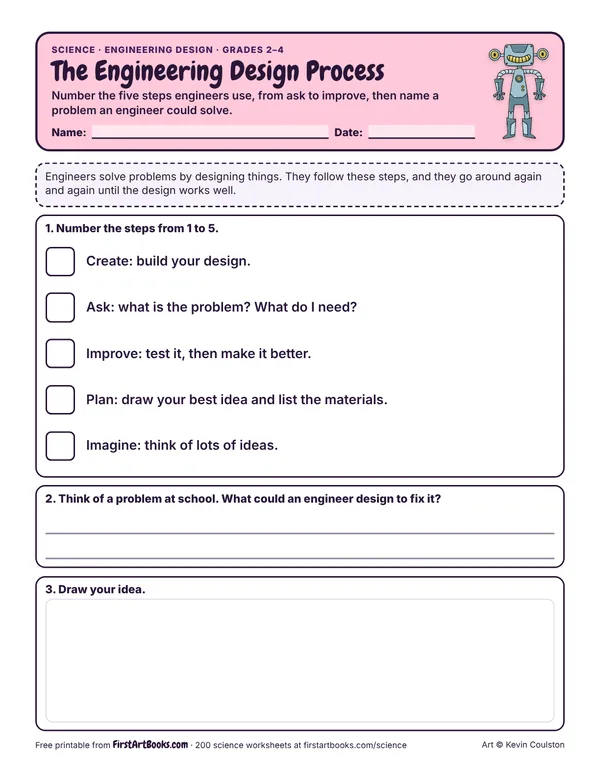
Number the five steps engineers use, from ask to improve, then name a problem an engineer could solve.
Print this sheet (PDF)Teacher notes and tips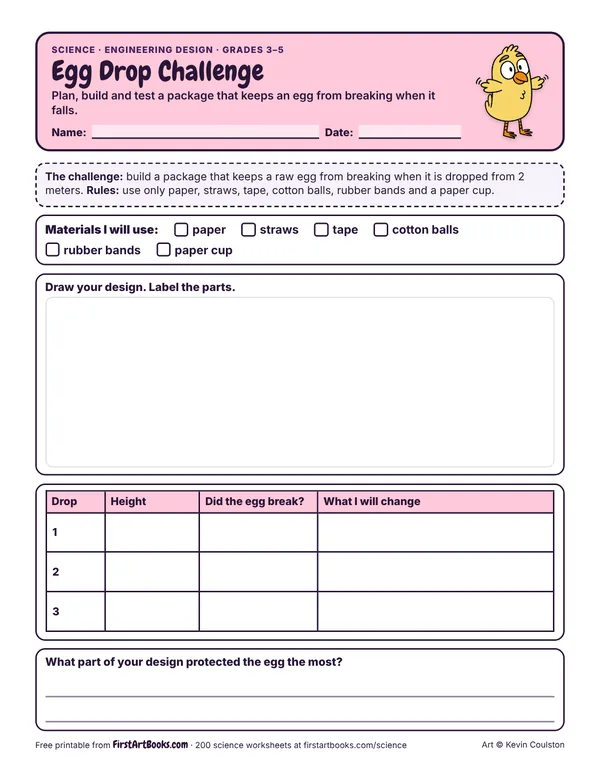
Plan, build and test a package that keeps an egg from breaking when it falls.
Print this sheet (PDF)Teacher notes and tips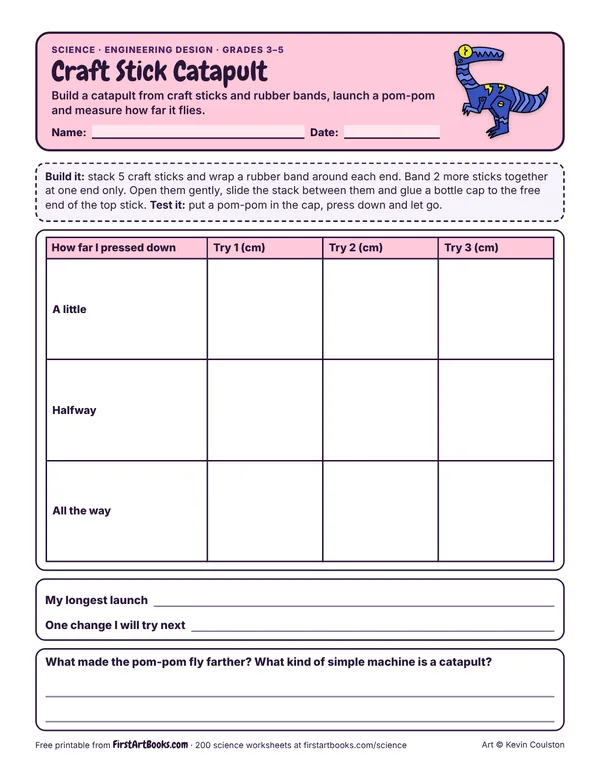
Build a catapult from craft sticks and rubber bands, launch a pom-pom and measure how far it flies.
Print this sheet (PDF)Teacher notes and tips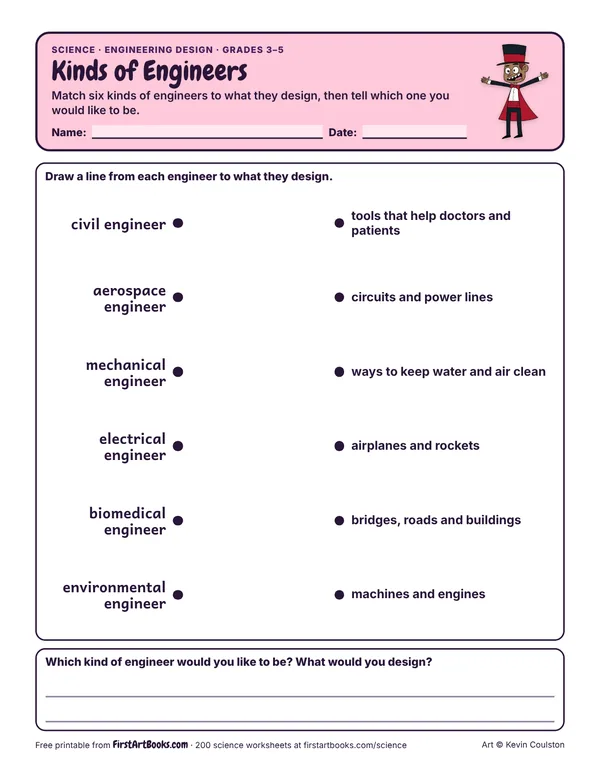
Match six kinds of engineers to what they design, then tell which one you would like to be.
Print this sheet (PDF)Teacher notes and tips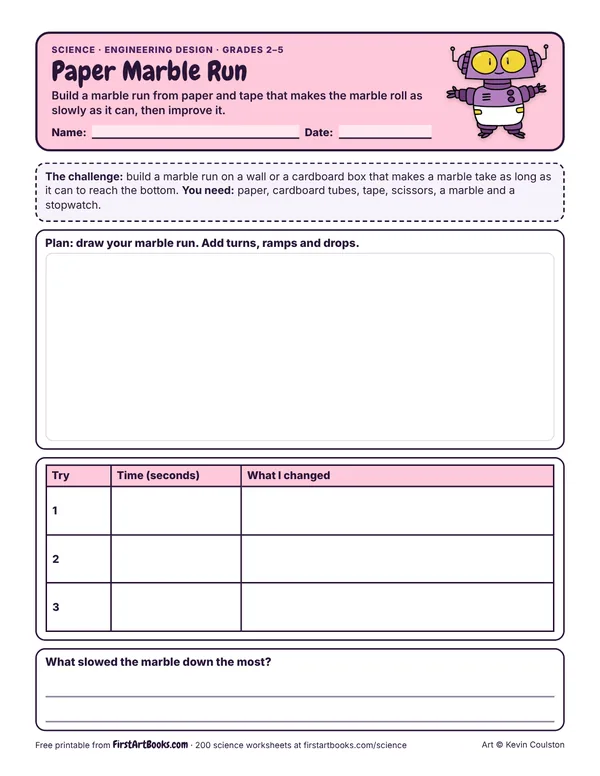
Build a marble run from paper and tape that makes the marble roll as slowly as it can, then improve it.
Print this sheet (PDF)Teacher notes and tipsGrades K–5. Code a robot through a grid, a robot maze, put an algorithm in order, find the bug in the code and write your name in binary.
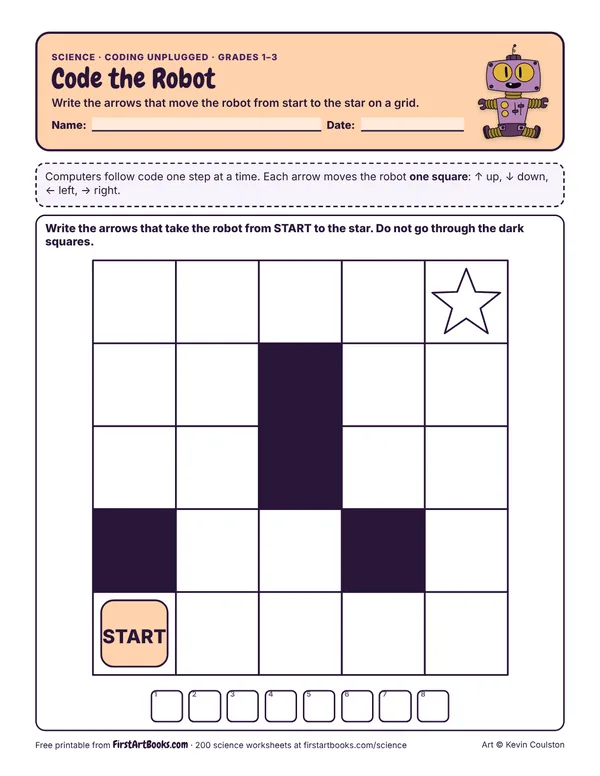
Write the arrows that move the robot from start to the star on a grid.
Print this sheet (PDF)Teacher notes and tips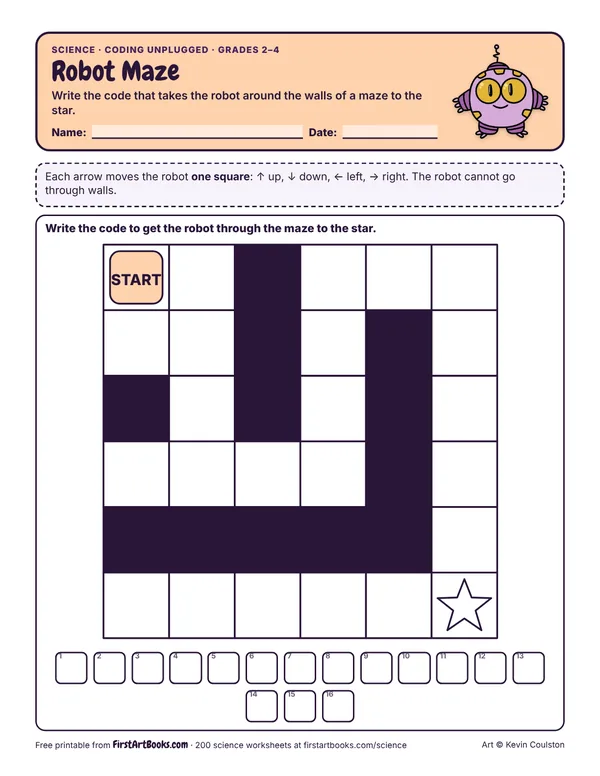
Write the code that takes the robot around the walls of a maze to the star.
Print this sheet (PDF)Teacher notes and tips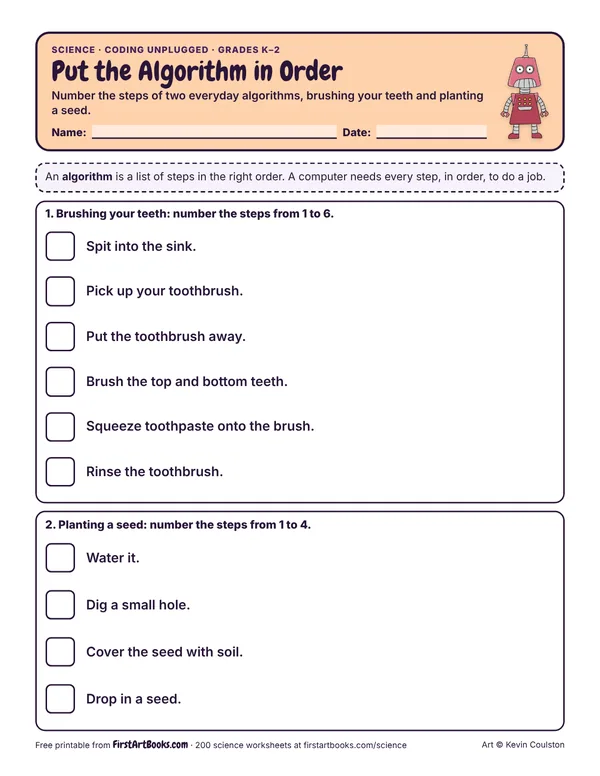
Number the steps of two everyday algorithms, brushing your teeth and planting a seed.
Print this sheet (PDF)Teacher notes and tips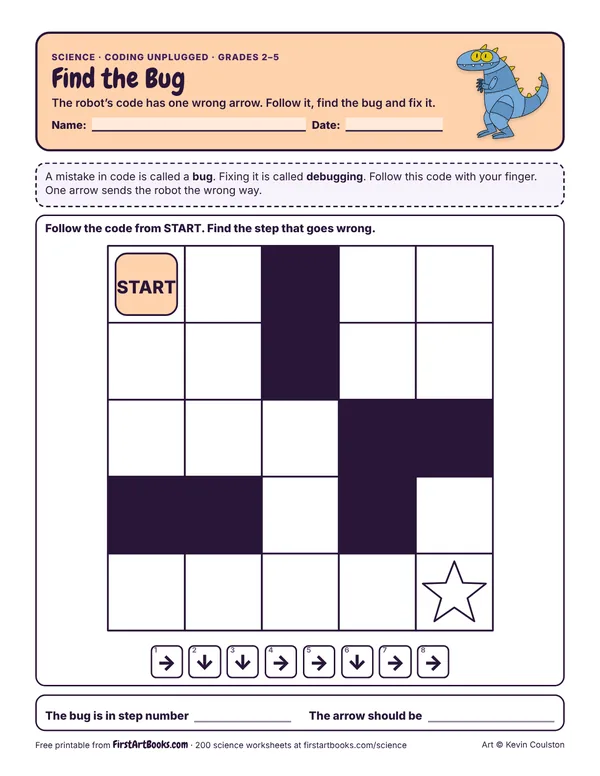
The robot’s code has one wrong arrow. Follow it, find the bug and fix it.
Print this sheet (PDF)Teacher notes and tips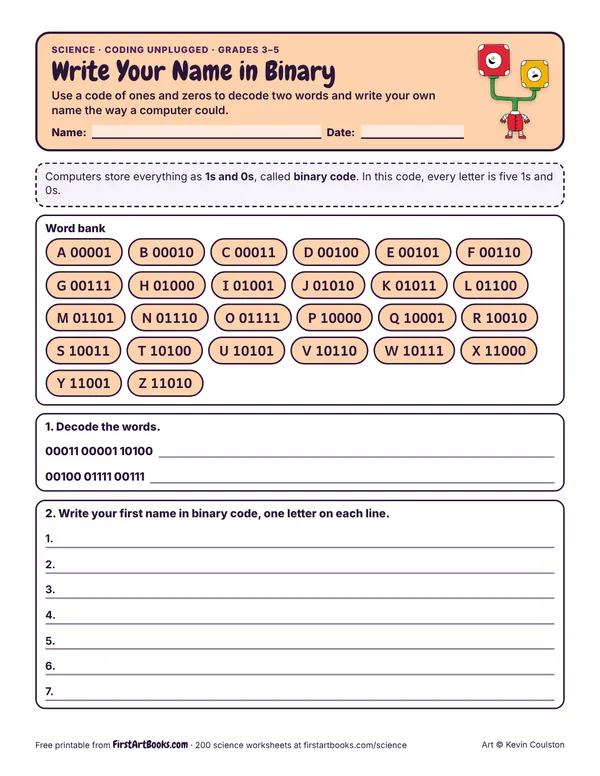
Use a code of ones and zeros to decode two words and write your own name the way a computer could.
Print this sheet (PDF)Teacher notes and tipsGrades K–5. Six science tools and their jobs, lab safety rules, measure with a ruler, compare with a balance and read a measuring cylinder.
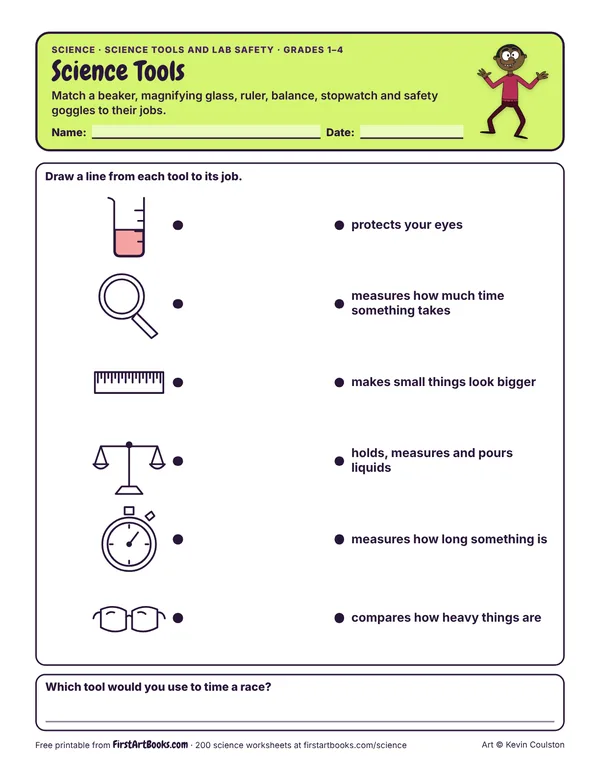
Match a beaker, magnifying glass, ruler, balance, stopwatch and safety goggles to their jobs.
Print this sheet (PDF)Teacher notes and tips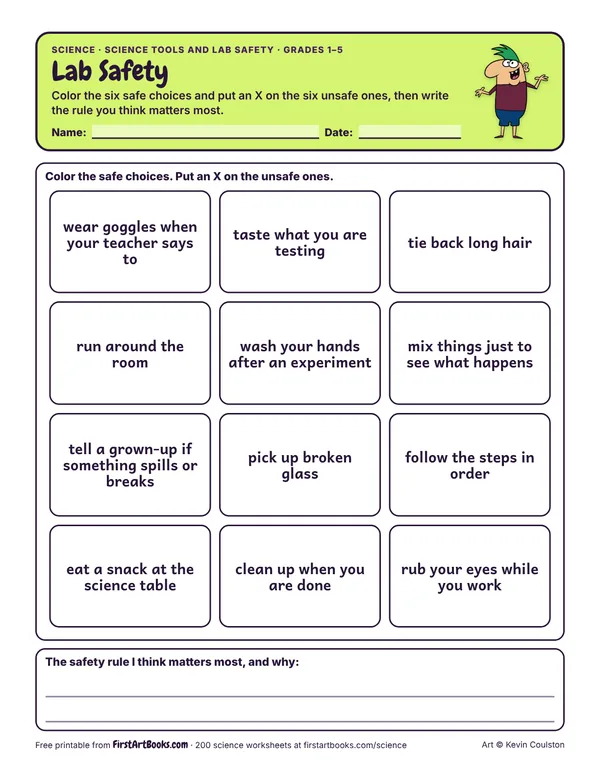
Color the six safe choices and put an X on the six unsafe ones, then write the rule you think matters most.
Print this sheet (PDF)Teacher notes and tips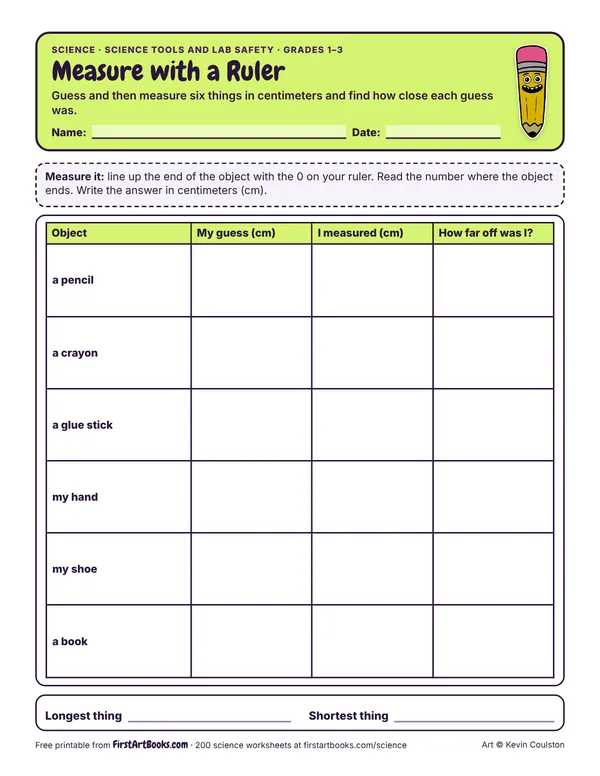
Guess and then measure six things in centimeters and find how close each guess was.
Print this sheet (PDF)Teacher notes and tips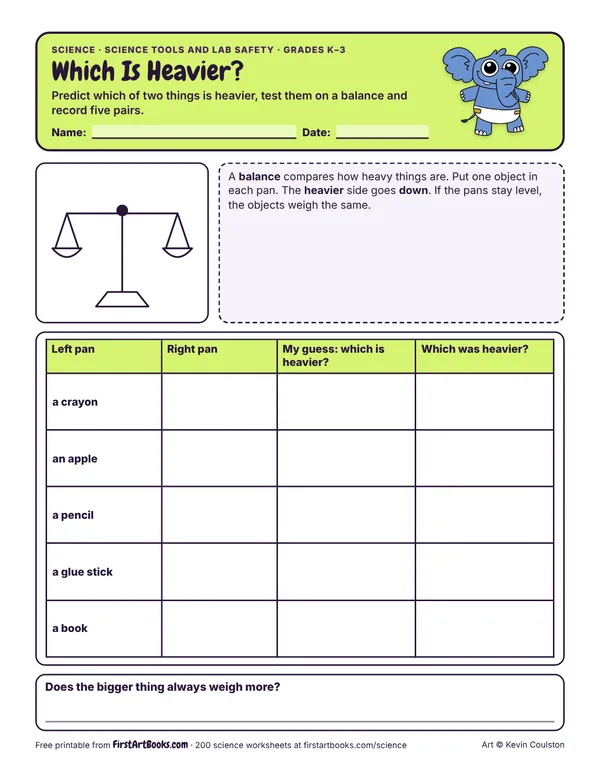
Predict which of two things is heavier, test them on a balance and record five pairs.
Print this sheet (PDF)Teacher notes and tips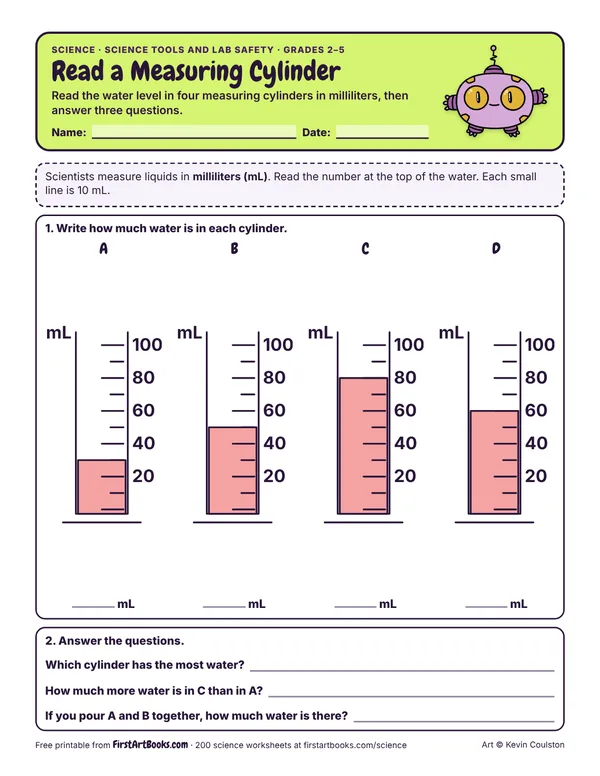
Read the water level in four measuring cylinders in milliliters, then answer three questions.
Print this sheet (PDF)Teacher notes and tipsEvery topic has five sheets, so the same plan works for butterflies and frogs, weather or matter.
Kids who love planets, sea creatures, robots and animals can draw them step by step in Kevin Coulston’s how-to-draw books.
Yes. All 200 worksheets, the 40 topic packs and the answer key are free to print for home and classroom use, as many copies as your class needs.
Kindergarten to 5th grade. Every sheet shows its grade range. The five senses, plant life cycle, seasons, day and night, bug, bird, tree, sink or float and Earth helper topics each have sheets that start in kindergarten; the food chain, moon phase, circuit, energy, heat transfer, chemistry and Earth’s plates sheets are for grades 3 to 5. Use the grade buttons to see only the sheets for your class.
Yes. 140 sheets have a matching answer key page: the cut-and-paste sorts, matching, labeling, true or false and fill in the blank sheets. Each topic pack ends with its own answer pages, and every answer page is also in one PDF. Journals, experiment sheets and engineering challenges have no single right answer.
Most sheets need only a pencil, crayons, scissors and glue. The experiment and challenge sheets list what you need at the top: a bean and a zip bag, ice cubes, paper and tape, pennies, a toy car and a few books, a magnet, a balloon, rubber bands, four rocks, an egg and salt, baking soda and vinegar, clay, craft sticks or a bouncy ball.
40 topics, five sheets each: plant life cycle, butterfly and frog life cycles, weather, solar system, habitats and adaptations, five senses, states of matter, simple machines and engineering, scientific method, food chains and ecosystems, human body, magnets, light and shadows, sound, rocks, soil and fossils, water cycle, electricity and circuits, forces and motion, animal classification, taking care of earth, seasons, day and night, stars and constellations, dinosaurs, oceans, insects and spiders, birds, trees and leaves, flowers, seeds and photosynthesis, animal babies and traits, food groups and healthy eating, landforms and erosion, volcanoes and earthquakes, heat and temperature, energy, mixtures and changes, sink or float, engineering design, coding unplugged, science tools and lab safety. They fit the life science, earth and space science, physical science and engineering units taught in most elementary schools.
Yes. The headers are light colors that look fine in gray, and every diagram is a black outline kids can color. Sheets are US Letter and also print on A4.
All sheets are US Letter, print well in black and white, and are free for home and classroom use. More for teachers in the teacher resources library.
12 printable pages: six step-by-step lessons, a grid activity, draw-and-write sheets and teacher notes, sent with your welcome email. After that, new classroom printables by email.