



Grades 1–3
Theater Words Match
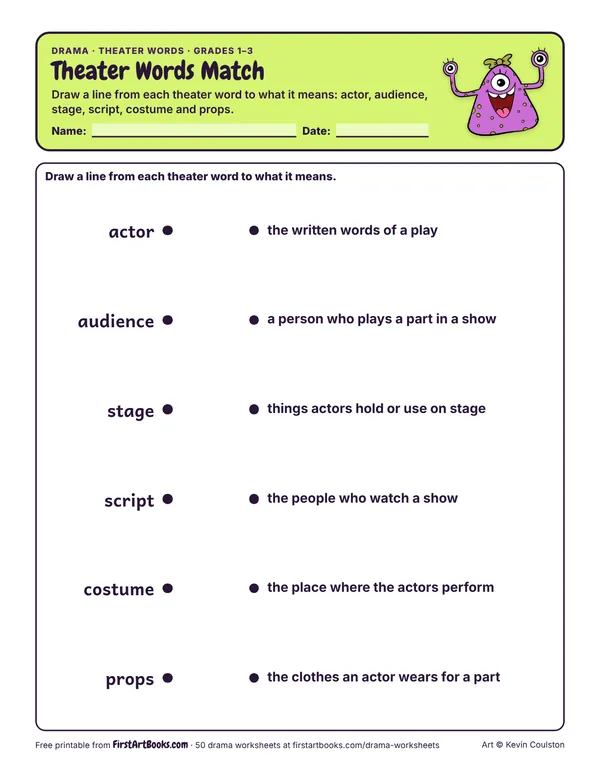
Draw a line from each theater word to what it means: actor, audience, stage, script, costume and props.
Print this sheet (PDF)Teacher notes and tips50 free drama worksheets in 10 topics: theater words, stage directions, using your voice, body and movement, feelings and faces, creating characters, scripts, reader’s theater, drama games and putting on a show. Five original reader’s theater scripts, 29 answer keys and one of Kevin Coulston’s cartoon characters on every page.
Learn the words of the theater: match actor, script and props to what they mean, meet the people who put on a show, label the parts of a theater and solve a theater crossword.
Draw a line from each theater word to what it means: actor, audience, stage, script, costume and props.
Print this sheet (PDF)Teacher notes and tips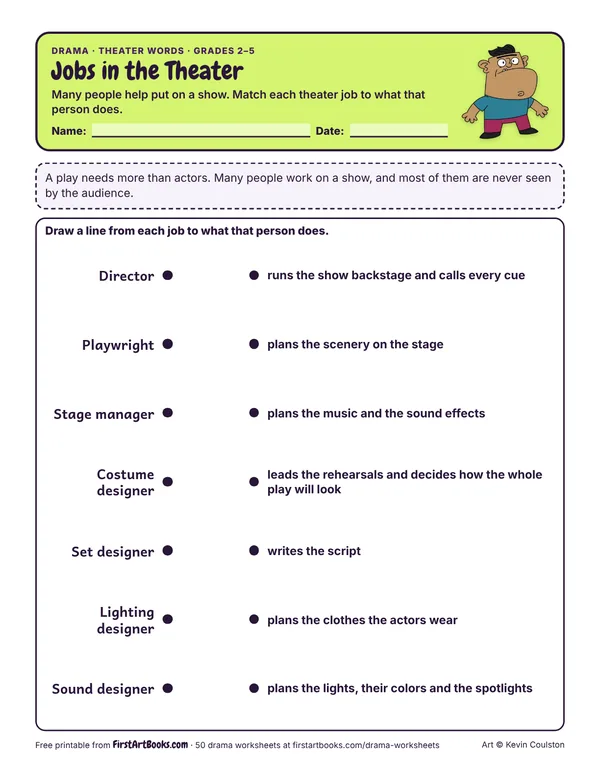
Many people help put on a show. Match each theater job to what that person does.
Print this sheet (PDF)Teacher notes and tips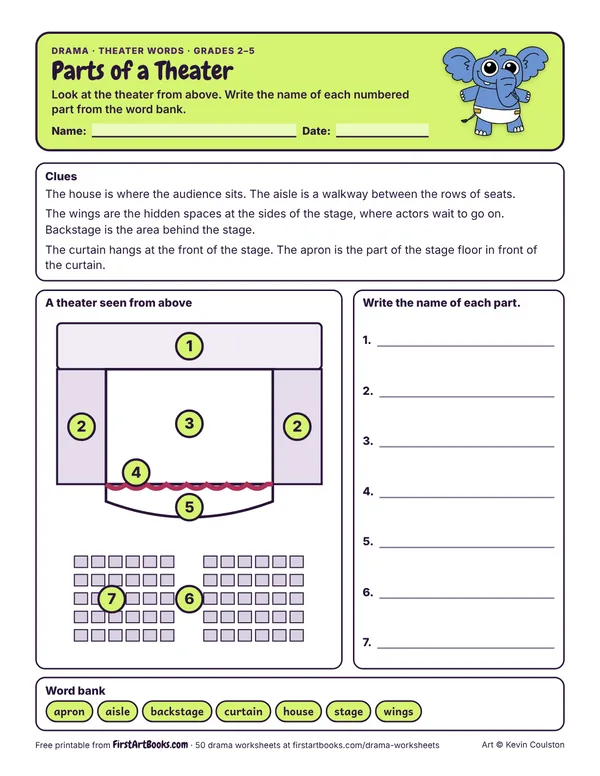
Look at the theater from above. Write the name of each numbered part from the word bank.
Print this sheet (PDF)Teacher notes and tips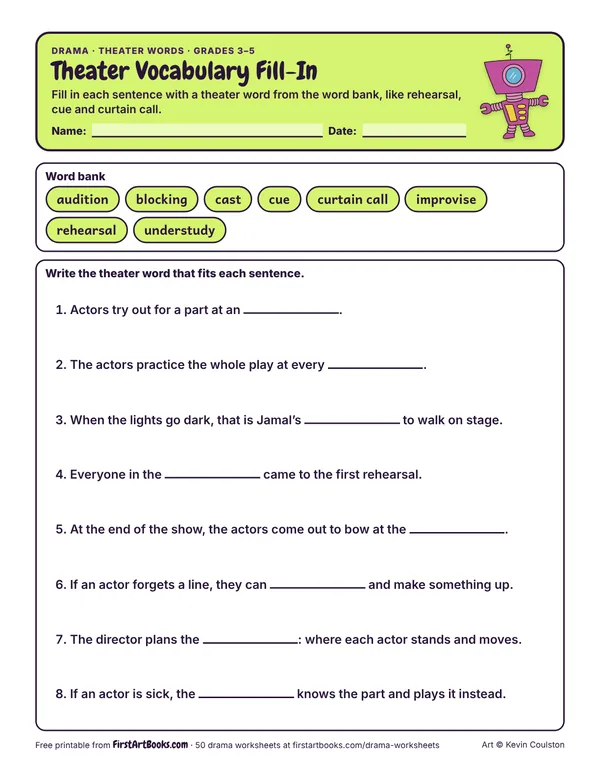
Fill in each sentence with a theater word from the word bank, like rehearsal, cue and curtain call.
Print this sheet (PDF)Teacher notes and tips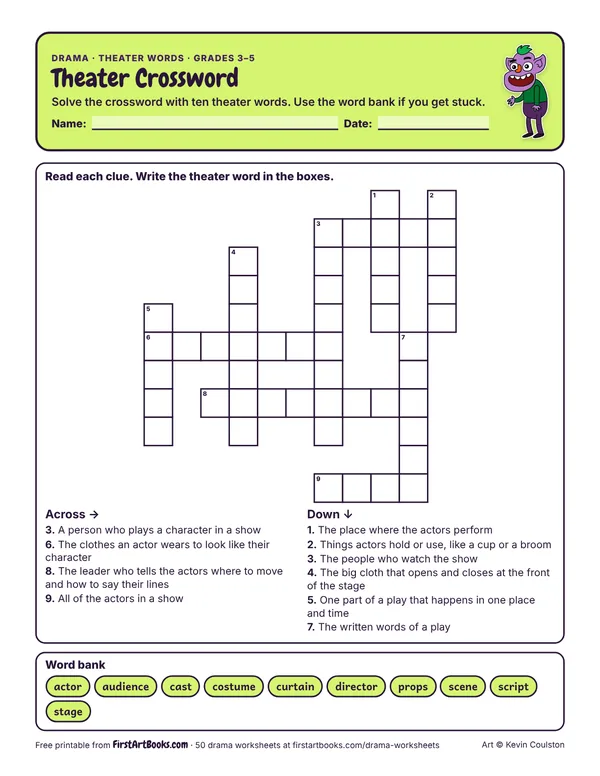
Solve the crossword with ten theater words. Use the word bank if you get stuck.
Print this sheet (PDF)Teacher notes and tips

Learn the nine areas of the stage, from upstage right to downstage left, tell stage left from stage right, follow stage directions and place actors on the stage.
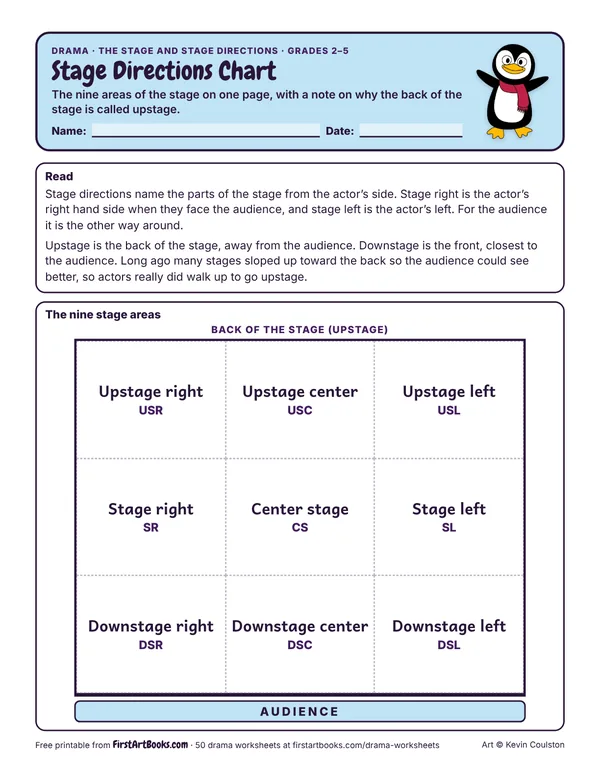
The nine areas of the stage on one page, with a note on why the back of the stage is called upstage.
Print this sheet (PDF)Teacher notes and tips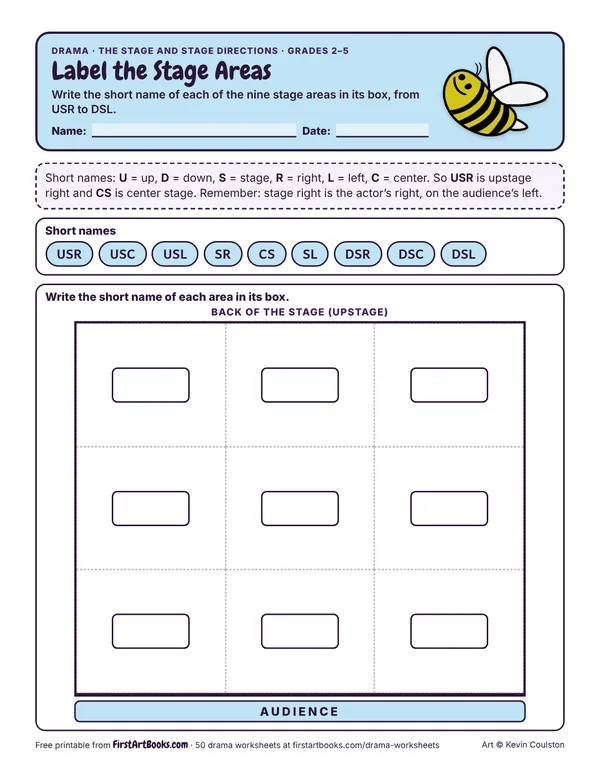
Write the short name of each of the nine stage areas in its box, from USR to DSL.
Print this sheet (PDF)Teacher notes and tips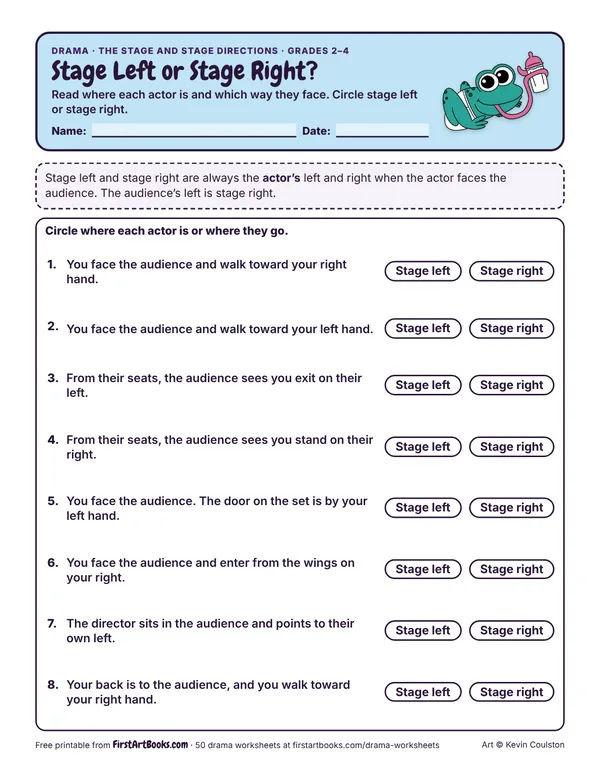
Read where each actor is and which way they face. Circle stage left or stage right.
Print this sheet (PDF)Teacher notes and tips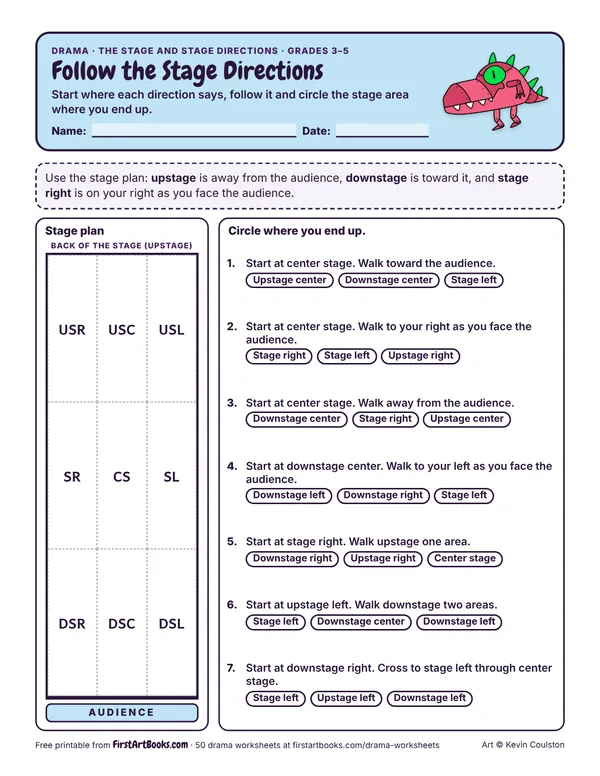
Start where each direction says, follow it and circle the stage area where you end up.
Print this sheet (PDF)Teacher notes and tips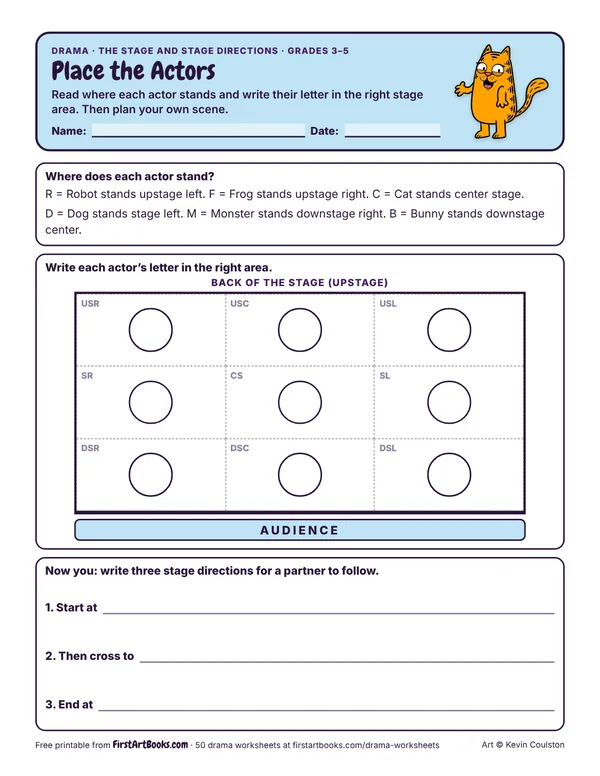
Read where each actor stands and write their letter in the right stage area. Then plan your own scene.
Print this sheet (PDF)Teacher notes and tips

Pick a loud or soft voice for each character, say one line five ways, warm up with tongue twisters, learn volume, pitch, pace and tone, and see how one stressed word changes a sentence.
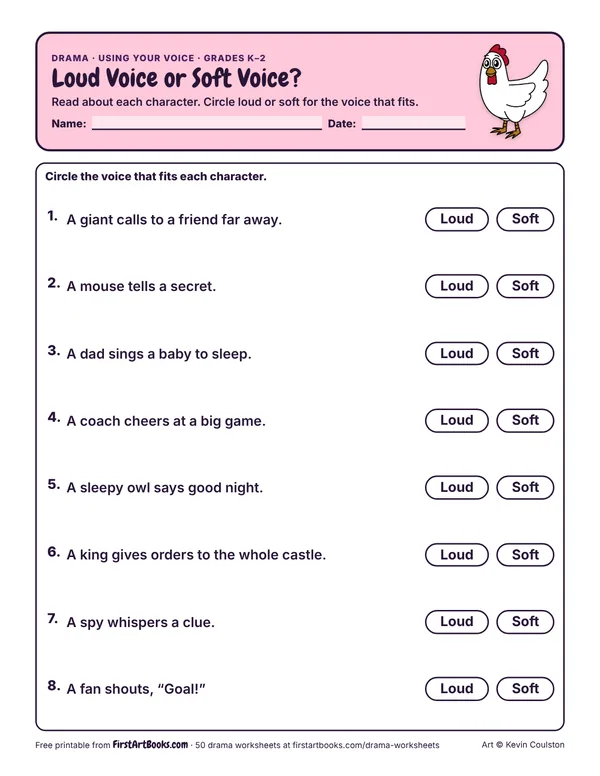
Read about each character. Circle loud or soft for the voice that fits.
Print this sheet (PDF)Teacher notes and tips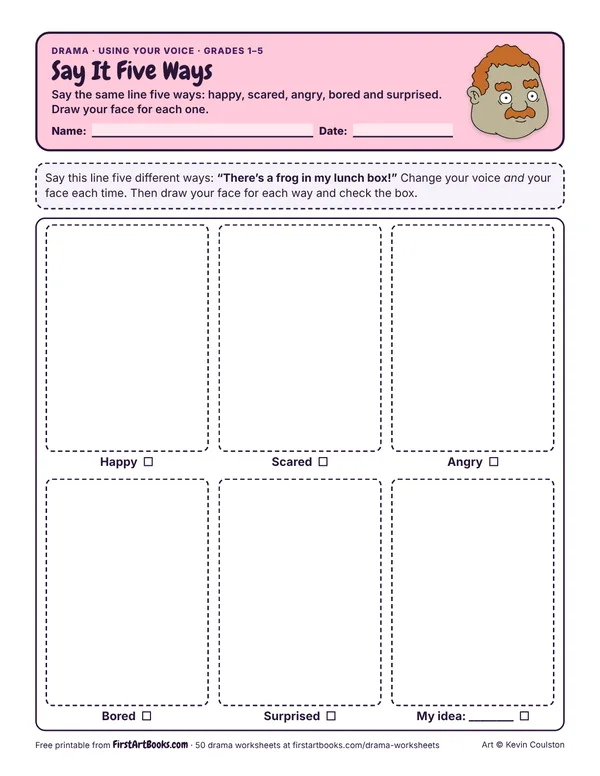
Say the same line five ways: happy, scared, angry, bored and surprised. Draw your face for each one.
Print this sheet (PDF)Teacher notes and tips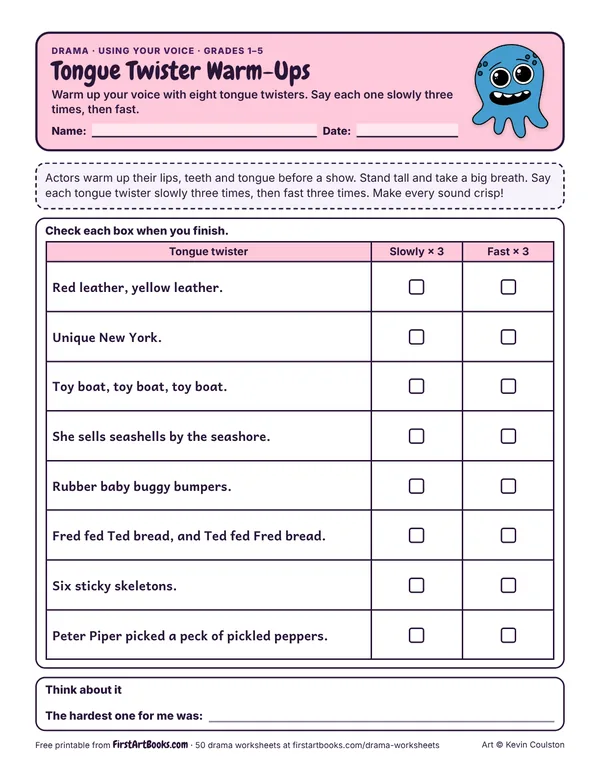
Warm up your voice with eight tongue twisters. Say each one slowly three times, then fast.
Print this sheet (PDF)Teacher notes and tips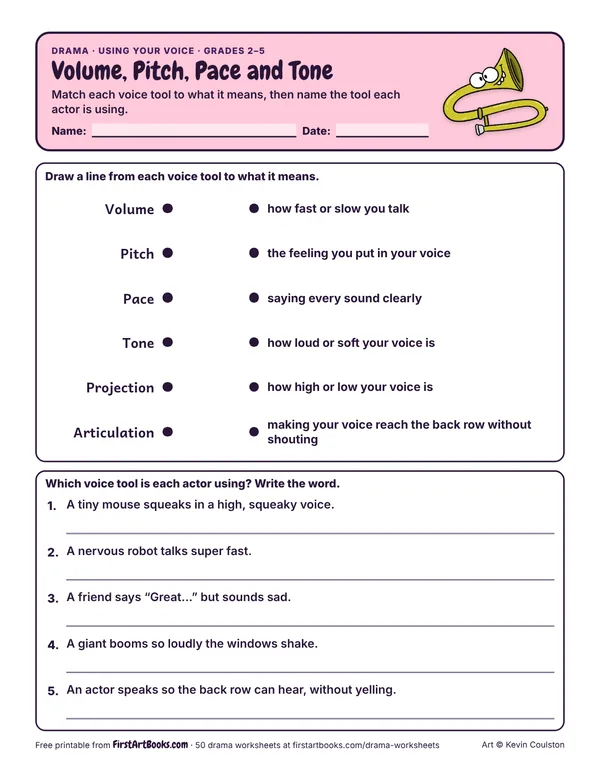
Match each voice tool to what it means, then name the tool each actor is using.
Print this sheet (PDF)Teacher notes and tips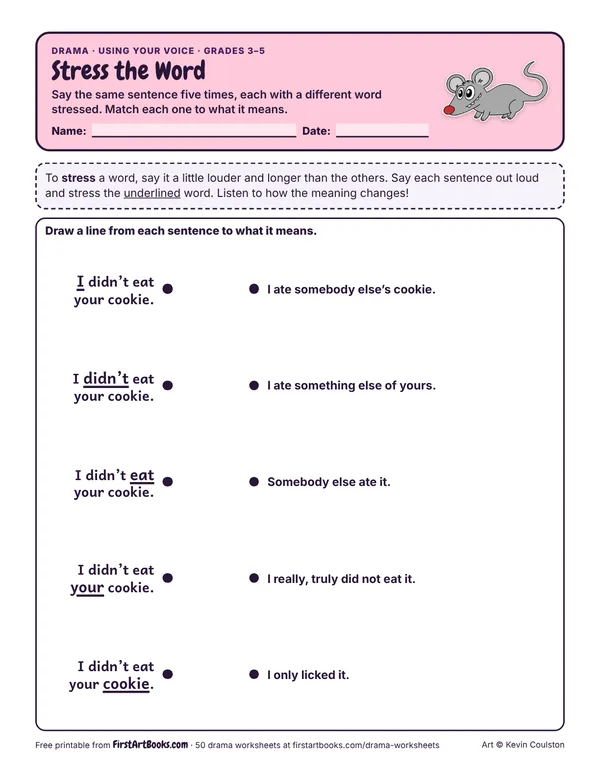
Say the same sentence five times, each with a different word stressed. Match each one to what it means.
Print this sheet (PDF)Teacher notes and tips
Act without words: pantomime action cards, guess the pantomime, plan freeze frames for a story, move like an animal and read the feelings in body language.
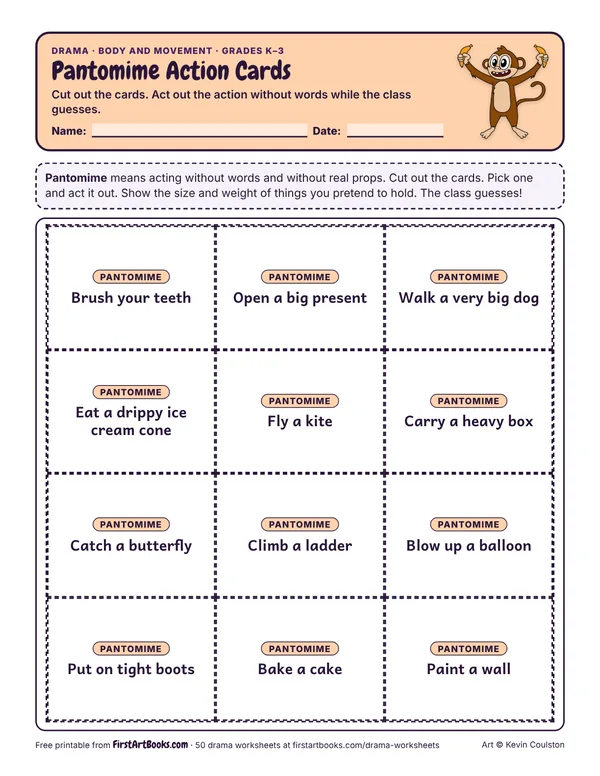
Cut out the cards. Act out the action without words while the class guesses.
Print this sheet (PDF)Teacher notes and tips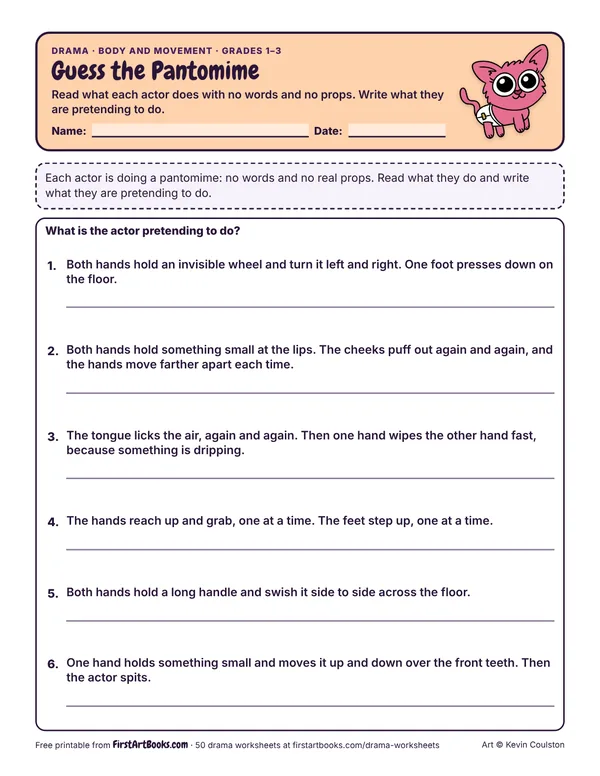
Read what each actor does with no words and no props. Write what they are pretending to do.
Print this sheet (PDF)Teacher notes and tips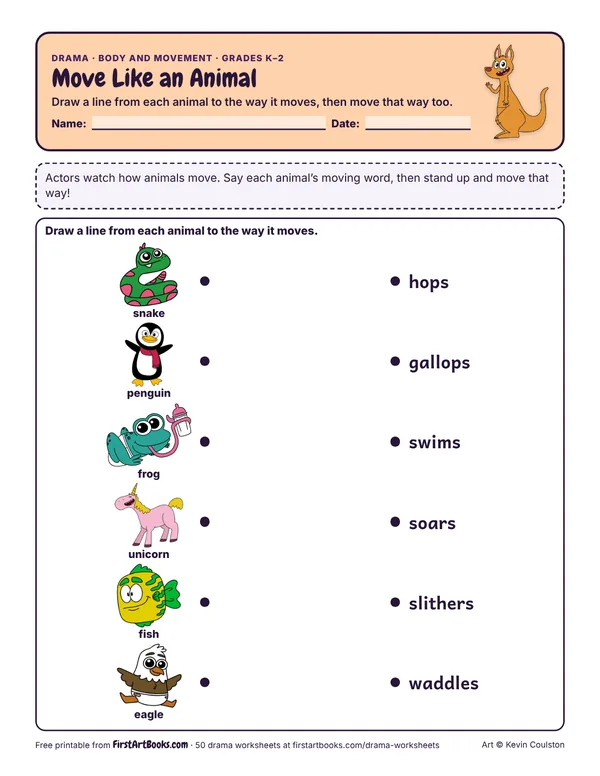
Draw a line from each animal to the way it moves, then move that way too.
Print this sheet (PDF)Teacher notes and tips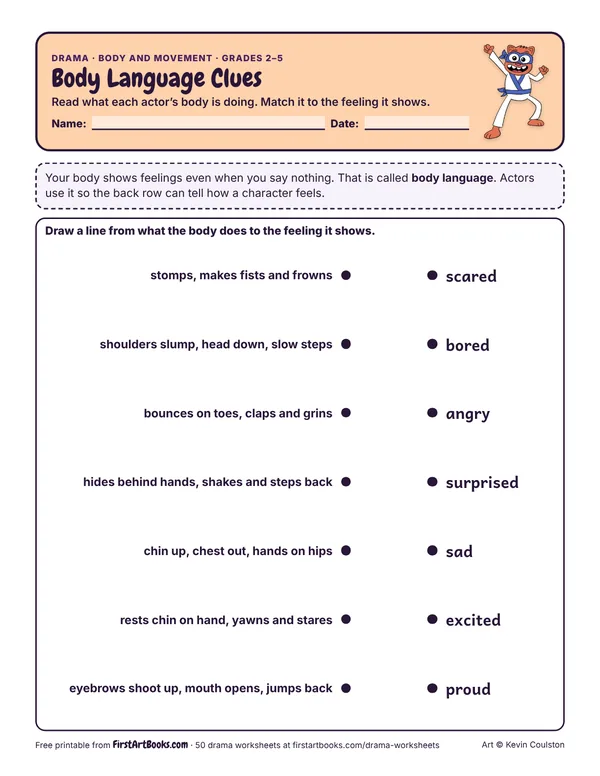
Read what each actor’s body is doing. Match it to the feeling it shows.
Print this sheet (PDF)Teacher notes and tips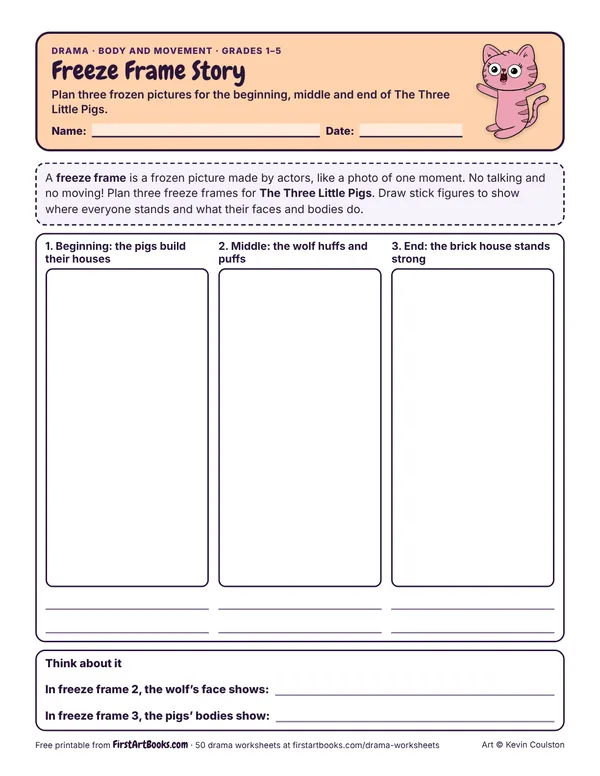
Plan three frozen pictures for the beginning, middle and end of The Three Little Pigs.
Print this sheet (PDF)Teacher notes and tips

Draw and act out feeling faces, play feelings charades, put feeling words in order from small to big, match lines to feelings and find the clues that show how a character feels.
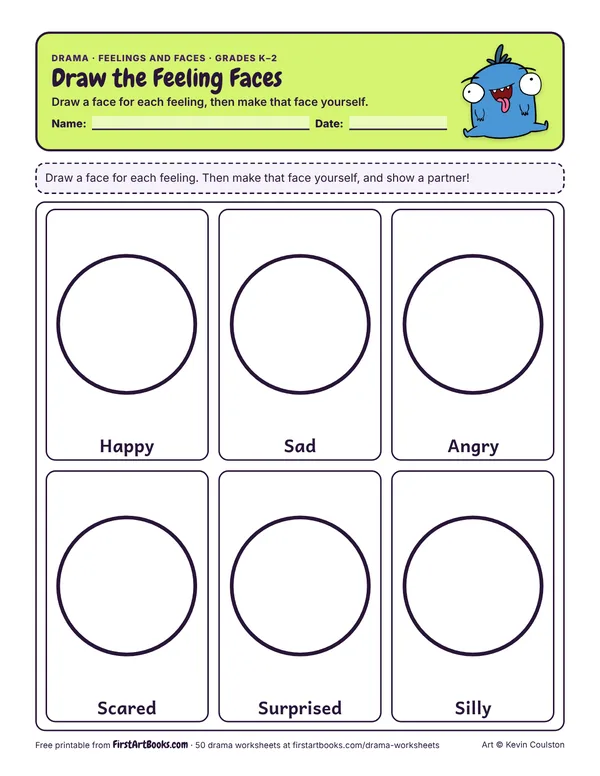
Draw a face for each feeling, then make that face yourself.
Print this sheet (PDF)Teacher notes and tips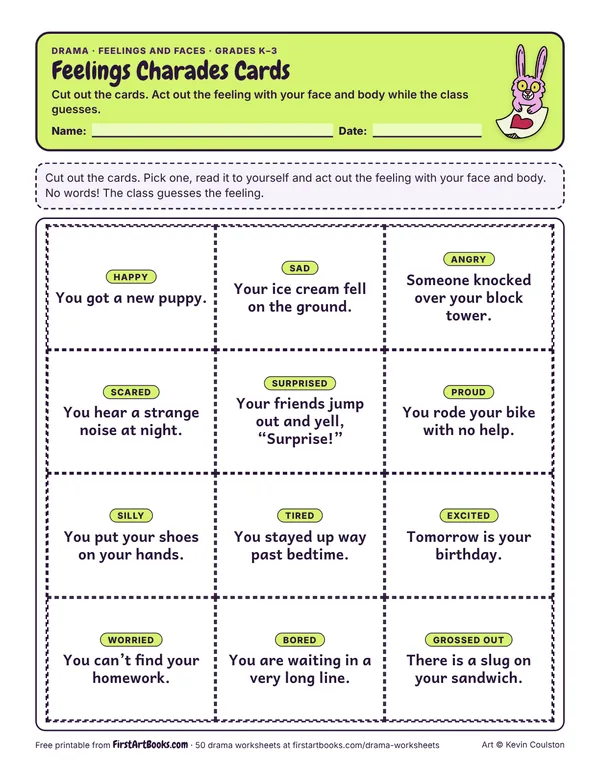
Cut out the cards. Act out the feeling with your face and body while the class guesses.
Print this sheet (PDF)Teacher notes and tips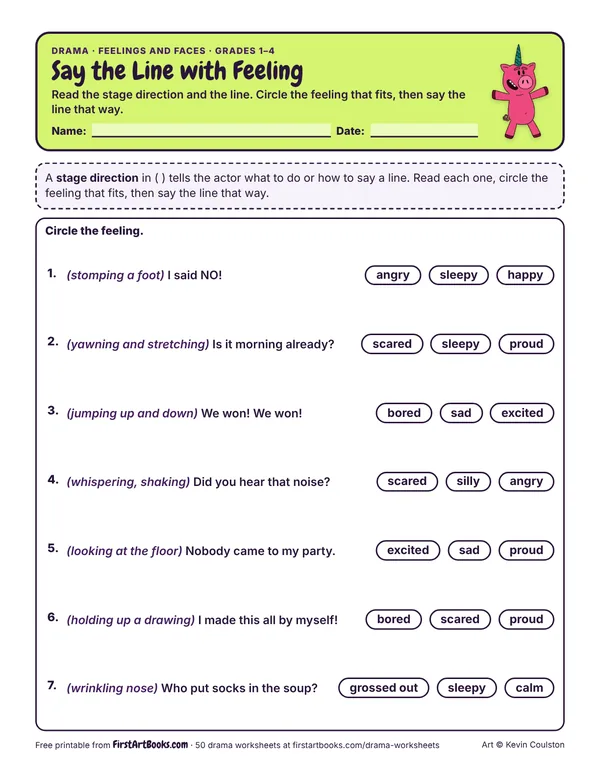
Read the stage direction and the line. Circle the feeling that fits, then say the line that way.
Print this sheet (PDF)Teacher notes and tips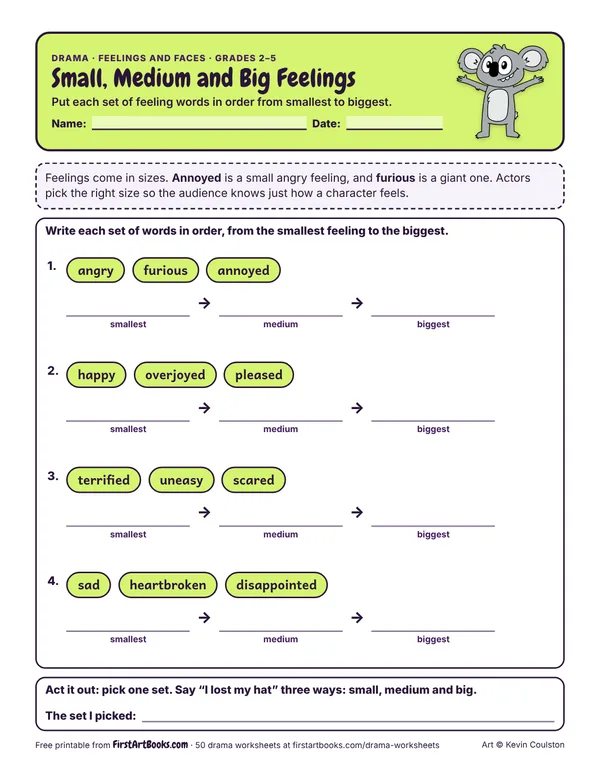
Put each set of feeling words in order from smallest to biggest.
Print this sheet (PDF)Teacher notes and tips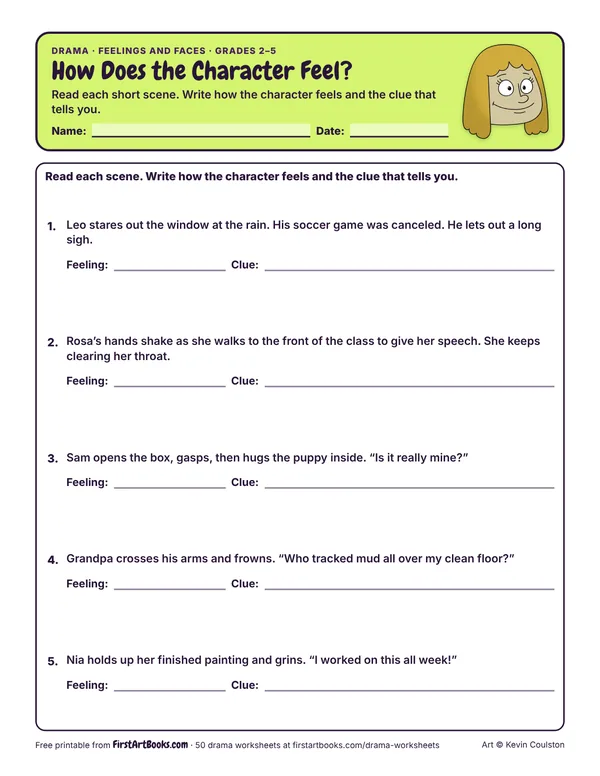
Read each short scene. Write how the character feels and the clue that tells you.
Print this sheet (PDF)Teacher notes and tips

Invent a character, sort inside and outside traits, interview a character in the hot seat, design a costume and give each character a walk and a voice.
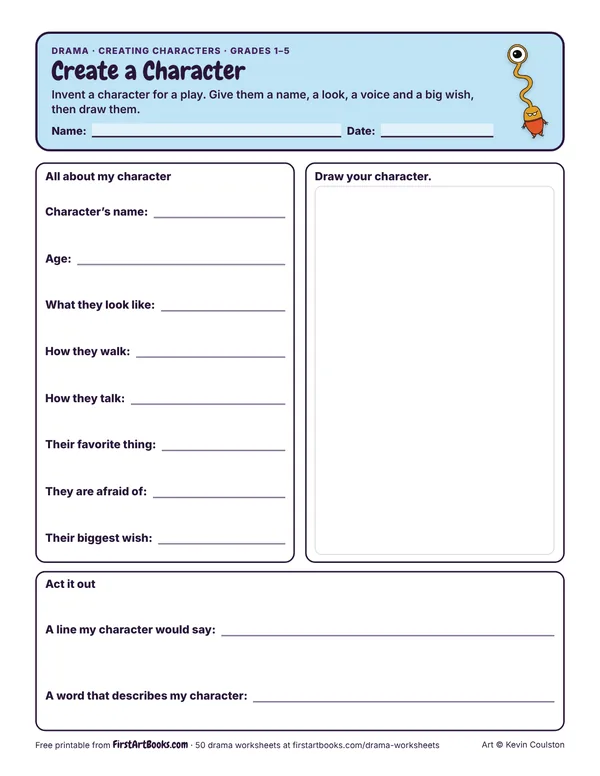
Invent a character for a play. Give them a name, a look, a voice and a big wish, then draw them.
Print this sheet (PDF)Teacher notes and tips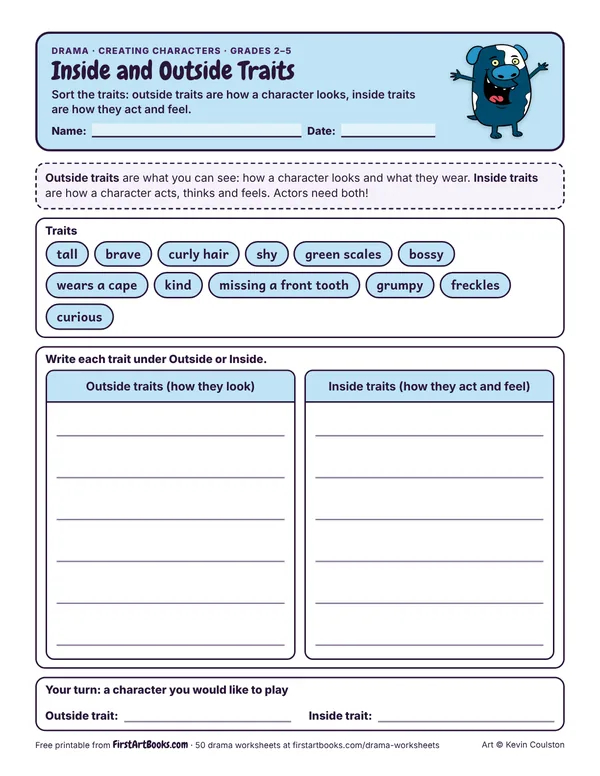
Sort the traits: outside traits are how a character looks, inside traits are how they act and feel.
Print this sheet (PDF)Teacher notes and tips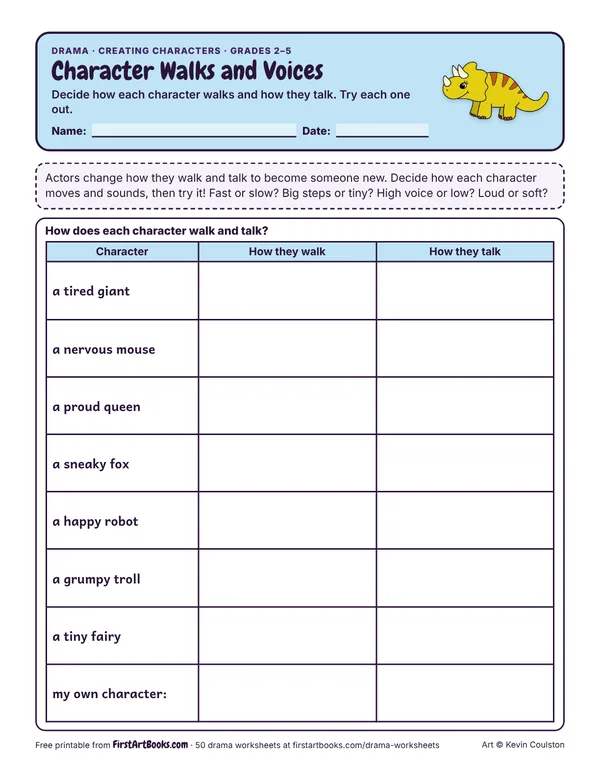
Decide how each character walks and how they talk. Try each one out.
Print this sheet (PDF)Teacher notes and tips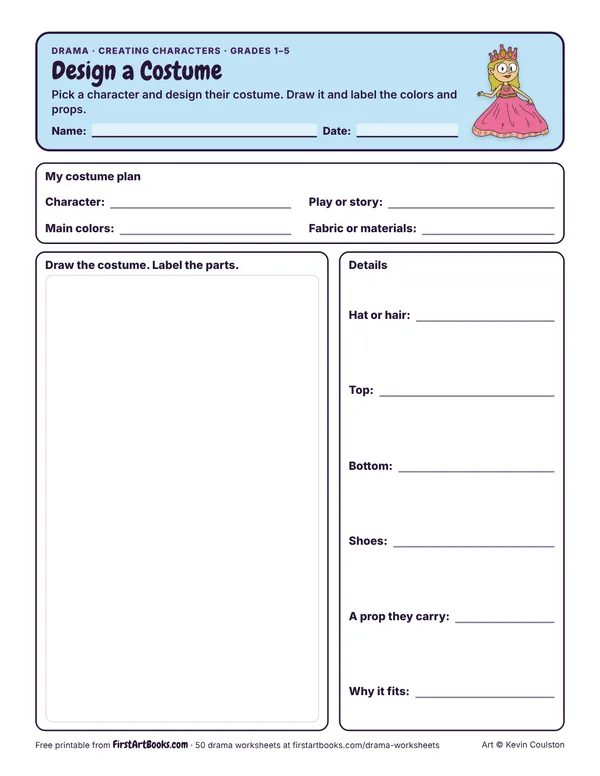
Pick a character and design their costume. Draw it and label the colors and props.
Print this sheet (PDF)Teacher notes and tips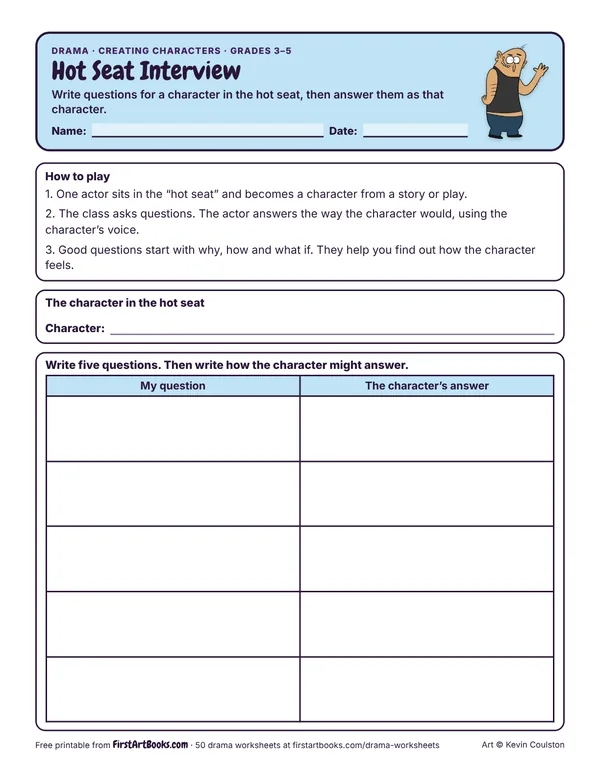
Write questions for a character in the hot seat, then answer them as that character.
Print this sheet (PDF)Teacher notes and tips

Learn the parts of a script, sort dialogue from stage directions, turn a story into a script, plan a play on a storyboard and write a short scene of your own.
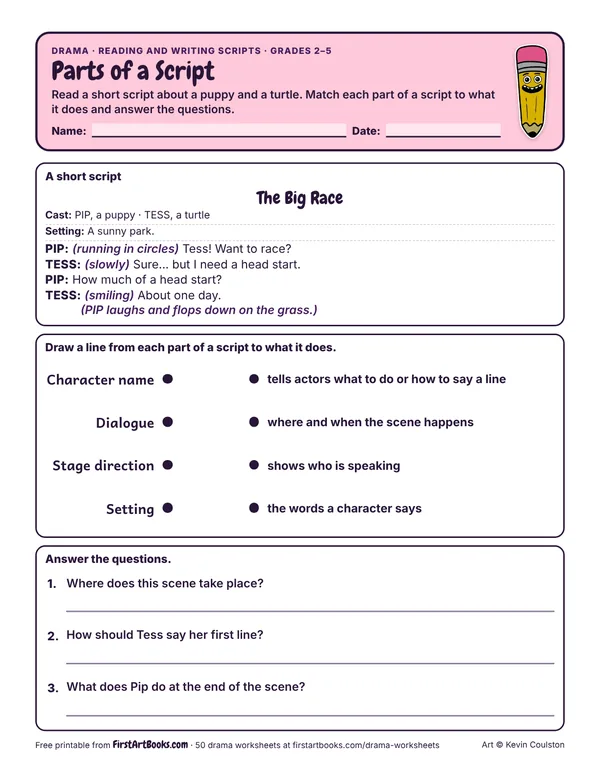
Read a short script about a puppy and a turtle. Match each part of a script to what it does and answer the questions.
Print this sheet (PDF)Teacher notes and tips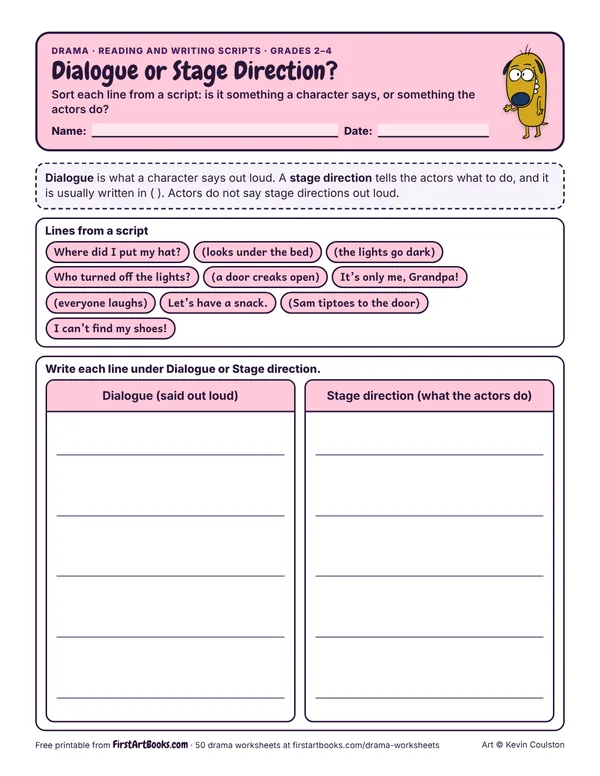
Sort each line from a script: is it something a character says, or something the actors do?
Print this sheet (PDF)Teacher notes and tips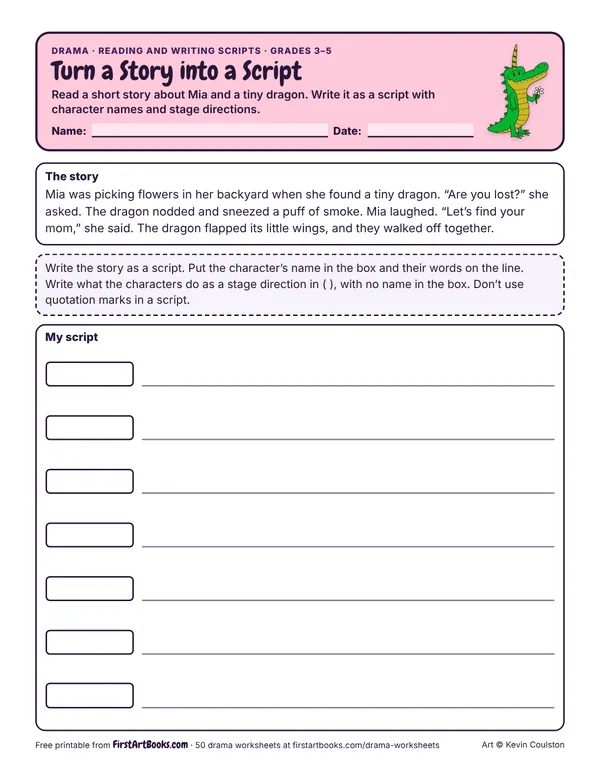
Read a short story about Mia and a tiny dragon. Write it as a script with character names and stage directions.
Print this sheet (PDF)Teacher notes and tips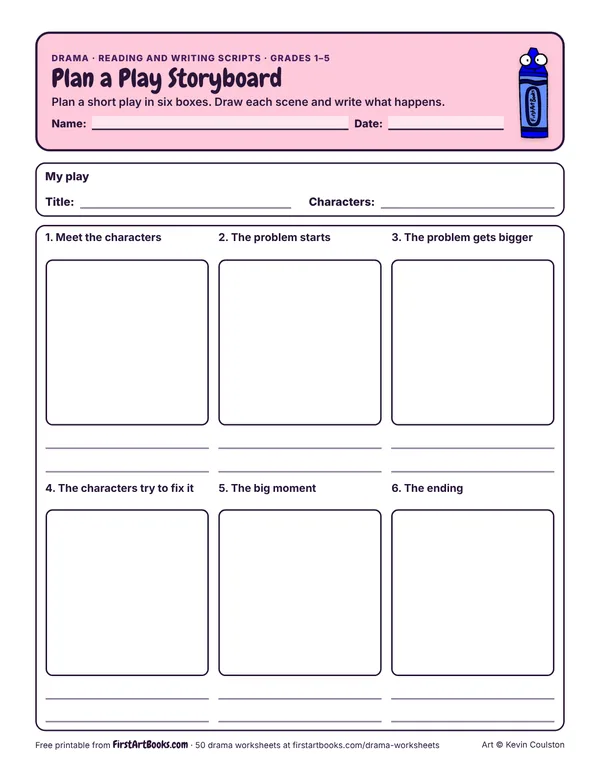
Plan a short play in six boxes. Draw each scene and write what happens.
Print this sheet (PDF)Teacher notes and tips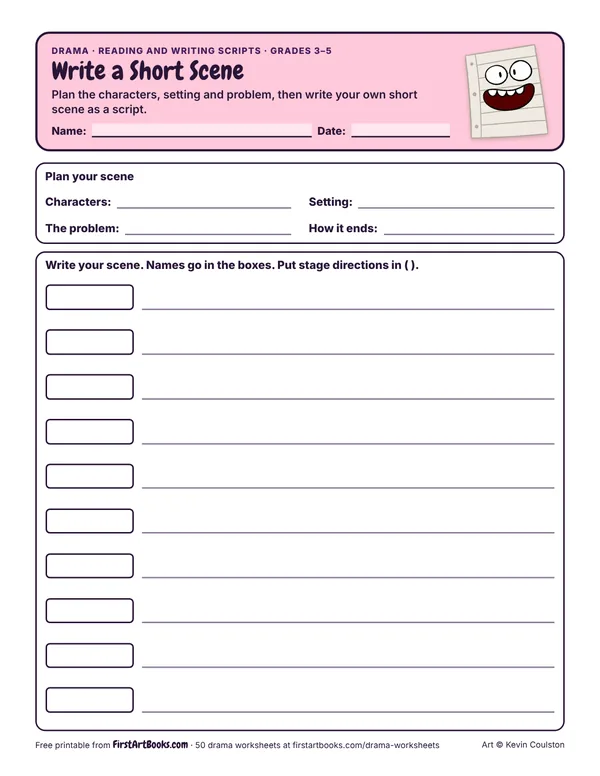
Plan the characters, setting and problem, then write your own short scene as a script.
Print this sheet (PDF)Teacher notes and tips

Five short, original reader’s theater scripts, from a three-part snail race for kindergarten to a five-part cookie mystery for 5th grade, each with questions to answer after the show.
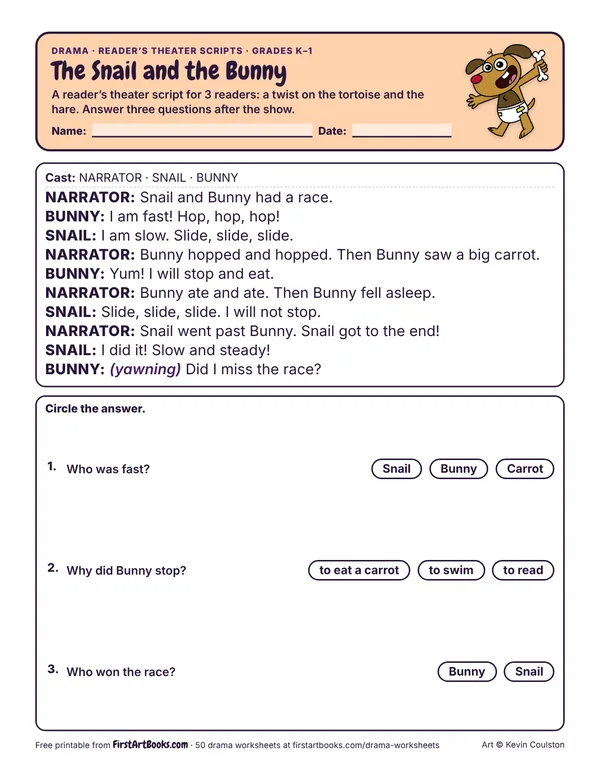
A reader’s theater script for 3 readers: a twist on the tortoise and the hare. Answer three questions after the show.
Print this sheet (PDF)Teacher notes and tips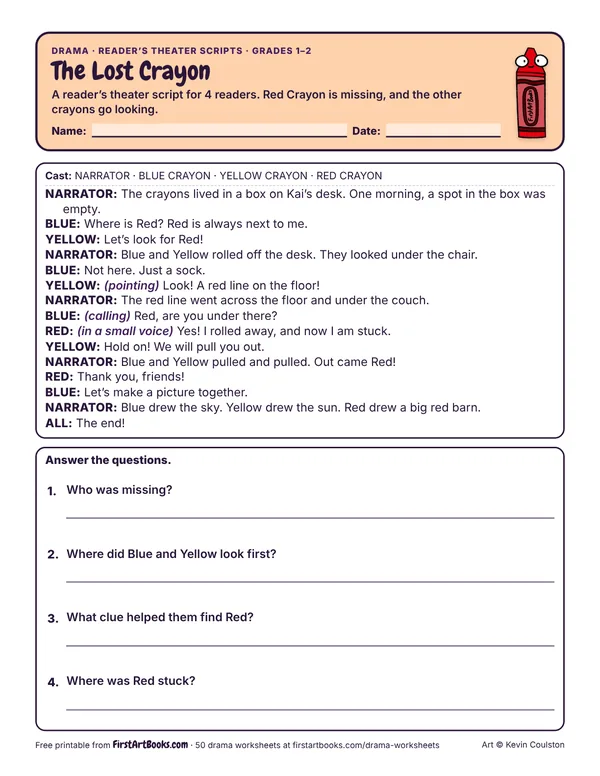
A reader’s theater script for 4 readers. Red Crayon is missing, and the other crayons go looking.
Print this sheet (PDF)Teacher notes and tips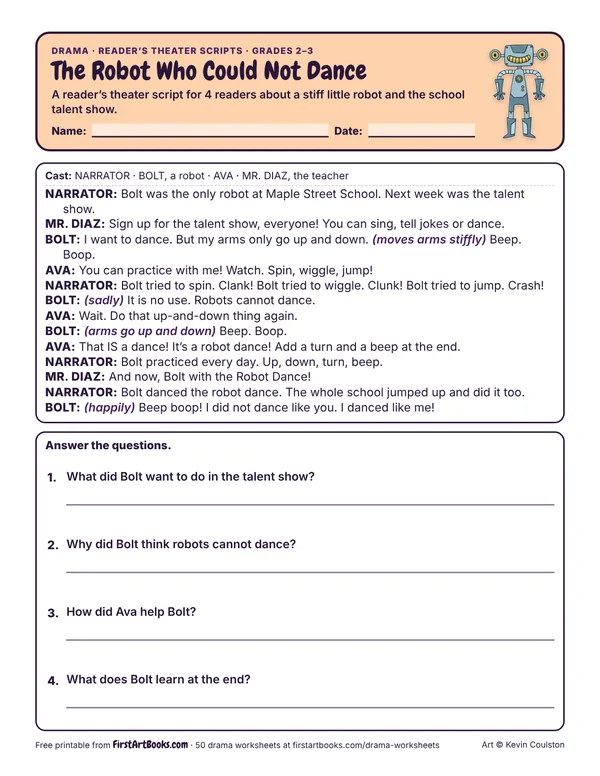
A reader’s theater script for 4 readers about a stiff little robot and the school talent show.
Print this sheet (PDF)Teacher notes and tips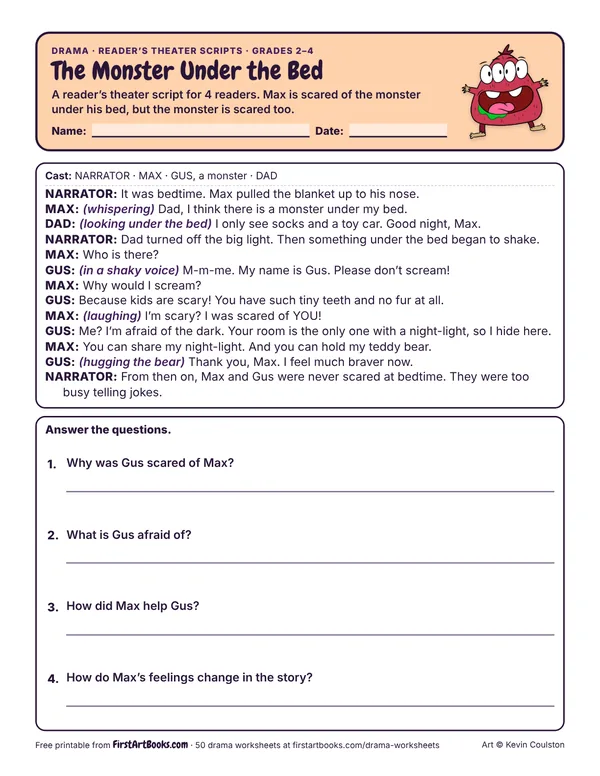
A reader’s theater script for 4 readers. Max is scared of the monster under his bed, but the monster is scared too.
Print this sheet (PDF)Teacher notes and tips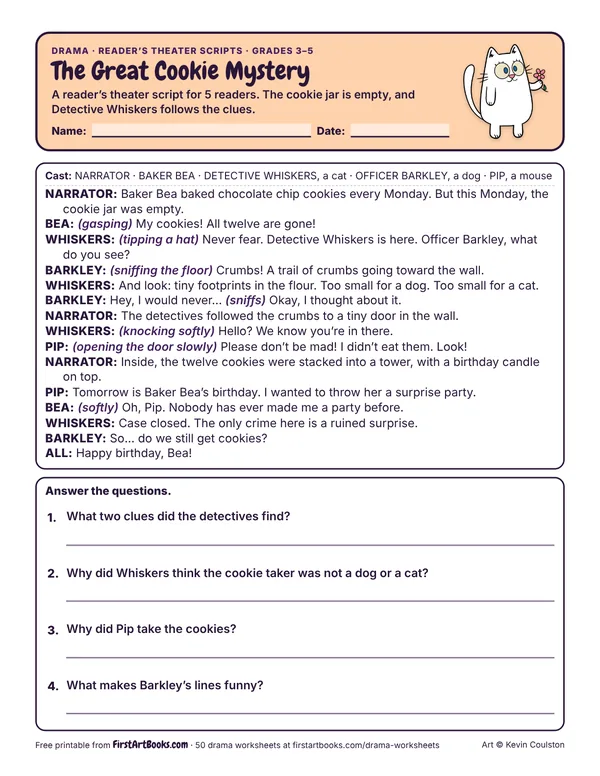
A reader’s theater script for 5 readers. The cookie jar is empty, and Detective Whiskers follows the clues.
Print this sheet (PDF)Teacher notes and tips

Warm-up game cards, who-what-where improv cards, a yes-and story builder, theater bingo and a theater word search.
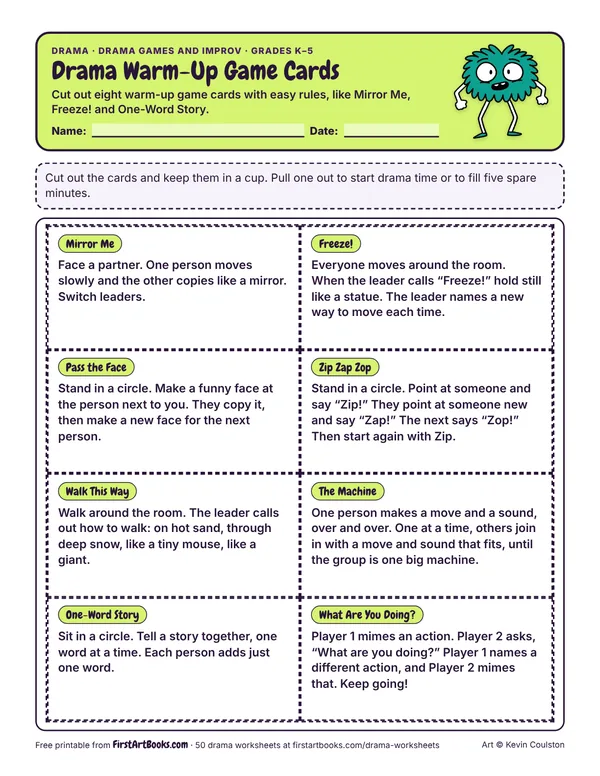
Cut out eight warm-up game cards with easy rules, like Mirror Me, Freeze! and One-Word Story.
Print this sheet (PDF)Teacher notes and tips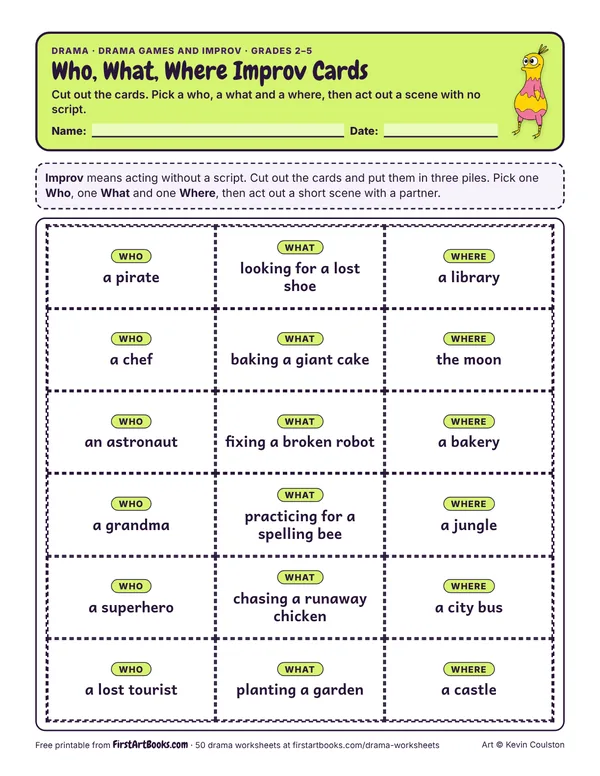
Cut out the cards. Pick a who, a what and a where, then act out a scene with no script.
Print this sheet (PDF)Teacher notes and tips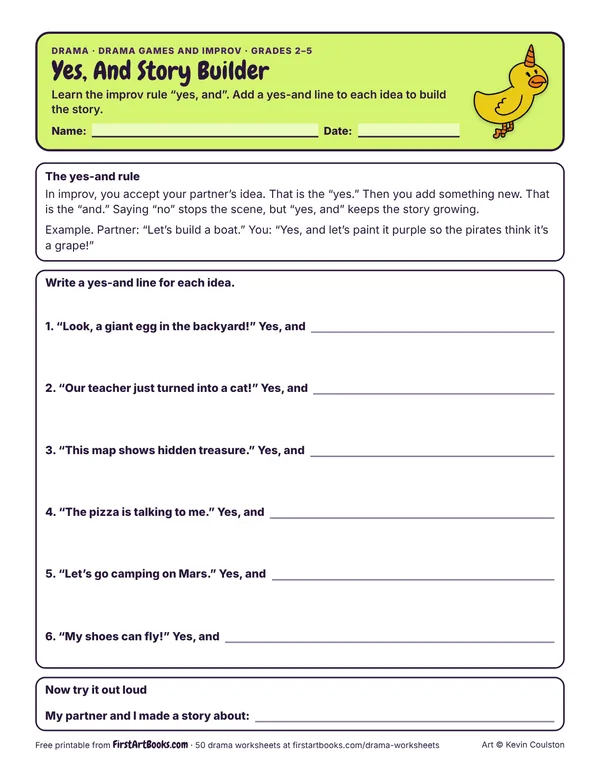
Learn the improv rule “yes, and”. Add a yes-and line to each idea to build the story.
Print this sheet (PDF)Teacher notes and tips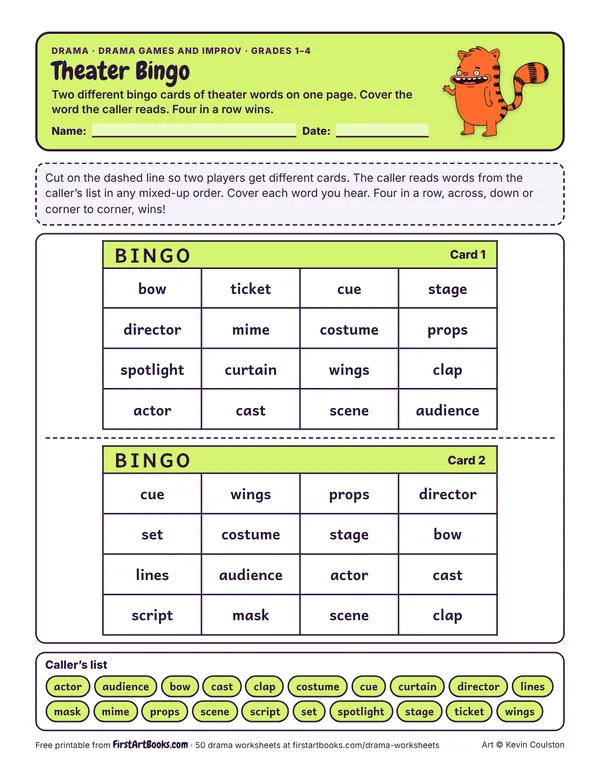
Two different bingo cards of theater words on one page. Cover the word the caller reads. Four in a row wins.
Print this sheet (PDF)Teacher notes and tips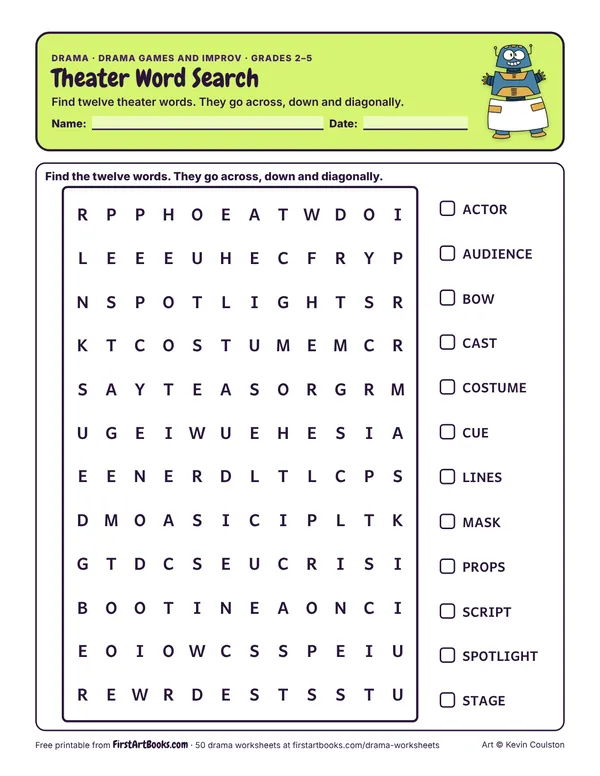
Find twelve theater words. They go across, down and diagonally.
Print this sheet (PDF)Teacher notes and tips
Learn good audience manners, design a set, make a poster for your show, look back on your performance and earn a drama star certificate.
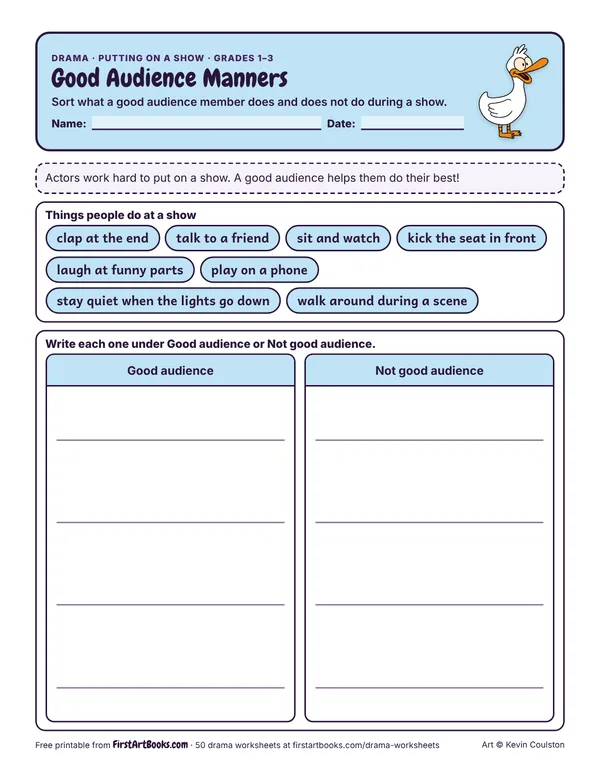
Sort what a good audience member does and does not do during a show.
Print this sheet (PDF)Teacher notes and tips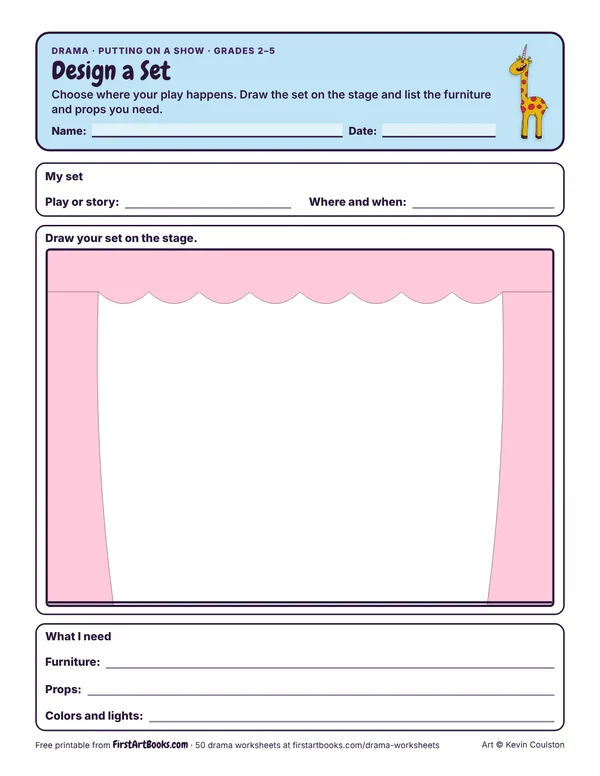
Choose where your play happens. Draw the set on the stage and list the furniture and props you need.
Print this sheet (PDF)Teacher notes and tips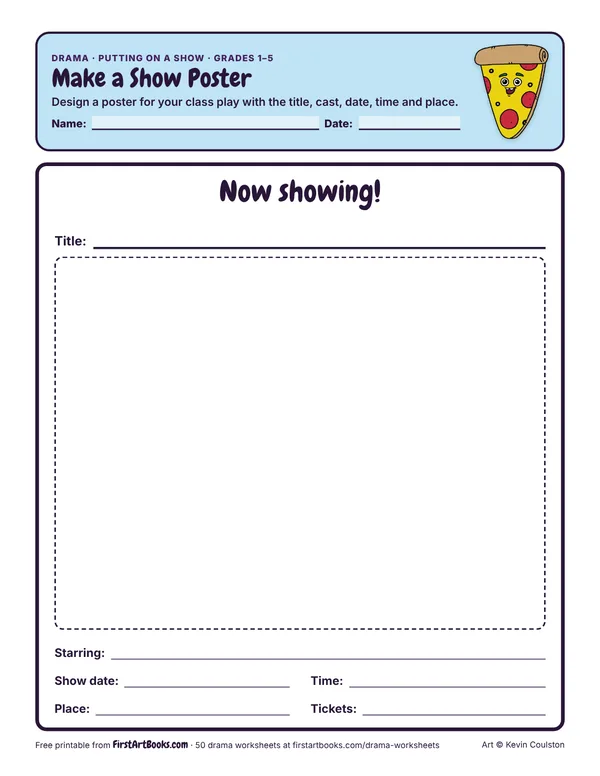
Design a poster for your class play with the title, cast, date, time and place.
Print this sheet (PDF)Teacher notes and tips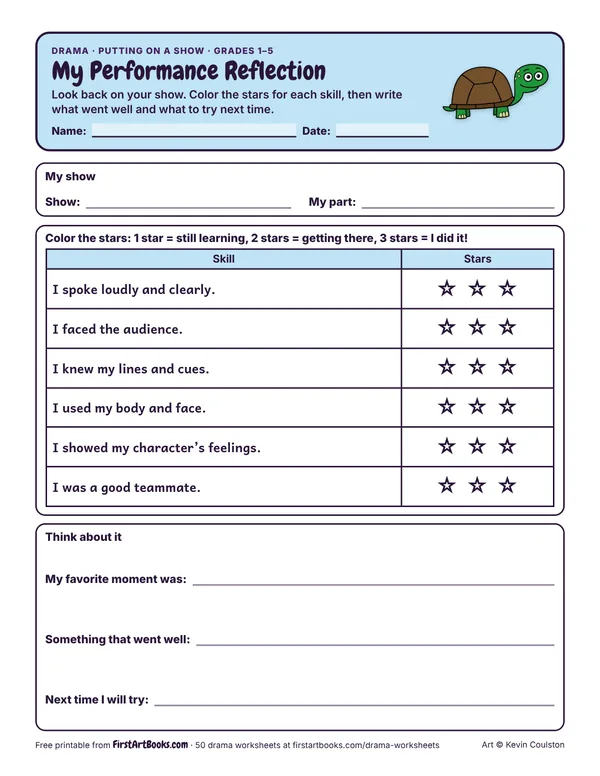
Look back on your show. Color the stars for each skill, then write what went well and what to try next time.
Print this sheet (PDF)Teacher notes and tips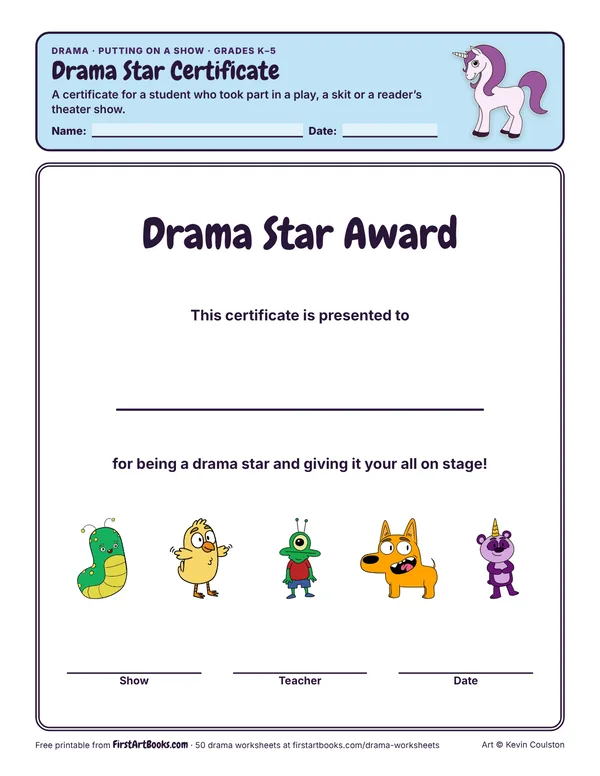
A certificate for a student who took part in a play, a skit or a reader’s theater show.
Print this sheet (PDF)Teacher notes and tips

Each topic has a pack of its five sheets and their answer keys: theater words, stage directions, using your voice, body and movement, feelings and faces, creating characters, scripts, reader’s theater, drama games, putting on a show.
The characters on these worksheets come from Kevin Coulston’s drawing books. Keep one in the classroom for kids who finish early: the How to Draw books build a drawing one small step at a time.
Yes. All 50 worksheets, the 29 answer keys and the topic packs are free to print for the classroom, homeschool, drama club and summer camp. Print one sheet, a topic pack of five or the whole set.
Kindergarten to 5th grade. Each card shows the grades it suits best, and the grade buttons hide the rest. Younger kids start with loud and soft voices, feeling faces, pantomime and the short reader’s theater scripts; older kids add stage directions, script writing and the longer scripts.
No. Every sheet works in a regular classroom with the desks pushed back. The stage sheets teach the nine stage areas on paper first, and the game cards explain each game in two or three sentences. Every sheet with right answers has an answer key page right after it.
Yes. All five scripts are original and free to perform in class, at an assembly or for families. They run from three parts for kindergarten and 1st grade to five parts for 3rd to 5th grade, and each one has questions to answer after the show.
Stage left is the actor’s left while they face the audience, so it is on the audience’s right. The Stage Directions Chart shows all nine areas, and Stage Left or Stage Right practices the difference.
The topics are grouped by kind, so mix them. Start with a warm-up game and the theater words, then voice, body and feelings, then characters and scripts. End a unit with a reader’s theater script, the reflection page and the Drama Star certificate.
Yes. Nothing depends on color, and the cut-out cards print well on plain paper or card stock. Sheets are US Letter and also print on A4.
All sheets are US Letter, print well in black and white, and are free for home and classroom use. The reader’s theater scripts are free to perform. More for teachers in the teacher resources library.
12 printable pages: six step-by-step lessons, a grid activity, draw-and-write sheets and teacher notes, sent with your welcome email. After that, new classroom printables by email.