


Grades K–1
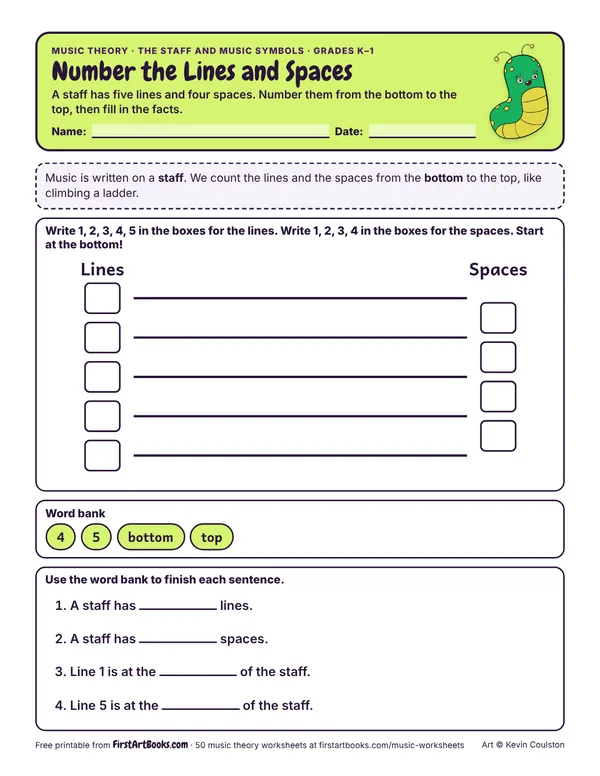
Number the Lines and Spaces
A staff has five lines and four spaces. Number them from the bottom to the top, then fill in the facts.
Print this sheet (PDF)Teacher notes and tips50 free worksheets for elementary music class, piano lessons and homeschool, in 10 topics: the staff, note values, rests, rhythm, treble clef notes, piano keys and bass clef, dynamics and tempo, instrument families, composers and listening. Real music notation, 44 answer keys and one of Kevin Coulston’s cartoon characters on every page.
Number the five lines and four spaces, tell line notes from space notes, label the parts of a line of music, match the first music symbols and count the measures.
A staff has five lines and four spaces. Number them from the bottom to the top, then fill in the facts.
Print this sheet (PDF)Teacher notes and tips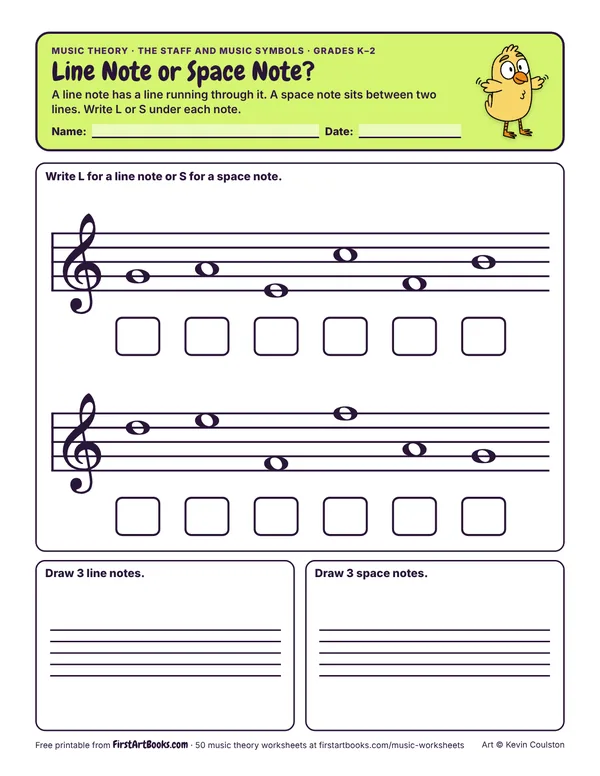
A line note has a line running through it. A space note sits between two lines. Write L or S under each note.
Print this sheet (PDF)Teacher notes and tips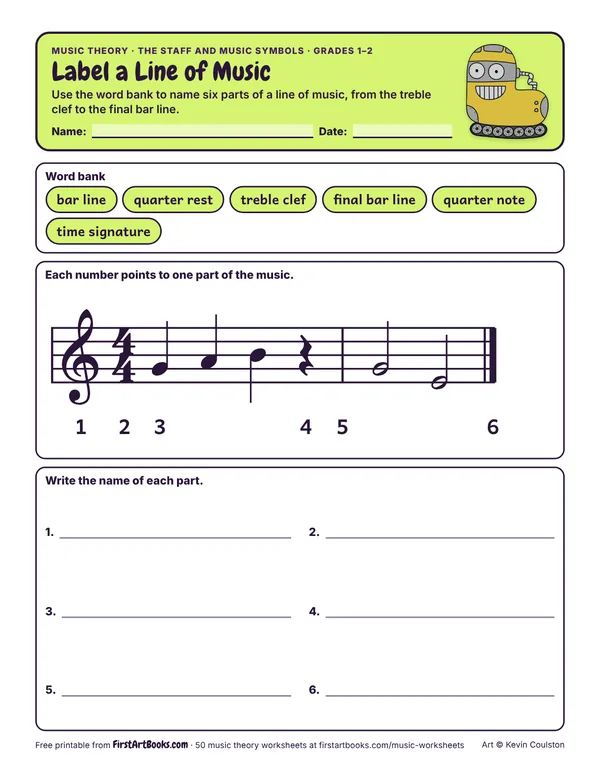
Use the word bank to name six parts of a line of music, from the treble clef to the final bar line.
Print this sheet (PDF)Teacher notes and tips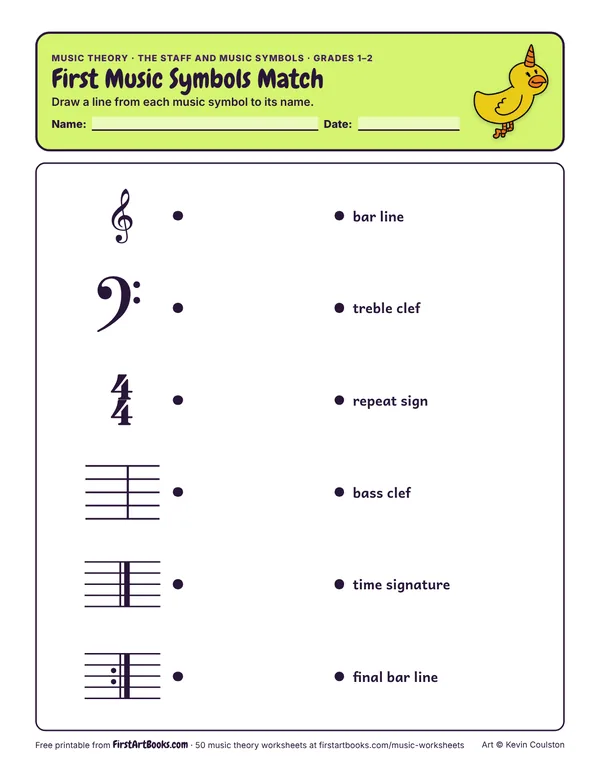
Draw a line from each music symbol to its name.
Print this sheet (PDF)Teacher notes and tips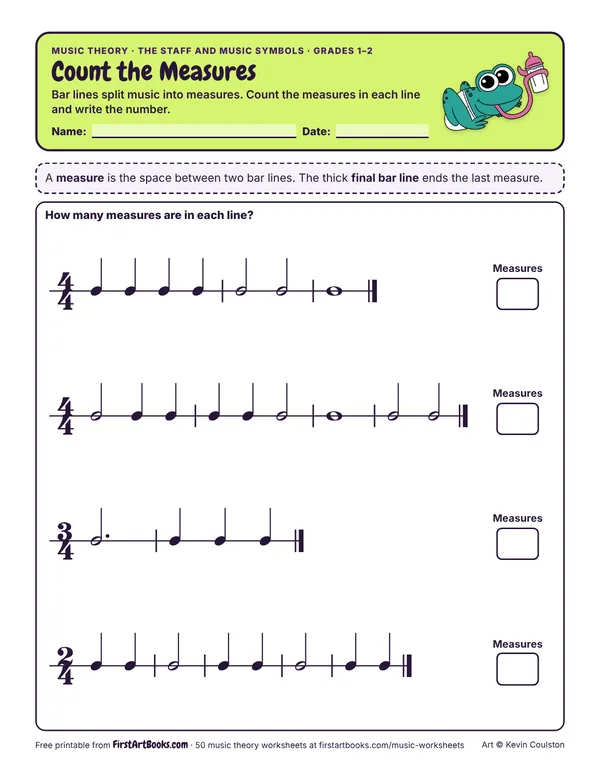
Bar lines split music into measures. Count the measures in each line and write the number.
Print this sheet (PDF)Teacher notes and tips

Meet the whole, half, quarter and eighth notes, match each note to its name, count how many beats each one gets, add notes together and fill in the note value tree.
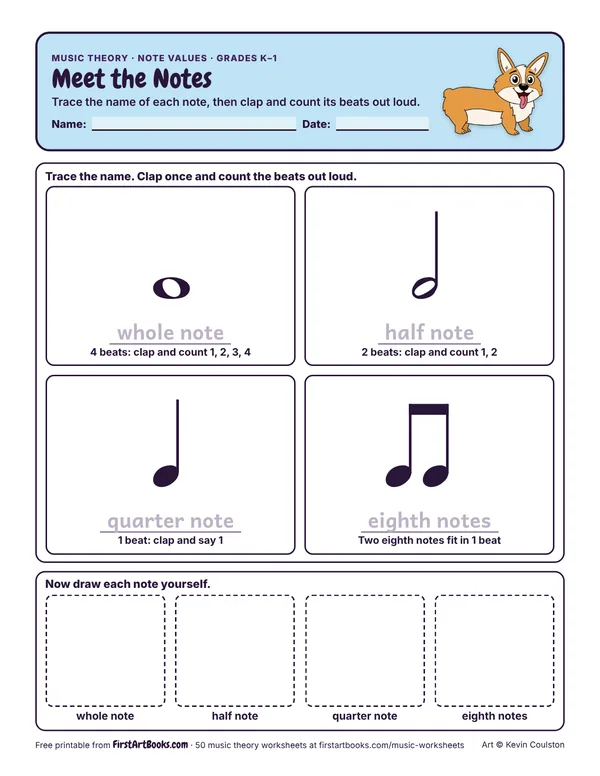
Trace the name of each note, then clap and count its beats out loud.
Print this sheet (PDF)Teacher notes and tips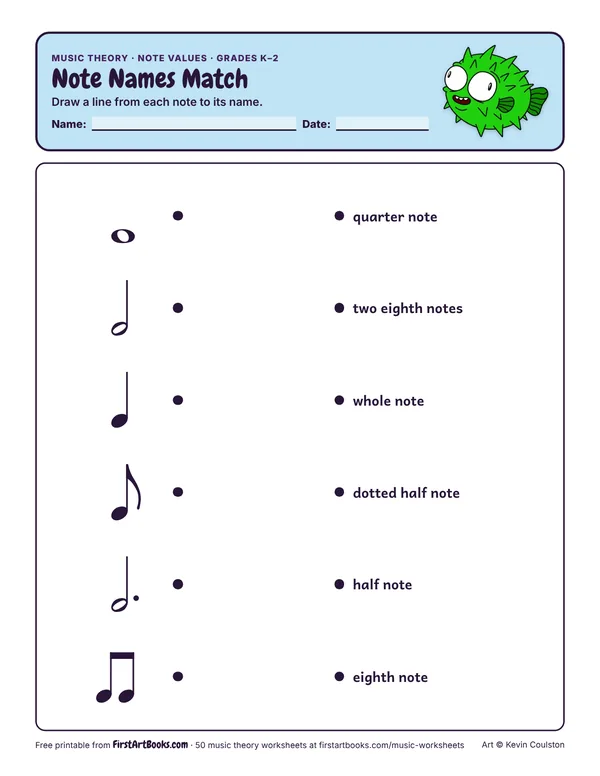
Draw a line from each note to its name.
Print this sheet (PDF)Teacher notes and tips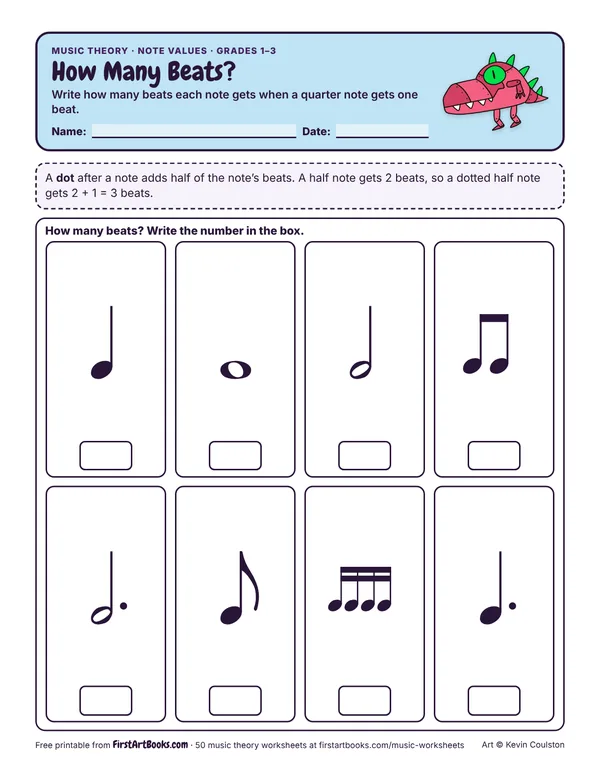
Write how many beats each note gets when a quarter note gets one beat.
Print this sheet (PDF)Teacher notes and tips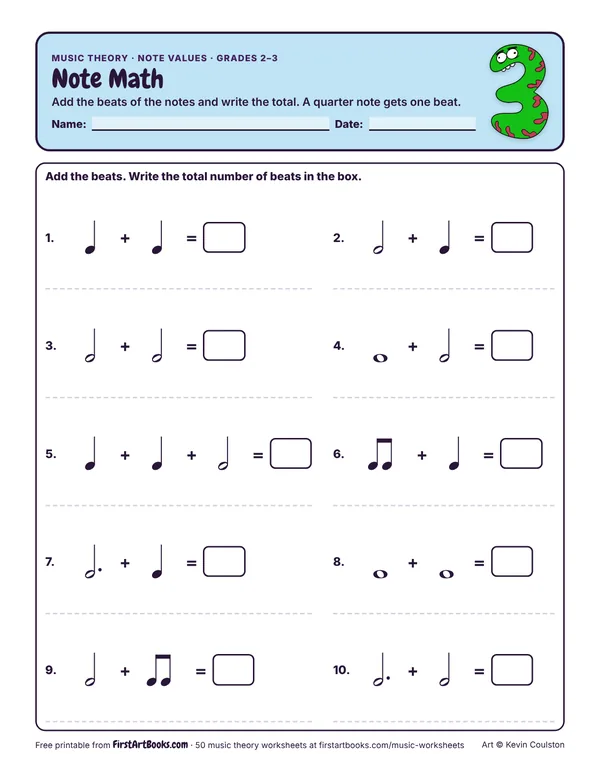
Add the beats of the notes and write the total. A quarter note gets one beat.
Print this sheet (PDF)Teacher notes and tips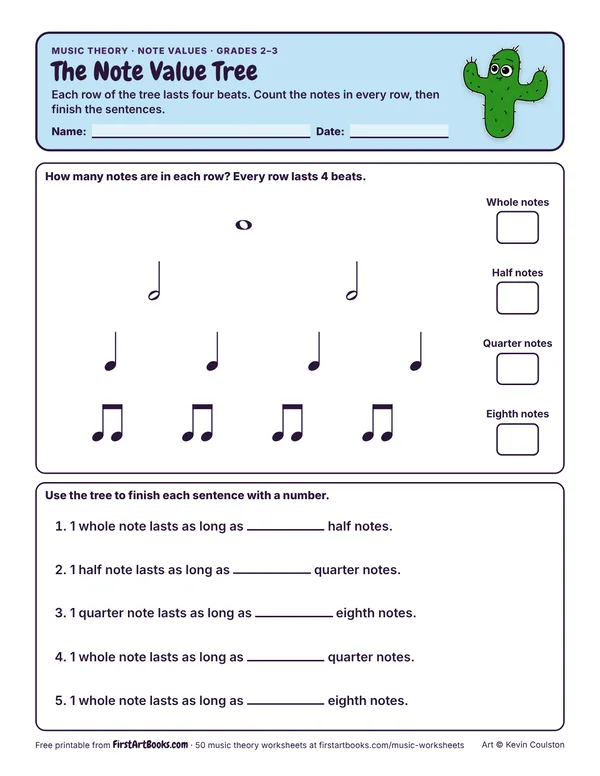
Each row of the tree lasts four beats. Count the notes in every row, then finish the sentences.
Print this sheet (PDF)Teacher notes and tips

Match each rest to its name, pair notes and rests that last the same time, count beats of silence, tell the whole rest from the half rest and add notes and rests.
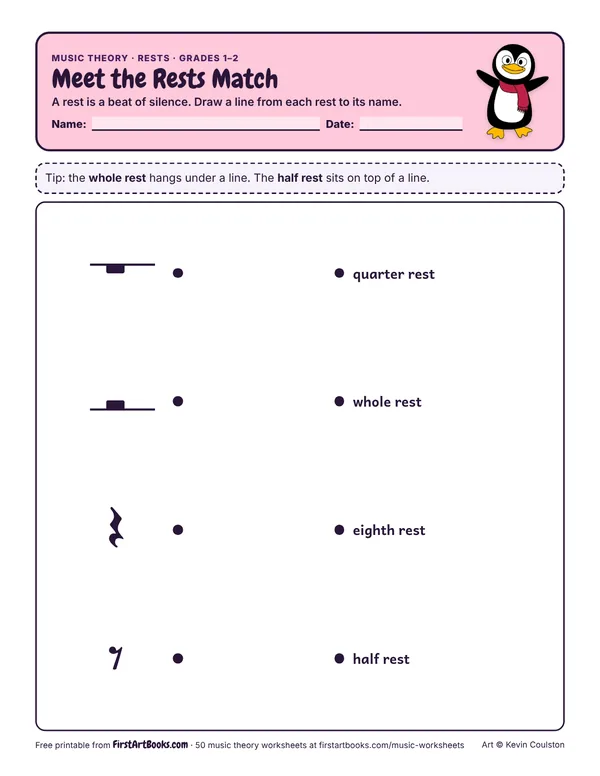
A rest is a beat of silence. Draw a line from each rest to its name.
Print this sheet (PDF)Teacher notes and tips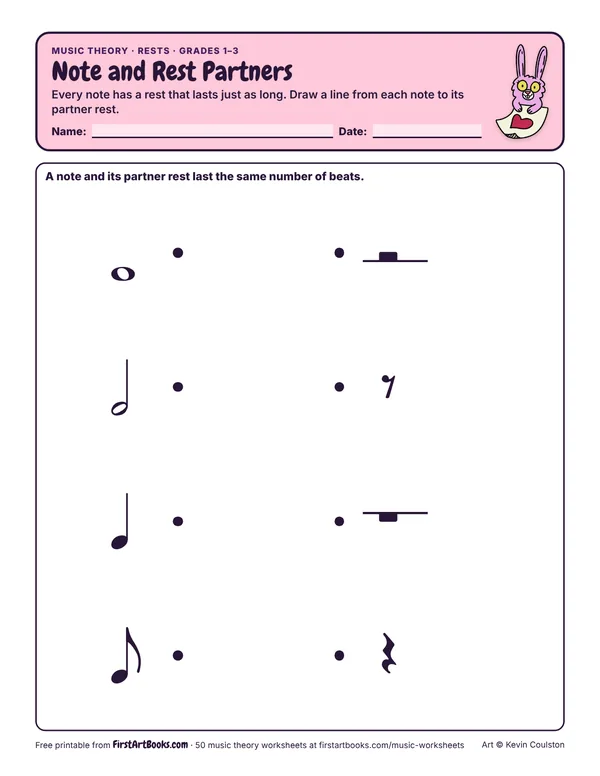
Every note has a rest that lasts just as long. Draw a line from each note to its partner rest.
Print this sheet (PDF)Teacher notes and tips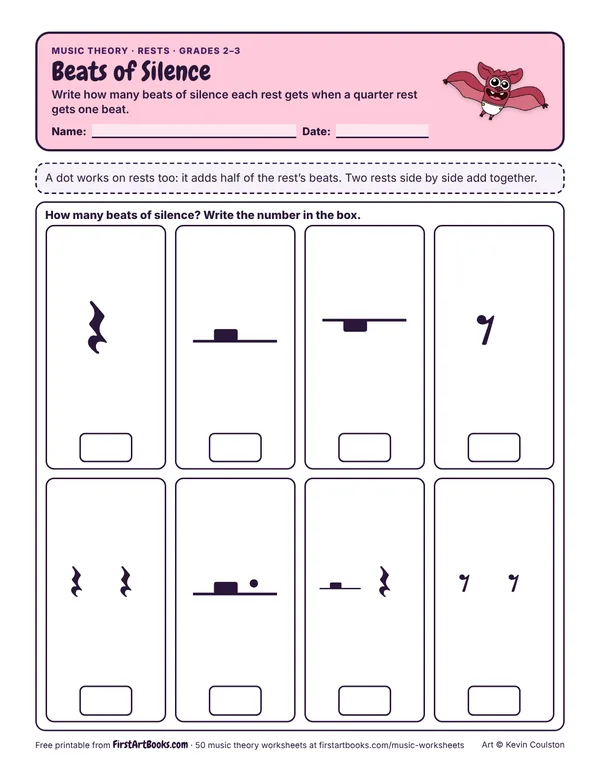
Write how many beats of silence each rest gets when a quarter rest gets one beat.
Print this sheet (PDF)Teacher notes and tips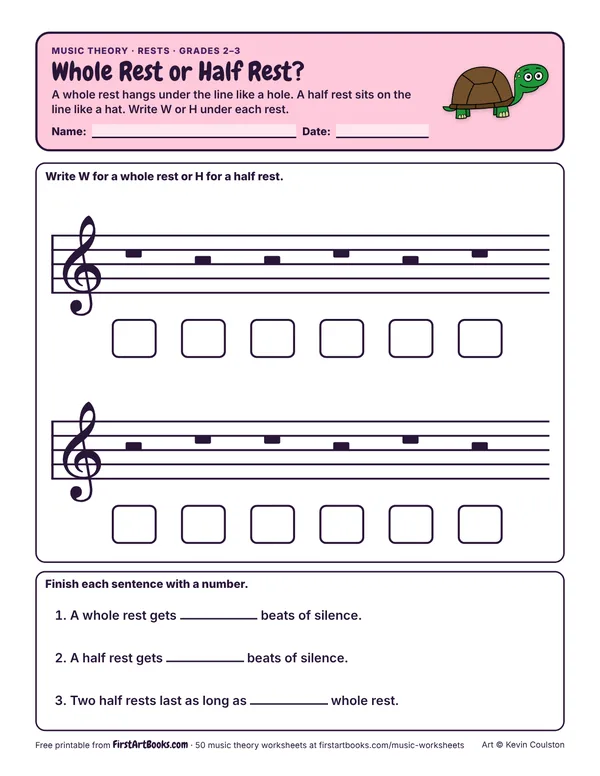
A whole rest hangs under the line like a hole. A half rest sits on the line like a hat. Write W or H under each rest.
Print this sheet (PDF)Teacher notes and tips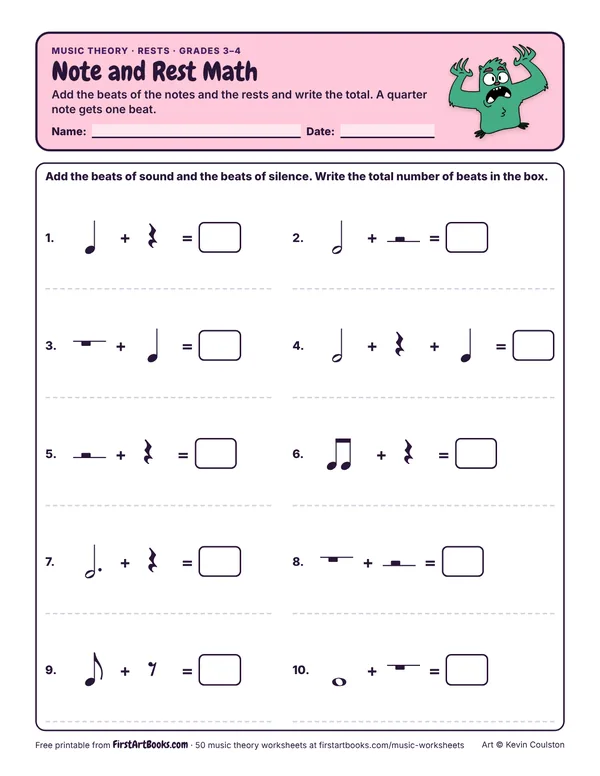
Add the beats of the notes and the rests and write the total. A quarter note gets one beat.
Print this sheet (PDF)Teacher notes and tips
Clap and say ta and ti-ti, write the counts under a rhythm, draw the missing bar lines, finish each measure with one note and work out the time signature.
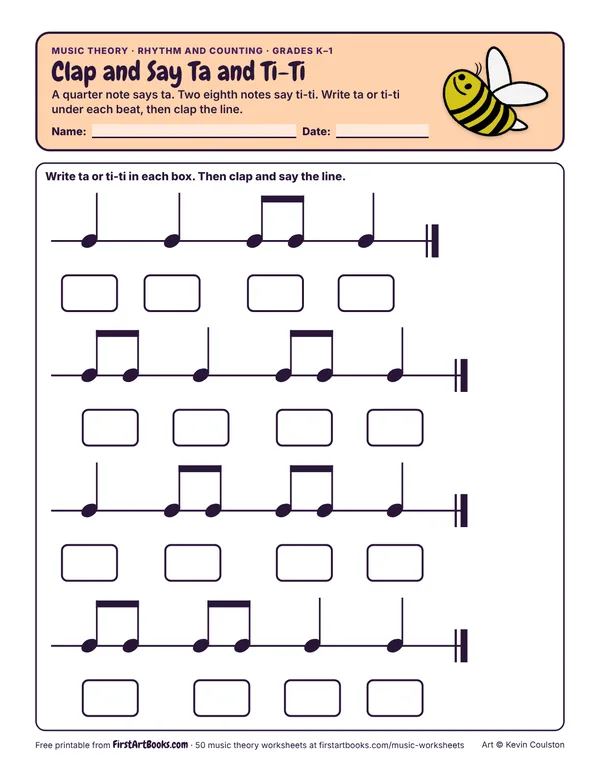
A quarter note says ta. Two eighth notes say ti-ti. Write ta or ti-ti under each beat, then clap the line.
Print this sheet (PDF)Teacher notes and tips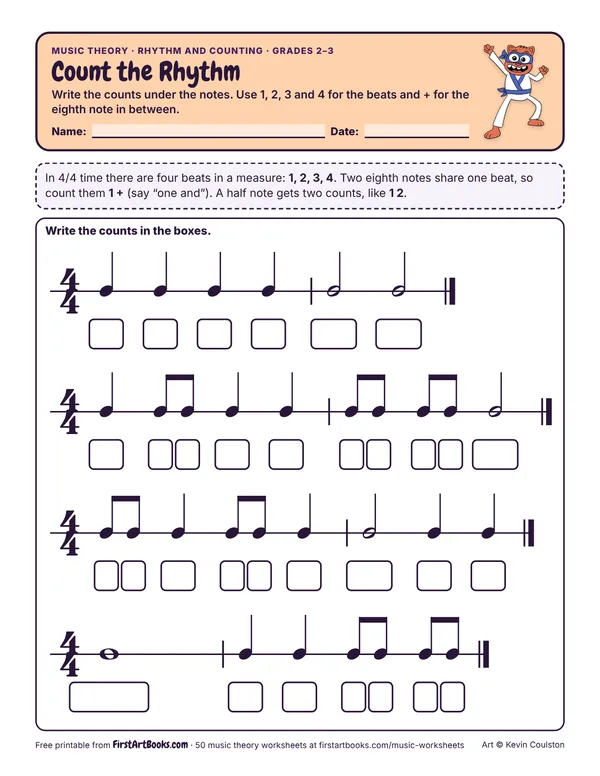
Write the counts under the notes. Use 1, 2, 3 and 4 for the beats and + for the eighth note in between.
Print this sheet (PDF)Teacher notes and tips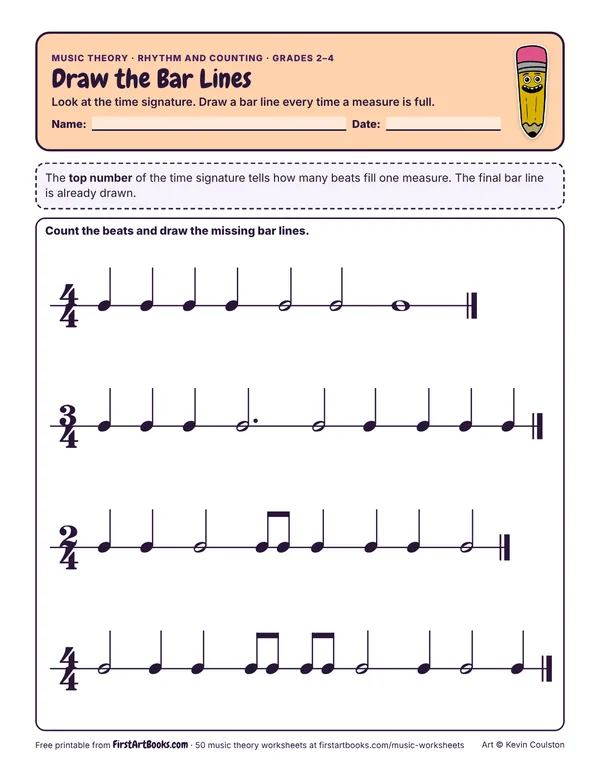
Look at the time signature. Draw a bar line every time a measure is full.
Print this sheet (PDF)Teacher notes and tips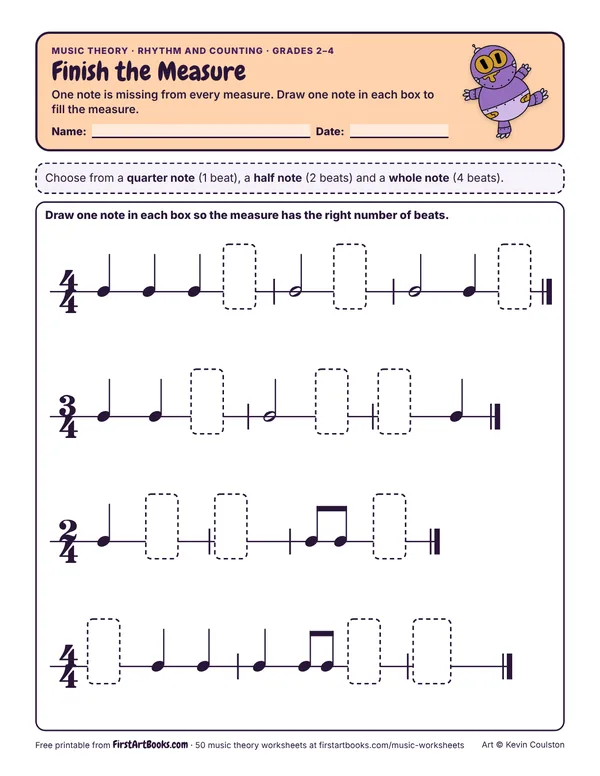
One note is missing from every measure. Draw one note in each box to fill the measure.
Print this sheet (PDF)Teacher notes and tips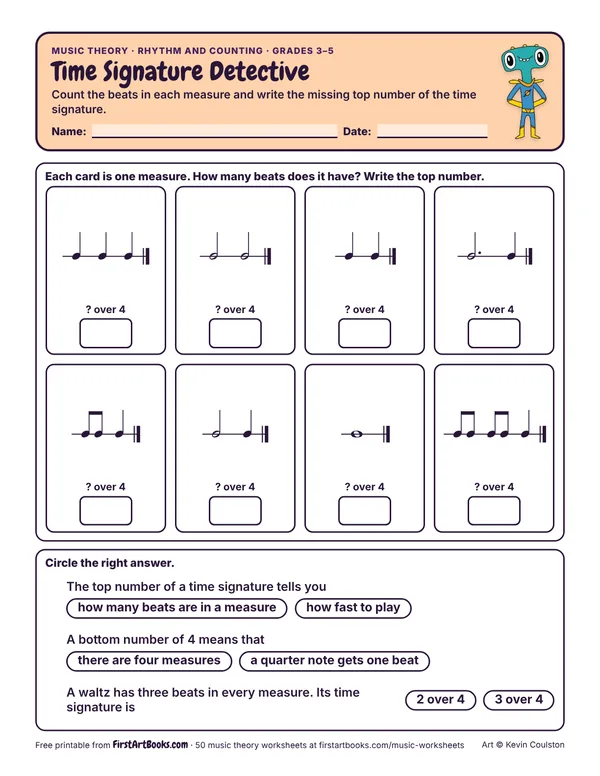
Count the beats in each measure and write the missing top number of the time signature.
Print this sheet (PDF)Teacher notes and tips

Name the line notes E G B D F and the space notes F A C E, name notes all over the staff, spell words with notes and draw the notes yourself.
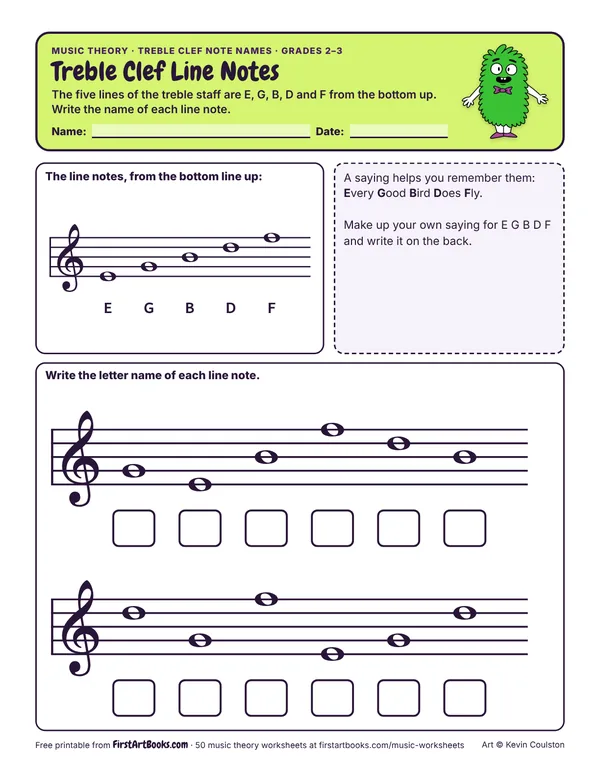
The five lines of the treble staff are E, G, B, D and F from the bottom up. Write the name of each line note.
Print this sheet (PDF)Teacher notes and tips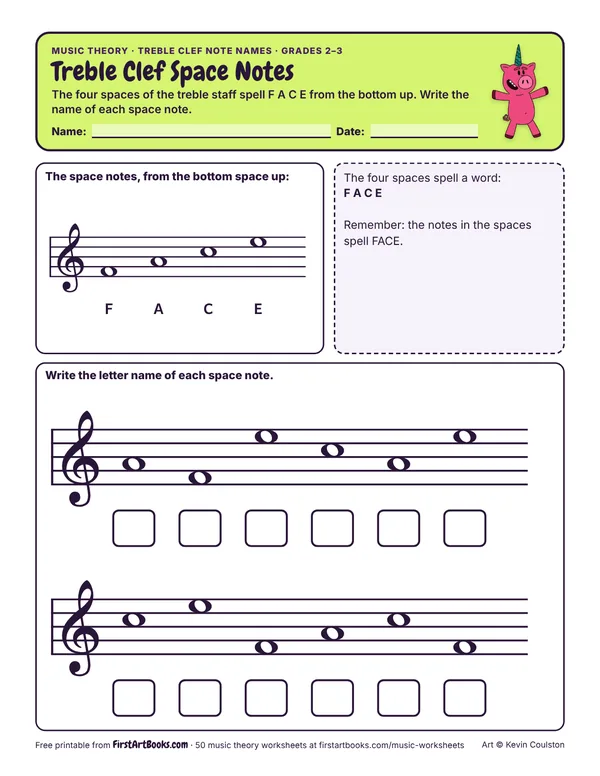
The four spaces of the treble staff spell F A C E from the bottom up. Write the name of each space note.
Print this sheet (PDF)Teacher notes and tips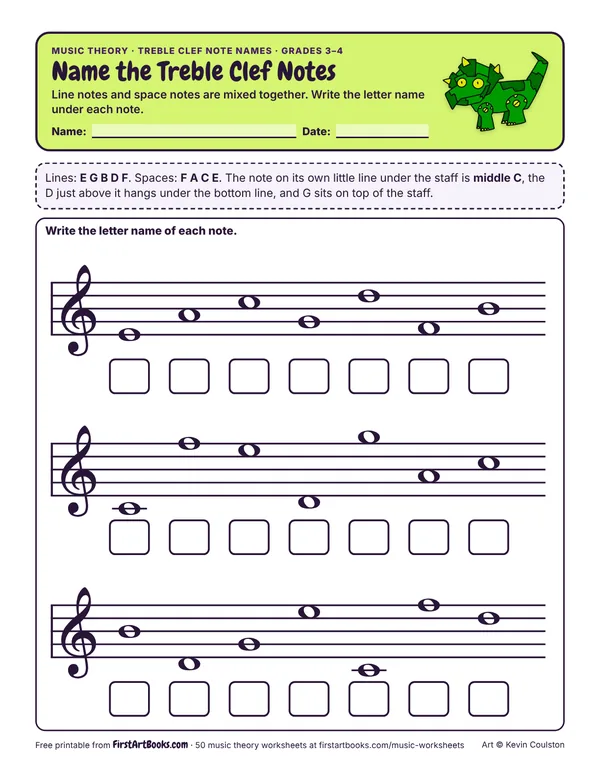
Line notes and space notes are mixed together. Write the letter name under each note.
Print this sheet (PDF)Teacher notes and tips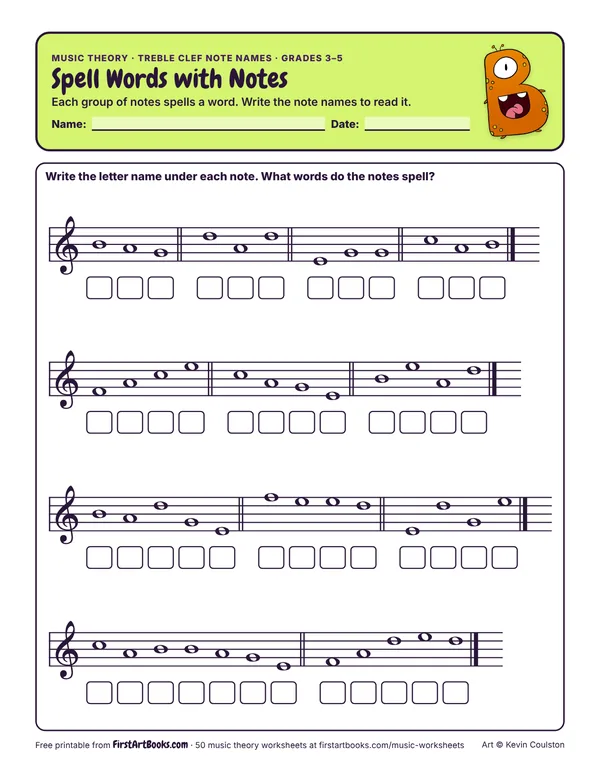
Each group of notes spells a word. Write the note names to read it.
Print this sheet (PDF)Teacher notes and tips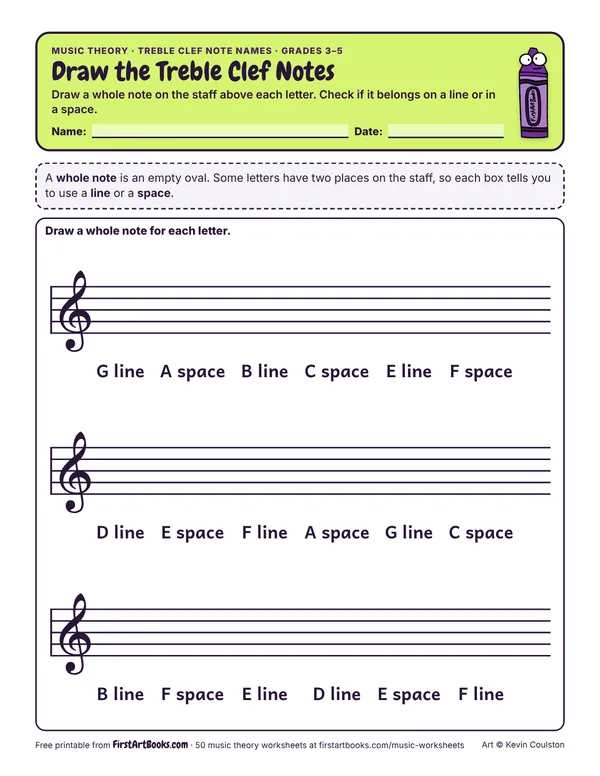
Draw a whole note on the staff above each letter. Check if it belongs on a line or in a space.
Print this sheet (PDF)Teacher notes and tips

Find every C with the groups of two and three black keys, name the white keys, then name the bass clef line notes G B D F A and space notes A C E G.
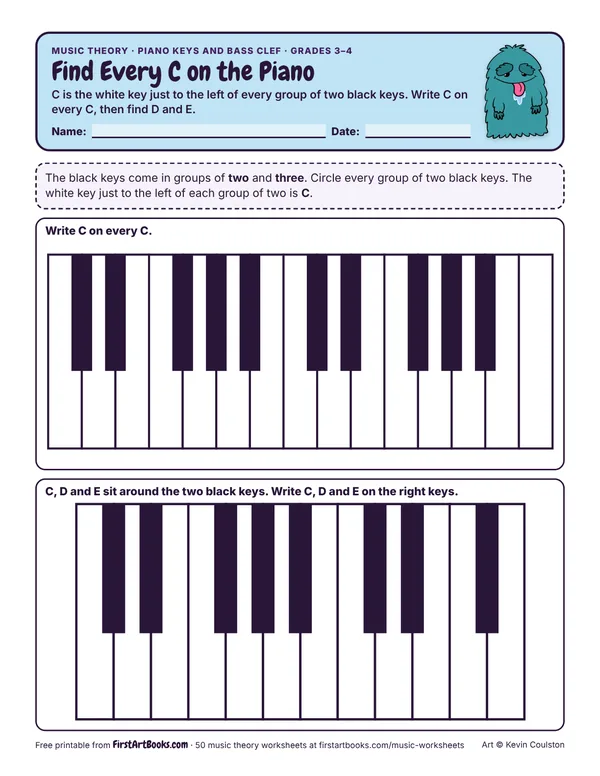
C is the white key just to the left of every group of two black keys. Write C on every C, then find D and E.
Print this sheet (PDF)Teacher notes and tips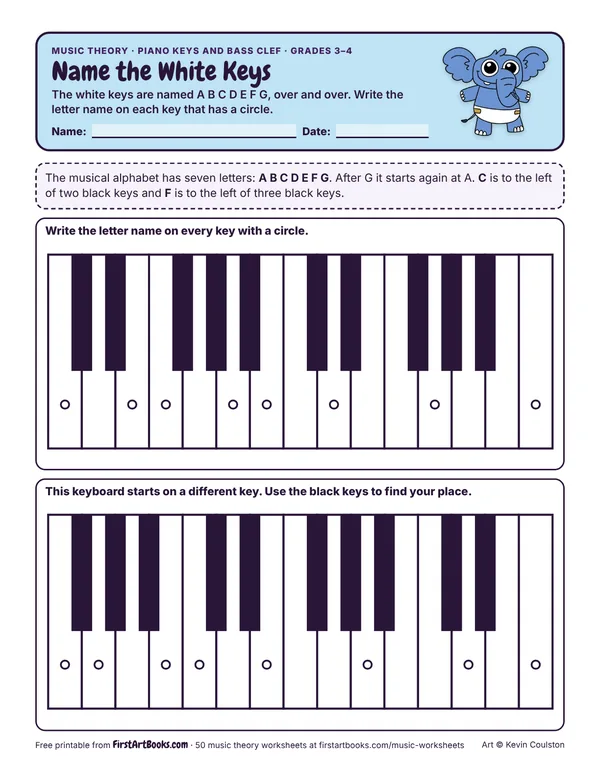
The white keys are named A B C D E F G, over and over. Write the letter name on each key that has a circle.
Print this sheet (PDF)Teacher notes and tips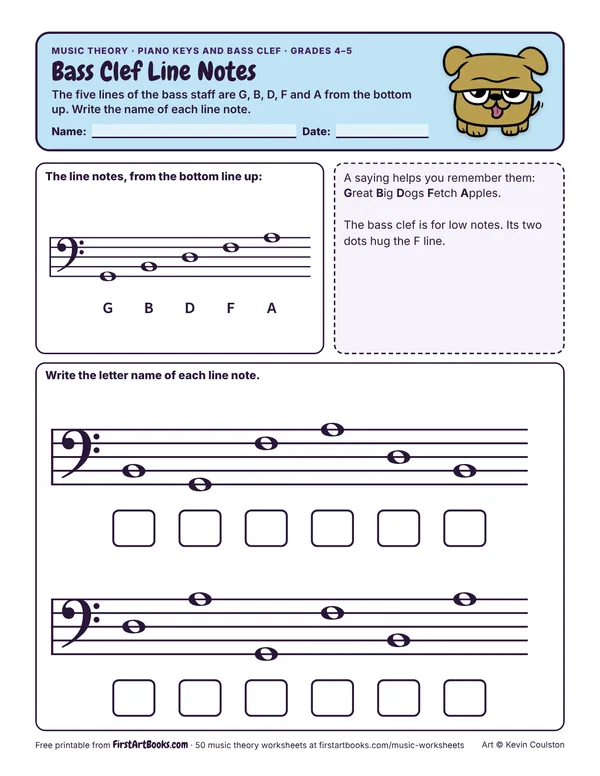
The five lines of the bass staff are G, B, D, F and A from the bottom up. Write the name of each line note.
Print this sheet (PDF)Teacher notes and tips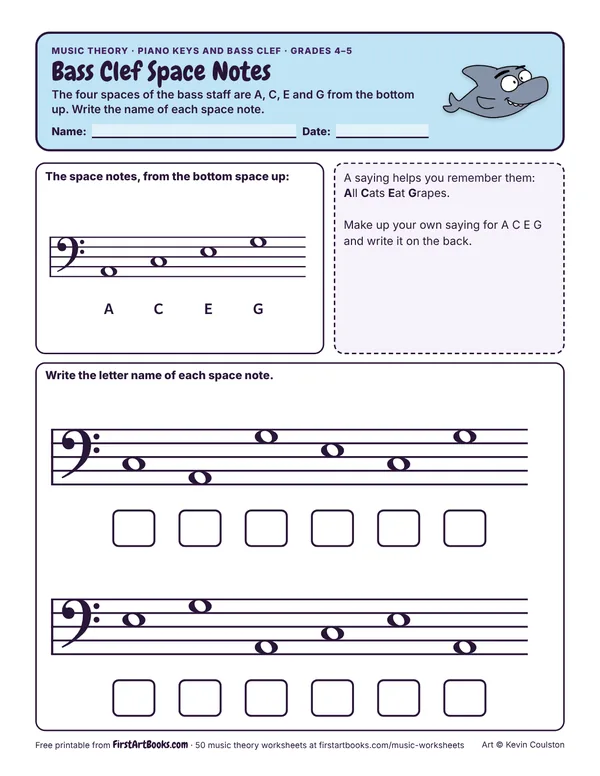
The four spaces of the bass staff are A, C, E and G from the bottom up. Write the name of each space note.
Print this sheet (PDF)Teacher notes and tips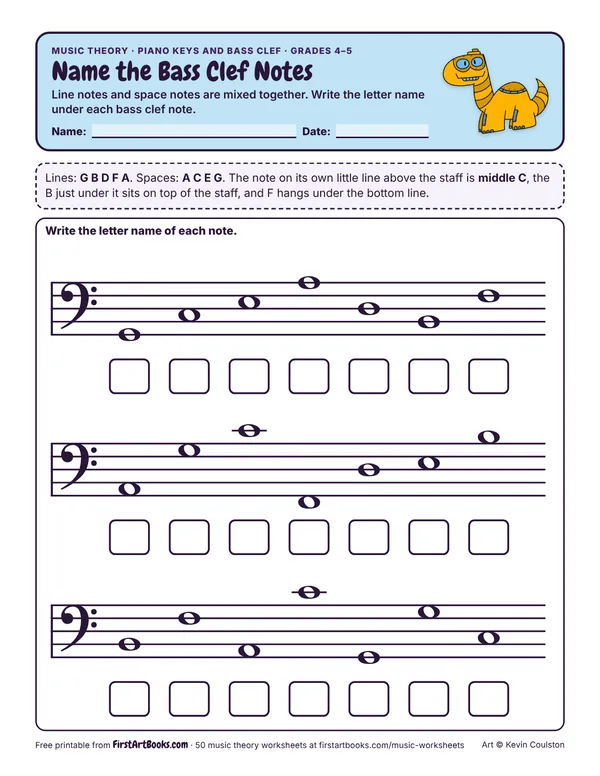
Line notes and space notes are mixed together. Write the letter name under each bass clef note.
Print this sheet (PDF)Teacher notes and tips

Match p, mp, mf and f to soft and loud, put the dynamics in order, read crescendo and decrescendo signs, learn the tempo words from largo to presto and find them in a word search.
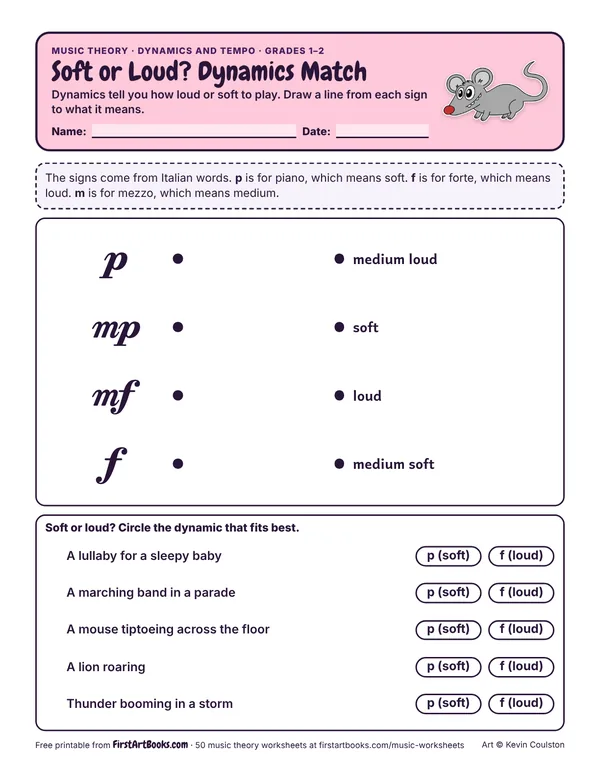
Dynamics tell you how loud or soft to play. Draw a line from each sign to what it means.
Print this sheet (PDF)Teacher notes and tips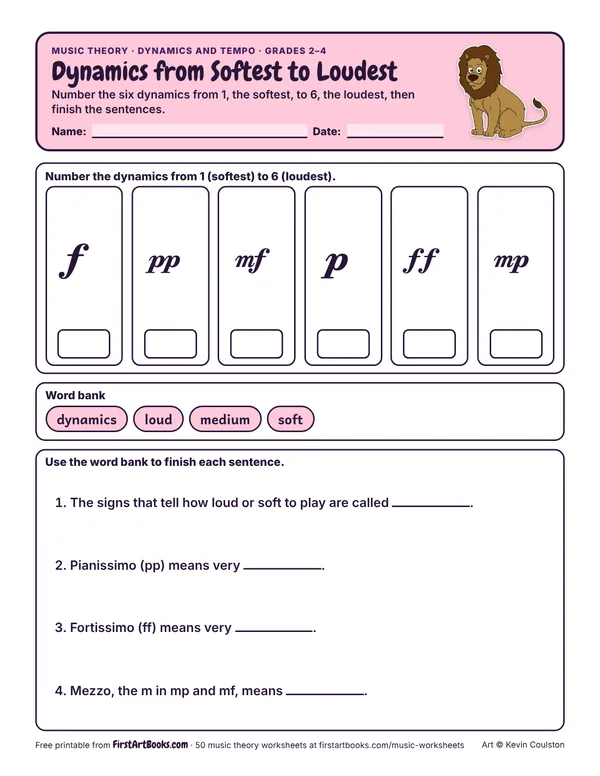
Number the six dynamics from 1, the softest, to 6, the loudest, then finish the sentences.
Print this sheet (PDF)Teacher notes and tips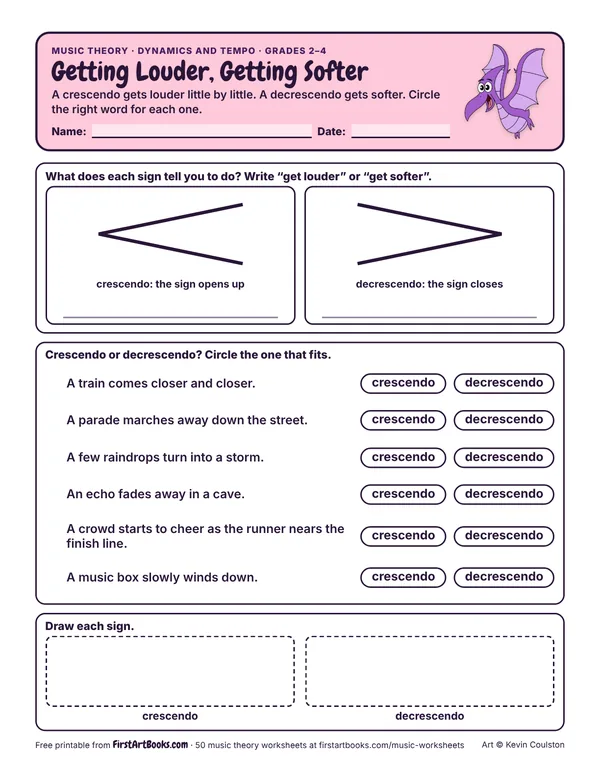
A crescendo gets louder little by little. A decrescendo gets softer. Circle the right word for each one.
Print this sheet (PDF)Teacher notes and tips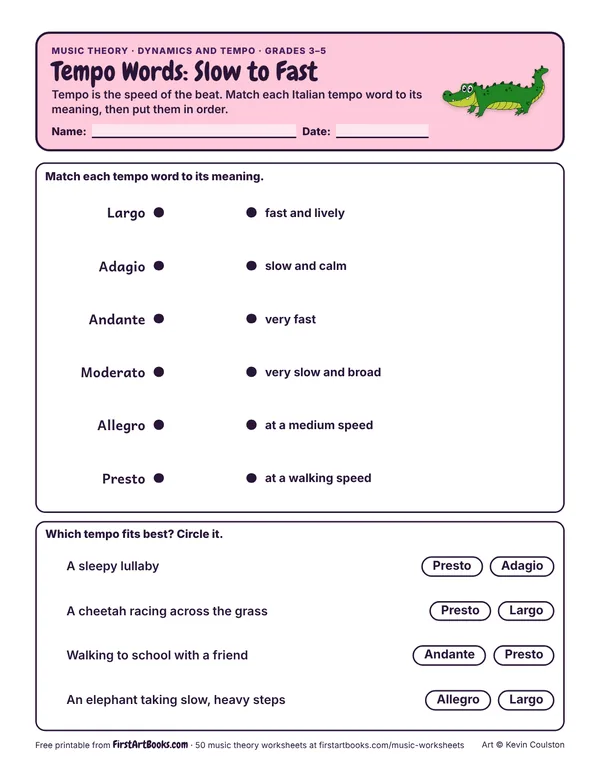
Tempo is the speed of the beat. Match each Italian tempo word to its meaning, then put them in order.
Print this sheet (PDF)Teacher notes and tips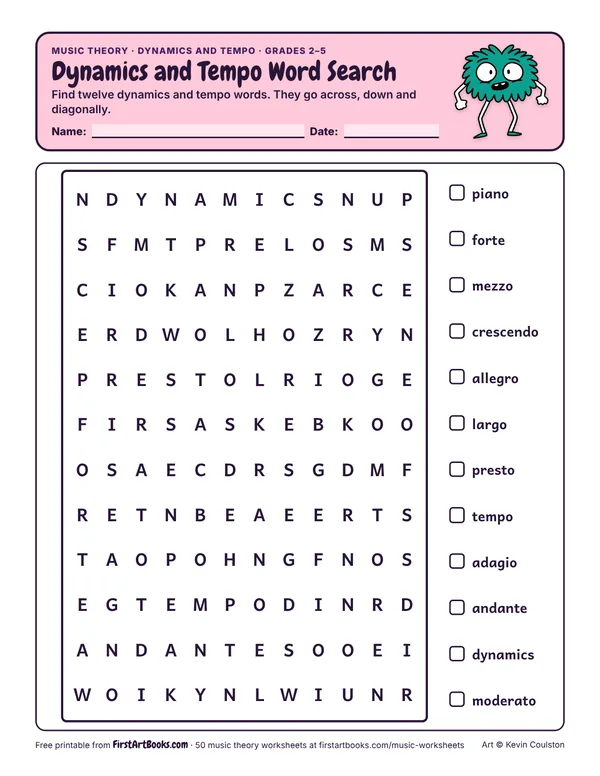
Find twelve dynamics and tempo words. They go across, down and diagonally.
Print this sheet (PDF)Teacher notes and tips

Sort instruments into strings, woodwinds, brass and percussion, learn how each family makes its sound, solve instrument riddles, find instruments in a word search and invent a new one.
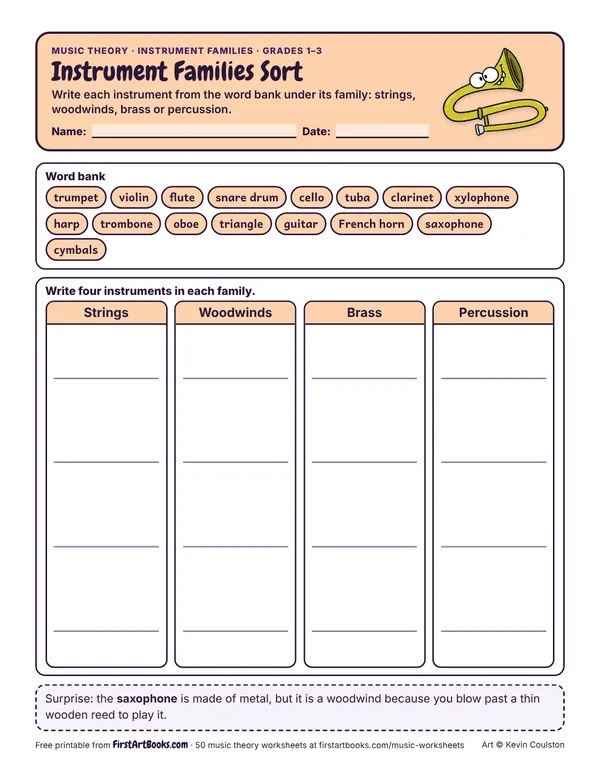
Write each instrument from the word bank under its family: strings, woodwinds, brass or percussion.
Print this sheet (PDF)Teacher notes and tips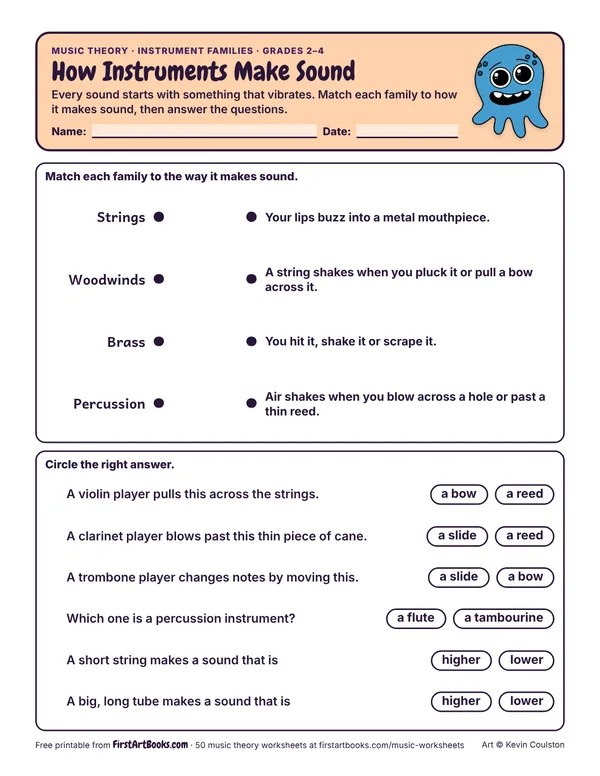
Every sound starts with something that vibrates. Match each family to how it makes sound, then answer the questions.
Print this sheet (PDF)Teacher notes and tips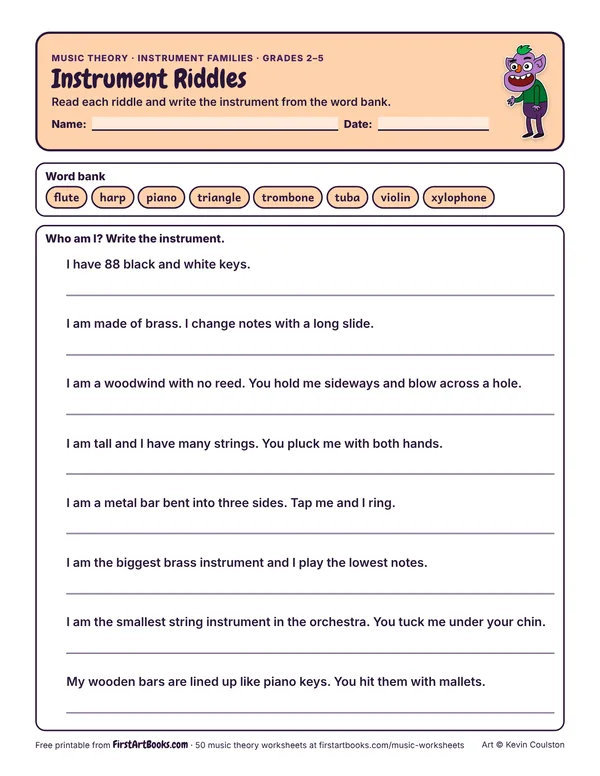
Read each riddle and write the instrument from the word bank.
Print this sheet (PDF)Teacher notes and tips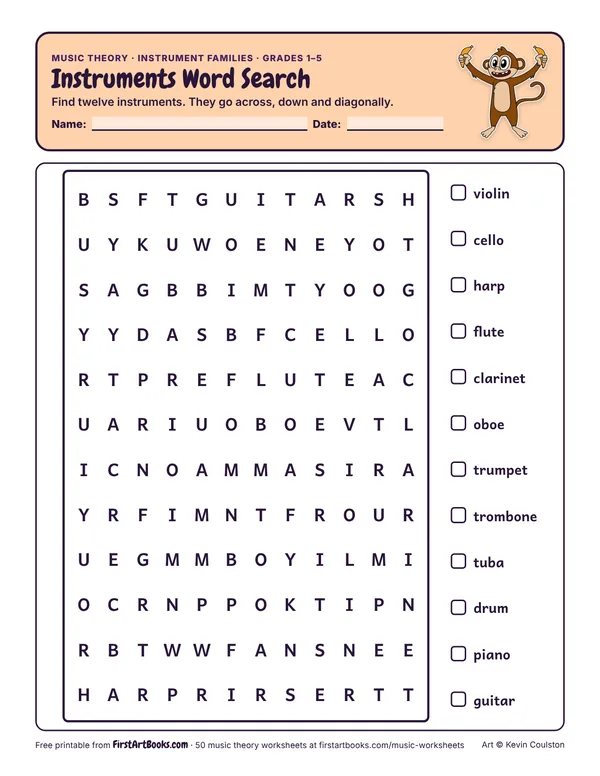
Find twelve instruments. They go across, down and diagonally.
Print this sheet (PDF)Teacher notes and tips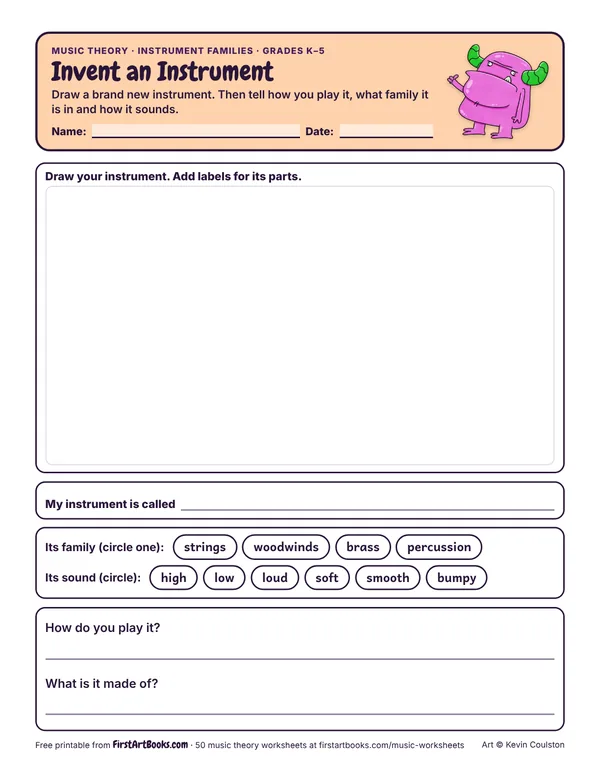
Draw a brand new instrument. Then tell how you play it, what family it is in and how it sounds.
Print this sheet (PDF)Teacher notes and tips

Read a short life story and answer questions about Johann Sebastian Bach, Wolfgang Amadeus Mozart, Ludwig van Beethoven, Florence Price and Scott Joplin.
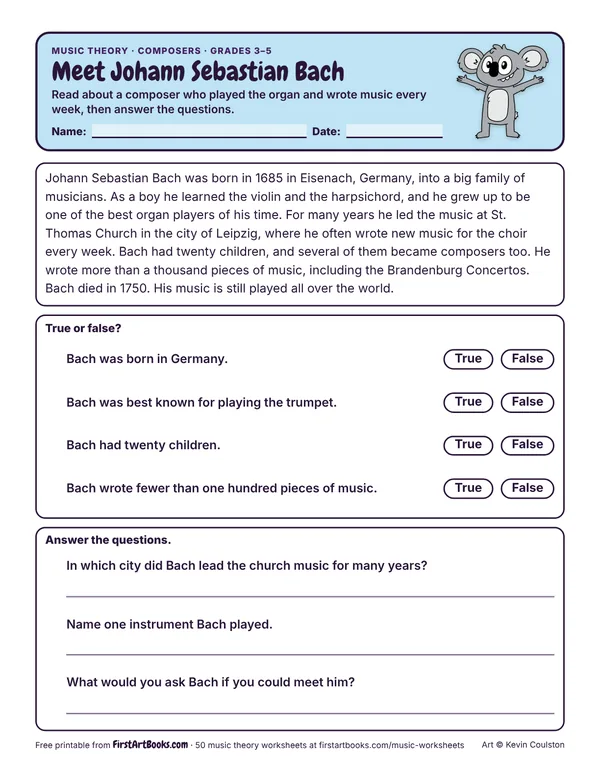
Read about a composer who played the organ and wrote music every week, then answer the questions.
Print this sheet (PDF)Teacher notes and tips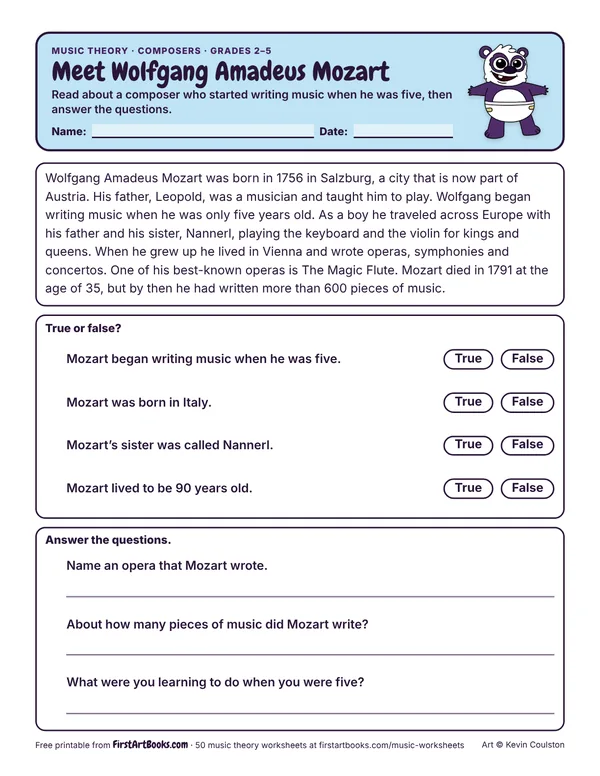
Read about a composer who started writing music when he was five, then answer the questions.
Print this sheet (PDF)Teacher notes and tips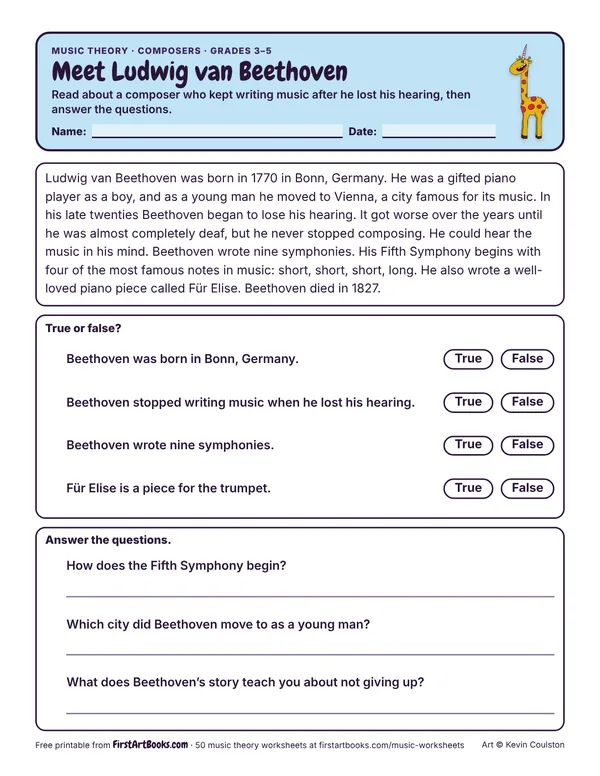
Read about a composer who kept writing music after he lost his hearing, then answer the questions.
Print this sheet (PDF)Teacher notes and tips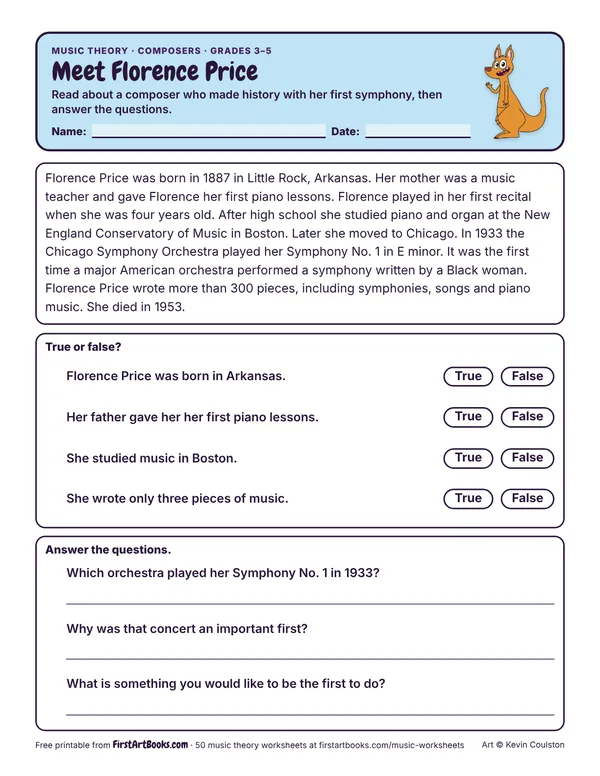
Read about a composer who made history with her first symphony, then answer the questions.
Print this sheet (PDF)Teacher notes and tips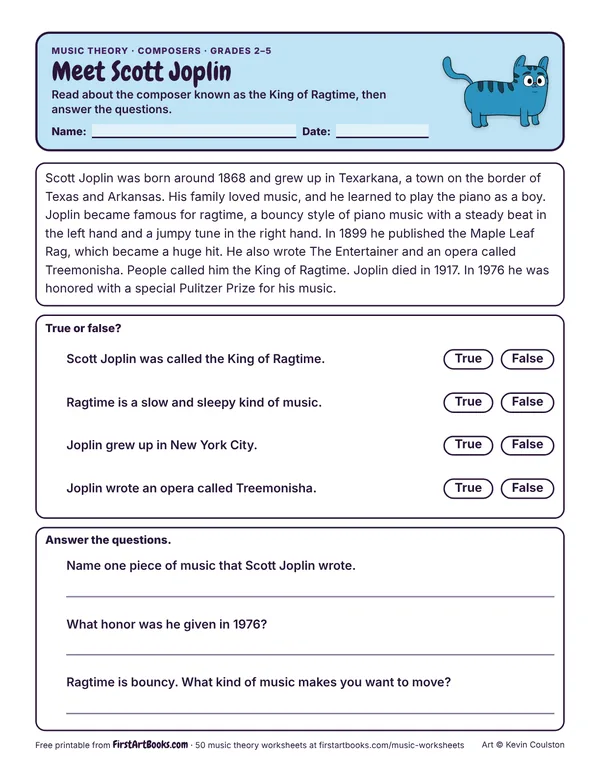
Read about the composer known as the King of Ragtime, then answer the questions.
Print this sheet (PDF)Teacher notes and tips

Match musical opposites, draw what a song makes you picture, keep a listening journal, compose a four-beat rhythm and write a melody of your own.
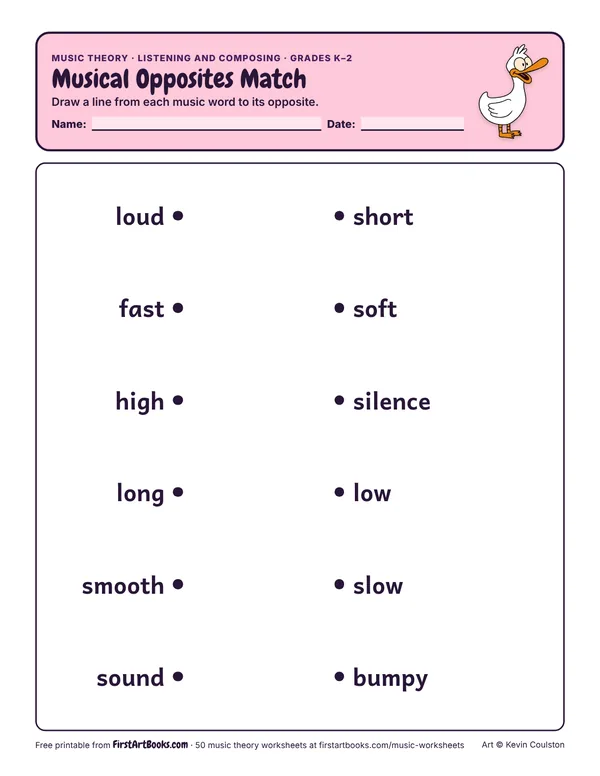
Draw a line from each music word to its opposite.
Print this sheet (PDF)Teacher notes and tips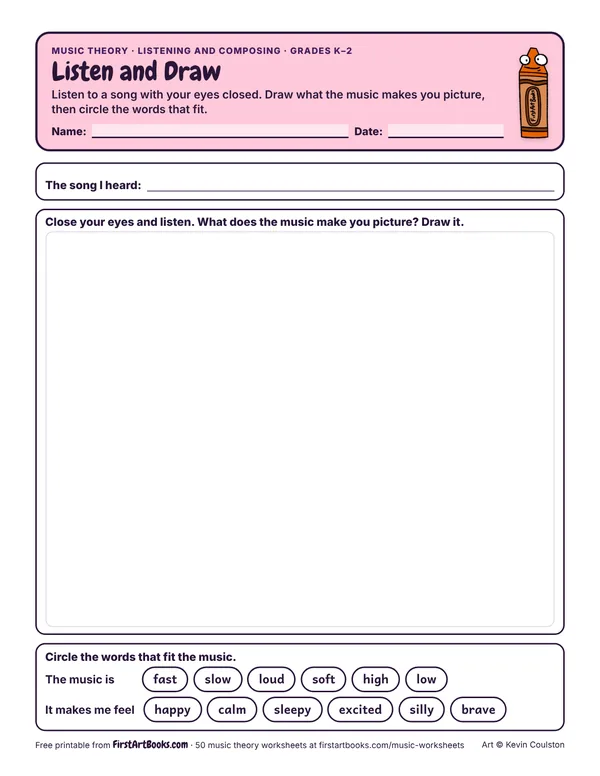
Listen to a song with your eyes closed. Draw what the music makes you picture, then circle the words that fit.
Print this sheet (PDF)Teacher notes and tips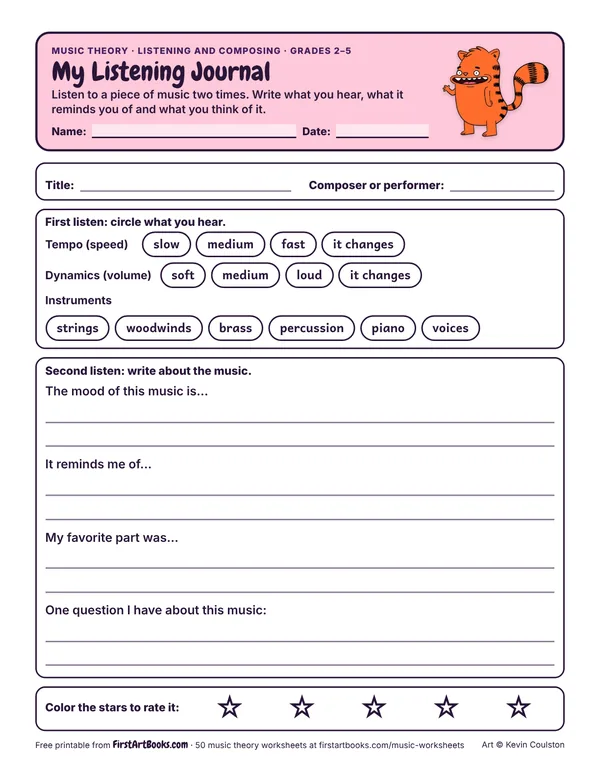
Listen to a piece of music two times. Write what you hear, what it reminds you of and what you think of it.
Print this sheet (PDF)Teacher notes and tips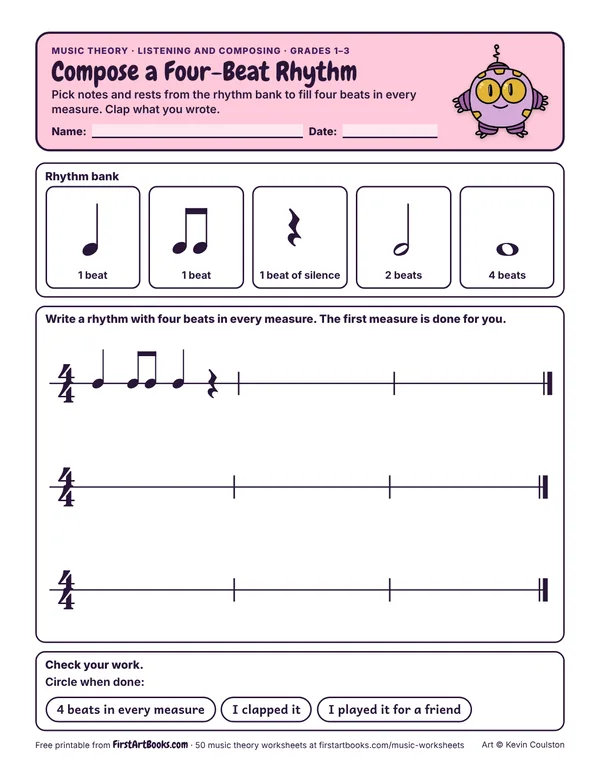
Pick notes and rests from the rhythm bank to fill four beats in every measure. Clap what you wrote.
Print this sheet (PDF)Teacher notes and tips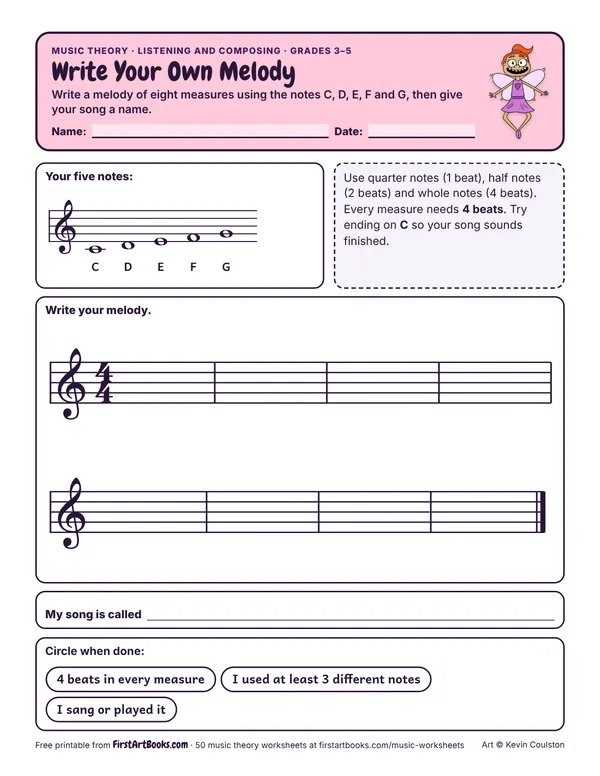
Write a melody of eight measures using the notes C, D, E, F and G, then give your song a name.
Print this sheet (PDF)Teacher notes and tips

Each topic has a pack of its five sheets and their answer keys: the staff, note values, rests, rhythm, treble clef, piano and bass clef, dynamics and tempo, instruments, composers, listening.
The characters on these worksheets come from Kevin Coulston’s drawing books. Keep one in the music room for kids who finish early: the How to Draw books build a drawing one small step at a time.
Yes. All 50 worksheets, the 44 answer keys and the topic packs are free to print for music class, piano lessons, homeschool and home practice. Print one sheet, a topic pack of five or the whole set in one PDF.
Kindergarten to 5th grade. Each card shows the grades it suits best, and the grade buttons hide the rest. The grades are only a guide: a beginner of any age starts with the staff, note values and rhythm, and a child who already takes lessons can jump ahead to note names.
The topics run from easiest to hardest. Start with the staff and music symbols, then note values, rests and rhythm. Next come treble clef note names, then piano keys and the bass clef. Dynamics, tempo, instrument families, composers and listening fit anywhere in the year.
No. Every skill sheet has a short reminder box at the top with the rule kids need, and an answer key for the grown-up. A classroom teacher, a substitute or a parent can hand them out with no music training.
Both. The youngest rhythm sheet uses ta for a quarter note and ti-ti for two eighth notes, which is how many elementary music classes start. The later sheets count with numbers: 1, 2, 3, 4, with a plus sign for the eighth note in between.
Five one-page life stories with questions: Johann Sebastian Bach, Wolfgang Amadeus Mozart, Ludwig van Beethoven, Florence Price and Scott Joplin. They work well as a reading passage before you play a piece by that composer.
Yes. The notes, staffs and keyboards are black on white, and nothing depends on color. Sheets are US Letter and also print on A4.
All sheets are US Letter, print well in black and white, and are free for home and classroom use. The music symbols are set in Bravura, an open music font. More for teachers in the teacher resources library.
12 printable pages: six step-by-step lessons, a grid activity, draw-and-write sheets and teacher notes, sent with your welcome email. After that, new classroom printables by email.