
Grades K–1
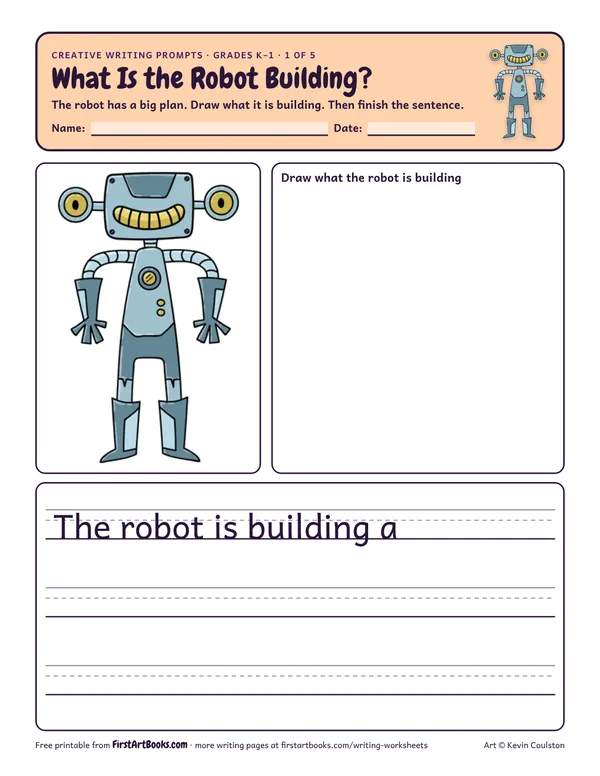
What Is the Robot Building?
A picture starter for the youngest writers: draw the robot’s invention, then finish one sentence on handwriting lines.
Print this sheet (PDF)50 free writing and grammar worksheets in 10 topics: picture writing prompts, sentence building, handwriting, parts of speech, capitalization and punctuation, story planners, opinion and informational writing, spelling and word sorts, and paragraph editing. Answer keys and Kevin Coulston’s cartoon characters on every page.
No sheets for that grade in this topic.
Picture starters with one of Kevin’s characters, a plan and room to write. Grades K–5.
A picture starter for the youngest writers: draw the robot’s invention, then finish one sentence on handwriting lines.
Print this sheet (PDF)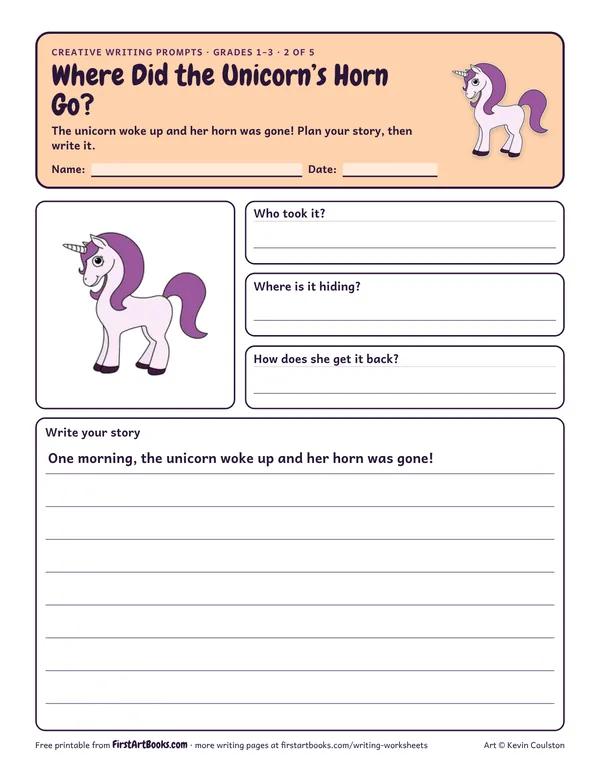
A silly mystery to plan and write: who took the unicorn’s horn, where it is, and how she gets it back.
Print this sheet (PDF)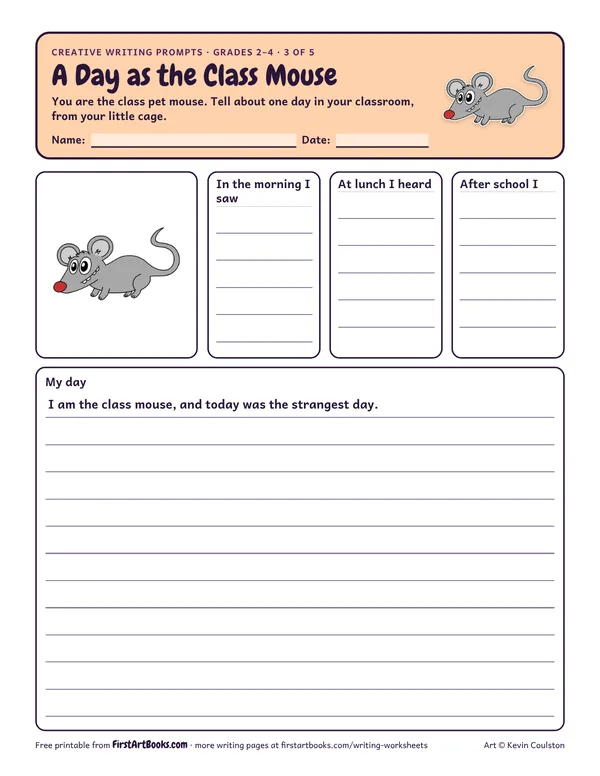
A point-of-view prompt: kids write one school day as the class pet mouse, from morning to after school.
Print this sheet (PDF)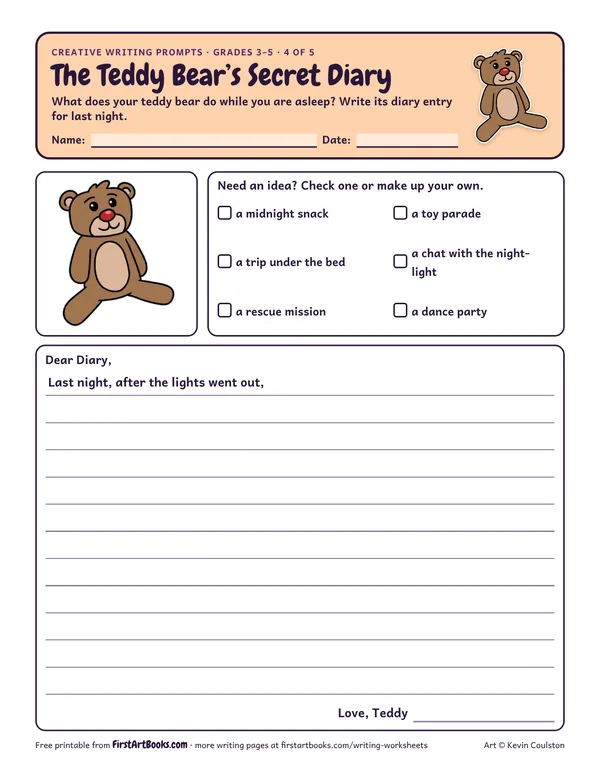
A diary-entry prompt: kids write in the voice of a teddy bear who has a secret life at night.
Print this sheet (PDF)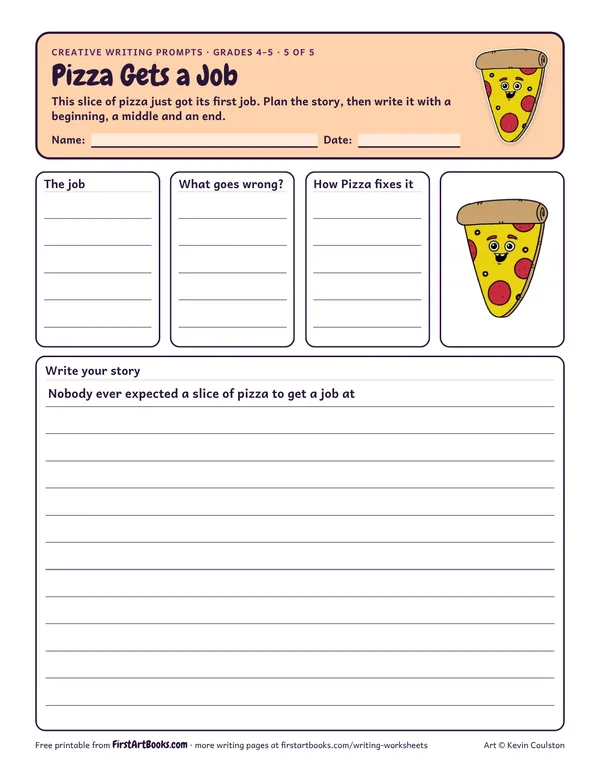
A funny story prompt with a four-part plan: the job, the problem, the fix and the ending.
Print this sheet (PDF)Who and what, naming and telling parts, fragments, and longer sentences. Grades K–3.
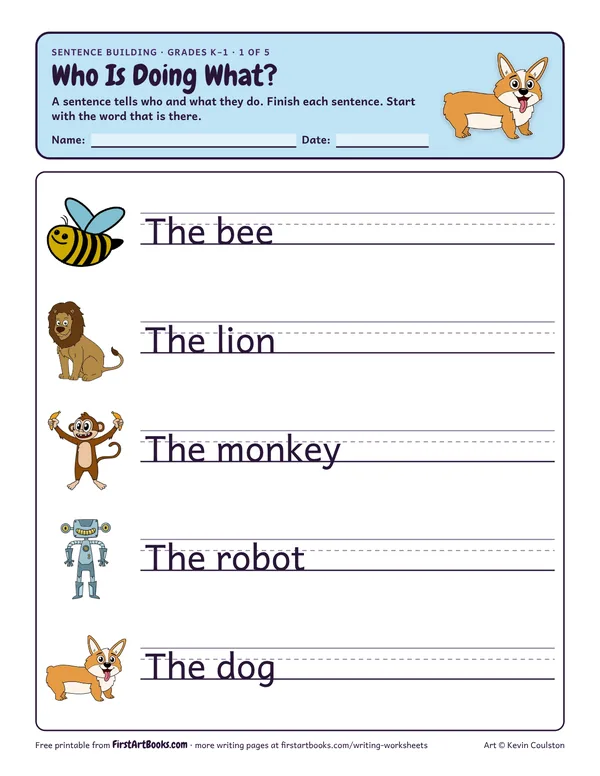
Five picture sentence frames on handwriting lines: kids add what the bee, lion, monkey, robot and dog are doing.
Print this sheet (PDF)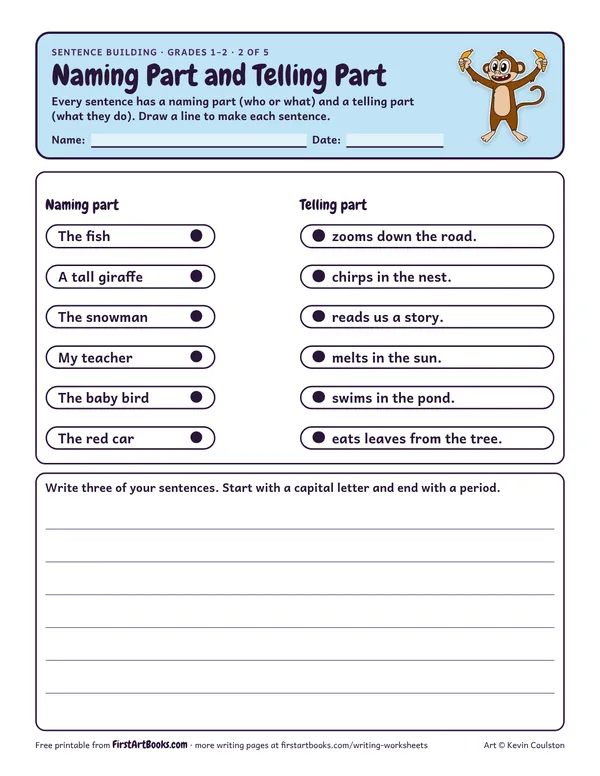
Match six naming parts to their telling parts, then write three of the sentences with a capital and a period.
Print this sheet (PDF)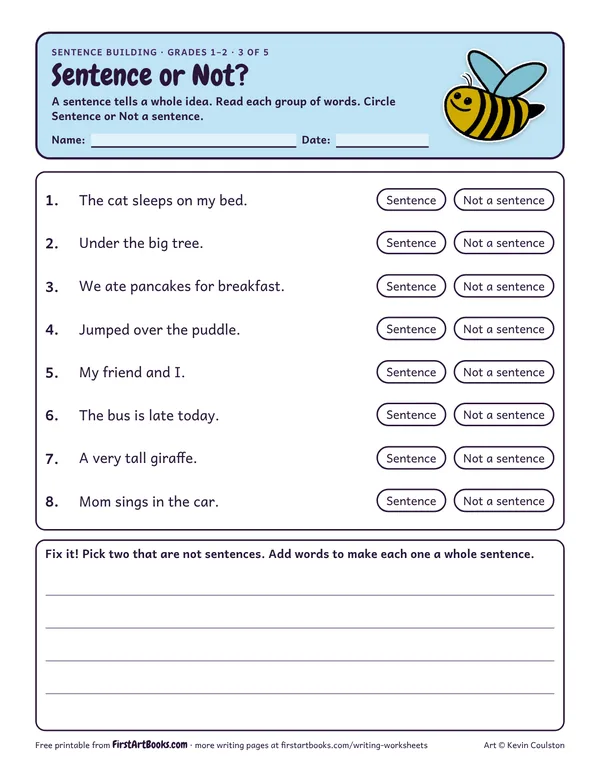
Eight word groups to sort into complete sentences and fragments, then two fragments to fix.
Print this sheet (PDF)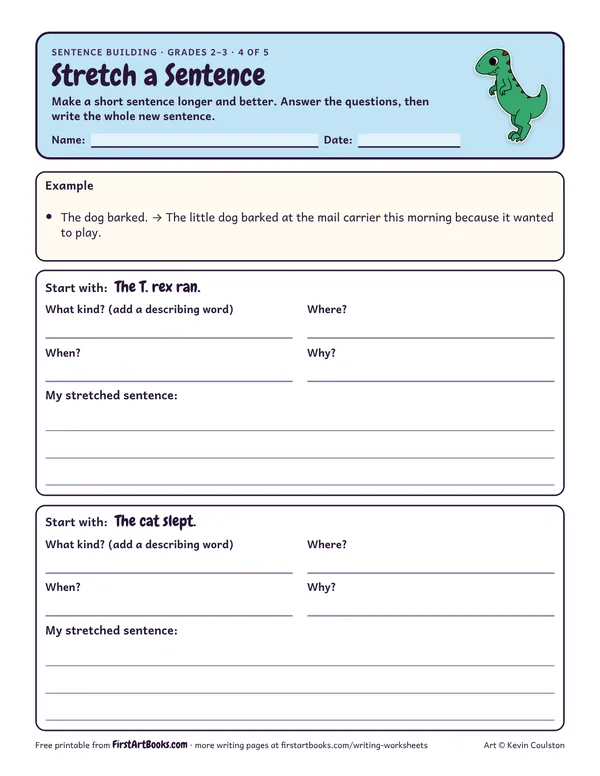
Kids stretch two short sentences by adding what kind, where, when and why, then write the long version.
Print this sheet (PDF)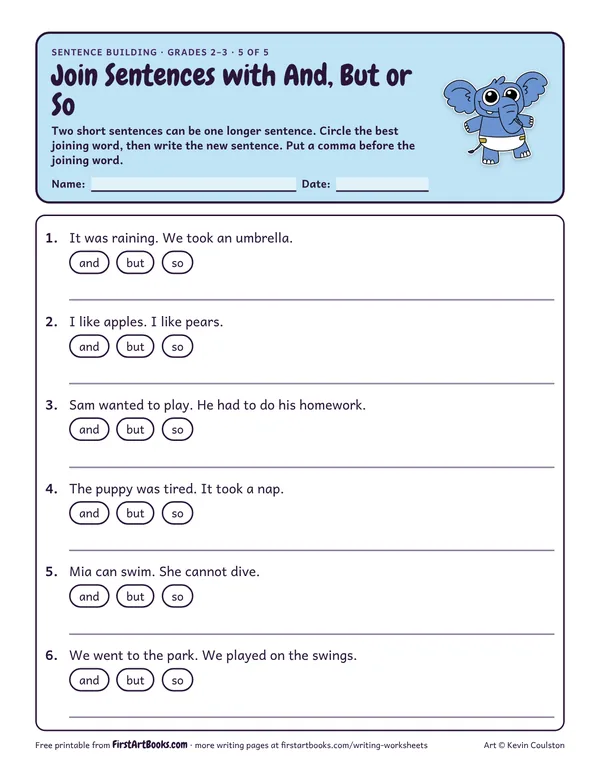
Six pairs of short sentences to join with and, but or so, writing each compound sentence with a comma.
Print this sheet (PDF)Trace and write every letter on handwriting lines, then copy whole sentences. Grades K–2.
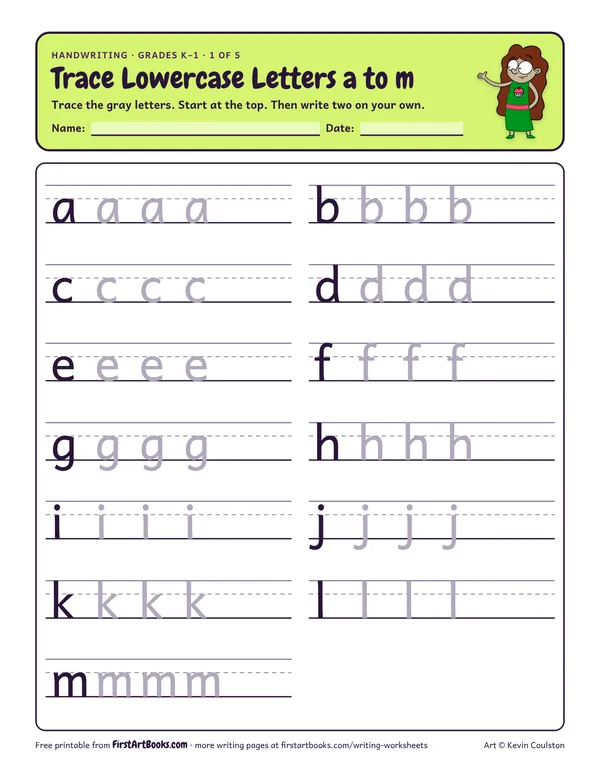
Lowercase a to m on handwriting lines: one dark model, four letters to trace and room to write two more.
Print this sheet (PDF)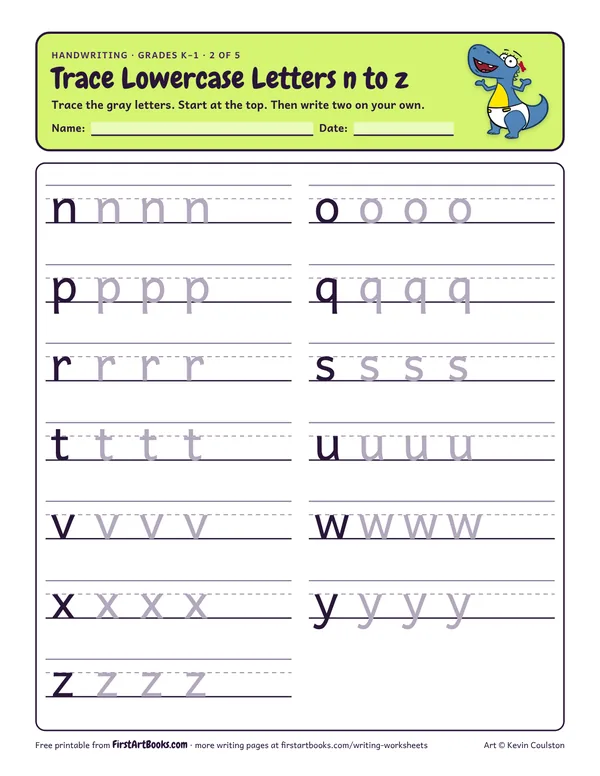
Lowercase n to z on handwriting lines: one dark model, four letters to trace and room to write two more.
Print this sheet (PDF)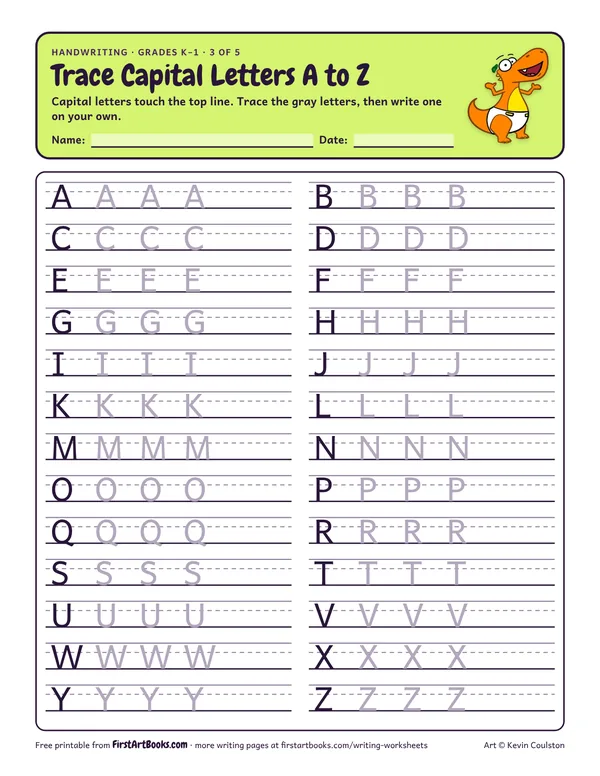
All 26 capital letters on one page of handwriting lines, with letters to trace and a space to write.
Print this sheet (PDF)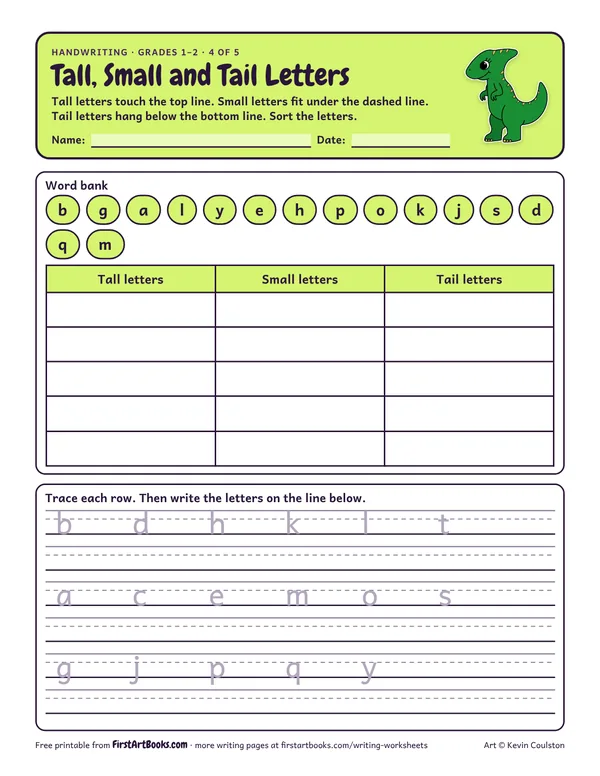
Kids sort 15 letters by where they sit on the lines, then trace a row of each kind.
Print this sheet (PDF)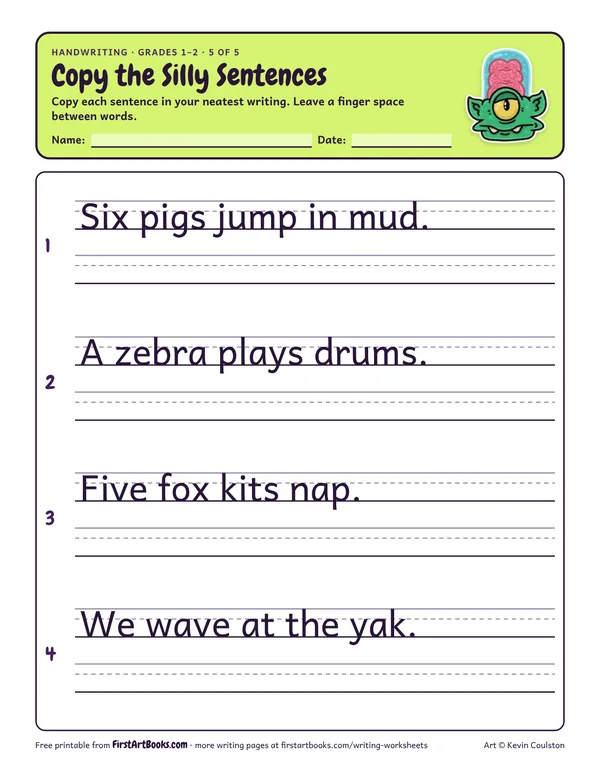
Four silly sentences to copy on handwriting lines, with finger spaces, capitals and periods.
Print this sheet (PDF)Nouns, verbs, adjectives, pronouns and adverbs. Grades 1–5.
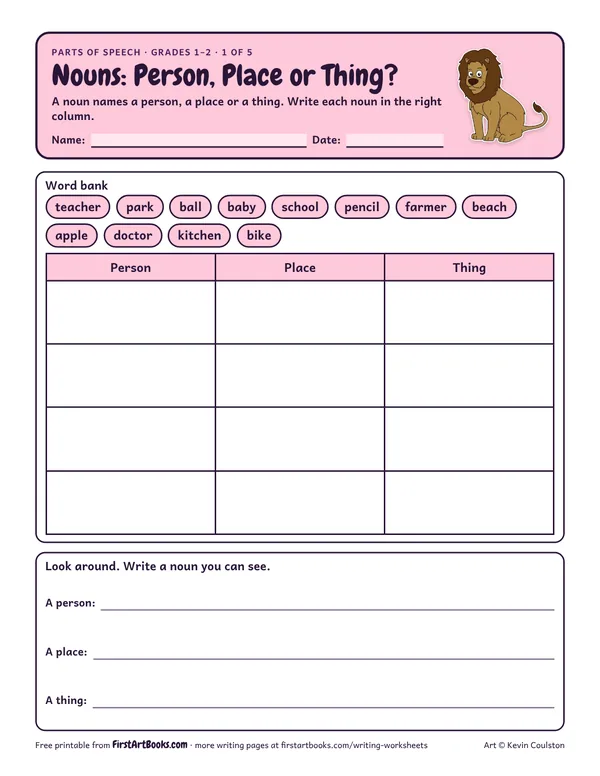
Sort 12 nouns into person, place and thing, then name one of each you can see right now.
Print this sheet (PDF)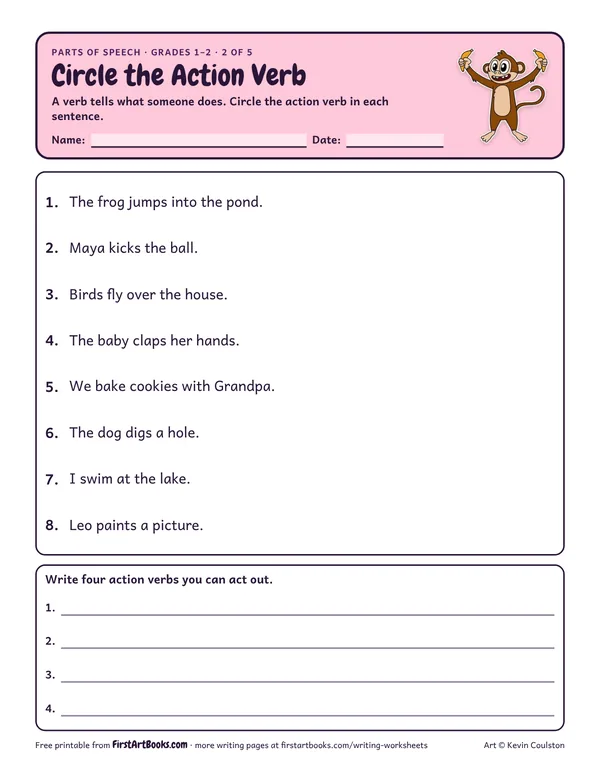
Eight sentences with one action verb each to find and circle, then four verbs kids can act out.
Print this sheet (PDF)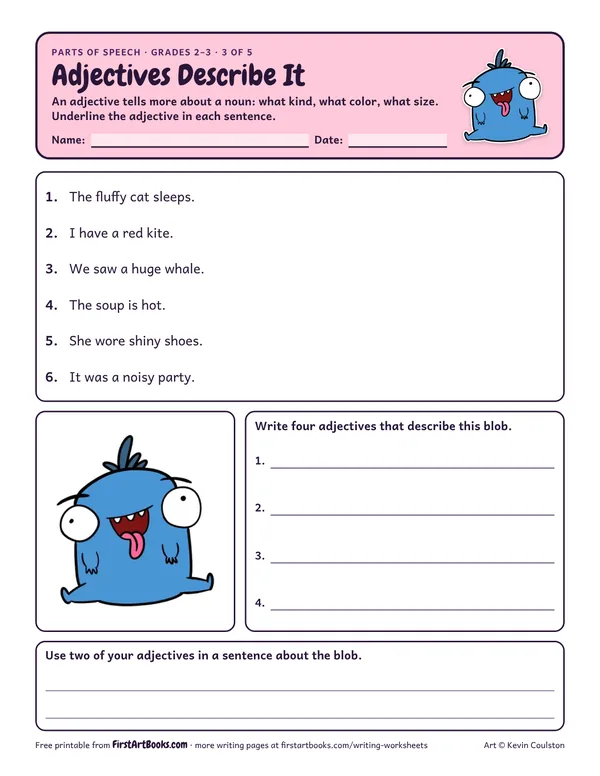
Find the adjective in six sentences, then describe one of Kevin’s blob characters with adjectives of your own.
Print this sheet (PDF)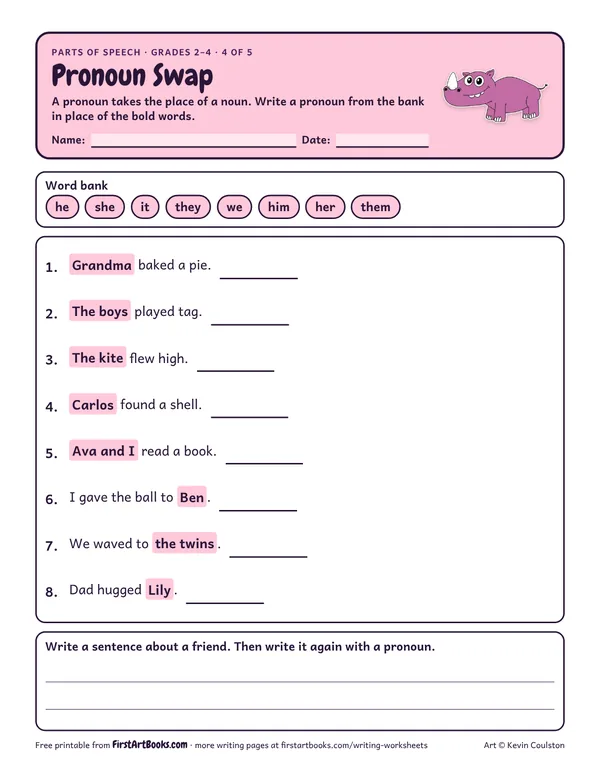
Eight sentences where kids swap the bold noun for he, she, it, they, we, him, her or them.
Print this sheet (PDF)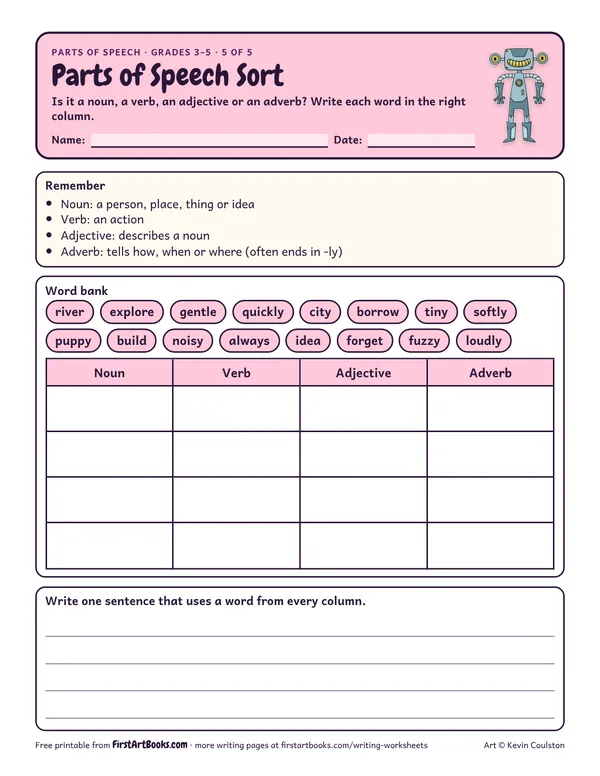
Sort 16 words into nouns, verbs, adjectives and adverbs, then use one of each in a sentence.
Print this sheet (PDF)Capital letters, end marks, commas and quotation marks. Grades 1–5.
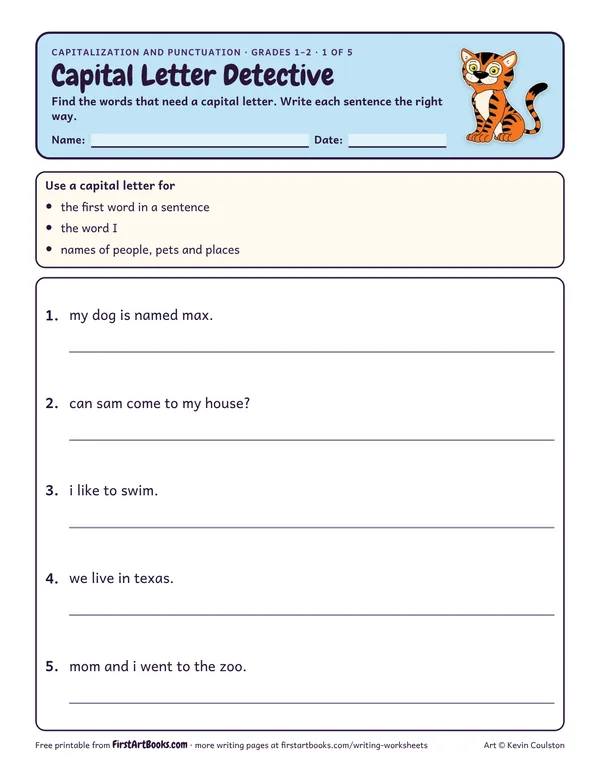
Five sentences to fix: capitals at the start, for the word I and for names.
Print this sheet (PDF)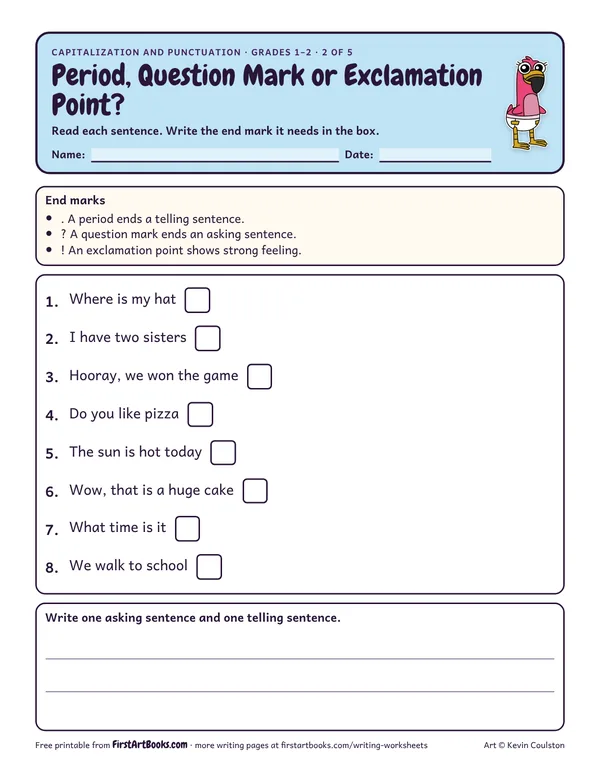
Eight sentences that need a period, a question mark or an exclamation point, with a reminder of each.
Print this sheet (PDF)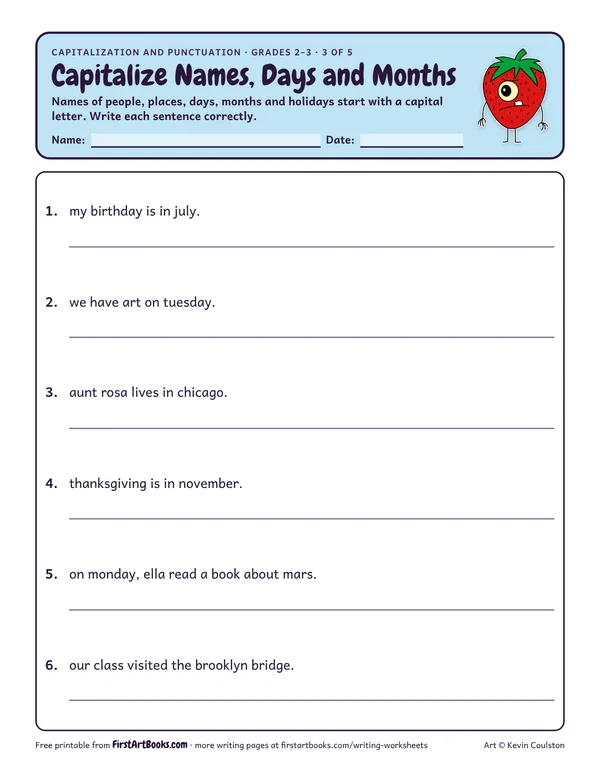
Six sentences with names, places, days, months and holidays to capitalize.
Print this sheet (PDF)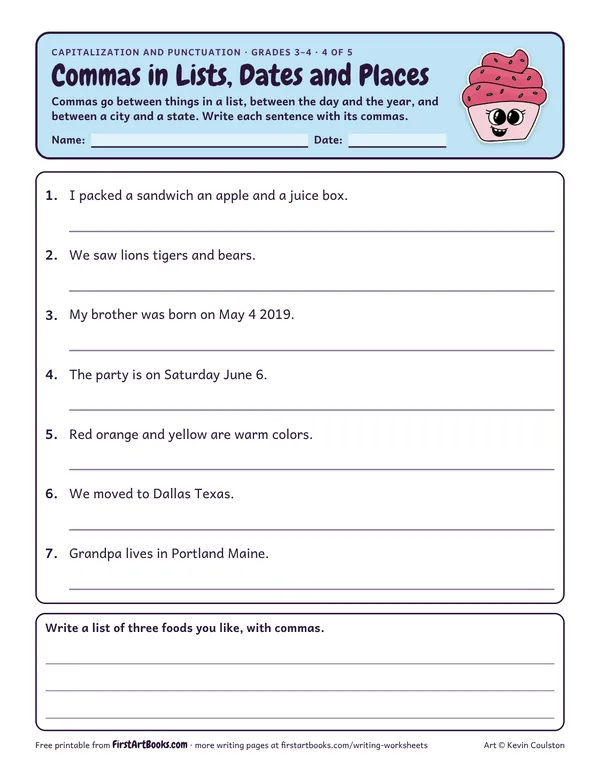
Seven sentences that need commas in a list, in a date or between a city and a state.
Print this sheet (PDF)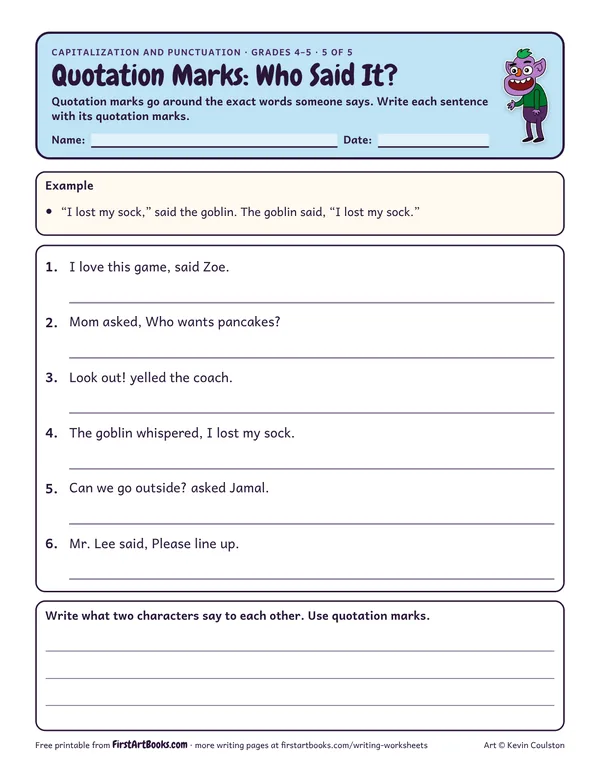
Six lines of dialogue to punctuate with quotation marks and commas, then a short conversation to write.
Print this sheet (PDF)Plan a story or a true moment before writing it. Grades 2–5.
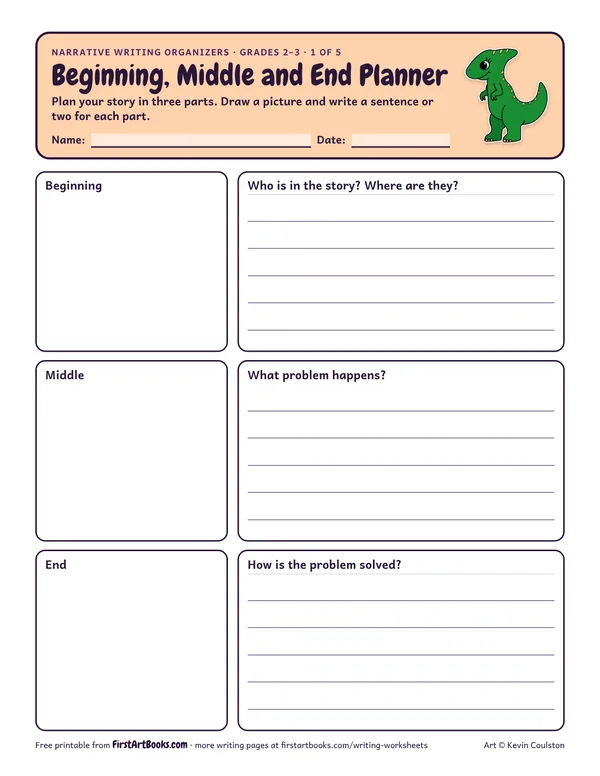
Three draw-and-write boxes for planning a story’s beginning, middle and end.
Print this sheet (PDF)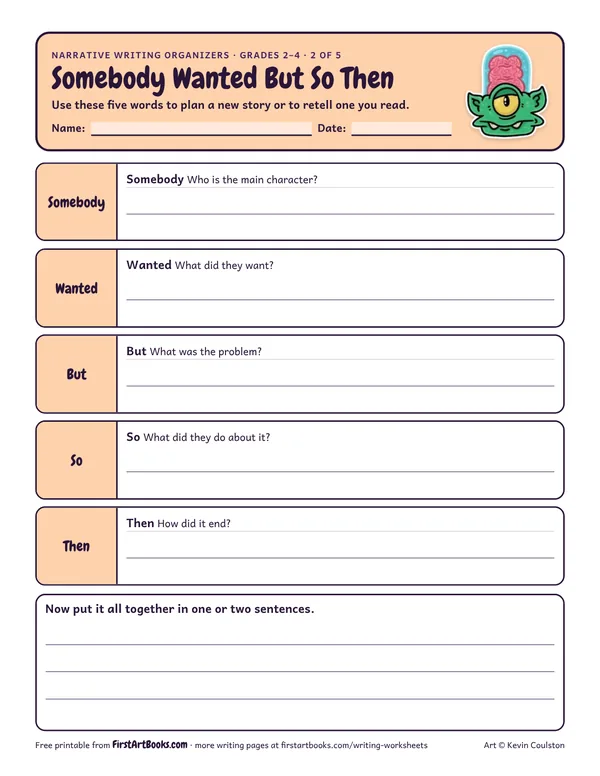
The Somebody, Wanted, But, So, Then chart for planning or retelling a story, plus a one-sentence summary.
Print this sheet (PDF)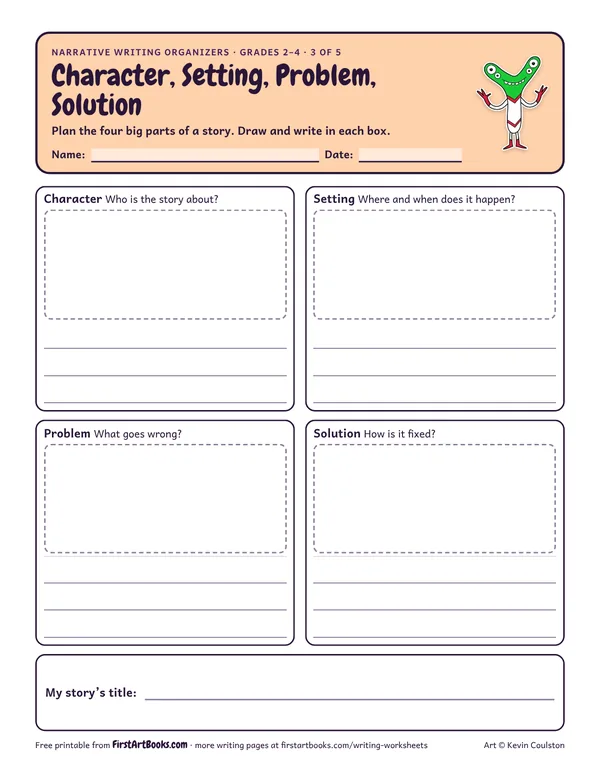
A four-square story planner: character, setting, problem and solution, each with room to draw and write.
Print this sheet (PDF)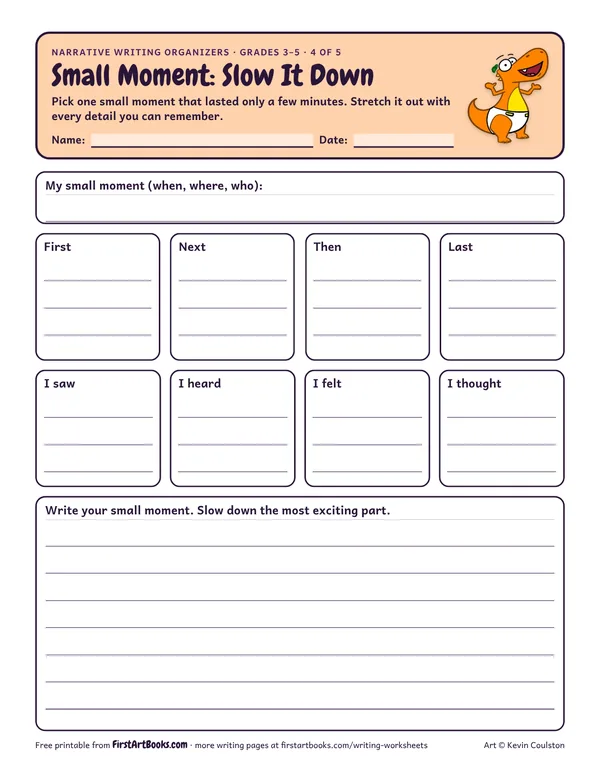
A personal narrative planner for one small moment: four steps, what you saw, heard, felt and thought, then the draft.
Print this sheet (PDF)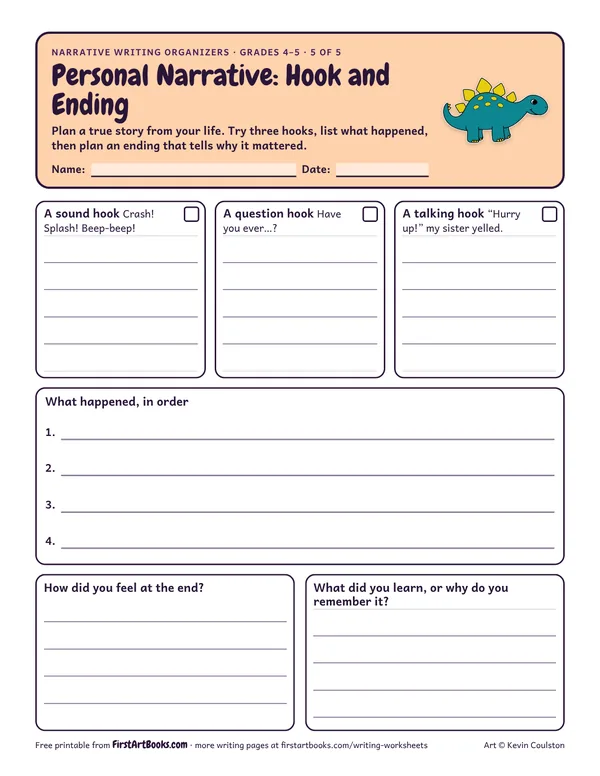
A planner for a true story: three kinds of hooks to try, the events in order and an ending with a feeling or a lesson.
Print this sheet (PDF)State an opinion, give reasons and examples, and wrap it up. Grades 2–5.
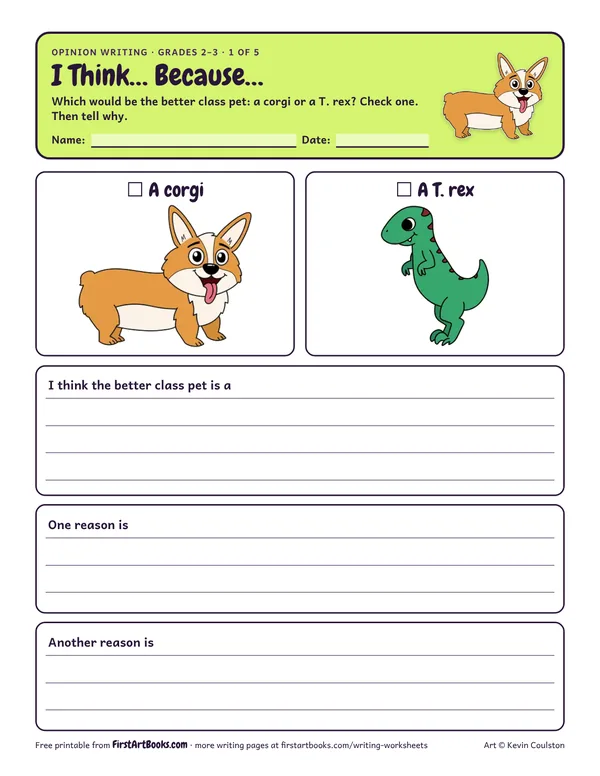
A first opinion piece with a silly choice: a corgi or a T. rex for a class pet, with two reasons.
Print this sheet (PDF)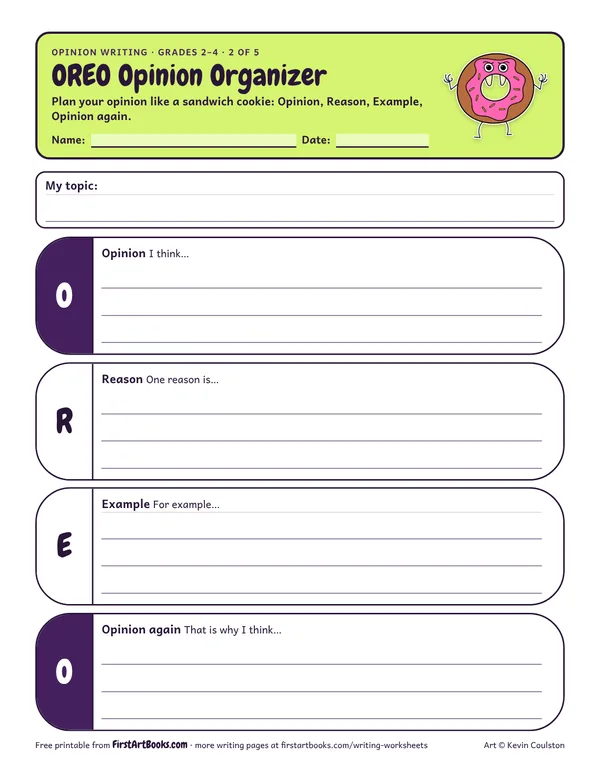
The OREO organizer: state an opinion, give a reason and an example, then say the opinion again in new words.
Print this sheet (PDF)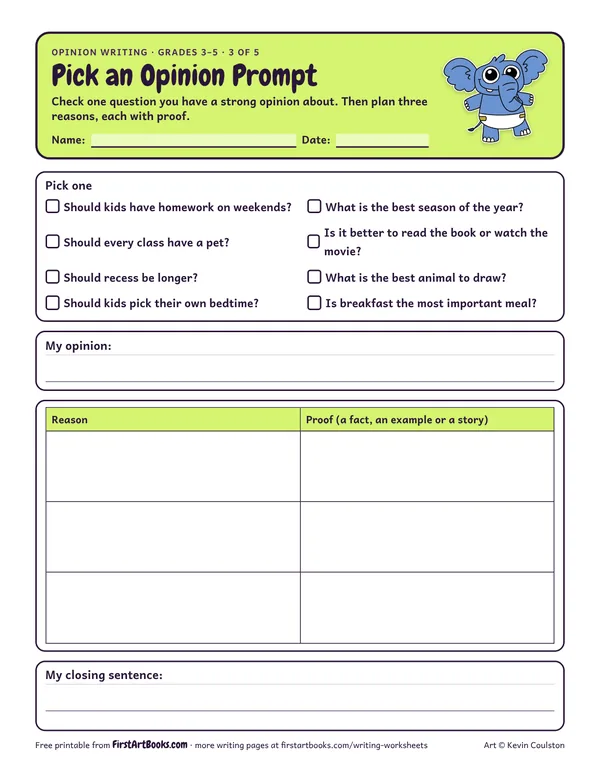
Eight kid-friendly opinion questions to choose from and a reasons-and-evidence plan.
Print this sheet (PDF)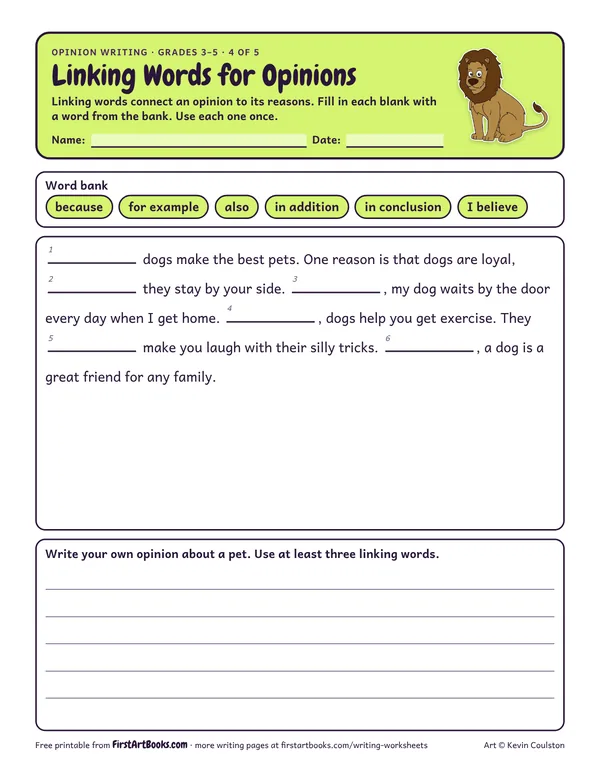
A short opinion paragraph with six blanks for linking words like because, for example and in conclusion.
Print this sheet (PDF)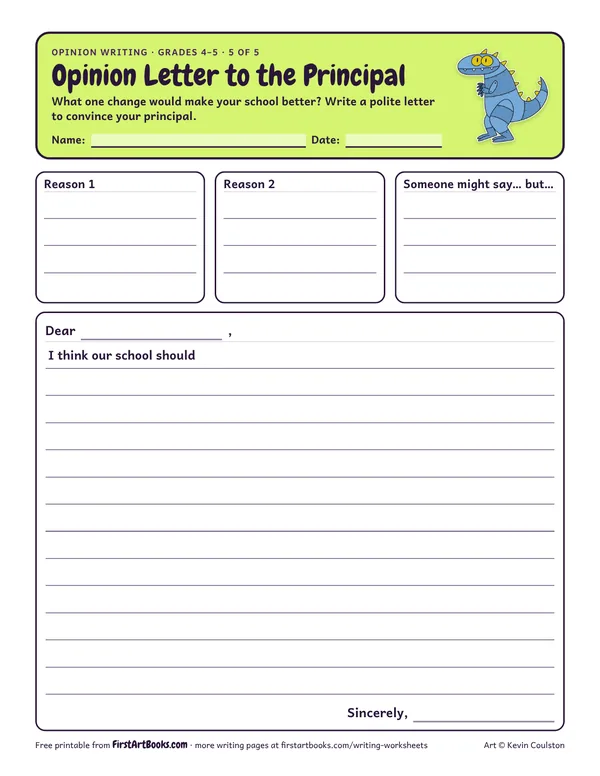
A persuasive letter frame: the change, two reasons, what someone might say against it and a polite closing.
Print this sheet (PDF)Teach a reader about a topic with facts, details and text features. Grades 2–5.
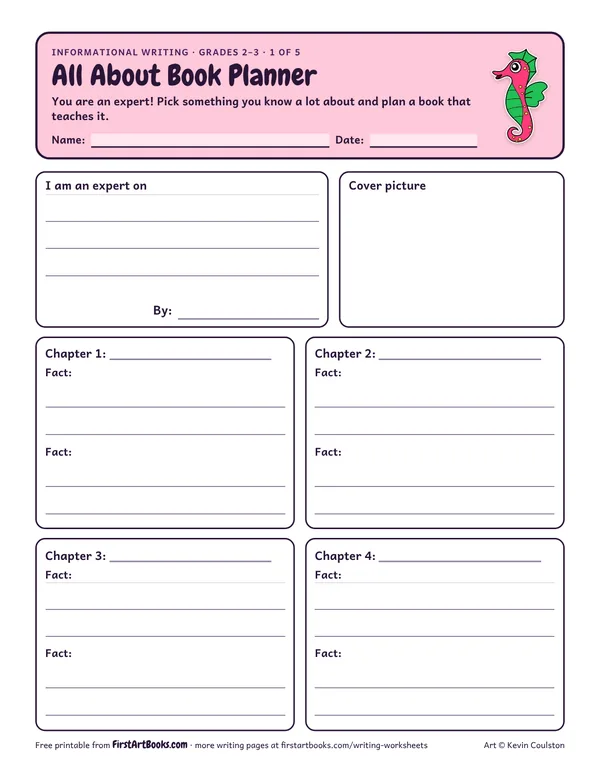
Plan an All About book: a topic, a cover and four chapters with two facts each.
Print this sheet (PDF)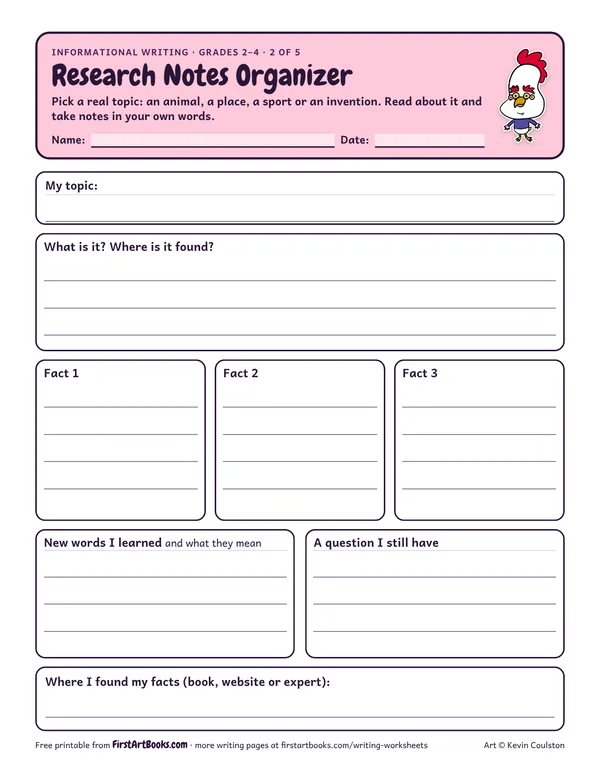
Note-taking boxes for any real topic: what it is, three facts, new words and where the facts came from.
Print this sheet (PDF)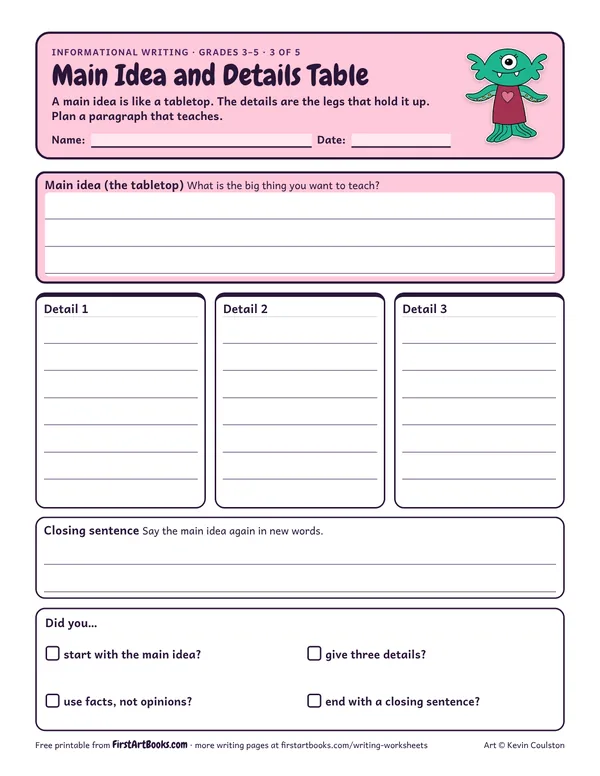
The tabletop organizer: one main idea, three supporting details and a closing sentence for an informational paragraph.
Print this sheet (PDF)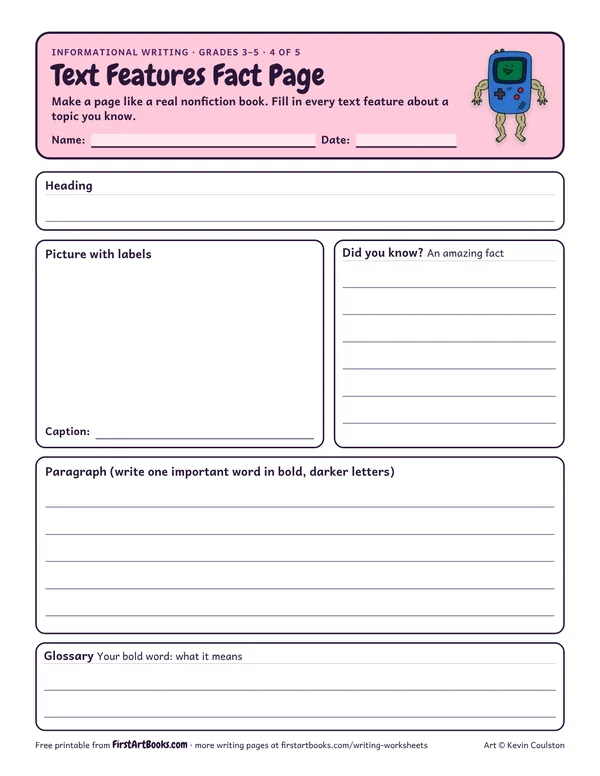
Kids build a nonfiction page with a heading, a labeled picture and caption, a fact box, a bold word and a glossary.
Print this sheet (PDF)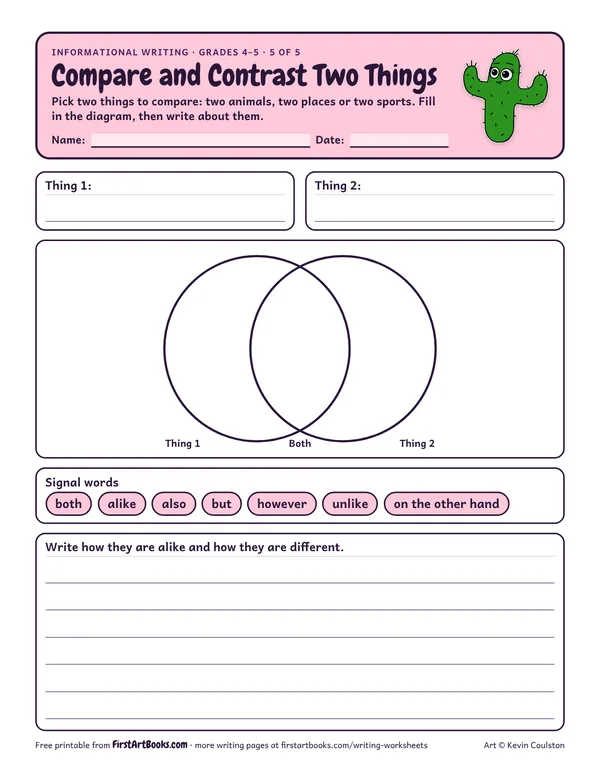
A Venn diagram plus compare-and-contrast signal words, then a paragraph about how two things are alike and different.
Print this sheet (PDF)Practice any word list, sort tricky endings and pick the right homophone. Grades 1–5.
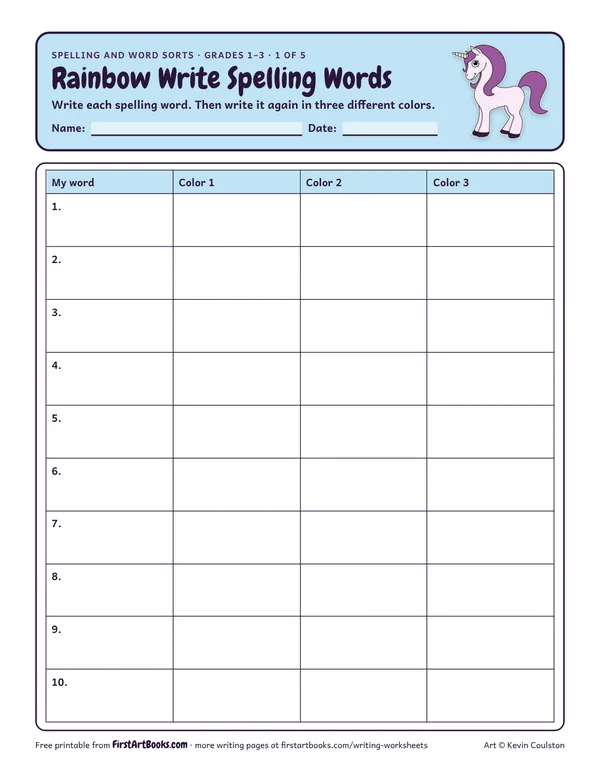
Rainbow writing for any spelling list: ten words, each written three more times in different colors.
Print this sheet (PDF)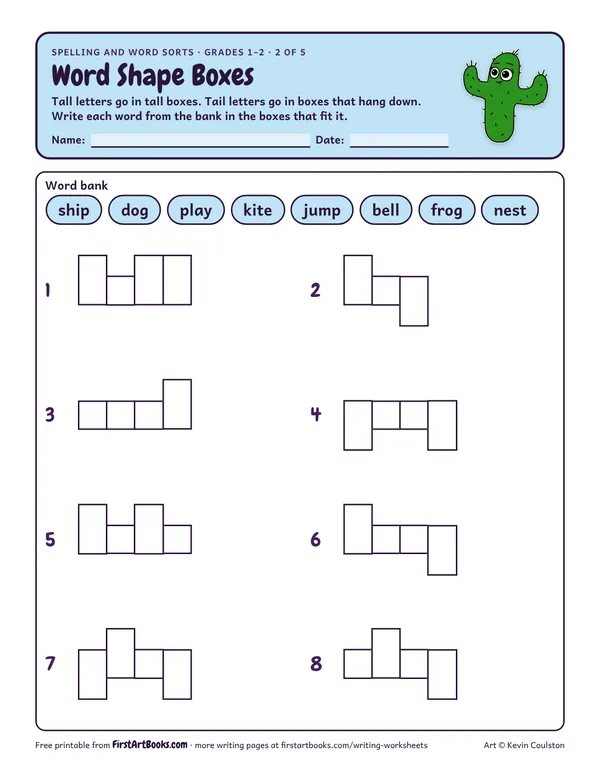
Eight word shapes to fill: kids match each word to its tall, small and tail letter boxes.
Print this sheet (PDF)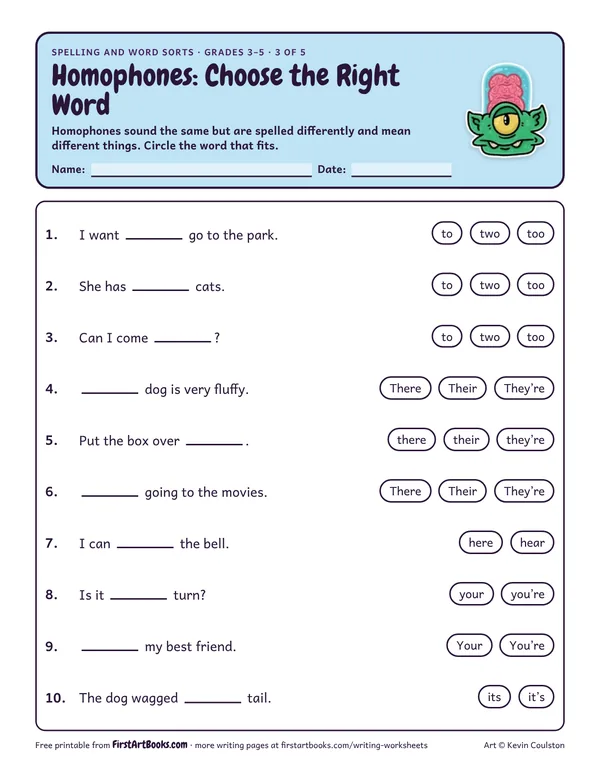
Ten sentences with to, two and too; there, their and they’re; hear and here; your and you’re; and its and it’s.
Print this sheet (PDF)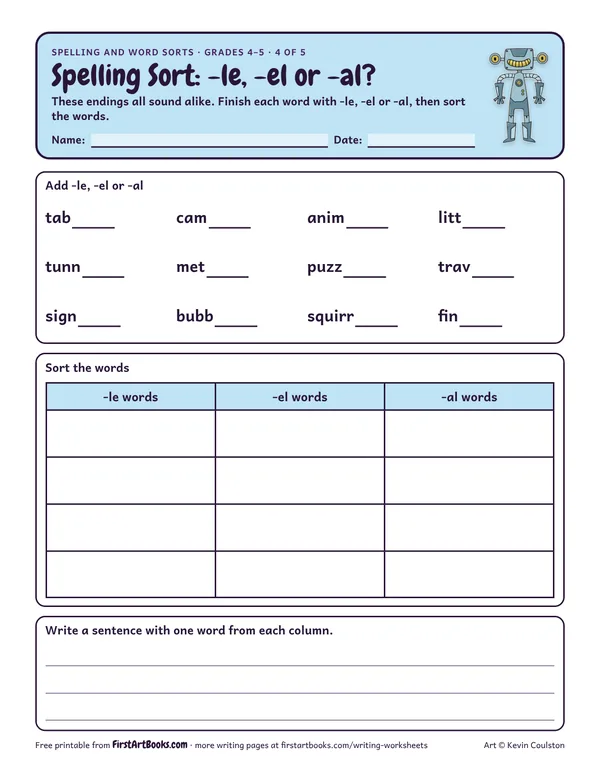
Twelve words to finish with -le, -el or -al and sort by ending, a tricky spelling pattern for upper grades.
Print this sheet (PDF)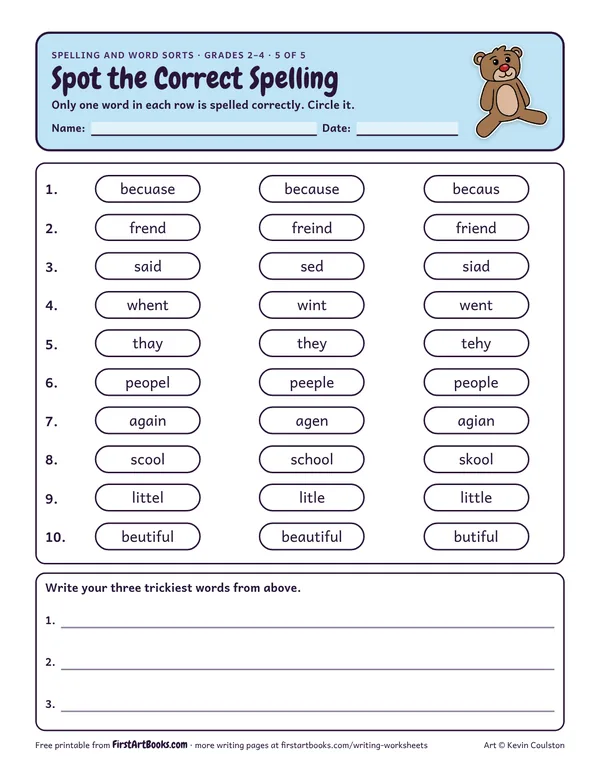
Ten rows of often-misspelled words like because, friend and people: kids circle the correct spelling.
Print this sheet (PDF)Topic sentences, details that belong, and editing and revising a paragraph. Grades 3–5.
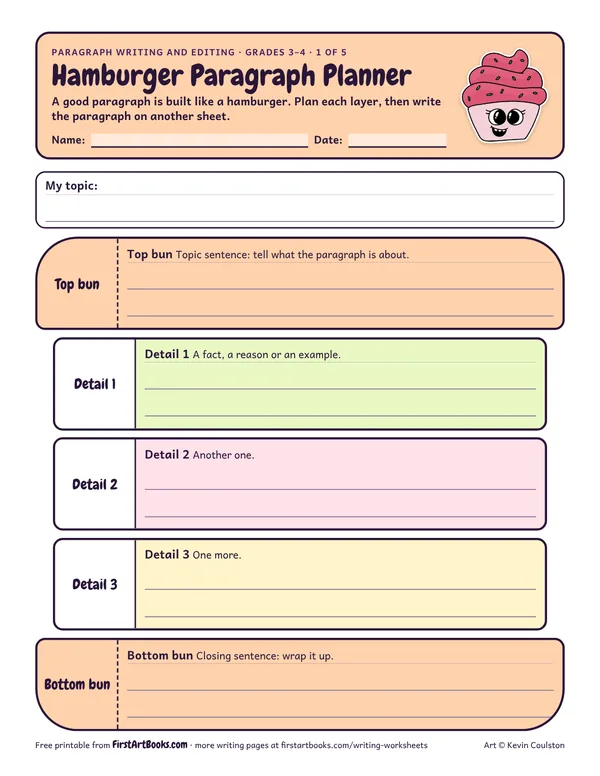
The hamburger organizer: a topic sentence bun, three detail fillings and a closing sentence bun.
Print this sheet (PDF)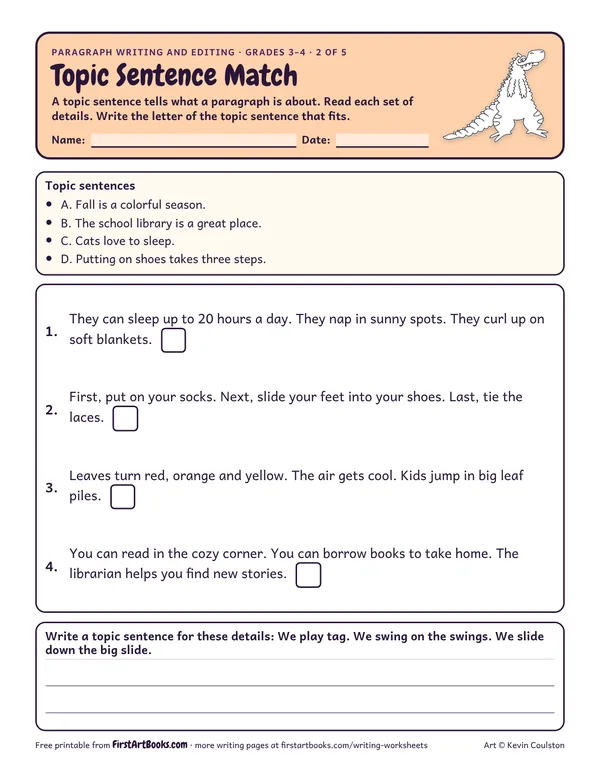
Four sets of detail sentences to match with their topic sentences, then a topic sentence to write.
Print this sheet (PDF)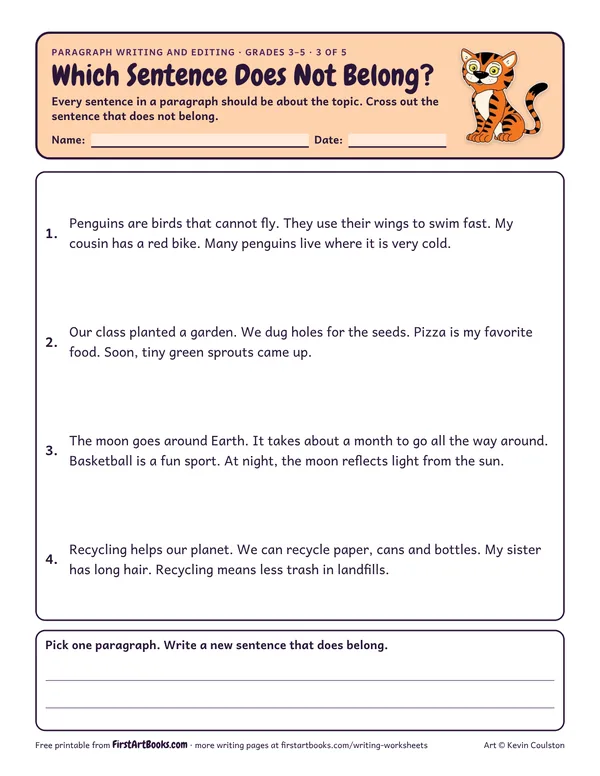
Four short paragraphs, each with one off-topic sentence to find and cross out.
Print this sheet (PDF)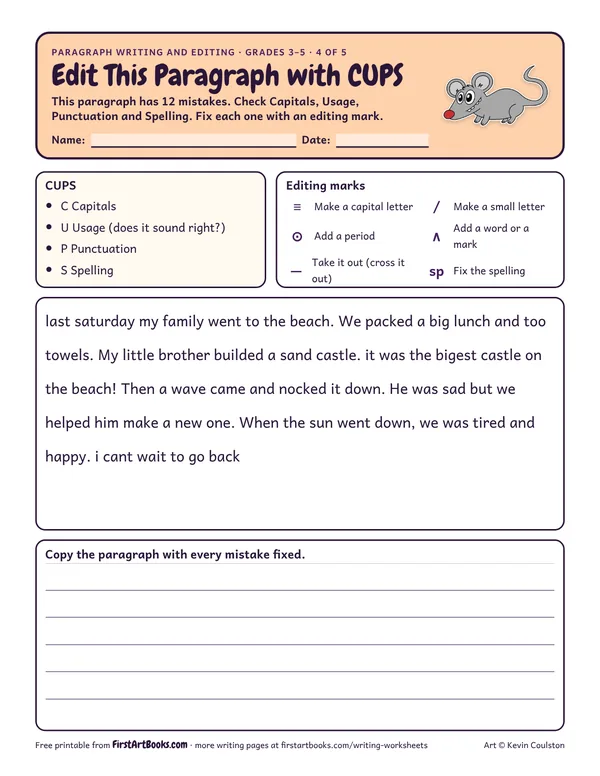
A beach-day paragraph with 12 mistakes to find with CUPS and proofreading marks, then copy correctly.
Print this sheet (PDF)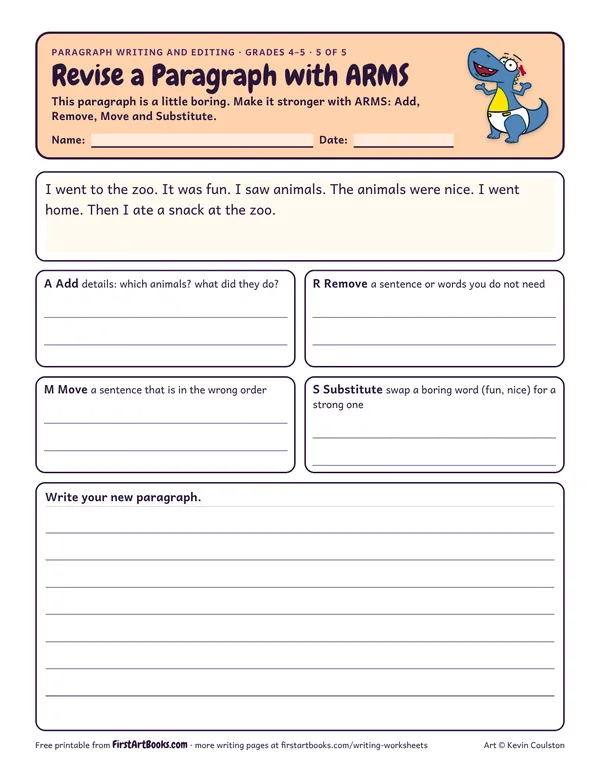
A plain zoo paragraph to revise with ARMS, with a plan box for each step and room to rewrite it.
Print this sheet (PDF)Each pack is one PDF with the topic’s 5 worksheets and its answer key, if it has one.
For opinion writing, swap in Pick an Opinion Prompt and the OREO Opinion Organizer.
Use Rainbow Write Spelling Words with any weekly spelling list.
Kevin Coulston’s Alphabet Monsters books turn every letter into a monster to draw, trace and color, a fun match for a handwriting or letter-sound unit. A sketchbook gives kids a place to keep drawing and writing their own stories.
As an Amazon Associate, FirstArtBooks earns from qualifying purchases.
Yes. All 50 worksheets and every answer key are free to print for home and classroom use. Print one sheet, a topic pack or the whole set.
Kindergarten to 5th grade. Each topic has a grade band (handwriting is K–2, sentence building K–3, the writing organizers 2–5 and paragraph editing 3–5), and every card shows its own grades. Use the grade buttons to see only the sheets for your class.
The 22 sheets with right-or-wrong answers (parts of speech, punctuation, homophones, spelling sorts, editing and more) have an answer key at the end of their topic pack, and all the keys are in one PDF too. Writing prompts and organizers are open-ended, so they have no key.
The handwriting sheets use school-style lines: a top line, a dashed middle line and a bottom line. Tall letters and capitals touch the top line, small letters reach the dashed line, and tail letters hang below the bottom line. The letters are in Andika, a font made for new readers, with the a and g that kids learn to write.
No. Every picture is one of Kevin Coulston’s own cartoon characters, the same ones in his drawing books, so kids can write about a robot, a unicorn, a class mouse or a slice of pizza with a job.
Memory words teachers use. OREO plans an opinion: Opinion, Reason, Example, Opinion. CUPS is for editing: Capitals, Usage, Punctuation, Spelling. ARMS is for revising: Add, Remove, Move, Substitute. Each has its own sheet.
Yes. The headers and boxes are light colors that look fine in gray. Sheets are US Letter and also print on A4.
All sheets are US Letter, print well in black and white, and are free for home and classroom use. More for teachers in the teacher resources library.
12 printable pages: six step-by-step lessons, a grid activity, draw-and-write sheets and teacher notes, sent with your welcome email. After that, new classroom printables by email.
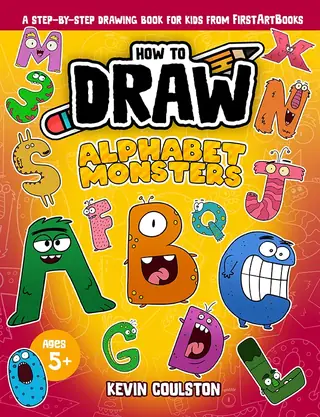 How to Draw: Alphabet Monsters
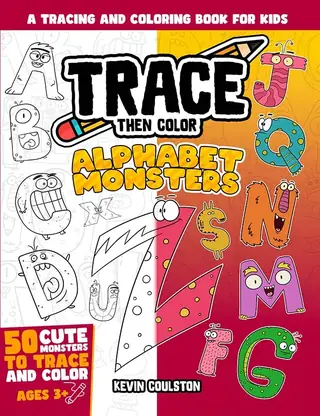 Trace Then Color: Alphabet Monsters
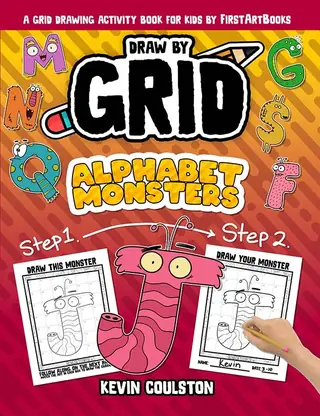 Draw by Grid: Alphabet Monsters
 How to Draw: Sketchbook: Extra Drawing Pages for the "How to Draw" Books by Kevin Coulston