

Grades K–2
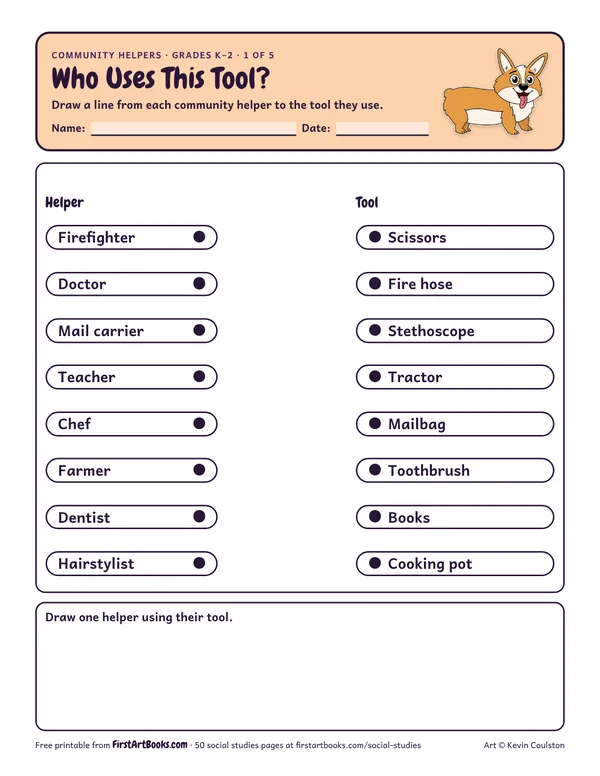
Who Uses This Tool?
Match 8 community helpers to the tools they use, from the firefighter’s hose to the doctor’s stethoscope.
Print this sheet (PDF)Teacher notes and tips200 free social studies worksheets in 10 topics, twenty each: community helpers, maps and cardinal directions, continents and oceans, U.S. states and capitals, American symbols, historical figures, needs and wants, cultures around the world, government and citizenship, and timelines. Real maps, answer keys and Kevin Coulston’s cartoon characters on every page.
No sheets for that grade in this topic.
Who helps us, the tools they use and where they work. Grades K–2.
Match 8 community helpers to the tools they use, from the firefighter’s hose to the doctor’s stethoscope.
Print this sheet (PDF)Teacher notes and tips
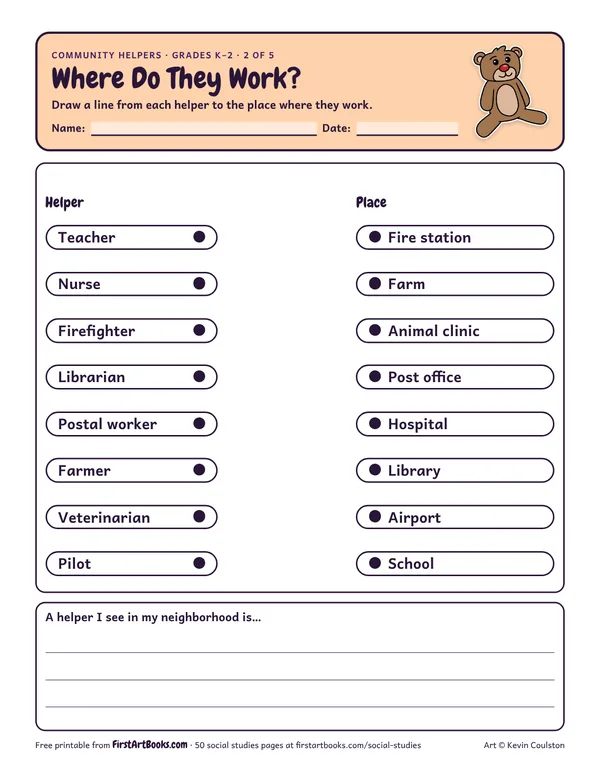
Connect 8 community helpers to their workplaces: school, hospital, fire station, library, post office and more.
Print this sheet (PDF)Teacher notes and tips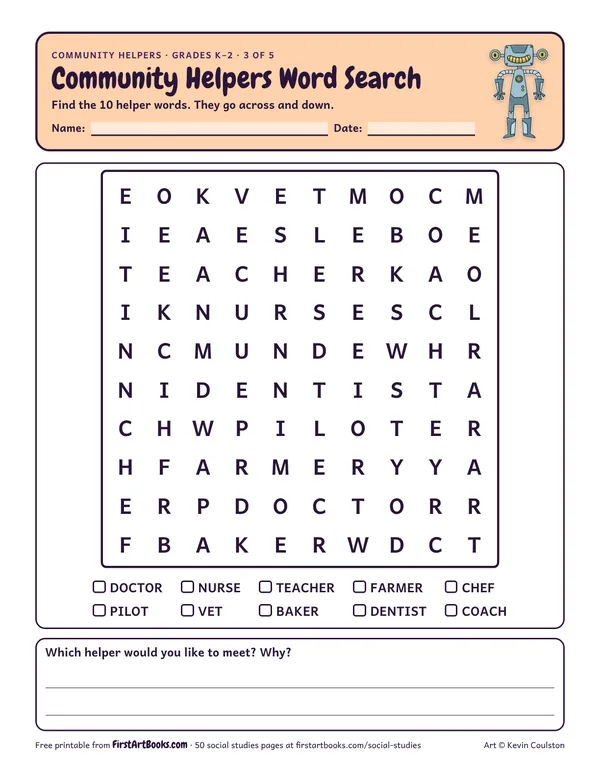
A 10 by 10 word search with 10 community helper words that run only across and down, just right for early readers.
Print this sheet (PDF)Teacher notes and tips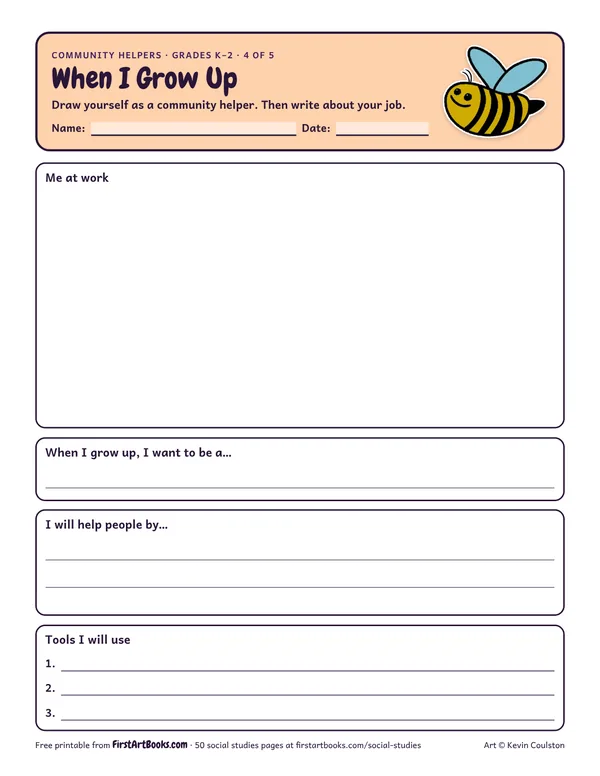
Kids draw themselves as the community helper they want to be, then write how they will help people.
Print this sheet (PDF)Teacher notes and tips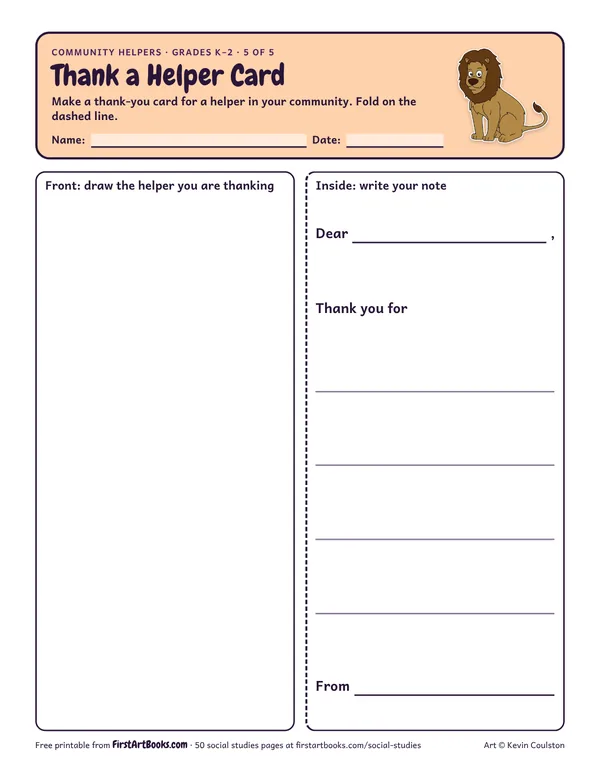
A fold-in-half thank-you card: draw a community helper on the front and write them a note inside.
Print this sheet (PDF)Teacher notes and tips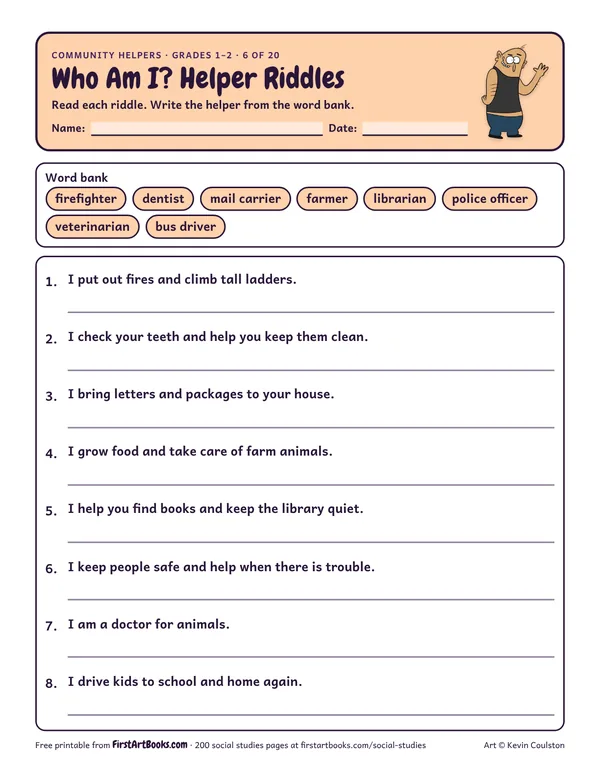
8 riddles about community helpers (“I put out fires and climb tall ladders”): read the clue and write the helper from the word bank.
Print this sheet (PDF)Teacher notes and tips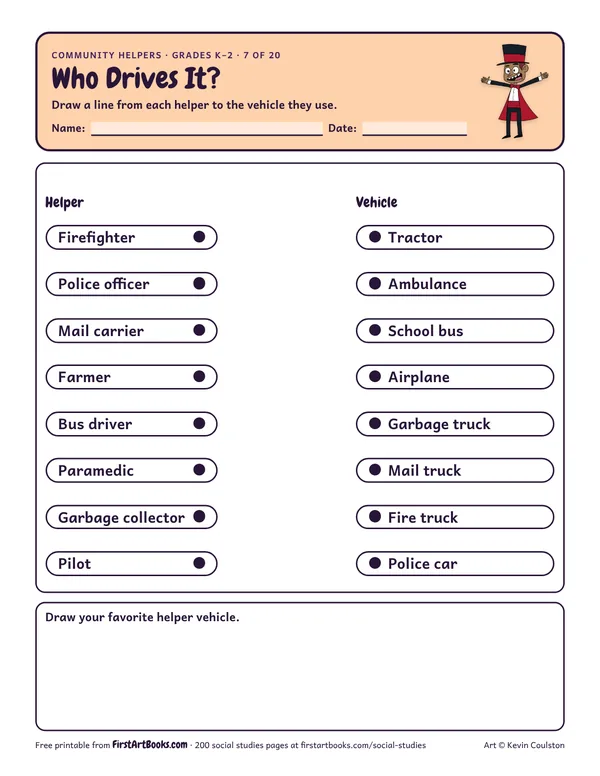
Match 8 community helpers to their vehicles: fire truck, police car, mail truck, tractor, school bus, ambulance, garbage truck and airplane.
Print this sheet (PDF)Teacher notes and tips

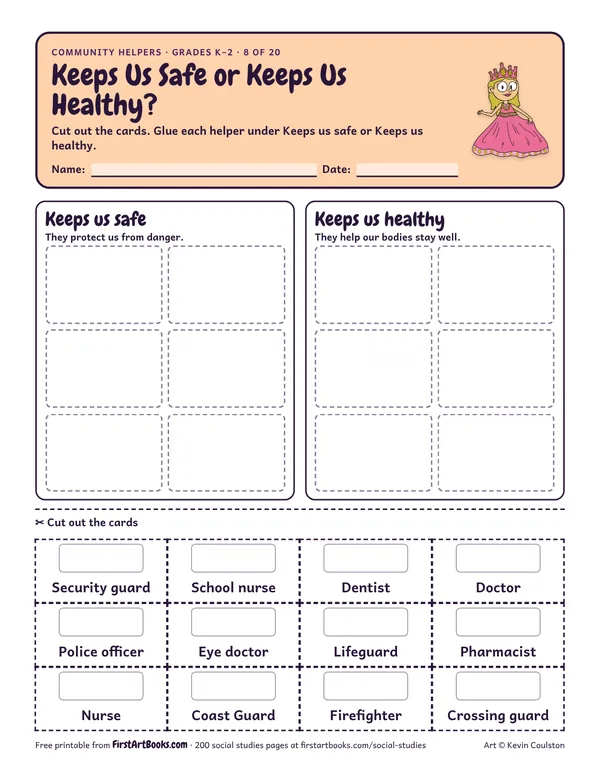
Cut out 12 helper cards and sort them: the ones who keep us safe (firefighter, crossing guard, lifeguard) and the ones who keep us healthy (doctor, nurse, dentist).
Print this sheet (PDF)Teacher notes and tips
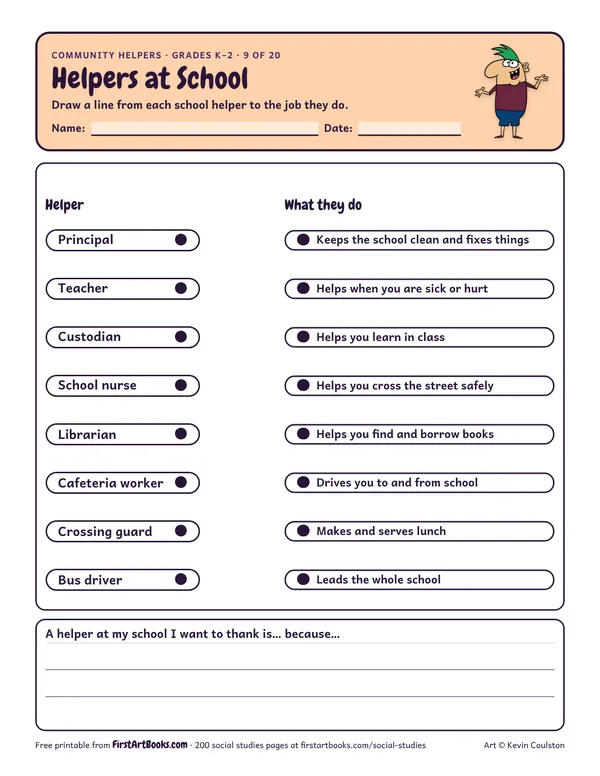
Match 8 people who help at school, from the principal and custodian to the crossing guard and cafeteria worker, to what they do.
Print this sheet (PDF)Teacher notes and tips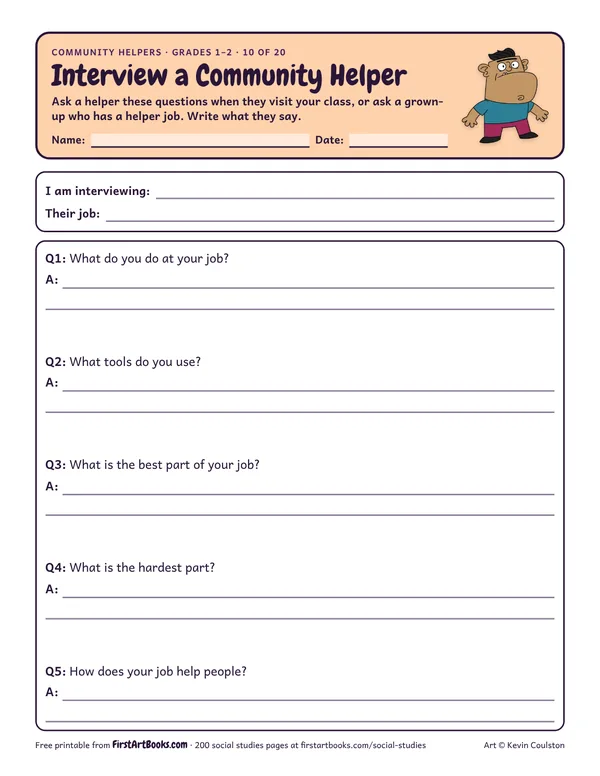
Five interview questions for a classroom visitor or a helper at home: what they do, their tools, their favorite part and how they help people.
Print this sheet (PDF)Teacher notes and tips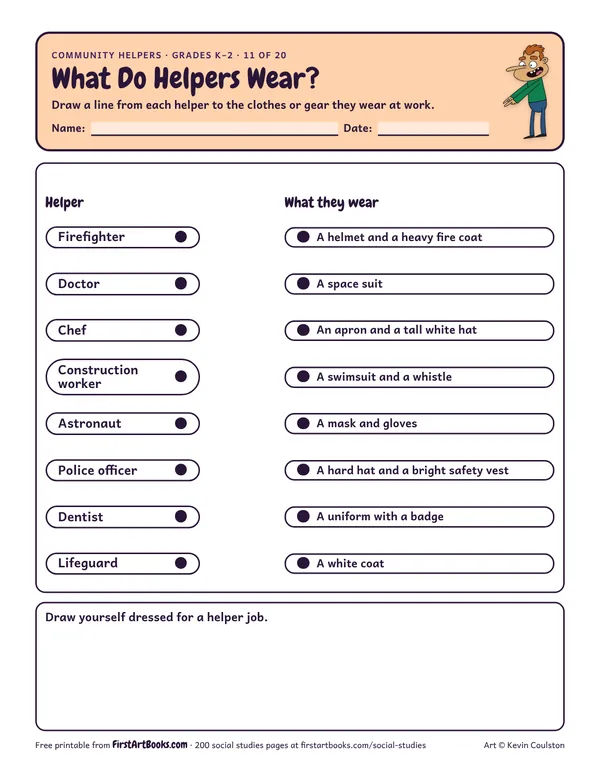
Match 8 community helpers to their work clothes and safety gear, from the firefighter’s helmet to the construction worker’s hard hat.
Print this sheet (PDF)Teacher notes and tips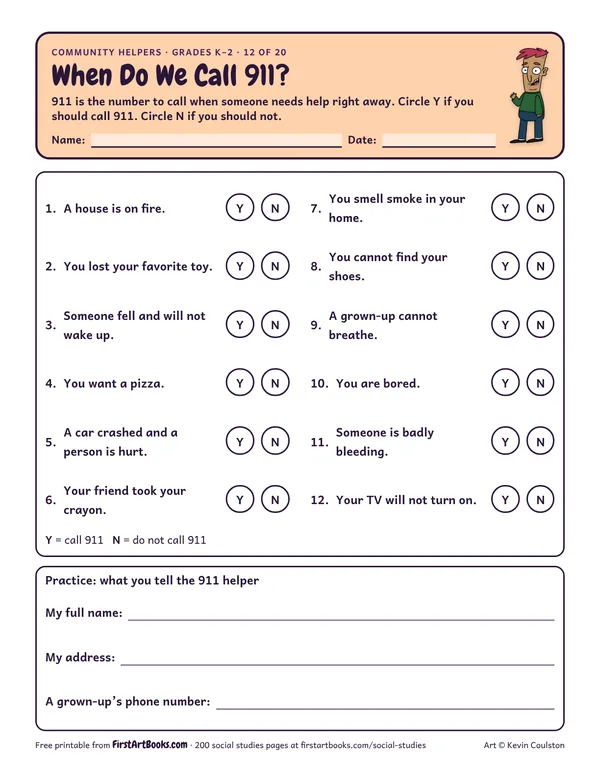
12 everyday situations to sort: call 911 for a fire or someone who is badly hurt, but not for a lost toy. Then kids practice their own name and address.
Print this sheet (PDF)Teacher notes and tips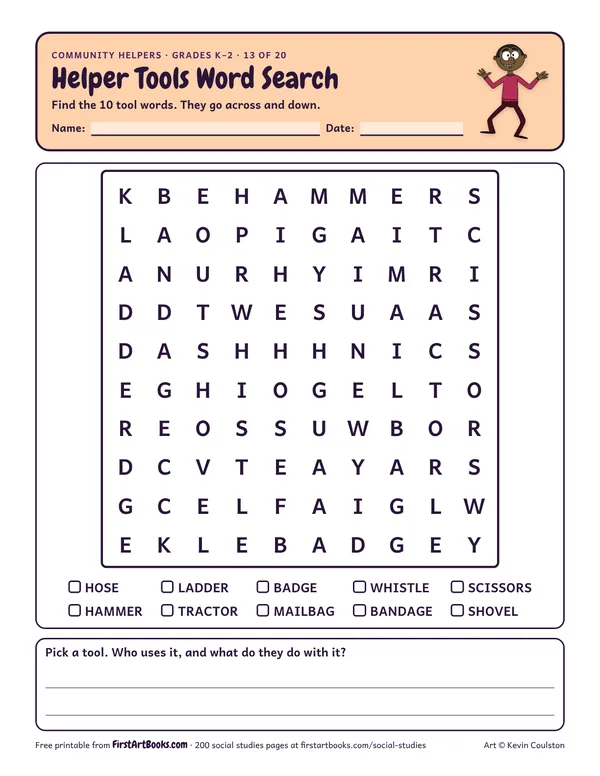
A 10 by 10 word search of the tools community helpers use: hose, ladder, badge, whistle, scissors, hammer and more.
Print this sheet (PDF)Teacher notes and tips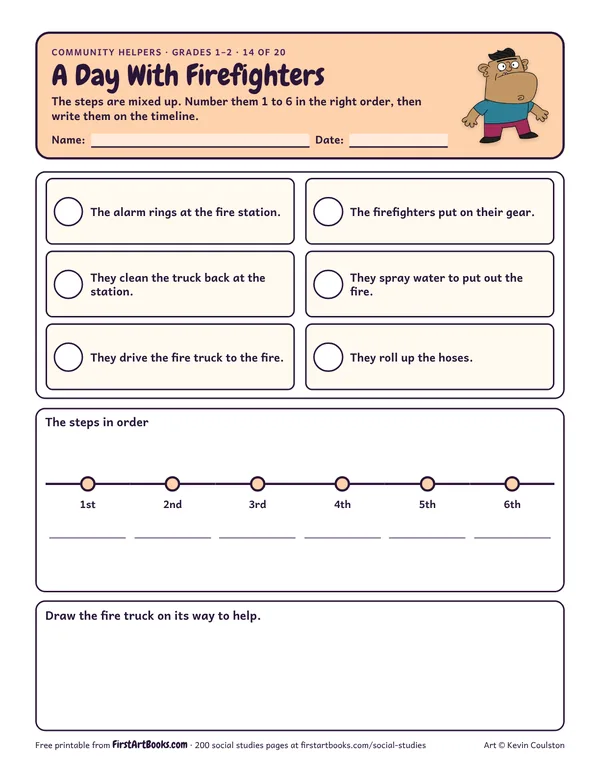
Put 6 steps of a firefighter call in order, from the alarm at the station to cleaning the fire truck, then draw the fire truck.
Print this sheet (PDF)Teacher notes and tips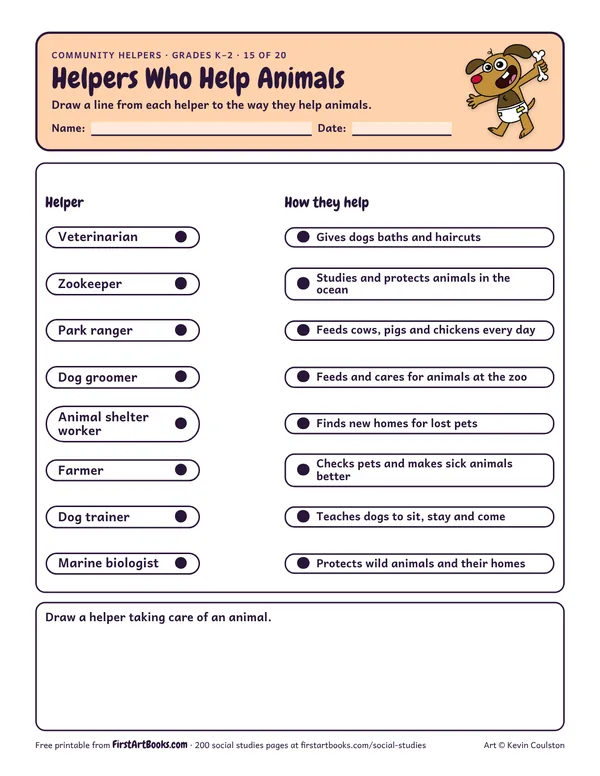
Match 8 people who work with animals, from the zookeeper and park ranger to the dog groomer and animal shelter worker, to what they do.
Print this sheet (PDF)Teacher notes and tips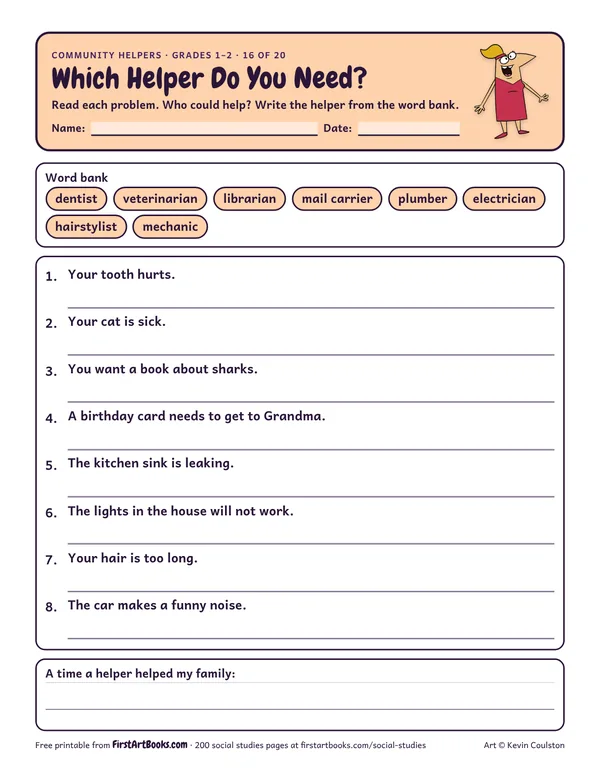
8 everyday problems, from a toothache to a leaky sink: kids read each one and write the community helper who can fix it.
Print this sheet (PDF)Teacher notes and tips
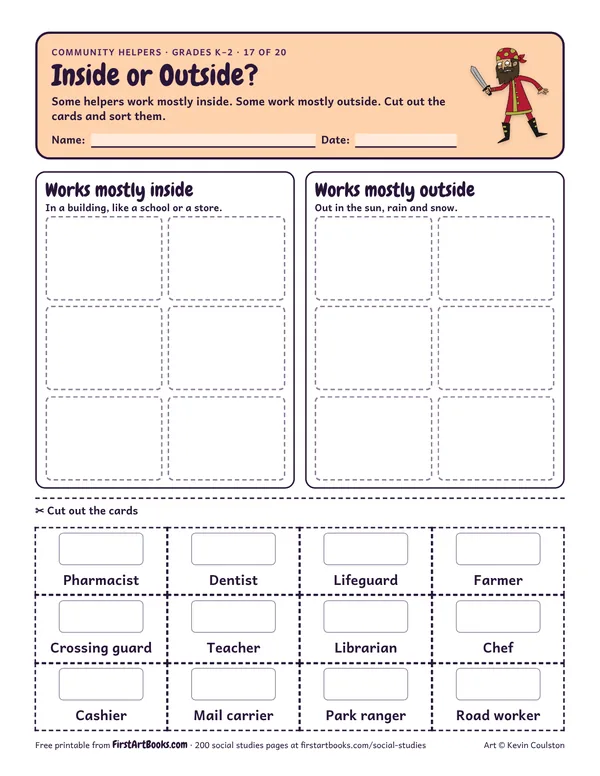
Cut out 12 community helper cards and sort them by where they do most of their work: inside (librarian, dentist, cashier) or outside (farmer, crossing guard, park ranger).
Print this sheet (PDF)Teacher notes and tips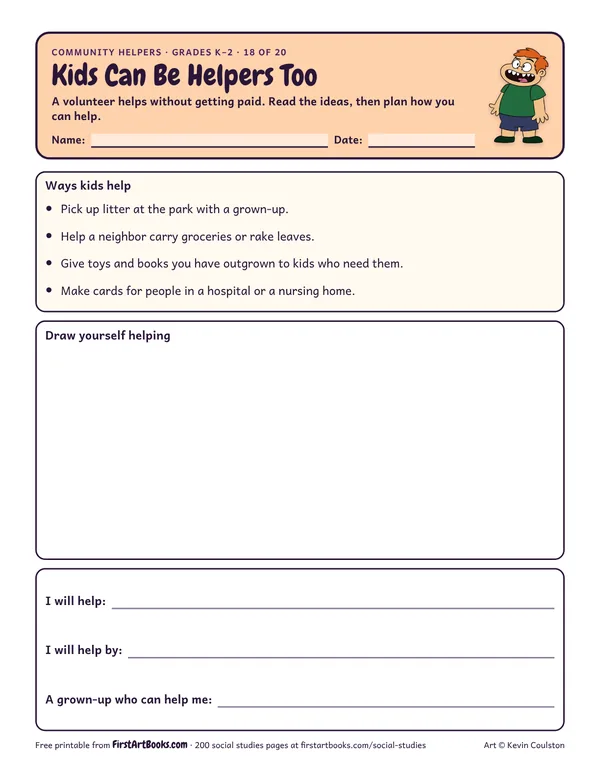
Read 4 ways kids can volunteer (pick up litter, help a neighbor, donate toys, make cards), then plan and draw a helping project of your own.
Print this sheet (PDF)Teacher notes and tips
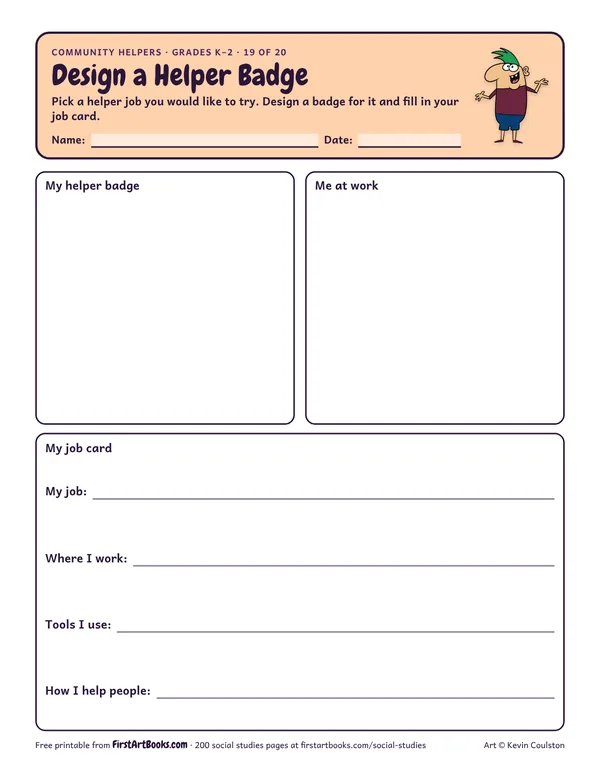
Kids pick a community helper job, design a badge for it and fill in a job card: the job, where they work, their tools and how they help.
Print this sheet (PDF)Teacher notes and tips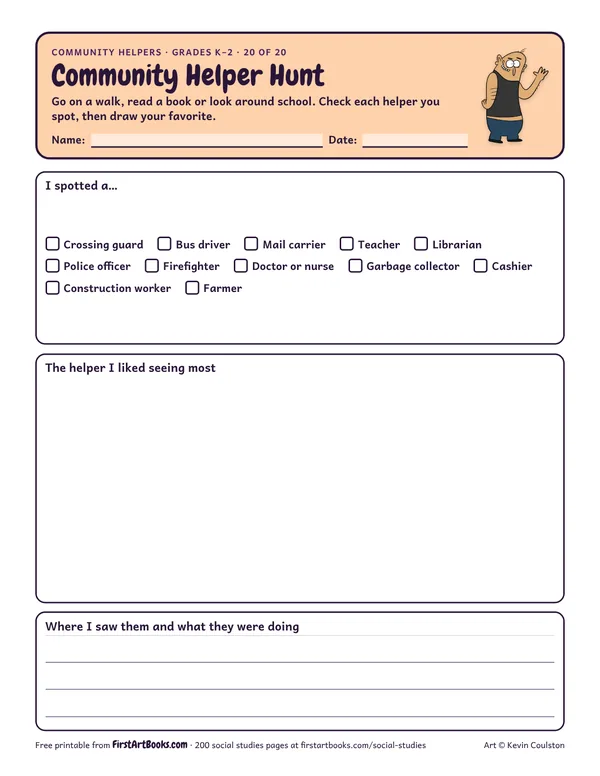
A helper scavenger hunt: kids check off 12 community helpers they spot on a walk, in a book or at school, then draw and write about one.
Print this sheet (PDF)Teacher notes and tipsCompass roses, map keys, grid squares and north, south, east and west. Grades 1–5.
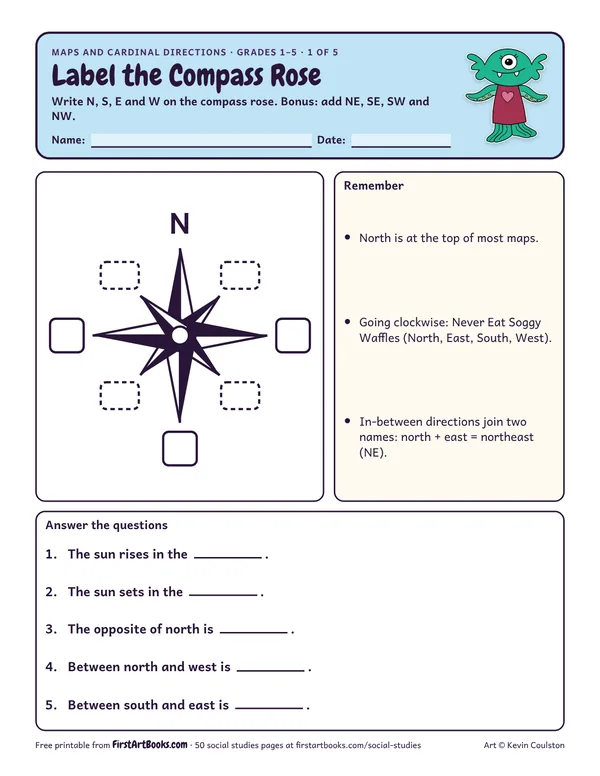
Label the four cardinal directions and the four in-between (intermediate) directions on a compass rose, then answer sun and map questions.
Print this sheet (PDF)Teacher notes and tips

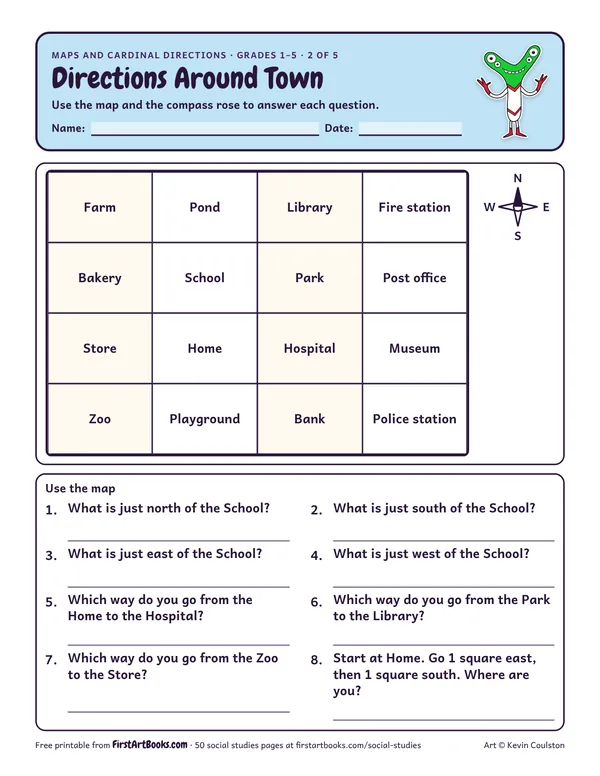
A 16-square town map with a compass rose: kids find what is north, south, east and west of each place.
Print this sheet (PDF)Teacher notes and tips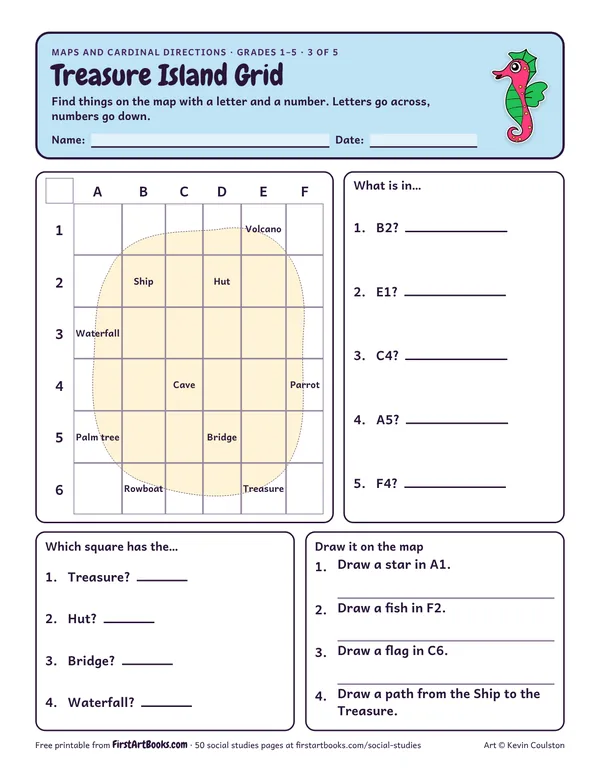
A lettered and numbered treasure island map: read grid squares like C4, then draw new things in the squares you are given.
Print this sheet (PDF)Teacher notes and tips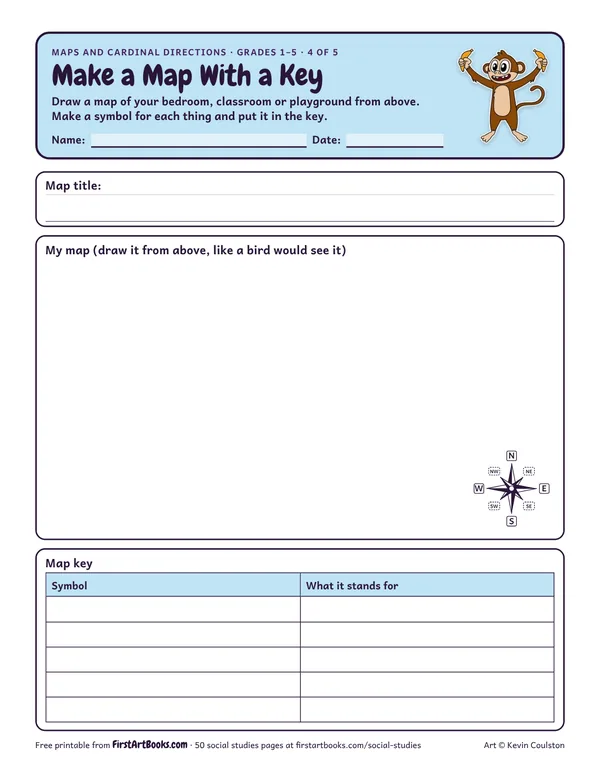
Draw a bird’s-eye map of a real place, add a compass rose and build a map key (legend) with your own symbols.
Print this sheet (PDF)Teacher notes and tips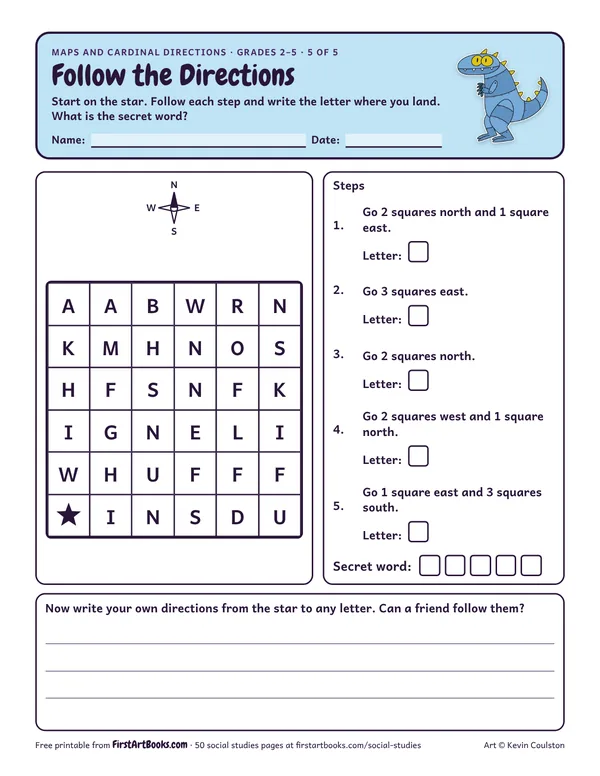
Follow north, south, east and west steps on a letter grid to spell a secret map word.
Print this sheet (PDF)Teacher notes and tips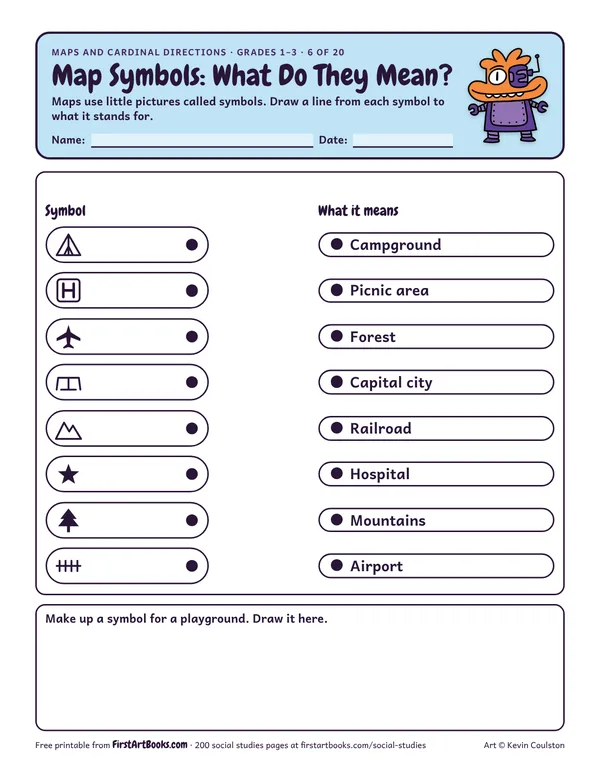
Match 8 common map symbols (tent, H, airplane, picnic table, mountains, star, tree and railroad) to what they mean on a map key.
Print this sheet (PDF)Teacher notes and tips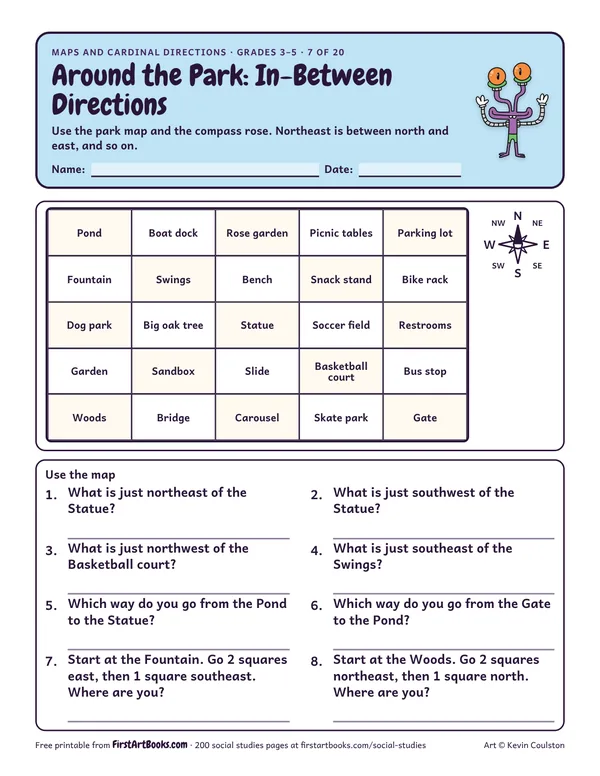
A 25-square park map for the intermediate directions: what is northeast of the statue, which way is the gate from the pond, and more.
Print this sheet (PDF)Teacher notes and tips
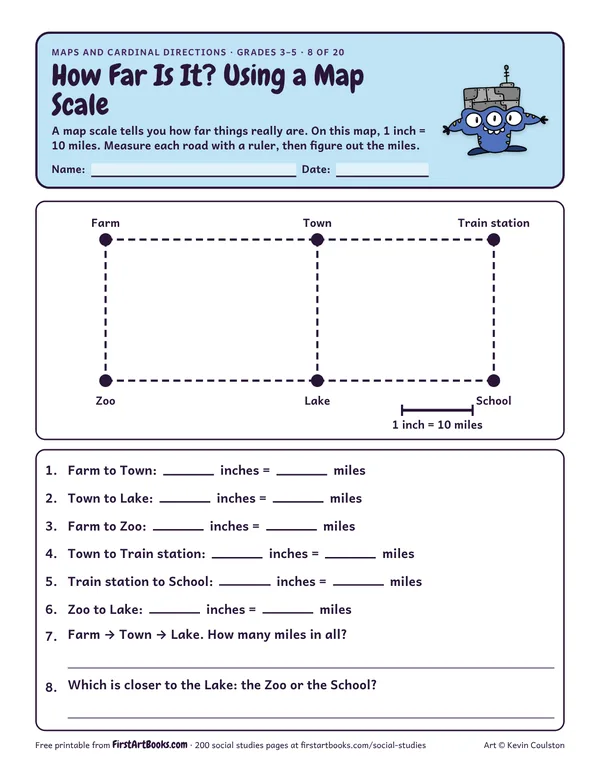
Measure straight roads with a ruler on a map drawn to scale (1 inch = 10 miles) and work out the real distances between the farm, the town, the lake and the school.
Print this sheet (PDF)Teacher notes and tips
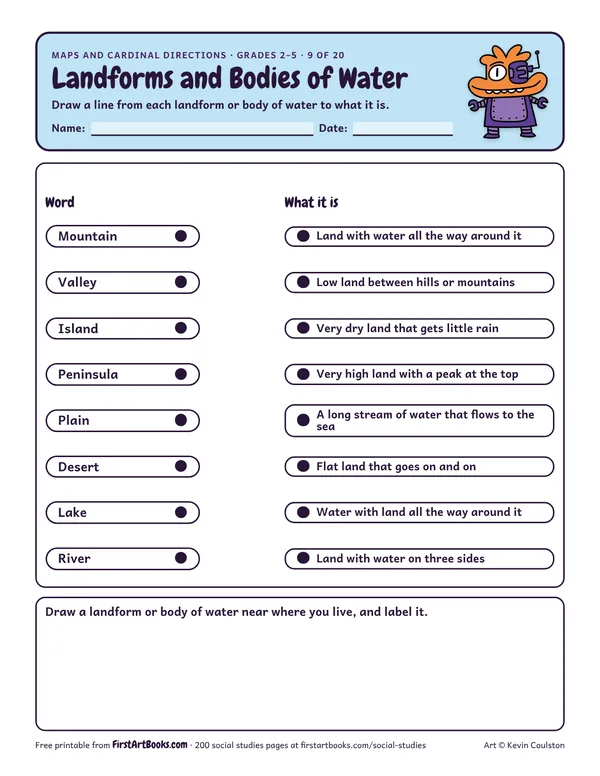
Match 8 geography words, from mountain and valley to island, peninsula, lake and river, to their meanings, then draw a landform you have seen.
Print this sheet (PDF)Teacher notes and tips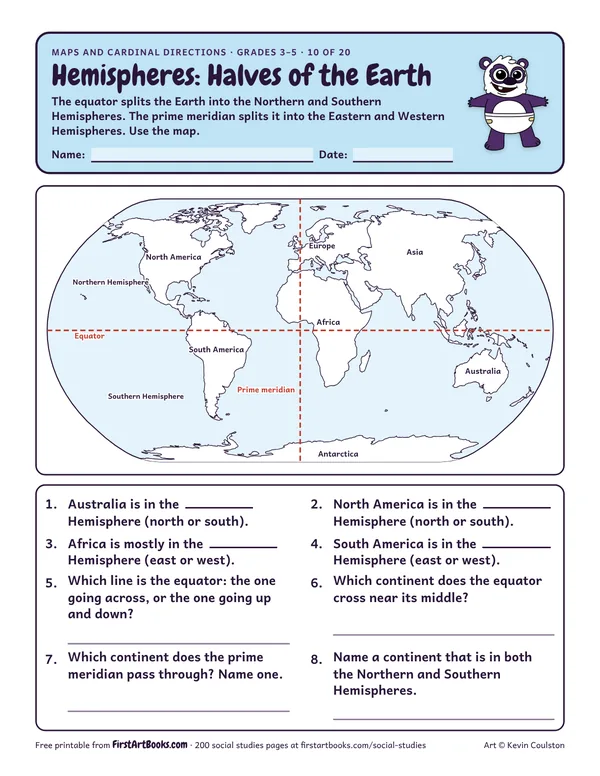
A world map with the equator and prime meridian drawn in: name the hemisphere each continent is in and answer questions about the two halves of the Earth.
Print this sheet (PDF)Teacher notes and tips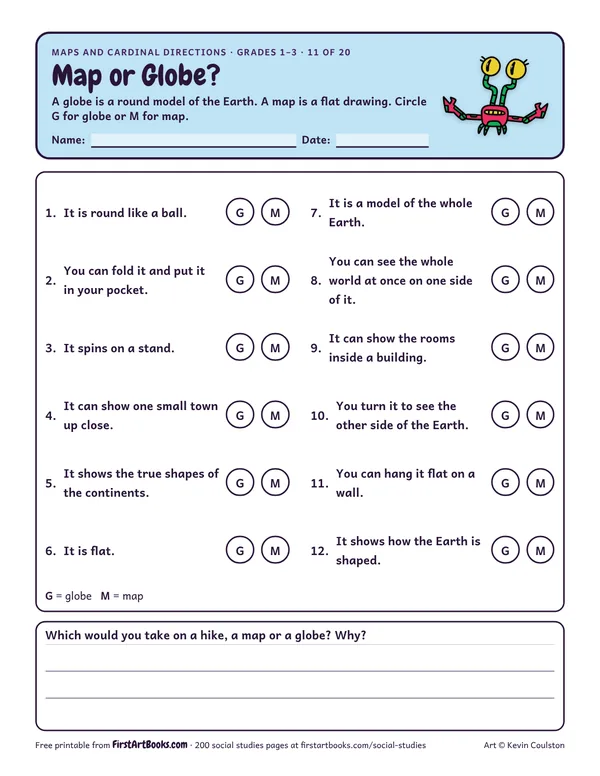
12 sentences that compare maps and globes: Which one can fold into a pocket? Which one shows the true shapes of the continents? Answer key included.
Print this sheet (PDF)Teacher notes and tips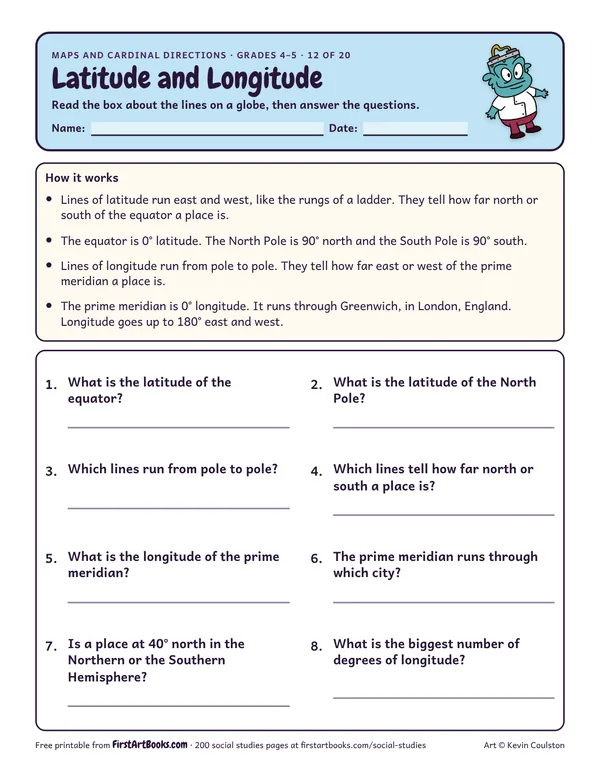
Learn how lines of latitude and longitude work (the equator is 0°, the poles are 90°, the prime meridian runs through Greenwich), then answer 8 questions.
Print this sheet (PDF)Teacher notes and tips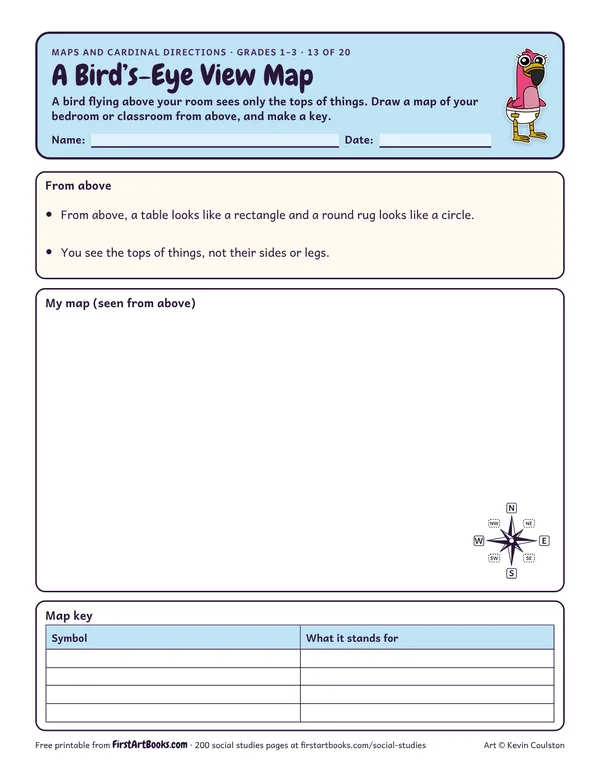
Kids learn what a bird’s-eye view is, then draw a map of their bedroom or classroom from above with a map key of 4 symbols.
Print this sheet (PDF)Teacher notes and tips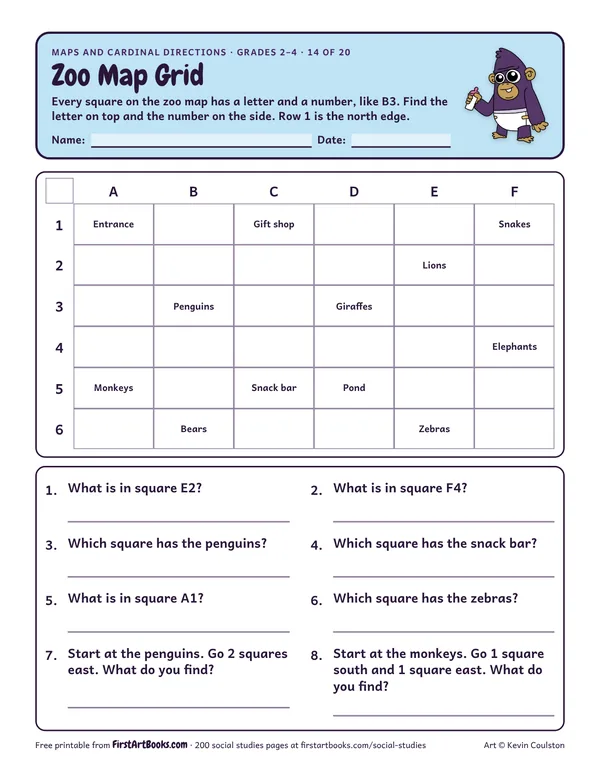
A 6 by 6 lettered zoo map: find what is in each square, write the square for each animal and follow directions from one exhibit to another.
Print this sheet (PDF)Teacher notes and tips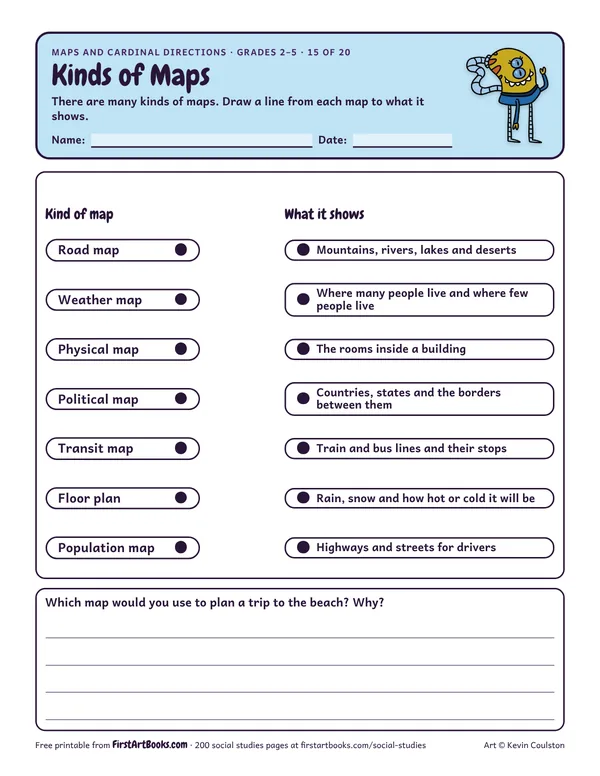
Match 7 kinds of maps, from road maps and weather maps to physical, political and transit maps, to what each one shows.
Print this sheet (PDF)Teacher notes and tips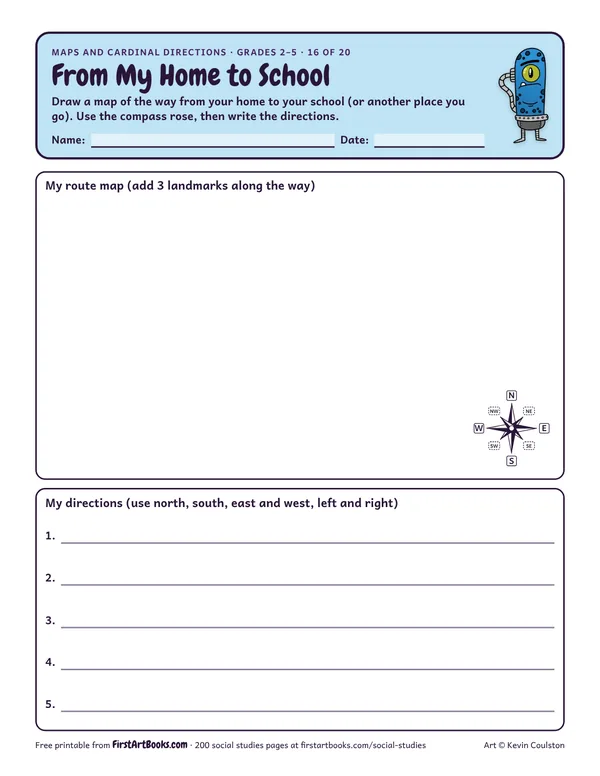
Kids draw a route map from home to school with landmarks along the way, then write step-by-step directions using north, south, east and west.
Print this sheet (PDF)Teacher notes and tips

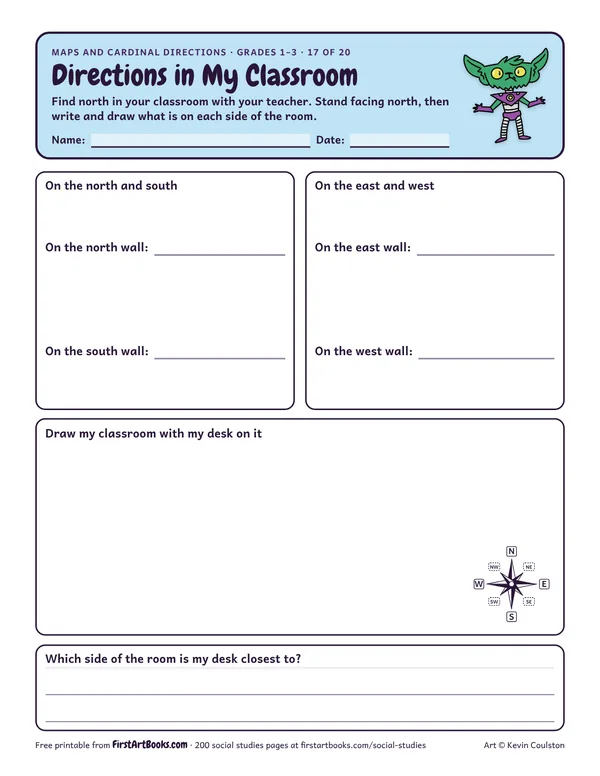
A hands-on compass page: kids find north in their classroom, then record and draw what is on the north, south, east and west sides of the room.
Print this sheet (PDF)Teacher notes and tips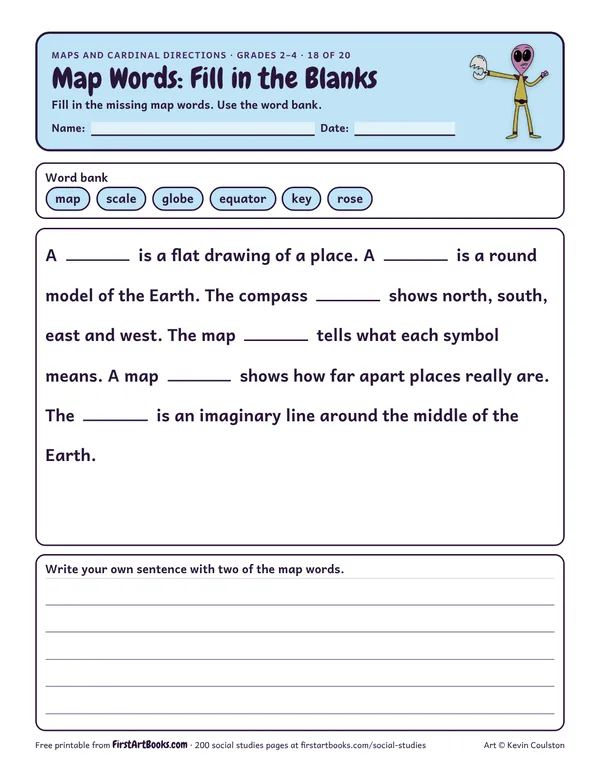
Fill in 6 missing geography words (map, globe, compass rose, key, scale and equator) in a short paragraph, then use two of them in your own sentences.
Print this sheet (PDF)Teacher notes and tips
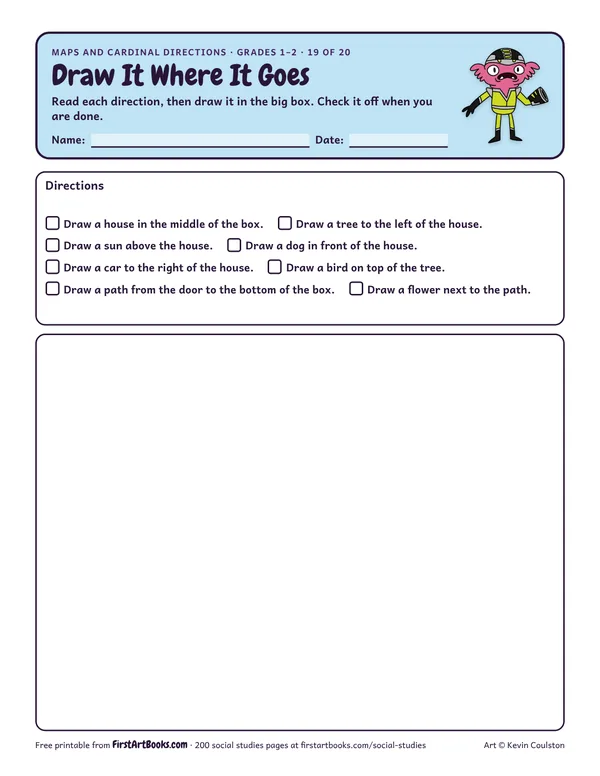
A follow-the-directions drawing page for position words: draw a house in the middle, a tree to its left, a sun above it, a dog in front and more.
Print this sheet (PDF)Teacher notes and tips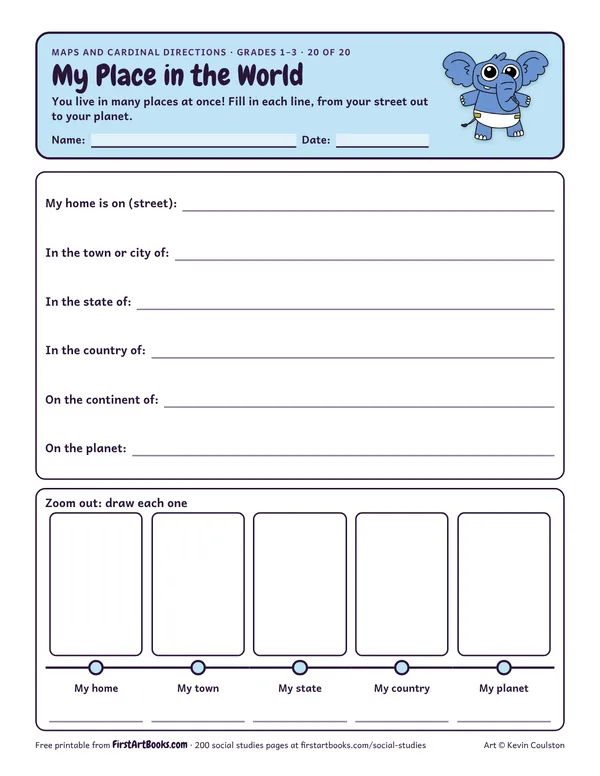
A where-I-live organizer that zooms out from home to street, town, state, country, continent and planet, with a drawing of each step.
Print this sheet (PDF)Teacher notes and tipsLabel, color and learn the 7 continents and 5 oceans. Grades 1–5.
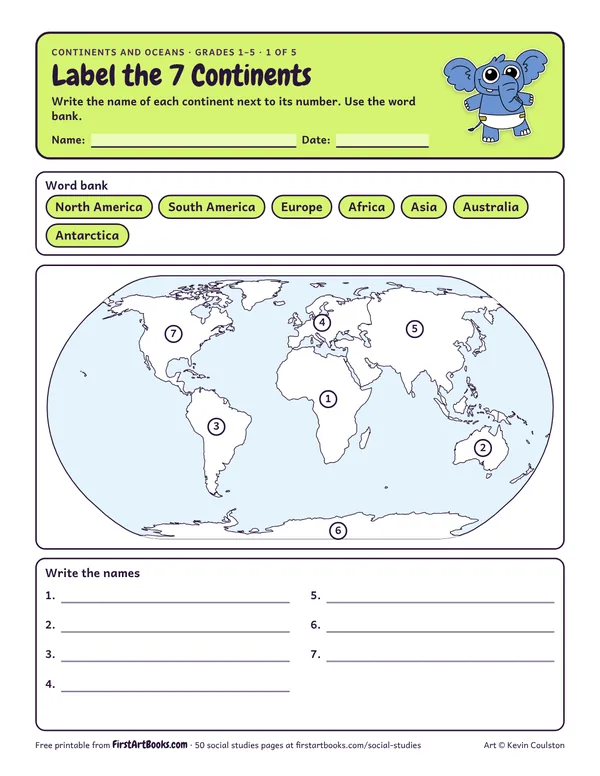
A world map with the 7 continents numbered: write each name from the word bank. Answer key included.
Print this sheet (PDF)Teacher notes and tips
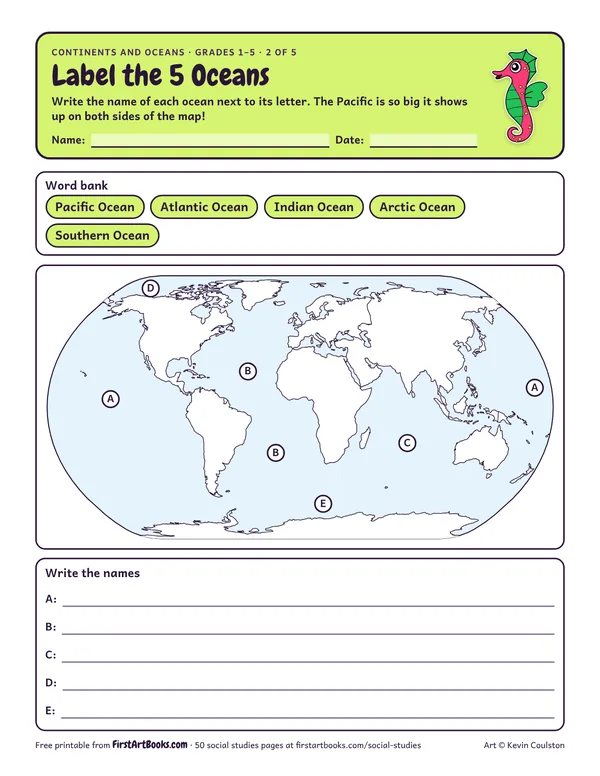
A world map with the 5 oceans lettered (Pacific, Atlantic, Indian, Arctic and Southern) to label from a word bank.
Print this sheet (PDF)Teacher notes and tips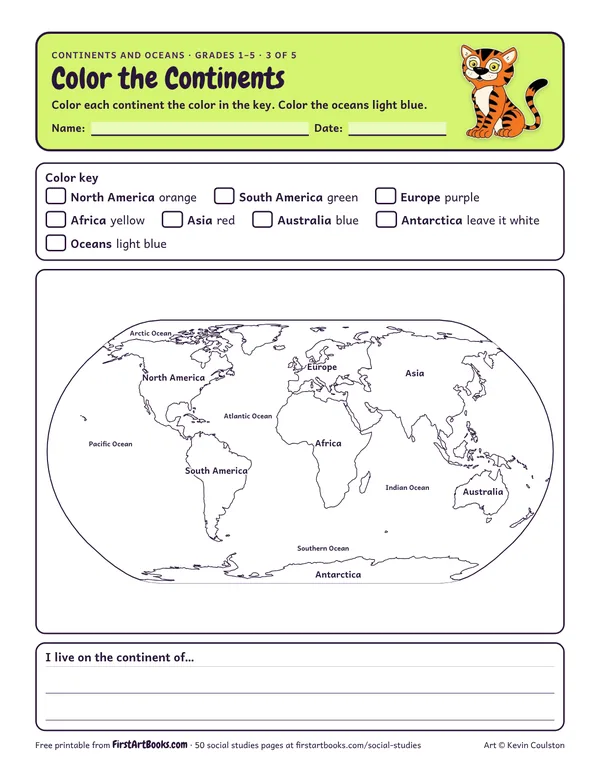
A labeled world map to color, with a color key for each continent, so kids learn where all 7 continents are.
Print this sheet (PDF)Teacher notes and tips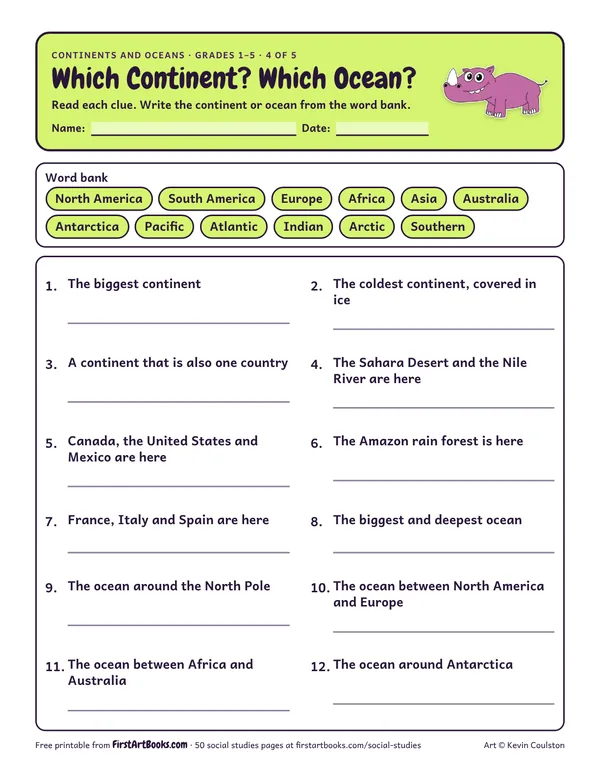
12 clue questions about the largest continent, the coldest continent, the deepest ocean and more.
Print this sheet (PDF)Teacher notes and tips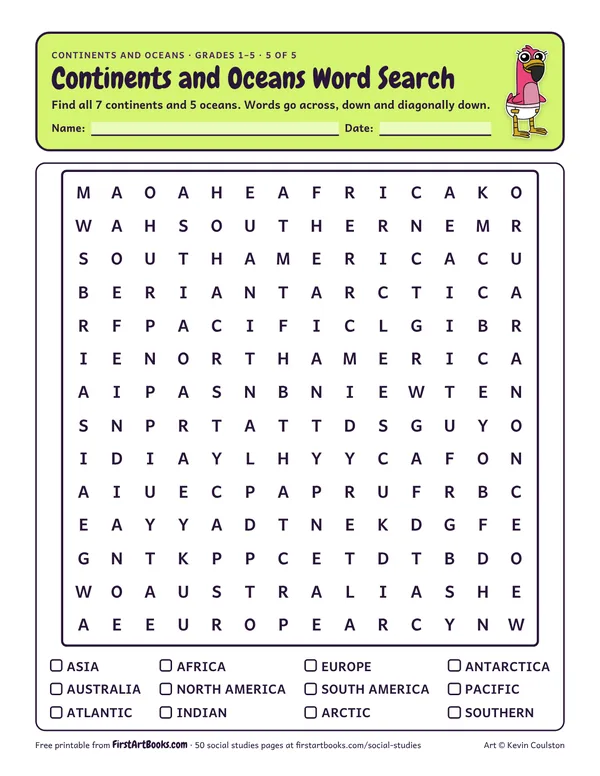
Find all 7 continents and 5 oceans in a 14 by 14 word search. Two-word names are written without a space.
Print this sheet (PDF)Teacher notes and tips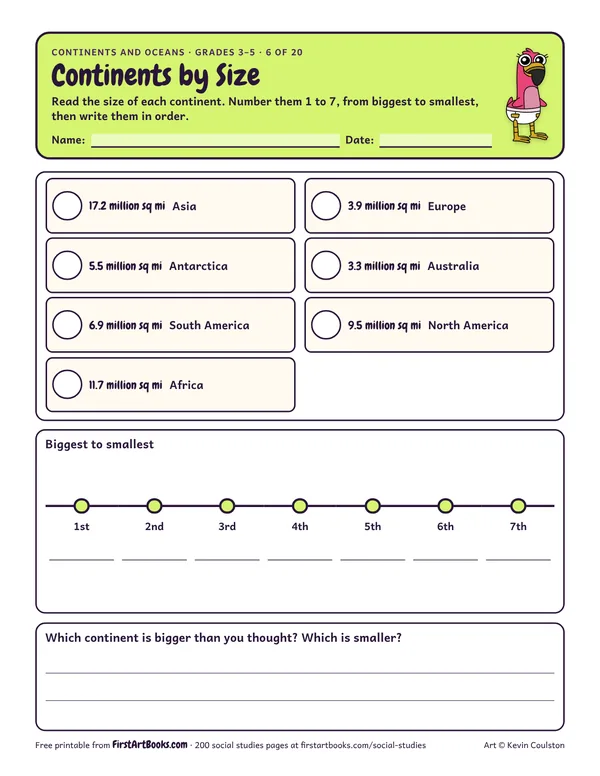
Rank all 7 continents from largest to smallest by their area in square miles, then write the order on a timeline.
Print this sheet (PDF)Teacher notes and tips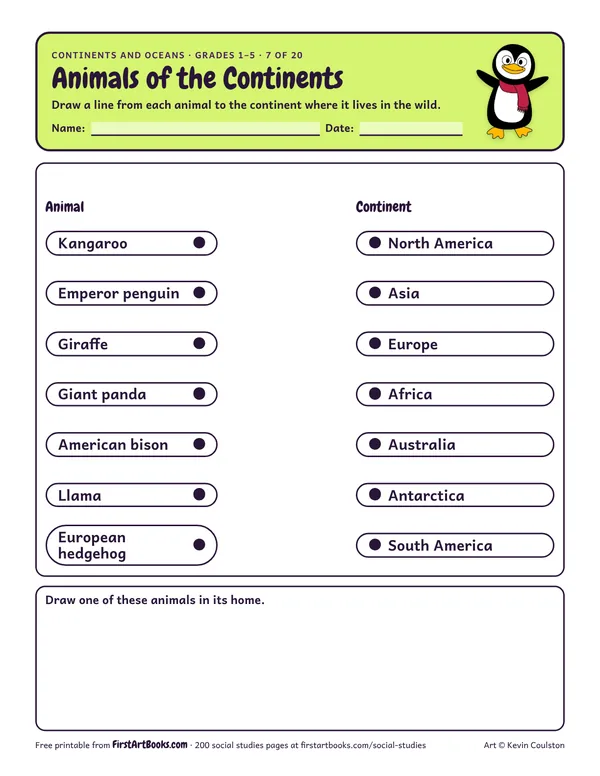
Match 7 animals, from the kangaroo and emperor penguin to the giant panda and llama, to the continent each one calls home.
Print this sheet (PDF)Teacher notes and tips
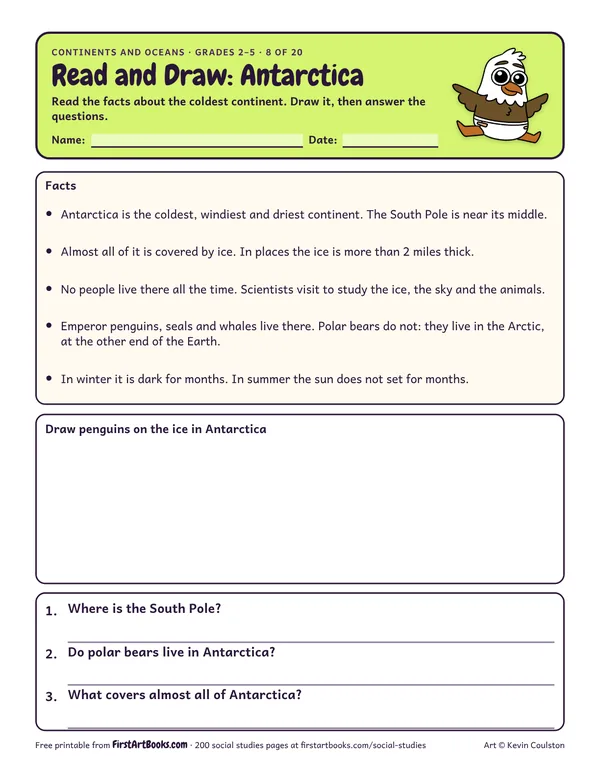
Read 5 facts about Antarctica (the South Pole, ice 2 miles thick, no permanent people, penguins but no polar bears), draw a scene and answer 3 questions.
Print this sheet (PDF)Teacher notes and tips
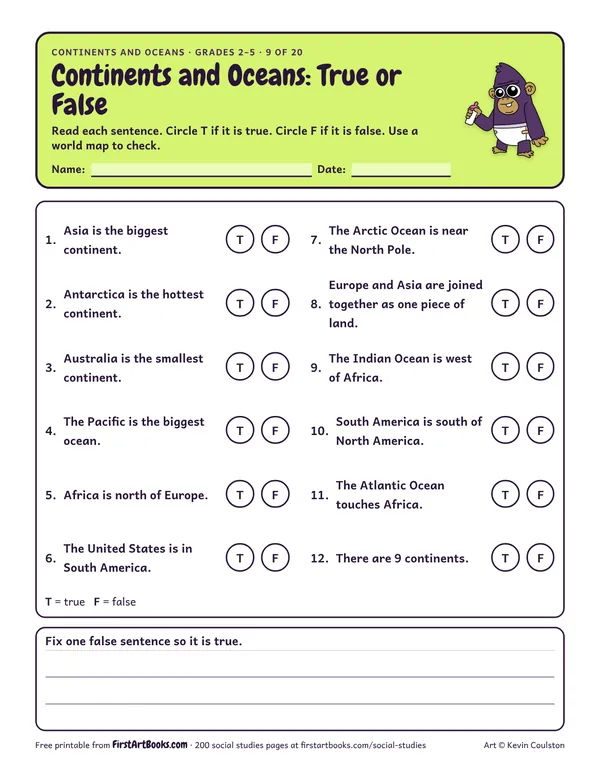
12 true-or-false sentences about the continents and oceans: Is Asia the biggest? Is the Indian Ocean west of Africa? Answer key included.
Print this sheet (PDF)Teacher notes and tips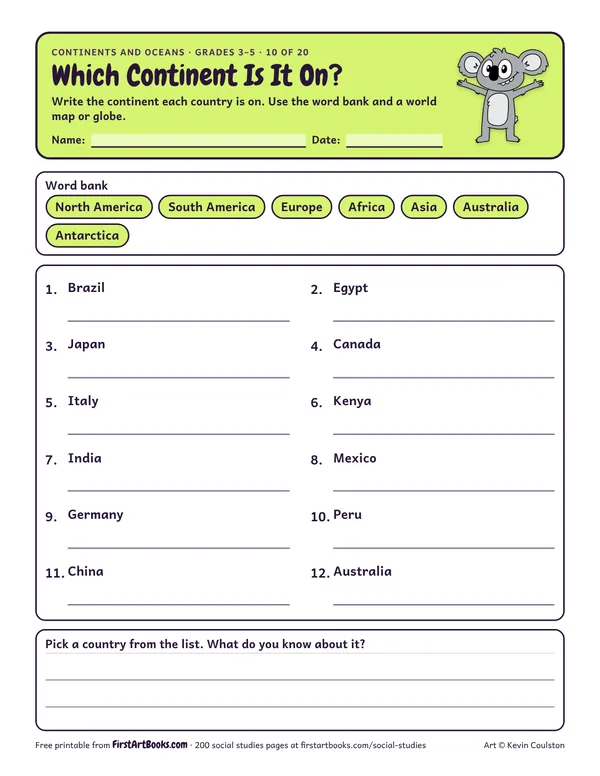
12 countries, from Brazil and Egypt to Japan and Canada: write the continent each one is on, using a globe or atlas.
Print this sheet (PDF)Teacher notes and tips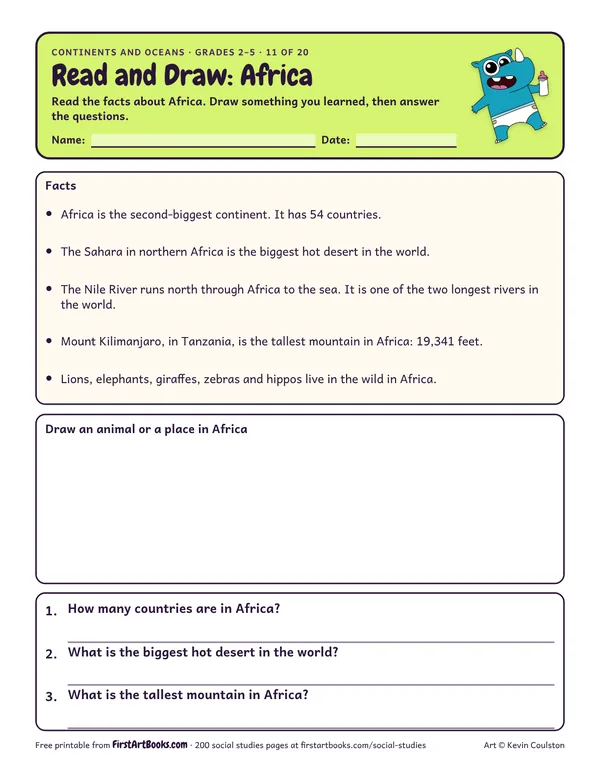
Read 5 facts about Africa (54 countries, the Sahara Desert, the Nile River, Mount Kilimanjaro, lions and elephants), draw a scene and answer 3 questions.
Print this sheet (PDF)Teacher notes and tips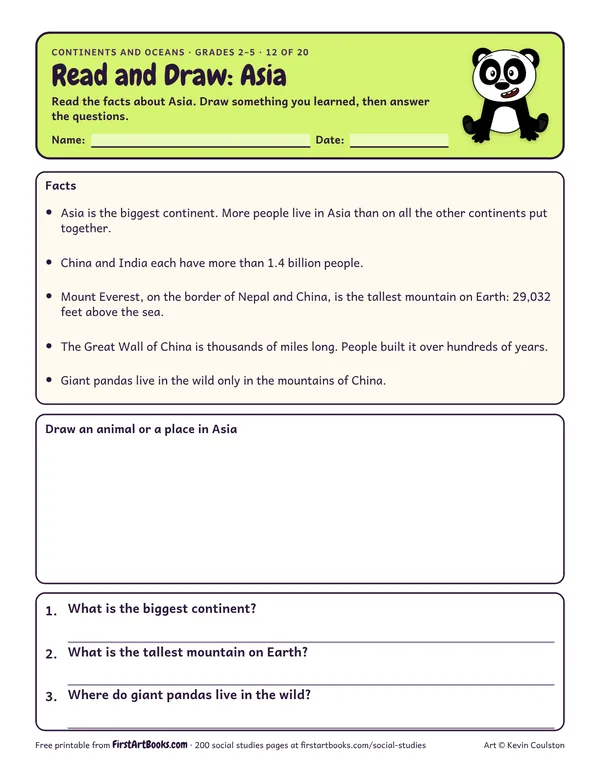
Read 5 facts about Asia (the biggest continent, the most people, Mount Everest, the Great Wall and giant pandas), draw a scene and answer 3 questions.
Print this sheet (PDF)Teacher notes and tips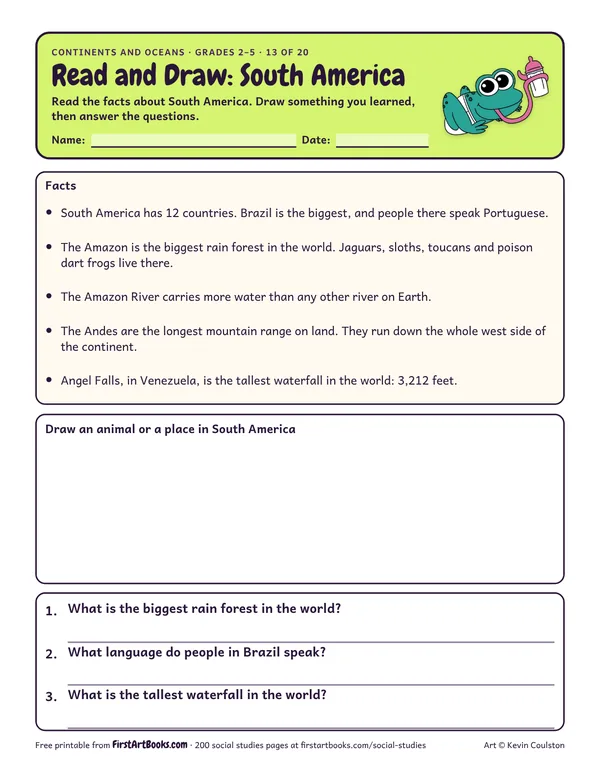
Read 5 facts about South America (the Amazon rain forest and river, the Andes, Angel Falls and Brazil), draw a scene and answer 3 questions.
Print this sheet (PDF)Teacher notes and tips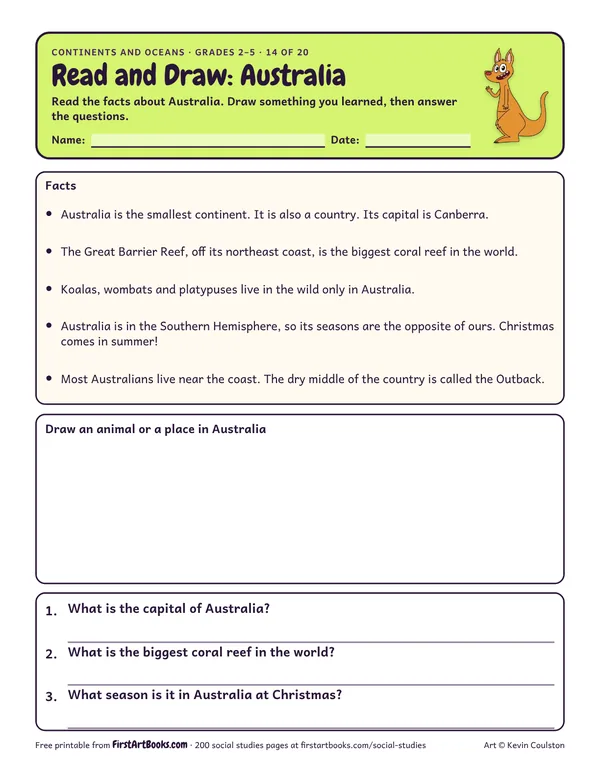
Read 5 facts about Australia (a continent and a country, the Great Barrier Reef, koalas and platypuses, and Christmas in summer), draw a scene and answer 3 questions.
Print this sheet (PDF)Teacher notes and tips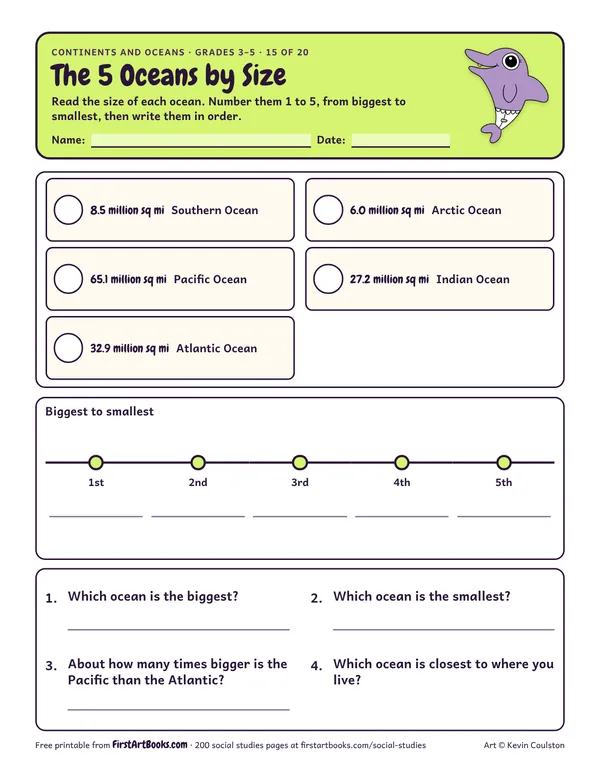
Rank the 5 oceans, from the Pacific to the Arctic, by their area in square miles, then answer questions about how they compare.
Print this sheet (PDF)Teacher notes and tips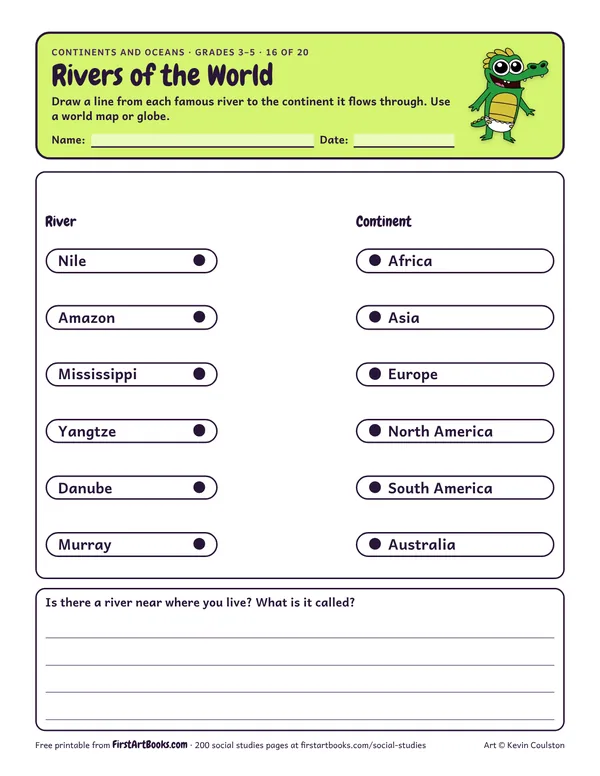
Match 6 great rivers, from the Nile and the Amazon to the Mississippi, the Yangtze and the Danube, to their continents.
Print this sheet (PDF)Teacher notes and tips
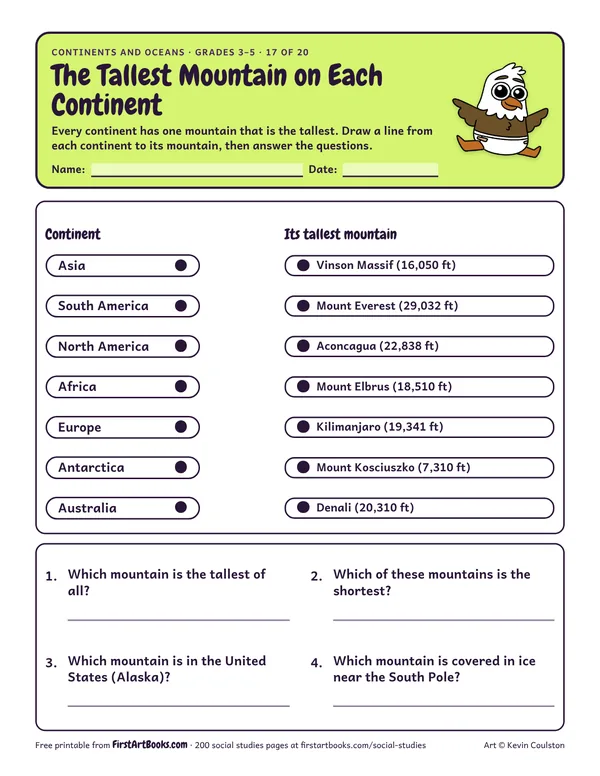
Match the tallest mountain on each of the 7 continents, from Mount Everest to Mount Kosciuszko, and compare their heights.
Print this sheet (PDF)Teacher notes and tips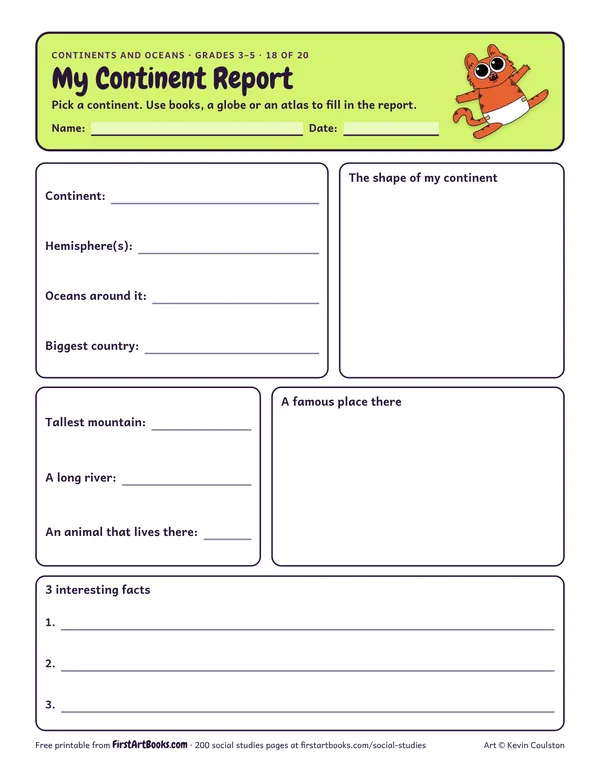
A one-page continent report template: hemisphere, oceans around it, the biggest country, the tallest mountain, a long river, animals and 3 facts.
Print this sheet (PDF)Teacher notes and tips

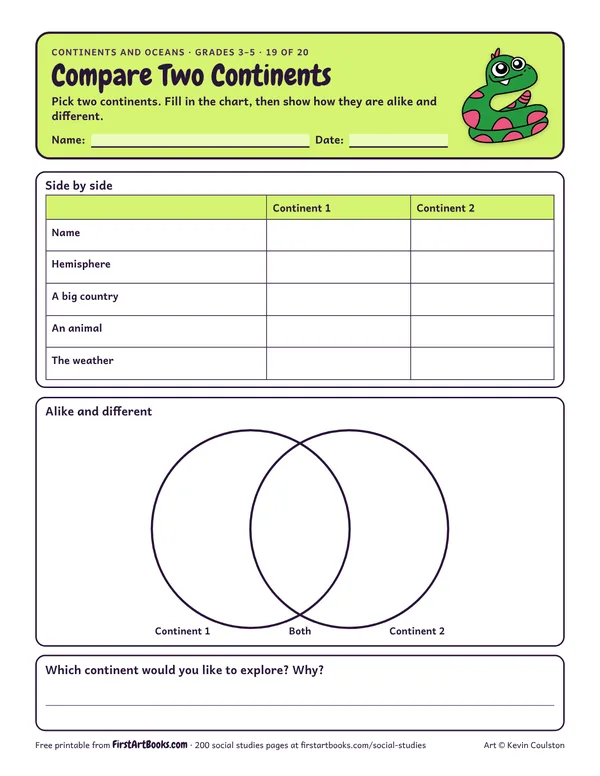
A side-by-side chart and a Venn diagram to compare two continents: size, hemisphere, a big country, an animal and the weather.
Print this sheet (PDF)Teacher notes and tips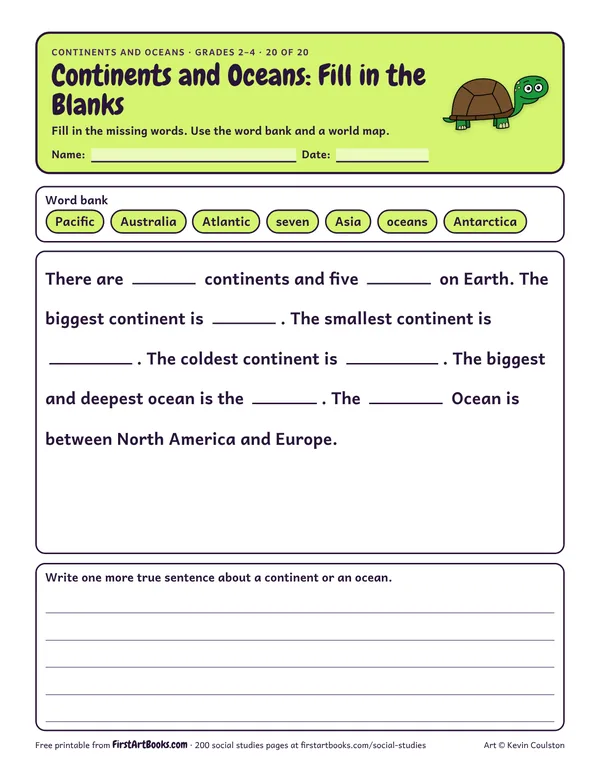
Fill in 7 missing words about the continents and oceans (the biggest, the smallest, the coldest, the deepest) in a short paragraph.
Print this sheet (PDF)Teacher notes and tipsAll 50 states, their capitals and the five regions. Grades 3–5.
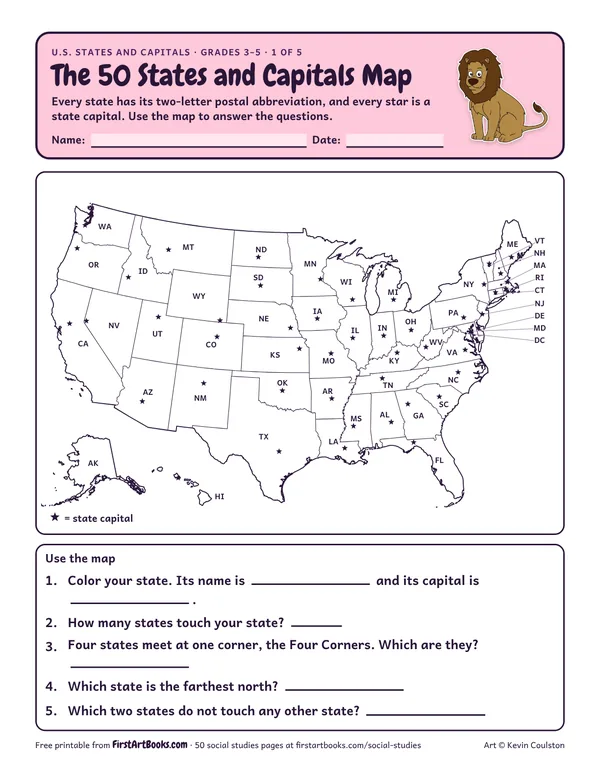
A U.S. map with every state’s abbreviation and a star on every capital, plus map questions about your own state.
Print this sheet (PDF)Teacher notes and tips

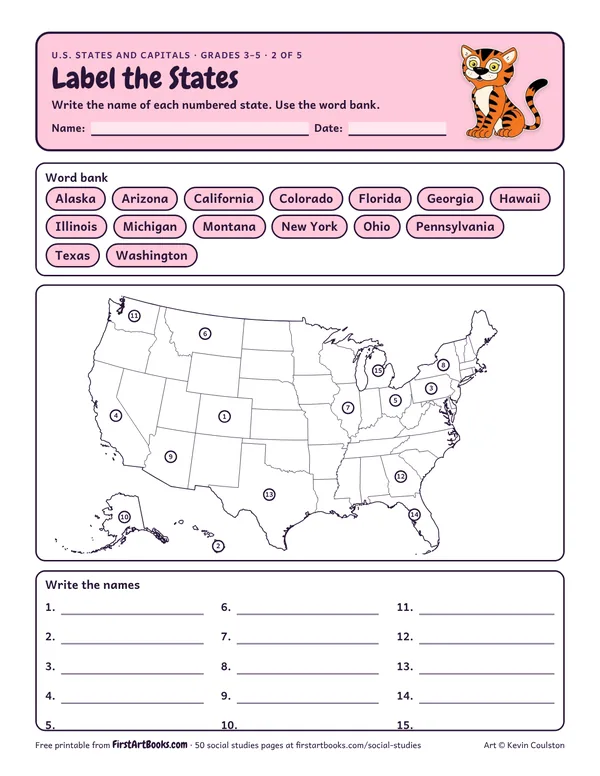
A blank U.S. map with 15 numbered states to name from a word bank, from California to Pennsylvania.
Print this sheet (PDF)Teacher notes and tips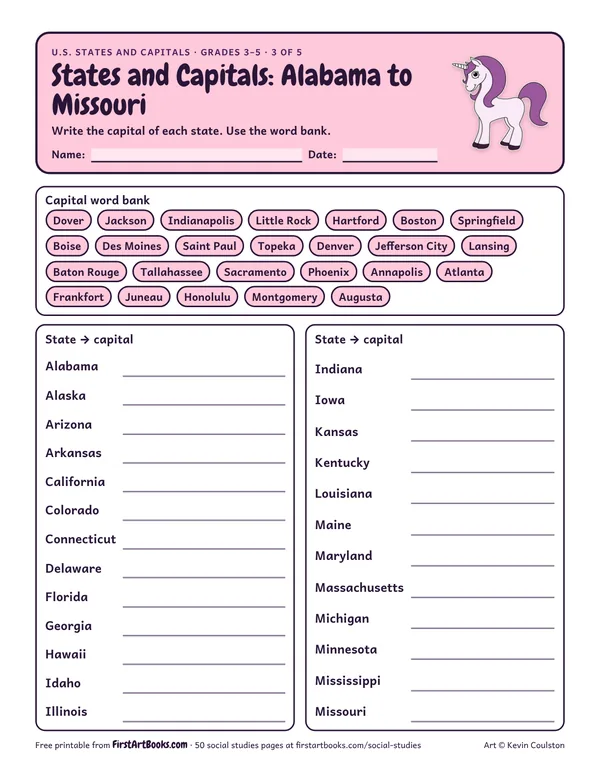
The first 25 states in ABC order, Alabama to Missouri: write each state capital from the word bank.
Print this sheet (PDF)Teacher notes and tips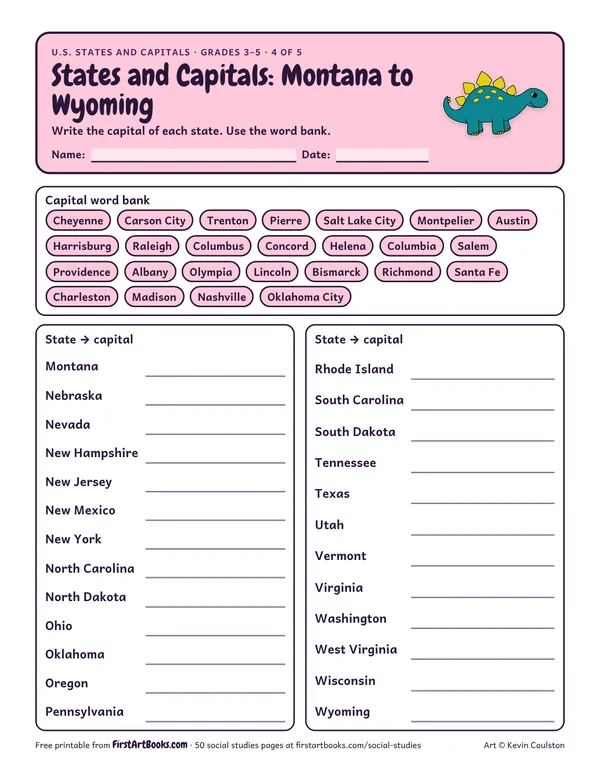
The last 25 states in ABC order, Montana to Wyoming: write each state capital from the word bank.
Print this sheet (PDF)Teacher notes and tips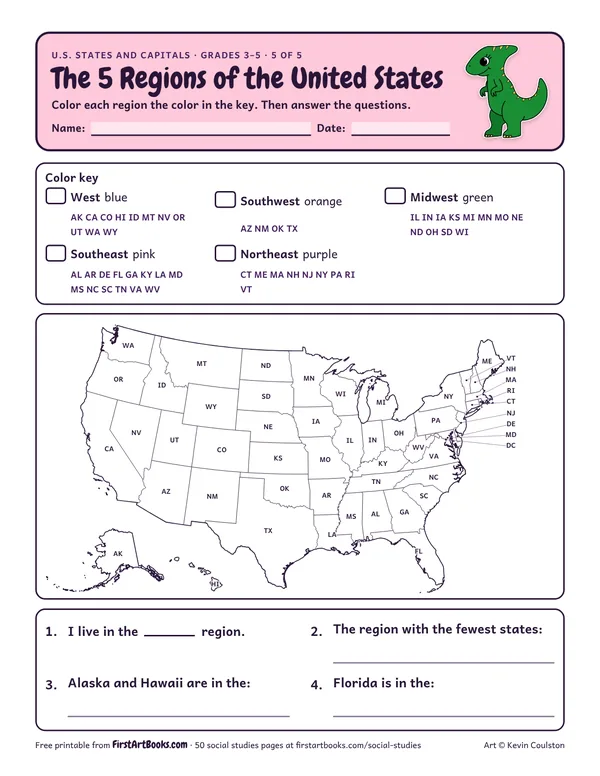
Color the West, Southwest, Midwest, Southeast and Northeast on a U.S. map, then answer questions about the regions.
Print this sheet (PDF)Teacher notes and tips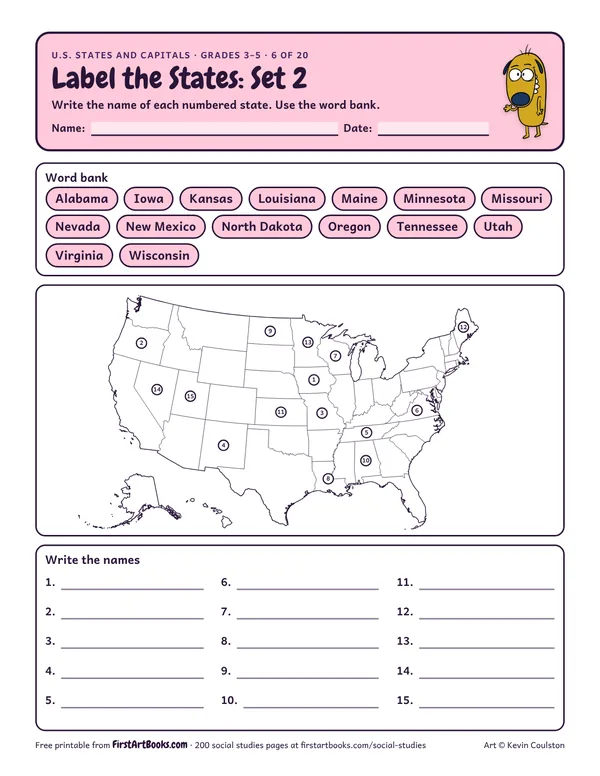
A second blank U.S. map with 15 different numbered states to name, from Oregon and Minnesota to Louisiana and Maine.
Print this sheet (PDF)Teacher notes and tips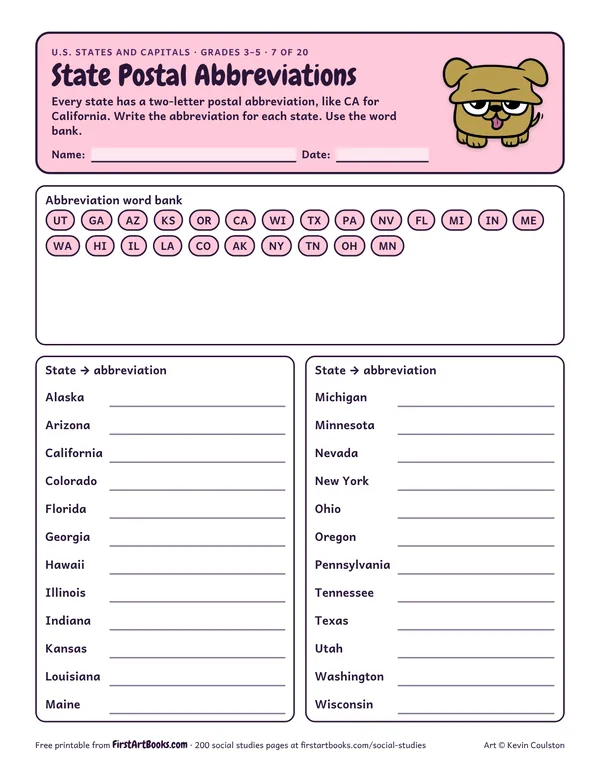
Write the two-letter postal abbreviation for 24 states, from AK to WI, with a word bank to choose from.
Print this sheet (PDF)Teacher notes and tips

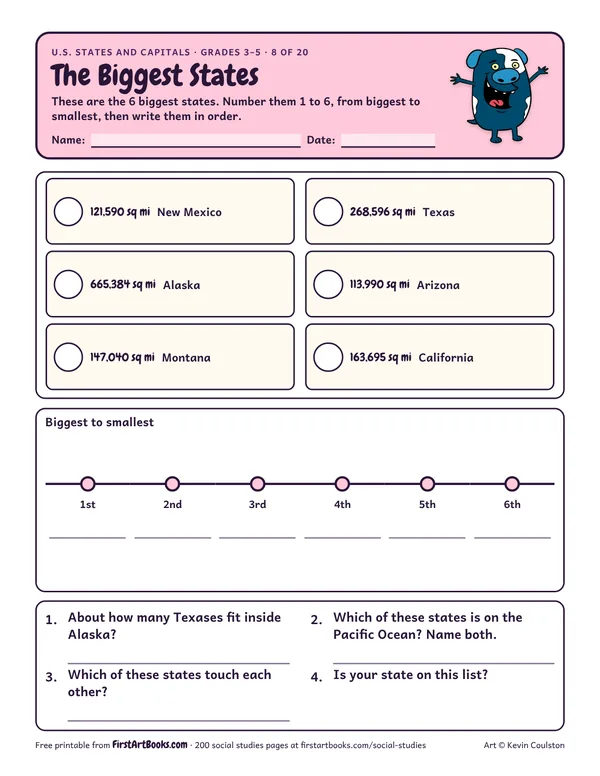
Rank the six largest states (Alaska, Texas, California, Montana, New Mexico and Arizona) by area, then answer questions about the map.
Print this sheet (PDF)Teacher notes and tips

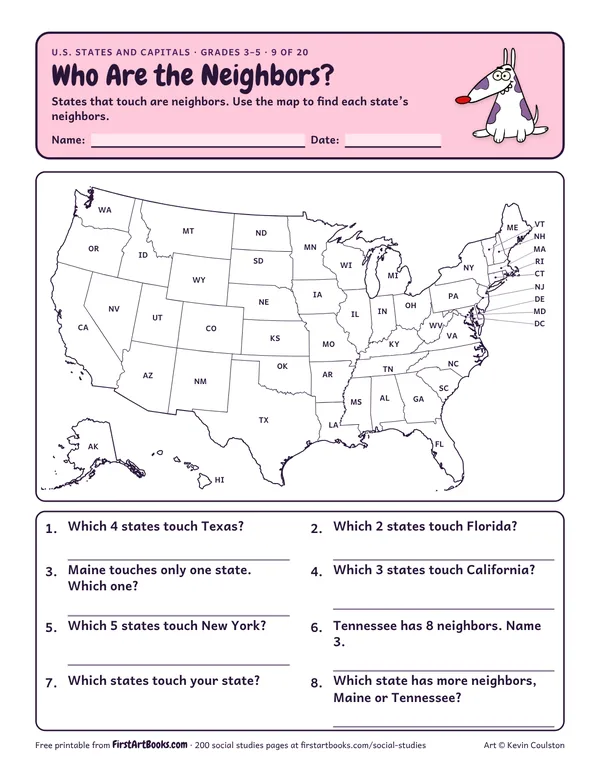
Use a labeled U.S. map to find which states border Texas, Florida, Maine, California, New York and Tennessee, then list your own state’s neighbors.
Print this sheet (PDF)Teacher notes and tips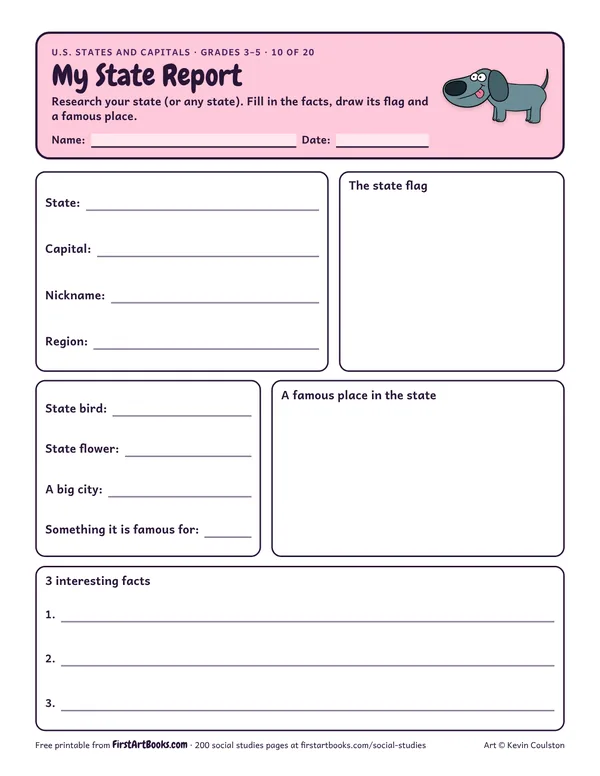
A one-page state report template: capital, nickname, state bird and flower, region, the flag, a famous place and 3 facts.
Print this sheet (PDF)Teacher notes and tips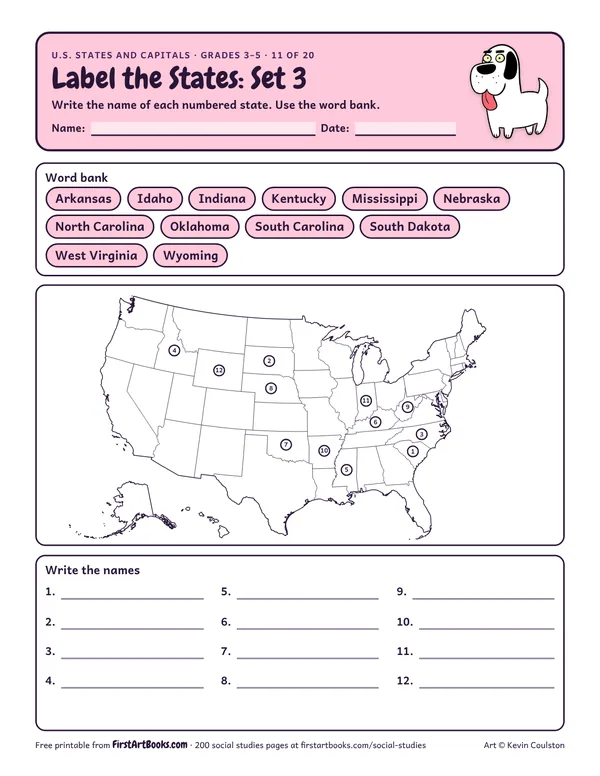
A third blank U.S. map with 12 more numbered states to name, from Idaho and Nebraska to Kentucky and the Carolinas.
Print this sheet (PDF)Teacher notes and tips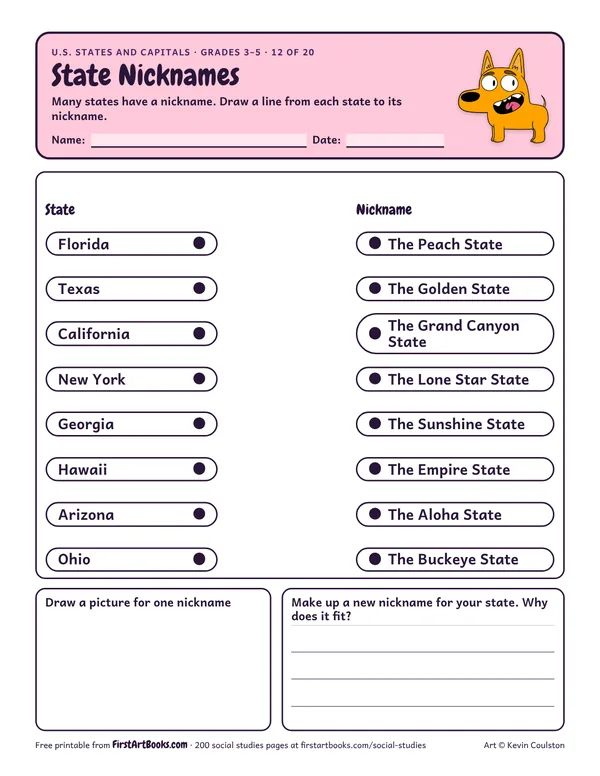
Match 8 states to their nicknames, from the Sunshine State and the Lone Star State to the Aloha State and the Buckeye State.
Print this sheet (PDF)Teacher notes and tips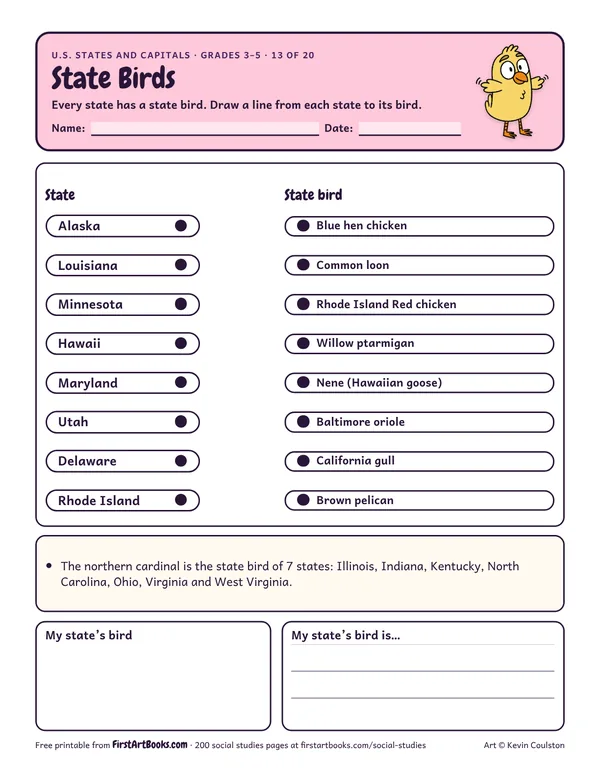
Match 8 states to their state birds, from Alaska’s willow ptarmigan and Louisiana’s brown pelican to Hawaii’s nene, and learn which bird 7 states share.
Print this sheet (PDF)Teacher notes and tips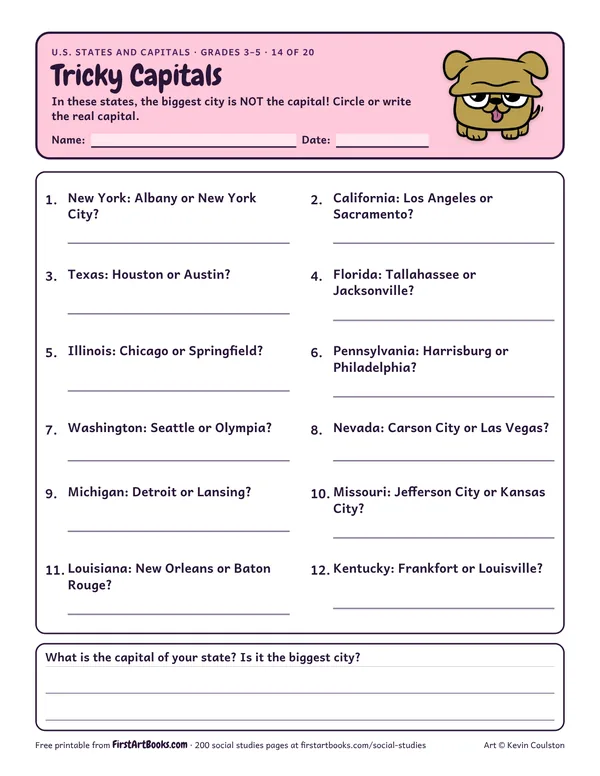
12 states where the capital is not the biggest city, from Albany (not New York City) to Sacramento (not Los Angeles): pick the real capital.
Print this sheet (PDF)Teacher notes and tips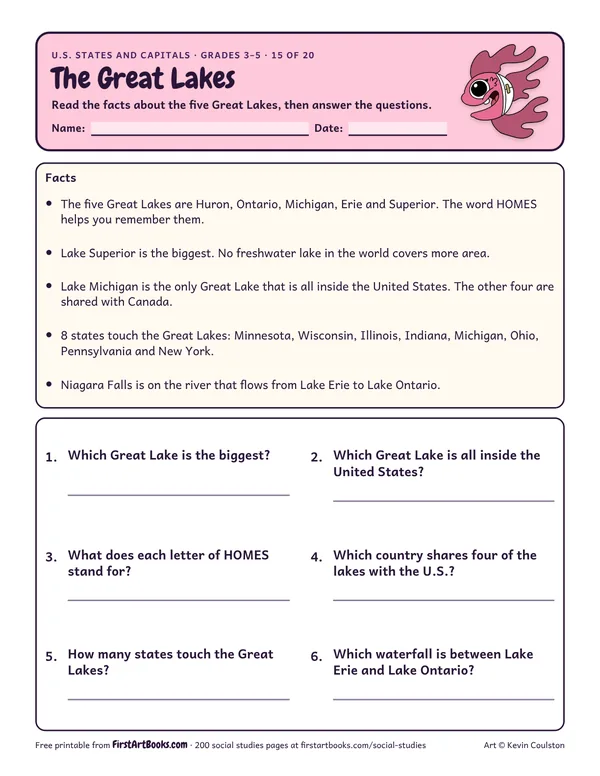
Read 5 facts about the Great Lakes (HOMES, Lake Superior, the only all-American lake, the 8 lake states and Niagara Falls) and answer 6 questions.
Print this sheet (PDF)Teacher notes and tips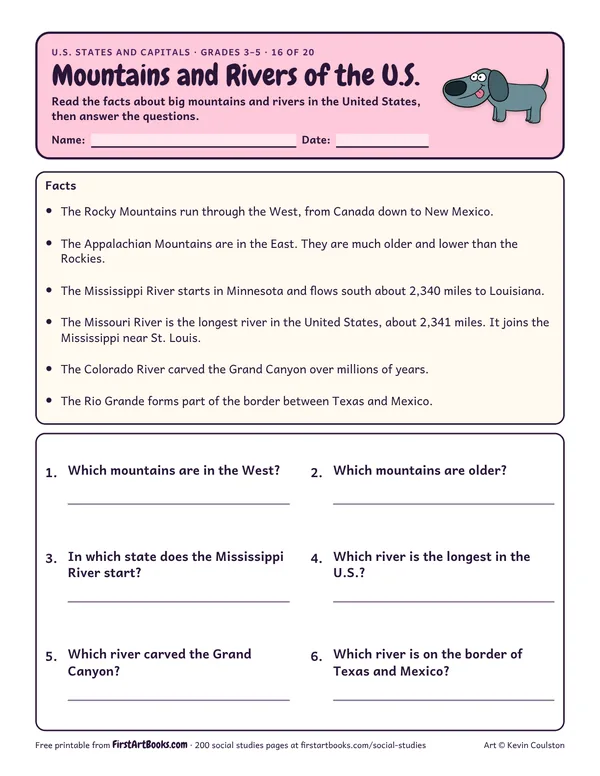
Read 6 facts about the Rocky and Appalachian Mountains and the Mississippi, Missouri, Colorado and Rio Grande rivers, then answer 6 questions.
Print this sheet (PDF)Teacher notes and tips
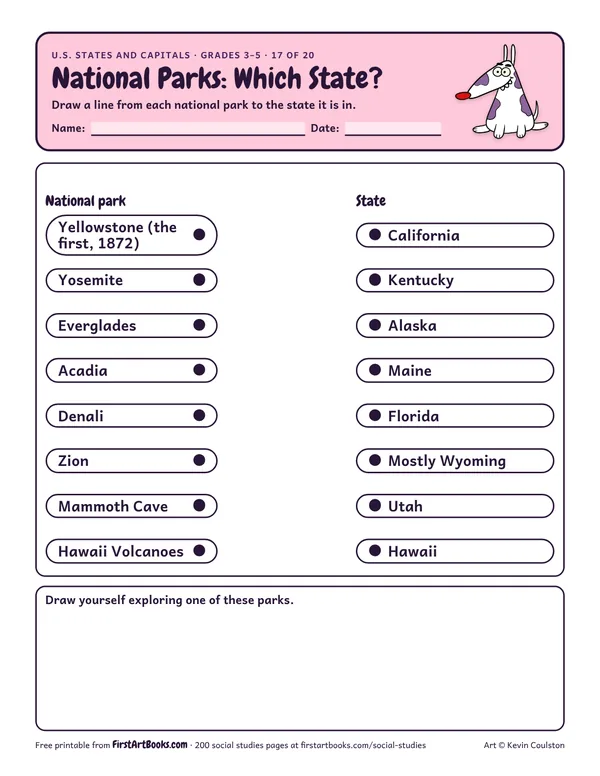
Match 8 national parks, from Yellowstone (the first one, in 1872) and Yosemite to the Everglades, Acadia and Denali, to their states.
Print this sheet (PDF)Teacher notes and tips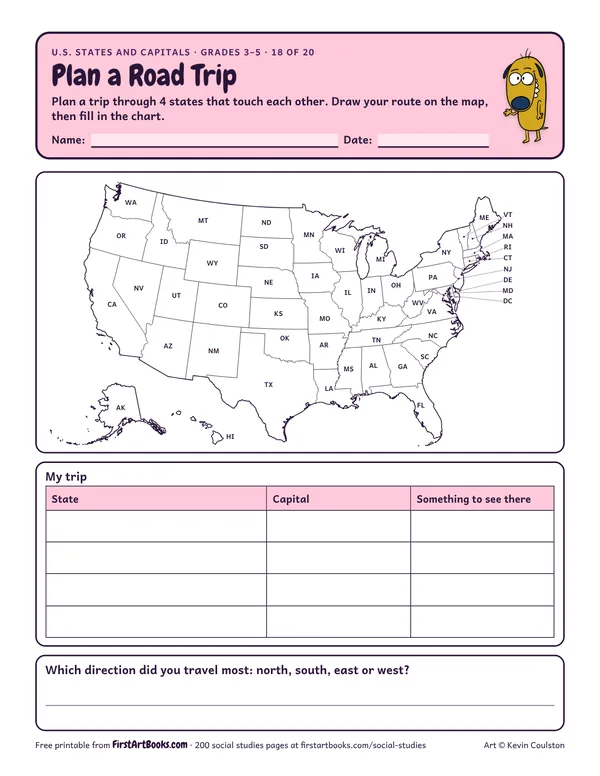
Kids plan a road trip through 4 neighboring states: draw the route on a labeled U.S. map and list each state’s capital and something to see there.
Print this sheet (PDF)Teacher notes and tips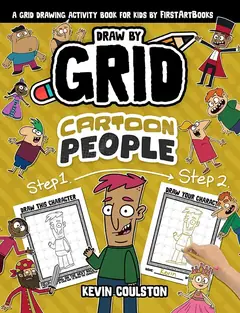
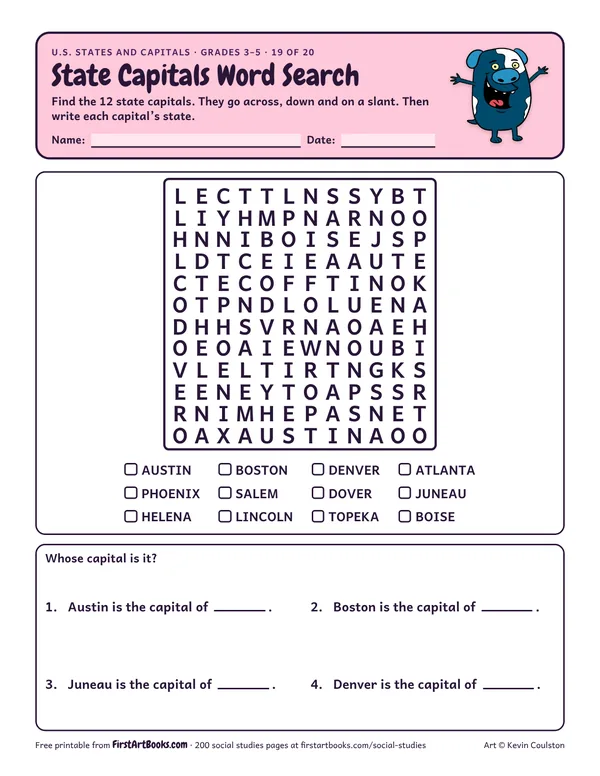
A 12 by 12 word search of 12 state capitals, from Austin and Boston to Juneau and Boise, then name the state for each one.
Print this sheet (PDF)Teacher notes and tips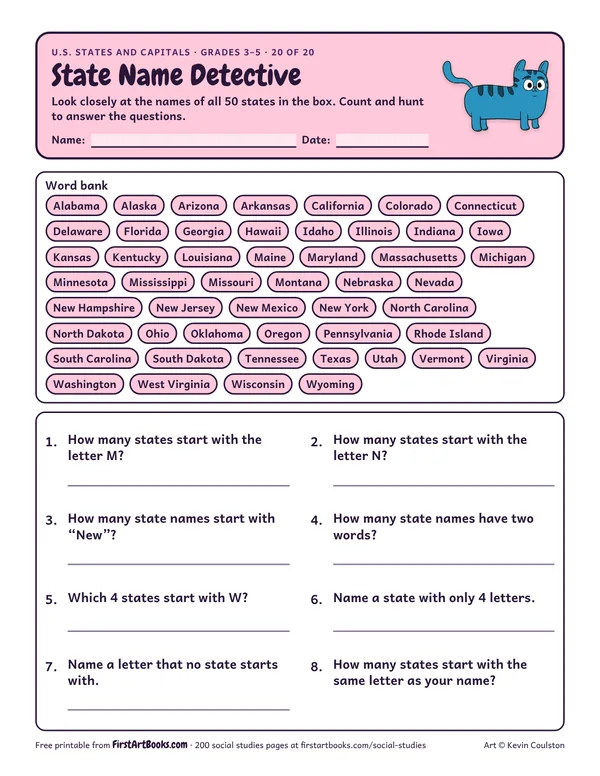
Use the list of all 50 state names to count and hunt: how many start with M or N, how many have two words, and which letters start no state at all.
Print this sheet (PDF)Teacher notes and tipsThe flag, the bald eagle, the Statue of Liberty and famous places. Grades K–3.
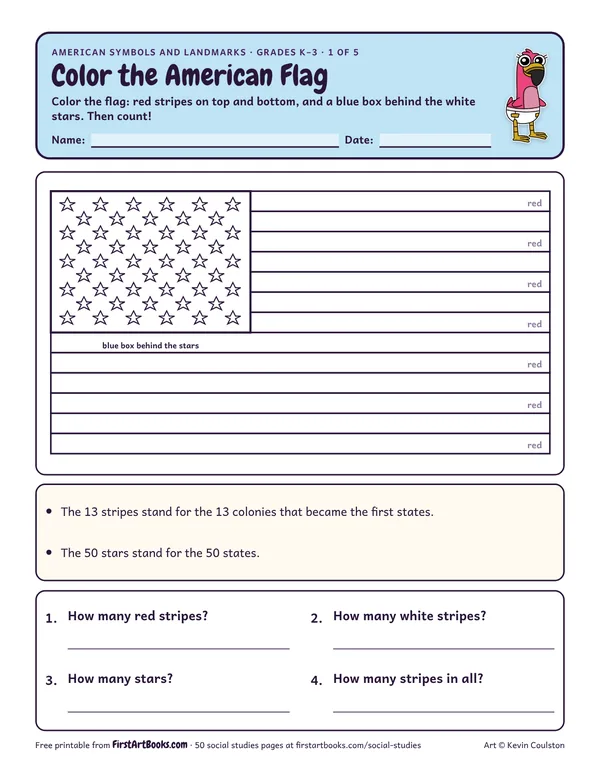
Color the U.S. flag, count its 13 stripes and 50 stars, and learn what each one stands for.
Print this sheet (PDF)Teacher notes and tips
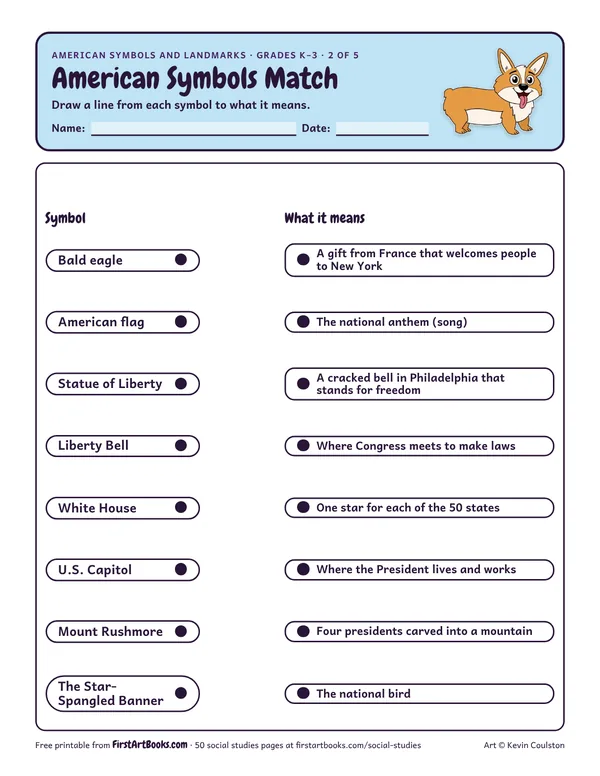
Match 8 American symbols, like the bald eagle, the Liberty Bell and the White House, to what each one means.
Print this sheet (PDF)Teacher notes and tips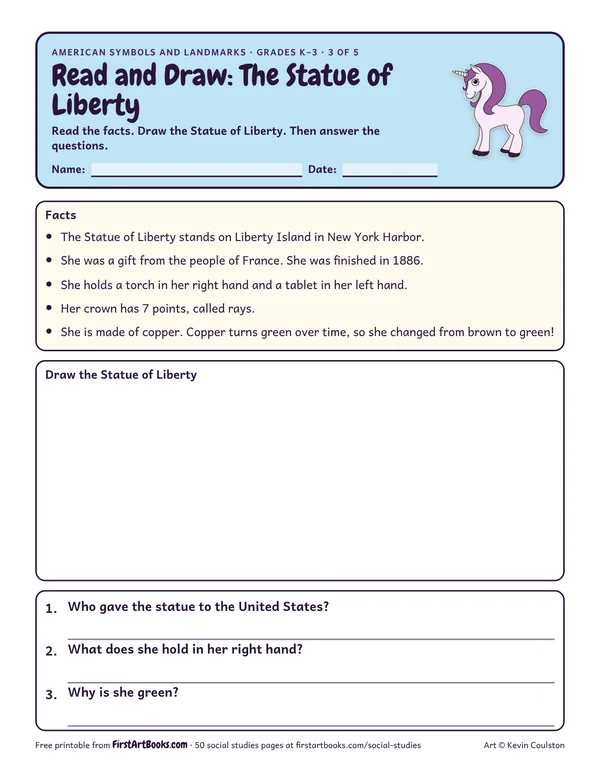
Read 5 short facts about the Statue of Liberty, draw her with her torch and tablet, and answer 3 questions.
Print this sheet (PDF)Teacher notes and tips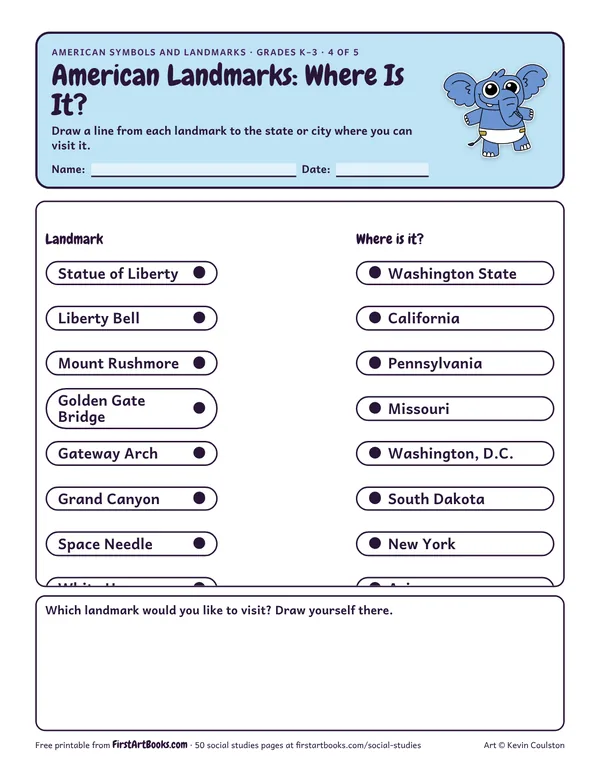
Match 8 famous American landmarks, from the Grand Canyon to the Space Needle, to their states.
Print this sheet (PDF)Teacher notes and tips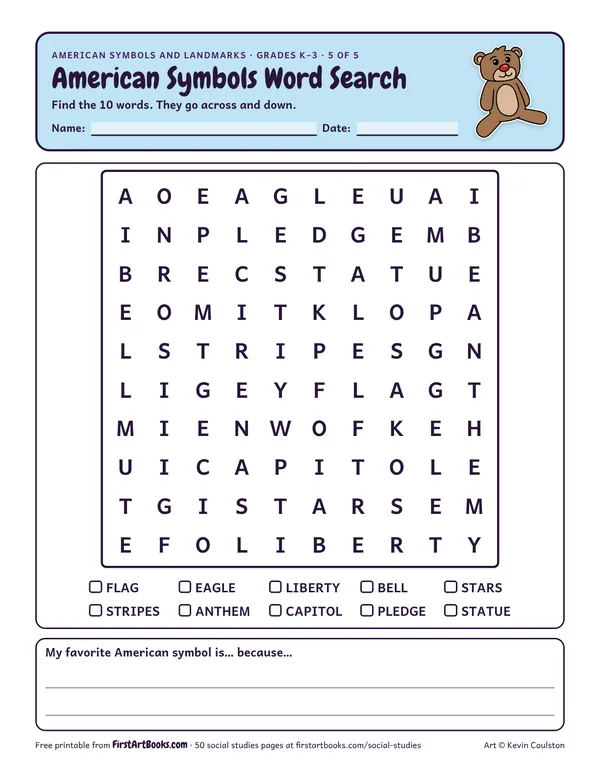
An across-and-down word search with 10 American symbols words: flag, eagle, Liberty Bell, stars, stripes and more.
Print this sheet (PDF)Teacher notes and tips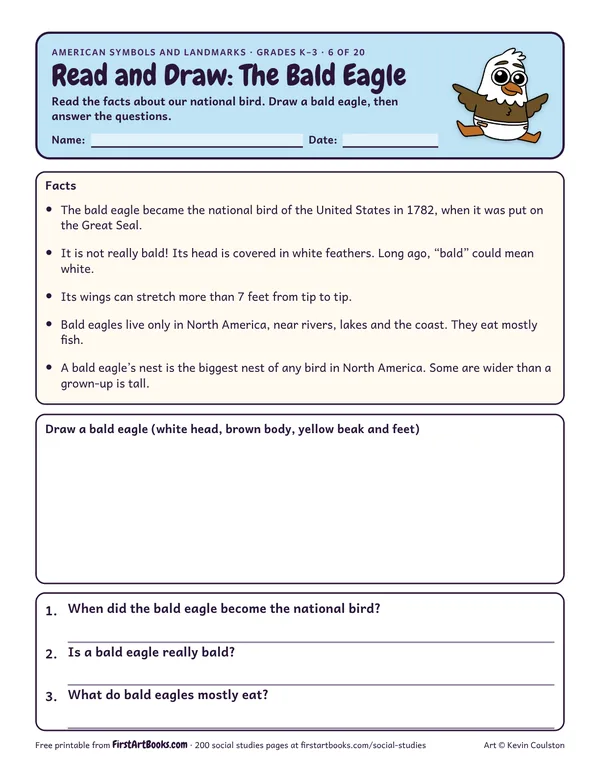
Read 5 facts about the bald eagle (on the Great Seal since 1782 and the official national bird since 2024, not really bald, wings up to 7 feet across), draw one and answer 3 questions.
Print this sheet (PDF)Teacher notes and tips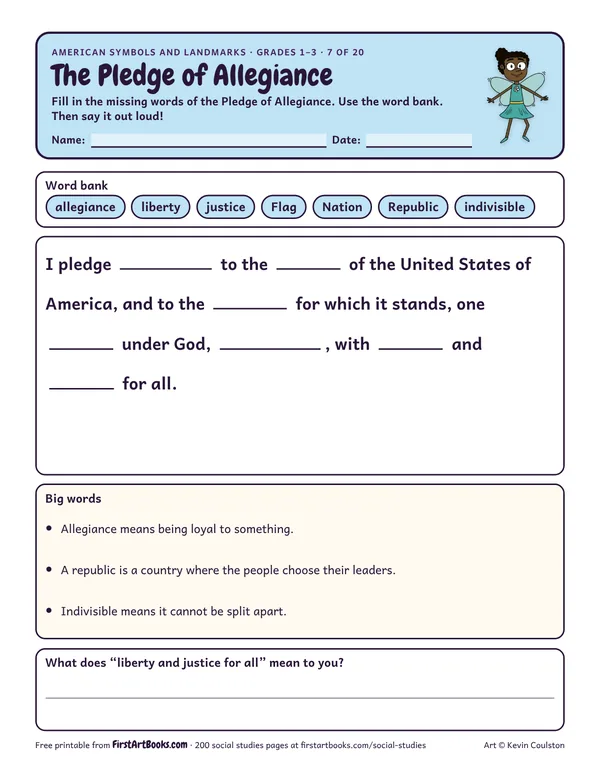
Fill in the 7 missing words of the Pledge of Allegiance from a word bank, then learn what allegiance, republic and indivisible mean.
Print this sheet (PDF)Teacher notes and tips
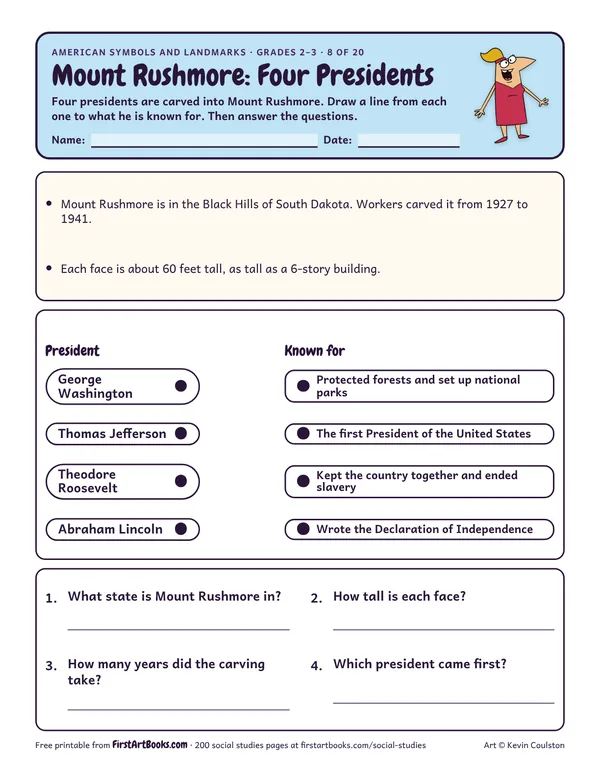
Learn the four presidents on Mount Rushmore (Washington, Jefferson, Theodore Roosevelt and Lincoln), match each to what he did and answer questions about the carving.
Print this sheet (PDF)Teacher notes and tips
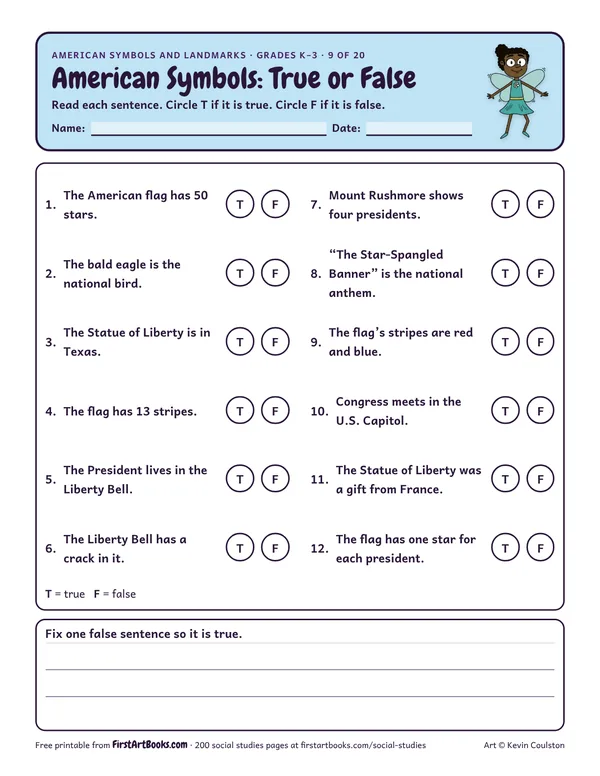
12 true-or-false sentences about the flag, the bald eagle, the Statue of Liberty, the Liberty Bell, Mount Rushmore and the White House.
Print this sheet (PDF)Teacher notes and tips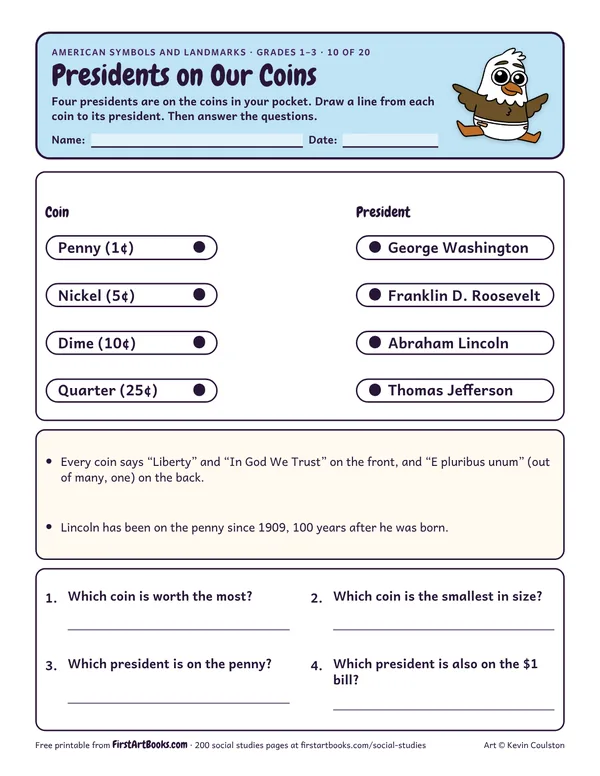
Match the penny, nickel, dime and quarter to Lincoln, Jefferson, Roosevelt and Washington, then answer questions about the coins.
Print this sheet (PDF)Teacher notes and tips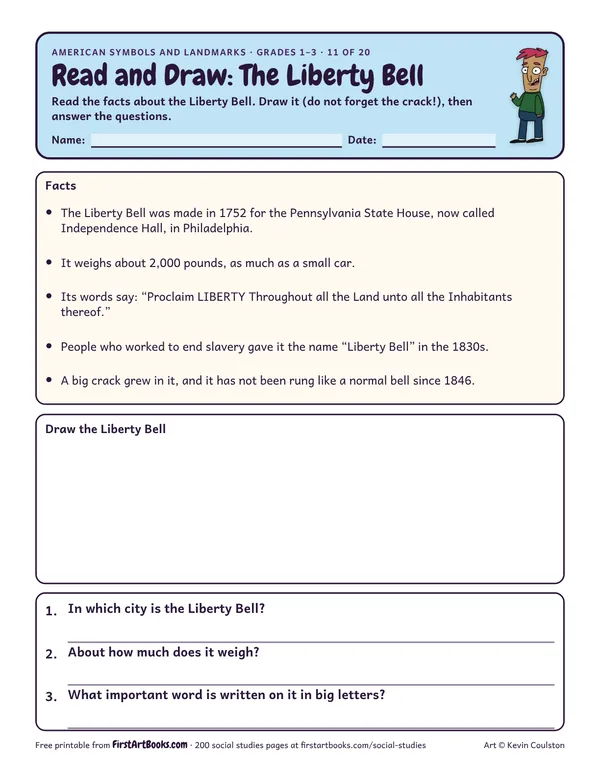
Read 5 facts about the Liberty Bell (made in 1752, about 2,000 pounds, its famous crack and its words about liberty), draw it and answer 3 questions.
Print this sheet (PDF)Teacher notes and tips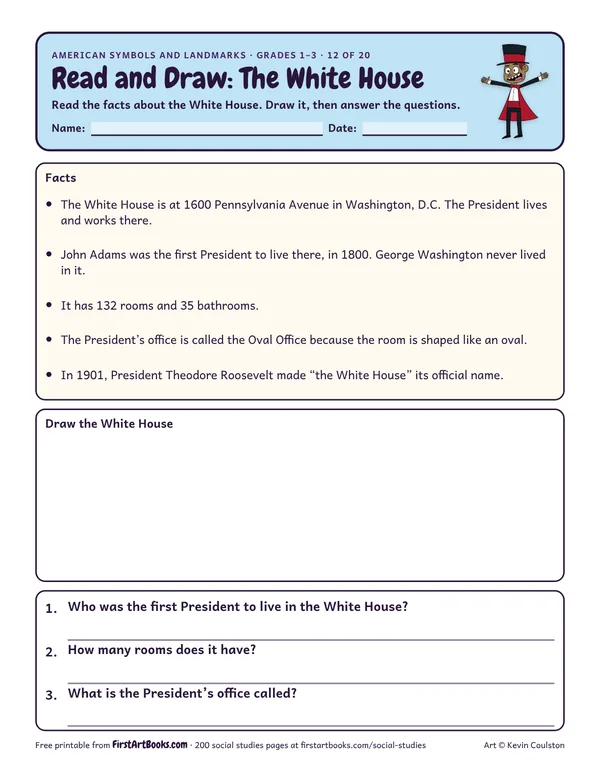
Read 5 facts about the White House (1600 Pennsylvania Avenue, 132 rooms, every president since John Adams), draw it and answer 3 questions.
Print this sheet (PDF)Teacher notes and tips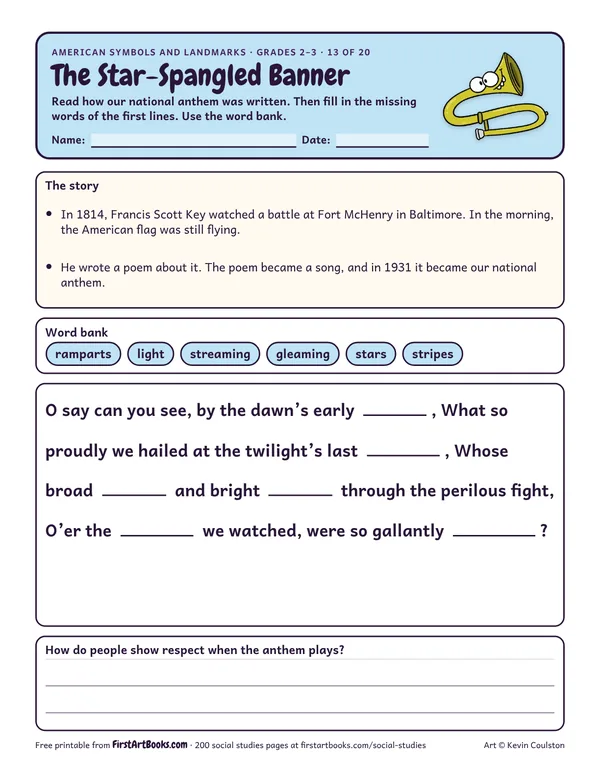
Learn how Francis Scott Key wrote “The Star-Spangled Banner” in 1814, then fill in 6 missing words of its first four lines from a word bank.
Print this sheet (PDF)Teacher notes and tips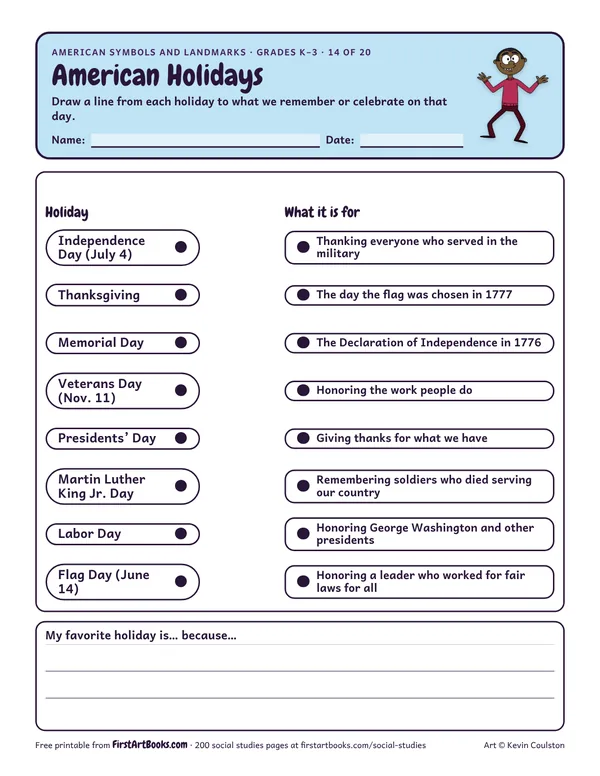
Match 8 national holidays, from Independence Day and Thanksgiving to Veterans Day, Labor Day and Flag Day, to what each one honors.
Print this sheet (PDF)Teacher notes and tips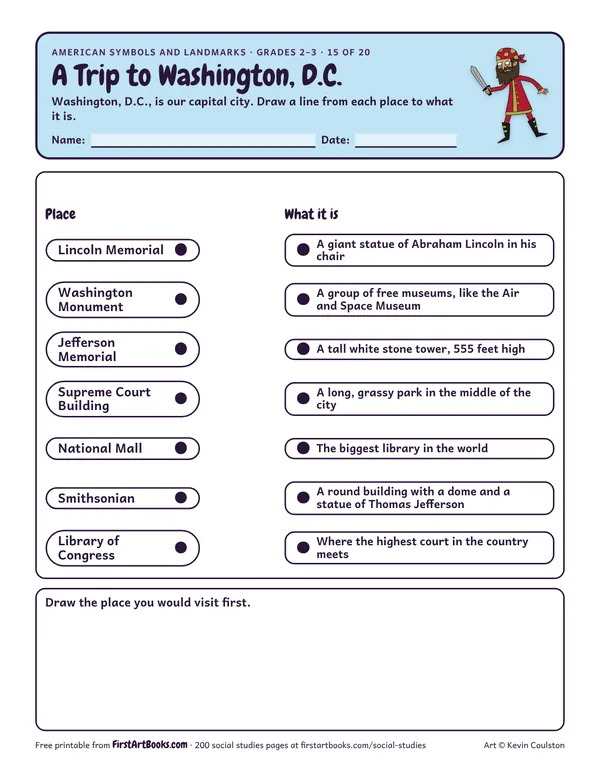
Match 7 places in the nation’s capital, from the Lincoln Memorial and the Washington Monument to the Smithsonian and the Library of Congress.
Print this sheet (PDF)Teacher notes and tips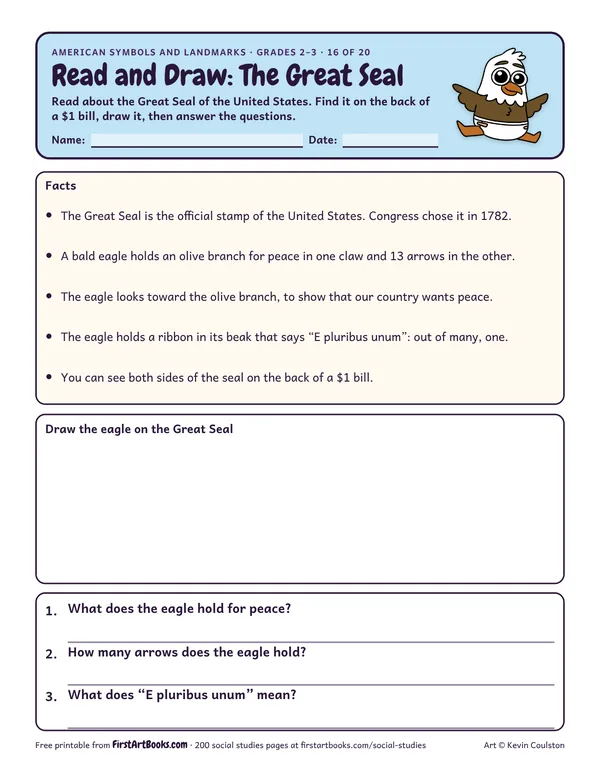
Read 5 facts about the Great Seal (adopted in 1782, the eagle with an olive branch and 13 arrows, E pluribus unum), draw it and answer 3 questions.
Print this sheet (PDF)Teacher notes and tips

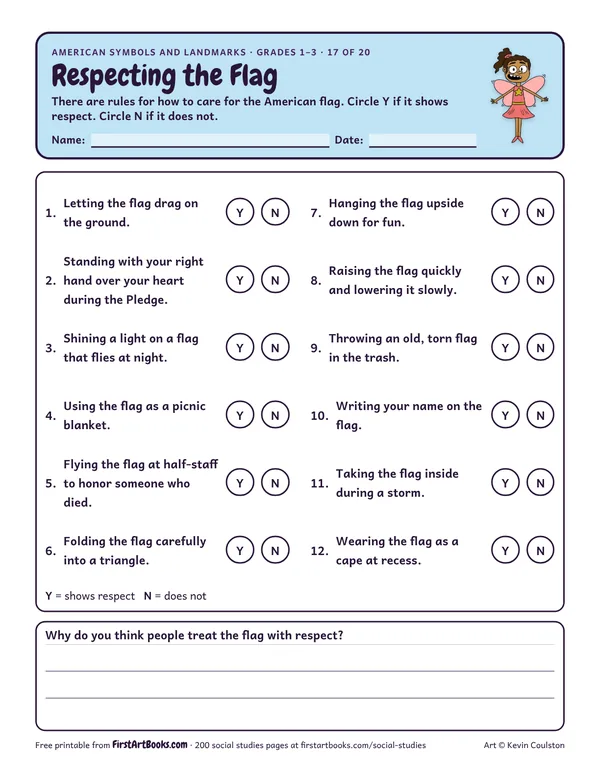
12 flag manners from the U.S. Flag Code to sort: keep it off the ground, light it at night, hand on heart for the Pledge, never use it as a blanket.
Print this sheet (PDF)Teacher notes and tips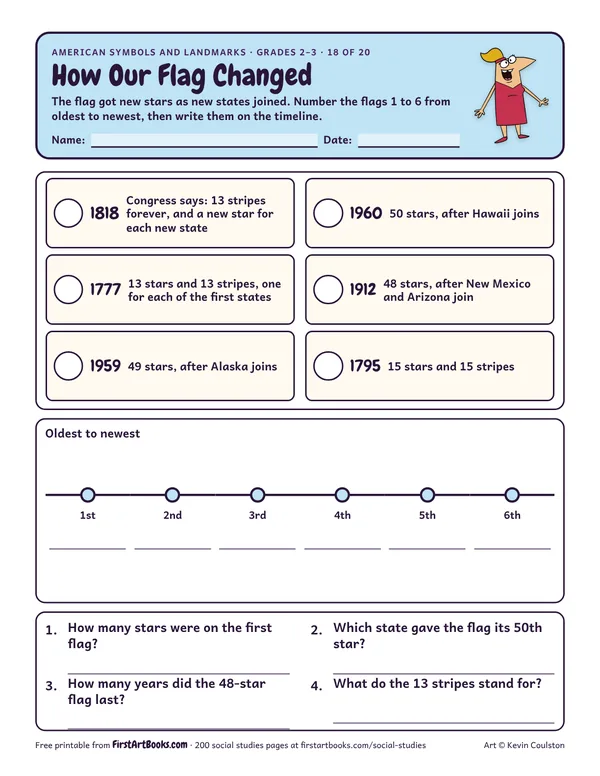
Put 6 changes to the American flag in order, from 13 stars in 1777 to 50 stars in 1960, and learn why the stripes went back to 13.
Print this sheet (PDF)Teacher notes and tips

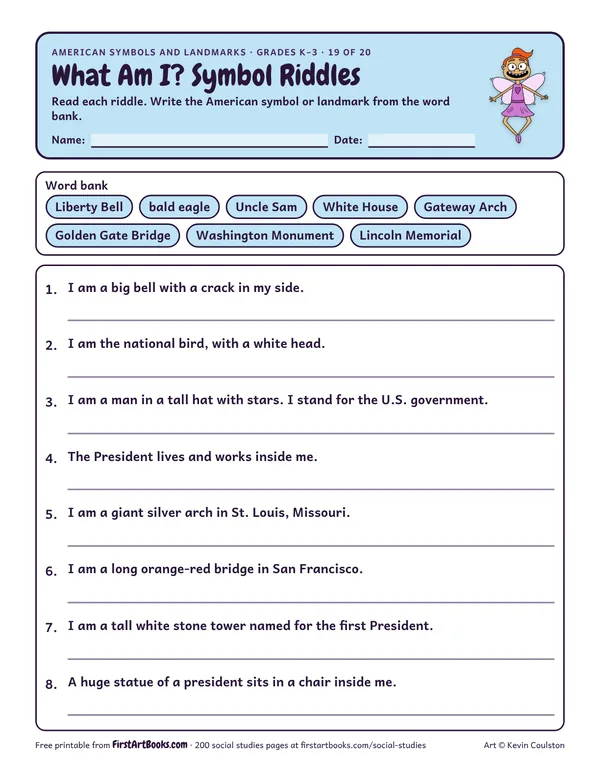
8 riddles about American symbols and landmarks (“I am a big bell with a crack in my side”): read the clue and write the answer from the word bank.
Print this sheet (PDF)Teacher notes and tips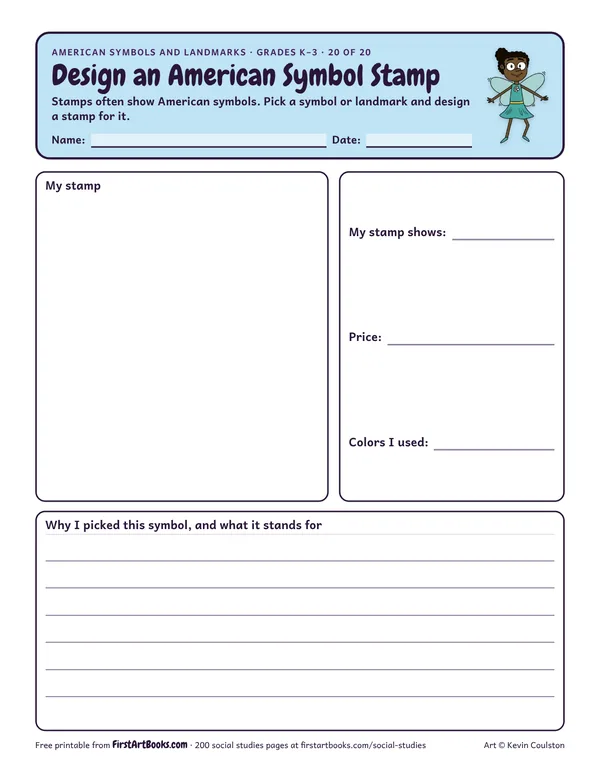
Kids design a postage stamp for an American symbol or landmark, give it a price and write why the symbol matters.
Print this sheet (PDF)Teacher notes and tipsResearch templates for any famous person from history. Grades 2–5.
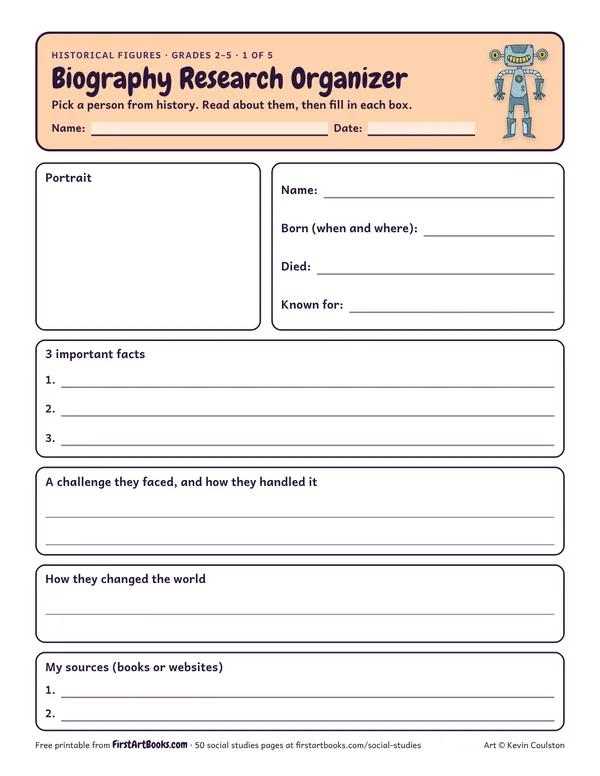
A one-page biography organizer for any historical figure: dates, a portrait, 3 facts, a challenge they faced and sources.
Print this sheet (PDF)Teacher notes and tips
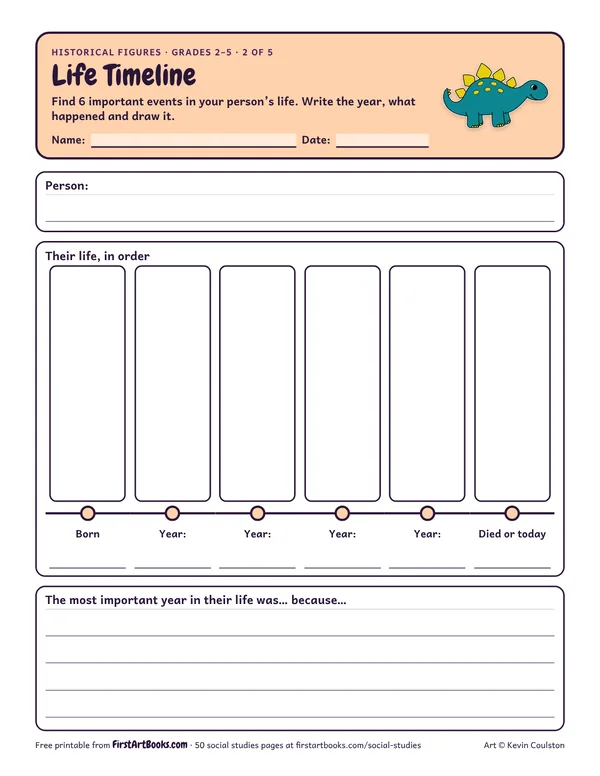
A 6-stop timeline template for any historical figure, with a year, an event and a little drawing for each stop.
Print this sheet (PDF)Teacher notes and tips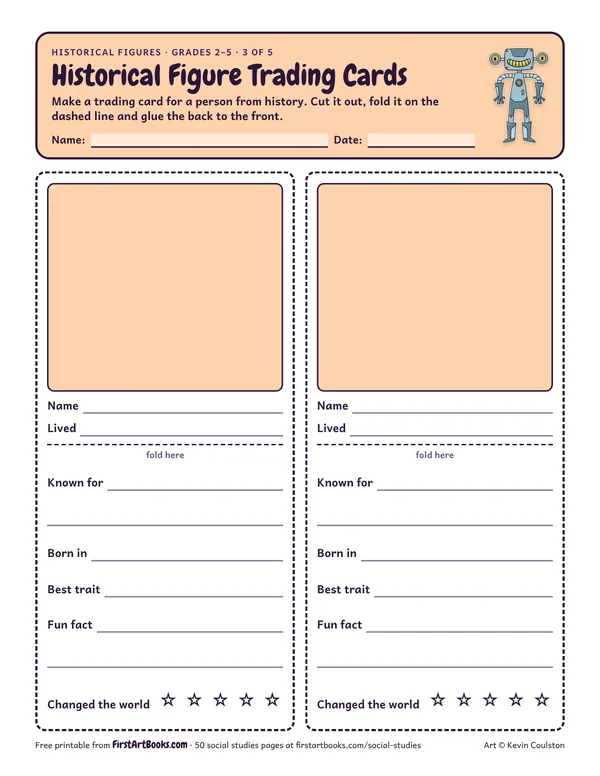
Make two fold-over trading cards for people from history: a portrait on the front and their stats on the back.
Print this sheet (PDF)Teacher notes and tips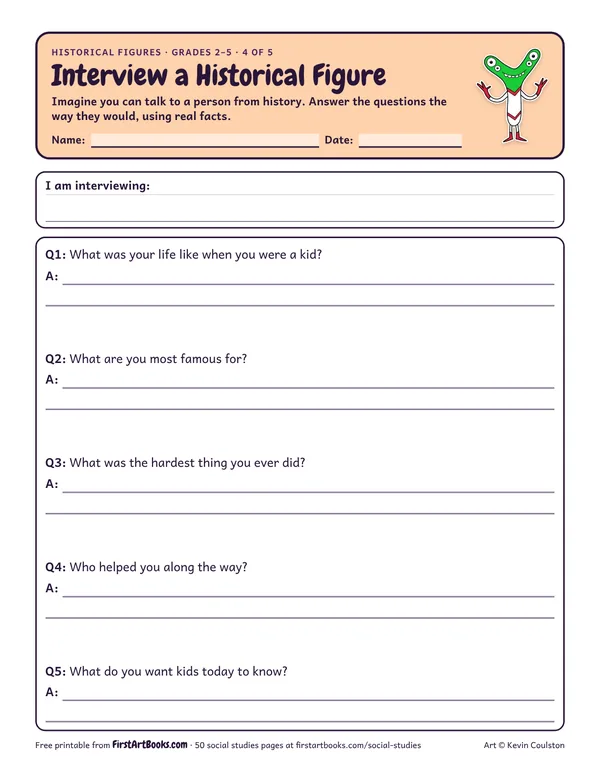
Kids research a famous person, then answer interview questions in that person’s voice, using real facts.
Print this sheet (PDF)Teacher notes and tips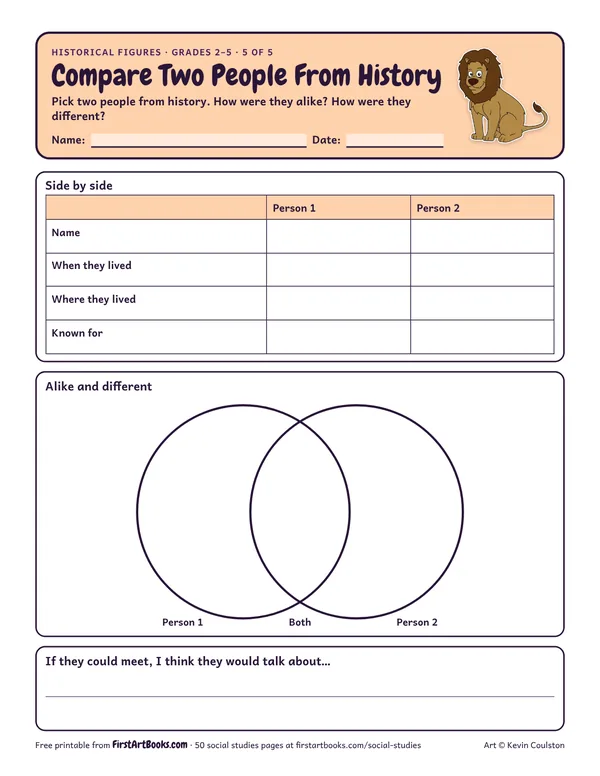
A Venn diagram and a side-by-side chart to compare two historical figures: when and where they lived, and what they did.
Print this sheet (PDF)Teacher notes and tips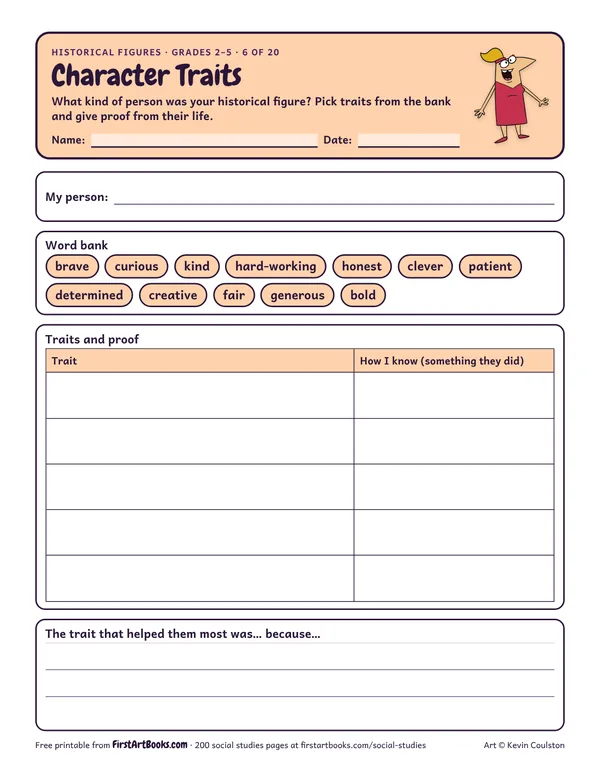
A character traits organizer: choose 5 traits from the word bank, back each one with proof from the person’s life, and explain which trait mattered most.
Print this sheet (PDF)Teacher notes and tips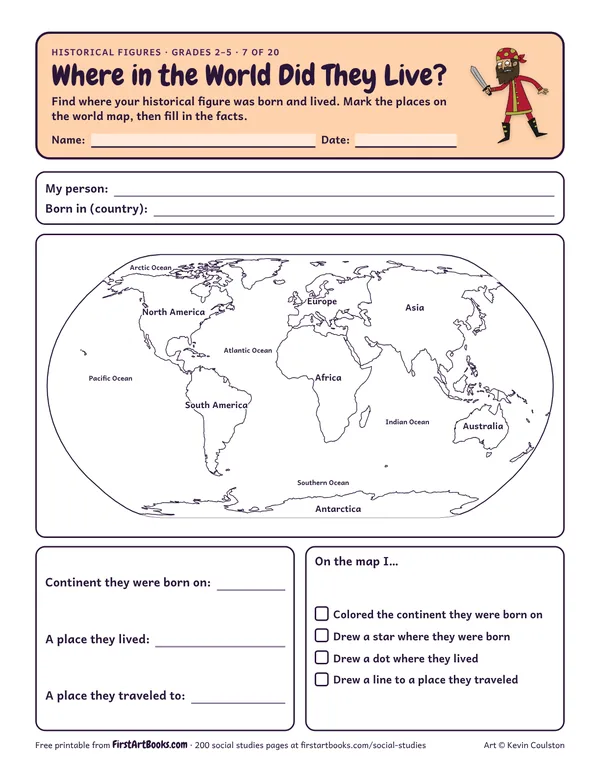
Put a historical figure on the map: color the continent they were born on, star the places they lived and traveled, and write the countries.
Print this sheet (PDF)Teacher notes and tips

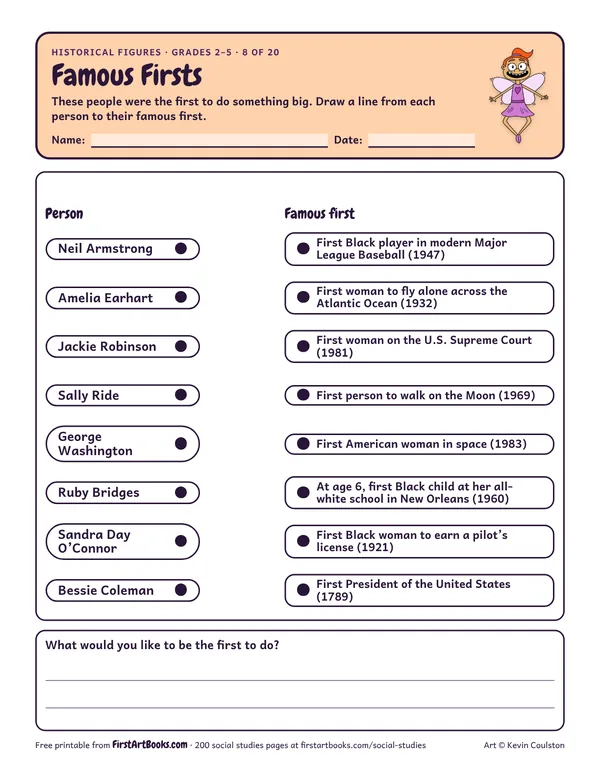
Match 8 people to their famous firsts: Neil Armstrong on the Moon, Amelia Earhart across the Atlantic, Jackie Robinson, Sally Ride, Ruby Bridges, Bessie Coleman and more.
Print this sheet (PDF)Teacher notes and tips
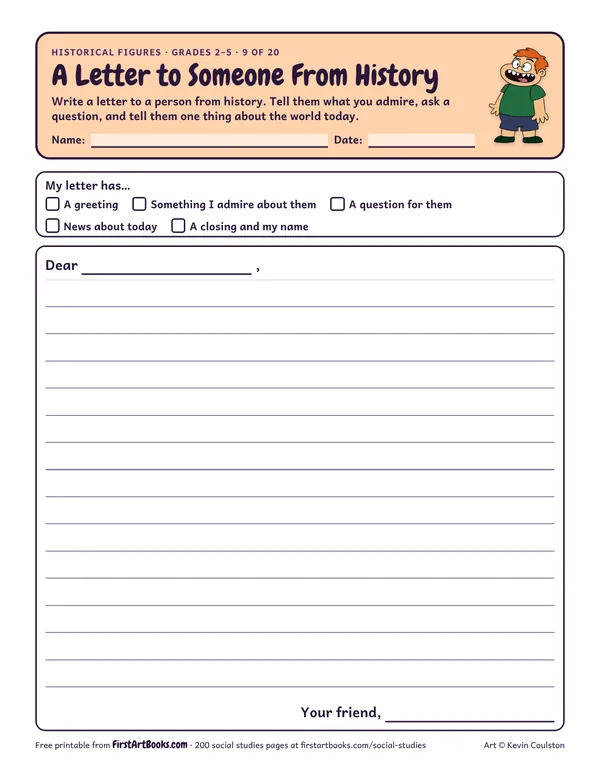
A letter-writing template to any historical figure, with a checklist: what you admire, a question for them, and news from today.
Print this sheet (PDF)Teacher notes and tips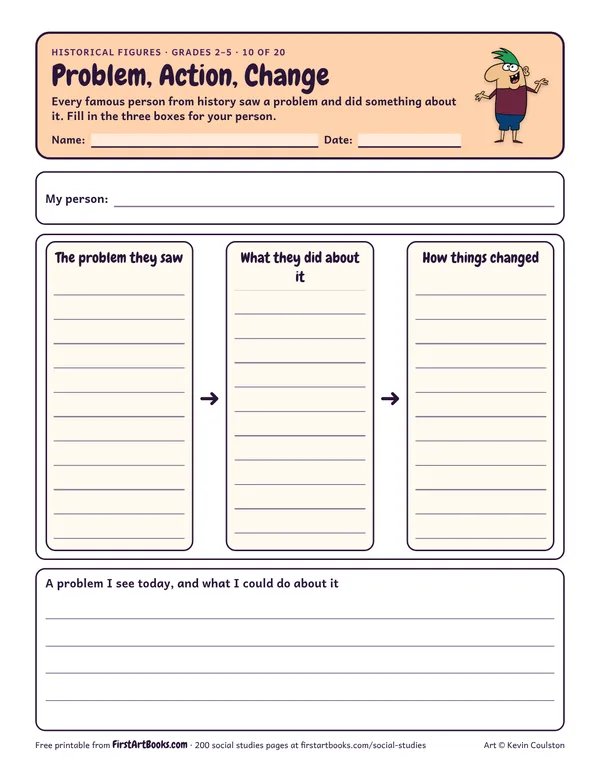
A cause-and-effect organizer for any historical figure: the problem they saw, what they did about it, and how the world changed.
Print this sheet (PDF)Teacher notes and tips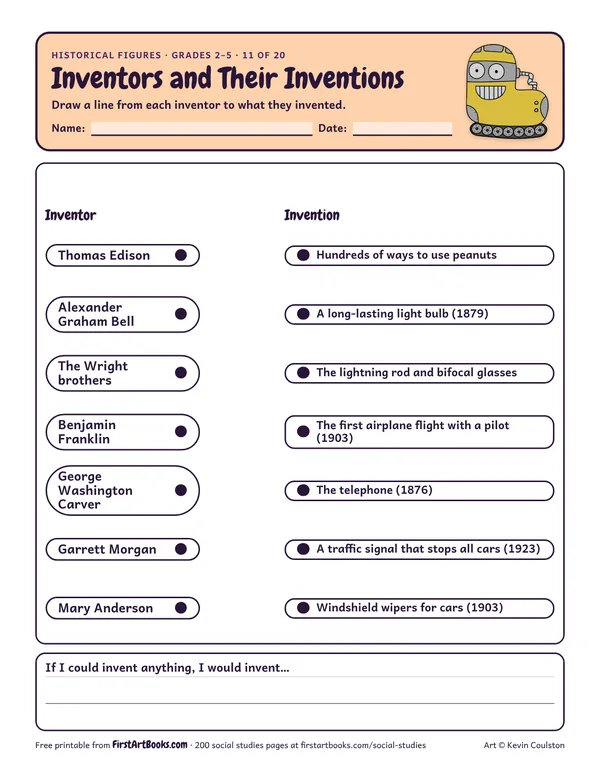
Match 7 inventors to their inventions: Edison, Bell, the Wright brothers, Ben Franklin, George Washington Carver, Garrett Morgan and Mary Anderson.
Print this sheet (PDF)Teacher notes and tips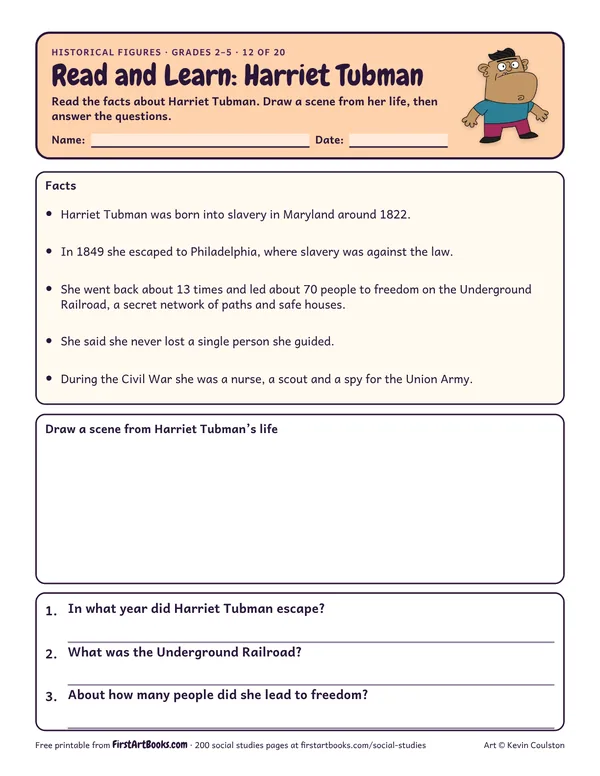
Read 5 facts about Harriet Tubman (her escape in 1849, about 13 trips on the Underground Railroad, her work in the Civil War), draw a scene and answer 3 questions.
Print this sheet (PDF)Teacher notes and tips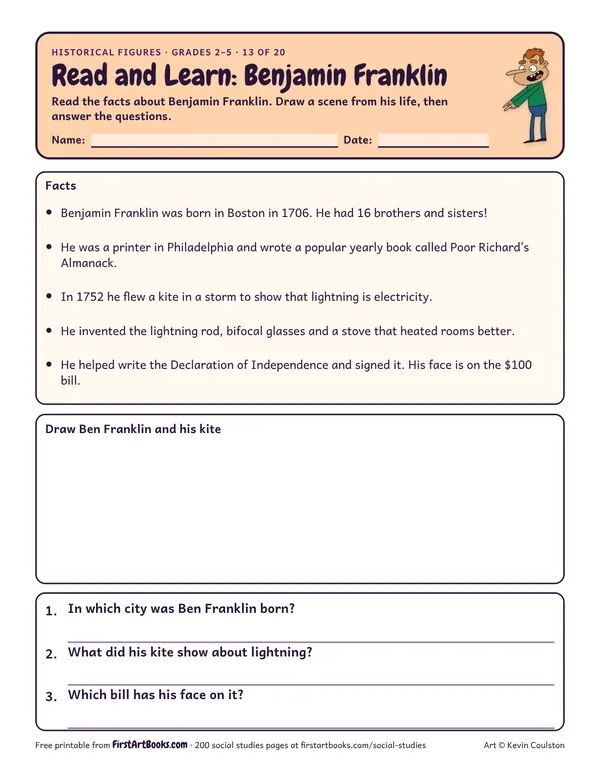
Read 5 facts about Ben Franklin (printer, kite experiment, inventor, signer of the Declaration of Independence, the face on the $100 bill), draw a scene and answer 3 questions.
Print this sheet (PDF)Teacher notes and tips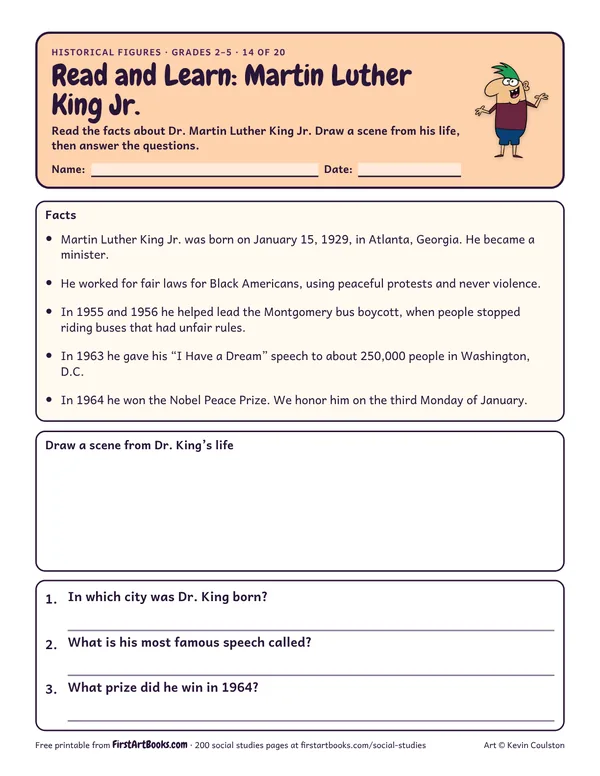
Read 5 facts about Martin Luther King Jr. (the bus boycott, the “I Have a Dream” speech, the Nobel Peace Prize, his holiday), draw a scene and answer 3 questions.
Print this sheet (PDF)Teacher notes and tips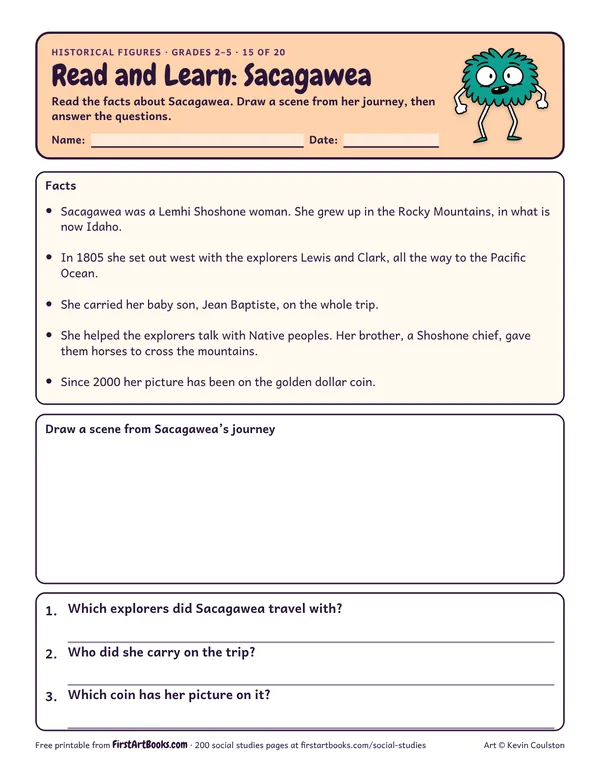
Read 5 facts about Sacagawea (the Lemhi Shoshone woman who traveled west with Lewis and Clark carrying her baby), draw a scene and answer 3 questions.
Print this sheet (PDF)Teacher notes and tips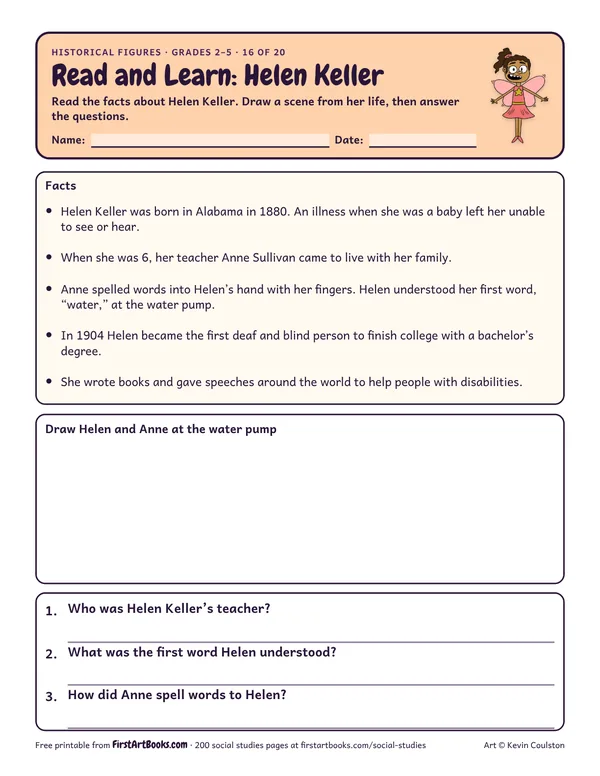
Read 5 facts about Helen Keller (deaf and blind from a baby, her teacher Anne Sullivan, the word “water”, college and her work for others), draw a scene and answer 3 questions.
Print this sheet (PDF)Teacher notes and tips
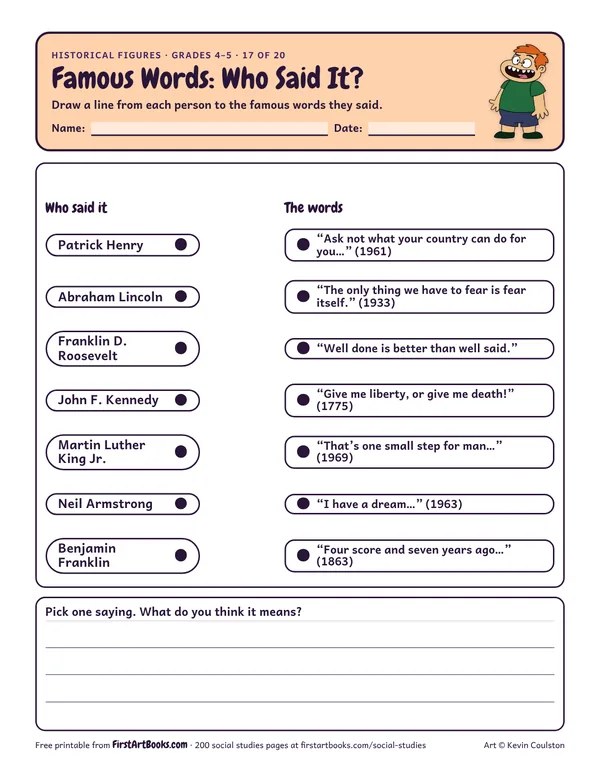
Match 7 famous words from American history (“Give me liberty, or give me death!”, “Four score and seven years ago”, “One small step”) to the people who said them.
Print this sheet (PDF)Teacher notes and tips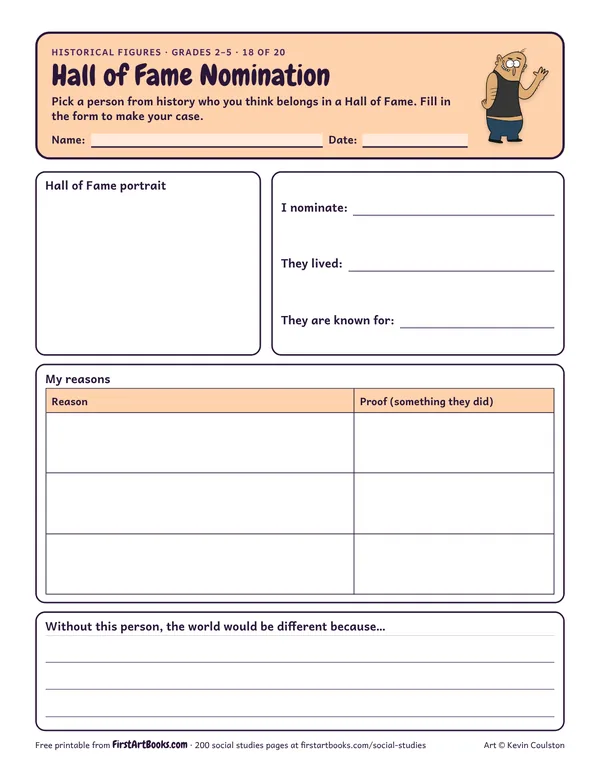
A persuasive research form: kids nominate a historical figure for a classroom Hall of Fame with a portrait, 3 reasons and proof for each.
Print this sheet (PDF)Teacher notes and tips

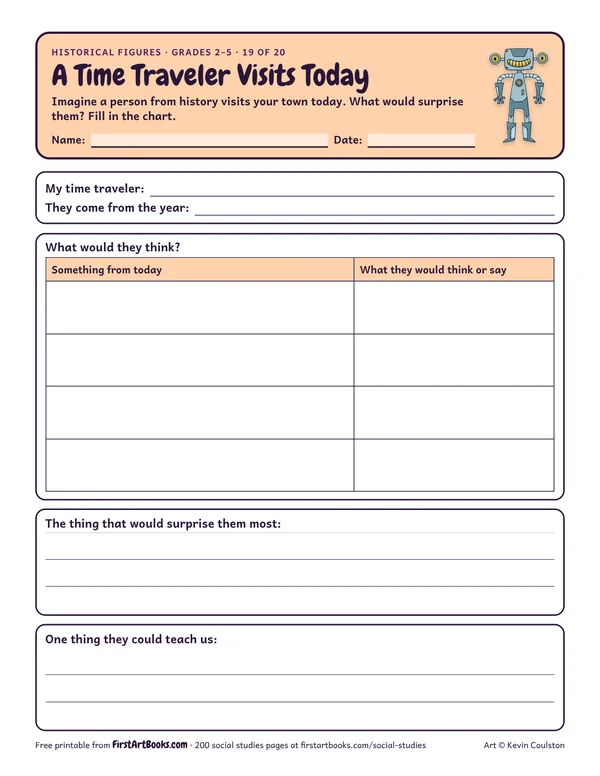
A then-and-now thinking page: kids imagine a historical figure visiting today and write what would amaze, confuse or please them, and what they would tell us.
Print this sheet (PDF)Teacher notes and tips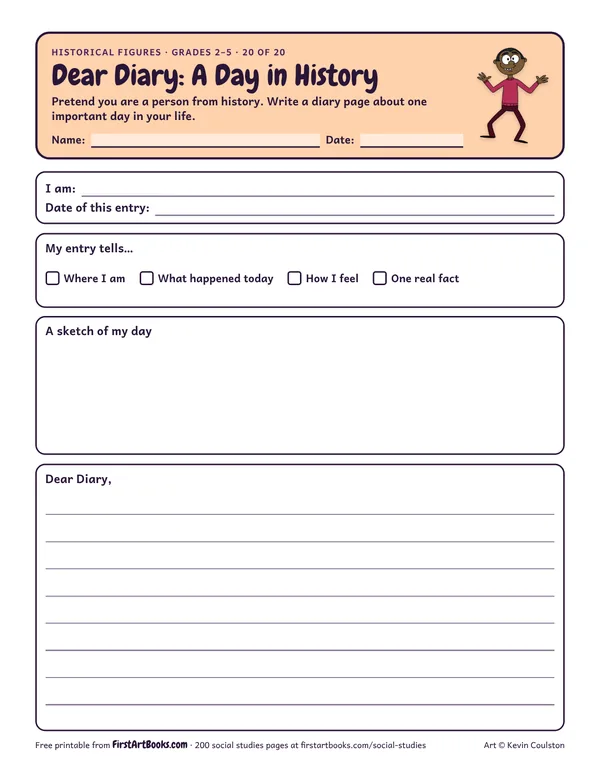
A creative writing template: kids write a diary entry as a historical figure about one important day, with a checklist of facts to include and a sketch.
Print this sheet (PDF)Teacher notes and tipsSort needs from wants, shop on a budget and save, spend and share. Grades K–2.
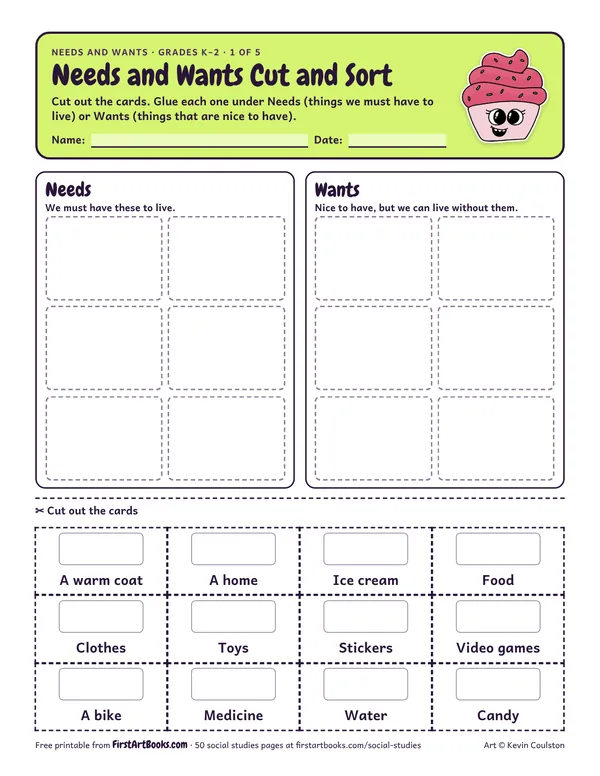
Cut out 12 picture-word cards and sort them into needs and wants. Answer key included.
Print this sheet (PDF)Teacher notes and tips

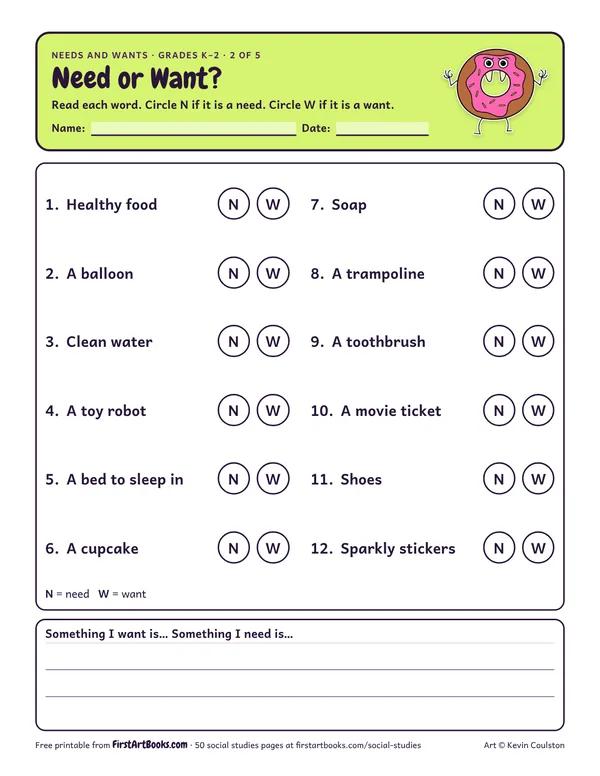
Read 12 everyday things and circle N for need or W for want.
Print this sheet (PDF)Teacher notes and tips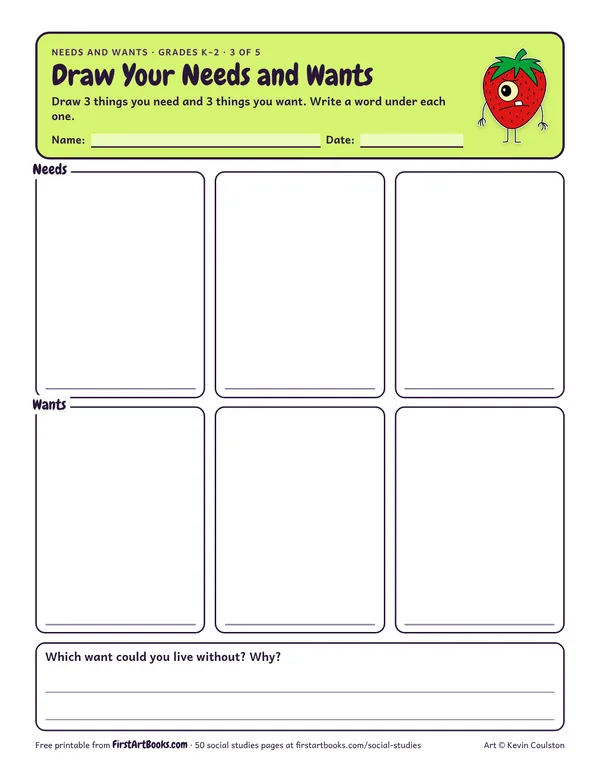
Kids draw and label 3 needs and 3 wants of their own, then tell which one they could live without.
Print this sheet (PDF)Teacher notes and tips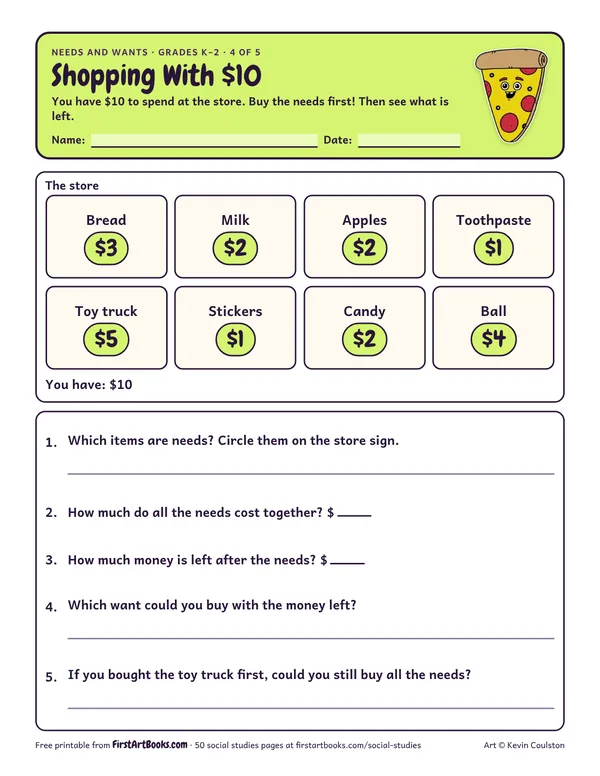
A simple store with prices: kids spend $10 on needs first, add up the cost and see what is left for a want.
Print this sheet (PDF)Teacher notes and tips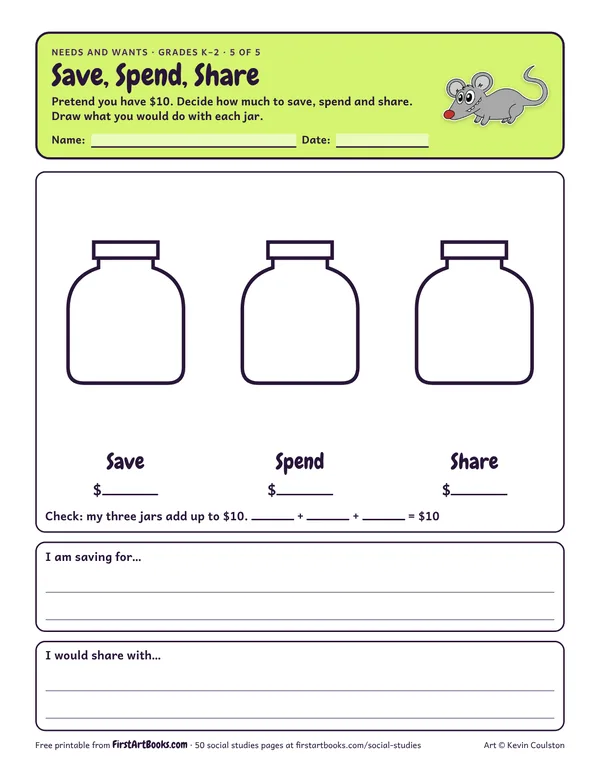
Three money jars to fill: kids split $10 into save, spend and share and draw what each part is for.
Print this sheet (PDF)Teacher notes and tips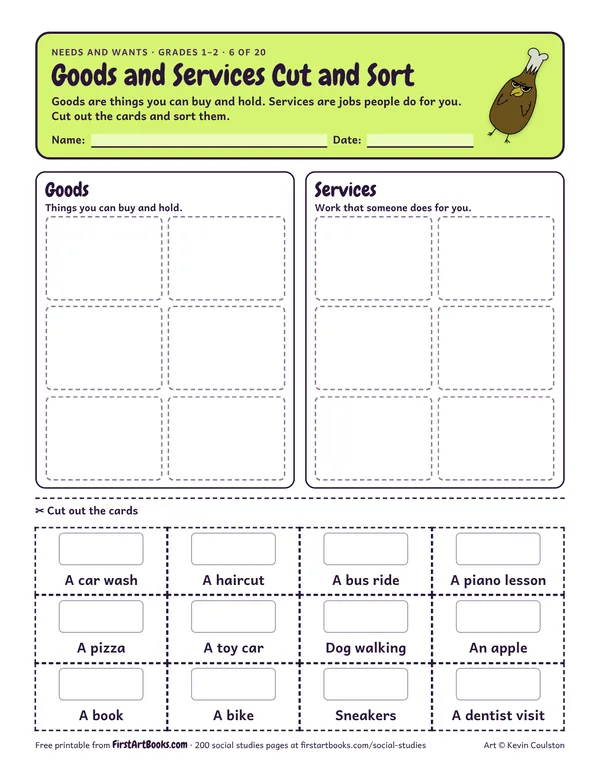
Cut out 12 cards and sort them into goods (things you can hold, like a bike or a pizza) and services (jobs people do for you, like a haircut or a bus ride).
Print this sheet (PDF)Teacher notes and tips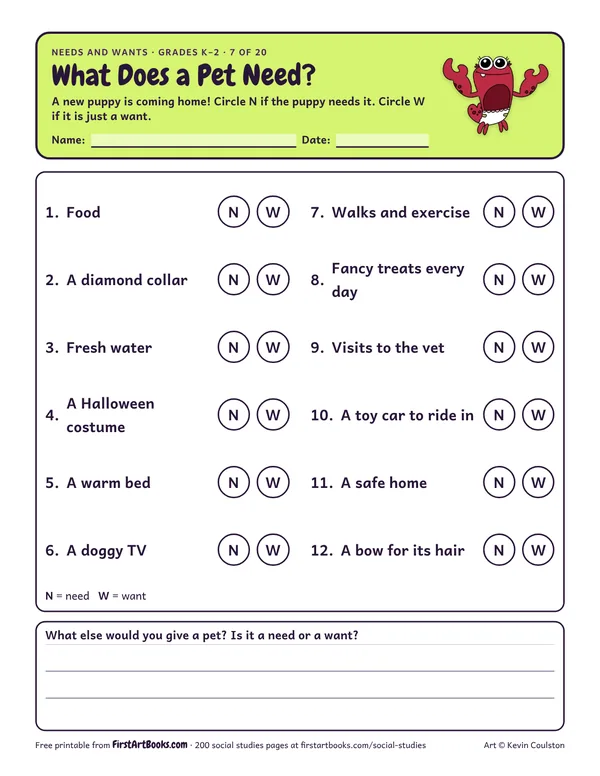
Needs and wants for a new puppy: circle N for the things a dog must have (food, water, a safe home, the vet) and W for the extras (a costume, fancy treats).
Print this sheet (PDF)Teacher notes and tips
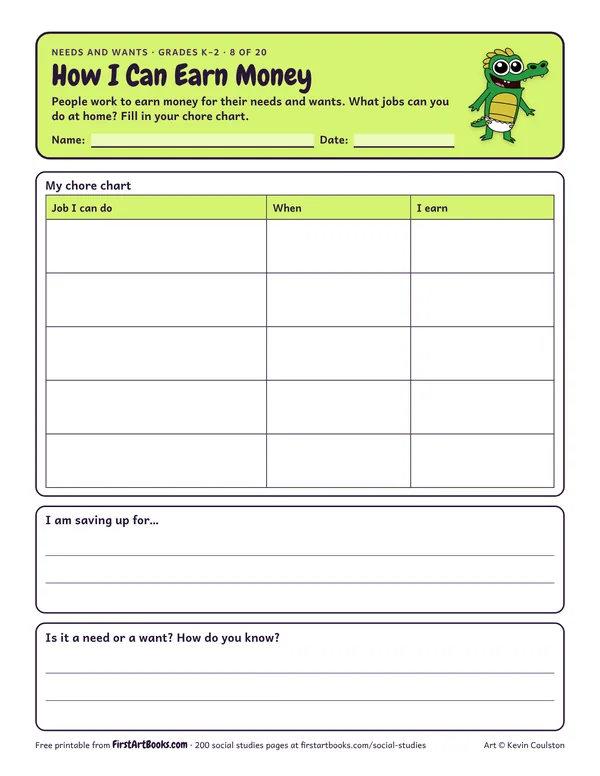
A chore-and-earnings chart: kids list jobs they can do at home, when they will do them and what they earn, then plan what to save for.
Print this sheet (PDF)Teacher notes and tips

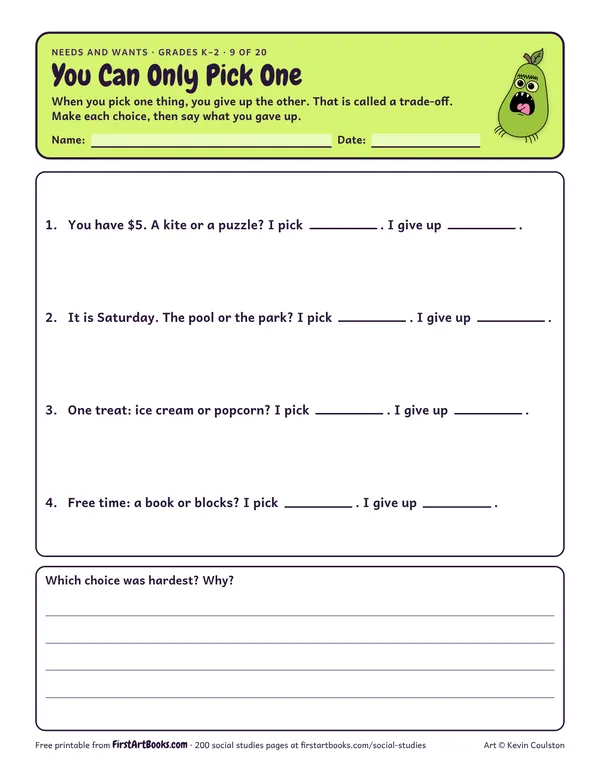
Four simple trade-off choices (a kite or a puzzle, the pool or the park): kids pick one, write what they gave up and explain why.
Print this sheet (PDF)Teacher notes and tips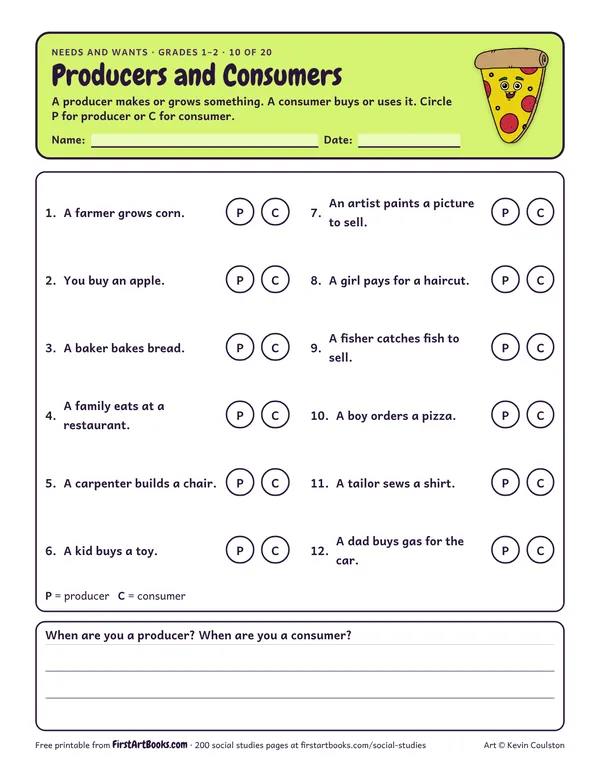
12 sentences to sort: who is the producer (the farmer who grows corn, the baker) and who is the consumer (the kid who buys the toy, the family at the restaurant).
Print this sheet (PDF)Teacher notes and tips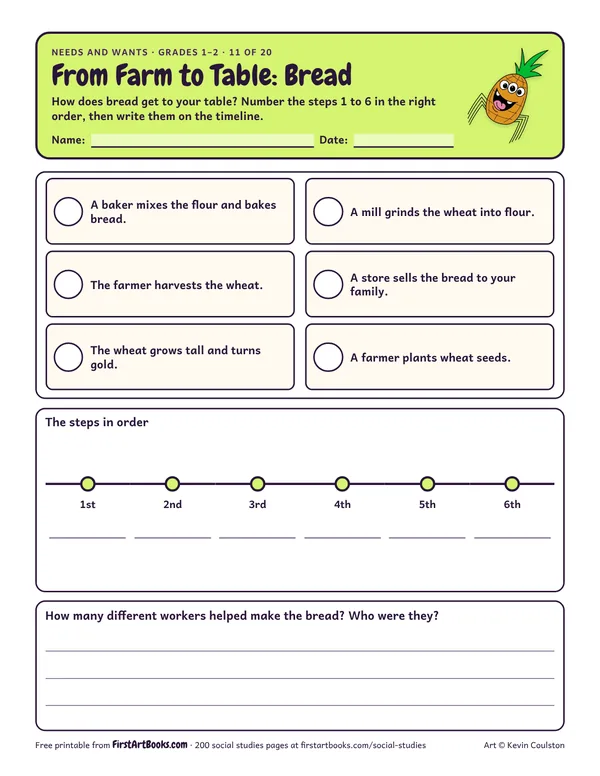
Put 6 steps in order, from the farmer planting wheat to the store selling bread, and see how many workers help make one loaf.
Print this sheet (PDF)Teacher notes and tips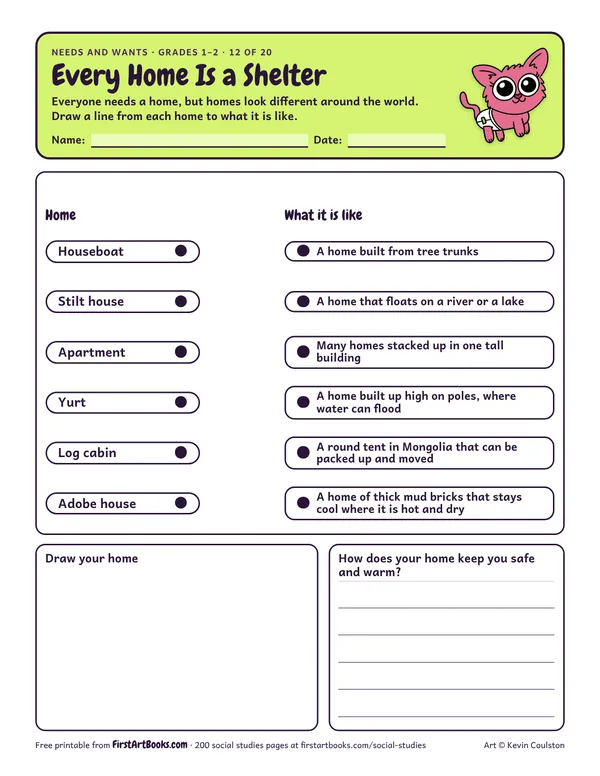
Shelter is a need: match 6 kinds of homes, from a houseboat and a stilt house to a yurt and an adobe house, to how they are built, then draw your own home.
Print this sheet (PDF)Teacher notes and tips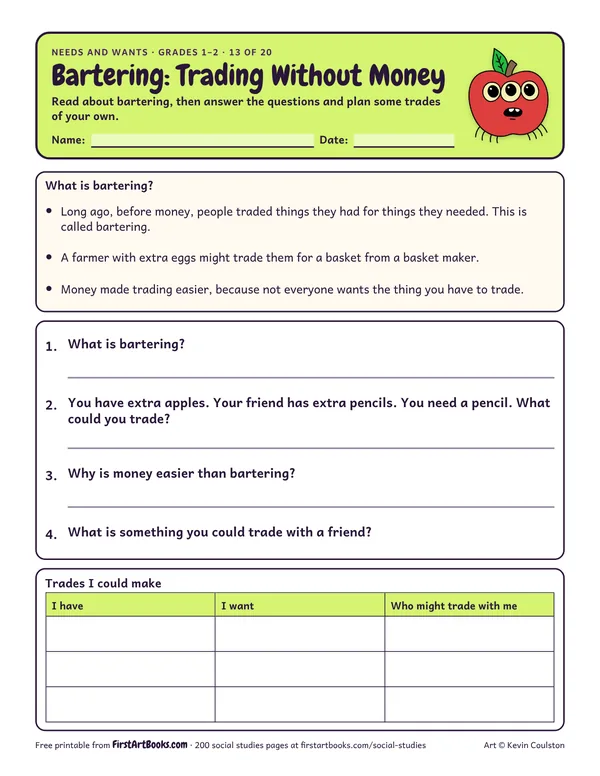
Learn how people traded before money (bartering), answer 4 questions about trades and plan 3 swaps with friends.
Print this sheet (PDF)Teacher notes and tips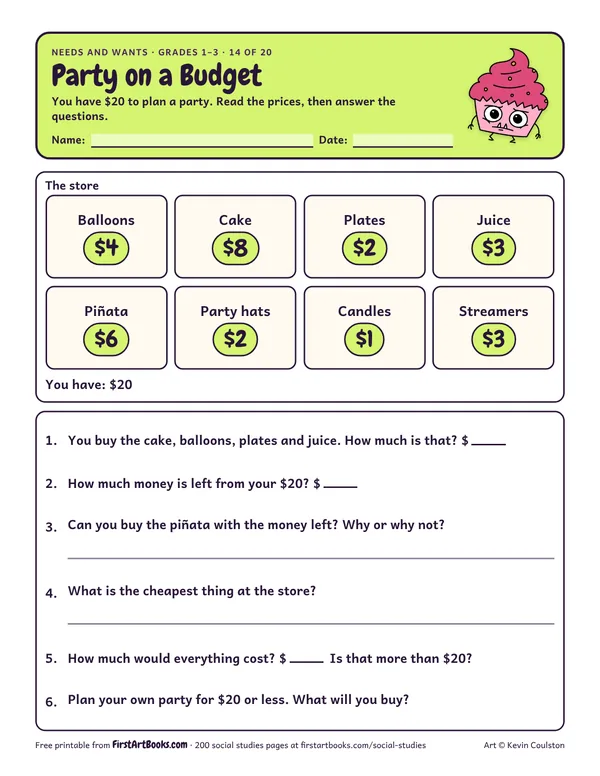
Plan a party with $20: add up cake, balloons and juice, find what is left, and learn why a budget means choosing.
Print this sheet (PDF)Teacher notes and tips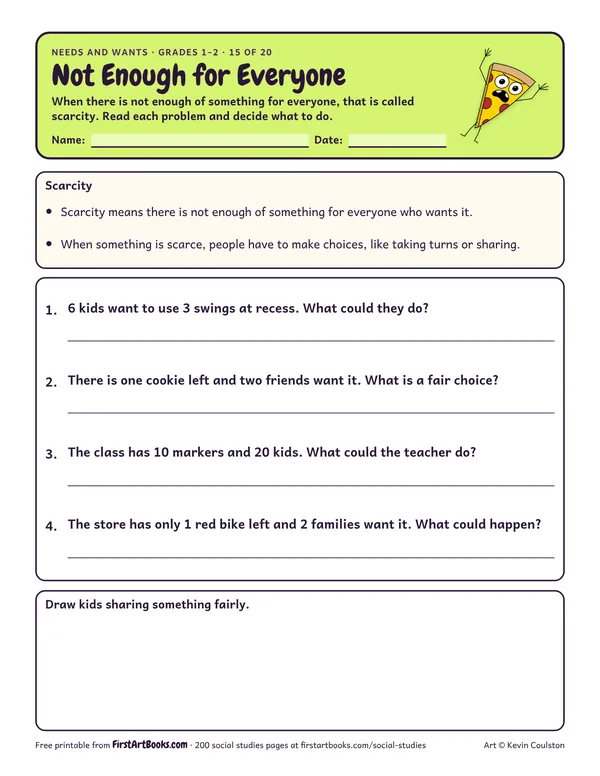
Learn the word scarcity with 4 classroom problems (6 kids and 3 swings, one last cookie), then think of fair ways to share.
Print this sheet (PDF)Teacher notes and tips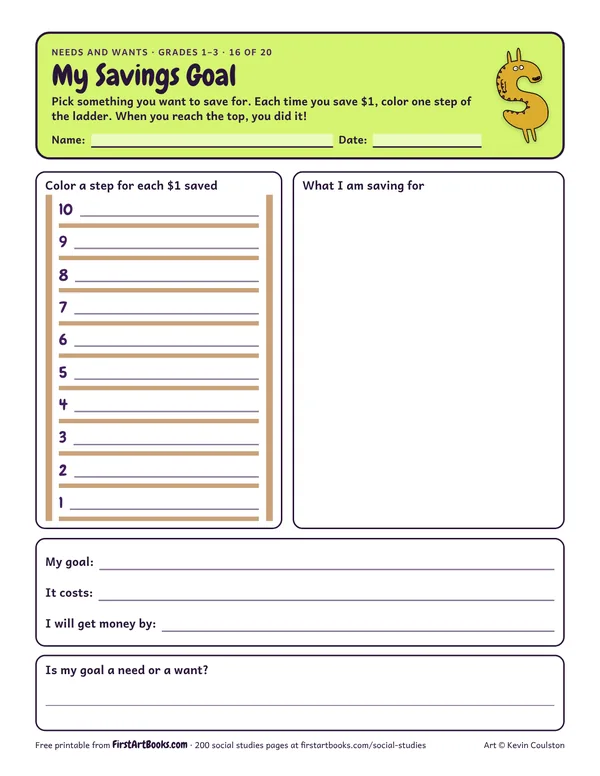
A savings goal tracker: kids pick a goal, color a step of a 10-rung ladder for every dollar saved and plan where the money will come from.
Print this sheet (PDF)Teacher notes and tips
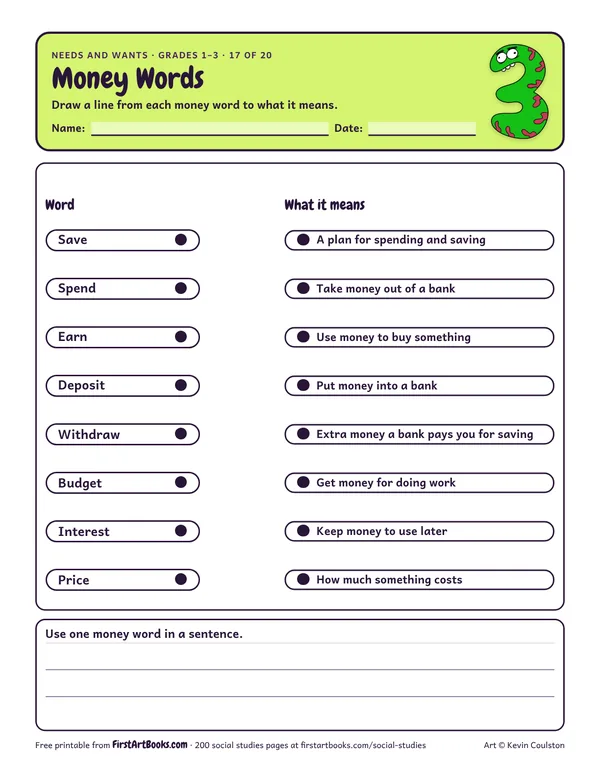
Match 8 money words (save, spend, earn, deposit, withdraw, budget, interest and price) to their meanings, then use one in a sentence.
Print this sheet (PDF)Teacher notes and tips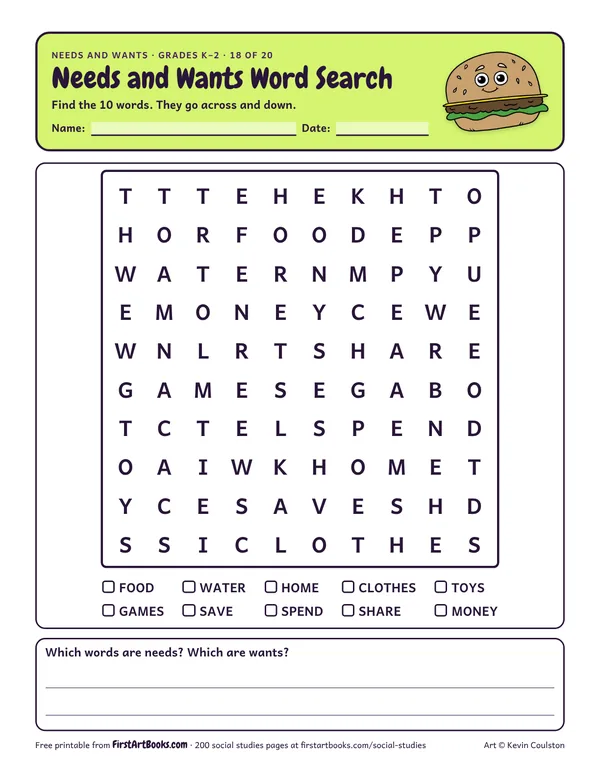
A 10 by 10 word search with 10 needs-and-wants and money words (food, water, home, clothes, save, spend, share and more) for early readers.
Print this sheet (PDF)Teacher notes and tips

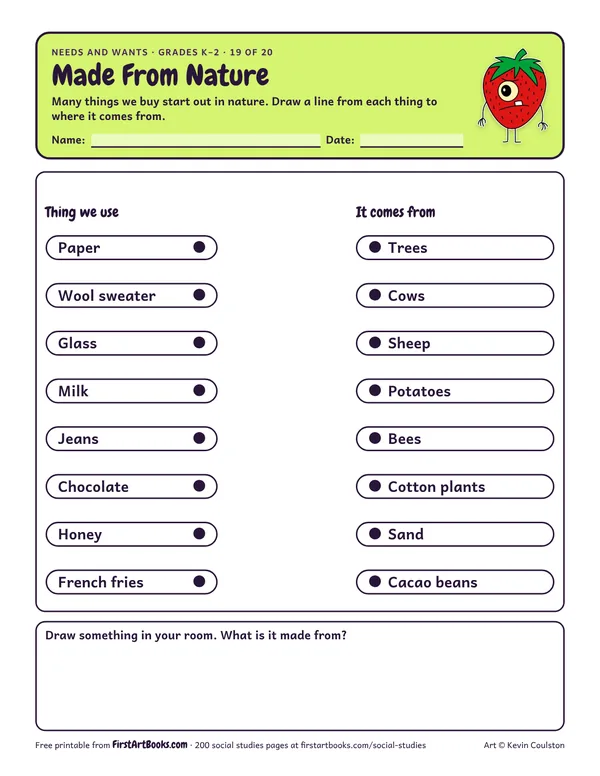
Natural resources for little learners: match 8 everyday goods (paper, wool, glass, milk, jeans, chocolate, honey and fries) to what they are made from.
Print this sheet (PDF)Teacher notes and tips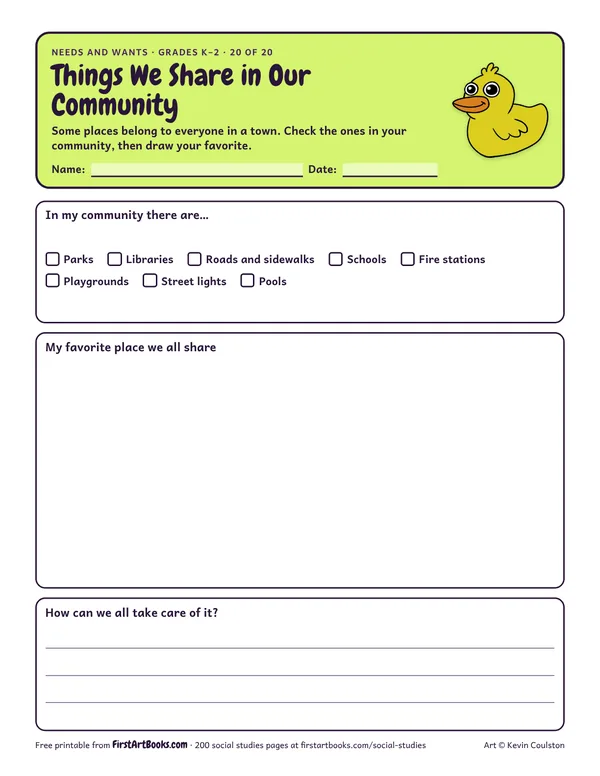
Public goods for K–2: kids check the shared places in their town (parks, libraries, sidewalks, fire stations), draw a favorite and think about how to take care of it.
Print this sheet (PDF)Teacher notes and tipsGreetings, foods and celebrations from around the world. Grades 1–5.
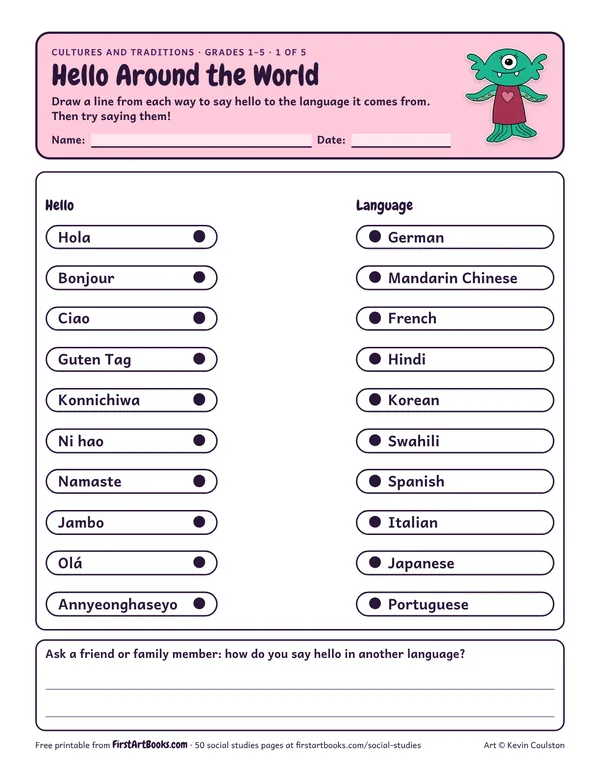
Match 10 ways to say hello, from hola to konnichiwa, to their languages, then practice saying them out loud.
Print this sheet (PDF)Teacher notes and tips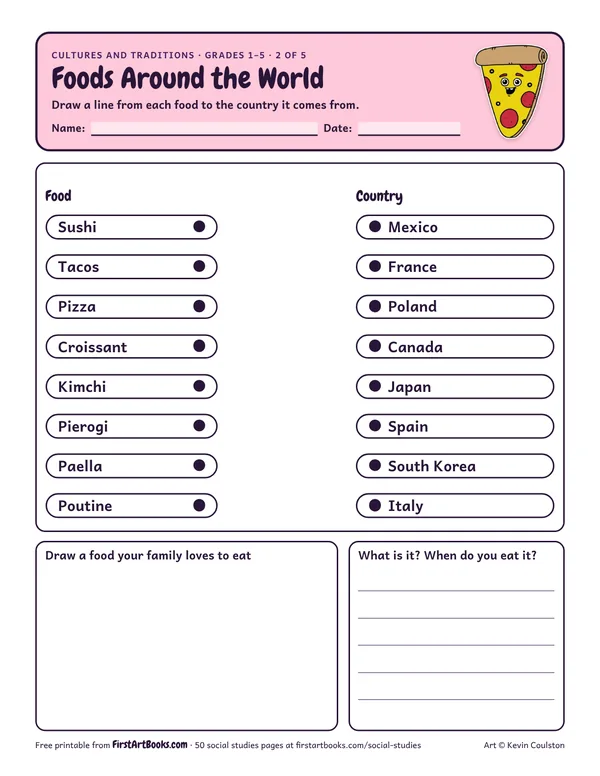
Match 8 famous foods, like sushi, tacos, paella and poutine, to the countries they come from, then draw a family favorite.
Print this sheet (PDF)Teacher notes and tips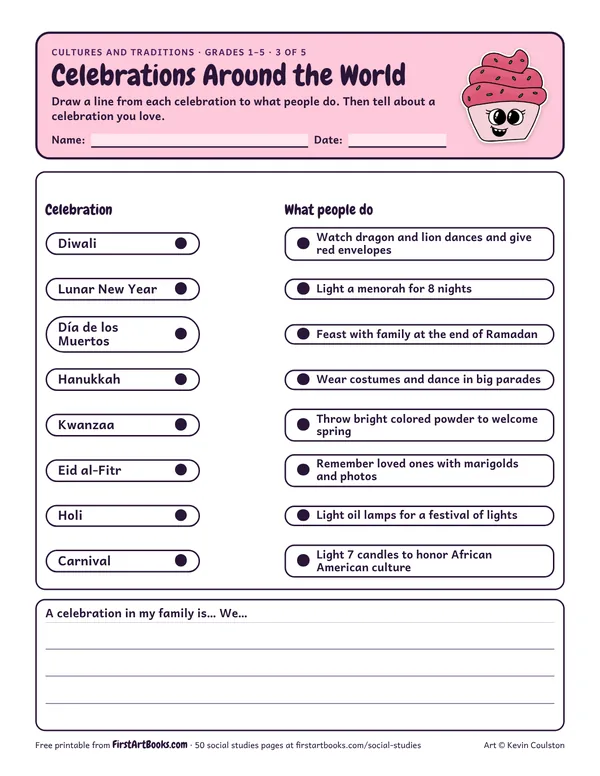
Match 8 celebrations, including Diwali, Lunar New Year, Hanukkah, Kwanzaa and Eid al-Fitr, to how people celebrate.
Print this sheet (PDF)Teacher notes and tips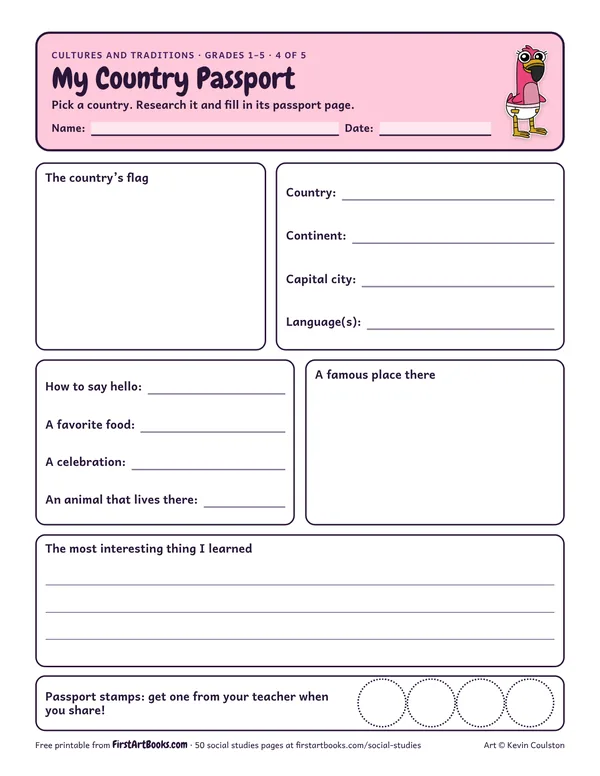
A passport-style research page for any country: flag, continent, capital, language, food, celebration and more.
Print this sheet (PDF)Teacher notes and tips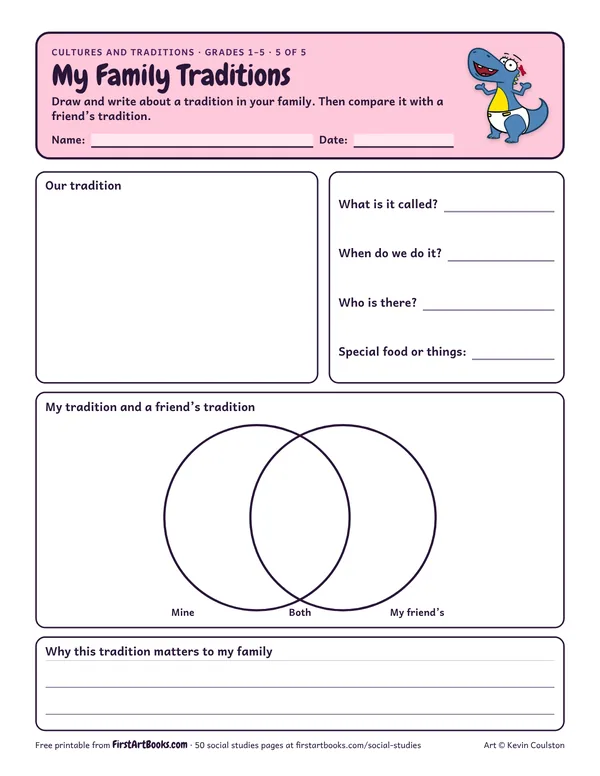
Kids draw and describe a family tradition, then compare it with a classmate’s in a Venn diagram.
Print this sheet (PDF)Teacher notes and tips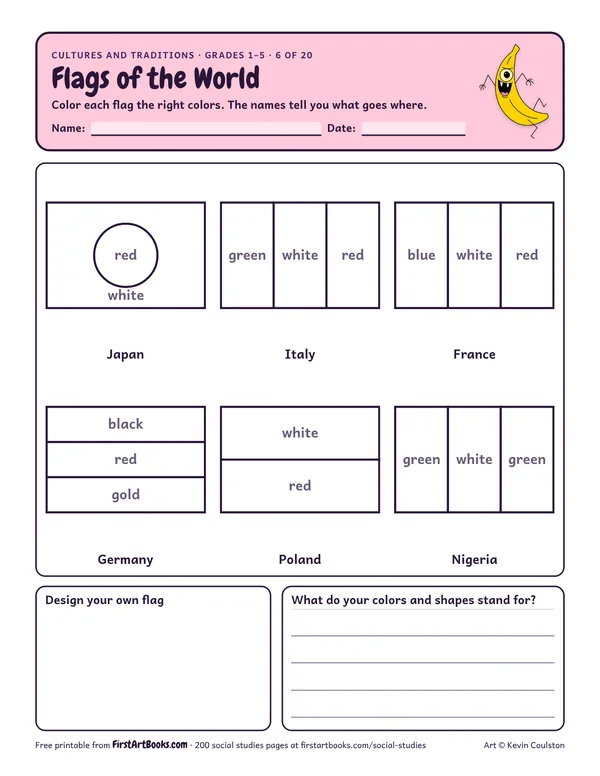
Color 6 real flags (Japan, Italy, France, Germany, Poland and Nigeria) by following the color labels, then design a flag of your own.
Print this sheet (PDF)Teacher notes and tips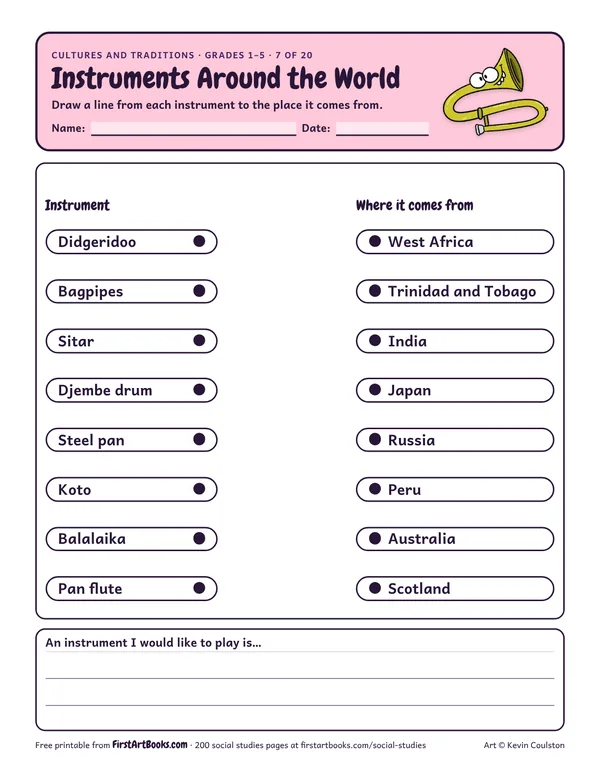
Match 8 instruments, from the didgeridoo and bagpipes to the sitar, djembe and steel pan, to the places they come from.
Print this sheet (PDF)Teacher notes and tips

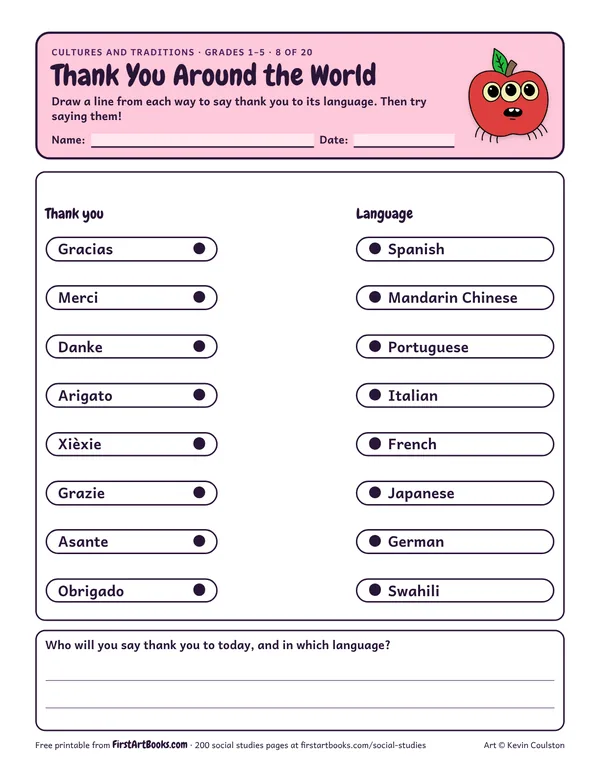
Match 8 ways to say thank you, from gracias and merci to arigato and asante, to their languages.
Print this sheet (PDF)Teacher notes and tips
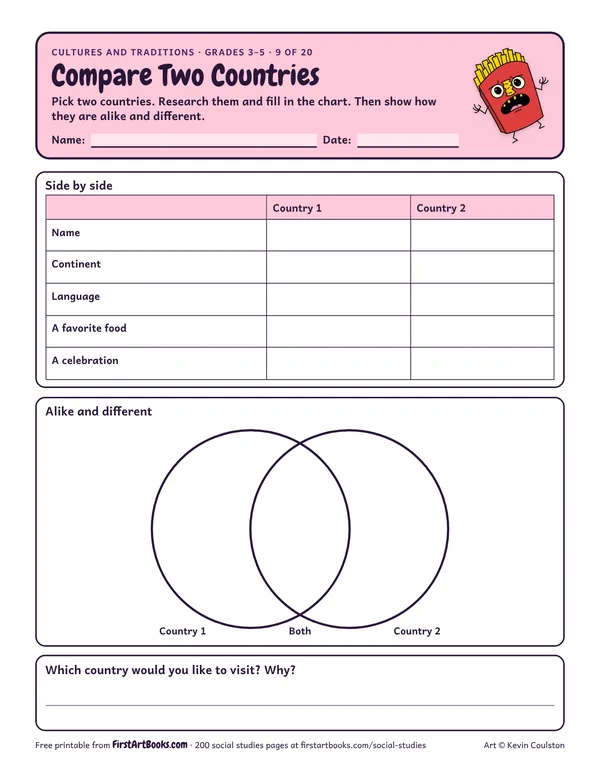
A side-by-side chart and a Venn diagram to compare two countries: continent, language, food, a celebration and the weather.
Print this sheet (PDF)Teacher notes and tips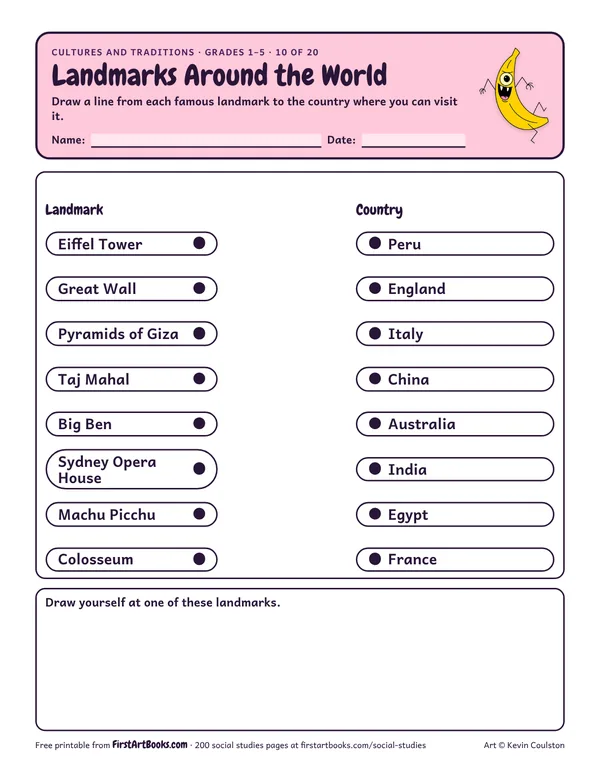
Match 8 world landmarks, from the Eiffel Tower and the Great Wall to the Taj Mahal and Machu Picchu, to their countries.
Print this sheet (PDF)Teacher notes and tips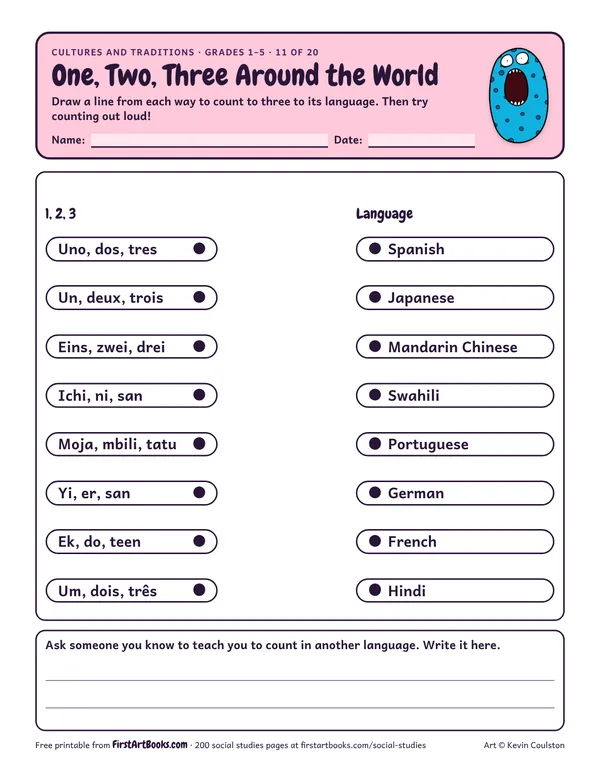
Match 8 ways to count to three, from uno, dos, tres and un, deux, trois to ichi, ni, san and moja, mbili, tatu, to their languages.
Print this sheet (PDF)Teacher notes and tips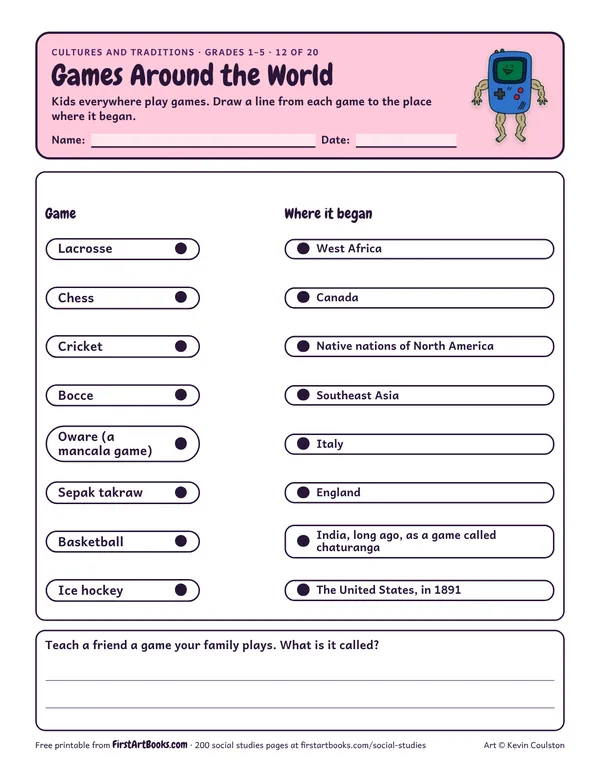
Match 8 games and sports, from lacrosse and chess to cricket, bocce, oware and sepak takraw, to the places where they began.
Print this sheet (PDF)Teacher notes and tips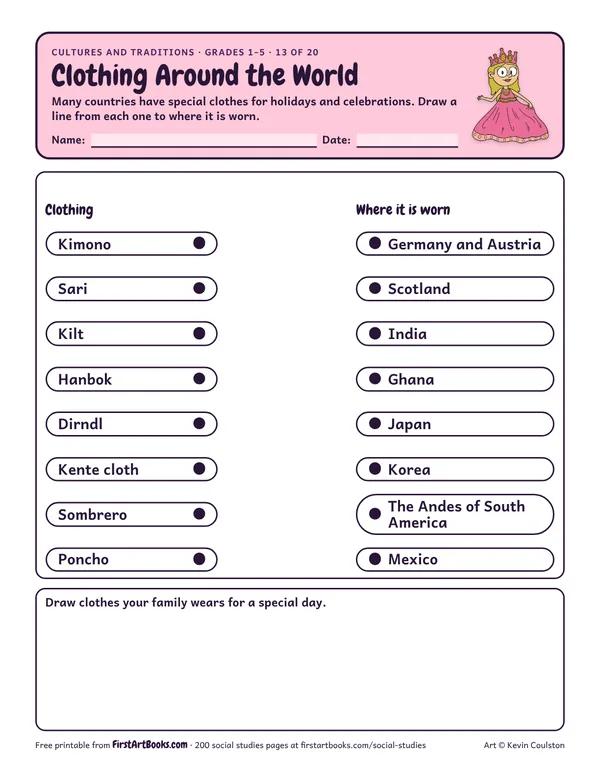
Match 8 kinds of traditional clothing, from the kimono and the sari to the kilt, the hanbok and kente cloth, to the places they come from.
Print this sheet (PDF)Teacher notes and tips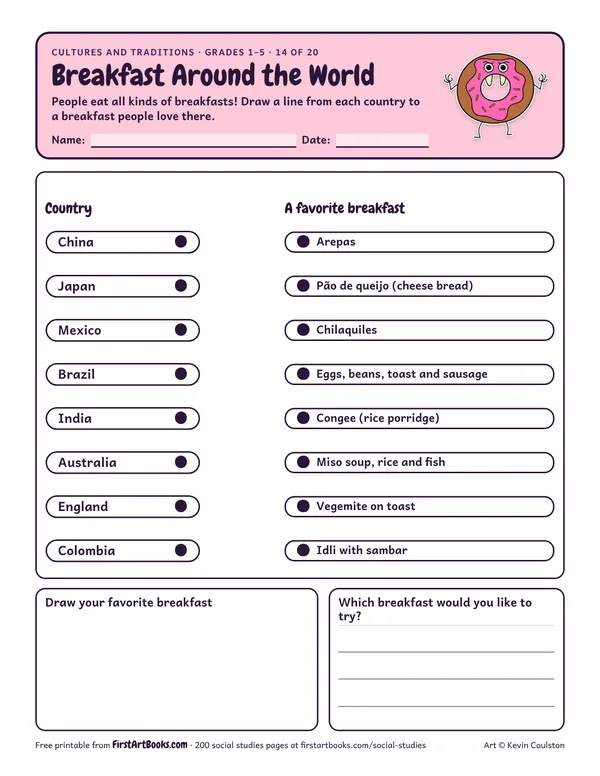
Match 8 breakfasts, from congee and miso soup to chilaquiles, pão de queijo and Vegemite on toast, to the countries where they are favorites.
Print this sheet (PDF)Teacher notes and tips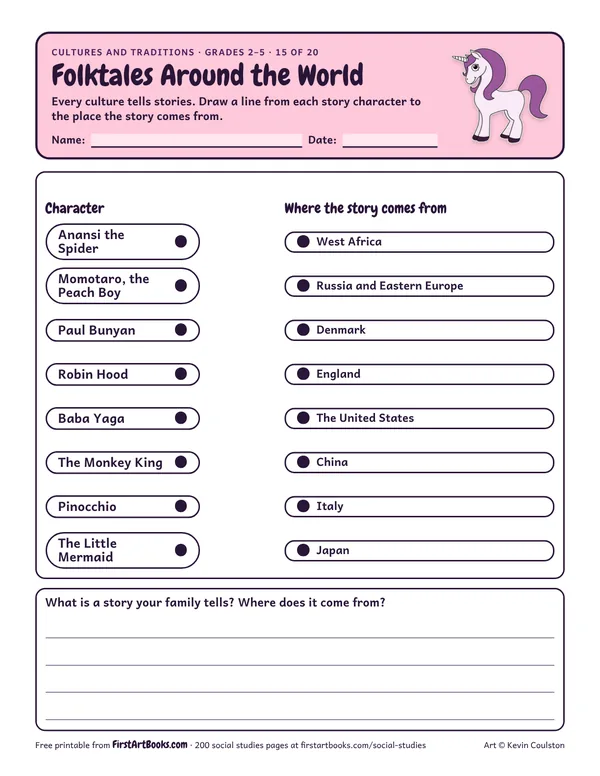
Match 8 storybook characters, from Anansi the Spider and Momotaro to Paul Bunyan, Baba Yaga and the Monkey King, to the places their stories come from.
Print this sheet (PDF)Teacher notes and tips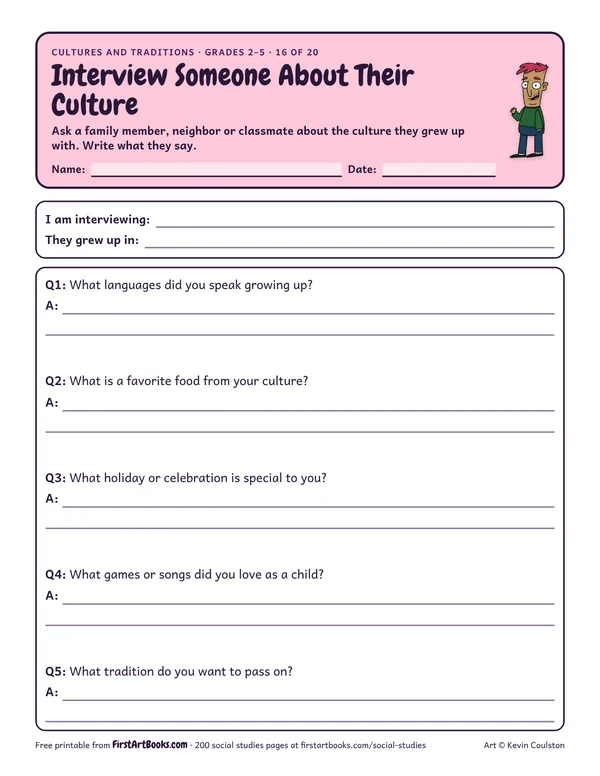
Five interview questions about someone’s culture: where they grew up, the language, a favorite food, a holiday and a tradition they want to pass on.
Print this sheet (PDF)Teacher notes and tips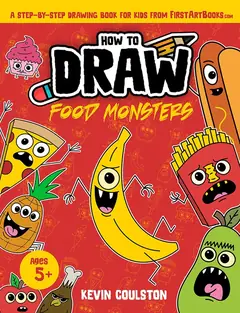
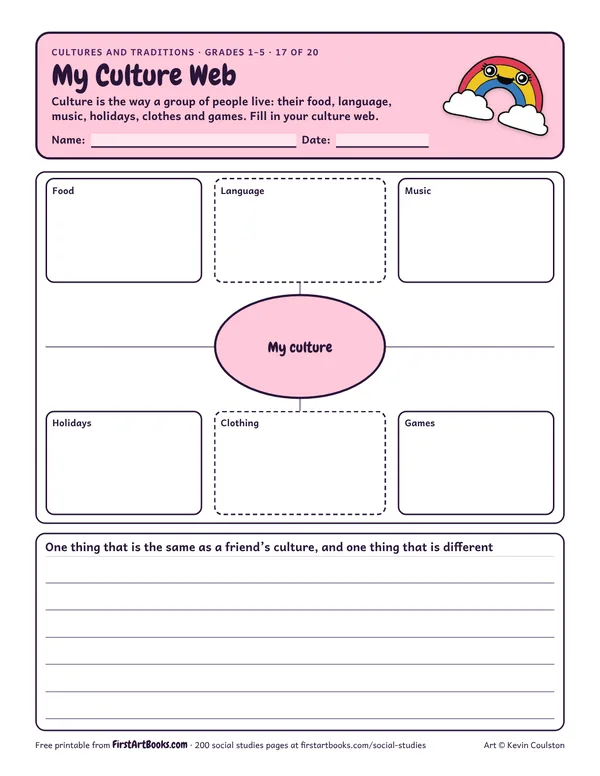
A six-spoke culture web: kids write and draw their family’s food, language, music, holidays, clothing and games, then compare with a friend.
Print this sheet (PDF)Teacher notes and tips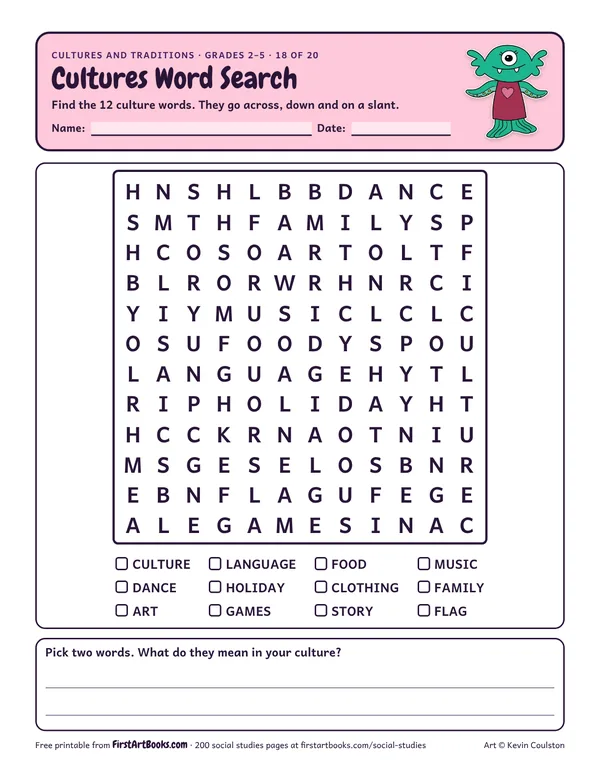
A 12 by 12 word search of culture words (language, music, dance, holiday, clothing, family, story and more), then a sentence about your own culture.
Print this sheet (PDF)Teacher notes and tips
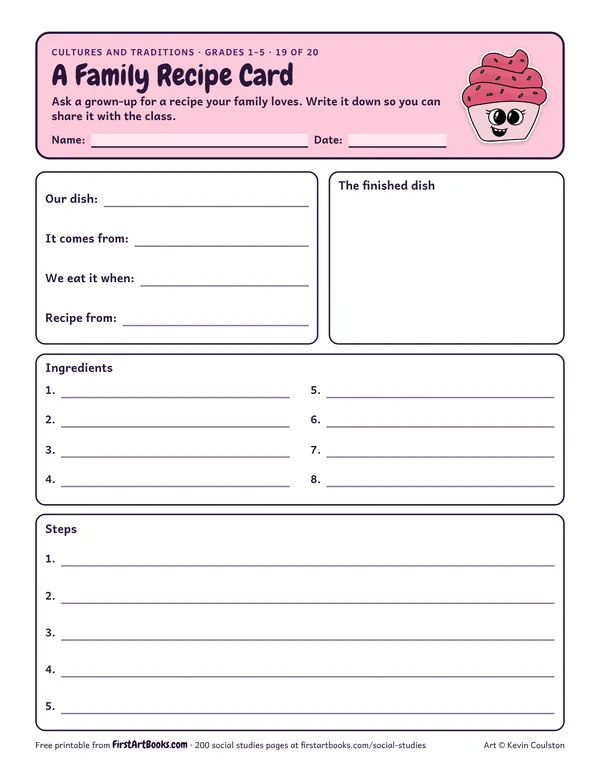
A recipe card template for a class cookbook: the dish, where it comes from, the ingredients, the steps and a drawing of the food.
Print this sheet (PDF)Teacher notes and tips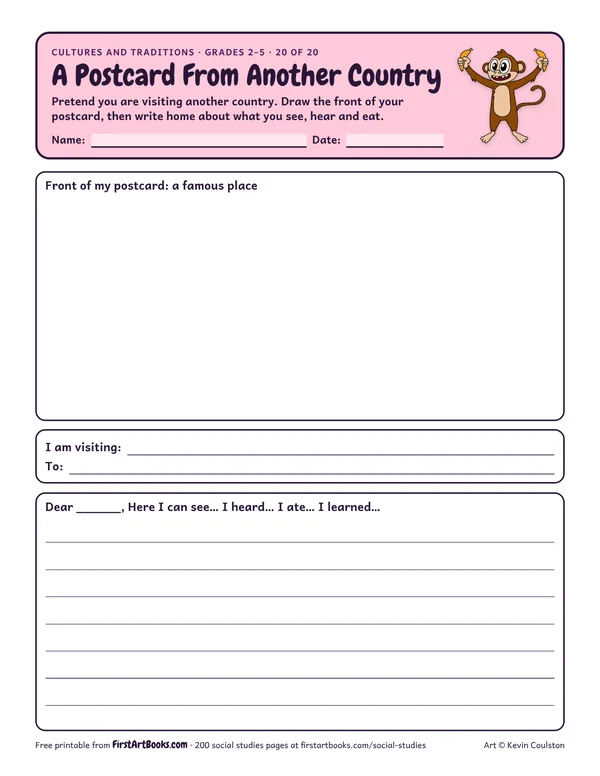
Kids research a country and write an imaginary postcard home: a drawing of a famous place, plus what they saw, heard, ate and learned.
Print this sheet (PDF)Teacher notes and tipsThe three branches, levels of government, voting and good citizens. Grades 2–5.
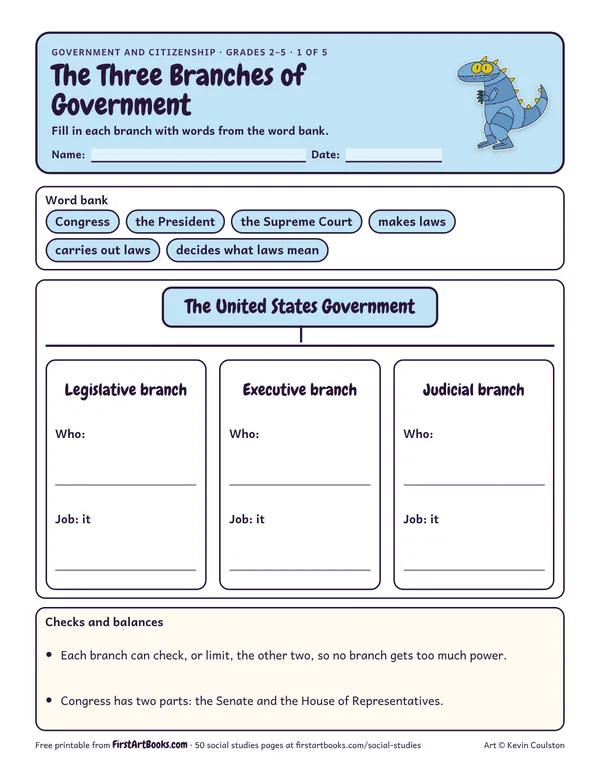
A tree diagram of the legislative, executive and judicial branches: who is in each one and what each one does.
Print this sheet (PDF)Teacher notes and tips
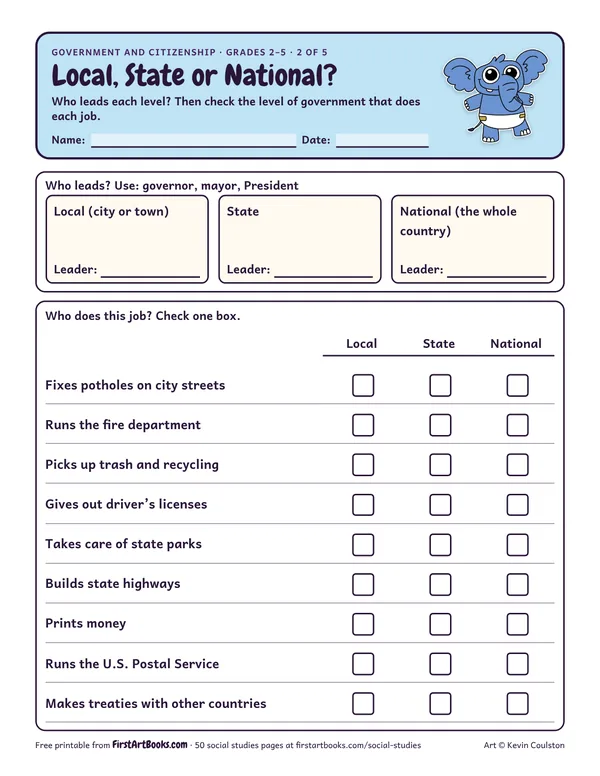
Learn the leader of each level of government (mayor, governor, President) and sort 9 jobs into local, state or national.
Print this sheet (PDF)Teacher notes and tips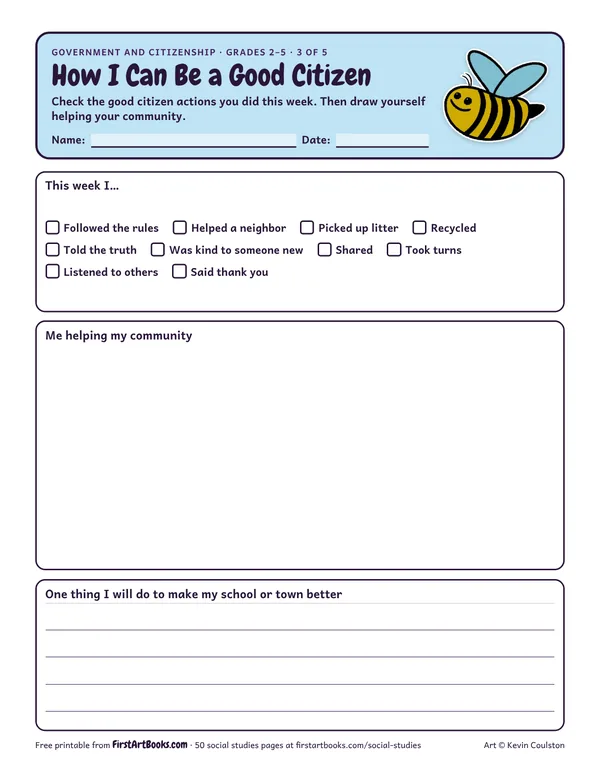
A good citizen checklist kids can use all week, plus a drawing and a promise for how they will help their community.
Print this sheet (PDF)Teacher notes and tips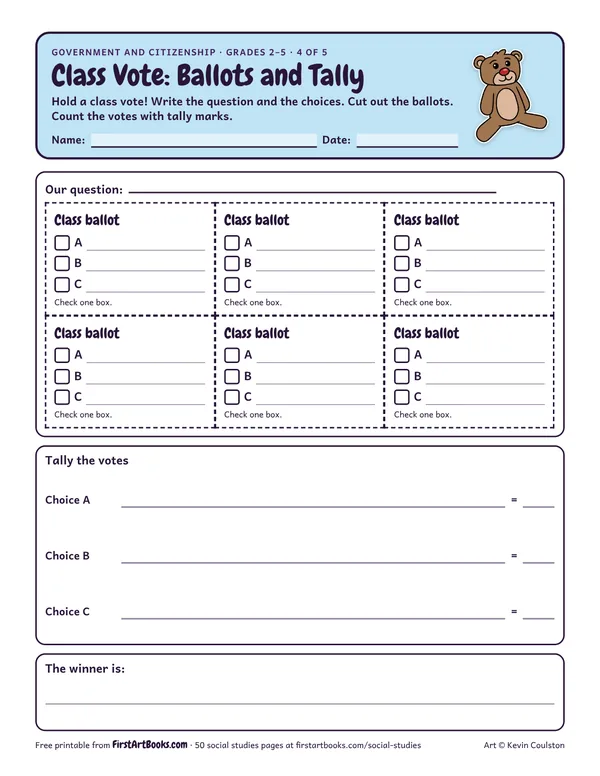
Hold a real class election: 6 cut-out ballots, a tally chart and a results box. In the United States, citizens can vote at 18.
Print this sheet (PDF)Teacher notes and tips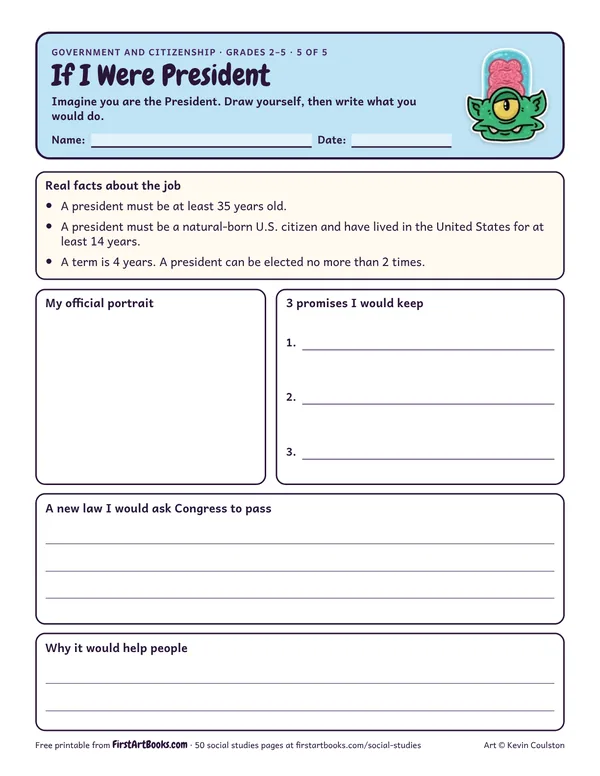
Kids imagine being President: draw a portrait, make 3 promises and invent a new law, with real facts about the job.
Print this sheet (PDF)Teacher notes and tips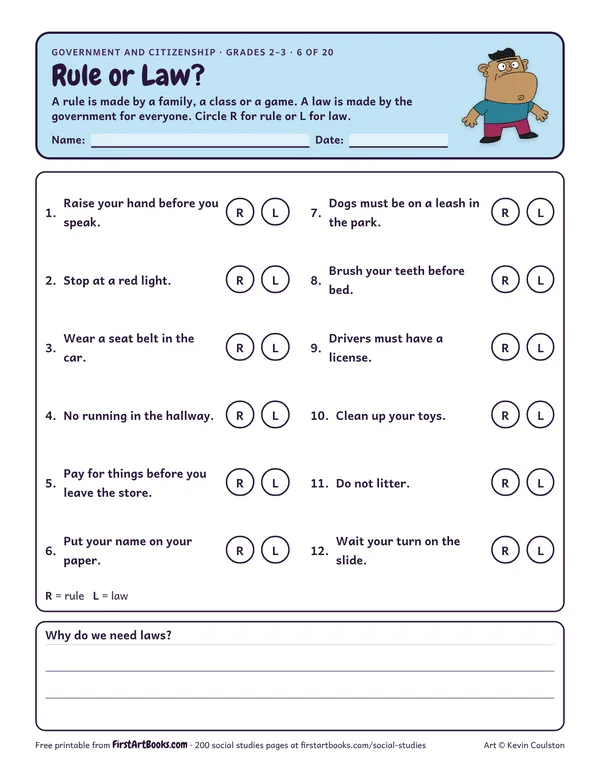
12 everyday sentences to sort: circle R for a rule (raise your hand, clean up your toys) or L for a law (stop at a red light, wear a seat belt).
Print this sheet (PDF)Teacher notes and tips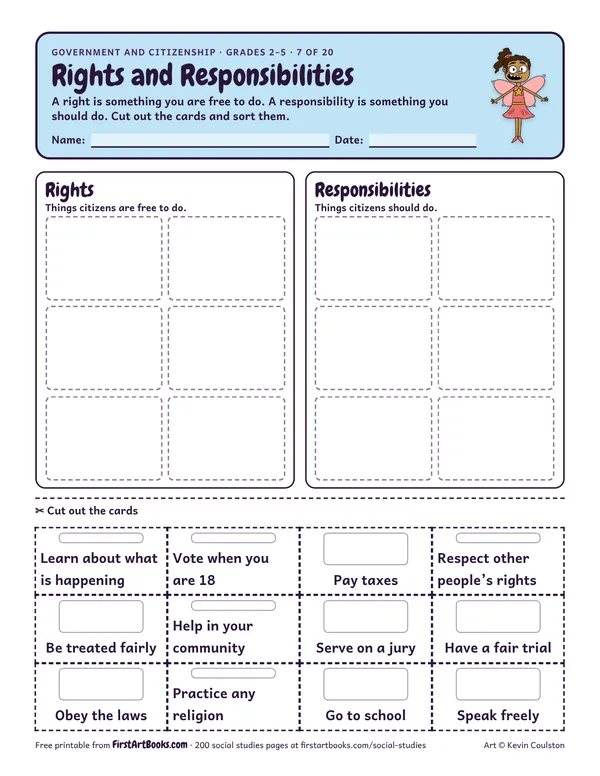
Cut out 12 cards and sort citizens’ rights (go to school, speak freely, vote at 18, a fair trial) from responsibilities (obey laws, pay taxes, serve on a jury, respect others).
Print this sheet (PDF)Teacher notes and tips
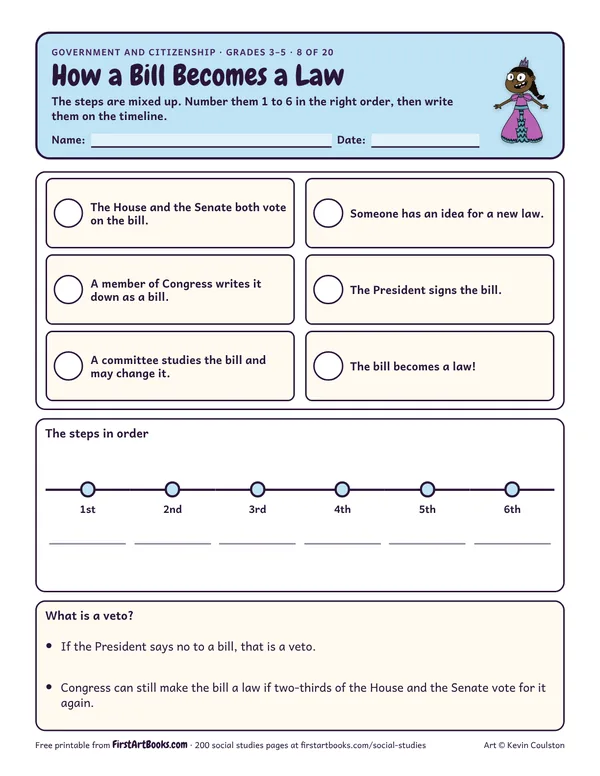
Put the 6 steps of how a bill becomes a law in order, from the idea to the President’s signature, and learn what a veto is.
Print this sheet (PDF)Teacher notes and tips

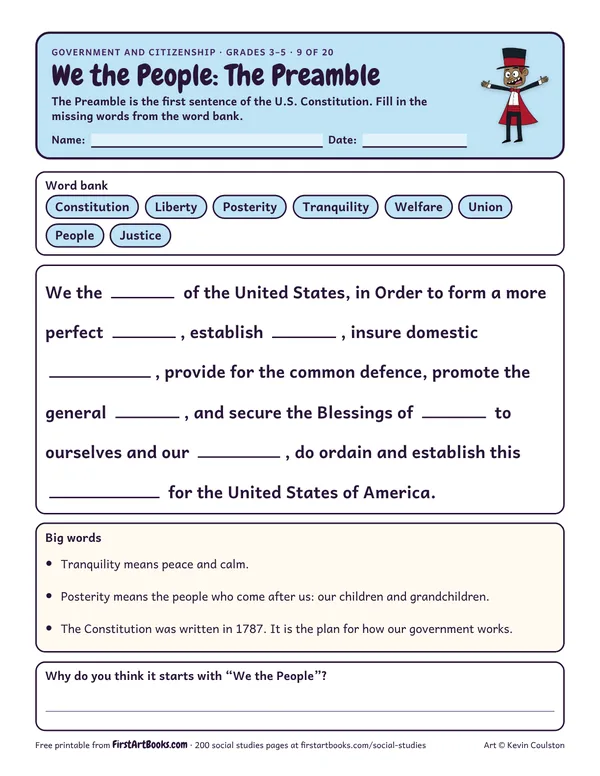
Fill in 8 missing words of the Preamble to the Constitution from a word bank, then learn what the big words mean.
Print this sheet (PDF)Teacher notes and tips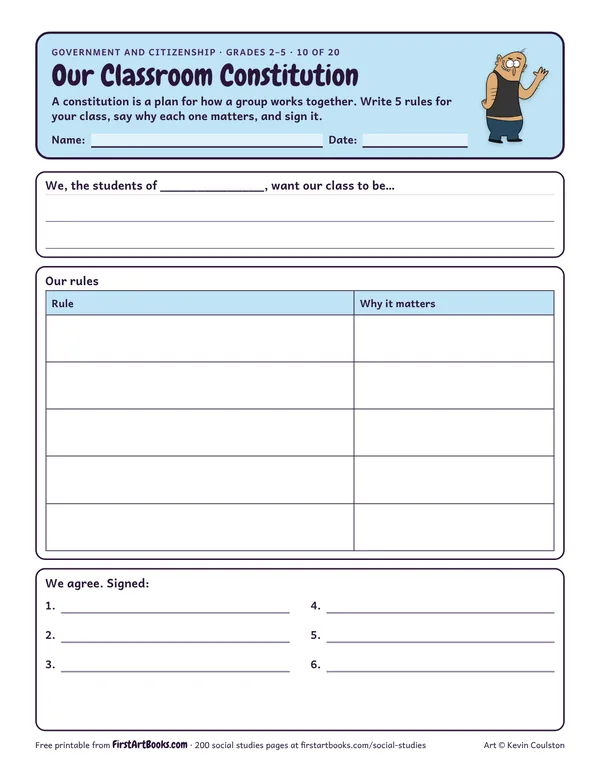
Write a classroom constitution: a preamble, 5 rules with reasons, and signature lines for everyone who agrees.
Print this sheet (PDF)Teacher notes and tips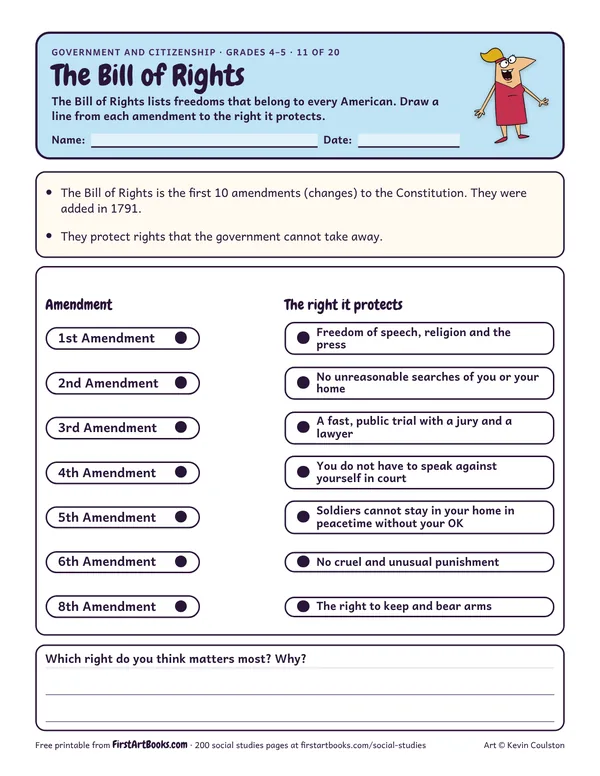
Learn what the Bill of Rights is (the first 10 amendments, added in 1791) and match 7 amendments to the rights they protect, from free speech to a fair trial.
Print this sheet (PDF)Teacher notes and tips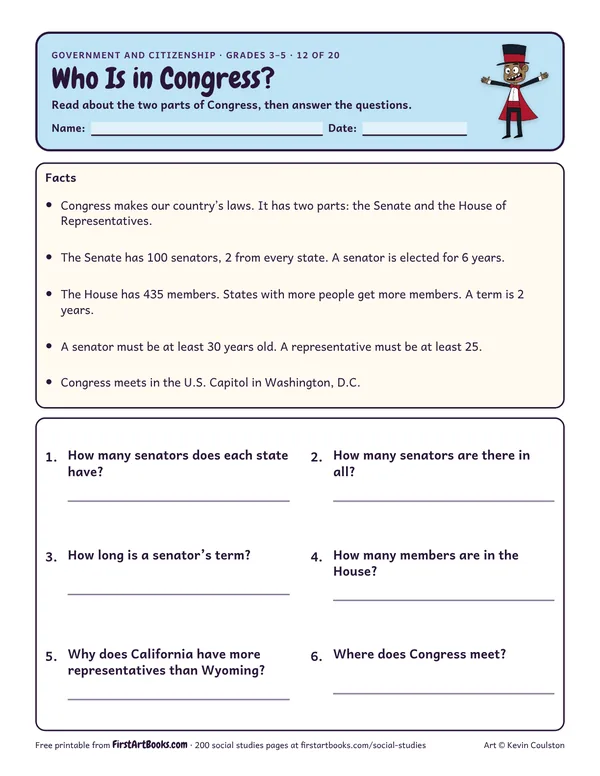
Read 5 facts about Congress (100 senators, 435 representatives, their terms and ages, the Capitol) and answer 6 questions.
Print this sheet (PDF)Teacher notes and tips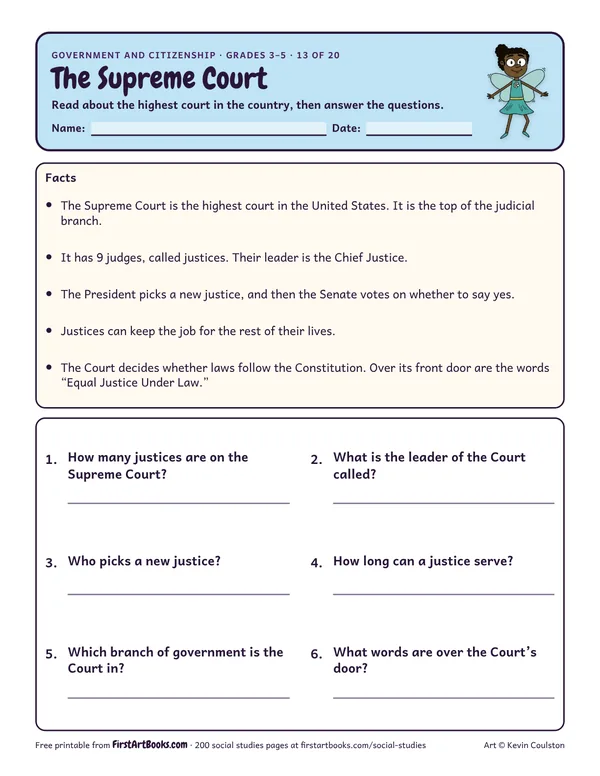
Read 5 facts about the Supreme Court (9 justices, the Chief Justice, how a justice is chosen, “Equal Justice Under Law”) and answer 6 questions.
Print this sheet (PDF)Teacher notes and tips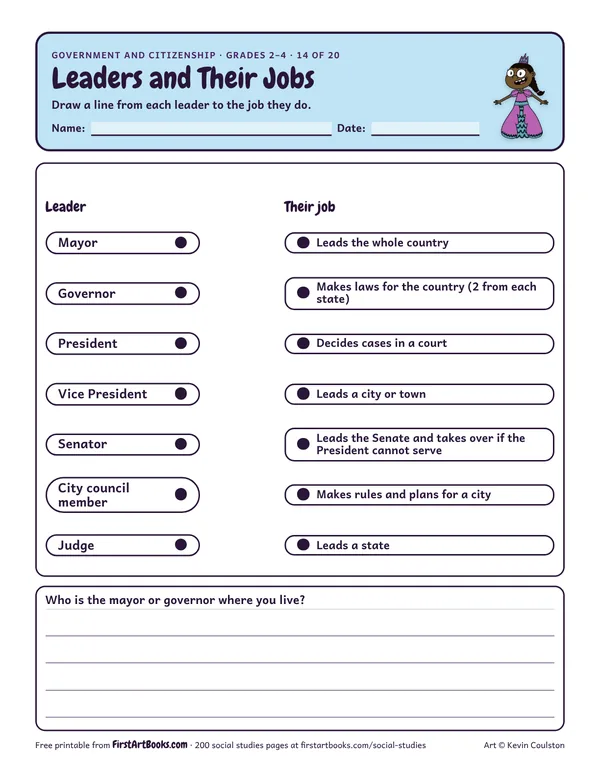
Match 7 government leaders, from the mayor and the governor to the Vice President, a senator and a judge, to what they do.
Print this sheet (PDF)Teacher notes and tips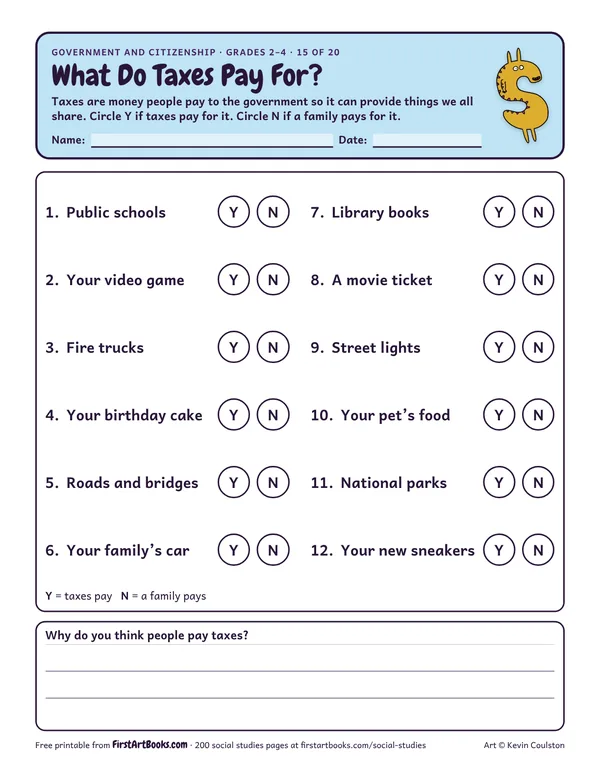
12 things to sort: what our taxes pay for (public schools, fire trucks, roads, libraries) and what families buy for themselves (a video game, a birthday cake).
Print this sheet (PDF)Teacher notes and tips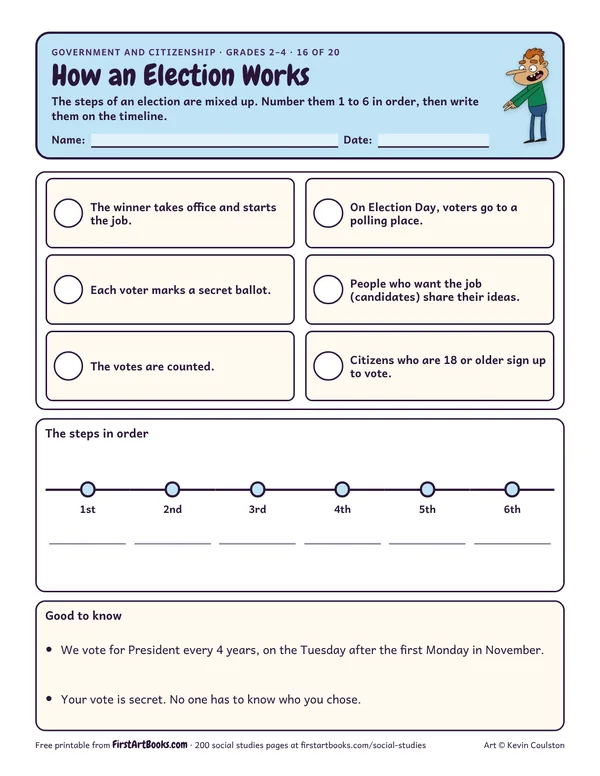
Put the 6 steps of an election in order, from candidates sharing their ideas to the winner taking office, and learn when we vote for President.
Print this sheet (PDF)Teacher notes and tips

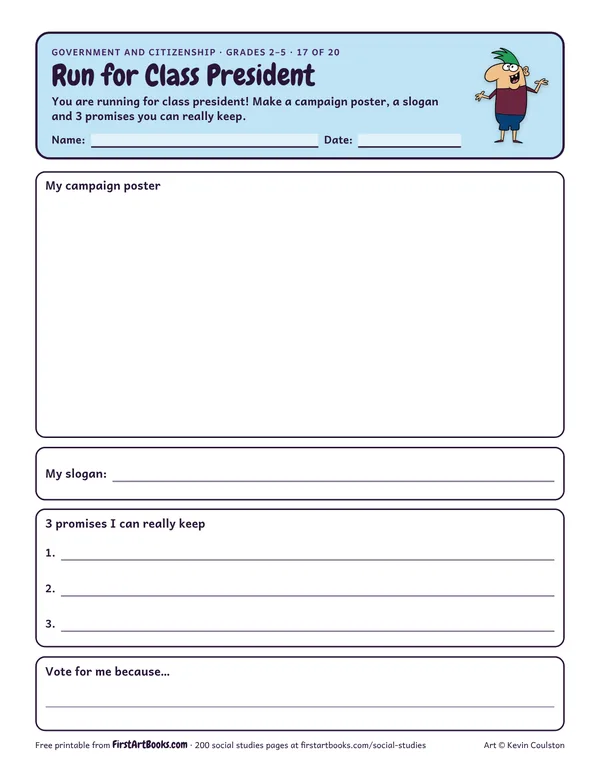
A campaign planning page: kids design a poster, write a slogan and list 3 realistic promises, then explain why classmates should vote for them.
Print this sheet (PDF)Teacher notes and tips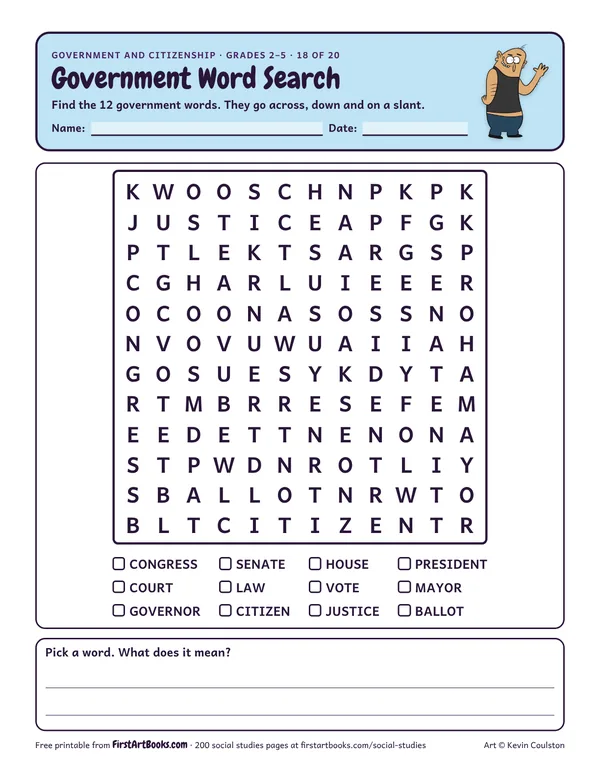
A 12 by 12 word search of government and citizenship words: Congress, Senate, President, court, law, vote, mayor, governor, citizen and more.
Print this sheet (PDF)Teacher notes and tips
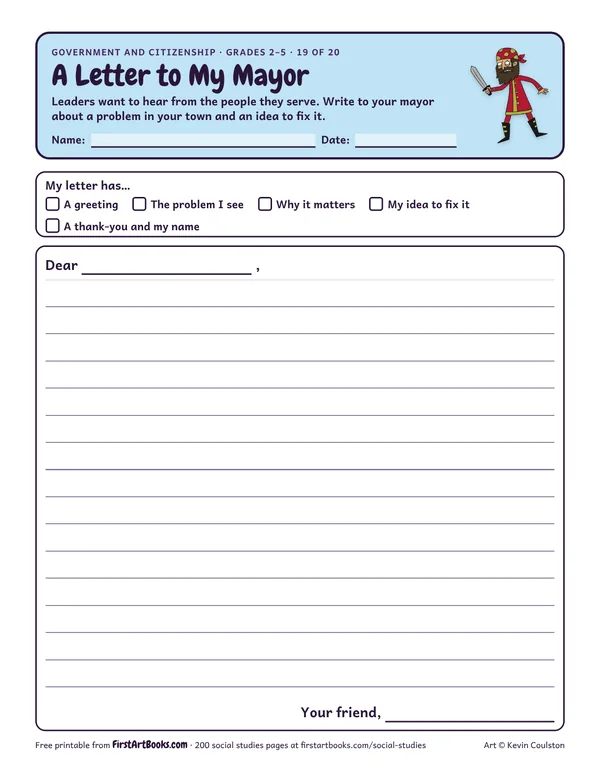
A civic action letter template: kids write to their mayor about a real problem in town (a broken swing, litter, a busy crossing) and suggest a fix.
Print this sheet (PDF)Teacher notes and tips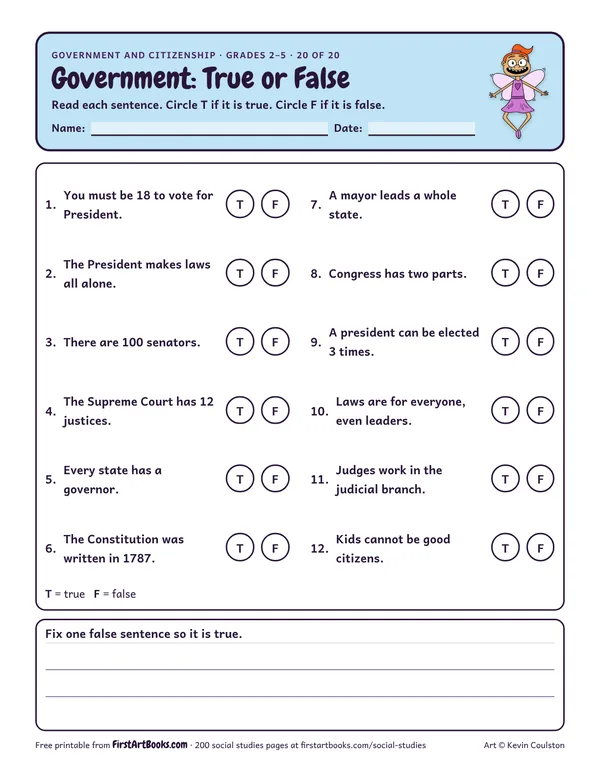
12 true-or-false sentences about government and citizenship: the voting age, the number of senators and justices, mayors, governors and the Constitution.
Print this sheet (PDF)Teacher notes and tipsPut events in order, read a timeline and make your own. Grades 2–5.
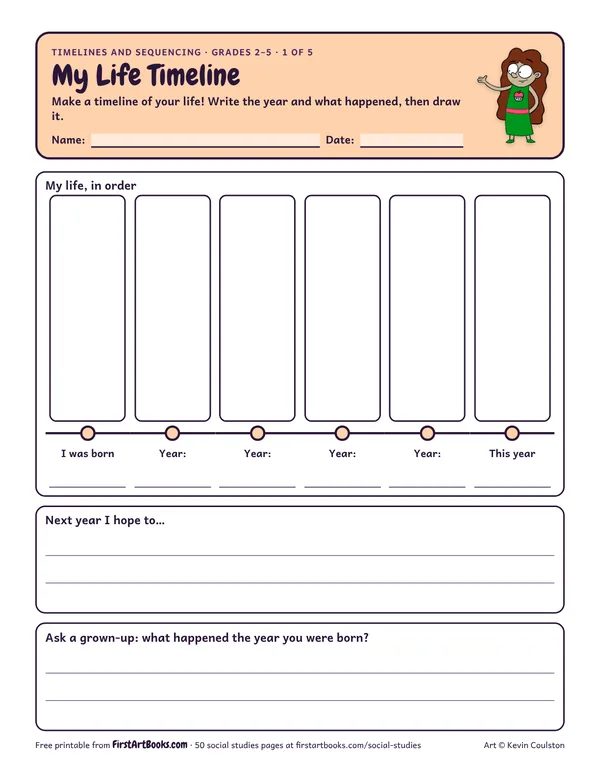
Kids make a 6-stop timeline of their own life, from the year they were born to today, with a drawing for each stop.
Print this sheet (PDF)Teacher notes and tips
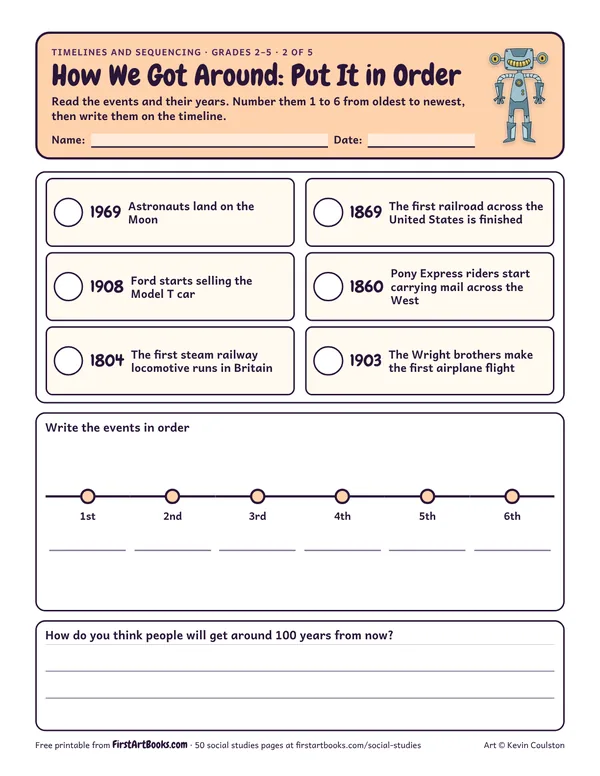
Put 6 transportation firsts in order, from the first steam locomotive in 1804 to the Moon landing in 1969.
Print this sheet (PDF)Teacher notes and tips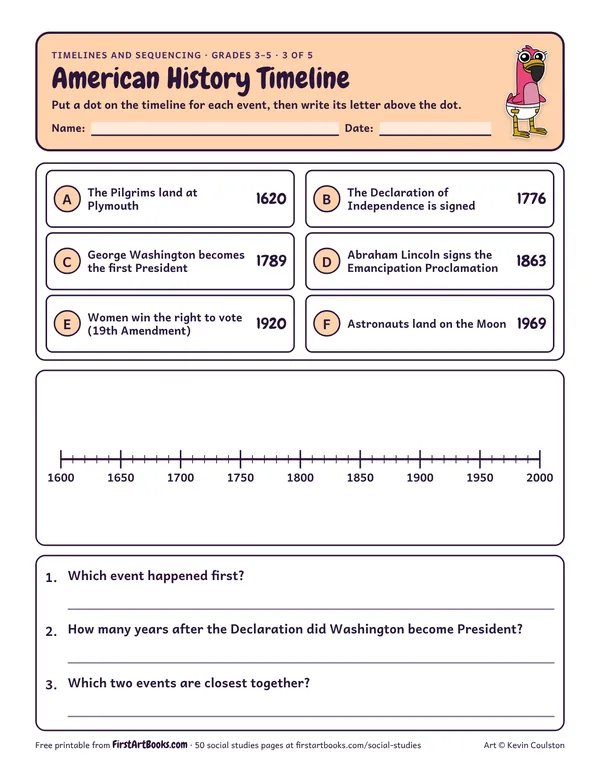
Place 6 big moments in American history, from the Pilgrims in 1620 to the Moon landing in 1969, on a timeline ruler.
Print this sheet (PDF)Teacher notes and tips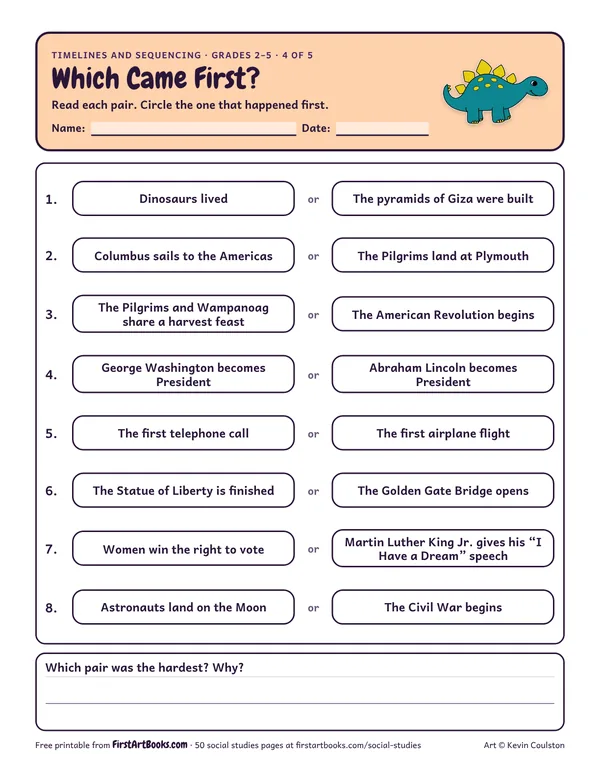
Eight pairs of history events, from the pyramids to the Moon landing: circle the one that happened first.
Print this sheet (PDF)Teacher notes and tips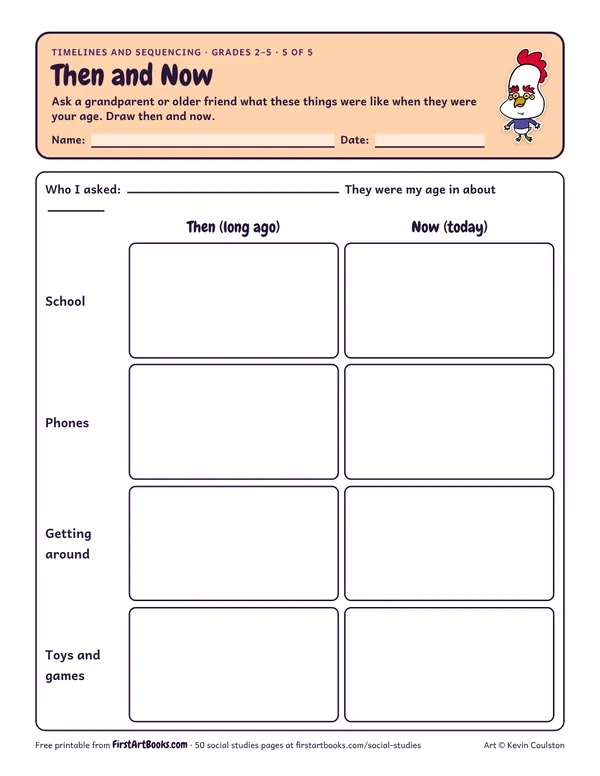
Interview an older family member and draw how school, phones, travel and toys have changed between then and now.
Print this sheet (PDF)Teacher notes and tips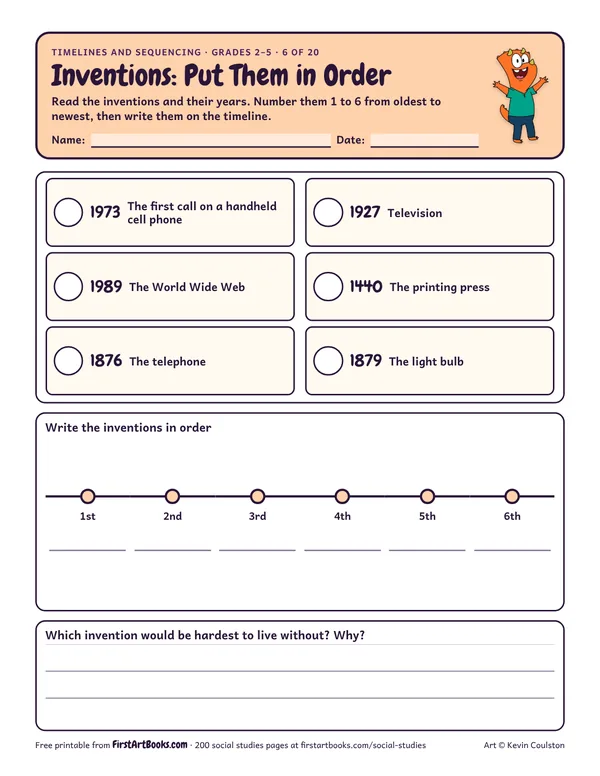
Put 6 inventions in order, from the printing press (about 1440) and the telephone (1876) to the World Wide Web (1989).
Print this sheet (PDF)Teacher notes and tips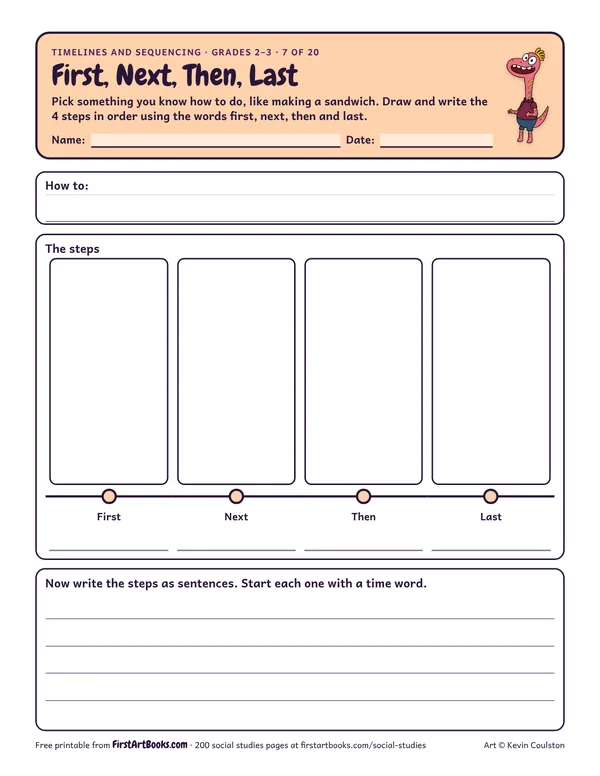
A 4-step sequencing page with drawing boxes: kids tell how to do something in order with the time words first, next, then and last.
Print this sheet (PDF)Teacher notes and tips
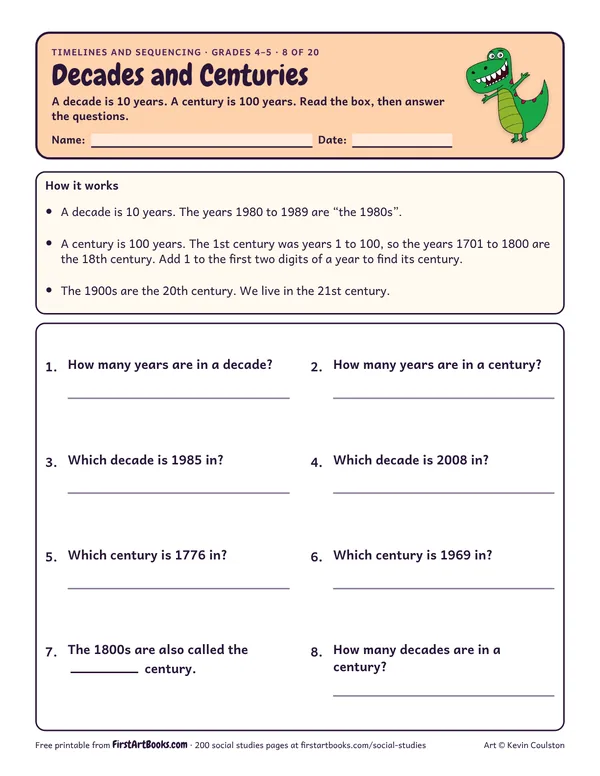
Learn how decades and centuries are counted (why 1776 is in the 18th century), then answer 8 questions about years, decades and centuries.
Print this sheet (PDF)Teacher notes and tips
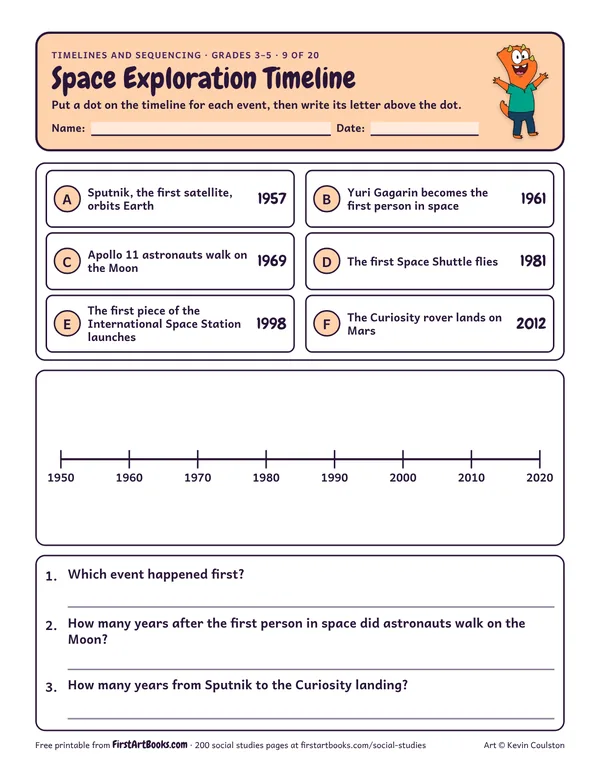
Place 6 space firsts, from Sputnik in 1957 and the Moon landing in 1969 to the Curiosity rover on Mars in 2012, on a timeline ruler.
Print this sheet (PDF)Teacher notes and tips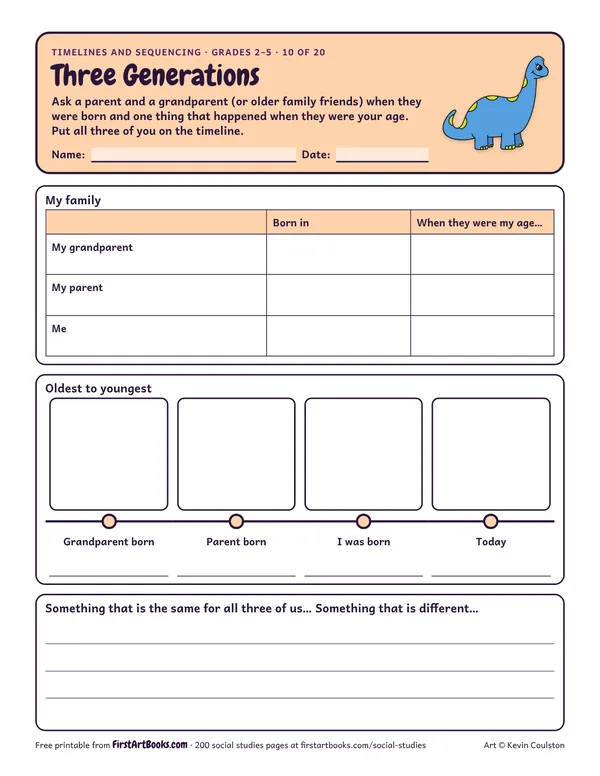
A family history timeline: kids interview a parent and a grandparent, record their birth years and a memory from each, and plot all three generations.
Print this sheet (PDF)Teacher notes and tips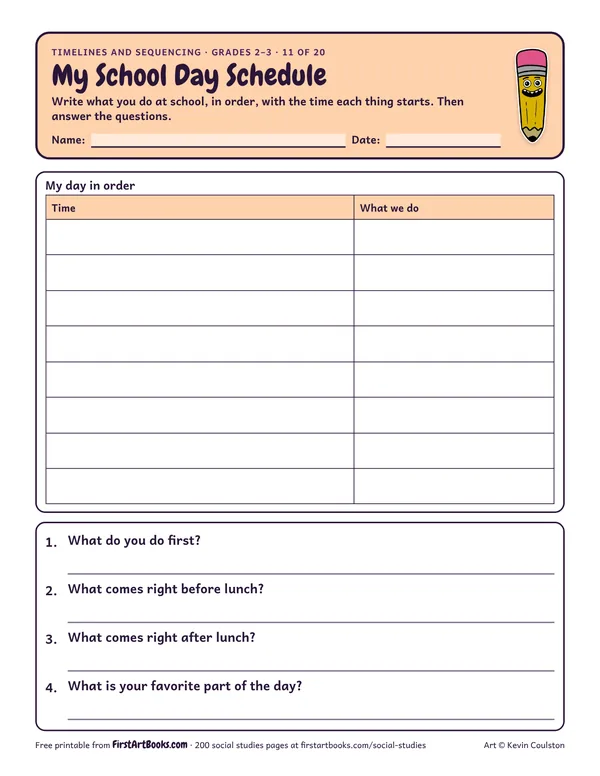
A daily schedule timeline: kids write 8 parts of their school day in order with start times, then use before and after to talk about it.
Print this sheet (PDF)Teacher notes and tips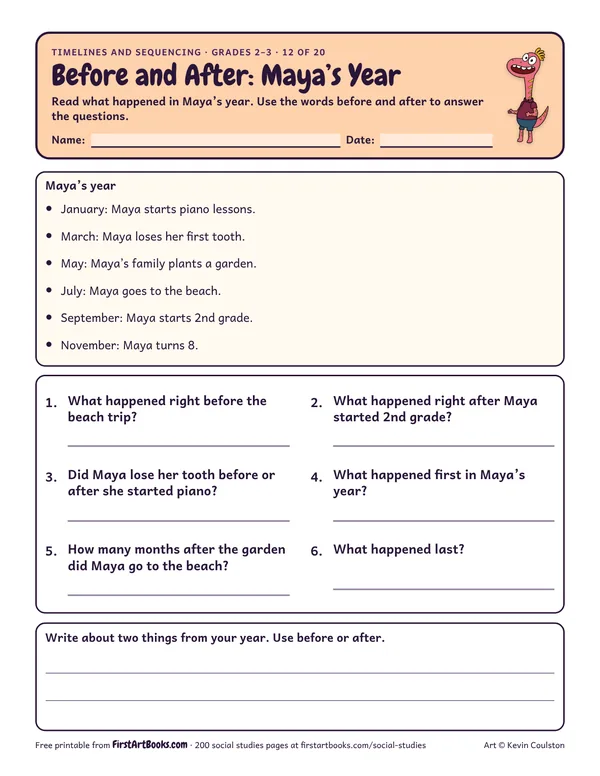
Read 6 events from Maya’s year (piano lessons, a lost tooth, a garden, the beach, 2nd grade, a birthday) and answer before-and-after questions.
Print this sheet (PDF)Teacher notes and tips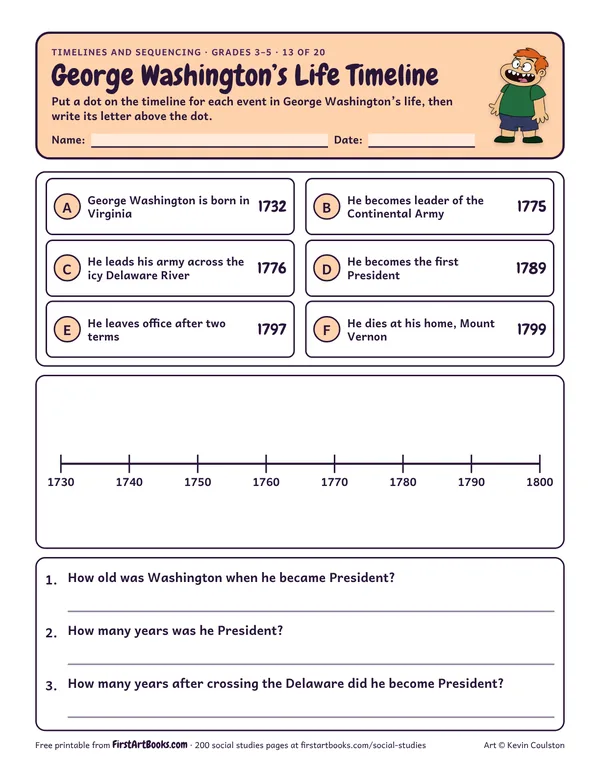
Place 6 events from George Washington’s life, from his birth in 1732 to crossing the Delaware and becoming the first President, on a timeline ruler.
Print this sheet (PDF)Teacher notes and tips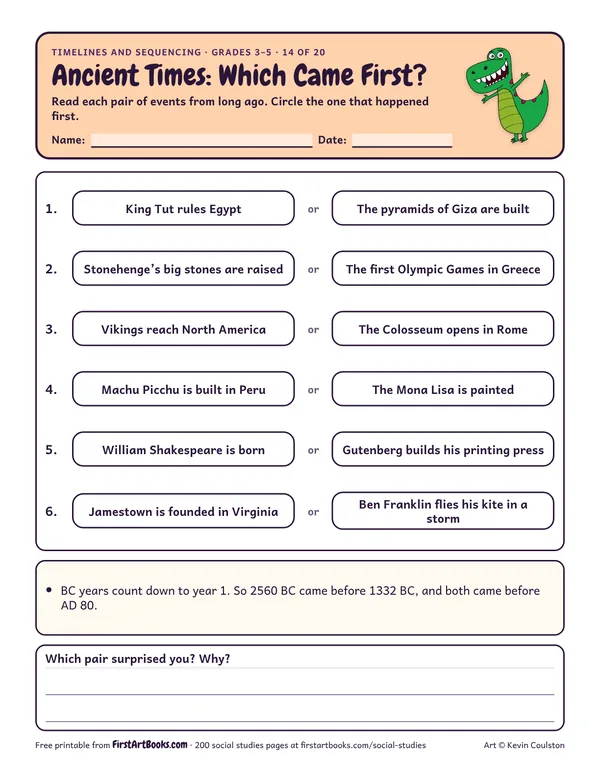
6 pairs of events from ancient and early times, from the pyramids of Giza and Stonehenge to the Colosseum, the Vikings and Machu Picchu: circle which came first.
Print this sheet (PDF)Teacher notes and tips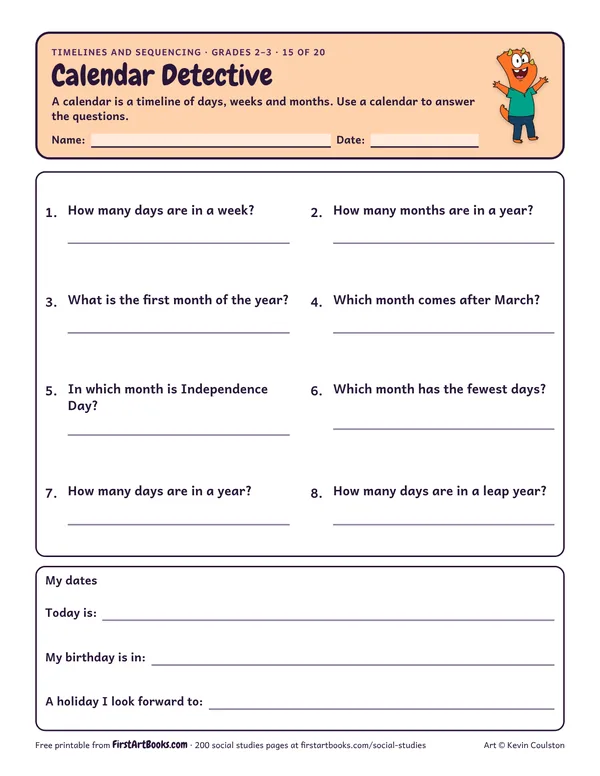
8 calendar questions about days, weeks, months and leap years (Which month comes after March? Which has the fewest days?), plus your own important dates.
Print this sheet (PDF)Teacher notes and tips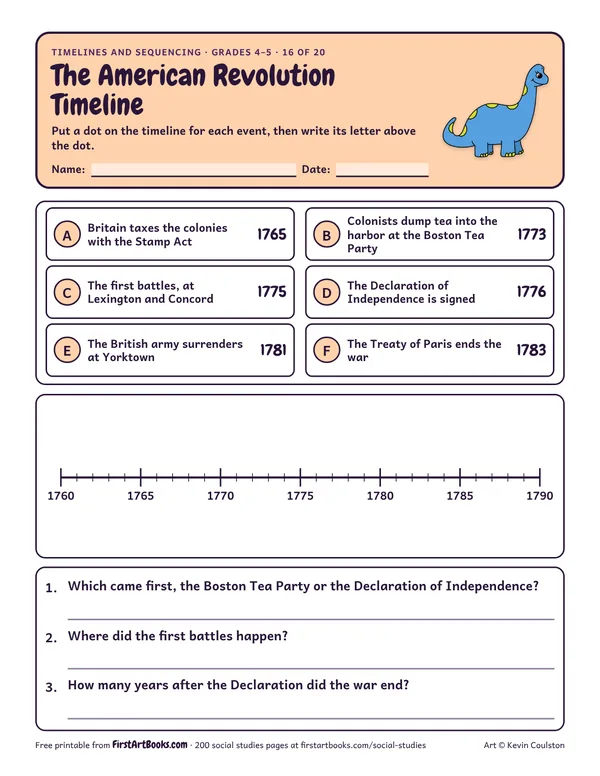
Place 6 events of the American Revolution, from the Stamp Act in 1765 and the Boston Tea Party to Yorktown and the Treaty of Paris, on a timeline ruler.
Print this sheet (PDF)Teacher notes and tips
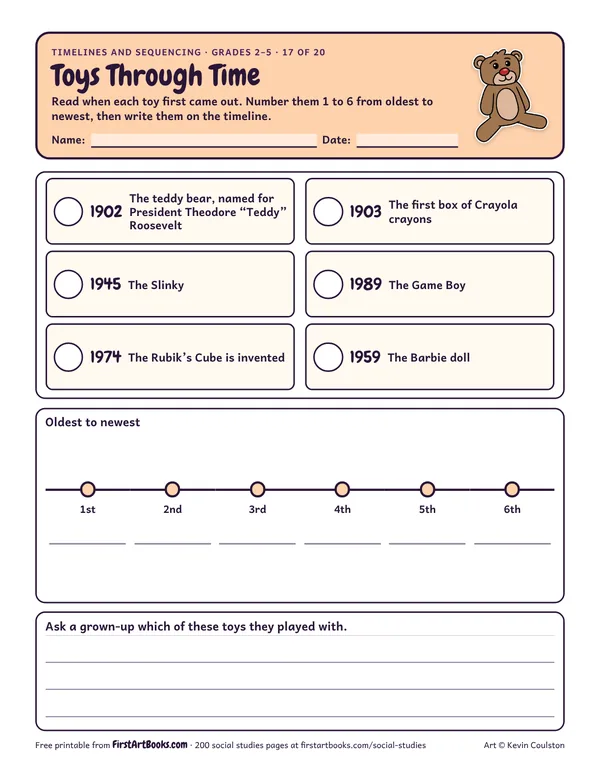
Put 6 famous toys in order, from the teddy bear (1902) and Crayola crayons to the Slinky, Barbie, the Rubik’s Cube and the Game Boy.
Print this sheet (PDF)Teacher notes and tips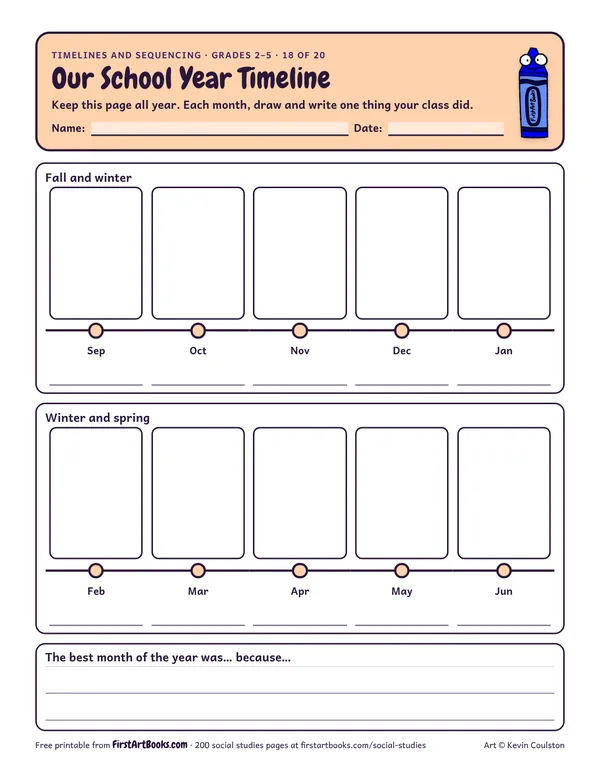
A year-long class timeline from September to June: one drawing box and caption for each month, then a look back at the whole year.
Print this sheet (PDF)Teacher notes and tips
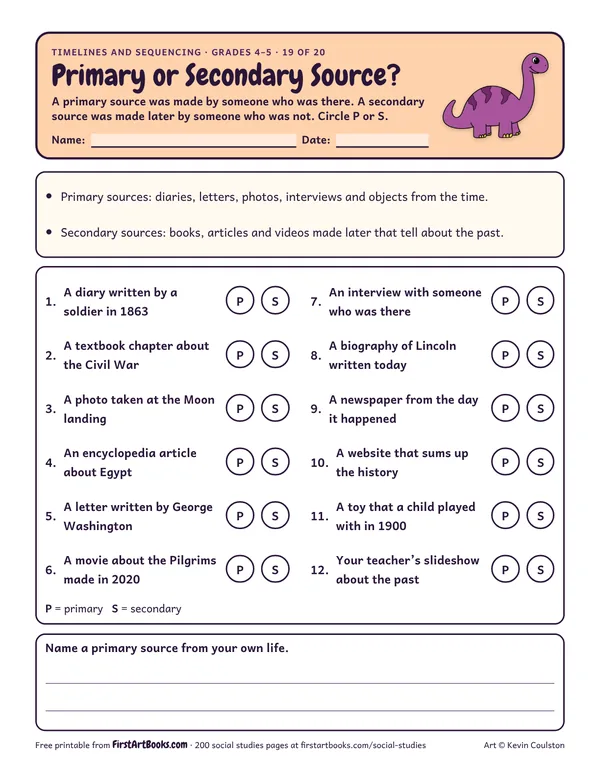
Learn how historians use sources, then sort 12 examples (a soldier’s diary, a textbook, a photo, an encyclopedia) into primary and secondary sources.
Print this sheet (PDF)Teacher notes and tips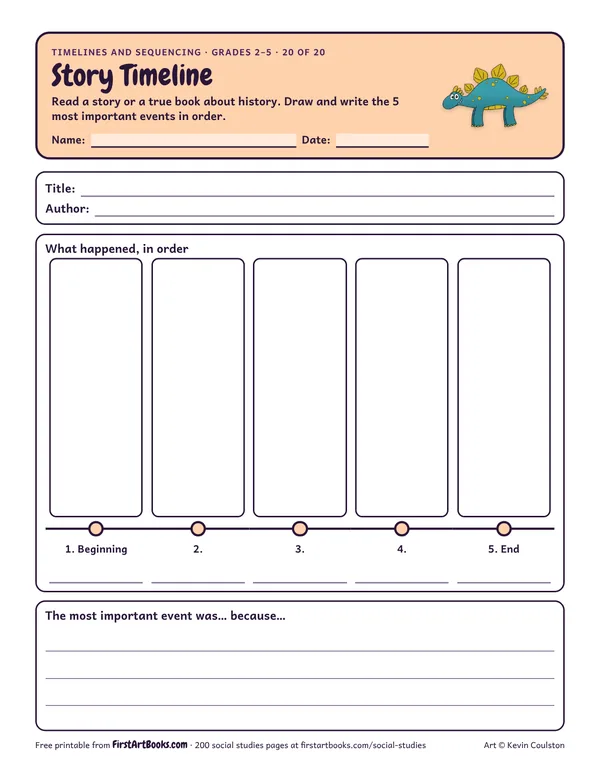
A 5-box sequencing organizer for any book, story or history lesson: the title, the events in order with drawings, and how the story ended.
Print this sheet (PDF)Teacher notes and tipsEach pack is one PDF with the topic’s 20 worksheets and its answer keys.
Every state, its capital and its region, in ABC order. Practice them with States and Capitals: Alabama to Missouri, States and Capitals: Montana to Wyoming, State Postal Abbreviations and the The 50 States and Capitals Map.
| State | Capital | Region |
|---|---|---|
| Alabama AL | Montgomery | Southeast |
| Alaska AK | Juneau | West |
| Arizona AZ | Phoenix | Southwest |
| Arkansas AR | Little Rock | Southeast |
| California CA | Sacramento | West |
| Colorado CO | Denver | West |
| Connecticut CT | Hartford | Northeast |
| Delaware DE | Dover | Southeast |
| Florida FL | Tallahassee | Southeast |
| Georgia GA | Atlanta | Southeast |
| Hawaii HI | Honolulu | West |
| Idaho ID | Boise | West |
| Illinois IL | Springfield | Midwest |
| Indiana IN | Indianapolis | Midwest |
| Iowa IA | Des Moines | Midwest |
| Kansas KS | Topeka | Midwest |
| Kentucky KY | Frankfort | Southeast |
| Louisiana LA | Baton Rouge | Southeast |
| Maine ME | Augusta | Northeast |
| Maryland MD | Annapolis | Southeast |
| Massachusetts MA | Boston | Northeast |
| Michigan MI | Lansing | Midwest |
| Minnesota MN | Saint Paul | Midwest |
| Mississippi MS | Jackson | Southeast |
| Missouri MO | Jefferson City | Midwest |
| Montana MT | Helena | West |
| Nebraska NE | Lincoln | Midwest |
| Nevada NV | Carson City | West |
| New Hampshire NH | Concord | Northeast |
| New Jersey NJ | Trenton | Northeast |
| New Mexico NM | Santa Fe | Southwest |
| New York NY | Albany | Northeast |
| North Carolina NC | Raleigh | Southeast |
| North Dakota ND | Bismarck | Midwest |
| Ohio OH | Columbus | Midwest |
| Oklahoma OK | Oklahoma City | Southwest |
| Oregon OR | Salem | West |
| Pennsylvania PA | Harrisburg | Northeast |
| Rhode Island RI | Providence | Northeast |
| South Carolina SC | Columbia | Southeast |
| South Dakota SD | Pierre | Midwest |
| Tennessee TN | Nashville | Southeast |
| Texas TX | Austin | Southwest |
| Utah UT | Salt Lake City | West |
| Vermont VT | Montpelier | Northeast |
| Virginia VA | Richmond | Southeast |
| Washington WA | Olympia | West |
| West Virginia WV | Charleston | Southeast |
| Wisconsin WI | Madison | Midwest |
| Wyoming WY | Cheyenne | West |
Week two for grades 3–5: Map Symbols: What Do They Mean?, Around the Park: In-Between Directions, How Far Is It? Using a Map Scale with a ruler, Landforms and Bodies of Water and Hemispheres: Halves of the Earth.
The same templates work for a country with My Country Passport.
Kevin Coulston’s draw-by-grid books use the same letter-and-number grid squares as a map, and his cartoon people and animals are a fun way to draw community helpers and the animals of every continent.
Yes. All 200 worksheets and every answer key are free to print for home and classroom use. Print one sheet, a 20-sheet topic pack or the whole set.
Kindergarten to 5th grade. Each topic has a grade band (community helpers and needs and wants are K–2; maps, continents and cultures are 1–5; states and capitals are 3–5), and every card shows its grades. Use the grade buttons to see only the sheets for your class.
Yes. The world map is drawn from Natural Earth data and the U.S. map from US Census boundaries, so coastlines and state lines are real, not hand-drawn. Every capital star sits inside its own state, the equator and prime meridian are projected from real coordinates, and the map-scale sheet is drawn so that 1 inch on the printed page really is 1 inch. The world map shows the seven continents taught in US schools, with Europe and Asia split at the Ural Mountains.
The sheets use 7 continents (North America, South America, Europe, Africa, Asia, Australia, Antarctica) and 5 oceans (Pacific Ocean, Atlantic Ocean, Indian Ocean, Arctic Ocean, Southern Ocean), the model most US schools teach. The Pacific Ocean appears on both edges of the world map, so it has the same letter on both sides.
One common five-region split: West (11 states), Southwest (4 states), Midwest (12 states), Southeast (14 states), Northeast (9 states). Regions are drawn in different ways, so the color key on the sheet lists every state in each region.
The third set of 100 (sheets 11 to 20 in every topic) was added on November 7, 2026: what helpers wear and when to call 911, map or globe, latitude and longitude, a zoo map grid and kinds of maps, read-and-draw pages for Africa, Asia, South America and Australia, the oceans by size and the tallest mountain on each continent, a third label-the-states map, state nicknames and birds, tricky capitals, the Great Lakes and national parks, the Liberty Bell, the White House, the national anthem and how the flag changed, Harriet Tubman, Ben Franklin, Martin Luther King Jr., Sacagawea and Helen Keller, farm to table, bartering and a party budget, counting, games, clothing, breakfasts and folktales around the world, the Bill of Rights, Congress and the Supreme Court, taxes and elections, George Washington and the American Revolution on a timeline, and primary and secondary sources. The second set (sheets 6 to 10) was added on November 4.
Yes. Every topic with right-or-wrong answers has answer key pages at the end of its topic pack. All the keys are also in one PDF of their own. Research templates, like the biography organizer, are open-ended and have no key.
Yes. The headers are light colors that look fine in gray, and the coloring sheets write each color name next to its box, so kids can follow the key without color ink. Sheets are US Letter and also print on A4.
All sheets are US Letter, print well in black and white, and are free for home and classroom use. Map data: Natural Earth (public domain) and US Census Bureau boundaries. More for teachers in the teacher resources library.
12 printable pages: six step-by-step lessons, a grid activity, draw-and-write sheets and teacher notes, sent with your welcome email. After that, new classroom printables by email.