
Children’s drawings change in predictable stages: scribbles from about 2, simple shapes and “tadpole people” from 3 to 4, recognizable people and houses from 4 to 7, detailed scenes from 7 to 9, and a push toward realism from about 9 to 12. Every child moves at their own pace, so use these ages as a rough guide, not a test.
The stages of drawing development
Art educators, most famously Viktor Lowenfeld, have described how children’s drawings develop. Here is a simple version.
Ages 2 to 3: scribbling
Kids make marks for the joy of moving. First random scribbles, then controlled lines and loops, then circles. Near the end of this stage, kids start naming their scribbles: “That’s Daddy.”
How to help: Big paper, chunky crayons, no correction. Celebrate the marks.
Ages 3 to 5: first shapes and symbols
Circles become faces. The famous “tadpole person” appears: a circle head with legs. Kids draw what they know, not what they see, and size shows importance (Mom may be huge). Colors are chosen for fun.
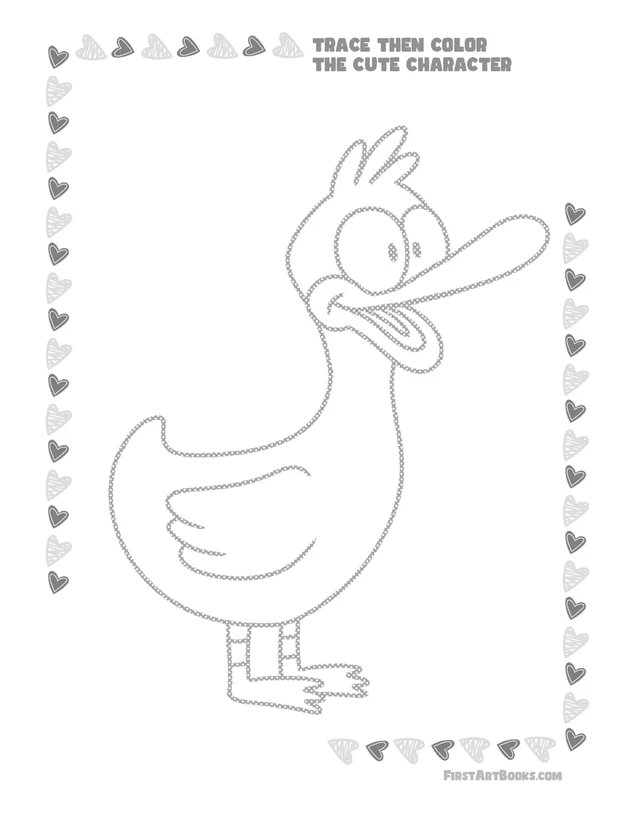
How to help: Shape games and tracing pages. See how to teach a preschooler to draw.
Ages 5 to 7: symbols with a system
Kids develop their own way of drawing a person, a house, a tree, and repeat it. A ground line and a sky strip appear. Drawings tell stories.
How to help: Step-by-step lessons give new “symbols” to add to their collection. See how to teach a kindergartner to draw.
Ages 7 to 9: more detail and planning
Drawings get clothes, patterns, overlapping and more detail. Kids start to care about how things “should” look and may start comparing.
How to help: Teach methods like sketching lightly and drawing with shapes. See drawing activities for 6 and 7-year-olds.
Ages 9 to 12: dawning realism
Kids want drawings to look real. They notice proportion and perspective and can be very hard on themselves. Many stop drawing at this stage.
How to help: Grid drawing, cartooning and private sketchbooks. See drawing for tweens.
Is my child behind?
Probably not. Drawing skill depends heavily on practice: a child who draws every day will look “ahead,” and a child who prefers building blocks may look “behind.” If your child enjoys drawing and their drawings slowly gain detail, they are on track. If you have concerns about fine motor skills, such as a very weak grip or great difficulty holding a crayon at 4 or 5, ask your pediatrician or teacher.
How to support every stage
- Keep supplies out. Kids draw more when paper and crayons are easy to reach.
- Ask, don’t judge. “Tell me about it” opens a conversation.
- Give guided and free drawing. Guided pages teach skills; blank paper lets kids use them.
- Save the art. A folder per year makes progress visible. See how to display and store kids’ art.
The right book for each stage
Tracing books fit ages 3 and up, step-by-step books fit 5 and up, and grid books fit about 5 and up but really shine from 7. Our guide to which series is right for your child helps you pick.
The book that helps
The Cute Cartoon Animals trio follows the milestones: tracing for the youngest, step-by-step drawing from 5, and grid drawing for older kids, all with the same characters.
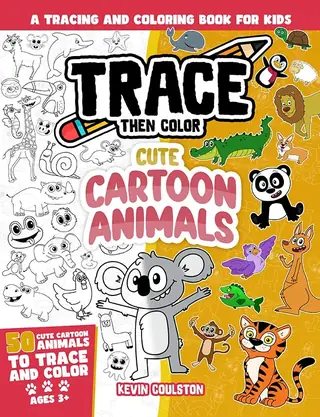 Trace Then Color: Cute Cartoon Animals
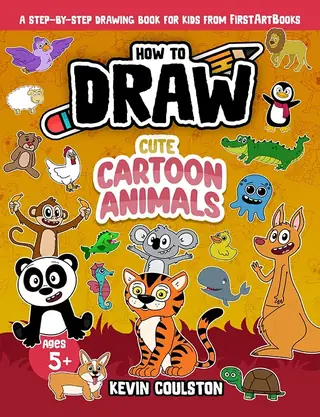 How to Draw: Cute Cartoon Animals
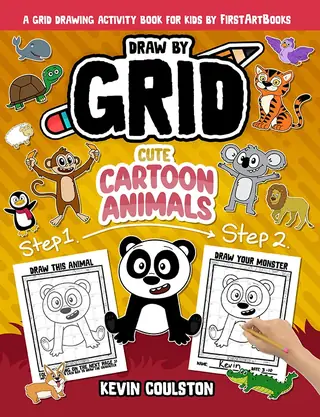 Draw by Grid: Cute Cartoon Animals
As an Amazon Associate, FirstArtBooks earns from qualifying purchases.
Get free drawing pages by email
Kevin’s newsletter brings new printable drawing and coloring pages and book news. New subscribers also get the free bonus packs: Christmas, animals, dinosaurs, robots, monsters and more, plus the Classroom Drawing Kit.
Questions
When do kids start drawing people?
Most children draw a "tadpole person" (a head with legs) around 3 to 4, and people with bodies, arms and legs by about 5.
What are the stages of children’s drawing?
Roughly: scribbling (2 to 3), first shapes and symbols (3 to 5), symbols with a system (5 to 7), more detail (7 to 9) and dawning realism (9 to 12).
Should I worry if my child’s drawings look young for their age?
Usually not. Drawing skill grows with practice. Talk to a pediatrician only if you notice real difficulty with grip or hand control.