
Grid drawing is a natural math activity. Kids use coordinates to find squares, count rows and columns, and see how a picture changes size when the grid changes size, which is scale and ratio in action. A single grid drawing lesson can cover several math skills, from counting in kindergarten to scale factors in grade 5.
The math inside a grid drawing
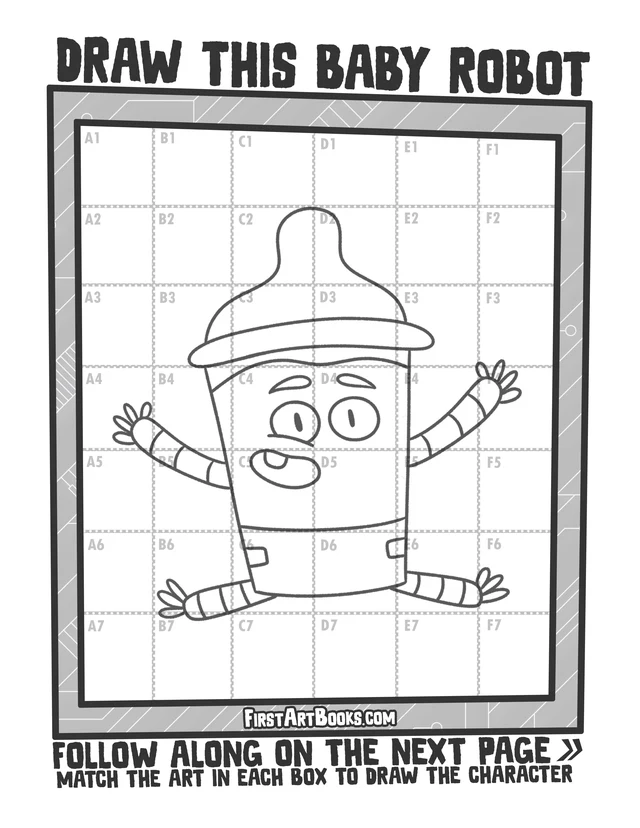
- Coordinates. Each square has an address (B4, row 2 column 3). Finding it is coordinate practice.
- Rows and columns. Counting across and down.
- Area. How many squares does the character cover?
- Fractions. The line crosses halfway, a quarter of the way.
- Scale. Copy onto a grid with bigger squares and the drawing grows.
- Ratio. If 1 small square becomes 1 big square twice as wide, everything doubles.
- Symmetry. Many characters have matching left and right halves.
A 45-minute lesson (grades 2 to 5)
1. Warm-up (5 minutes)
Play coordinate bingo: call out squares, students mark them on a blank grid.
2. Introduce the method (5 minutes)
Show a picture on a grid. Demonstrate copying one square, talking about where lines enter and leave.
3. Draw (25 minutes)
Students copy a picture from a Draw by Grid page or a free grid page, square by square.
4. Scale it (5 minutes, early finishers)
Copy one part again onto a grid with squares twice as big. What happened to the size?
5. Reflect (5 minutes)
“What made this easier or harder? How did you know where the line goes?”
Adapting by grade
- K to 1: big squares (4 by 4), simple shapes, counting rows. See how to teach a kindergartner to draw.
- Grades 2 to 3: 6 by 6 or 8 by 8 grids, letters and numbers for coordinates.
- Grades 4 to 5: larger grids, scale changes, measuring with rulers. See how to make a drawing grid.
Standards links
Grid drawing connects to common math topics such as graphing points on a coordinate plane (grade 5), area (grade 3), and ratio and scale (later grades), and to visual arts standards on observation and technique. Check your own state’s standards for exact codes.
Classroom tips
- Laminate grid pages so they can be reused with dry-erase markers.
- Pair students: one calls out squares, one draws, then swap.
- Display finished drawings with their original pictures.
More for teachers
Grid pages make great early finisher activities. For the history, share grid drawing through history with students. And see the teacher resources for more lessons.
The book that helps
Draw by Grid books are ready-made math-and-art lessons: every page is a labeled grid to copy. Robots, with their straight lines, are a great place to start.
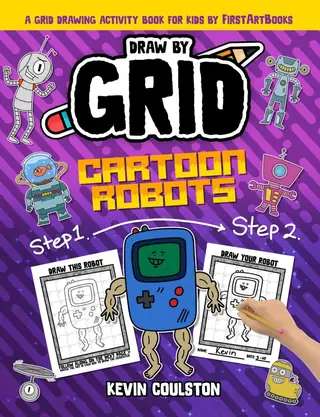 Draw by Grid: Cartoon Robots
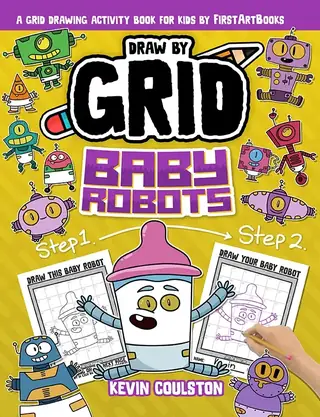 Draw by Grid: Baby Robots
As an Amazon Associate, FirstArtBooks earns from qualifying purchases.
Get free drawing pages by email
Kevin’s newsletter brings new printable drawing and coloring pages and book news. New subscribers also get the free bonus packs: Christmas, animals, dinosaurs, robots, monsters and more, plus the Classroom Drawing Kit.
Questions
How does grid drawing teach math?
Students use coordinates to find squares, count rows and columns, think about fractions of a square and see scale and ratio when grid sizes change.
What grade is grid drawing for?
Simple grids work from kindergarten; larger grids and scale activities suit grades 3 to 5.
How long does a grid drawing lesson take?
About 30 to 45 minutes for one drawing, including a warm-up and reflection.