
When a child copies a cartoon one square at a time, they are using one of the oldest tricks in art. Grid drawing has helped artists get proportions right for thousands of years, from tomb painters in ancient Egypt to Renaissance masters and the art teachers of today.
Ancient Egypt: grids for the perfect figure
Egyptian artists drew a grid of lines on a wall before painting a figure on it. The grid set the proportions: a standing person was always so many squares tall, with the knees, waist and shoulders on set lines. Some unfinished tomb paintings still show the red grid lines under the figures. It let teams of painters make figures that matched, wall after wall.
The Renaissance: drawing through a grid
In 1435 the Italian architect and writer Leon Battista Alberti described a “veil”: a thin cloth stretched on a frame and divided into squares by threads. The artist looked at the subject through the veil and copied what appeared in each square onto paper ruled with the same grid. About a hundred years later, the German artist Albrecht Dürer published woodcuts showing artists drawing through gridded frames, and the idea spread across Europe.
Squaring up: making small drawings big
Painters also used grids to enlarge a small sketch onto a big wall or canvas. They drew a grid over the sketch, a larger grid on the wall, and copied square by square. Many Renaissance drawings still have their grid lines on them, which is why this is often called “squaring up.” Muralists, sign painters and poster artists used the same method for centuries, and many still do.
Modern artists and classrooms
In the 20th century, the American painter Chuck Close made giant portraits by copying photographs one grid square at a time, and the grid became part of the art itself. Today, grid drawing is a favorite in art classrooms because it turns a hard drawing into many small, easy ones. A child doesn’t have to copy a whole dragon, only the lines inside one square.
Why grid drawing works for kids
- It slows the eye down. Kids notice where a line starts and ends inside each square, so the finished drawing has the right shape.
- It breaks one big job into small jobs. That makes it calm and doable, even for kids who think they can’t draw.
- It teaches proportion without a lecture. If the head takes four squares on the example, it takes four squares on the copy.
- It builds patience and focus. Many teachers use grid drawing as a quiet, settling activity.
Try it
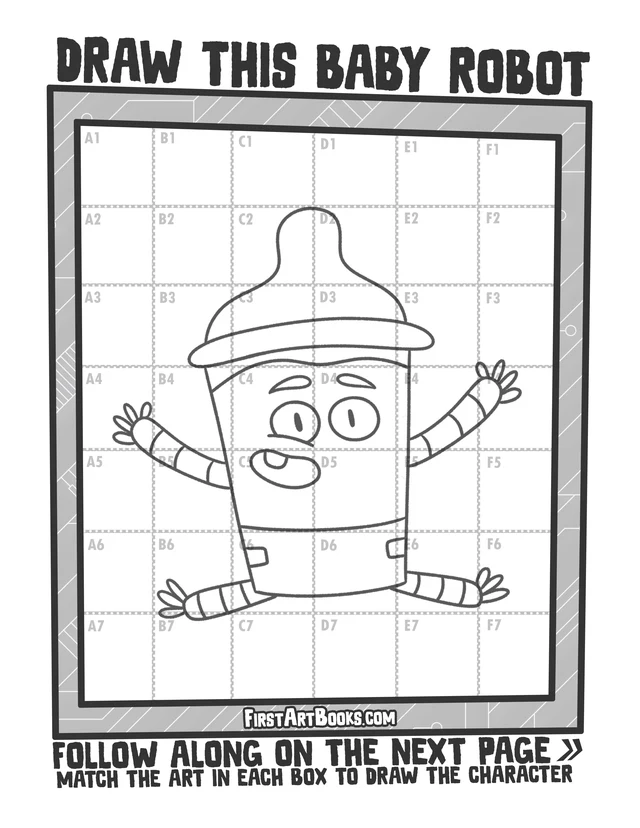
Every page in Kevin Coulston’s Draw by Grid books shows a cartoon character on a lettered grid, with a blank grid to copy onto. Grid drawing suits ages 5 and up (grades K to 5); younger kids can start with simple characters. These free grid pages are a good first try:
- How to Draw a Baby Bottle Robot The Easy Way
- How to Draw a Robot Dinosaur with Grid Drawing
- How to Draw a Dolphin Dude
Teachers can print whole grid sets from the teacher resources; each one prints with its blank grid as a two-page set.
Questions
Who invented grid drawing?
No one person. Ancient Egyptian artists already used grids to lay out figures, and the Renaissance writer Leon Battista Alberti described drawing through a gridded “veil” in 1435.
What age is grid drawing for?
Kids about 5 and up (grades K to 5) can do simple grid drawings. Older kids enjoy bigger grids with more detail.